Jam Card Review (2026): The No-KYC Visa That Costs ~7% to Load

Jam Card is a no-KYC, non-custodial virtual Visa you open with just an email and load with USDT. It spends up to $250,000 a day from a wallet you control, with no monthly fee. The catch: loading and spending stacks to roughly 4.2% + gas per conversion, plus 2.5% FX and a $21 issuance fee — and you can never unload funds once they're on the card.
Updated October 2026
Almost every crypto card asks you to pick your poison: hand over your ID, park your coins with a custodian, or accept limits that cap you at a few thousand dollars. Jam (jamcard.io) pitches itself as the card that asks for none of that — a virtual Visa you open with an email in about 30 seconds, funded straight from a self-custody wallet, spending up to a quarter of a million dollars a day. It is a genuinely unusual product. It is also, once you read the fee stack, one of the most expensive ways to spend a stablecoin in 2026.
The one-line verdict
If you want the lowest-friction, highest-limit, truly non-custodial USDT card that exists and you don't mind paying for the privilege, Jam delivers. If you care about cost, flexibility, or a track record, almost anything else in the category beats it.
What Jam Card actually is
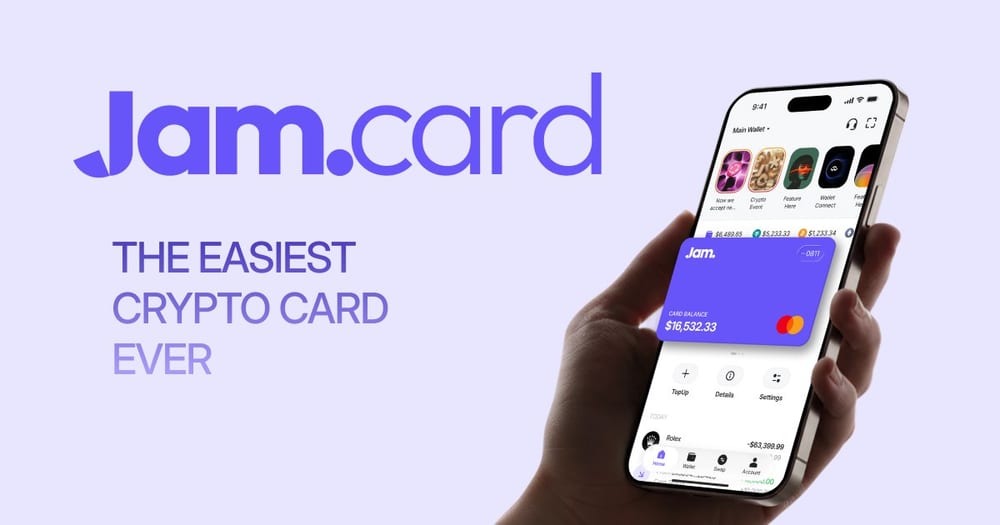
Jam is a virtual-only Visa debit card tied to the non-custodial Jam wallet app. There is no physical card and no bank account behind it. You sign up with an email (no government ID, no selfie), fund the wallet with USDT, convert and load the card, then add it to Apple Pay or Google Pay and spend anywhere Visa is accepted. The card runs on Reap's issuing infrastructure — the BIN (49387519) resolves to a Visa debit issued out of Hong Kong, not the Mastercard some listings claim. The wallet advertises "1,000+ tokens," but for actually funding the card you are looking at USDT only, loadable over five chains: Ethereum, Tron, Arbitrum, Polygon and BNB Smart Chain. Tron transfers are gas-free.
The catch nobody puts on the landing page: what it really costs
Jam's homepage leads with "no monthly fee" and "$250,000 a day." Both are true. What it doesn't show is the cost of getting a dollar of USDT onto the card and out again. Independent review data (there is essentially one detailed third-party source, cryptonoshi, so treat exact figures as best-available rather than gospel) breaks down like this:
| Fee | Amount | When it hits |
|---|---|---|
| Card issuance | $21 one-time | On sign-up |
| Monthly / annual / inactivity | $0 | Never — genuinely free to hold |
| Load / top-up | 3.5% + $0.30 | Every time you add funds |
| Crypto → USD conversion (all-in) | ~4.2% + gas | Baked into loading |
| Foreign-exchange (non-USD spend) | 2.5% | Every non-dollar purchase |
| Apple Pay | 0.2% | Every Apple Pay tap |
| ATM | N/A | Virtual-only, no cash access |
Do the math before you load
Loading and spending in dollars costs about 4.2% + gas. Spend abroad through Apple Pay and you stack ~4.2% + 2.5% FX + 0.2% ≈ ~6.9% + gas on the money you loaded. On a $2,000 trip that's roughly $140 gone before you buy anything. Reviewers score Jam's fee structure 3.8/10 against a peer average of 6.3.
The genuinely good part: no KYC, non-custodial, huge limits
Cost aside, three things make Jam stand out in a crowded field, and they're real:
- No KYC. Email sign-up, no ID or selfie. The app still runs AML checks on the addresses you send to, but you are never asked to prove who you are to open or hold the card.
- Truly non-custodial. Your funds sit in a self-custody wallet you control, not parked in the issuer's account. This is a real differentiator against custodial-leaning no-KYC rivals — your keys, your card.
- Up to $250,000/day. One of the highest published spend limits in the category. If you need to move a five-figure purchase through a card without a bank in the loop, few competitors come close.
Two more small wins: Apple Pay and Google Pay both work, and the app's customer service scores unusually well (9.1/10 in the one structured review that rates it — rare praise in a category full of support horror stories).
Jam Card vs Kast: the honest comparison
The card most people cross-shop against Jam is Kast — the other no-KYC USDT card that actually works. Here's the straight read:
| Jam Card | Kast | |
|---|---|---|
| KYC | None | None |
| Custody | Non-custodial (your wallet) | Custodial-leaning |
| Card format | Virtual only | Virtual + physical |
| Daily limit | Up to $250,000 | Tiered, lower |
| Load / conversion cost | ~4.2% + gas | Leaner |
| FX fee | 2.5% | ~2% |
| Cashback | None | Rewards tiers |
| Unload funds? | No — one-way | Generally yes |
The pattern is clear: Jam wins on limits, custody and onboarding; Kast wins on fees, flexibility, rewards and a physical card. If your priority is spending a large sum from your own wallet with no ID, Jam. If it's day-to-day spending where the fee drag matters, Kast — and it's worth checking the rest of our no-KYC card list before you commit.
No-KYC and non-custodial cards worth comparing


Who Jam is for — and who should skip it
- Good fit: privacy-first users who want a working Visa this afternoon with zero paperwork; whales who need a very high one-off spend limit; people who genuinely value non-custodial control over cost.
- Bad fit: anyone spending regularly (the ~4.2%+ load fee compounds fast); anyone who wants cashback, a physical card, or the ability to move money back off the card; anyone who wants a proven, reviewed product.
Is Jam Card safe and legit?
There is no evidence of fraud or theft reported against Jam. The risk profile is "new and unproven," not "scam." That said, be clear-eyed: the product is very new (the app has too few ratings to even show a score), there are no independent Reddit or Trustpilot threads yet, and the company itself notes "quirks still being worked out." The biggest concrete downside is structural, not security: funds are one-way — once you load the card, there is no way to withdraw them back to your wallet. Load only what you intend to spend, and confirm the current excluded-country list in-app before you rely on it for travel.
What real users say about Jam Card
One honest caveat: Jam is so new that independent reviews barely exist. There's no Trustpilot page and no Reddit threads, and the wallet app has too few ratings to display a score — that scarcity is itself a finding worth knowing before you load real money.
The one structured third-party review, from cryptonoshi, ranks Jam #46–50 of ~74 crypto cards: it praises standout customer service (9.1/10, vs a 7.4 peer average) and the unlimited daily spend, but scores its fee structure just 3.8/10 (peers average 6.3) and flags that funds can't be unloaded once added.
Compare Jam against the full field
Answer 5 quick questions and we'll match a card to your priority — whether that's no-KYC privacy, low fees, or high limits.
Frequently asked questions
Yes. You open Jam with just an email — no government ID and no selfie required to sign up or hold the card. The app does run anti-money-laundering checks on the wallet addresses you interact with, but you are never asked to verify your personal identity.