Saylor says STRC buybacks will be funded by selling BTC and MSTR stock
Based on verified official data as of 27.07.2026; hands-on update coming.
Michael Saylor posted that Strategy will fund its STRC preferred-share buyback program by selling Bitcoin and MSTR common stock rather than drawing on a dollar reserve. The stated goal is to hold STRC near $100 with high liquidity and low volatility, positioning Strategy as a disciplined buyer whenever STRC trades below $100. For crypto cardholders this is not a card product; it is a corporate treasury signal that Strategy may become a periodic BTC seller.
TL;DR
- Michael Saylor said STRC buybacks are funded by selling BTC and MSTR stock, not a dollar reserve (post dated in the source thread).
- Strategy's stated target is keeping STRC near $100 with high liquidity and low volatility.
- The company plans to be a 'permanent and disciplined buyer' of STRC below $100.
- This is a treasury/securities story, not a crypto card - it does not change any spending product.
- The key market signal: Strategy is willing to sell BTC to defend a preferred-share peg.
What Saylor actually said
In a post on X, Michael Saylor stated that Strategy's buyback of STRC preferred shares will be financed by selling Bitcoin and MSTR common stock, and explicitly not by drawing down a dollar reserve. The message frames STRC as a product Strategy wants to keep trading around the $100 mark.
The stated mechanics: high liquidity, low volatility, and steady demand, with the company acting as a 'permanent and disciplined buyer' of STRC whenever the price sits below $100. That is a commitment to intervene in the market for its own preferred shares.
The source for this is Saylor's own X post plus a Crypto Headlines Telegram summary. No SEC filing or official Strategy press release is linked in the material provided, so treat the funding detail as a founder statement rather than audited policy until a filing confirms it.
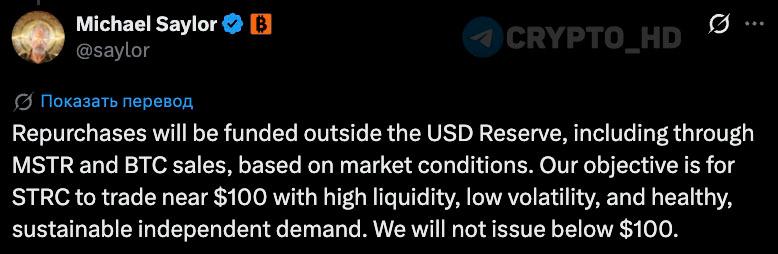
“Repurchases will be funded outside the USD Reserve, including through MSTR and BTC sales, based on market conditions. Our objective is for STRC to trade near $100 with high liquidity, low volatility, and healthy, sustainable independent demand. We will not issue below $100.”
STRC, MSTR and BTC: how they connect
STRC is a preferred-share instrument issued by Strategy (the company formerly branded MicroStrategy). MSTR is the common stock. BTC is the treasury asset Strategy is best known for accumulating since 2020.
The novelty here is direction of flow. For years the narrative was one-way: raise capital, buy Bitcoin, never sell. Funding STRC buybacks with BTC sales reverses that for a slice of the balance sheet, using the crown-jewel asset to defend a preferred-share price near $100.
For anyone holding MSTR exposure or watching BTC supply flows, the relevant question is scale and frequency: how much BTC would need to be sold, and how often, to keep STRC pinned. That figure is not published in the source.

| Instrument | What it is | Role in the buyback plan |
|---|---|---|
| STRC | Strategy preferred shares | The asset being bought back, target price near $100 |
| MSTR | Strategy common stock | One funding source (equity sales) |
| BTC | Strategy's Bitcoin treasury | Second funding source (asset sales) |
| Dollar reserve | Cash on balance sheet | Explicitly NOT used, per Saylor's post |
Why a card-comparison site is covering this
This is not a card launch, and nothing here changes how a crypto debit or prepaid card works. We cover it because Strategy is the single largest corporate Bitcoin holder, and any signal that it may become a seller feeds into BTC price expectations that affect the value loaded onto crypto cards.
If Strategy sells BTC to defend STRC and the market reads it as sustained supply, spot price can wobble. Cardholders who top up from a BTC balance rather than a stablecoin balance carry that volatility straight into their spending power.
The practical takeaway sits in our stablecoin-versus-BTC funding notes: if you spend from card balances, funding from USDT or USDC insulates you from headlines like this one. Holding BTC as your card float means treasury news becomes your problem too.

How reliable is this claim?
The claim rests on one X post by Saylor and a Telegram channel restating it. That is a founder speaking, not a filed document. Founder statements on X have historically preceded formal disclosures, but they can also be directional framing rather than exact policy.
Before treating 'buybacks funded by BTC sales' as fact, wait for a Strategy SEC filing (8-K or similar) or an official investor-relations statement that confirms the funding mechanism. Until then the honest label is: reported, single-source, founder-stated.
No dollar amounts, timelines, or BTC quantities appear in the material. Anyone modelling the impact on Bitcoin supply is working from assumptions, not disclosed numbers.
Risk warning: derivatives and crypto-backed credit involve significant risk, including liquidation of your collateral. Never commit funds you cannot afford to lose. Nothing on this page is financial, investment or tax advice.
Who this is NOT for
- Cardholders looking for a new spending product - this is a treasury/securities story with no card involved.
- Anyone wanting confirmed figures: no BTC sale amounts, timelines or filings are in the source.
- Investors seeking financial advice on MSTR or STRC - this is reporting, not a recommendation.
- Readers who need audited policy rather than a founder's X post.
Frequently asked questions
Saylor's post says STRC buybacks will be funded partly by BTC sales, but no SEC filing confirming amounts or dates is in the source. Treat it as a founder statement until an official filing appears.
NomadCrypto Editor
Editorial Team, NomadCard
The NomadCrypto editorial team verifies every published fee across 59 crypto cards against issuer documentation, with the verification date shown on every figure.