Visa's Stablecoin Platform and Open USD: The Card Networks Stop Renting the Rails

Photo: contactless fare payment, Shanghai Metro, by Painjet / Wikimedia Commons, CC BY-SA 4.0.

On June 30, 2026, a consortium of 140+ companies — Visa, Mastercard, Stripe, Coinbase, BlackRock among them — announced Open USD (OUSD), a stablecoin whose reserve yield flows to the partners who use it. On July 16, Visa launched its Stablecoin Platform (VSP) to mint, move and manage OUSD for institutions. It's an infrastructure war over who earns the interest on your digital dollars — and in 2026 it changes nothing at the checkout for crypto card users, yet.
Updated October 2026
Twice in two weeks this summer, the plumbing of digital dollars shifted. On June 30, a consortium called Open Standard announced Open USD (OUSD) — a dollar stablecoin backed by more than 140 companies, including Visa, Mastercard, American Express, Stripe, Coinbase, BlackRock, Google Cloud, BNY, IBM and DoorDash. On July 16, Visa followed with the Visa Stablecoin Platform (VSP) — an enterprise environment for banks and fintechs to mint, burn, store and move stablecoins, with OUSD as its first supported asset.
Read together, the two announcements say one thing: the card networks are done renting stablecoin rails from crypto companies. They are building their own — and taking the yield with them. Here's what actually launched, what's still a press release, and what it means (and doesn't) for anyone spending crypto through a card today.
What Visa actually shipped on July 16
The Visa Stablecoin Platform is not a consumer product. It's a single Visa-managed environment where financial institutions, fintechs and payment providers get four things: direct mint-and-burn connectivity for Open USD; Wallet-as-a-Service onchain wallet infrastructure with dual-control approvals, audit logging and passkey security; integration into Visa's existing network — settlement, treasury and currency tools; and Visa's risk and fraud layer on top of stablecoin flows. Per the announcement, VSP is in beta with institutional clients now.
"Stablecoins are opening up a new layer of programmable money, but for most institutions the hard part isn't the concept, it's the operational reality," Visa's Chief Product and Strategy Officer Jack Forestell said in the release. Translation: banks don't want to run their own hot wallets, and Visa would very much like to be the one running them instead.
Open USD: the 140-company bid to unseat USDC
OUSD's design has one genuinely new idea, and it's economic, not technical. With USDC, the interest earned on the reserve assets goes to the issuer, Circle — which then pays Coinbase roughly half of that reserve income as a distribution deal. Open Standard flips the default: nearly all reserve yield flows back to the 140+ partner businesses that use OUSD, after a management fee. Minting and redeeming is free, with no volume caps. The founding CEO is Zach Abrams, co-founder of Bridge — the stablecoin startup Stripe bought.
The token itself is expected to go live later in 2026 on Solana, Stellar, Base and Polygon. Until then, OUSD is a governance structure and a waiting list — a very well-connected one.
| Open USD (OUSD) | USDC (Circle) | USDT (Tether) | |
|---|---|---|---|
| Who earns the reserve yield | 140+ partner companies (after mgmt fee) | Circle (≈half shared with Coinbase) | Tether |
| Mint / redeem cost | Free, no volume caps (stated) | Free via Circle Mint (institutions) | Fees + minimums via Tether direct |
| Governance | Consortium (Open Standard) | Single issuer | Single issuer |
| Networks at launch | Solana, Stellar, Base, Polygon (planned) | 20+ chains live | 20+ chains live |
| Status July 2026 | Announced, live "later in 2026" | Live since 2018 | Live since 2014 |
| Retail availability | Not yet — institutional first | Everywhere | Everywhere |
Why Circle's stock fell off a cliff
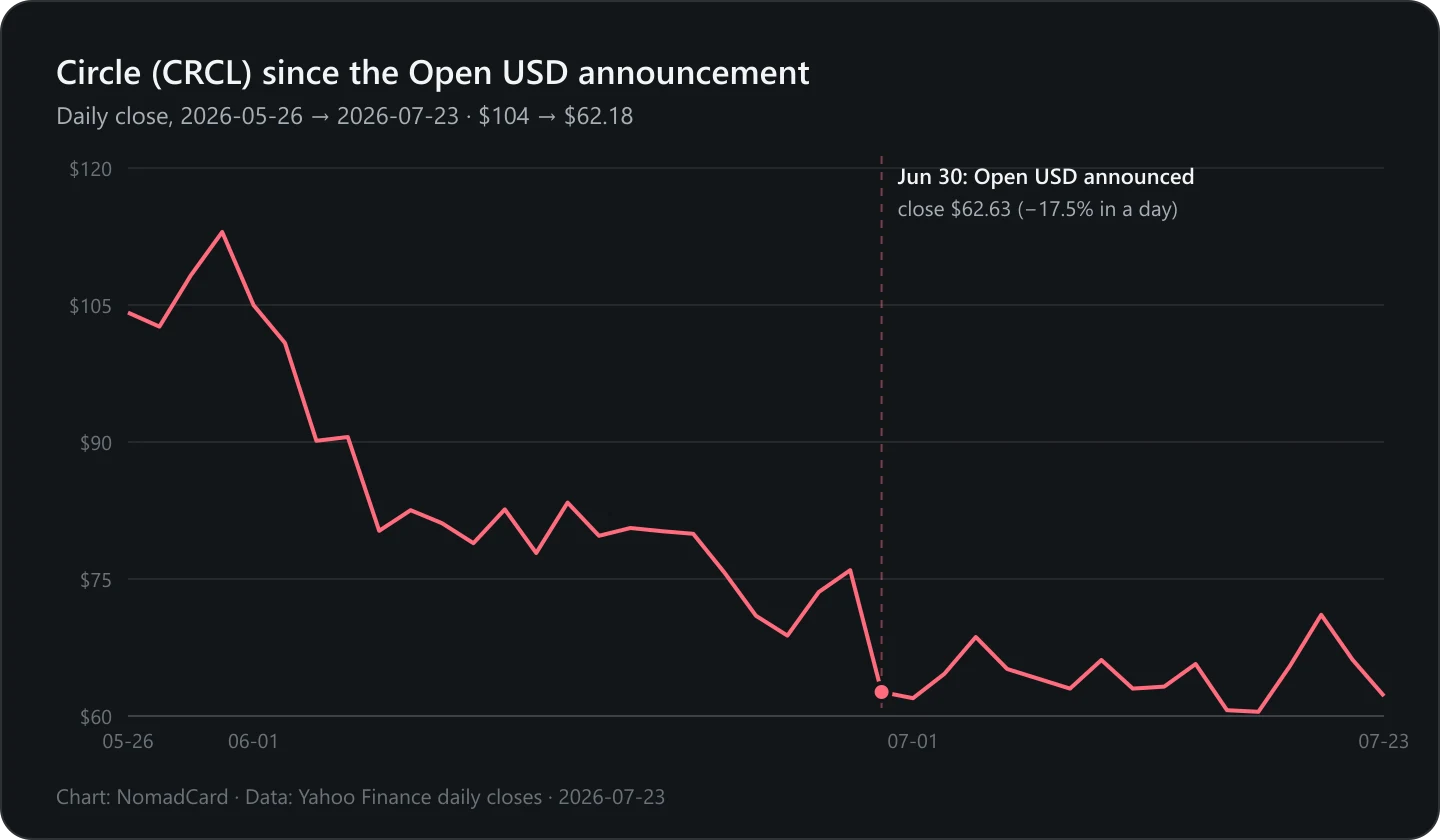
The market read the announcement exactly as intended. Circle (CRCL) closed at $75.96 on June 29 and $62.63 on June 30 — a 17.5% one-day drop on the OUSD news, extending a slide from $113 in late May to around $62 by late July. The logic is brutal: Circle's business is the yield on USDC reserves, and it already has to buy distribution by paying Coinbase. OUSD makes yield-sharing the default for every partner — which resets what any large USDC distributor can demand from Circle at the next negotiation, whether or not OUSD itself wins.
The counterargument, made by CoinDesk and CoinShares analysts, deserves airtime: consortium stablecoins have a poor track record (remember Diem), 140 partners means 140 opinions about governance, and USDC's real moat is boring operational liveness on 20+ chains since 2018. An announcement is not adoption. Coinbase, notably, is on both sides of the table — a USDC distribution partner and an OUSD founding member — which tells you everyone is hedging.
What this means for crypto cards — honestly
Here's the part that matters for this site's readers. Almost every crypto card we track runs on Visa or Mastercard rails, and stablecoins are already the working currency of card spending: across the 59 cards in our live dataset, USDT and USDC are the most commonly supported funding assets. Today, when you tap a card funded with USDT, the issuer converts your stablecoin to fiat and settles with Visa in fiat — that conversion is where the industry hides its margin. Our dataset puts the average combined FX-plus-conversion cost at 2.06% (≈€20.60 per €1,000 spent abroad), and 4 of 59 cards don't publish a conversion fee at all.
VSP is Visa building the machinery for issuers to settle in stablecoins natively — mint, burn and move them inside Visa's own environment. If card programs eventually settle in OUSD end-to-end, the conversion step that costs you 0.75–2.49% per purchase becomes a much shorter, cheaper hop. That is the long-term bull case for card users: settlement competition compressing the hidden conversion spread. The bear case: issuers keep the spread and pocket the savings — which is exactly what happened to most FX-fee reductions before it. Fee transparency, not fee level, is what to watch first.
Who's positioned where: Coinbase Card sits closest to both camps (USDC today, OUSD consortium membership tomorrow). Crypto.com Visa and other big custodial programs are classic candidates for early VSP settlement pilots. Self-custody programs like Gnosis Pay and ether.fi are the interesting outliers — their pitch is precisely that you don't need a consortium's permission to hold your money. None of these programs has announced OUSD settlement; treat any such claim as speculation until an issuer says it out loud.
Our verdict: an infrastructure war, not a consumer event — yet
- 2026: nothing changes at the checkout. OUSD isn't live, VSP is institutional beta, and no card issuer settles in OUSD. Your card's fees today are set by its published tariff, not by this announcement.
- 2027 is the real test: whether OUSD reaches wallets and issuers outside the consortium, and whether any card program passes settlement savings to users as a lower conversion fee.
- Circle isn't dead, it's repriced. The stock now prices in a world where reserve yield is negotiable. USDC's operational moat is real; so is the new pressure on its economics.
- The GENIUS Act made this possible. A federal stablecoin framework is why Visa, Amex and US Bank can put their names on a stablecoin consortium at all — regulated stablecoins are becoming bank-grade plumbing.
- Watch the yield question for users: OUSD shares yield with businesses, not consumers. If a card ever pays you the reserve yield on your stablecoin balance, it will look like ether.fi's model, not OUSD's.
What to do as a card user right now
Nothing — except keep judging cards on what's real today: published fees, custody model and limits. The average card still takes ~2% (≈€20 per €1,000) in combined FX and conversion fees abroad, and that spread — not the settlement rail behind it — is what you actually pay. Compare the numbers in our live fee dataset or run the card finder.
Frequently asked questions
An enterprise platform Visa announced on July 16, 2026 that lets banks, fintechs and payment providers mint, burn, store and move supported stablecoins — starting with Open USD — inside a Visa-managed environment, including Wallet-as-a-Service infrastructure and integration with Visa's settlement and treasury tools. It is in institutional beta, not a consumer product.