Vitalik's diamond iO: what program obfuscation could mean for private crypto
Based on verified official data as of 28.07.2026; hands-on update coming.
On 28 July 2026 Vitalik Buterin published part two of his obfuscation series, focused on diamond iO. Obfuscation (iO) lets you 'encrypt' a program so anyone can run it on plaintext inputs but nobody can read its internal logic or extract embedded secrets. Diamond iO's contribution is speed: earlier iO schemes needed 'galactic' runtimes longer than the age of the universe, while diamond iO is 'planetary' - still infeasible today but far closer. It relies on braver, less tested math assumptions, and Vitalik stresses it is not production-ready.
TL;DR
- Vitalik Buterin published 'Obfuscation (Part II): Diamond iO' on 28 July 2026, co-reviewed by Sora Suegami and Janmajaya Mall.
- Indistinguishability obfuscation (iO) turns a program into a black box: runnable, but its logic and embedded secret keys stay hidden.
- Older conservative iO schemes had 'galactic' runtimes longer than the lifetime of the universe; diamond iO is 'planetary', billions of times lighter but still infeasible today.
- Diamond iO modifies the BGG+14 attribute-based encryption scheme and is 'as computationally intensive as' functional encryption, avoiding a tall protocol stack.
- The tradeoff: diamond iO leans on newer, less proven cryptographic assumptions, so security confidence is lower than mainstream iO.
What is obfuscation and why does it matter for crypto?
Cryptographic obfuscation (indistinguishability obfuscation, or iO) lets you package a program so anyone can run it on plaintext inputs and get plaintext outputs, without seeing how it works inside. The key use case is programs that hold a secret key: obfuscation gives someone the ability to use that key in specific conditions, but never to read or extract it.
Vitalik frames this as a near-universal primitive. If iO ever becomes fast and safe enough, it could replace many existing cryptographic mechanisms and let people build services that require almost no trust in an operator. Think private voting, protected computation, and applications that today need a trusted middleman.
The catch has always been runtime. Vitalik describes the most conservative iO protocols as 'galactic': if you calculated how long one run would take, the answer exceeds the lifetime of the universe. That is why iO has stayed a theoretical curiosity despite real feasibility breakthroughs.
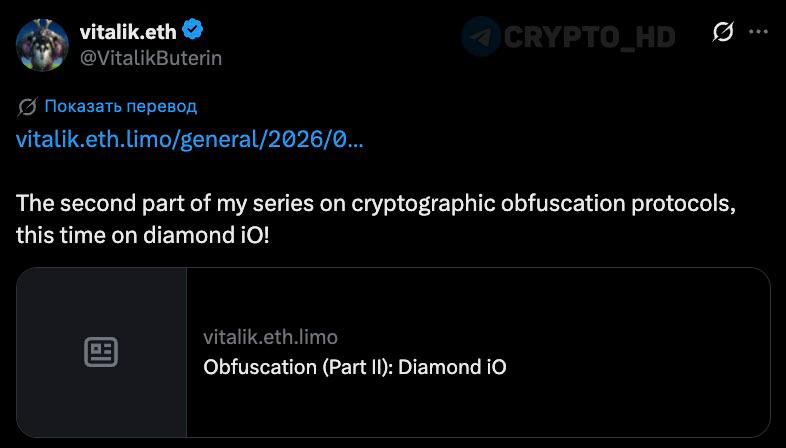
“#eth 🤔 Технология, которая может изменить криптографию – Виталик Бутерин ➠ Основатель Ethereum опубликовал вторую часть статьи, посвященную технологии обфускации. Простыми словами, она позволяет превратить программу в «черный ящик» – ею можно пользоваться, но понять, как она устроена и извлечь ее секреты практически невозможно. ➠ Если такую технологию удастся сделать достаточно быстрой и безопасной, она сможет заменить множество существующих криптографических механизмов и позволит создавать сервисы, которым практически не придется доверять. ➠ В этот раз Виталик разобрал diamond iO – новый под”
How is diamond iO different?
Diamond iO, described in a paper by Sora Suegami and others, takes a more direct route. Instead of building a tall tower of protocols stacked on top of functional encryption, it modifies the BGG+14 attribute-based encryption scheme so the whole thing is only 'as computationally intensive as' functional encryption itself.
Vitalik outlines the core steps: generate BGG+14 matrices and encodings for the input, run a computation that turns the input into an FHE ciphertext of a hidden function, FHE-decrypt the output through a modified BGG+14 step, then use a trapdoor step so decryption only succeeds if the correct circuit was run.
The payoff is runtime. Diamond iO moves from 'galactic' to 'planetary' cost - Vitalik's words - meaning billions of times lighter, though still far too slow to deploy. The price is that it depends on 'braver' and less battle-tested mathematical assumptions than mainstream iO.
| Aspect | Conservative iO | Diamond iO |
|---|---|---|
| Runtime class | 'Galactic' (> age of universe) | 'Planetary' (billions of times lighter) |
| Structure | Tall stack of protocols | Direct, near functional encryption |
| Base scheme | Mainstream iO tech tree | Modified BGG+14 ABE |
| Assumptions | More conservative, better tested | Braver, less proven |
| Usable today | No | No |
What could this enable if it works?
Vitalik ties diamond iO's future to blockchains. If the runtime can be pushed down further, iO plus blockchains could open the door to fully private voting systems, protected computation, and other applications that currently rely on trusted intermediaries.
He draws a direct comparison to zero-knowledge proofs. ZK technology once looked impractical and academic; today it runs inside many live blockchain projects. Vitalik suggests obfuscation may follow a similar path from theory to deployment, though he gives no timeline.
For readers of a crypto card site, the honest takeaway is that none of this changes anything you can spend today. Diamond iO is a research signal about where trust-minimised infrastructure might head, not a product. Privacy tooling you can actually use now still lives in wallets, coin choices and the KYC tradeoffs covered in our no-KYC hub.
The technical core, in plain terms
BGG+14 works with encodings of the form s * (B - G * m) + e, where s is a secret, B is a public matrix per circuit wire, m is the bit on that wire, and e is an error term. From two input-wire encodings you can build an output-wire encoding for addition, multiplication or negation.
Crucially this is not full homomorphic encryption: to multiply, you must know one of the two values in the clear. Diamond iO runs an FHE computation inside the ABE layer, then lets the evaluator decrypt the result only if the circuit matches the intended function f, borrowing BGG+14 decryption machinery in a new way.
Two of the three key ideas came from prior work (HLL23 and AKY24). The fresh contribution reuses the GGH15 mechanism not to evaluate the whole program, which proved insecure, but only to generate BGG+ encodings for the inputs. This is what keeps the scheme both compact and, so far, secure in the paper's model.
Should you act on this now?
No. Diamond iO is a paper and a blog explainer, not deployable software. Vitalik is explicit that runtime remains infeasible and that the underlying assumptions are less proven than mainstream cryptography. Treat any product claiming to ship 'iO privacy' today with heavy scepticism.
The realistic near-term privacy toolkit is unchanged: zero-knowledge rollups, careful network and coin selection, and understanding where custody and identity checks bite. Our KYC friction ranking and no-KYC hub cover the tradeoffs that actually apply to cards and spending right now.
If diamond iO or a successor does become practical, the security review process will take years, not months. Follow the research, but do not restructure how you hold or spend money around a primitive that no one can run at usable speed yet.
Risk warning: derivatives and crypto-backed credit involve significant risk, including liquidation of your collateral. Never commit funds you cannot afford to lose. Nothing on this page is financial, investment or tax advice.
Who this is NOT for
- Anyone looking for a card or wallet feature they can use today - this is unshipped research.
- Readers who want a non-technical overview only; the mechanism section assumes some cryptography background.
- People seeking investment signals - there is no token or product tied to this post.
- Those needing production privacy now, who are better served by existing ZK tools and coin/network choices.
Frequently asked questions
It is a way to obfuscate a program so anyone can run it but nobody can read its internal logic or extract embedded secrets. Diamond iO's specific contribution is making obfuscation dramatically faster than earlier schemes, though still too slow to use.
NomadCrypto Editor
Editorial Team, NomadCard
The NomadCrypto editorial team verifies every published fee across 59 crypto cards against issuer documentation, with the verification date shown on every figure.