The most popular advice about choosing a Bitcoin Visa card is also the least useful. Pick the highest cashback rate, check that merchants accept Visa, and you're done. That shortcut ignores what determines your cost and your risk, which asset gets sold when you pay, who holds your funds in the meantime, and who you can complain to when a purchase goes wrong. Two cards with the same logo can answer all three questions differently.
Table of Contents
- Why Bitcoin Visa Card Comparisons Often Miss the Point
- How Bitcoin Visa Cards Work and Where They Operate
- Comparing Fees, Cashback and Net Value Side by Side
- Supported Assets and What Gets Sold at Checkout
- Custody Models, KYC Levels and Spending Limits
- Matching a Bitcoin Visa Card to Your Spending Profile
- Refund Protection and Choosing Your Next Step
Why Bitcoin Visa Card Comparisons Often Miss the Point
A Visa logo doesn't make two cards interchangeable. One Bitcoin Visa card may sell BTC the moment you tap to pay. Another may spend a stablecoin balance and never touch your Bitcoin. A third may extend credit against Bitcoin held as collateral, so nothing is sold unless the collateral value falls sharply.
Those differences change your tax position, your exposure to price moves during the purchase, and your counterparty risk. They also sit behind marketing that emphasizes a single headline number, usually cashback. A comparison that starts and ends there tells you what a card advertises, not what you'll keep.
Six Fields That Actually Separate Cards
Compare any shortlist on the same six criteria before you look at branding.
- Fees: Issuance, annual, ATM, foreign transaction, and inactivity charges, plus the spread built into conversion.
- Cashback: The rate, the caps, the eligible categories, and whether rewards arrive in Bitcoin, a platform token, or fiat.
- Supported Assets: Which balances can fund a purchase, and in what order they're drawn down.
- Custody Model: Whether an exchange or issuer holds your assets, or you spend from a wallet you control.
- KYC Requirements: No KYC, email only, or full identity verification, and what each tier offers.
- Limits and Regional Availability: Per transaction and monthly ceilings, and whether the card is issued where you live.
Context matters too, because this market hasn't grown in a straight line. Visa's analysis of crypto-linked card volume on its network indexes January 2021 at 1.0, reports volume reaching approximately 11 times that level in April 2022, then stabilizing at roughly four times the baseline after activity weakened following the May 2022 collapse of Terra Luna, before recovering to approximately nine times the January 2021 level by the end of 2025.
That's a cyclical market, not a mature one. Products launched, paused, and relaunched through that cycle, which is why availability and terms you're quoted today deserve direct verification with the issuer rather than reliance on an older review.
How Bitcoin Visa Cards Work and Where They Operate
A Bitcoin Visa card settles purchases in fiat, even when Bitcoin funds the account. The important question is when the issuer sells the crypto, because conversion timing affects the exchange rate and the balance used for payment.
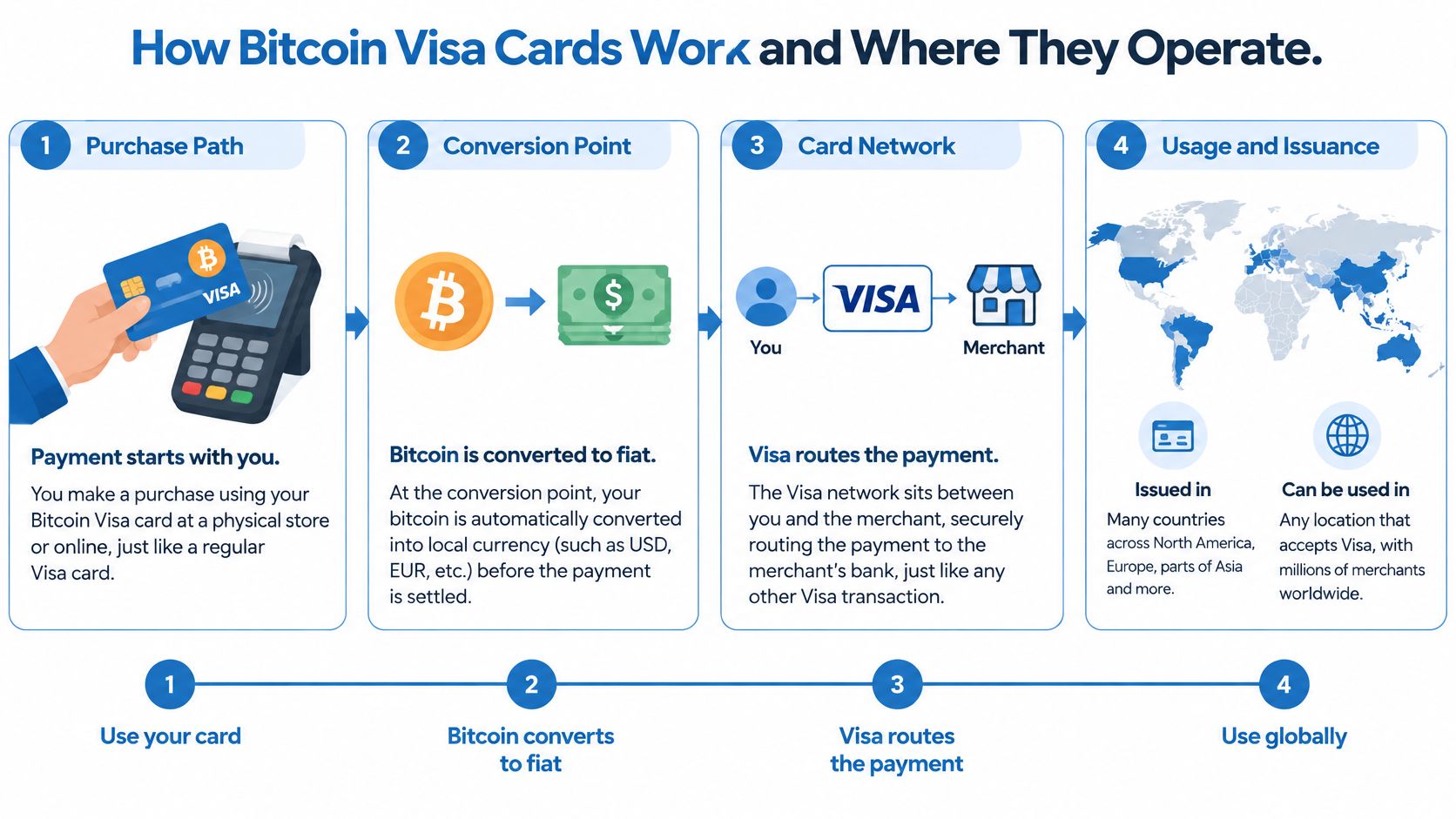
From Balance to Merchant in Four Steps
- Authorization request: The merchant's terminal sends the card network a transaction request for a specified fiat amount.
- Balance check: The issuer checks the card's funding source. Depending on the product, it may be Bitcoin, a stablecoin, fiat, or a credit line secured by crypto.
- Conversion: If crypto funds the purchase, the issuer or its partner converts enough of the asset into the required currency. Conversion may happen before authorization or at settlement, so the timing can affect the rate applied.
- Settlement: The merchant receives fiat through standard card rails. The merchant does not receive Bitcoin and usually cannot tell that crypto funded the transaction.
Practical rule: Ask the issuer when it converts the asset and which rate source it uses. Without those details, you cannot assess the actual conversion cost.
Visa and Mastercard both support crypto-linked card programs, but reported network-share estimates are not a substitute for official totals. Industry coverage of tracked crypto card volume describes activity tracked by that source, rather than a complete accounting of either network's transactions. For cardholders, the network name alone does not establish where crypto is sold, which exchange rate applies, or who handles a transaction dispute. Those terms depend on the issuer and its partners.
Issuance also limits where a card can be used. A card may work at merchants that accept Visa while remaining unavailable to residents of many countries. Virtual cards may be offered before physical cards, so check whether the issuer will provide the card in your country of residence before comparing its features.
The short video below illustrates the conversion sequence.
Comparing Fees, Cashback and Net Value Side by Side
Headline cashback is a weak comparison field because issuers don't fund rewards from the same revenue pool. Interchange, the fee paid to the issuing side on each transaction, sets the ceiling for what's sustainable without other revenue.
That ceiling differs sharply by region. SpendNode's breakdown of crypto card revenue models notes that issuer interchange on premium US credit products can reach approximately 2.5 to 3.0% of transaction value, while EU consumer interchange is capped at 0.2% for debit and 0.3% for credit.
Read that gap carefully. An EU card advertising rewards well above its capped interchange must recover the difference somewhere, through subscription fees, foreign exchange spreads, token incentives, or other services. That doesn't make the card poor value. It means the cost has moved somewhere you need to find.
Net Value Fields to Check on Every Bitcoin Visa Card
| Factor | What to Check | Why It Matters |
|---|---|---|
| Headline Cashback | Rate, monthly cap, eligible categories | Caps and exclusions can cut the effective rate on real spending |
| Reward Asset | Bitcoin, platform token, or fiat | Token rewards add price risk and possible redemption restrictions |
| FX Markup | Spread over the reference rate on foreign currency spending | It directly subtracts from cashback on travel purchases |
| Conversion Spread | Rate applied when crypto is sold to fund payment | A wide spread is a fee even when no fee is listed |
| Fixed Fees | Annual, issuance, ATM, inactivity | Fixed costs weigh heaviest on low monthly spend |
| Staking Requirement | Amount and lock up needed for the top tier | Locked capital has an opportunity cost and price exposure |
Calculating What You Actually Keep
Use a net reward estimate rather than the advertised rate. Start with headline cashback, then subtract FX markup, transaction fees, and the expected value of any mandatory token exposure. That framing, including the point that a 3% reward paired with a 1% FX fee produces only a 2% gross benefit on qualifying foreign currency spending before volatility and redemption restrictions, is set out in the SpendNode analysis cited earlier in this section.
Apply it to your own spending pattern, not a generic one. A card with a strong rate on categories you rarely use, capped at a level you exceed by mid month, will underperform a lower uncapped rate on everything.
For a deeper walkthrough of when rewards survive their own conditions, read whether crypto card cashback is worth it after fees and caps and run your last three months of spending through the same fields.
Supported Assets and What Gets Sold at Checkout
Ask a blunt question of any Bitcoin Visa card. What asset leaves your account when you buy coffee? The answer is often not Bitcoin.
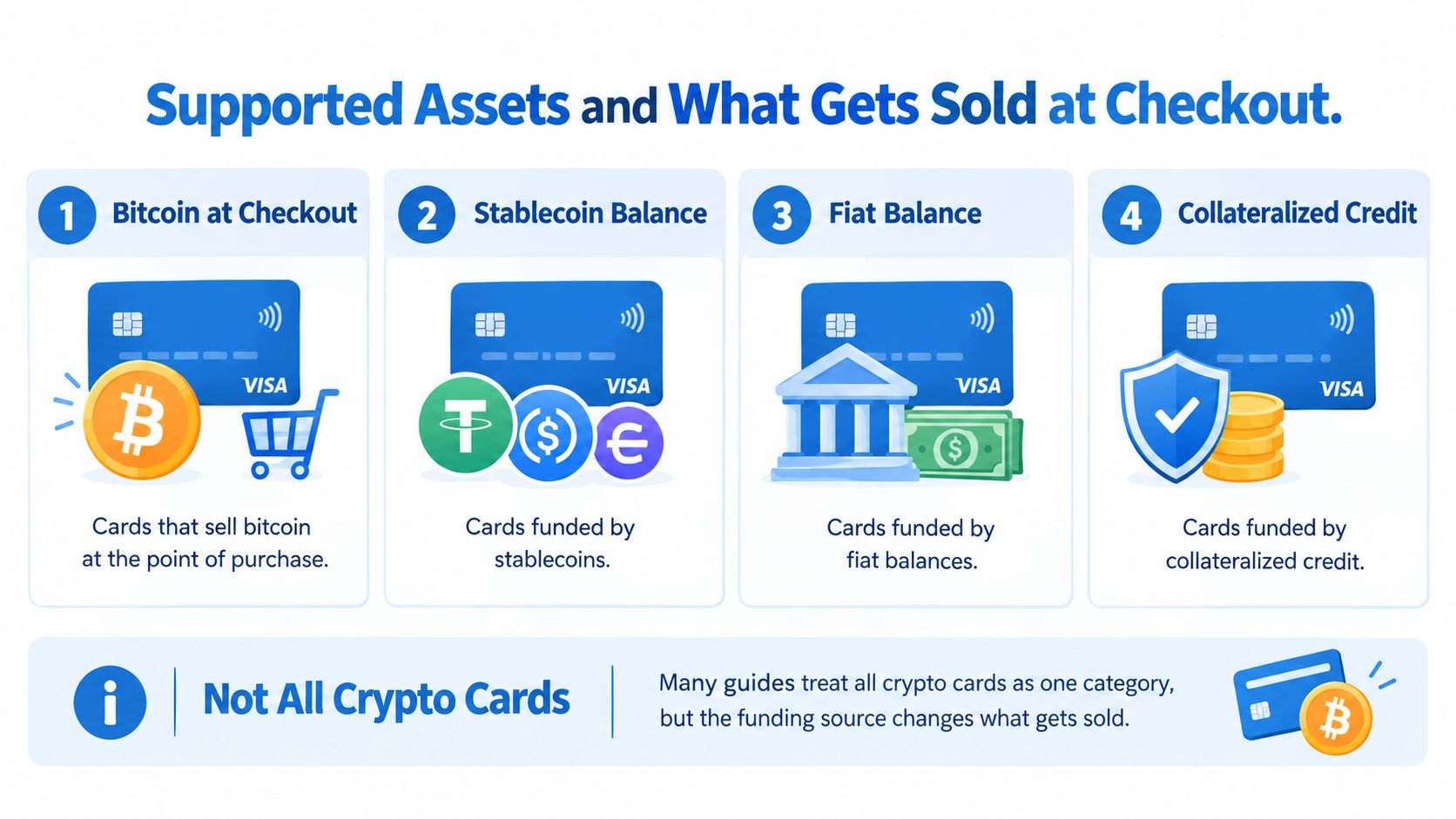
Bitcoin at checkout means the issuer sells BTC to cover each purchase. You realize a disposal on every transaction, you bear the spread at that moment, and a price move between authorization and settlement can change how much BTC is ultimately taken. Small everyday purchases create a long record of small disposals.
Stablecoin funded cards spend a dollar pegged balance instead. Your Bitcoin stays untouched unless you convert into the stablecoin yourself, and price volatility at the till largely disappears. Fiat funded cards go further and behave like a prepaid card you top up, with crypto involvement limited to how you loaded it.
Collateralized credit is structurally different. Products such as the Aven Bitcoin Visa Card, described by its issuer as a Bitcoin backed line of credit with collateral held by a regulated custodian, let you borrow rather than sell. That preserves your position, but introduces interest cost and liquidation risk if collateral value falls.
Market wide, the stablecoin model now dominates tracked activity. Fidelity's republication of CoinDesk reporting on stablecoin card data states that dollar backed stablecoins funded 70% of more than 10 million tracked card transactions in July 2026, with USDC at 50.8% of volume and USDT at 20.3%.
A long supported asset list tells you what a platform accepts. It doesn't tell you what gets liquidated first, and that order determines your exposure.
Three settings decide your real experience. Which asset is sold first when several balances exist. Whether you can disable automatic conversion so a purchase can't draw on Bitcoin by default. And whether conversion happens before authorization, which locks the rate early, or at settlement, which leaves it floating.
Volume headlines also deserve skepticism. The same CoinDesk reporting notes Allium measured $3.9 billion of stablecoin linked card spending through September 2026 but that only about 19% was supported by purchase level observations, with most of the remainder derived from settlement data that may not equal underlying purchases. Ranking cards by verifiable purchase activity and funding transparency is more defensible than ranking them by headline volume.
Tax follows the funding model, so check which crypto transactions trigger taxes before assuming a collateral or stablecoin route avoids a taxable event in your jurisdiction. If keeping your Bitcoin intact is the priority, ways to spend crypto without selling your holdings compares the borrowing and stablecoin approaches directly.
Custody Models, KYC Levels and Spending Limits
Custody decides who can freeze, lose, or lend out the assets behind your card. It's a risk decision disguised as a setup preference.
Custodial Cards
An exchange or issuer holds your balance and your keys. Setup is familiar, recovery is usually a password reset, and customer support can intervene when something breaks. The trade off is counterparty exposure. Your spending ability depends on that company's solvency, its banking relationships, and its willingness to keep your account open.
Account freezes are the practical version of this risk. A compliance review can suspend withdrawals and card spending at the same time, because both draw on the same custodial balance. Keeping only a working spending amount on a custodial card, rather than your full holdings, limits that blast radius.
Self Custodial Cards
Self custodial designs spend from a web3 wallet or on chain contract you control. No issuer holds a pooled balance in your name, so an issuer failure doesn't automatically trap your funds. Control cuts the other way when you make a mistake. Lost keys, a compromised wallet, or a signing error are yours to absorb, and there's no support desk that can restore access.
- Custodial fit: You value simple onboarding, fiat on ramps, and assisted recovery, and you'll keep balances small.
- Self custodial fit: You already manage keys competently and want spending to draw directly from your own wallet.
- Collateralized fit: You want to avoid selling Bitcoin and accept interest cost plus a custodian holding the pledged asset.
For a fuller side by side treatment, custodial versus self custody crypto card models compared sets out how recovery and insolvency exposure differ in practice.
KYC Tiers and What They Unlock
Verification usually falls into three bands. No KYC and email only options reduce the identity data you hand over, which matters if a provider later suffers a data breach. Full KYC requires government identification and often proof of address, and it's normally the route to higher limits and physical cards.
Don't treat low verification as free. Issuers compensate with tighter per transaction and monthly limits, restricted top up methods, and sometimes no ATM access. A card that protects your privacy but can't cover a hotel bill or a flight isn't anonymous, it's unusable for that purpose.
Limits also interact with travel. Preauthorizations for hotels and car rentals hold funds above the final charge, so a low ceiling can cause declines even when your balance looks sufficient. Check whether limits are stated per transaction, per day, or per month, and whether they apply to the card or to the underlying account.
Match the tier to the job. Small, occasional online purchases suit a minimal verification virtual card. Primary spending, travel, and larger purchases generally need full verification and the headroom that comes with it.
Matching a Bitcoin Visa Card to Your Spending Profile
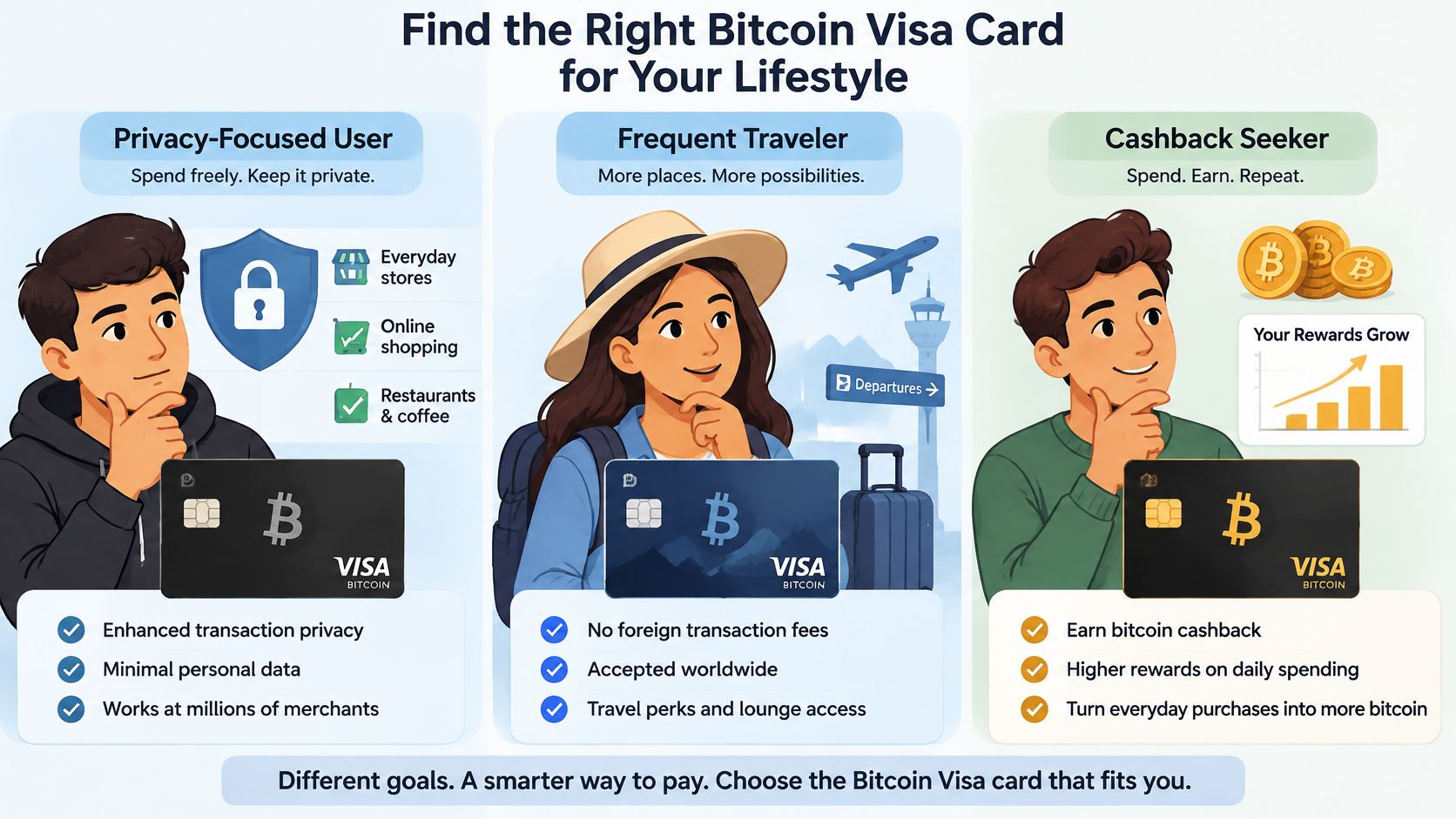
There's no single winner here, because the six criteria carry different weight depending on how you'll use the card. Three common profiles show how the weighting shifts.
The Privacy Focused User
You care about how much identity data leaves your hands and who holds your keys. Rank KYC level and custody model first, then check whether the resulting limits still cover your intended spending. Cashback is the least important field for you, since the highest reward tiers usually demand full verification, an account relationship, and sometimes a token balance that links your activity together.
Your main trap is choosing minimal verification and discovering the ceiling is too low for real use. Test with your largest typical purchase, not your average one.
The Frequent Traveler
Your costs concentrate in foreign currency. Regional availability, FX markup, and conversion spread outweigh a domestic cashback rate, because a markup applies to every overseas transaction while category rewards may not. You also need to confirm the card is issued in your home country, that a physical card is available for terminals that reject virtual credentials, and that ATM access exists where you're going.
Geography has shifted in this market. Visa's data, cited in the opening section, describes Asia Pacific becoming the largest regional contributor by October 2025 after early volume concentrated in Europe and North America. Issuance footprints are still uneven, so verify your own eligibility rather than inferring it from global acceptance.
The Rewards Optimizer
You should ignore advertised rates until you've run your own numbers. Take three months of actual spending, apply each card's caps and category rules, subtract FX and conversion costs, then subtract fixed fees. The card with the lower headline rate frequently wins once a cap binds.
- Privacy profile: Verification tier first, limits second, rewards last.
- Traveler profile: FX markup and issuance region first, physical card availability second.
- Optimizer profile: Net reward on your real categories first, reward asset liquidity second.
The common mismatch across all three is buying a feature you can't use. A card chosen for cashback that excludes your country, or a no KYC card whose limits can't fund your rent, fails before its strengths matter.
Refund Protection and Choosing Your Next Step
Refund and dispute recourse should decide your shortlist, and it's the field comparison pages most often skip. A Visa acceptance mark tells you a terminal will process the card. It does not by itself establish that you'll receive ordinary bank card chargeback protection when a merchant fails to deliver.
Crypto funded purchases pass through more layers than a standard bank card payment, potentially a wallet or exchange, a card issuer, the network, and the merchant acquirer. Each layer can point to another when you ask for your money back. The funding model, not the network branding, tends to determine whether you have a practical remedy.
The scale of disputes in conventional payments shows why this isn't an edge case. Spark's research on payment dispute resolution and crypto chargebacks cites Mastercard reported 2025 figures of $33.79 billion in global chargeback losses and 261 million disputes.
Build a Consumer Protection Profile
Before you apply, get written answers to these questions from each issuer.
- Chargeback eligibility: Can you dispute a transaction at all, and for which reason codes?
- Dispute administrator: Who investigates, the issuer, the network, or a program manager?
- Refund denomination: Are you repaid in fiat, in the original crypto asset, or in account credit?
- Price movement handling: If Bitcoin's price changes between purchase and reimbursement, who absorbs the difference?
- Processing deadline: How long does resolution take, and is provisional credit offered meanwhile?
- Account status during investigation: Can your account or card be frozen while a dispute is open?
- Insolvency exposure: What happens to a pending refund if the program manager fails?
- Escalation route: Which regulator or ombudsman accepts complaints if the issuer refuses?
Self custodial designs need extra scrutiny here. If funds move directly from your wallet under your signature, there may be no intermediary able to reverse anything, however legitimate your complaint is. That's the other side of removing counterparty risk.
Analyst note: A card with mediocre cashback and a clear, documented dispute process is a safer primary card than a generous card whose refund terms nobody will put in writing.
NomadCards, an independent comparison site for crypto linked debit and credit cards, lets you filter programs by KYC level, network, limits, supported coins, custody model, and regional availability, with standardized fields for cashback rate and annual fee. Use filters like those to narrow the field, then do the part no comparison table can do for you.
Shortlist three cards that match your profile and your country. Then verify each one's dispute terms, refund denomination, and conversion timing directly with the issuer before you apply or load funds.
Compare Bitcoin Visa card programs side by side on fees, cashback, custody model, KYC level, supported assets, and regional availability, then check the dispute terms that matter before you commit. Visit NomadCards to filter active cards against your own spending profile and build a shortlist you can verify with each issuer.