
Tangem built its name on the little hardware wallet cards you tap to a phone to move crypto. Tangem Pay takes that same idea and points it at a checkout terminal. It is a Visa debit card, virtual for now, that spends the USDC sitting in a wallet you actually control. The tagline the company uses puts it plainly: "the bridge between your hardware wallet and the real world."
The one thing that sets it apart is where your money lives. With most crypto cards you load a balance onto a platform and trust that platform to hold it. Here your funds stay on-chain in a smart contract you control, and the USDC settles to USD through Visa at the exact moment you tap. You keep self-custody right up to the point of sale. That is rare, and for some people it is the whole reason to look at this card.
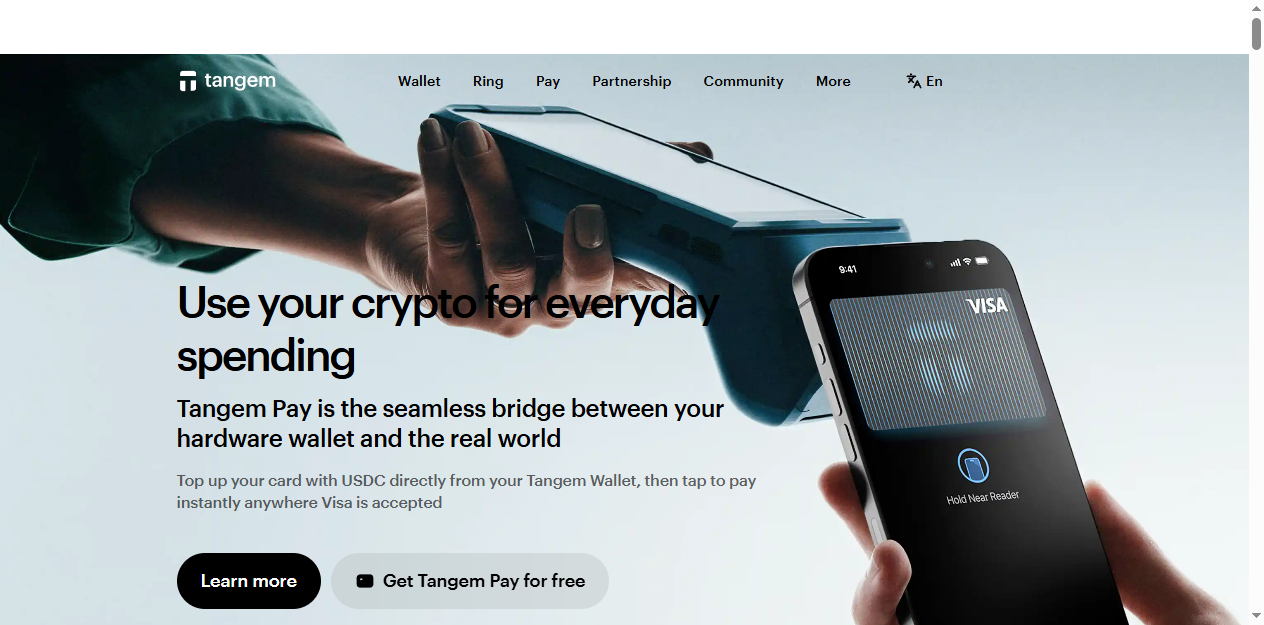
Tangem Pay at a glance
| Feature | Detail |
|---|---|
| Network | Visa (debit) |
| Custody | Non-custodial. Funds stay on-chain in a user-controlled smart contract |
| KYC | Required, handled by Rain, Tangem's independent issuing partner |
| Card format | Virtual only for now. Physical planned. Apple Pay and Google Pay supported |
| Issuance fee | Free. No issuance fee |
| Monthly fee | Free. No monthly fee, no transaction fee |
| FX fee | Markup applies on non-USD spend. Exact rate not published |
| Cashback | None advertised |
| Supported coin | Native USDC on Polygon only |
| Network (crypto) | Polygon. Gas fees apply when you top up |
| Availability | U.S. and select countries across LATAM, APAC, MEA and Africa. Not all countries or US states |
How the non-custodial model actually works
This is the part worth slowing down on. Your USDC never leaves the Polygon network to sit on a Tangem balance sheet. It stays in a smart contract that you control through your Tangem hardware wallet. When you tap the card, the contract releases the right amount of USDC, it converts to dollars, and Visa settles the purchase to the merchant. To the cashier it looks like any other debit card. Behind the scenes you spent on-chain money without handing custody to anyone.
That design has a real consequence: Tangem cannot freeze a balance it does not hold. It also means KYC still applies, because Rain issues the card and runs identity checks as Tangem's independent partner. So you get self-custody of the money and a normal regulated card program on top. Issuance is quick in most cases, within about five minutes.
The fees, and the one they don't spell out
On paper the pricing is clean. Tangem Pay is free to issue and free to maintain. There is no monthly fee, no issuance fee, and no per-transaction fee. For a card, that is genuinely good.
The catch is foreign exchange. Any purchase in a currency other than USD picks up an FX markup, and Tangem does not publish the exact rate. If you spend mostly in dollars this may never touch you. If you travel or buy from merchants priced in euros, pounds, or anything else, you are paying a spread you cannot see in advance. There are two smaller costs too: Polygon gas fees when you top up the card, and ATM withdrawal fees that will apply once that feature launches. Right now ATM withdrawals are not available at all.
What you can and cannot do today
Coin support is narrow on purpose: native USDC on Polygon, and nothing else. No BTC, no ETH, no basket of tokens. If your crypto lives somewhere other than USDC on Polygon, you will bridge or swap before you can spend it. The card is virtual for now, with physical cards planned but not shipping, so it works through Apple Pay and Google Pay rather than a piece of plastic in your wallet. You can set a daily spending limit anywhere from $0 to $50,000 and adjust it whenever you want, which gives you a decent safety valve.
The one thing to know
Tangem Pay is a rare card that keeps you in self-custody all the way to the checkout. The price of that is real limits: it spends USDC on Polygon only, it is virtual with no ATM access yet, and it charges an FX markup on non-USD spend that Tangem does not publish. Go in expecting a USD-first, USDC-only card.
What's good
- True self-custody: your USDC stays in a smart contract you control, settled to USD only at the moment you tap.
- No issuance fee, no monthly fee, no per-transaction fee.
- Fast setup, with the card issued in most cases within about five minutes.
- Adjustable daily limit from $0 to $50,000, plus Apple Pay and Google Pay support.
What to watch
- FX markup on non-USD purchases, with no published rate, so travel spend costs you an unknown spread.
- USDC on Polygon only. Any other coin means a bridge or swap first, plus Polygon gas on top-ups.
- Virtual only for now, and ATM withdrawals are not yet available.
- KYC is required through Rain, and availability is limited by country and even by US state.
The verdict
Get Tangem Pay if you already trust Tangem's hardware wallet, you hold USDC on Polygon, and you spend mostly in dollars. For that person the pitch lands: no fees to carry the card, real self-custody, and a quick setup. Skip it if you need a physical card today, want ATM cash, hold coins other than USDC, or spend a lot abroad, because the unpublished FX markup makes non-USD purchases hard to price. If you are weighing it against other options, run your spending profile through our card finder, and if you live out of a suitcase, our guide to the best cards for digital nomads puts this kind of trade-off in context.


