Telegram Is Shipping a Non-Custodial Wallet to a Billion People. Here's Who Should Be Nervous

Telegram will build a native, non-custodial Gram wallet into every version of its app this summer — users hold their own keys, transactions are instant and zero-fee, and the addressable audience is over 1 billion monthly users. It replaces nothing yet: the existing @wallet bot (custodial, 150M users) keeps running. GRAM rose about 7% on the news, from ~$1.36 to $1.52. The biggest losers, in order: Telegram's own custodial @wallet, standalone TON wallets like Tonkeeper, and the habit of leaving coins on exchanges.
Updated October 2026
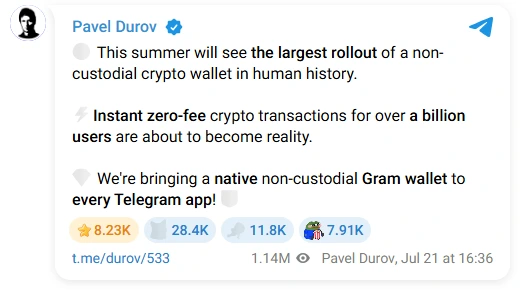
Some announcements need interpretation. This one didn't leave much room for it. On July 21 at 16:36 UTC, Pavel Durov posted three sentences to his 1.1-million-view channel, and the operative one was this: “We're bringing a native non-custodial Gram wallet to every Telegram app.” Before it: “This summer will see the largest rollout of a non-custodial crypto wallet in human history.”
I've spent the last two days pulling this apart — reading the Gram team's clarifications, checking what's actually live today, and watching where the price went. Below is everything that's confirmed, everything that isn't, and my honest read on who wins and who bleeds users when a messenger with a billion people quietly becomes the world's largest wallet vendor. Fair warning up front: nobody outside Telegram knows the full plan, GRAM is a volatile asset, and nothing here is investment advice.
What exactly was announced (and what wasn't)
Three confirmed facts, straight from the announcement and the Gram team's follow-up. One: the wallet is native — built into Telegram itself, not a bot, not a mini-app, not a third-party integration. Two: it is non-custodial from day one — users hold their own keys; Telegram does not control the funds. Three: transfers are instant and zero-fee, and the rollout targets every Telegram app — that's 1 billion+ monthly active users as the addressable ceiling.
The rollout is staged, which most headlines missed. Stage one is already live: a web version of the Gram Wallet where you can create or import a wallet and hold GRAM, jettons and NFTs from a browser. Stage two — the native wallet inside every Telegram app — is what Durov's post was about, and it's slated for “later this summer.” No exact date.
Now the unknowns, because they matter as much as the confirmations. Telegram has not said which assets beyond GRAM the wallet will support — USDT on TON is the obvious candidate given it's already the workhorse of the ecosystem, but it is not confirmed. It has not explained how key management will work at scale for people who have never seen a seed phrase — and that detail decides whether “non-custodial for a billion people” is a revolution or a support-ticket apocalypse. And it has not said which countries get it — worth remembering that the existing custodial bot has historically excluded major markets like the US.
Wait — Telegram already has a wallet. What's the difference?
| @wallet (today) | Native Gram wallet (announced) | |
|---|---|---|
| Custody | Custodial — a company holds your funds | Non-custodial — you hold the keys |
| Where it lives | A bot/mini-app you have to find and open | Built into every Telegram app natively |
| Who runs it | A separate company (not Telegram itself) | Telegram |
| Users | 150M+ | 0 today; 1B+ addressable |
| KYC | Yes, for meaningful limits | Unknown — non-custodial wallets typically need none |
| Can it be frozen? | Yes — custodian can freeze/comply | Not by Telegram — keys are yours |
That custody line is the entire story. A custodial wallet at Telegram's scale is a regulatory magnet: money-transmitter licenses, KYC obligations, freezing orders, the works — which is exactly why @wallet is run at arm's length by a separate company and stays out of the US. A non-custodial wallet is legally closer to shipping software than holding money. Users hold keys; Telegram ships code. That's the clever part of this move: it's the only architecture that could plausibly reach all billion users without turning Telegram into a bank.
What the market did: +7% in hours, and what the chart really says
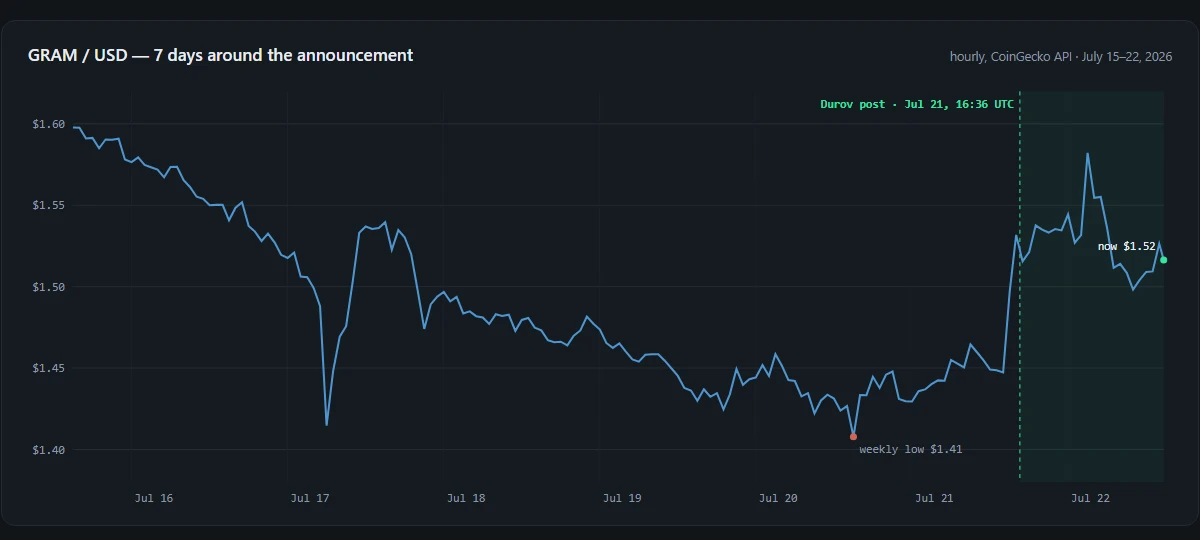
The numbers, for the record: GRAM jumped roughly +7% on the news, from about $1.36 intraday to a spike at $1.58, settling around $1.52 with a market cap near $4.15 billion — good for a top-25 coin. Context keeps the excitement honest: July was brutal for GRAM (down ~25% through most of the month, weekly low $1.41 the day before the announcement), the token still trades below its 200-day EMA, it would need an 88% rally just to revisit its May 2026 peak of $2.89 — and the all-time high of $8.25 from June 2024 is another world entirely. One announcement un-broke a bad week; it did not un-break the downtrend.
GRAM? Wasn't this Toncoin?
Same chain, recycled name. Telegram raised $1.7B in 2018 for a token called Gram, the SEC sued, and Telegram settled in 2020 — returning $1.2B and paying an $18.5M penalty. Community developers carried the chain on as TON with Toncoin. In June 2026, an 81% community vote renamed Toncoin back to Gram. So yes: the token the SEC killed in 2020 is now, name and all, being wired into every copy of Telegram. History has a sense of humor.
My verdict: what this actually becomes
Here's my read, plainly labeled as analysis. This is not a wallet feature; it's a distribution play. Every previous wallet in crypto history had to convince people to download something. Telegram is inverting that: the wallet arrives inside an app people already open dozens of times a day. The nearest precedent isn't MetaMask — it's WeChat Pay, which went from zero to dominating Chinese payments because it lived inside the message thread where the money talk was already happening.
The realistic outcome over 12–18 months, if the execution lands: Telegram becomes the default first wallet for the next hundred million crypto users — not the best wallet, not the power user's wallet, but the one that requires zero decisions. Zero-fee instant transfers inside a messenger is a genuinely better UX for the single most common crypto action on earth: sending stablecoins to another human. The TON ecosystem's April 2026 “Make TON Great Again” upgrade (6x block rate, sub-second finality, with a 6x fee cut as step two) exists precisely to carry that load.
The bear case is equally concrete. Key management for normies is an unsolved problem — if the answer is a seed phrase, mainstream users will lose funds at scale and the headlines will be ugly; if the answer is some recoverable scheme, purists will argue it isn't really non-custodial. Regulators will not shrug — the EU under MiCA treats genuinely non-custodial software more gently, but a billion-user payment surface will attract creative legal theories, and Durov personally knows how that feels. And “zero-fee” is a promise someone has to fund — TON validators don't work for free, so either fees are subsidized (fragile) or batched/sponsored on-chain (clever, but untested at this scale). I'd put it at: transformative for stablecoin transfers and onboarding, overhyped as a near-term GRAM price story.
Who bleeds users first: the migration map
The question I find most interesting — and the one nobody in the coverage is answering — is where the users come from. A billion-user wallet doesn't conjure a billion crypto users out of thin air; in the first year, it mostly reshuffles existing ones. My honest ranking of who loses, in order of bleeding:
| Rank | Who | Why they lose users | Exposure |
|---|---|---|---|
| 1 | Telegram's own @wallet (custodial, 150M users) | Same audience, same app, strictly better custody story. This is planned cannibalization — the custodial bot becomes the on-ramp/off-ramp layer at best. | Severe |
| 2 | Standalone TON wallets (Tonkeeper, MyTonWallet, Tonhub) | Their entire value was “the good TON wallet.” When the chain's parent app ships a native one, the standalone's reason to exist shrinks to power-user features. | Severe |
| 3 | Exchange-as-a-wallet balances (Bybit, OKX, Binance holdings of GRAM/TON assets) | The cohort that holds coins on an exchange out of convenience now has a one-tap non-custodial alternative in an app they already use. Trading balances stay; idle balances leak. | Moderate |
| 4 | Multi-chain mobile wallets for the Telegram-native demographic (Trust Wallet, SafePal) | Users whose crypto life is USDT + a memecoin or two don't need five chains — they need the one in their messenger. | Moderate |
| 5 | MetaMask, hardware wallets, DeFi power tooling | Different species. EVM DeFi users and cold-storage holders aren't the target and won't move. | Minimal |
Notice what's not on that list: banks and cards. A wallet solves holding and sending; it does not solve spending at a till — that still requires rails into Visa or Mastercard. Which is exactly the gap the crypto card market fills, and why this announcement matters to the niche we cover daily.
The card-market angle: non-custodial wallets need non-custodial spending
There's a precedent for what happens next. When MetaMask — the biggest non-custodial wallet of the EVM world — wanted to close the spending gap, it shipped a card that spends stablecoins directly from self-custody. If Telegram follows the same logic (and a payments layer is the obvious monetization for a free wallet), a Telegram card would instantly be the largest crypto card launch in history. Until that exists, a billion people are about to learn the difference between custodial and non-custodial — and the ones who internalize it will want their spending non-custodial too. In our database of 59 cards, exactly that category — cards that spend from a wallet you control, no exchange custody involved — is where MetaMask Card and Gnosis Pay live, and it's the category this announcement just validated:
Non-custodial cards — spend from keys you hold



Compare all non-custodial cards
Filter by custody model, fees and country — every figure verified against issuer sites with dates shown.
What to watch next
- The asset list. If USDT-on-TON is in the native wallet at launch, this is a payments story and the stablecoin migration begins immediately. If it's GRAM-only, it's a token story and much smaller.
- Key management design. Seed phrases = mass loss events incoming; social/cloud recovery = a fight about what “non-custodial” means. Either way, it decides mainstream viability.
- Geographic availability. @wallet's exclusion list (notably the US) is the template to beat. A US launch would be a regulatory statement in itself.
- What happens to @wallet's 150M users. A migration prompt inside the bot would be the clearest signal that cannibalization is the plan.
- A payments/card layer. Any hint of a Telegram card or merchant payments API turns this from a wallet into a WeChat Pay run — and reshuffles the entire card market we track.
- GRAM's 200-day EMA. Technically, the token is still in a downtrend; reclaiming the long-term average on rollout news would be the first structural (not headline) bullish signal.
Disclosure and disclaimer
This is a research and news-analysis piece. We hold no position in GRAM, Telegram has no relationship with this site, and nothing here is investment advice — a token that fell 25% in a month and rallied 7% on a tweet-length post will do violent things in both directions. The card links above are part of our regular comparison catalog; our scoring is editorially independent and affiliate links are always disclosed.
Frequently asked questions
Non-custodial from day one, per the announcement — users hold their own keys and Telegram does not control the funds. That's the key difference from the existing @wallet bot, which is custodial: a company holds the funds, can apply KYC and can freeze accounts. How exactly key backup and recovery will work for a mainstream audience hasn't been disclosed yet.