“Buy it with cash, skip ID, and you'll be untraceable” is the most tempting advice about an anonymous debit card, and the least reliable. A prepaid card might let you spend without presenting the same identity documents a bank account requires, but that doesn't erase records created when the card is loaded, authorized, or used online.
The useful question isn't whether a card is anonymous in the abstract. It's what information stays private, from whom, at which stage, and under which rules. That distinction matters because the card's limits and protections can change with its issuer, its features, and the country where you use it.
Table of Contents
- What an Anonymous Debit Card Actually Is
- How Identity Verification Actually Works
- The Three KYC Tiers Explained
- What Regulators Actually Require
- Crypto-Linked Cards and the Anonymity Question
- The Privacy Versus Recovery Trade-Off
- What Anonymity Gets You in Practice
- Choosing the Right Card for Your Privacy Goal
What an Anonymous Debit Card Actually Is
An anonymous debit card is usually an open-loop prepaid card, not a universal category of bank card that guarantees identity-free use. “Open-loop” means it can work across a payment network rather than only at one shop. Some prepaid products have allowed limited use with less identity checking than a bank account, but that doesn't make them permanently untraceable.
Prepaid cards had already become a significant payment channel before crypto-linked cards and modern digital wallets expanded. The U.S. Department of Justice reported that about 7 million Visa- and Mastercard-branded prepaid debit cards were in circulation by January 2005, issued through more than 2,000 programs. A later U.S. Treasury assessment cited Federal Reserve data showing prepaid cards generated about 6 billion transactions in 2009, worth more than $140 billion (Justice Department background on prepaid cards). Those figures help explain why regulators focused on how prepaid products could offer cash-like access to digital payments while separating spending from a verified bank identity.
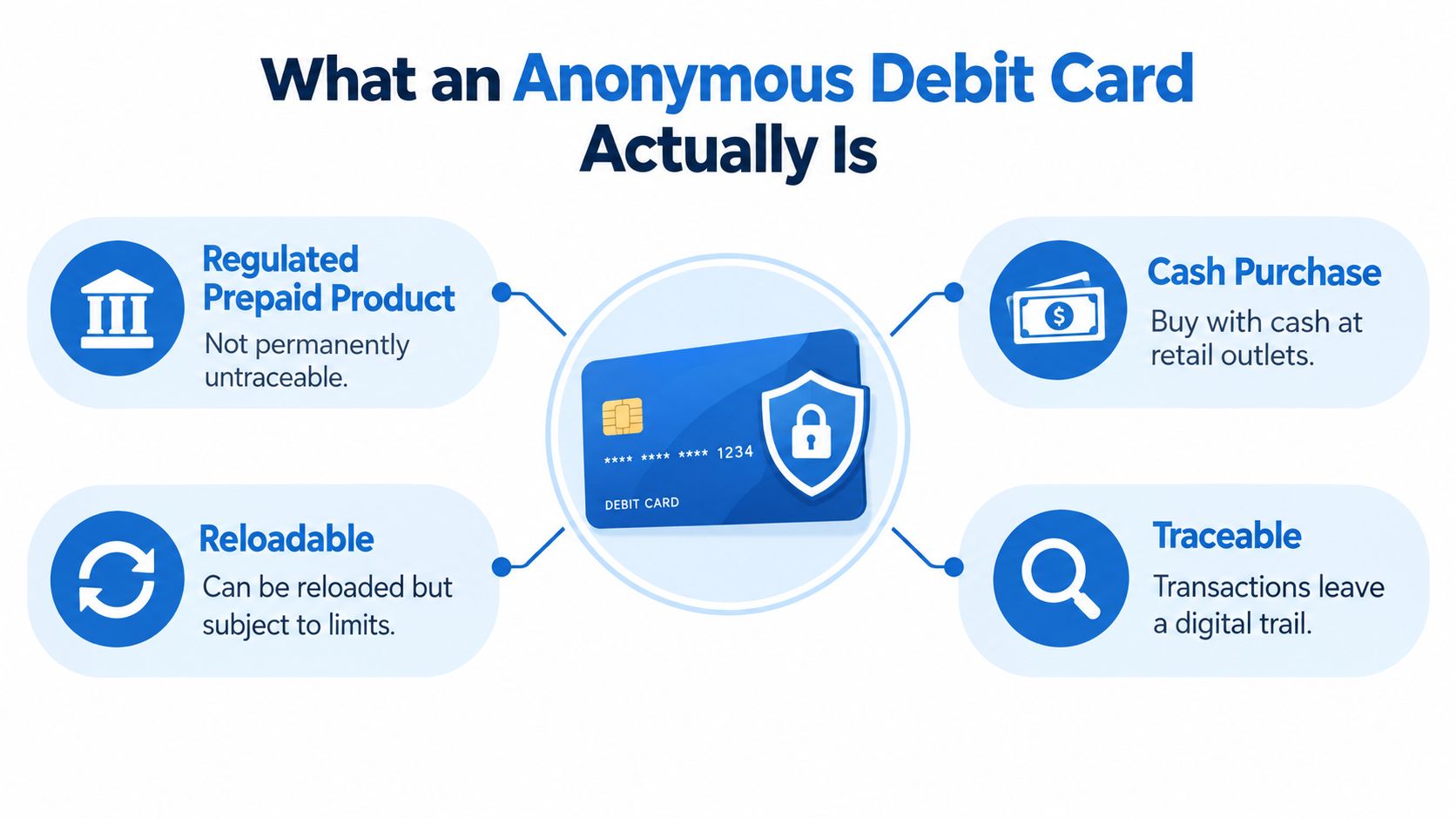
Think of “anonymous” as a claim about identity checks, not a promise that no record exists. A cash purchase may avoid directly linking a bank account to the card, yet the issuer can still hold card records, a merchant can record a purchase, and a payment network can process an authorization. Reloading, international spending, transfers, and higher balances may lead to additional checks or restrictions.
Practical rule: Ask what information is collected at purchase, loading, payment, and account recovery. “No ID at signup” answers only one part of the privacy question.
The same distinction applies to other privacy tools. For example, a guide to no KYC eSIM setup can help clarify what limited identity disclosure looks like in a different service, but it doesn't tell you how a card issuer handles payments. With cards, the key is to identify who can connect your identity to each stage of use.
How Identity Verification Actually Works
Verification isn't a single switch that flips from “anonymous” to “identified.” Providers can apply checks progressively, responding to how a card is bought, registered, funded, and used. The more a product can do, the more likely it is to face controls around identity and activity.
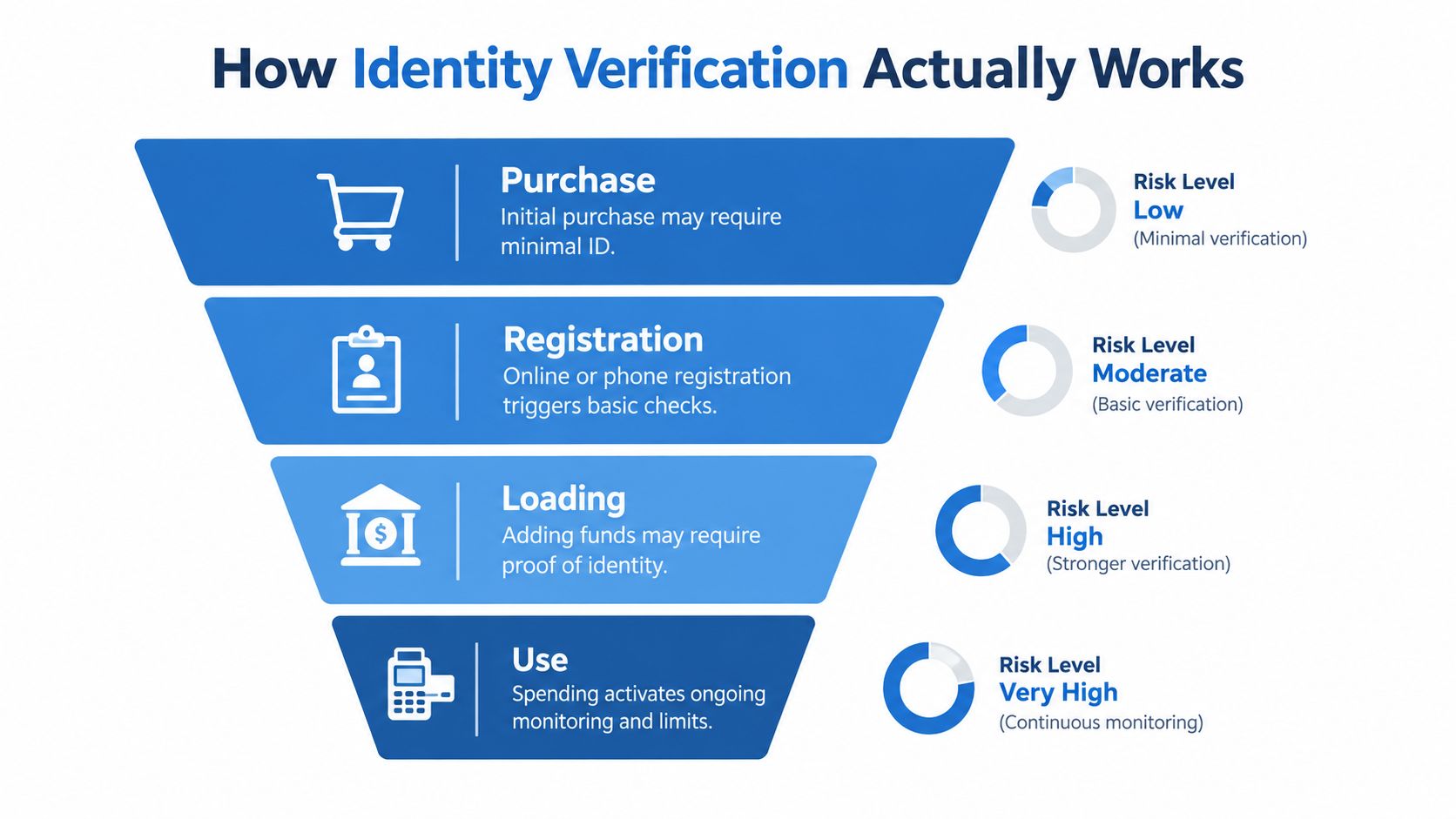
Consider a hypothetical prepaid card with a €150 stored-value ceiling. That number is a regulatory limit in a particular EU framework, not a promise that a specific product will let you use the full amount without checks. Buying a card with cash might involve little identity disclosure. Registering it online can ask for contact details. Loading it through a particular method can require more information, and attempts to use it for cash withdrawals, cross-border purchases, or online payments may be restricted or prompt further review.
The four touchpoints are easiest to understand separately:
- Purchase: A retail cash purchase may disclose less directly to the issuer than a bank transfer, but the card's terms and local rules still apply.
- Registration: Activating a card online or by phone can connect it to contact details, even if no identity document is requested.
- Loading: Reloads can reveal a funding source or trigger limits and checks. A card's initial purchase conditions don't automatically govern every later load.
- Use and recovery: Authorization records can show where and when the card was used. If it's lost, the issuer may ask for information to establish that you're entitled to recover the balance.
Spending a small amount at a local shop may fit a product's low-friction use case. Repeated loads, cash access, international activity, or remote payments can change the risk profile, and an issuer may impose limits or request more due diligence. A card that's low-friction for a small in-person purchase may not behave the same way for larger or more complex use.
That's why “anonymous” is conditional. Before relying on a card, check which actions are allowed without added verification, what triggers a review, and what happens if you need to recover funds.
The Three KYC Tiers Explained
Product labels such as No KYC, email only, and full KYC describe different onboarding expectations, but they don't tell you every operational limit. A “No KYC” label doesn't establish that a card is reloadable, accepted internationally, usable online, or available in your country. Providers may also apply checks when usage changes or when regulations require them.
| Anonymous debit card KYC tiers compared | Stored value cap | Monthly load cap | Online use | ATM access | Reloadable |
|---|---|---|---|---|---|
| No KYC | Product- and jurisdiction-specific; expect a low ceiling or no availability | Check issuer terms; loads may be restricted | May be unavailable or limited | Often restricted; verify the product terms | May be unavailable or tightly limited |
| Email only | Set by issuer and local rules; email doesn't guarantee a particular cap | Check whether cumulative loads trigger added checks | Depends on issuer and transaction limits | Depends on product and region | May be available within limits |
| Full KYC | Set by issuer, regulation, and account tier | Set by issuer and account tier | Usually subject to issuer controls and monitoring | May be offered, subject to terms | Often available, with applicable checks |
The table is a comparison framework, not a set of universal product specifications. No KYC usually means the provider doesn't request standard identity documents at a particular point in the onboarding process. It doesn't mean no transaction records exist. Email-only describes a lighter signup step, not a guarantee of anonymity throughout the card's lifecycle. Full KYC generally involves identity verification, with further checks possible depending on the provider and use.
When you compare offers, separate the stages rather than treating KYC as a single rating. Ask whether identity checks apply at purchase, activation, loading, online payments, ATM withdrawals, or account recovery. Then check whether the issuer distinguishes a daily transaction limit from a stored-value ceiling or a cumulative loading threshold. These are different controls, and one doesn't tell you the others.
For a more detailed vocabulary around verification labels and what they imply, see this guide to crypto card KYC levels. The practical lesson is simple: compare the actual permitted activity, not just the badge on the product page.
What Regulators Actually Require
Marketing copy often treats privacy as a product feature. Regulators focus on risk controls: where a card can be bought, how it can be funded, whether it can be reloaded, how much value it can hold, and what kinds of transactions it can make. The rules vary by jurisdiction, so a card advertised as “no KYC” in one market may be restricted or unavailable in another.
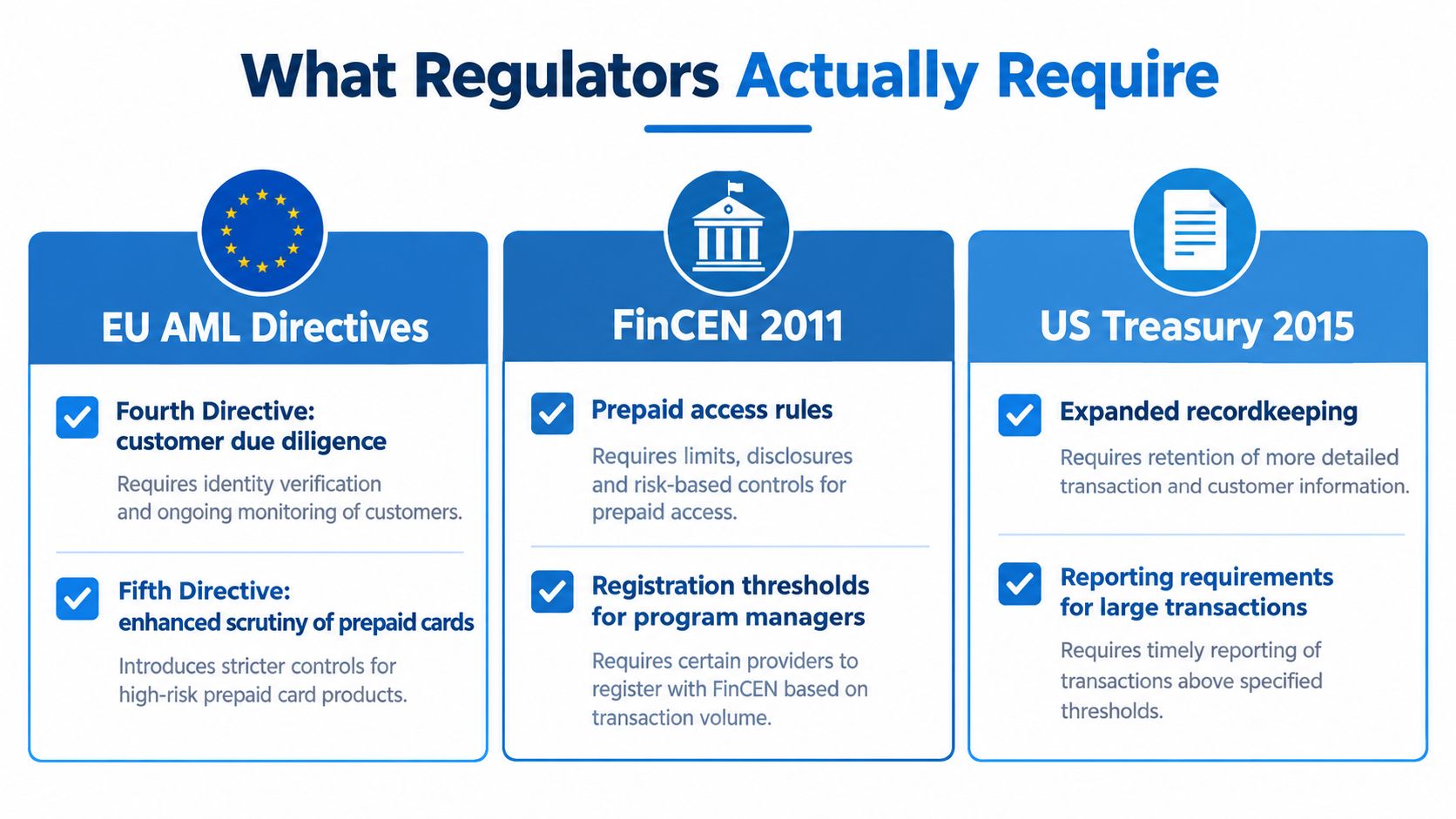
In the EU framework described by the Fifth Anti-Money Laundering Directive, anonymous prepaid instruments are constrained by a €150 maximum stored value or monthly transaction limit. They must be non-reloadable or usable only within the issuing member state, and anonymous remote payments above €50 aren't permitted under the stated conditions (EU directive text). The framework also requires EU acquirers to reject anonymous prepaid cards issued outside the EU unless they meet equivalent safeguards. Those provisions make geography and acceptance part of the privacy question, not fine print.
Other rules add context rather than creating one global standard. FATF guidance identifies anonymity risks at purchase, registration, loading, reloading, and use, and describes controls such as funding limits, restrictions on cash access, and capped balances (FATF guidance on prepaid payment products). In the United States, FinCEN's 2011 rules established anti-money-laundering obligations for providers and sellers of certain prepaid products, including customer identification, suspicious-activity reporting, and recordkeeping. The Treasury's 2015 risk assessment described additional obligations for covered nonbank prepaid-access providers, including risk-based AML programs and specified reporting and customer-information retention.
A separate humanitarian-program context used a €1,800 annual transaction threshold under guidance associated with the Fourth Anti-Money Laundering Directive, alongside restrictions such as use only in the issuing country and no online or ATM transactions. That figure doesn't replace the EU-wide product constraints above; it belongs to a different context.
A “no KYC” label is never a substitute for checking the card's jurisdiction, balance rules, reload policy, and permitted transaction types.
For crypto users, jurisdiction-specific reporting obligations can also matter. This overview of DAC8 crypto reporting changes offers a related lens on how rules can affect crypto activity, though it shouldn't be treated as a substitute for checking a card's own terms and applicable law.
Crypto-Linked Cards and the Anonymity Question
A crypto-linked card introduces two distinct questions: who controls the funds before spending, and what information the payment process exposes. A self-custodial setup keeps assets in a wallet controlled by the user until a payment is made. A custodial setup involves a third party, such as an exchange, holding assets or managing the balance connected to the card.
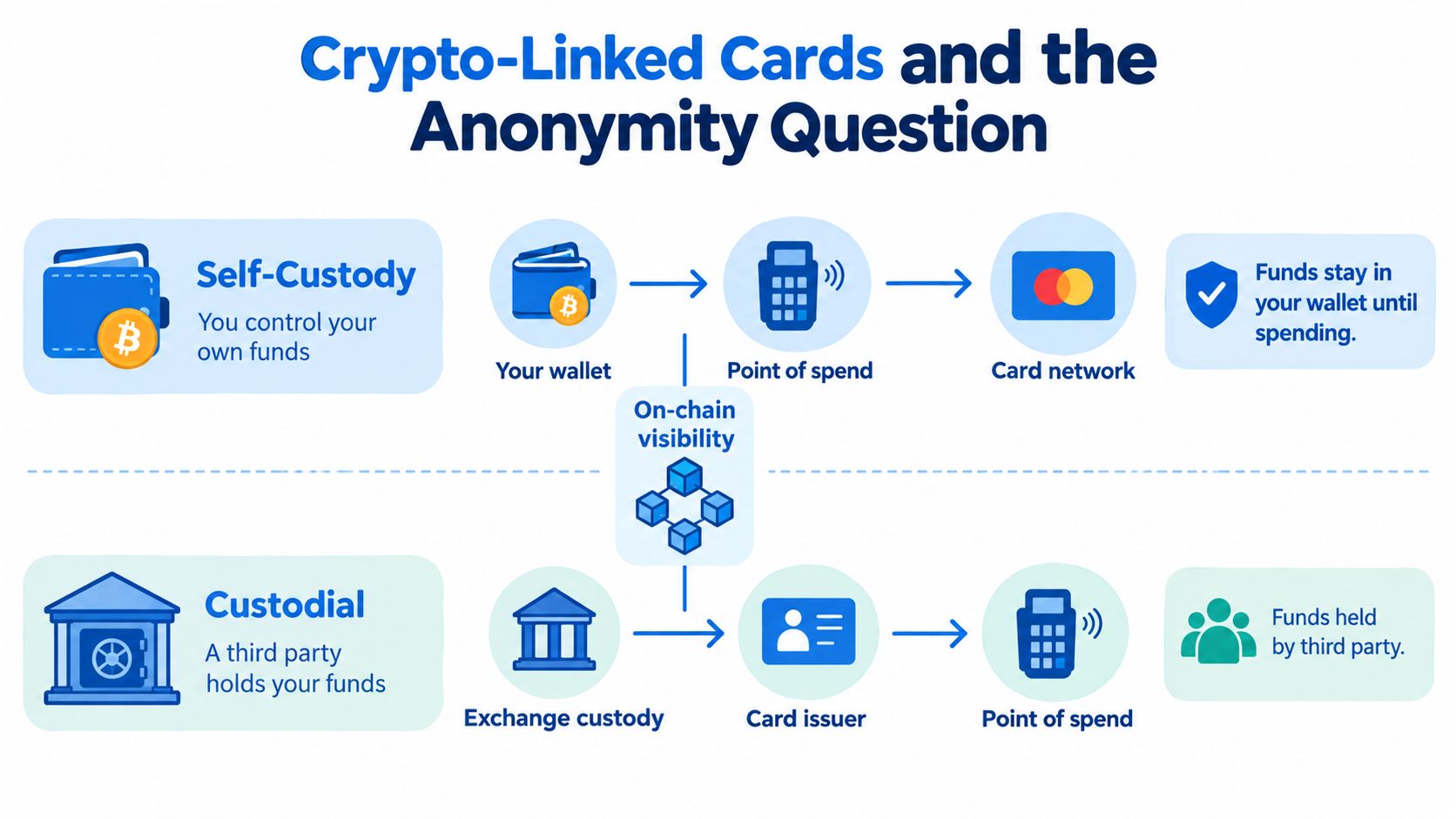
Neither arrangement automatically makes a card payment anonymous. Self-custody can reduce exposure to an exchange holding funds, but it doesn't remove the issuer, payment network, or merchant from the transaction. In a custodial arrangement, the provider may also have records tied to the account and its funding. The privacy implications depend on the specific product and the data each participant handles.
There's a further distinction between on-chain visibility and card-network records. A blockchain transaction may reveal movement between addresses without showing a legal name in the transaction itself. Other information may still connect those addresses or the subsequent card activity to an account. Conversely, a card authorization can create records even when the cardholder funds it from a self-controlled wallet.
The network stage matters. Mastercard's crypto-card program describes anti-money-laundering checks, sanctions screening, fraud monitoring, and fiat conversion before transactions reach its network. That's a reminder that a card payment passes through regulated and operational controls, even when the user's funding source is a self-custodial wallet.
The flow below can help keep the concepts separate. It illustrates custody and payment steps, not a promise about what any particular issuer can see.
When evaluating a crypto-linked card, check whether the provider controls the funds, whether spending requires a conversion step, and what transaction or identity records may be retained. Self-custody answers who holds the assets; it doesn't answer who can identify the card user.
The Privacy Versus Recovery Trade-Off
A lower identity footprint can mean less information available to an issuer when something goes wrong. If a card is lost, compromised, or frozen, the provider may have fewer ways to verify that you're the rightful user. That can make account recovery, fraud investigation, and disputed-payment support more difficult. The exact protections depend on the issuer and the card terms, so don't assume anonymity automatically removes or preserves any particular right.
This trade-off matters because people value several payment qualities at once. In recent European consumer research, 81% of surveyed adults expressed concern about misuse of personal or financial data or government surveillance, while consumers also ranked security, reliability, fraud refunds, low fees, and privacy among important payment attributes (BEUC report on consumer expectations for the digital euro). Privacy is one part of the decision, not the only one.
Use a practical scorecard before choosing a card:
- Identity exposure: What details does the provider collect at signup and later checks?
- Recovery: What proof will you need if you lose access to the card or account?
- Disputes: What process applies to an unauthorized or incorrect card transaction?
- Freezes: What circumstances can suspend spending, and how can you contact the provider?
- Funding trail: Does the funding method create its own identifiable or publicly visible records?
Crypto adds a separate risk: on-chain transfers may be difficult or impossible to reverse. That risk isn't the same as a card dispute. A provider might offer a process for disputing a card transaction while being unable to undo an earlier crypto transfer that funded the account.
If you're comparing crypto products, separate custody from payment support. A guide to custodial versus self-custody crypto cards can help frame that distinction. Then read the issuer's recovery, dispute, and freeze terms directly. A privacy label can't tell you whether support will restore access when you need it.
What Anonymity Gets You in Practice
Maja buys a low-value prepaid card with cash and uses it for an ordinary in-person purchase. The transaction works, and she hasn't given the merchant her bank-card details. That's a real privacy benefit: she has separated this payment from her usual account information, at least from the merchant's point of view.
Later, Maja loses the card. She contacts the issuer, but the provider has limited information to distinguish her from someone else holding the card. If she didn't register it or keep whatever recovery details the issuer requires, recovering the balance may be harder. Less identity disclosure can reduce exposure, but it can also remove evidence the provider could use to confirm ownership.
Now imagine that a later transaction triggers the issuer's monitoring controls. The provider suspends use while it asks for additional information. Maja's “anonymous” card hasn't made review impossible; it has only changed when and how the provider asks questions. If she can't meet the issuer's requirements, access to the funds may remain limited under the product's terms.
Privacy can reduce what a company knows about you, but it can also limit what that company can do to help prove you're you.
A crypto-funded card can add another complication. If Maja sends assets on-chain to fund the card, that transfer may not be reversible even if the issuer later supports a dispute over a card purchase. Funding reversibility and card dispute rights are separate questions. She should check both before moving funds.
Maja's experience isn't a claim about every product. Some issuers may provide recovery and dispute processes; others may impose narrower limits. The useful lesson is to test the card against the situations that matter to you: routine spending, a lost card, an unauthorized transaction, a frozen balance, and a mistaken transfer. A product that feels private at checkout may be less convenient when you need assistance.
Choosing the Right Card for Your Privacy Goal
Start with your goal, not the label. “Anonymous” could mean you don't want to expose bank-card details to a merchant, you want to avoid uploading identity documents during signup, or you want to limit what a crypto custodian can connect to your activity. Those goals aren't interchangeable, and no single card feature answers all of them.
Use three questions to narrow your options:
- What do you want to keep private, and from whom? Separate the issuer, merchant, payment network, wallet provider, and any other service involved. A card may limit what one party receives while leaving other records intact.
- What will you need the card to do? Check country availability, online acceptance, cash access, reloads, supported funding methods, stored-value limits, and whether the card works with the merchants you use.
- What happens when something goes wrong? Read the terms for lost-card replacement, account recovery, transaction disputes, freezes, and crypto funding reversals. Don't assume the same protections apply to each.
Then compare product pages using consistent labels: No KYC, email only, or full KYC; custodial or self-custodial; reloadable or not; and the relevant country or region. Look for separate limits on stored value, cumulative funding, remote payments, cash withdrawals, and cross-border use. If a product page doesn't explain those details, ask the issuer before funding the card.
Comparison tools can help organize fragmented terms, but they can't replace issuer documentation. NomadCards provides filters for KYC level, supported networks, card type, and features, alongside standardized card profiles and regional availability details. Treat that as a starting point for comparison, then verify current conditions with the provider.
The clearest definition is also the most useful: anonymity means what stays private from whom, at which stage, and under which limits. Answer those questions before deciding whether a card's privacy model fits your needs.
NomadCards compares crypto-linked card programs by verification requirements, custody model, supported features, and regional availability. Use NomadCards to compare the terms that matter to your privacy goal, then confirm the limits and recovery rules with the card issuer before you load funds.