The most popular advice about finding the best card for cashback is also the least reliable: choose the card with the highest advertised rate. That approach ignores the costs that decide whether rewards survive contact with real spending, including annual fees, foreign exchange charges, category caps, conversion spreads, custody requirements, and redemption restrictions.
A crypto-linked card makes the comparison harder. Two cards can advertise similar cashback while differing materially in supported assets, card network, KYC requirements, regional availability, and whether spending comes from a custodial balance or a self-custody wallet. A headline rate is only the starting field. The useful figure is effective net cashback, the value left after every relevant cost.
NomadCards normalizes those terms into comparable fields and refreshes composite rankings weekly. This guide uses that analytical lens to show how to translate rewards marketing into actual value, compare crypto cards without pretending they're interchangeable, and choose according to spending pattern, travel needs, privacy preferences, and region.
Table of Contents
- Introduction Why Headline Cashback Rarely Tells the Full Story
- How Cashback Actually Works on Crypto Linked Cards
- The Hidden Costs That Shrink Your Cashback
- Comparing Top Crypto Cards by Effective Cashback After Fees and FX
- Best Picks by User Profile and Region
- How to Choose the Right Card With NomadCards Filters and Scoring
- Final Recommendation and Next Steps
Introduction Why Headline Cashback Rarely Tells the Full Story
Cashback looks simple because the reward is expressed in money rather than miles or points. That simplicity is real, and it helps explain the format's reach. A 2024 J.D. Power study found that 58% of U.S. cardholders used cashback cards, compared with 31% using points or miles cards and 11% using cards with no rewards, as reported by Digital Transactions' coverage of the study. The same coverage reported an average annual fee of $44 for cashback cards, versus $140 for miles-earning cards, while 10% of cashback issuers charged no annual fee.
Those figures don't prove that every cashback card is good value. They show why cashback is a practical baseline. Rewards are easier to understand, fees are often lower, and redemption can be more direct. J.D. Power's coverage also reported that 21% of cashback cardholders redeemed rewards as a statement credit, compared with 9% of points and miles users, a difference that reinforces the appeal of immediate, uncomplicated value.
Crypto cards add another layer. The reward might be paid in a token rather than fiat, the card might draw from an exchange balance, or the transaction might trigger an asset conversion at checkout. A card that advertises 5% cashback can therefore underperform a flat-rate card advertising 1.5% if the larger reward is capped, conditional, expensive to redeem, or offset by FX and conversion costs. The comparison must measure what remains, not what appears in the banner.
Analyst's rule: Treat the advertised cashback rate as gross revenue. Treat fees, limits, FX and redemption conditions as costs of collection.
The method in this guide is practical:
- Normalize the terms: Put cashback, annual fees, FX charges, supported assets, custody and availability into common fields.
- Calculate usable value: Estimate rewards against the spending categories you use.
- Subtract friction: Account for fees, caps, conversion losses and requirements that can prevent full redemption.
- Match the profile: A low-fee everyday spender, a frequent traveler and a self-custody user shouldn't receive the same recommendation.
The result isn't a universal winner. It's a decision framework for readers who want the best card for cashback after fees, rather than the most impressive rate in an advertisement.
How Cashback Actually Works on Crypto Linked Cards
A cashback program has three separate stages: earning, valuation and redemption. Confusing those stages is how a gross rate becomes an inflated estimate of savings.
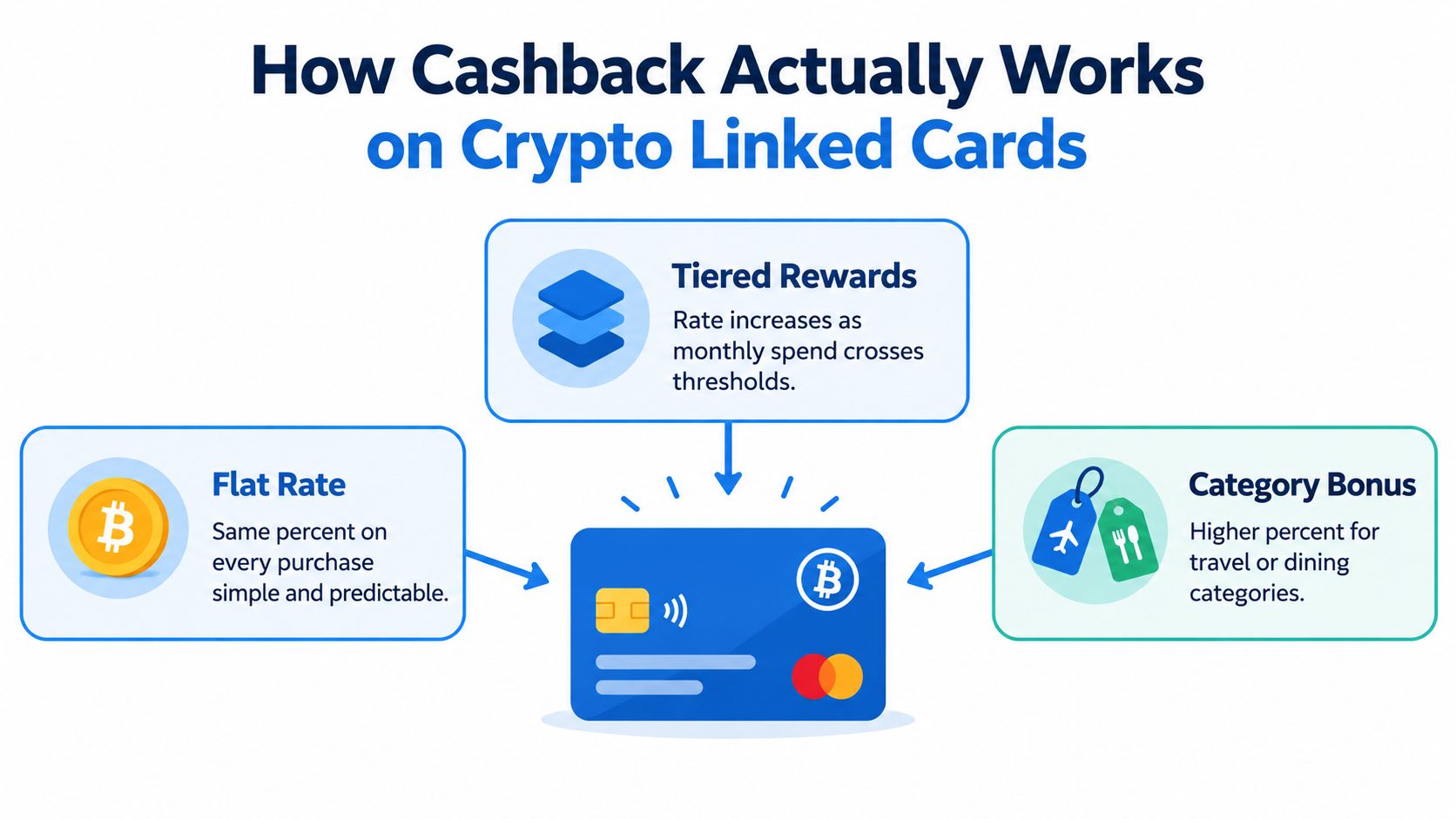
First, identify the earning model. Flat-rate cashback applies one rate to eligible purchases, which makes forecasting straightforward. Tiered rewards increase the rate after spending reaches defined thresholds. Category bonuses pay more for selected merchant types, such as dining or travel, while ordinary purchases earn less. Some crypto cards combine these structures with account tiers, token holdings or activation requirements.
Translate the rate into a common unit
For a true cashback program, the clean benchmark is direct: 1% of spending equals 1 cent per dollar spent, according to Bankrate's explanation of credit-card points and rewards. That gives you a neutral comparison point even when the issuer pays rewards in crypto.
If a card pays 2% in a token, start by valuing the reward at 2 cents for every dollar of eligible spend. Then ask whether the token's value can change before redemption, whether the issuer applies a spread during conversion, and whether you can use or sell the reward without an additional restriction. The advertised percentage describes the grant, not necessarily the amount you can realize.
Points-based programs can use a similar cash benchmark, commonly around 1 cent per point when redeemed as cash. The difference is that points may have multiple redemption values, while a direct cashback credit has a clearer floor. Crypto rewards need an equivalent conversion step before they can be compared fairly with fiat cashback.
Separate earning from receiving
A card can credit rewards instantly, after a statement closes, or only after a condition is met. It may issue a statement credit, deposit crypto into an account, or require a manual claim. Each method changes the user experience and can create different levels of friction.
Statement credit is usually the easiest form to value because it offsets a known balance. Token rewards may be more attractive to someone who already wants that asset, but they introduce market exposure and potentially another transaction before the reward becomes spendable. A non-custodial structure can also offer a different control model from a card linked to an exchange, but it may require the user to understand wallet permissions and settlement mechanics.
The practical workflow is simple:
- Record the gross rate for each spending category.
- Check eligibility rules for merchant types, activation, account tier and payment method.
- Value the reward using the one-cent-per-dollar benchmark.
- Record how rewards are delivered, including crypto or fiat settlement.
- Apply costs and limits before calling the result cashback.
For a deeper treatment of whether rewards justify the trade-offs, use this crypto card cashback analysis. The key distinction is that a high earning rate isn't automatically a high realized return. You need to know how much spending qualifies, what the reward is worth at redemption, and how much effort or cost stands between the transaction and usable value.
The Hidden Costs That Shrink Your Cashback
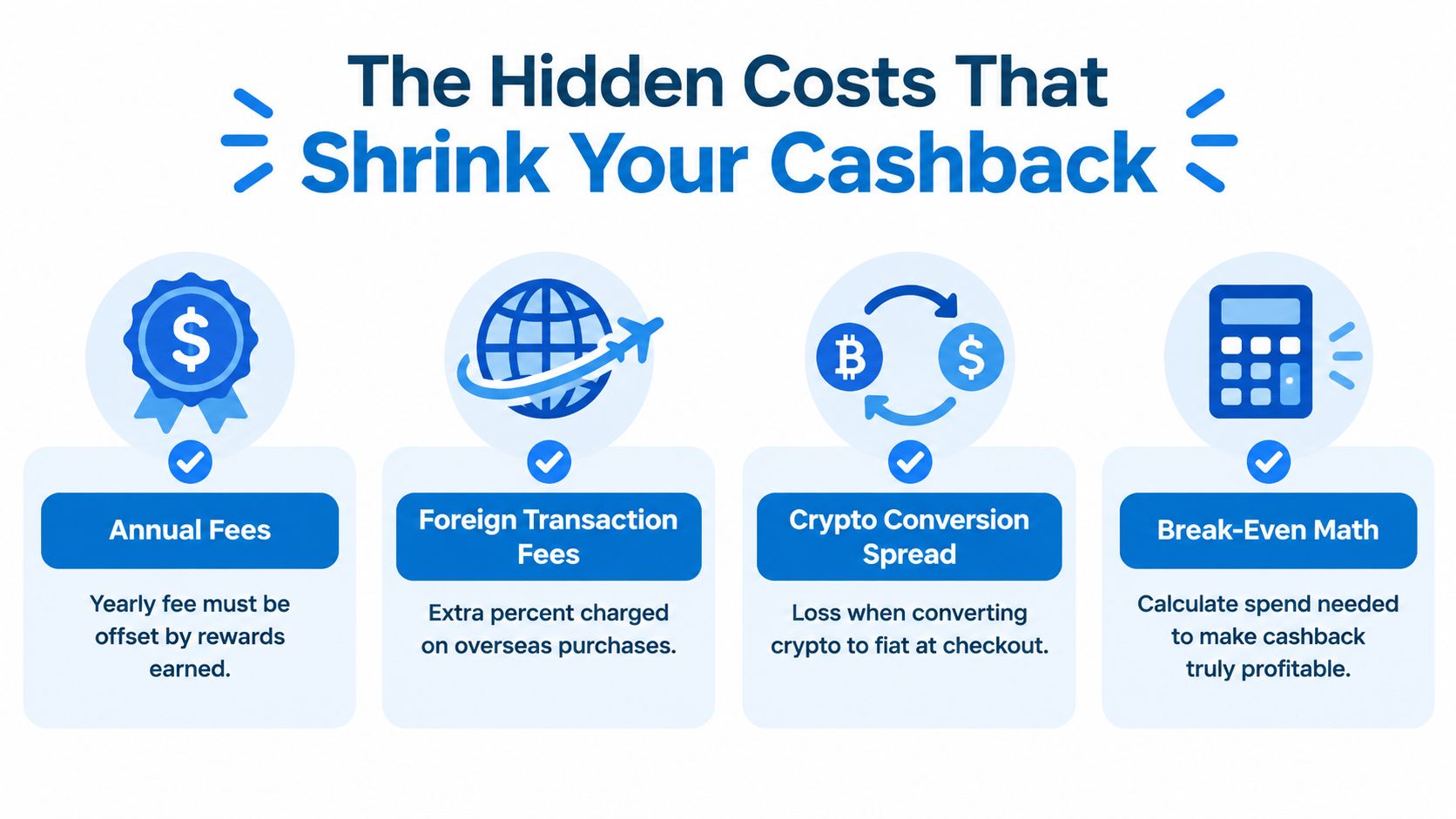
The fastest way to misread a cashback offer is to calculate rewards before calculating costs. A card earning a generous gross rate can still produce a poor result if the annual fee applies to modest spending, foreign transactions carry an additional charge, or the bonus rate ends at a low cap.
Annual fees create a measurable hurdle
Use this formula:
Break-even annual spend = marginal annual fee ÷ cashback rate difference
The formula comes from Doctor of Credit's break-even analysis. Its example uses a card with a $95 annual fee that earns 2% instead of 1%. The card needs about $9,500 in incremental annual spending to offset the fee through the extra reward alone. That calculation excludes credits, sign-up offers and benefits, so it should be treated as a baseline rather than a complete valuation.
The important word is marginal. If a fee card earns 2% and a no-fee alternative earns 1%, only the extra 1% pays for the fee. Counting the full 2% exaggerates the card's advantage.
FX fees can reverse a travel decision
A traveler should calculate cashback on the transaction currency, then subtract the card's foreign transaction fee and any crypto-to-fiat conversion cost. A reward earned abroad isn't a benefit if the associated markup is larger than the reward.
This matters especially for cards that settle crypto at checkout. The user may face a spread when the card converts an asset into the merchant's settlement currency, even if the issuer describes the purchase as cashback eligible. The correct field is therefore not “FX fee,” but the combined overseas cost, including conversion mechanics where applicable.
Caps and redemption rules limit the headline rate
Bonus categories often have monthly or annual limits. Once the cap is reached, spending may earn a lower base rate or no reward at all. Conditional cashback can also require activation, a particular token balance, a minimum account tier or redemption through a designated channel.
The market is also moving toward more conditional cashback and lower caps in 2026, according to Research and Markets' coverage of global cashback programs. That doesn't make every offer unattractive, but it makes uncapped assumptions unsafe. The same source notes that Australia is scheduled to reduce its domestic credit-card interchange cap from 0.8% to 0.3% on 1 October 2026, a reform that could pressure reward economics. That future change is a projection about market pressure, not a guarantee that every issuer will reduce rewards.
Before applying, check:
- Annual fee: Compare it with the incremental reward over a no-fee alternative.
- Foreign transaction fee: Confirm whether the fee applies to purchases, cash withdrawals or both.
- Conversion spread: Review the exchange path used when crypto funds a fiat transaction.
- Caps: Calculate rewards only within the eligible limit.
- Redemption minimums: Confirm whether small balances can be claimed.
- Lockups: Check whether token rewards can be transferred or sold immediately.
- Eligibility: Verify residency, KYC and supported assets before treating the rate as available to you.
An automated expense finder can help identify recurring spending patterns and overlooked charges before you estimate annual card value. For card-specific terms, compare normalized costs in this crypto card fees comparison.
Comparing Top Crypto Cards by Effective Cashback After Fees and FX
A useful comparison can't rank cards by cashback alone. It needs fields that explain whether the advertised reward can be earned, retained and used. For crypto-linked products, those fields include the reward rate, annual fee, FX treatment, caps, supported assets, card network, custody model and geographic availability.
The table below is a comparison template, not a claim that every listed product has identical terms in every market. Rates, eligibility and regional availability can change, so treat the issuer's current conditions as the final authority. Where the brief provides a product-level rate, it can be shown as a reference point. Where it doesn't, the correct treatment is to mark the field as requiring verification rather than inventing a figure.
| Card | Headline Cashback | Annual Fee | FX Fee | Effective Net Cashback | Best For |
|---|---|---|---|---|---|
| Nexo Card | Up to 2% cashback, as listed by NomadCards' product coverage | Verify current issuer terms | Verify by region | Depends on tier, caps, asset conversion and FX | Users comfortable with tiered crypto rewards |
| Bitpanda Visa Card | 1% cashback, as listed by NomadCards' product coverage | Verify current issuer terms | Verify by region | 1% gross before fees and redemption conditions | Users seeking a simple published baseline |
| COCA Card | Verify current offer | Verify current issuer terms | Verify by region | Requires cap and redemption analysis | Users comparing conditional rewards |
| ZEN Card | Verify current offer | Verify current issuer terms | Verify by region | Requires category and fee analysis | Users whose spending matches eligible categories |
| Trustee Plus Card | Verify current offer | Verify current issuer terms | Verify by region | Requires asset and conversion analysis | Users already using the linked crypto platform |
| Krak Card | Verify current offer | Verify current issuer terms | Verify by region | Requires cap, FX and custody analysis | Users prioritizing platform integration |
| Plasma One Card | Verify current offer | Verify current issuer terms | Verify by region | Requires network and redemption verification | Users evaluating newer crypto-card models |
| Ledger Crypto Life Card | Verify current offer | Verify current issuer terms | Verify by region | Requires self-custody and spending-flow analysis | Users focused on wallet control |
Why the table needs more than a rate column
Nexo Card's published up to 2% figure is a ceiling, not a universal return. The relevant questions are which tier provides it, whether the reward is paid in a volatile asset, what spending qualifies and whether the user's region supports the offer. A lower base rate with no annual fee and uncomplicated redemption can produce more usable value for ordinary spending.
Bitpanda Visa Card's 1% cashback provides a cleaner gross benchmark, but gross value still isn't net value. A user should subtract any applicable annual or FX costs and verify how the reward is credited. That same discipline applies to COCA, ZEN, Trustee Plus, Krak, Plasma One and Ledger Crypto Life Card, where the structure may matter more than the headline number.
Comparison principle: A card wins only after it clears the same spending scenario as its competitors.
The custody model also changes the decision. A custodial card may offer a smoother conversion process, while a self-custodial implementation may appeal to users who want greater control over funds. Neither model is automatically superior. The trade-off can involve convenience, counterparty exposure, wallet permissions, KYC and regional compliance.
Network acceptance matters for everyday reliability and travel. Supported assets matter if the user doesn't hold the issuer's preferred token. Regional availability matters because a card can be attractive on paper but unavailable to the applicant's country. These aren't secondary details. They determine whether the advertised reward is usable at all.
Build a personal effective-rate comparison with one spending scenario, then hold that scenario constant across cards. Include domestic purchases, overseas purchases, likely bonus categories, annual spending, redemption timing and the user's preferred custody model. That produces a more defensible result than selecting the largest percentage in a search result.
Best Picks by User Profile and Region
The best card changes when the job changes. An everyday spender may value predictable rewards and no annual fee, while a frequent traveler may accept a lower domestic rate in exchange for low FX costs and broad acceptance. A crypto-heavy user may care more about direct token settlement or wallet control than about a small difference in the headline percentage.
The low-fee everyday spender
Choose a flat-rate card when your purchases are spread across ordinary merchants and you don't want to activate categories or maintain a reward tier. The benefit isn't only ease. A predictable rate makes your annual estimate more accurate and reduces the chance that you'll overvalue a bonus that applies to a narrow portion of spending.
A no-fee structure deserves priority if your annual spend is modest. A card with a higher gross rate must first recover its fee against the reward you'd earn elsewhere. If it can't, the lower-rate card may deliver the stronger net result.
The rewards optimizer
A tiered or category-based card can fit a user who tracks spending carefully and reliably reaches the qualifying threshold. The optimizer should calculate the reward only on eligible purchases within the cap, then compare the result with a flat-rate alternative.
This profile suits products such as Nexo Card only when the user can satisfy the relevant tier and accepts the asset and redemption conditions. The rate is valuable because the spending pattern triggers it, not because the advertisement displays it.
The privacy-focused user
A privacy-sensitive applicant should filter by KYC level before comparing rewards. No-KYC, email-only and full-KYC models represent different access and compliance trade-offs. A card that fails the user's identity requirements isn't a candidate, regardless of cashback.
Regional rules can also restrict issuance. Verify the applicant's country, supported documents, card type and funding method before assigning value to a reward rate.
The self-custody DeFi user
A user spending from a web3 wallet should examine whether the card is non-custodial, how transactions authorize spending, and what happens during crypto-to-fiat settlement. The right product may sacrifice some convenience in exchange for a closer relationship between wallet control and card spending.
Supported assets and network compatibility belong in this decision. A card isn't useful if it requires moving funds into an asset or platform the user doesn't want to use.
The frequent traveler
Travelers should start with FX costs, acceptance and settlement reliability, then evaluate cashback. A domestic bonus can be less valuable than avoiding an overseas markup if much of the user's spending occurs abroad. Check whether the card supports the countries visited, works through the relevant network, and charges separately for cash withdrawals.
The regional answer is never universal. A card available in one market may have different fees, rewards or verification requirements elsewhere. Treat region as a primary filter, not a footnote at the end of a comparison.
How to Choose the Right Card With NomadCards Filters and Scoring
Start with constraints, not rewards. If a card must support Mastercard, a specific coin, Apple Pay, a physical card or non-custodial spending, filter those requirements before sorting by cashback. This removes products that look attractive but can't perform the job.
NomadCards provides normalized card fields covering KYC level, network, supported coins, card type, per-transaction limits and features such as no annual fee, non-custodial access, IBAN, Apple Pay, Google Pay, and virtual or physical issuance. Those fields matter because availability and usability can eliminate a candidate before reward math begins.
A repeatable shortlisting process
- Set the region first. Filter for cards issued or available where you live.
- Choose the custody model. Decide whether a custodial account or self-custody flow fits your risk and operating preferences.
- Filter the network and assets. Remove products that don't support your preferred card network or crypto holdings.
- Apply fee constraints. Select no-annual-fee or low-fee options if your break-even calculation requires them.
- Check transaction limits. A high reward rate doesn't help if the card's limits conflict with your normal purchases.
- Review cashback conditions. Verify tiers, caps, merchant categories, activation and settlement asset.
- Read the issuer page. Confirm current terms before applying.
The weekly composite score can help sort a shortlist, but it shouldn't replace the fields behind the score. NomadCards combines factors including fees, privacy posture, trust and regulatory context, community sentiment and rewards. That broader view is useful when two cards have similar cashback but different KYC, custody or availability profiles.
Use rankings as triage, not approval: The profile page and issuer terms decide whether the card fits your actual transaction pattern.
Final Recommendation and Next Steps
The best card for cashback is usually the one with the highest usable net return, not the highest advertised rate. Start with a flat-rate option when your spending is broad, your annual volume is moderate, or you don't want to manage thresholds and caps. Consider a tiered or category card only when your real spending consistently qualifies for the higher rate.
Calculate the break-even point against a no-fee alternative. Then adjust the estimate for foreign transactions, crypto conversion, redemption delays, token volatility and any reward limit. If you travel often, low FX costs may matter more than a domestic bonus. If privacy or self-custody is a priority, those constraints should filter the market before cashback enters the ranking.
The practical choice is a shortlist, not a permanent winner. Reward programs, regional availability and fee terms can change, so use the latest ranked data and methodology notes as a starting point, then verify the issuer's current conditions before applying.
Use NomadCards to compare crypto-linked cards by normalized cashback, fees, FX treatment, custody, KYC, supported assets and regional availability. Build a shortlist with the finder, calculate your personal after-fee return, and confirm the final terms on the issuer's page before you apply.