The best prepaid direct deposit card may not be the one with the lowest monthly fee or the earliest advertised paycheck access. A card can accept payroll deposits and still become a poor substitute for a transaction account if a waiver fails, the insurance structure is unclear, or a locked account leaves your wages inaccessible. The Federal Deposit Insurance Corporation found that 43% of unbanked monthly prepaid-card users used direct deposit, compared with 30% of banked prepaid-card users who used direct deposit or regularly reloaded their cards, making deposit reliability a core product function rather than a bonus (FDIC prepaid-card analysis).
I've learned to treat prepaid and crypto-linked cards as operating tools, not lifestyle accessories. The useful questions are practical: Can payroll or benefits reach the account reliably? What does the balance cost under irregular income? Who holds the funds? What happens when verification fails? And can you still access money after an automated risk control freezes the card?
Table of Contents
- Why the Advertised Fee Is the Least Important Number
- How Direct Deposit on a Prepaid Card Actually Works
- What FDIC Insurance Really Covers on a Prepaid Card
- Calculating the Annual Cost of Fee Waivers
- What Happens to Your Paycheck When the Card Freezes
- Crypto-Linked Prepaid Cards for Travelers and Privacy Users
- Choosing Your Card by Situation
Why the Advertised Fee Is the Least Important Number
The monthly fee is often the easiest number to compare and the least useful one to trust. A card advertised as free may require a qualifying deposit, a particular load amount, or other conditions before the waiver applies. A card with a visible fee can cost less in practice if direct deposit reliably removes that charge and eliminates the need for cash reloads.
The right scorecard has five parts:
- Deposit reliability: Does the issuer support payroll, government benefits, and other recurring deposits, and does it explain when funds become usable?
- Insurance structure: Which bank holds the balance, and does registration create valid pass-through coverage?
- Verification burden: Does the product require full identity verification, limited verification, or a more restrictive onboarding process?
- Effective cost: What do you pay after waiver conditions, reloads, ATM use, and foreign-exchange charges?
- Access-to-funds risk: How does the issuer handle freezes, disputed transfers, failed identity checks, and account closure?
The Federal Deposit Insurance Corporation's transaction analysis found that retail prepaid cards with apparent direct deposit generally stayed active for more than one year, received a median of 24 deposits, and supported more than 120 purchase transactions (FDIC transaction analysis). That pattern suggests many users rely on these cards for recurring income and daily spending, not just occasional purchases.
Practical rule: Score the card against your actual pay pattern, not the issuer's easiest promotional scenario.
This is the same discipline used when comparing payment infrastructure. A guide such as Suby's payment gateway pricing 2026 guide is useful because headline pricing rarely captures the full operating cost. The same logic applies here. If you travel or use crypto-linked cards, compare the fee layers in your own transactions, as shown in this crypto card hidden-fees account, rather than relying on a “no monthly fee” label.
How Direct Deposit on a Prepaid Card Actually Works
Direct deposit on a prepaid card is less about the plastic in your wallet and more about the deposit account behind it. The issuer assigns a routing number and account number, and that pair is what your employer, payroll processor, or benefits payer uses. In practice, the card number usually has nothing to do with where wages land.
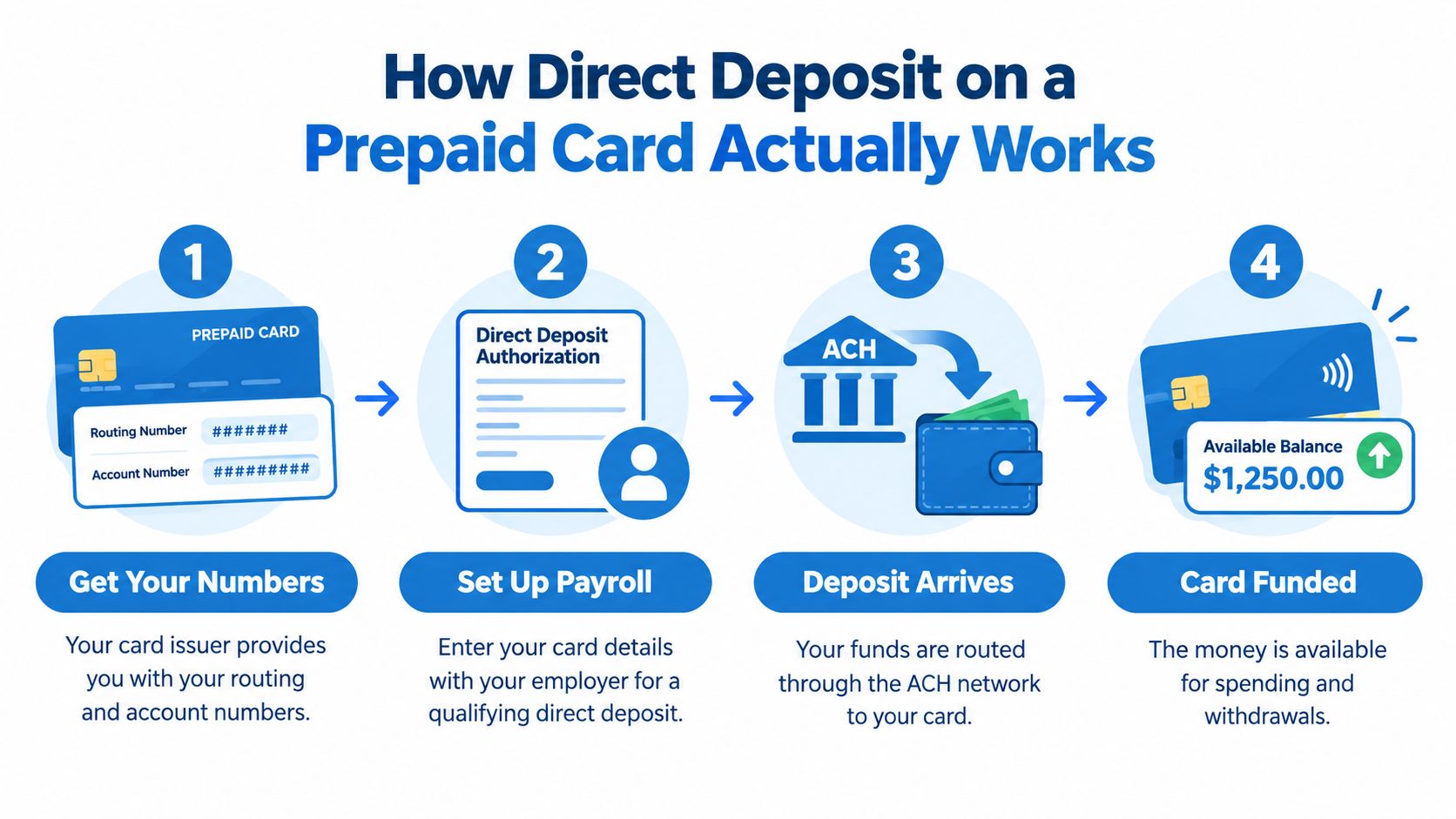
That sounds simple. The failure points are not.
Start with registration. Many prepaid programs will show account details before you have fully set up the account, but direct deposit can still fail or be delayed if identity checks, card registration, or account restrictions are unresolved. That detail matters more than the marketing copy about getting paid early. If your income is irregular, one rejected payroll file can cost more than a waived monthly fee saved you all quarter.
The next point is deposit eligibility. Payroll is the standard case, but issuers do not always treat every inbound payment the same way. A card may accept employer payroll, handle government benefits differently, and review gig-platform payouts or tax-related payments under separate rules. If you use multiple income sources, that distinction matters because the fee waiver often depends on what the issuer classifies as qualifying direct deposit.
Timing is also easy to misunderstand. ACH moves the payment, but card issuers decide when to make the money available within their stated policy. “Early deposit” usually means the issuer fronts access after receiving payment instructions and before final settlement. It does not mean your employer suddenly paid faster. The practical question is not the advertised perk. It is whether the money is usable when rent, transit, or card-linked bills hit.
Check these points before payday:
- Which payments qualify? Verify whether payroll, government benefits, and gig income count.
- What information is required? Use the issuer's routing and account details exactly as shown in your account.
- When is the balance available? Separate normal posting time from any early-access policy.
- What happens if a deposit is rejected? Confirm whether funds go back to the payer or sit in review.
- Can income be split? Some workers need deposits divided across more than one account.
Prepaid cards often function as operating accounts, not side wallets. The FDIC's transaction analysis found that retail prepaid cards with direct deposit typically remained active for more than a year, received a median of 24 deposits, and were used for more than 120 purchase transactions. That usage pattern points to recurring income and everyday spending, not occasional loading or one-off purchases, FDIC household survey.
What FDIC Insurance Really Covers on a Prepaid Card
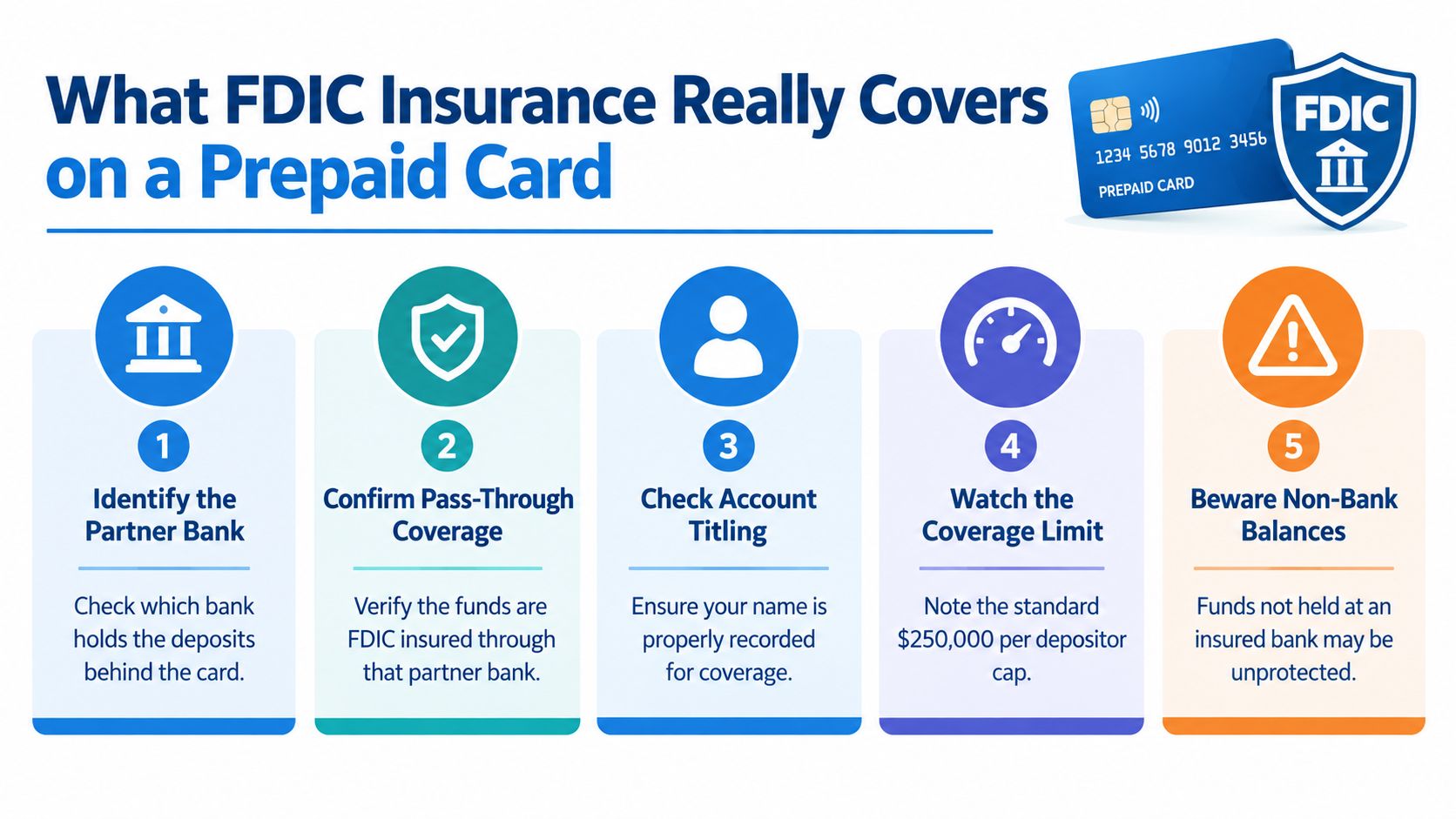
“FDIC insured” isn't a complete answer. For a prepaid card, the relevant question is whether your registered funds are held at an FDIC-insured bank under a valid ownership and pass-through structure.
Qualifying deposits are generally insured up to $250,000 per depositor, per insured bank, per ownership category (FDIC deposit insurance FAQ). That protection addresses the failure of the insured bank. It doesn't reimburse you just because a card was stolen, a transaction was unauthorized, or a nonbank issuer experienced an operational failure.
Verify the structure, not the badge
Look for the partner bank in the cardholder agreement and fee disclosures. The issuer should explain whether the money is held at that bank and whether the arrangement passes insurance through to individual cardholders. If the documents only use broad language about protection without identifying the deposit-holding institution, the claim deserves closer scrutiny.
Registration matters because the bank needs records that identify the customer and the customer's ownership interest. You should also consider whether your prepaid balance is combined with other deposits you hold at the same insured bank. The coverage limit applies across the relevant ownership relationship, not as a separate unlimited allowance for every card product.
A five-question insurance check
- Who holds the money? Identify the insured partner bank.
- Is pass-through coverage described? Look for an explanation of how your balance is attributed to you.
- Is registration required? Confirm what happens if the card remains unregistered.
- Could balances aggregate? Check whether other deposits at that bank count toward the same limit.
- What isn't covered? Separate bank failure protection from fraud, theft, freezes, and nonbank insolvency.
A card that doesn't satisfy these conditions shouldn't receive the same safety score as a registered balance held through an insured bank. That distinction is more meaningful than a green insurance icon beside a product name.
Calculating the Annual Cost of Fee Waivers
Start from your deposit pattern, then work back to the fee. Waiver rules decide the annual cost more reliably than the advertised monthly charge.
Use this formula:
Annual effective cost = 12 × monthly fee after your waiver status + reload fees + ATM fees + foreign-exchange charges.
The CFPB short-form disclosure guide gives a standardized way to inspect prepaid fees, but the short form is only the first pass. The harder question is what counts toward the waiver. Some cards require a minimum payroll deposit. Others use a monthly load threshold or a purchase count. Some exclude benefits, peer-to-peer transfers, gig payouts, or employer payments routed in a way the issuer does not classify as qualifying direct deposit.
Model the deposit pattern you have
Income pattern changes the math more than a headline fee sheet suggests. A salaried employee with one steady payroll stream may clear the waiver every cycle. A contractor with split deposits, seasonal gaps, or frequent employer changes can land on the same product and pay a very different annual amount.
| Card archetype | Waiver threshold | Low-deposit annual cost | High-deposit annual cost |
|---|---|---|---|
| Direct-deposit waiver card | Qualifying payroll deposit or other stated condition | 12 × monthly fee if the waiver fails, plus actual usage fees | Reload and usage fees only if the waiver applies |
| Transaction-based card | Required purchase or load activity | Monthly fee may remain if activity is missed, plus actual usage fees | Monthly fee may be waived, with actual usage fees |
| Cash-reload-oriented card | No qualifying direct deposit required | Reload fees can dominate total cost | Direct deposit can reduce reload costs if supported |
| Crypto-linked prepaid card | Product-specific funding and usage rules | Network, conversion, ATM, or other disclosed fees may apply | Costs depend on funding method and transaction pattern |
The table uses formulas on purpose. Without a named issuer, a published fee schedule, a deposit type, and a spending pattern, a dollar ranking creates false precision. For a field-by-field comparison, use this card fees master table, then swap the generic fields for your own habits.
That last step matters because waiver failure is rarely random. It often tracks irregular income. If your pay arrives late once, gets split across platforms, or pauses for a month, the card can stop being cheap right when cash flow is tightest.
Fill in the worksheet
Write down the type of deposit you expect, whether income arrives on a fixed schedule or in pieces, how often you use out-of-network ATMs, whether you reload cash, and whether you spend abroad. Then record the monthly fee that applies under your likely waiver status, not the promotional outcome shown in the marketing copy.
Check the statement cycle used for eligibility. A card can waive the fee in one month and charge it in the next because the qualifying deposit posted a day later than you expected. If an overdraft-style advance or another feature has its own deposit test, treat that as a separate line item rather than folding it into the base card cost.
My rule is simple. A prepaid card is cheap only if it stays cheap under the income pattern you already have. If the waiver works only under perfect payroll timing, treat the monthly fee as a recurring cost, not a conditional bonus.
What Happens to Your Paycheck When the Card Freezes
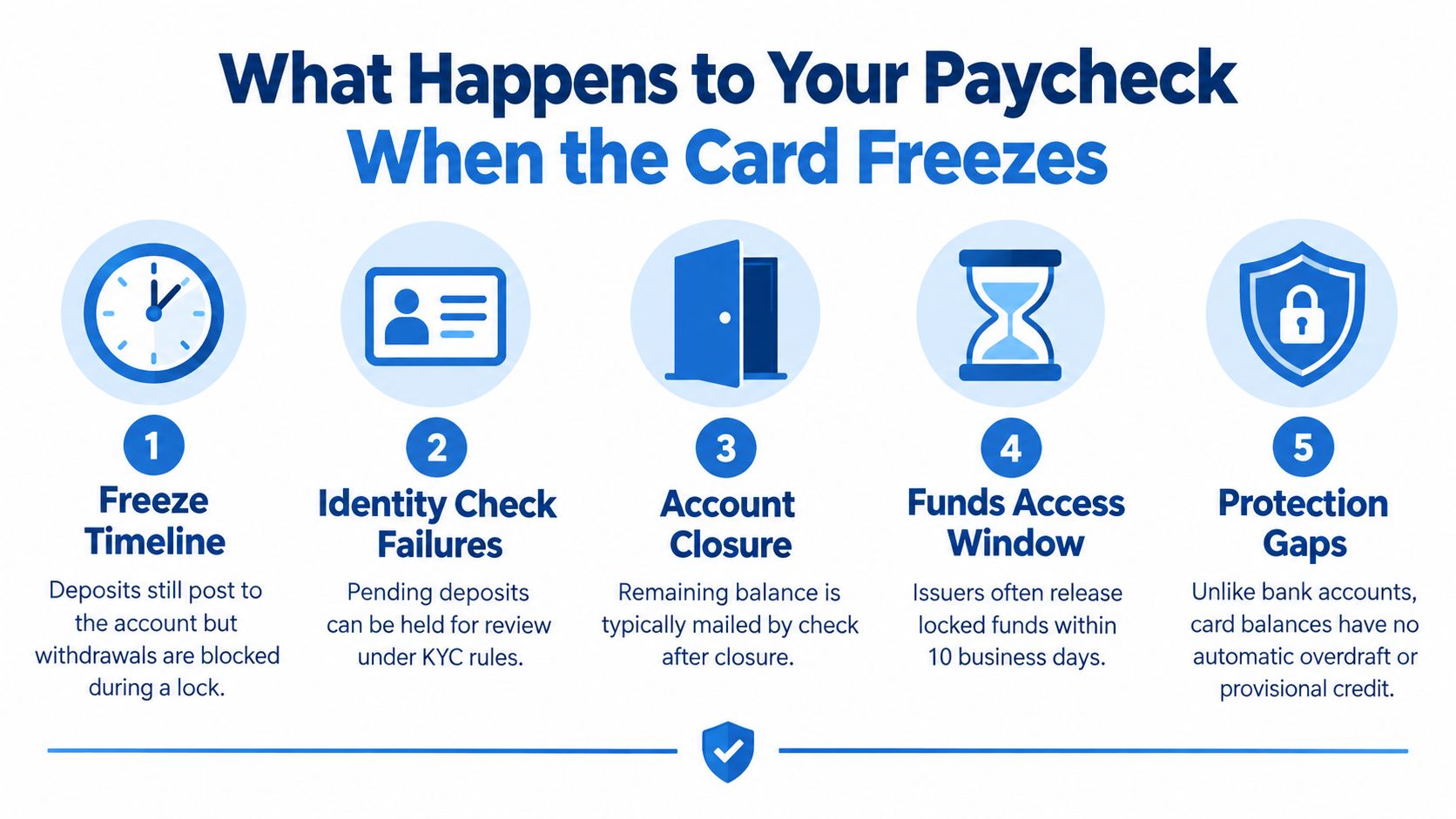
A direct deposit can arrive successfully while the card remains unusable. That gap is the operational risk most “best card” rankings overlook.
The Consumer Financial Protection Bureau reported approximately 10,300 prepaid-card complaints in 2025, with trouble using the card as the most common issue. Reported problems included activation failures, declined purchases, blocked withdrawals or transfers, difficulty reaching support, frozen accounts with little explanation, and repeated requests for identity documents (CFPB complaint report).
The paycheck problem is different from a routine fraud alert
A temporary purchase decline is inconvenient. A freeze affecting withdrawals, transfers, and incoming deposits can interrupt rent, food, or other essential payments. Workers who allocate payroll directly to a card may not have a second account ready to receive the next payment.
The same practical concern applies when people research a freeze on your bank account, although a prepaid freeze has its own contract, support process, and account rules. The label matters less than the questions you can answer before enrolling.
Verify the recovery path
- Escalation channels: Check whether support includes secure messaging, telephone escalation, or a formal complaint route.
- Document handling: Find out how identity documents are submitted and whether the issuer explains a failed review.
- Access policies: Ask whether any provisional access exists while a dispute or verification review is open.
- Closure procedure: Read what happens to the remaining balance if the account closes.
- Rerouting speed: Confirm how quickly payroll or benefits can be redirected to another destination.
Don't assume FDIC coverage solves an access problem. Deposit insurance addresses a covered bank failure, not the time you spend waiting for an issuer to clear a restriction or return funds after closure. A reliable comparison should therefore score recovery quality beside fees and deposit speed.
Crypto-Linked Prepaid Cards for Travelers and Privacy Users
Crypto-linked cards introduce a different trade-off. A custodial exchange-linked card may convert or draw from assets held by a centralized platform, while a non-custodial design may connect spending to a web3 wallet or an on-chain contract. The first can feel operationally familiar, while the second may reduce dependence on an exchange but introduce wallet, network, and smart-contract considerations.
| Comparison field | Custodial exchange-linked card | Non-custodial crypto card |
|---|---|---|
| KYC | Often tied to the issuer's verification policy | May offer lower or different verification requirements, subject to region and product rules |
| Custody | Assets may remain with a centralized platform until spending | Spending can be linked to a wallet or contract structure |
| Traveler fit | Evaluate network acceptance, conversion terms, and physical availability | Evaluate the same factors plus wallet funding and network compatibility |
| Issuance | Virtual and physical options vary by program | Virtual and physical options vary by program |
| Main risk | Counterparty and account-access dependence | Wallet security, contract behavior, and network complexity |
A traveler should start with acceptance and predictable conversion costs, then check regional issuance and whether a physical card is available. A privacy-sensitive user may prioritize a lower KYC requirement, but that choice can narrow funding routes, support options, geographic access, or spending limits. Avoid treating “no KYC” as a universal advantage. It describes one dimension of the product, not its complete risk profile.
Identity protection also matters when a card account, wallet, or exchange account is compromised. A practical identity-theft recovery guide can complement the card comparison, especially for users managing multiple financial identities across countries.
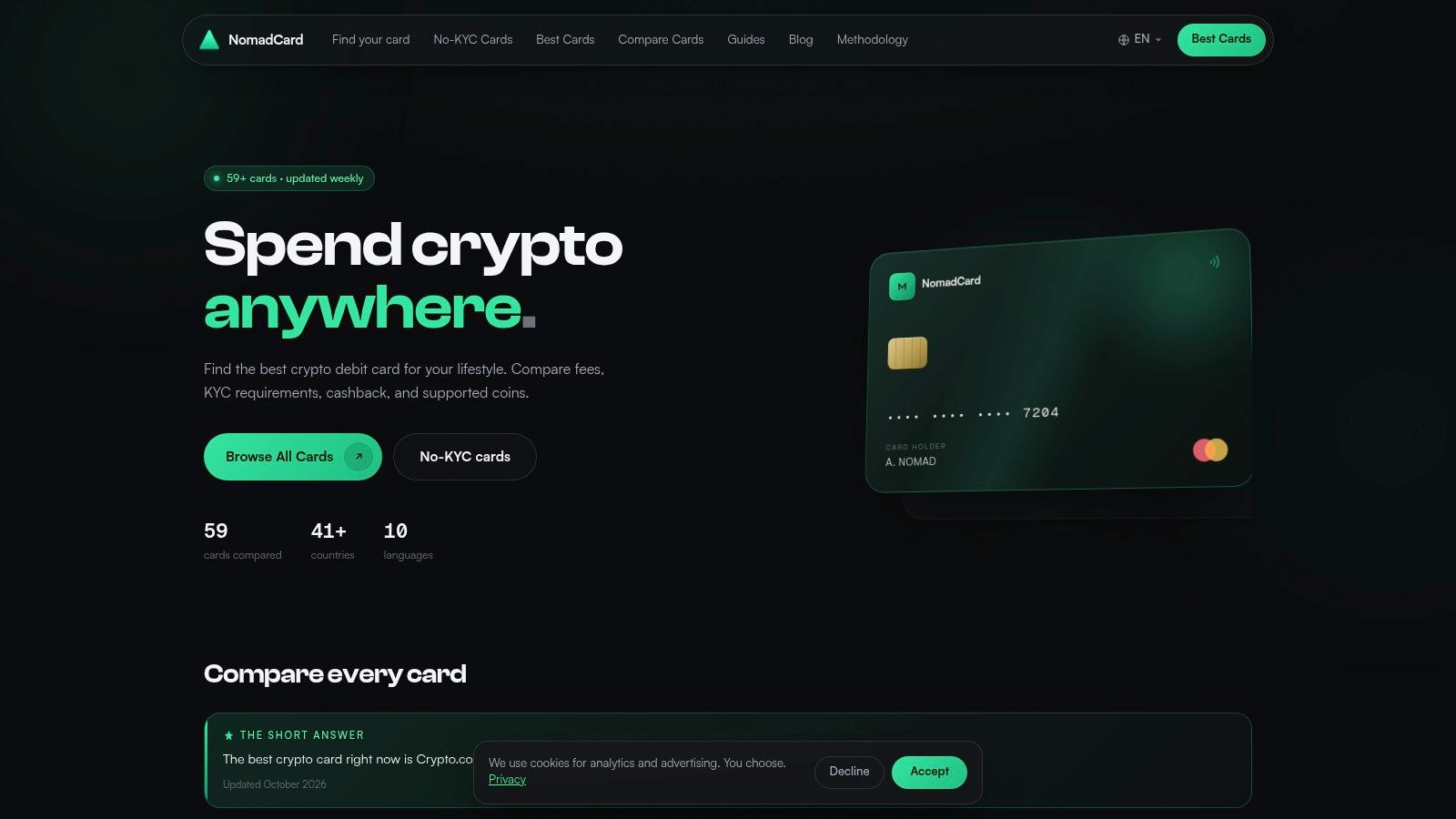
NomadCards offers an interactive comparison of crypto-linked cards, with filters for KYC level, network, supported assets, card type, fees, custody model, and regional availability. Its best crypto cards guide is most useful when you treat those fields as constraints rather than as a universal ranking.
Choosing Your Card by Situation
The right verdict depends on the income pattern and the failure you can least afford.
Unbanked wage earner
Choose a conventional prepaid account with dependable payroll support, clear routing and account instructions, registration, and documented pass-through insurance through an FDIC-insured bank. Your trade-off is that the product may require more identity information than a privacy-first crypto card. Verify the partner bank and deposit setup before directing your full paycheck.
Gig worker with irregular deposits
Choose the card whose fee waiver remains acceptable when deposits vary, pause, or arrive from several platforms. Don't count an advertised free month unless your income reliably satisfies the threshold under the issuer's measurement period. Your trade-off is that a flexible card may carry a visible fee when your qualifying deposit disappears. Test the low-deposit scenario before moving payroll or benefits.
Digital nomad
Start with network acceptance, regional availability, foreign-exchange pricing, ATM access, and physical-card availability. A crypto-linked card can fit if you understand its custody model and funding route, but a prepaid card with strong direct deposit may be more practical for U.S. payroll. Your trade-off is between convenience and control. Verify the countries where the card is issued and used.
Privacy-minimal user
Compare the KYC level, custody arrangement, supported assets, and account-recovery process. A non-custodial or lower-verification option may reduce identity exposure, but it can impose narrower availability and more responsibility for wallet security. Your first check should be whether the card's privacy posture is genuine for your region, not just a marketing label.
Before enrolling, confirm five items: qualifying deposit types, registration requirements, insurance structure, fee-waiver conditions, and the freeze or closure procedure. Then calculate the annual cost using your own deposit pattern and travel needs.
NomadCards lets you filter crypto-linked card programs by KYC level, custody model, network, supported assets, fees, card type, and regional availability. Visit NomadCards to compare those fields alongside your prepaid direct-deposit requirements before choosing a card.