Your favourite dollar stablecoin is still sitting in your wallet, but it has vanished from the list of assets your card issuer accepts. The token has not failed. The exchange dropped it, or the network you funded with is not the one your card provider settles on, and at checkout the ticker alone tells you nothing.
The practical test is narrower than market cap: can you move the token to the exchange or card you use, and can you find out how the issuer says it is backed? USDC on Ethereum is not the same deposit as USDC on Solana, and every bridge between them adds a failure point you carry. Compare regional reach and integrations across the services you use before choosing a stablecoin for everyday spending.
These seven picks are judged on three things: whether your card or exchange accepts the token on the network you need, how often the issuer publishes reserve information, and what breaks if the issuer or a bridge fails. The BIS analysis of stablecoins shows why a large market footprint shouldn't be mistaken for a complete measure of safety or suitability. Confirm the exact asset and network your card or exchange accepts before you transfer funds.
Table of Contents
- 1. USDC by Circle
- 2. USDT by Tether
- 3. PYUSD by PayPal
- 4. USDP by Paxos
- 5. USDS by Sky Protocol
- 6. EURC by Circle
- 7. USDG by Global Dollar
- Seven Stablecoins Compared by Issuer, Peg and Reserve Reporting
- Match the Stablecoin to Your Card, Exchange and Network
1. USDC by Circle
USDC is a practical first choice if you want a dollar stablecoin with reserve information that's relatively easy to find. Circle says USDC is designed to be redeemable one-to-one for U.S. dollars and publishes reserve information with monthly third-party assurance reports. Read the report itself, then check whether your exchange, wallet, and card support the same USDC network.
Where USDC fits
Many wallets, exchanges, and onchain services support USDC, which can make it convenient to transfer between platforms. Circle Mint offers institutional on- and off-ramps, but it isn't an individual consumer account. Most everyday users will get USDC through an exchange, wallet, or another provider, each with its own custody and withdrawal rules.
That distinction matters at checkout. A card can support USDC but not accept deposits on every network where USDC exists. A transfer sent to the wrong network may be difficult or impossible to recover. Network fees can also apply.
Circle's reserve disclosures can help you understand the issuer's stated backing, but they don't remove risks tied to your exchange, wallet provider, legal access, or the blockchain itself. I'd choose USDC when clear reserve reporting and broad ecosystem support matter more than direct access to Circle's institutional services.
Use it if: You want a dollar stablecoin for spending or transfers and your card accepts USDC on your chosen network. Avoid it if: You need direct access to Circle Mint as an individual or haven't confirmed your provider's network support.
Compare cards that support USDC, and visit Circle's USDC page for issuer information.
2. USDT by Tether
USDT's practical advantage is familiarity across crypto exchanges and services. If a counterparty or card provider specifically accepts USDT, that can make it a straightforward option for moving dollar-denominated value between trading and spending accounts. Tether lists the token on multiple blockchain networks, but the network label matters as much as the ticker.
Tether typically updates circulation information daily and publishes quarterly reports on reserve categories. Those are different kinds of disclosures: circulation information isn't the same as a reserve report. Review the report and its date before deciding how much weight to place on it.
The network is the first check
USDT's availability across networks can give users options, but it also creates room for costly mistakes. Before sending, compare the withdrawal network on your exchange with the deposit network displayed by your wallet or card provider. Don't assume a USDT balance on one chain can be sent directly to a USDT address on another.
The CoinGecko 2025 RWA report highlights a related issue for stablecoin payments: raw transfer totals can include automated activity and internal movements, not just payments people make. For card use, check supported networks and conversion terms rather than treating transfer activity as proof that an asset will work at checkout.
USDT can suit users who value broad service support or need the specific token their counterparty accepts. But issuer, redemption, and exchange-liquidity risks still apply, and no network choice removes them.
Use it if: Your exchange, recipient, or card explicitly supports USDT on the network you'll use. Avoid it if: You can't verify the destination network or you need more frequent reserve reporting.
See card options that support USDT, and check Tether's website for its disclosures.
3. PYUSD by PayPal
Your PayPal balance already holds dollars. PYUSD is the version you can move out. Paxos issues the token for PayPal, and PayPal states that eligible users can buy and sell it with U.S. dollars at a one-to-one rate, with no PayPal fee to buy, sell, hold or transfer it inside the account.
The word "eligible" carries the weight here. Crypto features require identity verification, and what you can access depends on your country and your account standing. Inside PayPal the token behaves like a balance. Outside it, you run into the same question as with any other stablecoin: does the merchant, card or exchange you want to use accept PYUSD?
The exit is where it gets practical
PayPal describes PYUSD as backed by dollar reserves and cash equivalents, with monthly reserve reporting and independent attestations. A monthly document is a workable cadence for checking backing, provided you read the date on it rather than the headline figure.
Sending PYUSD to an external wallet only works on supported networks. Network fees apply, and converting into another asset can add a spread on top. If the card you want to fund does not list PYUSD, price in a swap, then confirm which network that card accepts before you move anything.
The issuer arrangement is split too. PayPal distributes the token, Paxos issues it. Your access, though, runs through a PayPal login. An account restriction affects your ability to move PYUSD the same way it affects any other balance movement, and no chain-level feature changes that. That is the honest trade-off of a convenience token: fewer moving parts on the way in, less independence on the way out.
Until you have confirmed a specific card lists PYUSD, treat the balance as money you will spend through PayPal-linked rails or convert first. I would check the card's supported coins page before funding it, not after.
Use it if: You already hold dollars in PayPal and want a token you can move to a wallet on a network both sides support. Avoid it if: Your card provider does not list PYUSD, or you object to identity verification sitting between you and your spending balance.
Check PayPal's PYUSD information for current account and access requirements.
4. USDP by Paxos
USDP is another dollar stablecoin from Paxos, designed to be redeemable one-to-one for U.S. dollars. Paxos describes its reserves as cash and cash equivalents and publishes monthly transparency reports. That gives holders a recurring disclosure to review, but it doesn't mean every exchange or card will support the token.
Check the chain before moving funds
Paxos lists USDP on Ethereum and Solana. Those versions aren't interchangeable by default. If you hold USDP on Ethereum and your card provider only accepts it on Solana, you'll need a supported route to move or exchange it. Don't improvise with a bridge unless you understand how that bridge works and what risks it adds.
USDP may suit someone who wants a Paxos-issued dollar token and can already use it on a supported platform. Its availability may be more limited than that of the largest stablecoins, so check the token listing and deposit instructions before buying. Direct Paxos services and redemption are subject to account and service terms, too.
Use it if: Your exchange or card supports USDP on the exact network you hold. Avoid it if: You're relying on an unsupported bridge or assuming that a Paxos-issued token will be available everywhere.
Review Paxos's USDP information and confirm the network shown by your provider.
5. USDS by Sky Protocol
USDS is a DeFi-native alternative to stablecoins backed through a conventional issuer reserve model. Sky Protocol, which evolved from MakerDAO, issues USDS through a protocol governed by SKY token holders. Sky says backing and protocol information can be inspected onchain. That's a different kind of transparency from reading an issuer's reserve report, and it comes with a different set of risks.
Don't confuse USDS with sUSDS
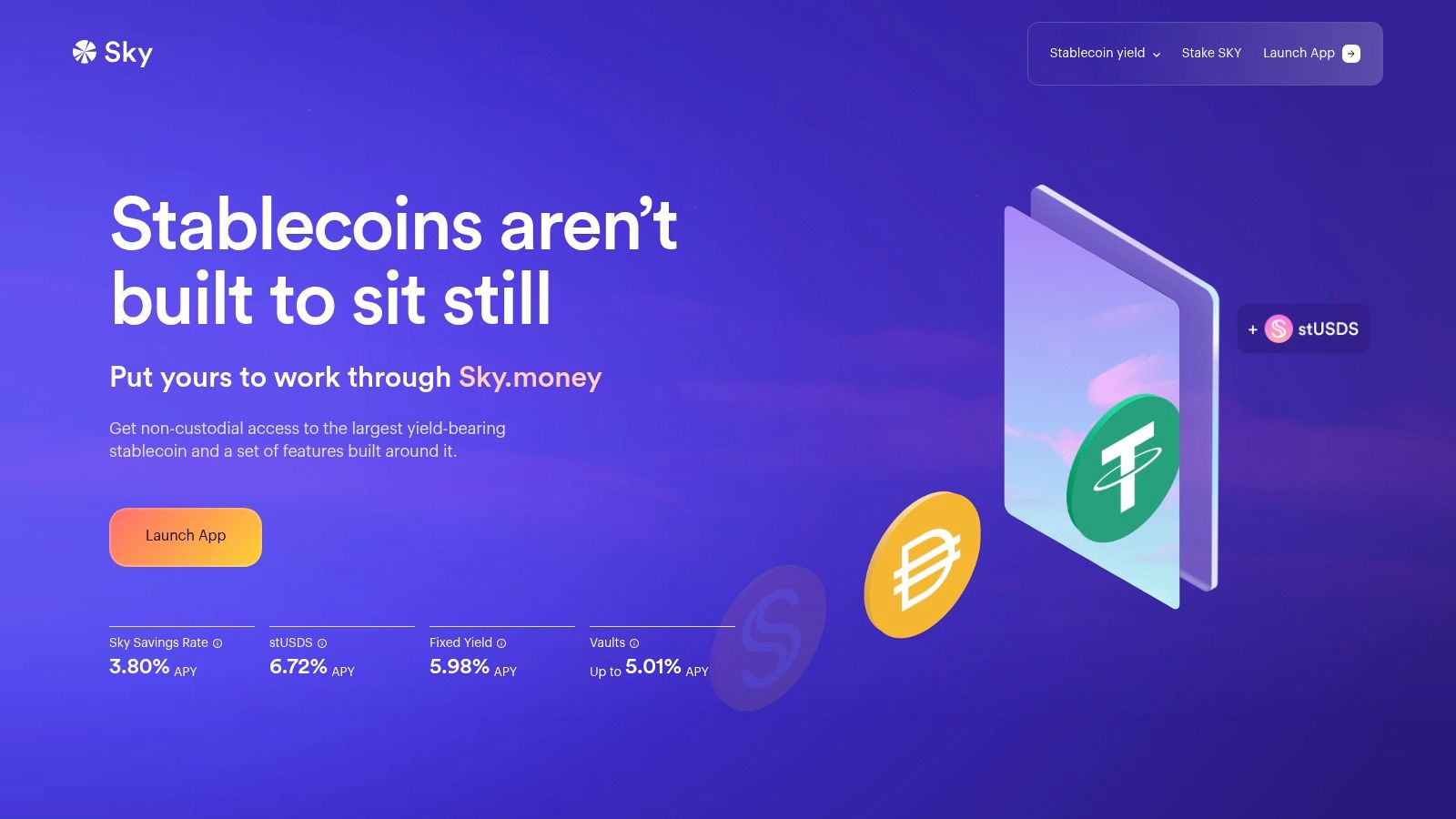
USDS is designed to track the U.S. dollar. It doesn't itself pay yield. sUSDS is a separate product with variable terms set through governance. Treating them as interchangeable can lead to a misunderstanding of what you hold and what risks apply.
USDS can be useful if you already use Sky or compatible DeFi applications and understand smart contracts, protocol collateral, and governance. It's less straightforward if your priority is spending through a card. Card compatibility depends on the provider and chain, and the onchain model doesn't erase the possibility of software, collateral, or governance problems.
I'd choose USDS for a specific DeFi use, not just because it's a stablecoin. Check which version and network your wallet holds, and confirm that any app or card accepts that exact asset.
Use it if: You want a DeFi-native dollar asset and understand Sky's protocol risks. Avoid it if: You're looking for a simple card balance or assume USDS itself earns yield.
Visit Sky Protocol for its protocol information and supported applications.
6. EURC by Circle
EURC is pegged to the euro, not the U.S. dollar. Circle says it's backed by euro-denominated assets and designed to be redeemable one-to-one for euros. Circle also publishes reserve information and monthly attestations. If your regular expenses are in euros, holding a euro-denominated token may help you avoid repeatedly converting from dollars, depending on your wallet, exchange, and card terms.
Circle lists EURC on supported networks including Ethereum, Solana, Avalanche, Base, and Stellar. But a long network list doesn't guarantee your card accepts EURC on each one. Check both the token and network, then review any conversion fees or foreign-exchange spread before spending.
Match the peg to your bills
EURC may be more useful than a dollar token when you're funding euro-denominated payments. It isn't designed to maintain a one-dollar value, so don't choose it as though it were a dollar cash equivalent. Exchange and card support can also be narrower than for the most widely used dollar stablecoins.
Direct access to Circle Mint is aimed at qualified businesses and wholesale distributors, not ordinary individual users. Most consumers will need to rely on a supported exchange, wallet, or other provider. For users comparing services in Europe, this guide to MiCA and licensed exchanges can help frame the regional availability question.
Use it if: You need euro exposure for payments and your provider accepts EURC on your chosen network. Avoid it if: You need a dollar peg or your card only accepts dollar stablecoins.
Check Circle's EURC page for issuer and reserve information.
7. USDG by Global Dollar
USDG works like a membership token: a dollar stablecoin issued by Paxos entities and built around the Global Dollar Network of partner exchanges, wallets, payment firms and onchain services. That network is the point, and it is also the limit. Where your platform sits inside it, USDG moves and settles like any dollar token. Where it doesn't, you are holding something you may struggle to spend.
Partner support isn't universal acceptance
A card or exchange listing USDG on one chain doesn't mean the same support exists on another. Before funding a card, check three things: the exact deposit route, whether the network matches what the card accepts, and whether redemption or conversion runs through the platform you already use. A partner-network model concentrates those checks on whoever issued your account, so two users holding the same token can get different answers.
On reserves, Paxos and Global Dollar Network describe USDG as backed one to one. Reporting cadence is the part to confirm yourself. Ask how often the issuer publishes reserve information for your entity, and whether the latest figure sits on the issuer's site rather than in a blog post.
Check which Paxos entity issues the USDG you hold and what regulatory oversight applies in your jurisdiction, using the issuer information on Global Dollar's website.
Third-party yield or rewards products built on USDG carry their own terms and counterparty risk. Those features aren't part of holding the token, and they don't make the peg any safer.
The practical failure mode isn't the peg breaking. It's getting stuck. If your exchange or bridge drops USDG support, converting to USDC or USDT can mean fees, spread, or a detour through a chain your card won't accept. Treat network support as a dependency you verify, not a footnote you skim.
Use it if: Your wallet, exchange or card supports USDG on the network you hold, and you have confirmed redemption through that provider. Avoid it if: You need dependable acceptance across several providers or haven't checked local availability yet.
Visit Global Dollar for information about the token and its partner network.
Seven Stablecoins Compared by Issuer, Peg and Reserve Reporting
| Item | Issuer | Reserve Reporting | Best For |
|---|---|---|---|
| USDC, Circle | Circle affiliates | Reserve information and monthly third-party assurance reports | Users seeking broad support and accessible reserve reporting |
| USDT, Tether | Tether | Daily circulation updates and quarterly reserve reports | Crypto users needing wide service support or multiple network options |
| PYUSD, PayPal USD | Paxos Trust Company | Monthly reserve reporting and independent attestations | Eligible PayPal users |
| USDP, Pax Dollar | Paxos | Monthly transparency reports; reserves described as cash and cash equivalents | Users seeking a Paxos-issued dollar token |
| USDS, Sky Protocol | Sky Protocol | Onchain backing and protocol information | DeFi users familiar with Sky |
| EURC, Circle Euro Coin | Circle | Reserve information and monthly attestations | Users seeking euro-denominated onchain funds or payments |
| USDG, Global Dollar | Paxos entities | Described as 1:1-backed; reporting details depend on issuer and jurisdiction | Users whose preferred platform supports USDG |
Match the Stablecoin to Your Card, Exchange and Network
A stablecoin that looks suitable on paper can still fail your practical test if the card won't accept it or you can't move it on the right network. Before you buy or transfer, check these points:
- Confirm the exact token and network. Ask whether the card or exchange accepts the specific stablecoin you hold, and on which blockchain. Don't treat two versions of the same token as interchangeable.
- Review the latest reserve information. Check the issuer's own disclosure page and note when its latest report was published. Reserve reporting doesn't guarantee that you can redeem directly or quickly.
- Pick the right currency peg. Use a dollar-pegged token for dollar needs or consider EURC for euro-denominated payments. Conversion fees and spreads can still affect what reaches your card balance.
- Check what happens during a disruption. Find out whether you'd depend on an issuer redemption, an exchange, a card provider, or a bridge to access your funds. If a service pauses withdrawals or a bridge fails, your options may be limited.
Stablecoin payment figures also need careful interpretation. The McKinsey analysis of stablecoins in payments distinguishes actual payment activity from much larger raw onchain transfer totals. For a cardholder, merchant acceptance, settlement, conversion costs, and the available off-ramp matter more than a headline transfer figure.
NomadCards lets you filter its card comparison by coin, including USDT and USDC, to find programs that list support for the assets you hold. You can also compare fees, networks, KYC requirements, custody models, limits, and regional availability. Treat a listing as a starting point, then confirm the issuer's current terms before transferring funds.
Crypto and the cards that use it carry risk, including loss of funds. This article is general information, not financial advice. NomadCards is not a bank, card issuer, or financial adviser.
Use NomadCards to compare crypto cards by supported stablecoin, network, fees, KYC requirements, and availability. Check the card's terms against the exact token and chain you plan to use before moving funds.