Most roundups tell you to grab the bitcoin credit card with the highest cashback and move on. That advice treats one phrase as one product, and it fails the first practical test. The rate on the banner is the last number that matters, not the first.
A card can pay you bitcoin while you borrow dollars, convert coins into fiat the moment you tap, or lock bitcoin as collateral so a price drop forces a sale. Those structures change what you owe, what you can lose, and whether the reward is still there after a year of fees. A Visa or Mastercard logo only names the merchant rail. It does not say who holds the coins, whether interest applies, or what a falling price does to your balance.
Classify the product before you compare brands. Then run the headline reward through APR, foreign-exchange markup, custody, and liquidation. The tables below work on any card, including one that is not on a list.
Table of Contents
- Three Products Sold Under the Same Name
- What the Rewards Are Really Worth
- How Custody and Collateral Risk Differ
- Eligibility, Verification and Availability
- Pick the Card Type for Your Situation
- Confirm Current Terms Before You Apply
Three Products Sold Under the Same Name
Bitcoin credit card is a label that hides three products. Comparison pages lead with a rewards percentage and skip the question that decides the outcome: am I borrowing dollars, selling bitcoin, or pledging bitcoin as collateral? Cointelegraph separates a conventional card that pays bitcoin rewards, a crypto-funded debit or prepaid card that converts assets to fiat at purchase, and a secured or collateralized card backed by crypto. That split changes credit reporting, APR exposure, liquidation risk, tax treatment, chargeback rights, and custody.
Much of the spending routed through crypto cards is denominated in stablecoins rather than BTC, so search demand for a "Bitcoin card" often describes broader crypto payment products. Merchants on crypto-linked Visa transactions generally receive fiat through normal payment rails. You are spending crypto-funded value, not sending an on-chain bitcoin payment.
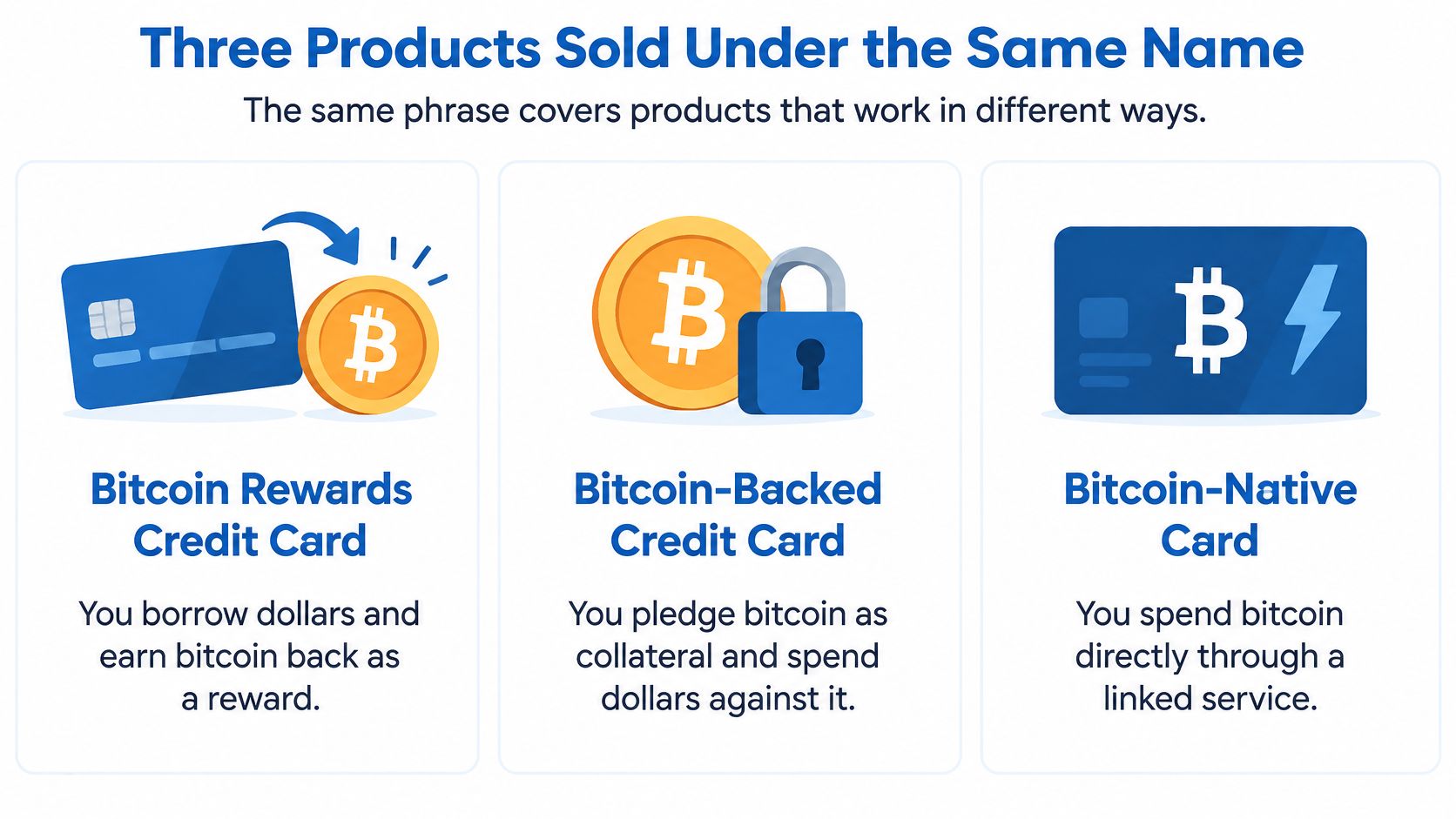
A rewards credit card is ordinary revolving credit. You borrow fiat from the issuer, you may carry a balance, and the issuer pays bitcoin on eligible purchases. Miss the full payment and you take conventional revolving-debt risk. The bitcoin price only changes what that reward is worth when you redeem it.
A crypto-funded debit or prepaid card spends a balance you already hold. Bitcoin or stablecoins convert to fiat at the purchase. There is no loan, so APR is irrelevant and the funded balance is your ceiling. The costs that matter are the conversion spread, any FX markup, and loss of funds if the provider fails.
A crypto-backed secured card or credit line is borrowed fiat secured by pledged bitcoin. You keep the coins on paper, but a fall below the required collateral ratio can force a sale. Neither this product nor a rewards card should be judged by cashback alone.
| Product type | Where the spending money comes from | Credit structure | Main risk |
|---|---|---|---|
| Rewards credit card paying BTC | Borrowed fiat from the issuer | Revolving credit with variable APR | Interest on balances; reward value depends on BTC price at redemption |
| Crypto-funded debit or prepaid card | Bitcoin or stablecoins converted to fiat at purchase | No borrowing; spending limited to funded balance | Conversion spread, FX markup, and loss of funds if the provider fails |
| Crypto-backed secured card or credit line | Borrowed fiat secured by pledged bitcoin | Collateralized borrowing with interest | Forced liquidation if the collateral falls below the required ratio |
Run three checks on any offer before you read the rewards line.
- Funding source: Is the purchase paid with borrowed fiat, with coins converted at checkout, or with a credit line against pledged bitcoin?
- What leaves your control: Are you selling bitcoin, pledging it, or only receiving it as a reward?
- A falling price: Does a drop change only the reward's dollar value, or can it trigger a sale of your collateral?
Two cards can show the same headline reward and sit in different rows of the table. That is why classification comes first: it tells you which cost lines in the next section apply at all.
What the Rewards Are Really Worth
Cashback is the wrong first number. Classify the card first, then ask what the reward survives. On a rewards credit card, the spend is borrowed fiat, so the test is APR, annual fee, exclusions, and whether the bitcoin can be withdrawn. On a crypto-funded card, the spend is converted balance, so spread and FX come off the top. On a secured line, rewards are secondary to collateral terms.
Gemini's bitcoin credit card page shows the split between issuer claims and checkable costs. Eligibility pre-checks can be soft while a submitted application can trigger a hard inquiry, and approval still depends on credit history and other information. The costs that decide net value sit in the agreement: variable APR set by creditworthiness, cash advances and balance transfers that earn nothing, cash-like purchases that can be excluded, and reward terms that separate nominal bitcoin from bitcoin you can move.
| Line | What to verify | Effect on net value |
|---|---|---|
| Cashback rate | Percentage, whether it is paid in BTC or in points, and any cap | Headline rate; real value depends on BTC price at redemption |
| Variable APR | The rate set by creditworthiness, and whether it applies to purchases | Erases rewards on any balance carried past the due date |
| Foreign-exchange markup | The percentage added on non-base-currency spending | Reduces rewards on international purchases and travel |
| Annual fee | Whether a fee applies and whether it is waived | Subtracted from rewards every year |
| Hard credit inquiry | Whether a pre-check is soft and whether applying is hard | Small temporary score impact when you submit an application |
| Excluded transactions | Cash advances, balance transfers, and cash-like purchases | Usually earn no rewards and may carry higher interest |
A balance can erase the rate
Say you put $8,000 of eligible spend on a card that pays 2% back in bitcoin and you pay the statement in full. The nominal reward is $160, before any annual fee and before the bitcoin price moves between posting and the day you can withdraw it. Now leave $3,000 revolving. At a 24% purchase APR, a year of interest on that balance is about $720. The $160 reward does not come close.
That is the product test in one line: borrowed dollars make APR the dominant variable, converted spending value makes spread and FX the dominant variables, and pledged collateral makes liquidation terms dominant before rewards even matter. A high BTC rate can lose to a lower rate on an ordinary card, or to no rewards card at all, when you carry a balance, pay international conversion costs, or cannot withdraw rewards to a self-custodied wallet. Caps, clawbacks, and excluded categories live in the terms.
Crypto-card spending is often small everyday taps rather than large financed purchases. On a small purchase, even a generous percentage pays cents. A single foreign-exchange markup on one trip can exceed a year of those cents, and an annual fee can do the same before travel is involved.
If you want a fiat baseline before you judge a bitcoin rate, browse reward-earning card options and put both cards through the same costs. The guide on whether crypto card cashback is worth it walks the same math in more detail.
Three lines, then a decision
- Pay-in-full value: Cashback minus the annual fee, minus any spread between the posted bitcoin and what you can withdraw.
- Revolving value: That same net reward minus interest on every dollar you do not pay by the due date. If interest is larger, the rewards card loses.
- Travel value: Cashback minus FX markup on the non-base-currency spend you make. If markup wins, the travel card with no FX fee wins.
How Custody and Collateral Risk Differ
The reward rate does not tell you who can lose your bitcoin. Custody does.

On a rewards credit card, you do not give up bitcoin in order to spend. The purchase is a dollar loan. Your main exposure is ordinary debt: interest, fees, and a balance that can outlast the reward. The bitcoin itself is the issuer's obligation to you. Some programs hold it in the issuer's custody until you withdraw. Others pay it out to a wallet. Read which one you are getting. A reward you cannot move is a balance on someone else's books.
On a crypto-funded spending card, you transfer bitcoin or stablecoins to the card provider before the purchase. Custody sits with that company. Counterparty risk is the chance you lose access if the provider fails, freezes withdrawals, or changes the conversion terms. A stablecoin balance adds the stablecoin issuer on top of the card company. You have two parties who have to stay solvent and cooperative.
On a crypto-backed credit line, the pledged bitcoin is collateral, not a reward. The loan-to-value ratio sets how much you can borrow against it. A margin call or liquidation trigger sets the price, or the ratio, at which the provider can sell. A sharp drop can force that sale at a bad moment, which is the opposite of "I held through the dip." Model the drop before you like the interest rate.
Chargebacks stop at the card purchase
A card-network chargeback can cover a disputed merchant charge on the card. It does not automatically cover a transfer into the provider, a wallet withdrawal, or a collateral top-up. Those are account actions, and the recovery path is the provider's own process, which can be slow or unavailable in a failure.
Before you apply: Name who holds the asset, what event triggers a sale, the liquidation threshold in the contract, and the exact steps to withdraw rewards or close the line.
Some programs offer a self-custodied option. You keep the keys, and you give up protections that a custodian or card issuer might otherwise provide, including help if you lose access. The trade is control against convenience, and our custodial versus self-custody crypto card guide sets the two side by side.
Tax is a separate bill
Treatment differs by product, and it differs by country. Converting bitcoin to fund a spending card can count as a disposal, with a gain or loss. Bitcoin rewards can be treated as income when you receive them. Interest on a crypto-backed line can fall under yet another rule. Confirm the treatment with a tax professional before you apply. A rewards rate that ignores tax is not a net figure.
If you want a short walk-through of how collateral calls and spending cards fail in practice, this explainer is a clear starting point.
Eligibility, Verification and Availability
Four checks, in this order, stop most applications that looked fine on a comparison page. Skip one and you can spend a hard inquiry, or a coin transfer, on a card you cannot open.
- Confirm your country of residence is on the supported list. A global brand is not a global card.
- Identify the verification level before you upload anything. Our explanation of crypto card KYC levels separates email-only checks from full document review.
- Check the minimum collateral or the minimum funding the issuer requires before the card will spend.
- Compare the stated terms with the issuer's own page, including the date on that page. Card terms can differ by country and tier, so the same brand can charge different fees and offer different features in two markets.
Why each check can kill a match
Rewards credit cards follow standard underwriting. Credit history, income, and existing debt set approval and the APR band. A large bitcoin balance rarely decides it. You can hold coins and still be declined, or approved at a rate that makes the rewards pointless.
Crypto-funded spending cards often ask for identity verification that runs from email-only to a full document package. Some are closed to residents of specific countries even when the marketing site looks open. A light check can look attractive and still cap your spend, your network, or the regions where the card works. That cap is the price of the lighter file.
Crypto-backed lines usually will not release credit until the collateral is deposited and checked. Minimum balances are common. If you cannot move that bitcoin and leave it pledged, the line is not available to you, whatever the advertised limit says.
Terms change. Confirm the current country list, verification level, minimums, and fees on the provider's own site before you apply. A screenshot from last quarter is not an offer.
Pick the Card Type for Your Situation
Start with structure, not with a brand. Five decisions, taken in order, drop most cards before rewards enter the conversation.
First, name what you are doing. Borrowing dollars, spending converted value, or pledging collateral. If you only want bitcoin as a reward and you already pay cards in full, a rewards credit card is the candidate. If you refuse to borrow, that card is out.
Second, if you pay in full every month, compare cashback after the annual fee and after FX markup. Only then compare brands. Two cards with the same percentage are not equal if one charges a fee you will not clear and the other pays points you cannot withdraw as bitcoin.
Third, if you carry any balance, drop rewards from the decision. Compare APR first, and ask whether any bitcoin product beats an ordinary low-APR card once interest is counted. It usually does not. If you are weighing a pledged-bitcoin line against a cash-secured card, compare secured and unsecured credit cards on how the security works before you treat "secured" as a single idea.
Fourth, if you want to spend without selling a long-term bitcoin stack into a taxable exit you did not plan, a crypto-funded card is the fit only after you price the conversion spread and the counterparty terms. Cashback comes after those two.
Fifth, if you are considering a crypto-backed line, model a 30% to 50% price drop and read the liquidation trigger before anything else. If you cannot accept a forced sale at that level, the product is wrong for you regardless of rewards or a low advertised rate.
Cross-border use is where headline cashback loses most often. DataIntelo's card-program analysis recorded cross-border transaction rates of 28% on crypto-backed programs, compared with 10% for traditional non-crypto programs, across more than 4,000 programs, about 5 million cards, and users in 40 countries. The same analysis found dollar spending on crypto-backed cards increased eightfold from 2020 to 2021, exceeding $7.5 billion in 2021. That is fast growth from a small base. For a traveler or digital nomad, FX pricing, merchant acceptance, settlement currency, and where the card is even issued matter more than the cashback line.
| Situation | Card type that tends to fit | Main trade-off |
|---|---|---|
| Pays the full balance every month at home | Rewards credit card | Annual fee and reward currency must be worth the effort |
| Carries a balance month to month | Ordinary low-APR card, or a crypto-backed line only after you model collateral risk | Rewards rarely cover APR; collateral can be liquidated |
| Frequent traveler or digital nomad | Card with no FX markup and broad network acceptance | Foreign-exchange pricing outweighs headline cashback |
| Small everyday purchases without selling bitcoin | Crypto-funded debit or prepaid card | Conversion spread and provider counterparty risk |
| Wants light identity checks | Card with email-only or limited verification | Spending caps, network limits, or regional limits |
Small everyday taps make the same point from the other direction. If most of your charges are a few euros, you are paying for convenience and acceptance. A slightly lower rewards rate with a cleaner fee schedule will beat a loud percentage you never clear.
The card that pays the most cashback is often the one that costs the most once its structure is counted.
Confirm Current Terms Before You Apply
Do this on the issuer's site, not on a roundup, and write the date next to every figure you keep.
- Name your card type and its single worst risk. Interest on a carried balance, FX markup, provider failure, or liquidation. If you cannot name it, you have not classified the product.
- Pull the current fee schedule from the issuer. Note annual fee, APR or interest, FX markup, conversion spread, and which transactions earn nothing. If a charge on a statement does not match that schedule, why your card was charged extra is a plain check on ordinary bank fees before you assume the crypto product invented a new one.
- Model net value with your own pattern. Use pay-in-full spend, any balance you revolve, and the travel spend you make. A generic "2% back" example is not your year.
- Confirm residence and verification. Supported country, the KYC level, and any minimum funding or collateral. Stop if one of those fails.
- Write the exit before you enter. How you withdraw rewards, how you close the card, and what happens to collateral if the price falls through the trigger you modeled.
We keep a filterable comparison of crypto debit and credit cards on fees, KYC requirements, cashback, and supported coins, plus a 5-question card finder, and we refresh the list weekly. NomadCards is not a bank, card issuer, or financial adviser. This is general information, not a recommendation. Affiliate commissions that fund the research are disclosed. Crypto and the cards that use it carry risk, including loss of funds. Confirm every term on the provider's own page before you apply.
NomadCards lets you line up bitcoin credit card programs by card type, fees, KYC level, network, and supported coins so the structure is visible before the rewards rate. Filter for debit, credit, prepaid, or secured, then open the issuer's current terms and run the cost lines yourself. Start with the comparison on NomadCards.