You're trying to move a four-figure sum from your crypto-linked card to another card, but the app shows a sending limit, a funding limit, and an available balance. None quite answers the question that matters: how much will reach the other card? There's no single global card to card transfer limit. The usable amount is the smallest applicable allowance across the transfer route, your account, the recipient's country, and the time windows you've already used.
Table of Contents
- Published Card to Card Transfer Limits
- How the Rail and Layers Set Your Cap
- Country and Bank Ladders Behind One App
- Protections You Give Up on a Transfer
- Fees and Workarounds for Crypto Cards
- Confirm the Live Limit Before You Send
Published Card to Card Transfer Limits
Published card to card and push-to-card ceilings
| Program | Single transfer | Short window | Longer window |
|---|---|---|---|
| Visa domestic consumer P2P | $10,000 reported for most domestic consumer-funded transactions | One-day velocity controls; amount not stated | Seven-day and 30-day velocity controls; amounts not stated |
| Visa business-funded disbursement | $50,000 reported for many disbursements | One-day velocity controls; amount not stated | Seven-day and 30-day velocity controls; amounts not stated |
| Moov Visa and Mastercard push-to-card, October 2024 | $25,000 | 150 transactions or $100,000 in one day | 250 transactions or $250,000 in seven days |
| Apple Cash to linked debit card or bank, published in 2026 | $10,000 | $20,000 within seven days | No additional longer-window amount stated |
The Visa figures and velocity windows come from the Faster Payments Council's State of Play report, which reports $10,000 for most domestic consumer-funded P2P transactions and $50,000 for many business-funded disbursements, alongside one-, seven-, and 30-day controls. These are different payment categories, not alternative limits a consumer can choose.
The Moov October 2024 changelog publishes $25,000 per push-to-card transaction, with 150 transactions or $100,000 in one day, and 250 transactions or $250,000 in seven days. That schedule illustrates why an amount ceiling alone isn't enough: a sender can exhaust the transaction-count allowance while still having unused monetary capacity.
Apple's transfer-limit guidance, published in 2026, allows $10,000 in a single transfer to a linked debit card or bank account and $20,000 within seven days. This is an Apple Cash product limit, not a universal allowance attached to the debit card receiving the money.
Read the row before reading the maximum
Start with the funding direction. A business paying a consumer isn't the same transaction as a consumer sending personal funds, even when both payments arrive at a debit card.
Next, identify what the window measures. A single-transfer maximum controls one instruction. A cumulative window measures activity across multiple instructions, while a count limit measures how often you've sent.
Finally, check whether the stated ceiling belongs to the network, the processor, or your particular account. A processor's published capability doesn't establish that every app using that processor offers the same allowance.
Practical rule: Match your payment to the tightest applicable row, not the largest number on the page.
Bank instant-payment system ceilings belong in a different category altogether. They describe what an account-based rail can accommodate, not what your consumer card permits you to send.
If an app advertises a maximum without identifying the route, country, funding source, or window, treat it as incomplete information. Don't convert crypto merely because the headline looks large enough. First establish that the limit applies to the movement you're about to make.
How the Rail and Layers Set Your Cap
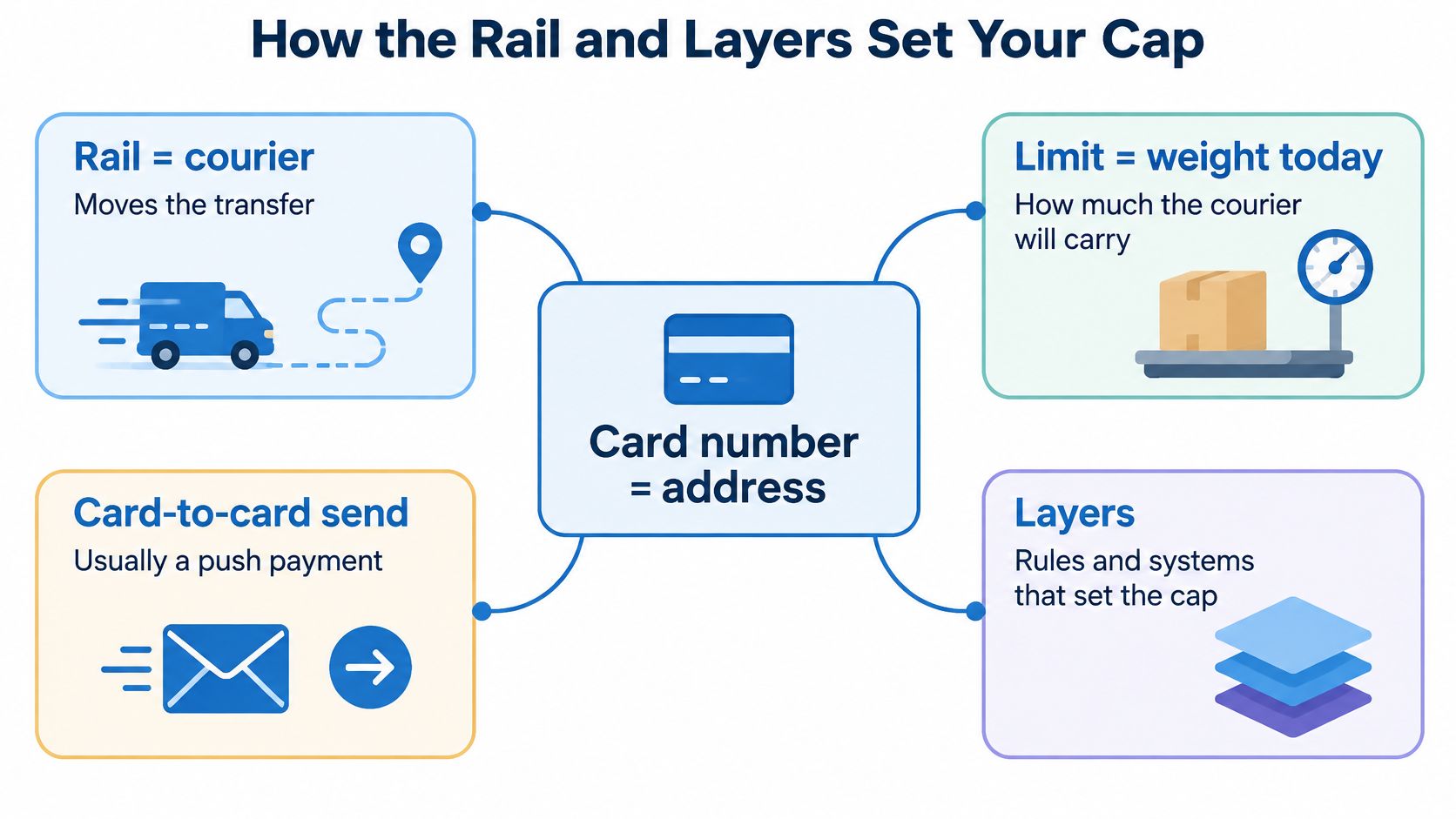
Think of the card number as the address, the rail as the courier, and the limit as the weight that courier will carry today. Knowing the destination doesn't tell you which service will move the money or which restrictions that service applies.
A card-to-card send may use Visa Direct or Mastercard Send, an account-to-account rail, or an issuer's internal ledger. The Richmond Fed's explanation of instant-payment systems distinguishes card-network payout services, which can deliver funds within seconds, from full real-time settlement systems, and notes that RTP and FedNow increased their system transaction ceilings from $1 million to $10 million in 2025.
Those bank-rail ceilings aren't consumer card allowances. Likewise, a recipient seeing spendable funds doesn't necessarily mean the underlying card-network settlement has finished. The receiving bank may have advanced the funds.
Why a payment below the daily limit can fail
Suppose your app still shows unused daily sending capacity, but earlier transfers have exhausted the weekly allowance. Today's instruction can still fail. The daily counter doesn't override the weekly counter.
PrivatBank's international card-transfer schedule demonstrates this layered approach through separate daily, weekly, and monthly limits for different recipient-card networks and countries. It also defines its monthly period by the calendar month rather than a rolling window.
That distinction changes when capacity returns. A calendar-month allowance refreshes at the provider's stated month boundary. A rolling allowance frees up as earlier activity falls outside the measurement period. Don't assume waiting until tomorrow will restore capacity.
Several parties can constrain the same instruction:
- Issuer and processor: The card contract and processing configuration can impose separate ceilings.
- Compliance program: Verification status and risk review can restrict activity.
- Card and destination: Card type, recipient country, and supported payment route affect eligibility.
- Customer-level counters: Linked cards may share an allowance rather than receiving independent capacity.
Crypto adds another funding step
For a crypto-linked card, distinguish converting BTC, ETH, USDT, or USDC from funding the card balance and sending from that balance. Each stage can have its own eligibility rules and ceiling. Completing the conversion doesn't guarantee that the outbound transfer will clear.
The FFIEC's prepaid-access risk guidance identifies load amounts, reload frequency, and restrictions on transferring or combining funds as risk controls. An issuer can therefore request more verification or restrict activity even when its payment network could technically carry the transaction.
Read the guide to crypto-card KYC levels before treating a higher verification tier as a solution. Verification can change eligibility, but it doesn't remove every other ceiling.
Country and Bank Ladders Behind One App
A traveler can use the same app and still encounter a different allowance after changing the destination card. The app's appearance hasn't changed, but the recipient's country, network, and applicable controls have.
Ukraine offers a concrete historical example. Piraeus Bank Ukraine's implementation notice describes the National Bank's temporary UAH 150,000 monthly card-to-card transfer limit beginning October 1, 2024.
For customers without documented income, ProCredit Bank Ukraine's guidance published in 2026 lists February 2025 monthly limits of UAH 50,000 for high-risk customers and UAH 150,000 for medium- and low-risk customers. These dated rules shouldn't be read as a guarantee of the allowance available to every Ukrainian customer today.
Regulatory and bank card-to-card caps by case
| Case | Who it hits | Cap | Window |
|---|---|---|---|
| NBU temporary rule from October 1, 2024 | Card-to-card transfers in Ukraine | UAH 150,000 | Month |
| NBU February 2025, no documented income, high risk | High-risk customers without documented income | UAH 50,000 | Month |
| NBU February 2025, no documented income, medium or low risk | Medium- and low-risk customers without documented income | UAH 150,000 | Month |
| Foreign Visa card at PrivatBank | Transfers to a foreign Visa card | USD 10,000 daily; USD 25,000 weekly; USD 50,000 monthly | Day, week, calendar month |
| Ukrainian Visa card at PrivatBank | Transfers to a Ukrainian Visa card | USD 20,000 daily; USD 50,000 weekly; USD 100,000 monthly | Day, week, calendar month |
| Mastercard at PrivatBank | Transfers to one Ukrainian or foreign Mastercard | USD 10,000 | Month |
The bank rows describe a particular implementation, not a general Visa-versus-Mastercard ranking. A traveler comparing cards should record sender country, recipient country, network, risk tier, and income-document requirements alongside the amount.
A higher bank allowance also doesn't displace an applicable country-level restriction. Both conditions must be satisfied.
A shared legal baseline isn't a shared transfer cap
The European Commission's PSD2 impact assessment describes a common framework for electronic-payment security and liability across the European Economic Area. It doesn't establish one universal card-to-card sending amount.
An issuer can consequently operate under the same broad legal framework as another issuer while offering different country, currency, verification, and rail restrictions. A card issued in Europe doesn't automatically qualify for every European payment route.
Also keep credit-card balance transfers out of your P2P comparison. Bankrate's 2025 balance-transfer guide reports a Chase allowance of up to $15,000 within 30 days and notes that some issuers cap balance transfers at 75% of the card's credit limit.
Those figures govern moving credit-card debt. They don't tell you how much cash you can push to someone else's debit card, and they shouldn't appear in the same comparison field.
Protections You Give Up on a Transfer
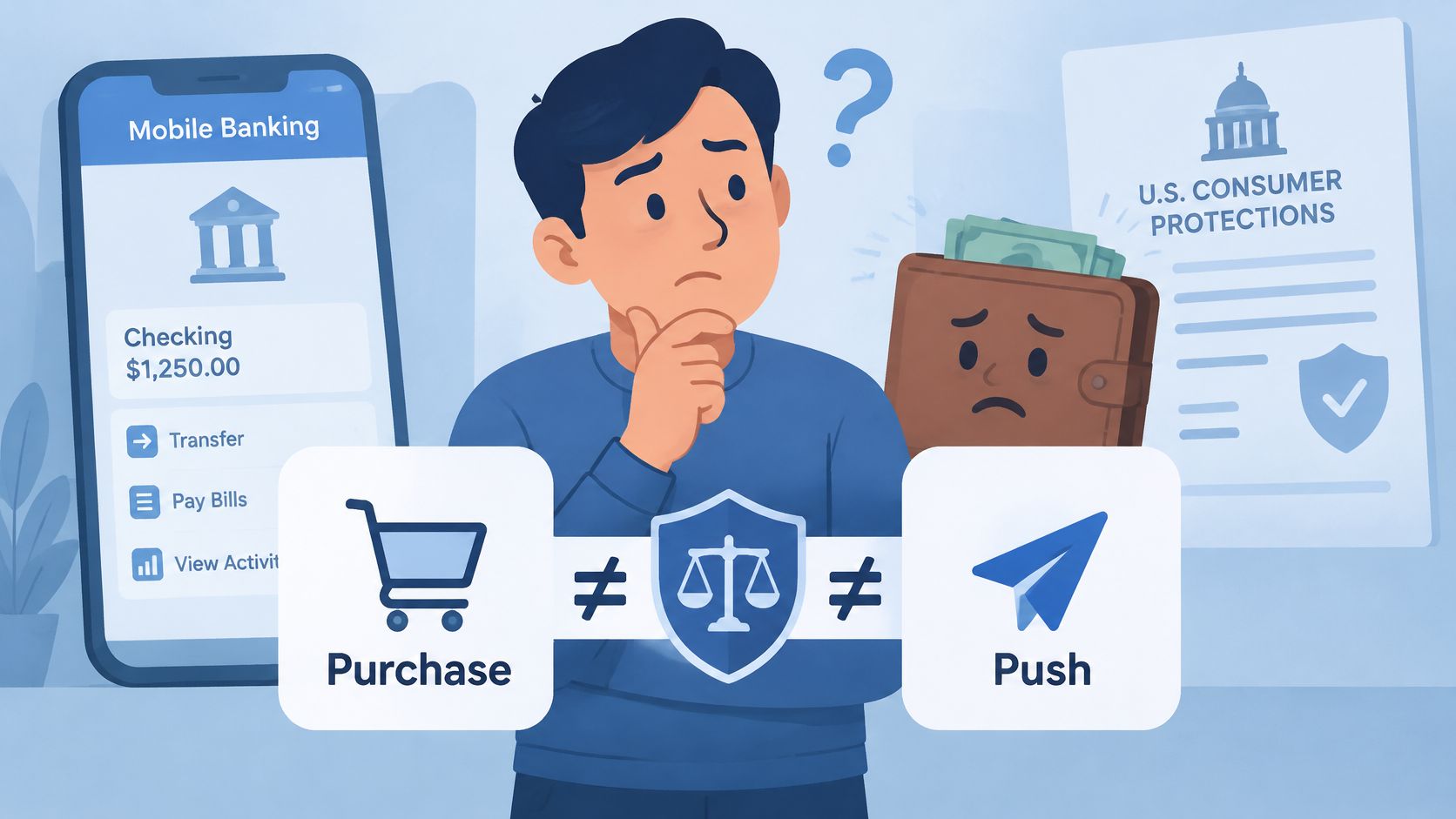
A higher transfer limit can be the worse deal. If you're buying something, a large push-payment allowance may expose more money without providing the dispute process you expected from paying a merchant by card.
The CFPB's Regulation E rules cover electronic fund transfers and address disclosures, error resolution, and liability. Their model disclosures also contemplate separate limits on transaction numbers and dollar values, rather than assuming that every electronic movement has one interchangeable allowance.
Classification matters. A card purchase, peer-to-peer transfer, wallet movement, cash advance, and bank transfer can follow different reimbursement and dispute procedures. Don't assume the presence of a card number turns a money transfer into a protected merchant purchase.
Separate fraud, mistakes, and merchant disputes
An unauthorized payment isn't the same as a transfer you authorized to the wrong recipient. A seller failing to deliver goods is another category again.
Describe the event accurately when contacting the provider. State whether you authorized the payment, whether the recipient details were correct, and whether the issue concerns delivery, duplication, or missing funds. Save the transaction reference and the confirmation screen.
A successful transfer proves that money moved. It doesn't prove that the recipient will deliver what they promised.
Crypto can add a separate point of irreversibility. A completed on-chain movement or conversion may not be undone just because the later card payment is disputed. The custodial versus self-custody crypto-card guide helps distinguish who controls the assets and which party handles each stage.
Put protection beside the maximum
Before authorizing a transfer, establish:
- Cancellation window: Can you cancel while the instruction is pending, and where?
- Unauthorized-transfer liability: Which account terms apply, and what reporting deadlines do they specify?
- Dispute route: Does the sending app, card issuer, wallet provider, or receiving bank handle the problem?
- Settlement status: Does the app distinguish submitted, available, completed, and failed?
- Crypto finality: Has a conversion or on-chain transaction already occurred?
For a purchase, use the merchant's card checkout when it offers the payment relationship you need. Use a card-to-card send when moving money is the purpose, not merely because a seller asks you to bypass checkout.
If someone promises that you can always reverse a push payment later, don't rely on that promise. Verify the actual cancellation and error-resolution terms before releasing funds.
Fees and Workarounds for Crypto Cards
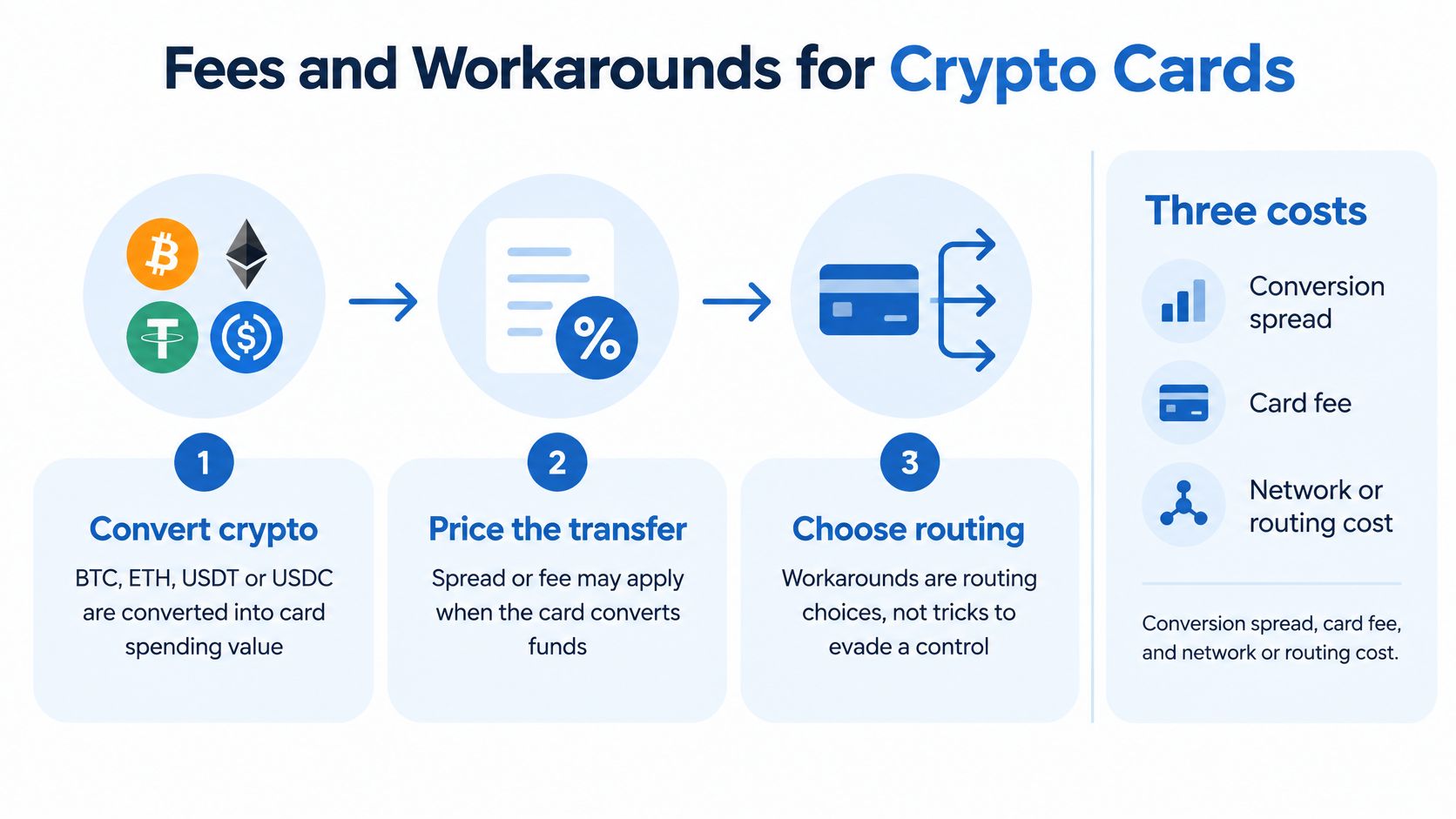
Price the crypto conversion separately from the outbound transfer. An app can advertise a free send while charging through the conversion rate, a cash-out fee, or foreign exchange.
Check the amount of crypto debited, the card-currency balance created, and the recipient's expected net credit. A transfer isn't cheap merely because the final confirmation screen lists no sending fee.
Choose a permitted route
Workarounds should mean routing choices, not attempts to evade controls. Use these options in order:
Identify the operation. Confirm whether the quoted maximum covers card funding, outbound peer transfers, or bank withdrawals. Don't sell crypto against a loading allowance when you need an outbound sending allowance.
Split only when the rules permit it. Multiple sends can fit a per-transfer ceiling, but they still consume cumulative amount and transaction-count capacity. Never split transactions to avoid verification, reporting, or a compliance restriction.
Compare eligible domestic routes. If both cards qualify, price a domestic debit-card push against a cross-border send. Check actual eligibility and net delivery rather than assuming that matching network logos guarantee acceptance.
Verify the European fallback. Don't assume that a card network's account-to-account option is available because another transfer method failed. Ask for the exact supported route before changing the destination.
Consider the verification trade-off. Submit income documents or complete additional KYC only if the resulting access justifies the privacy trade-off. Get confirmation of the applicable band rather than assuming documents automatically produce the advertised maximum.
Avoid an unnecessary transfer. If your goal is buying goods, compare paying the merchant directly with first moving funds to another card. Confirm whether the purchase qualifies for any rewards; don't assume a money transfer earns them.
Compare the full cost, not the fee label
Use the crypto-card fees comparison guide to separate conversion, card, and foreign-exchange charges. For broader context on evaluating digital-asset decisions, the cryptocurrency articles from The Money Maniac can complement the issuer-specific terms you need for the payment itself.
Before retrying a failed send, inspect the original transaction status. Repeated submissions can create uncertainty over pending debits, available funds, and whether another conversion is necessary.
No verified public cap for a specific crypto-linked card is established by these payment-system examples. The particular card's published terms determine its stated ceiling, subject to applicable account controls. Crypto and cards that use it carry risk, including loss of funds, so an unsuccessful workaround isn't necessarily cost-free.
Confirm the Live Limit Before You Send
Open the issuer's limit screen before committing funds. Save the current terms or a screenshot that identifies your card tier and region, then make a short record of the allowance you intend to use.
A comparison listing helps you shortlist products. It doesn't confirm that your account, recipient, and payment instruction qualify today.
Make a pre-send record
Capture these fields together:
- Single-transfer amount: Record the maximum for the specific outbound instruction.
- Cumulative amounts: Include daily, weekly, and monthly allowances and any remaining capacity shown.
- Transaction-count cap: Note whether the count applies to sends, recipients, or all account activity.
- Reset rule: Identify calendar-based or rolling windows, including the provider's stated time zone.
- Movement type: Label the action as funding, peer transfer, or withdrawal.
- Scope: Record whether counters apply per card, customer, linked account, or recipient.
Add the recipient's issuing country and settlement currency. If the app displays only a single number, don't assume it answers every field. Read the applicable terms and obtain clarification through the issuer's authenticated support channel before converting assets.
Before committing: Know the permitted amount, the expected net receipt, and who handles a failed payment.
Turn the comparison into a decision
We compare more than 60 crypto cards side by side on fees, limits, KYC levels, and coin support, with per-transaction filters of $1K+, $5K+, $10K+, and $25K+. Use those filters to build a shortlist, then distinguish spending ceilings from transfer and funding ceilings on the provider's own page.
Card terms can differ by country and tier, so always confirm current details on the provider's site before applying. A displayed allowance may be a hard contractual maximum or a default that remains subject to account review.
Resolve the protection questions before pressing send: cancellation, unauthorized-payment liability, dispute ownership, settlement status, and any completed crypto step. If the payment is a purchase, decide whether merchant checkout removes the need to transfer money at all.
Finish with a small test on the intended rail when the program permits it. Confirm that the recipient sees the credit and verify the destination details independently, then send the remaining amount only if sufficient allowance remains.
A successful test validates the route and recipient for that test. It doesn't guarantee approval of a larger payment, so keep the full transfer within every applicable ceiling.
Visit NomadCards to compare crypto-linked cards by limits, fees, verification requirements, and supported assets. Shortlist cards that fit your intended payment, then confirm the issuer's live sending terms before converting crypto or moving the full amount.