You spend $1,500 a month on groceries, transport, dining, and bills. A card advertising 4% cashback looks like $60 back every month. That math rarely survives the terms.
The top rate may apply only to gas or dining. It may stop after a few hundred dollars of spending. It may require a paid membership, a large exchange balance, or a token commitment. The rest of your spending earns the base rate, which is often much lower.
That's why this comparison uses effective cashback, not the headline. For each pick, you'll see what $1,500 of realistic spending returns after caps and required costs, where that number is knowable from the card's own terms. You can rerun the same math with your own categories in about two minutes.
Cashback has moved into the mainstream, since the CFPB consumer credit card market report found the share of general-purpose accounts offering cash rewards rose from 28% in 2015 to 36% in 2024. More choice makes comparison harder, not easier. Before applying, confirm current rates and eligibility with the provider, since terms differ by country and tier, and understand credit card costs and risks so interest never wipes out your rewards.
Table of Contents
- 1. Crypto Cards With Cashback
- 2. Gemini Credit Card®
- 3. Coinbase One Card
- 4. Crypto.com Visa Signature® Credit Card
- 5. Fold Bitcoin Credit Card
- 6. Venmo Credit Card
- 7. Robinhood Gold Card
- Headline Cashback, Reward Currency and Membership Requirements Compared
- Choose the Cashback Card That Fits Your Spending, Not the Headline
1. Crypto Cards With Cashback
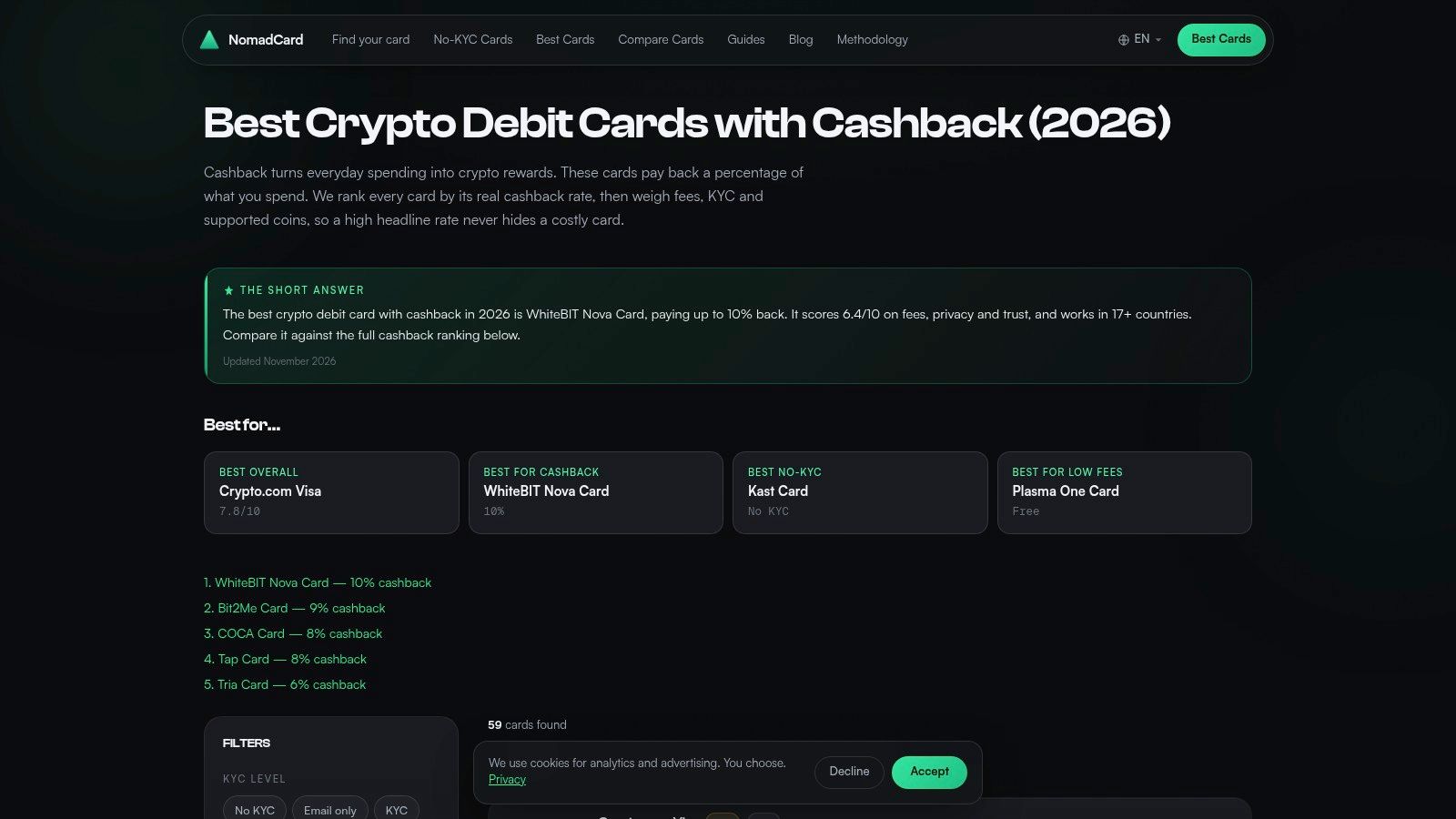
Issuer pages rarely quote terms the same way. One leads with a maximum tier, another buries a redemption threshold, and a third quotes rewards in a volatile token without showing the conversion cost. The NomadCard crypto cards with cashback comparison puts crypto-linked debit and credit cards into standardized fields, so the same facts appear for every product.
What the Comparison Standardizes
Each profile records cashback, fees, supported assets, card network, verification requirements, custody model, and regional availability in the same format. You can filter by Visa or Mastercard, by card type (debit, credit, prepaid, secured), by per-transaction limit and supported coins, and by features such as no annual fee, non-custodial, IBAN, Apple Pay, Google Pay, virtual or physical. Sorting covers best overall, highest cashback, lowest fees, and most countries.
Every card also carries a composite score from 0 to 10, weighted 30% fees, 20% privacy, 20% trust, 20% community sentiment, and 10% rewards. Scores are recalculated weekly, and the ranking follows a published formula. The site earns affiliate commissions on some cards, discloses them, and those commissions never buy a higher score or a placement.
- Custody side by side: custodial and self-custodial cards appear in the same list, so you see who holds your assets.
- KYC labeled per card: No KYC, Email only, and full KYC are marked, which matters if you want minimal verification.
- Costs next to rewards: fees appear beside cashback, not on a separate page you have to hunt for.
The preference for cashback shows up in survey data. In a 2023 U.S. Leger survey of 1,004 adults, 50% ranked cashback as their most desired card benefit and 58% would consider switching their primary card for a higher cashback rate. Switching for a headline rate you never earn is wasted effort, which is why the effective-rate math matters more than the advertised one.
Worked check: Take any card from the list, apply its category rates to your last statement, subtract its membership or annual fee, then divide by total spend. That percentage is the only one worth comparing.
One limit deserves a plain statement. The comparison does not lock in any card's current rate or terms for your country, since issuers change tiers, caps, and eligibility. Treat each profile as a shortlist entry and the provider's own site as the final word before applying. For the full decision logic behind this math, read the guide on whether crypto card cashback is worth it.
2. Gemini Credit Card®
The Gemini Credit Card is a no-annual-fee Mastercard that pays rewards directly as Bitcoin or another supported cryptocurrency into your Gemini account. There's no separate step where you convert cashback into crypto yourself.
The earning structure is category-based. You get 4% on eligible gas, EV charging, transit, taxis, and rideshare up to $300 per month, then 1% in those categories. Dining pays 3%, groceries 2%, and everything else 1%. Gemini states there's no annual fee and no foreign transaction fee.
The $1,500 Calculation
Say your month is $500 groceries, $300 dining, $200 transport, and $500 other spending. Groceries return $10. Dining returns $9. Transport returns $8, since you're under the cap. The rest returns $5.
That's $32 back, an effective rate of about 2.1%. It's a solid result, but it's roughly half the headline 4%. If your transport spending passed $300, every extra dollar there would drop to 1%.
- Best fit: You spend steadily on fuel, transit, dining, and groceries, and you already use Gemini.
- Real strength: You can choose Bitcoin or one of 50+ supported cryptocurrencies for rewards.
- The catch: Rewards and custody sit inside a Gemini account, and moving past an eligibility check may involve a hard credit inquiry.
Popularity isn't the issue with cards like this. In J.D. Power's 2024 U.S. Credit Card Satisfaction Study, 58% of surveyed U.S. cardholders primarily used cashback cards. The question is whether your categories line up. Check the full terms on our Gemini card profile against your last two statements before deciding.
3. Coinbase One Card
The Coinbase One Card pays Bitcoin rewards at a rate set by how much you hold on Coinbase. That's the whole design, and it's either the appeal or the dealbreaker.
There's no category to track and no rotating bonus to activate. Your rate sits between 2% and 4% depending on your Coinbase asset balance. Coinbase also says it doesn't lend or rehypothecate customers' crypto to fund card rewards, and that its eligibility check doesn't affect credit scores.
Where the Rate Actually Comes From
The higher tiers demand serious balances. The 2.5% tier requires $10,000 to $50,000 held on Coinbase. The 3% tier requires $50,000 to $200,000, and 4% requires over $200,000. Above 2%, the higher rate applies only to the first $10,000 of eligible monthly purchases, with additional purchases earning up to 2%.
On $1,500 of spending, the base 2% returns $30 in Bitcoin. At 3% you'd get $45, and at 4% you'd get $60. Now subtract the required Coinbase One membership, which you must pay for regardless of tier. For a base-tier holder, that recurring cost eats directly into the $30.
If you'd have to move assets onto an exchange just to unlock a higher tier, count the custody risk as a cost too. A rate you only earn by changing where you hold your crypto isn't free.
- Best fit: You're already a Coinbase One member with a balance that qualifies without any reshuffling.
- Weak fit: You're a new or small-balance user paying membership fees to chase a tier you won't reach.
Rewards at this scale shape behavior across the whole market. A CFPB circular on credit card rewards programs reported consumers earned $47.5 billion in rewards from general-purpose credit cards in 2024, with cashback accounting for $16.6 billion of that total. Big numbers fund big marketing. Your tier, not the market total, decides your return.
4. Crypto.com Visa Signature® Credit Card
With the Crypto.com Visa Signature Credit Card, begin at the bottom tier and work up. The advertised top rates belong to higher Level Up tiers. Most new applicants will start somewhere else.
The card itself carries no annual fee, and there's a no-subscription Basic tier. Rewards can be paid in BTC or CRO, which gives you a choice many single-asset cards don't offer. Higher tiers may add program benefits depending on eligibility.
The Basic Tier Math
On Basic, CRO rewards pay 1.5%. Bitcoin rewards pay 1.5% on the first $250 of monthly spending and 1% thereafter. That threshold is the number that controls your result.
Run $1,500 through the Bitcoin option. The first $250 returns $3.75. The remaining $1,250 returns $12.50. Your total is $16.25, an effective rate of about 1.1%. Choosing CRO at a flat 1.5% would return $22.50 in token value, provided you're comfortable holding CRO.
- Best fit: You want a foot in the Crypto.com ecosystem without committing to a paid tier on day one.
- The catch: Headline rates may require a paid membership or CRO commitment, and Bitcoin caps drag the effective rate down fast for anyone spending more than a few hundred dollars monthly.
How rewards land matters as much as the rate. In J.D. Power findings based on 38,852 credit card customers, 21% of cashback card users redeemed rewards as a statement credit, compared with 9% of points-and-miles users. With this card your reward lands as crypto, so decide in advance whether you'll hold BTC, hold CRO, or sell, and factor any conversion cost into your effective rate.
5. Fold Bitcoin Credit Card
The Fold Bitcoin Credit Card takes the opposite approach to tiered balance requirements. The base rate is flat and uncapped. The extra rewards depend on what you do inside Fold.
You earn 1.5% in Bitcoin on eligible purchases with no cap on base rewards. Qualifying Auto-Stack or Direct to Bitcoin activity can add up to 2% on the first $2,000 of monthly spending. Paying your statement in Bitcoin may add a further 0.5%. Fold advertises no annual fee, and tracking happens in the Fold app.
Base Case First, Bonuses Second
On $1,500, the base rate alone returns $22.50 in Bitcoin. That's your guaranteed floor, and it's the figure to compare against other cards.
If you qualified for the full additional 2%, you'd add $30, since your whole $1,500 sits inside the $2,000 cap. Paying the statement in Bitcoin could add $7.50 more. The ceiling is $60, a 4% effective rate, but every layer above $22.50 requires an action or a habit you may not have.
- Best fit: You're Bitcoin-first and already stack through Fold, so the bonuses reward behavior you have.
- Weak fit: You want set-and-forget earnings without app activity or paying statements in Bitcoin.
Availability is a real constraint here. The card is rolling out on a limited basis, so you may not be able to apply immediately. Bitcoin's price can also fall after you earn, which means your realized cashback can shrink before you spend it. Review the current position on our Fold card profile before building plans around the bonus tiers.
6. Venmo Credit Card
The Venmo Credit Card is a general-purpose Visa first and a crypto card second. That ordering is its strength for cautious users.
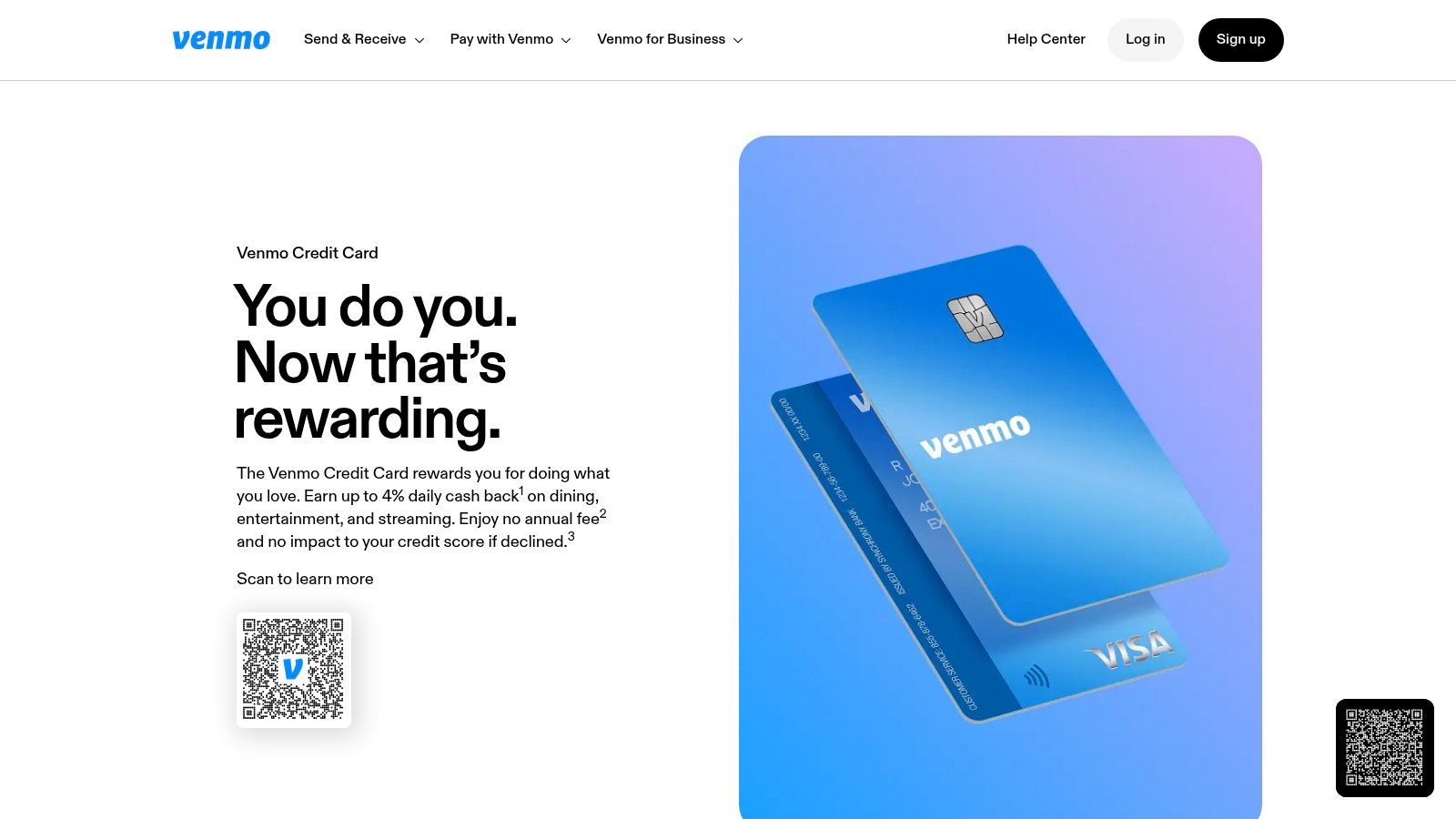
You earn 3% on your top eligible spending category, 2% on the next, and 1% on other eligible purchases. The categories adjust to your actual spending, so you don't pick in advance or track a quarterly calendar. Rewards and settings are managed in the Venmo app.
Optional Crypto, With a Spread
You can opt in to have cashback automatically buy a selected cryptocurrency. Venmo says it waives its standard transaction fee for reward-funded crypto purchases, but the exchange rate includes a spread. Selling that crypto later can incur fees, and cashback may only arrive after the statement period ends.
On $1,500 split as $500 in your top category, $300 in your second, and $700 elsewhere, you'd earn $15 plus $6 plus $7. That's $28, an effective rate of about 1.9%, before any spread if you route it into crypto. Keep it as cashback and that $28 is your full return.
Redemption flexibility like this is what people want. A 2025 TD Bank survey reported by FT Markets found statement credits were the preferred redemption method for 34% of U.S. cashback cardholders, with direct deposits at 20% and gift cards at only 14%.
- Best fit: You want ordinary cashback by default, with automated crypto purchases as an option you can switch on.
- The catch: Rewards aren't paid in crypto directly, so conversion timing and spread sit between you and your coins.
7. Robinhood Gold Card
The Robinhood Gold Card earns points, not crypto. If you're scanning this list for automatic Bitcoin, that distinction should stop you early.
You earn 3 points per dollar on eligible purchases by default, with no category selection. Points redeem through Robinhood's rewards program, and brokerage cashback redemption is valued at $0.01 per point. That cashback can move into a Robinhood investing account.
A Clean Rate With a Subscription Attached
On $1,500, you'd earn 4,500 points. Redeemed as brokerage cashback, that's $45, a 3% effective rate before costs. No cap or category split complicates that calculation, which is refreshing next to the tiered cards above.
Now subtract the required Robinhood Gold subscription. Whatever that costs you monthly comes straight off the $45. If you already pay for Gold and use its other features, the card's marginal cost may be near zero. If you'd subscribe only for the card, your effective rate drops and you should recalculate.
- Best fit: You're an active Robinhood user who wants rewards routed into investing, and you'd hold Gold anyway.
- The catch: Cashback redemption requires a Robinhood investing account, rewards never arrive as crypto automatically, and program terms may change.
There's a behavioral warning worth applying to every card here. A March 2025 Bankrate survey found 72% of U.S. adults carrying credit card debt were pursuing rewards, including 26% who made every effort to earn them. A subscription card earning 3% while you carry a balance is a loss dressed as a win. Pay in full or the effective rate is negative.
Headline Cashback, Reward Currency and Membership Requirements Compared
Headline rates overstate what these cards pay. The number that matters is effective cashback: the rate that survives category caps, membership costs, and required balances. The table lists the advertised terms. The math below applies them to a $1,500 monthly budget.
| Item | Headline Cashback | Rewards Paid In | Fee or Membership |
|---|---|---|---|
| Gemini Credit Card® | 4% on eligible transit and fuel-related spending up to $300 monthly; 3% dining, 2% groceries, 1% other eligible purchases | Bitcoin or another supported cryptocurrency | No annual fee |
| Coinbase One Card | 2%–4% in Bitcoin, depending on Coinbase asset balances; higher rates are capped | Bitcoin | Paid Coinbase One membership required |
| Crypto.com Visa Signature® Credit Card | Basic tier: 1.5% in CRO; BTC rewards are 1.5% on the first $250 monthly, then 1% | Bitcoin or CRO | No annual fee; Basic tier has no subscription, higher tiers may require a paid membership or CRO commitment |
| Fold Bitcoin Credit Card | 1.5% base rate, with potential additional rewards through qualifying activity | Bitcoin | No annual fee |
| Venmo Credit Card | 3% on top eligible category, 2% on the next, 1% on other eligible purchases | Cash back; optional conversion to supported cryptocurrency | Spread applies to optional crypto conversion; transaction fee waived for reward-funded crypto purchases |
| Robinhood Gold Card | 3 points per dollar on eligible purchases | Points redeemable for brokerage cash back | Robinhood Gold subscription required |
Run the same $1,500 through each structure and the spread narrows fast. Split that budget as $300 transit, $300 dining, $300 groceries and $600 everything else. Gemini pays $12 plus $9 plus $6 plus $6, or $33, a 2.2% effective rate. The 4% headline only ever touches the first $300 of transit and fuel.
Crypto.com's Basic tier shows why reward currency is a term, not a detail. Paid in CRO, $1,500 earns a flat $22.50. Paid in BTC, the same spend earns $3.75 on the first $250 and $12.50 on the rest, $16.25 total, or about 1.08%. On this budget the Bitcoin track is the weaker choice.
Venmo's tiered structure returns $30 on $1,500 when your spending fills all three buckets evenly, a 2% effective rate. Coinbase pays $30 at 2% and would pay $60 at 4%, but the top rate requires the qualifying asset balance, carries a cap, and the paid membership comes off the top. Fold returns $22.50 at base rate before any activity-based boosts. Robinhood's flat 3 points per dollar holds up best on paper, provided the Gold subscription is a cost you already carry.
Choose the Cashback Card That Fits Your Spending, Not the Headline
Run this routine before you apply for anything. It takes ten minutes and it eliminates most bad picks immediately.
First, pull your last two or three statements and sort spending into groceries, dining, transport, and everything else. Use your real category totals, not the budget you wish you kept. If transport is $80 a month, a 4% transport rate is worth $3.20 to you no matter how prominently it's advertised.
Second, calculate effective cashback for your top two candidates. Apply each card's category rates, stop the bonus rate where its monthly cap stops, then subtract any annual fee, membership, or subscription you're required to hold. Divide what's left by your total monthly spend. That's your number.
What the Math Usually Reveals
On a $1,500 budget, the cards above land in a narrow band once you strip the headlines away. Category cards reward people whose spending matches their categories. Flat-rate cards reward people who won't track anything. Balance-tiered cards reward people who already keep large balances with that provider, and cost everyone else.
- Pay in full monthly: One month of interest on a carried balance can erase several months of rewards, so read up on understanding different credit card APR types if your rate is unclear.
- Count custody as a term: Rewards held on an exchange carry platform risk that a statement credit doesn't.
- Value the reward you'll use: Bitcoin you'll hold, CRO you'll sell at a spread, and points you'll forget to redeem are three different returns at the same advertised rate.
Third, confirm the live details on the provider's own site. Check the current rate for your tier, country availability, redemption minimums, and any balance or subscription requirement. Card terms differ by country and tier, and issuers revise them without asking comparison sites first.
Then shortlist with filters rather than scrolling. On NomadCards you can narrow by network, KYC level, card type, and features like no annual fee or non-custodial, and sort by highest cashback, lowest fees, or most countries. That gets you to two finalists whose effective rates you've already verified with your own spending, which is the only ranking that was ever going to be right for you.
Visit NomadCards to compare more than 60 crypto cashback credit cards and debit cards side by side on fees, KYC levels, networks, and supported coins, with scores recalculated weekly from a published methodology. Filter by no annual fee, non-custodial, virtual or physical, then rerun the effective cashback math on your own spending before you apply.