“Zero annual fee” is popular advice, but it answers the wrong question. A card can waive its account fee and still cost more through foreign-exchange markups, conversion spreads, fixed transaction charges, ATM costs, or weak rewards. To compare credit card fees properly, you need to calculate the effective cost of a defined spending pattern, not rank products by one attractive line in a pricing schedule.
That distinction matters across the payment ecosystem. U.S. banks collected nearly $66 billion in interchange fees in 2025, up from $64 billion in 2024 and $52 billion in 2021, according to the Federal Reserve Bank of St. Louis analysis of card-fee revenue. Those costs sit inside merchant acceptance economics and can influence rewards, pricing, and product design. The same card may therefore look inexpensive to a consumer while creating a different cost for a merchant, a crypto-funded user, or someone spending abroad.
The practical answer is a normalized comparison. Add every relevant fee, subtract the realistic value of rewards, separate domestic and foreign spending, and test the result against your actual behavior.
Table of Contents
- Why the Cheapest Card Is Not Always the Lowest-Cost Card
- Credit Card Fees to Identify Before You Compare
- A Normalized Side-by-Side Fee Comparison
- How Spending Patterns Change the Outcome
- Calculate the Effective Cost of Every Card
- Match Card Features to Your Spending Priorities
- Choose the Right Card for Your Real Use Case
Why the Cheapest Card Is Not Always the Lowest-Cost Card
A card with no annual fee can still lose to a card that charges one. The reason is simple: recurring fees are only one component of total cost. A lower annual fee may be offset by a foreign-exchange spread, a top-up charge, a network conversion premium, or a fixed fee that appears small until you multiply it across many transactions.
Consider an illustrative comparison. Card A has no annual fee but adds a 70-basis-point spread and a $0.50 fixed fee to each foreign transaction. Card B charges a $60 annual fee but avoids those two costs. If a user spends $9,000 on foreign purchases, Card A's percentage spread alone is $63, before counting the fixed charges. The result depends on transaction frequency, but the supposedly free card can already exceed the annual-fee card before rewards or ATM usage enter the calculation.
That example isn't a universal verdict. It demonstrates why a headline rate can't answer a total-cost question without a spending profile.
The cost categories that change the result
For merchants, all-in card acceptance commonly falls around 1.5% to 3.5% per transaction plus roughly 10 to 30 cents, while flat-rate processors often charge around 2.6% to 2.9% plus $0.30, as summarized in this payment gateway fee breakdown. Consumer card comparisons should use the same discipline, even though the payer may not see the merchant-side charge directly.
A card comparison should ask:
- What does the account cost? Include annual, monthly, issuance, and replacement charges.
- What does each purchase cost? Separate percentage fees from fixed authorization or transaction fees.
- What happens across currencies? Distinguish the advertised FX markup from the exchange-rate spread.
- How is crypto converted? A card may charge for converting USDC or another asset into fiat, while the network or funding route adds another cost.
- What does cash access cost? Combine issuer fees, ATM operator charges, percentage cash fees, and any foreign-currency conversion.
- What value comes back? Treat cashback and points as offsets only when you can use them at their stated value.
Practical rule: Compare cards against the transactions you actually make, not against an imaginary user who never travels, withdraws cash, tops up, or carries a balance.
The rest of the analysis should therefore produce one figure, such as annual effective cost or cost per $100 spent. That figure makes a $60 annual fee visible beside a spread, a fixed charge, and a reward rate instead of allowing the annual fee to dominate the decision.
Credit Card Fees to Identify Before You Compare
A pricing page rarely presents one complete number. It distributes the cost across several schedules, footnotes, card tiers, transaction routes, and jurisdictional rules. Before comparing two products, extract each line item and record the condition that activates it.
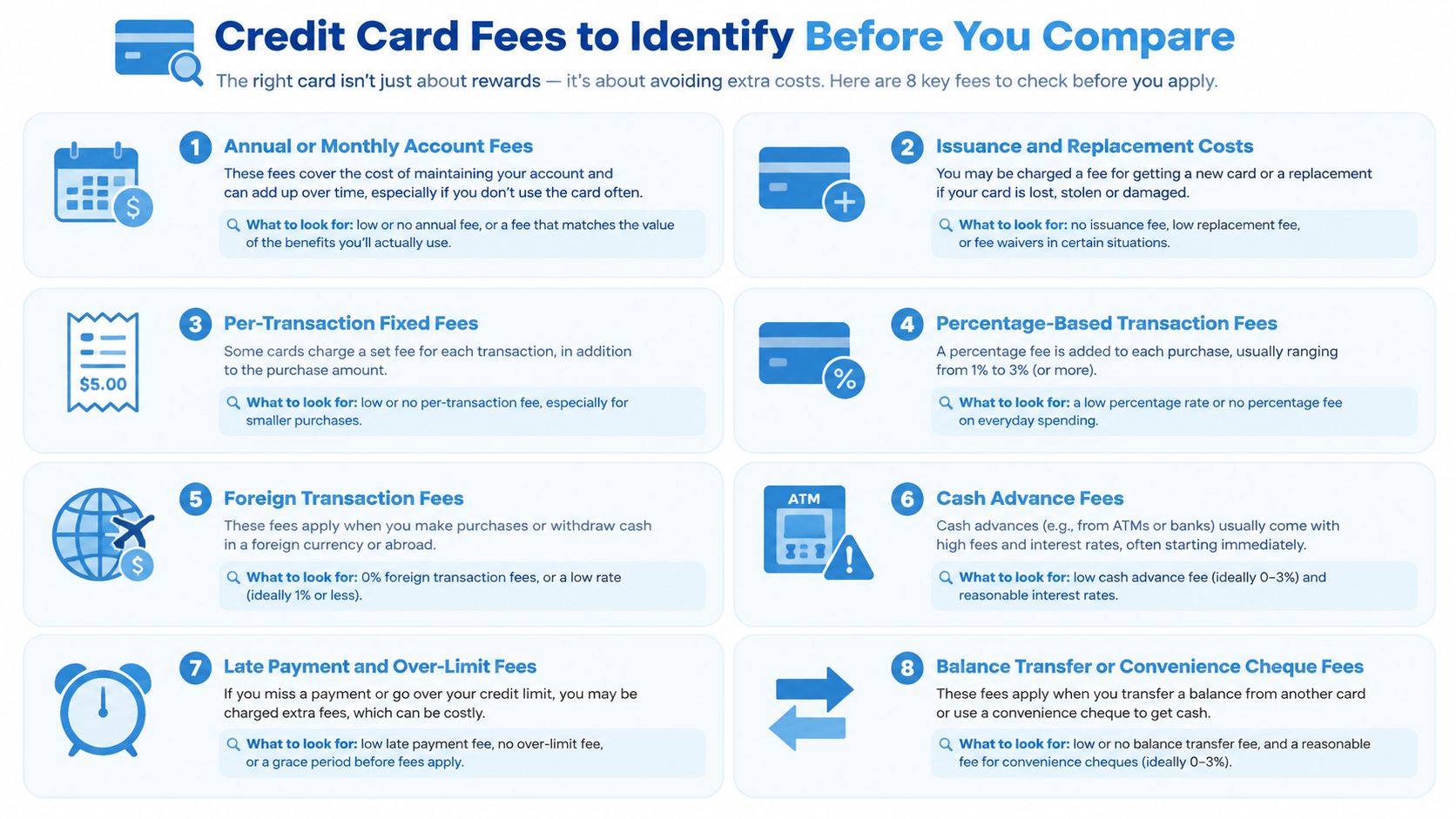
Build the fee inventory first
Annual or monthly account fees. Record the amount, billing frequency, first-year waiver, and whether an additional cardholder changes the price. A monthly fee should be converted into an annual total before comparison.
Issuance and replacement costs. Include physical-card delivery, expedited replacement, virtual-card creation, and renewal charges. These matter most when a product requires frequent replacement or offers separate physical and virtual formats.
Fixed transaction fees. Capture the amount charged per authorization, purchase, conversion, or funding event. A fixed charge has a very different effect on a small purchase than on a large one.
Percentage-based transaction fees. Identify whether the percentage applies to the original purchase amount, the converted fiat amount, or a previously marked-up amount. The base matters as much as the rate.
FX markups versus the mid-market rate. A card can advertise no foreign transaction fee while still using an exchange rate above the mid-market reference. Record both the explicit markup and the issuer or network spread.
Crypto-to-fiat conversion costs. Note the asset conversion spread, funding fee, liquidity charge, and route used to settle the purchase. The crypto card hidden-fee account offers a useful practical reminder that the visible card fee isn't always the complete conversion cost.
ATM withdrawal charges. Separate the issuer's fixed fee, percentage cash fee, ATM operator surcharge, foreign-currency spread, and any daily or transaction minimum. Never treat “ATM fee” as one undifferentiated input.
Top-up and funding charges. Check bank transfer, debit-card top-up, crypto deposit, and wallet funding routes separately. A product can be inexpensive for one route and costly for another.
Read the accounting rules, not only the labels
The order of operations can change the result. If a card applies an FX markup before calculating a percentage transaction fee, the percentage may be charged on a larger base. Minimums and maximums distort small purchases, while inactivity charges can affect an account that looks cheap for occasional use.
Your extraction checklist should contain:
- the fee name and amount;
- the percentage base;
- the currency in which the fee is charged;
- the transaction route;
- the card type and network;
- the country of issuance;
- whether the fee is capped, tiered, or subject to a minimum;
- whether rewards apply before or after fees.
Regulation reinforces the need for this detail. In the UK, domestic consumer interchange is fixed at 0.2% on debit cards and 0.3% on credit cards, while EU and EEA benchmarks are commonly around 0.2% for debit and 0.3% for credit. Australia retained a 0.8% interchange cap for commercial credit transactions acquired in Australia in its 2026 policy conclusion, as described in this interchange-fee explanation. Those are merchant-side benchmarks, but they show why card type, route, and jurisdiction belong in the comparison sheet.
A Normalized Side-by-Side Fee Comparison
A useful comparison table needs a fixed scenario. The figures below are illustrative inputs, not universal card terms. They show how to place recurring fees, transaction costs, conversion charges, cash access, and rewards in one model.
Assume the user spends domestically and abroad, makes occasional crypto-funded purchases, and values cashback at its stated face value. Replace every illustrative input with the relevant issuer term before making a decision.
| Fee Category | Traditional Travel Card | Fee-Free Crypto Card | Premium Rewards Card | Basic Debit-Backed Card |
|---|---|---|---|---|
| Annual fee | $95 | $0 | $450 | $0 |
| Domestic transaction fee | 0% | 0.5% conversion spread where crypto is used | 0% | 0% |
| Foreign transaction fee | 0% | 0% headline fee, spread varies | 2.5% | 1% |
| Crypto conversion cost | Not applicable | 0.5% illustrative spread | Not applicable | Not applicable |
| Fixed transaction fee | $0 | $0.50 per crypto-funded transaction | $0 | $0.10 |
| ATM cost | Issuer and operator terms vary | Issuer, operator, and conversion terms vary | Issuer and operator terms vary | Issuer and operator terms vary |
| Headline rewards | Travel points, value varies | 1% illustrative cashback | 2% illustrative cashback | No cashback assumed |
| Rewards offset | Subtract only redeemed value | Subtract realized cashback | Subtract realized cashback | $0 |
| Effective cost per $100 foreign spend | Annual fee and rewards allocated by usage | 0.5% spread plus fixed fee allocation | 2.5% fee minus reward value, plus annual-fee allocation | 1% fee plus fixed-fee allocation |
The table exposes a common error. A 1% cashback rate doesn't automatically beat a 2.5% foreign transaction fee, and a “fee-free” crypto card can still charge through a 0.5% conversion spread and a fixed fee. The fixed amount is especially important for low-value payments because it consumes a larger share of each purchase.
Use formulas instead of labels
For foreign spending:
FX cost = purchase amount × FX markup + purchase amount × issuer spread
For crypto-funded spending:
Crypto cost = purchase amount × conversion spread + fixed funding or transaction charges
For cash:
ATM cost = fixed issuer fee + withdrawal amount × cash percentage + operator surcharge + FX cost
For rewards:
Net cost = all fees minus realized reward value
Terms vary by jurisdiction and route. U.S. guidance places regulated debit near 0.05% plus $0.21 to $0.22, standard consumer credit around 1.51% plus $0.10 to 1.65% plus $0.10, and premium rewards credit around 2.1% to 2.5% plus $0.10. Card-not-present transactions can add roughly 20 to 50 basis points because of higher fraud risk, according to this updated U.S. interchange-rate reference. These are acceptance benchmarks, not promises about a consumer card's personal schedule.
For a more detailed field-by-field dataset, compare the card-fees master table. And when broader financial decisions involve credit qualification or borrowing, a separate resource such as Superior Credit Repair for homebuyers addresses a different part of the decision. Credit access and transaction economics shouldn't be confused.
How Spending Patterns Change the Outcome
The same card can be cheap for one user and expensive for another. A domestic shopper may never recover a travel card's annual fee, while a traveler can lose more to FX costs than to an account charge. A crypto-funded user adds another layer because each top-up can trigger a conversion event.
| Card | Domestic Groceries ($600/mo) | Traveler (€800/mo FX) | Crypto-Top-Up (USDC, $500/mo) |
|---|---|---|---|
| Traditional Travel Card | Annual fee spread across usage, no assumed domestic transaction fee | FX terms and reward value determine result | Usually requires an external funding route |
| Fee-Free Crypto Card | Conversion spread applies only when crypto funds the purchase | Headline FX fee may be zero, but conversion or routing spread can remain | Top-up fee, conversion spread, and fixed charges dominate |
| Premium Rewards Card | Annual fee must be recovered through rewards | Foreign fee can outweigh headline rewards | Crypto funding may be treated as a cash-like route |
| Basic Debit-Backed Card | Fixed fee is visible on each transaction | FX markup can dominate | Bank or crypto funding terms determine cost |
Domestic groceries
At $600 per month, a shopper making many small purchases feels fixed fees more sharply than a traveler making larger consolidated payments. A card with travel rewards may deliver no usable offset if the shopper doesn't redeem those benefits, while a basic debit-backed product with no account fee may win even if it lacks cashback.
EUR and GBP travel
A traveler paying in EUR and GBP should calculate the converted amount, the explicit FX markup, and the issuer spread. A card advertising 0% FX markup can still lose if its funding route charges 1% on top-ups, or if its exchange rate includes a separate spread. Cross-border treatment also varies by transaction type. New Zealand retained a 0.70% cap for domestic online credit transactions and introduced 1.50% for online foreign-issued credit transactions, while leaving commercial credit transactions uncapped, as documented in the Visa interchange-fee publication.
USDC-funded spending
For $500 per month funded with USDC, transaction frequency becomes decisive. One larger conversion may cost less than many small conversions when fixed fees apply. The crossover point is where the annual fee difference equals the accumulated spread and fixed charges saved by the alternative card. Calculate that point from the actual schedule rather than assuming higher volume always favors the premium product.
Calculate the Effective Cost of Every Card
A defensible comparison begins with four formulas. Keep the currency conversion explicit, record every fee separately, and subtract rewards only after deciding what those rewards are worth in practice.
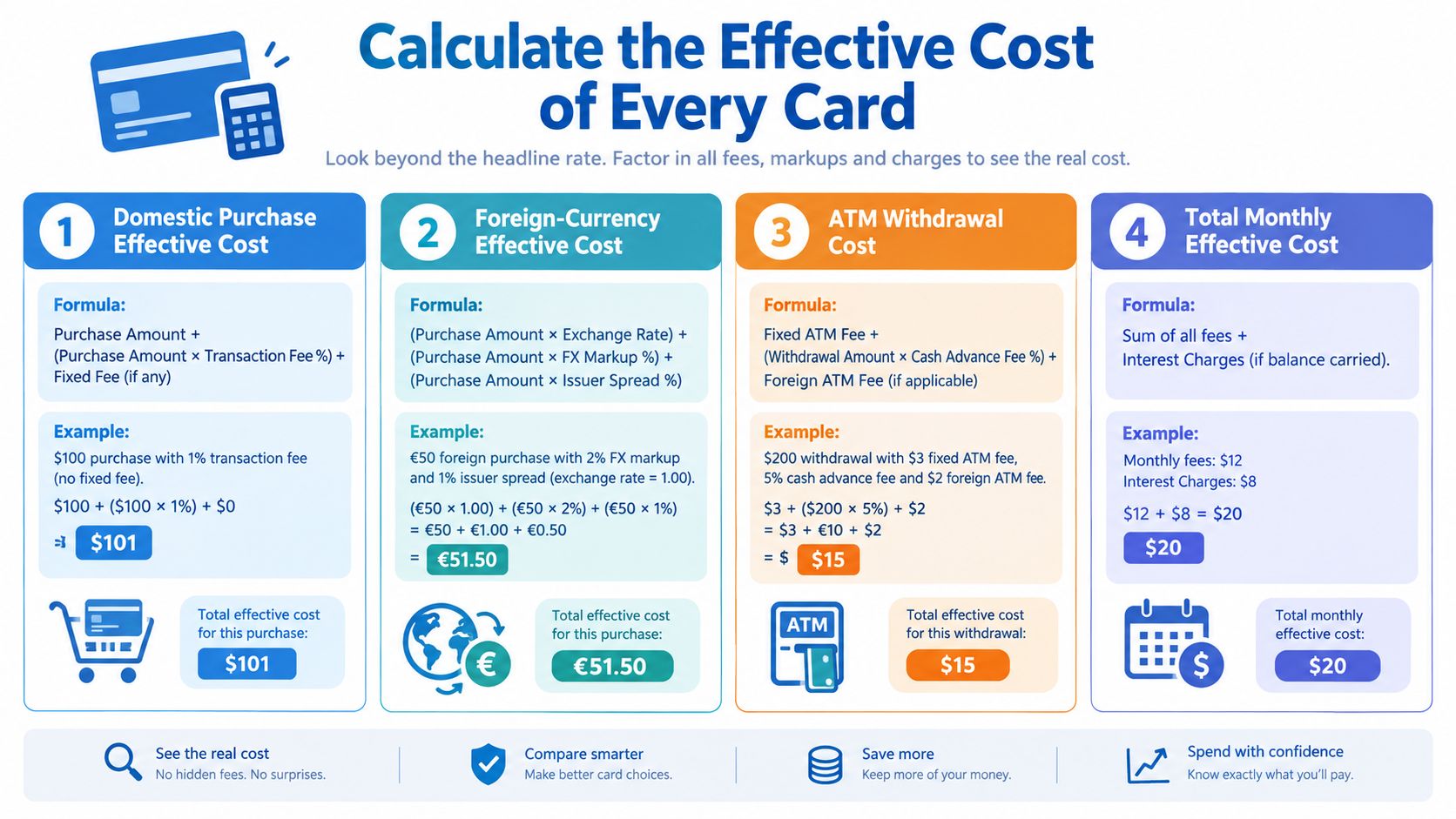
Domestic purchases
Domestic effective cost = purchase amount + (purchase amount × transaction fee percentage) + fixed fee
For a $100 purchase with a 1% fee, the fee is $1, so the effective cost is $101, before rewards. If the card returns cashback, subtract the value you can redeem.
For an annual domestic spend of $4,200, use:
$4,200 + ($4,200 × fee percentage) + (number of transactions × fixed fee)
Don't multiply the fixed fee by annual spend. Multiply it by the number of qualifying transactions.
Foreign-currency purchases
Foreign effective cost = (purchase amount × exchange rate) + (purchase amount × FX markup) + (purchase amount × issuer spread)
For a €50 purchase with a 2% FX markup and a 1% issuer spread, the fee component equals €1.50, producing an effective local-currency cost of €51.50 before applying the exchange rate. A card's “no foreign transaction fee” label removes only a stated fee. It doesn't prove that the exchange rate equals the mid-market rate.
A €2,400 Paris trip should be modeled transaction by transaction if some purchases are in person, some online, and some routed through a foreign-issued or commercial card category.
ATM withdrawals
ATM cost = fixed ATM fee + (withdrawal amount × cash fee percentage) + foreign ATM fee + FX cost
For a $600 withdrawal abroad, enter the issuer's fixed charge, the percentage cash fee, the local operator surcharge, and the currency conversion cost as separate cells. Cash advances may also carry interest when a balance is not paid according to the card's terms, so the cash model shouldn't stop at the visible withdrawal fee.
Crypto-funded purchases
Crypto effective cost = purchase amount + conversion spread + network or funding fee + fixed transaction fee
For a $9,000 annual USDC-funded spend, calculate the conversion spread on the amount converted, then add every top-up or transaction charge. If the card converts only the amount needed at authorization, use transaction count and purchase size rather than applying one annual fee blindly.
The 2026 crypto card fee report can help identify which fields require verification, but issuer terms remain the controlling source.
Spreadsheet inputs
A useful sheet needs at least:
- annual or monthly account fee;
- domestic transaction percentage and fixed charge;
- FX markup and issuer spread;
- crypto conversion spread and funding route;
- ATM fixed, percentage, and operator fees;
- annual spend and transaction count by category;
- reward rate and redemption value;
- interest charges if the balance is carried.
The Kansas City Fed's 2025 update shows that regulators continue to distinguish domestic, online, commercial, and foreign-issued routes. The implication is practical: your spreadsheet should have separate rows for those routes, not one universal “card fee” cell.
Match Card Features to Your Spending Priorities
A fee comparison becomes useful only when it reflects priorities. Five users can inspect the same product and reach different conclusions because they assign value to different protections, funding methods, and privacy conditions.
Fee-sensitive minimalists
Prioritize the annual fee, fixed transaction fee, FX spread, and ATM schedule. A flat zero-fee structure with a transparent exchange rate usually matters more than lounge access or complex reward tiers. Reject a card if it looks free but hides frequent funding charges.
Frequent travelers
Focus on the mid-market or interbank-rate policy, foreign-issued routing, ATM treatment, and acceptance network. A rewards multiplier can be valuable, but it shouldn't obscure a recurring FX spread. Check whether online and in-person purchases receive different treatment.
Privacy-conscious users
The decisive fields are KYC level, identity-document requirements, jurisdiction of issuance, and data-sharing terms. “No annual fee” doesn't compensate for a verification model that fails your requirements. Confirm eligibility before comparing rewards.
Self-custody crypto holders
Look for on-chain settlement, wallet control, supported assets, and the point at which conversion occurs. A product that spends directly from a wallet may have a different risk profile from a custodial exchange-linked card. Compare conversion spread and network fee separately.
Rewards maximizers
Calculate the break-even spend needed to recover the annual fee. Then test whether rewards apply to foreign transactions, crypto-funded purchases, ATM activity, and excluded merchant categories. A high multiplier can conflict with travel goals if the same card carries a foreign transaction fee.
Decision rule: Rank the three features that affect your real usage most. Discard a card that misses on two or more, even if its headline reward rate looks attractive.
These archetypes can overlap. A traveler who also maximizes rewards may accept an annual fee for stronger benefits, but only after the FX and redemption assumptions survive the normalized calculation.
Choose the Right Card for Your Real Use Case
Don't select one universal winner. Rank each candidate across four scenarios: domestic purchases, foreign-currency spending, ATM access, and crypto-funded transactions. Mark the scenario in which each card has the lowest calculated total cost, then apply non-fee filters such as issuance jurisdiction, KYC requirements, self-custody support, regional BIN acceptance, and consumer-protection coverage.
A fee-sensitive user should start with a flat-fee structure and a tight, clearly disclosed spread. A frequent traveler should prioritize interbank-rate FX, reliable foreign acceptance, and useful travel benefits. A rewards-focused user can accept a mid-tier annual fee only when the rewards earned exceed that fee after FX, redemption limits, and excluded categories are included.
The final method fits on one page:
- Enter monthly spend by domestic, foreign, ATM, and crypto-funded category.
- Add transaction counts, not only total volume.
- Apply the relevant percentage, fixed, conversion, and FX formulas.
- Subtract rewards at their realistic redemption value.
- Apply jurisdiction, verification, custody, and network constraints.
- Choose the card with the lowest total cost for your dominant scenario.
If 60% of your spending is FX-heavy, choose the candidate with the lowest tested conversion and routing cost. If rewards drive the value, choose the product whose redeemed rewards exceed its annual fee and transaction charges. If cash access matters, choose the card with the lowest combined ATM, operator, and FX cost, not the one with the most attractive annual-fee headline.
NomadCards provides a comparison platform for crypto-linked debit and credit cards, with standardized fields for fees, rewards, supported assets, networks, KYC requirements, custody models, and regional availability. Use the NomadCards database to shortlist products, then verify each issuer's current schedule and run the effective-cost calculation against your own spending.