You're standing at a hotel desk, or buying coffee in an airport, or checking out online from a laptop with ten tabs open. You've got stablecoins or other crypto sitting in a wallet, but the merchant wants ordinary card payment. You could sell first, move funds, wait, and then pay. Or you could tap a card and let the conversion happen in the background.
That simple checkout moment is why crypto cards matter.
The promise sounds almost too neat. Spend digital assets anywhere regular cards are accepted. Keep the familiar card experience. Maybe earn rewards at the same time. But the story is a little more nuanced than the marketing pages suggest. Some crypto card benefits are immediate and practical. Others only help in specific situations. Some disappear once you factor in FX markups, conversion spreads, annual fees, reward caps, or token lockups.
A lot of readers get stuck on the same question: are crypto cards cheaper, or do they just make spending feel easier?
That's the right question. Convenience is a benefit. So is global acceptance. So are rewards. But if you want to know whether a card saves you money, you have to look at net value, not just the advertised perk.
Table of Contents
- Introduction Why Crypto Cards Matter Right Now
- How Crypto Cards Work Without the Jargon
- The Core Benefits That Make Crypto Cards Worth Using
- Privacy KYC and Custody Choices That Shape Your Benefits
- Rewards and Fees What Your Cashback Is Really Worth
- Real World Use Cases Where Benefits Pay Off Most
- Choosing Your Card and Getting More From Every Swipe
Introduction Why Crypto Cards Matter Right Now
Crypto cards have moved past the novelty stage. One industry-tracked dataset reported $759 million in monthly volume in July 2026, up about 2.5x from $306 million a year earlier, and from less than $1 million when tracking began in October 2023. The same dataset showed nearly 9 million purchases in that month, up from about 5.2 million a year earlier, with an average spend of roughly $86 per transaction according to Changelly and Simple's crypto card study.
That matters because it tells you something very practical. People aren't only using these cards for a one-off test purchase. They're using them often enough that volume, purchase count, and ordinary ticket size now look like real consumer spending behavior.
The benefit is simple. The decision isn't.
At first glance, the appeal is obvious. A crypto card lets you spend stablecoins or other digital assets through ordinary card rails without doing a separate off-ramp step first. The merchant doesn't have to care that your funds started as crypto. From their side, it still looks like a normal card payment.
What gets confusing is that the biggest benefit depends on who you are.
- For a traveler, the main win may be lower friction on cross-border spending.
- For a rewards optimizer, the key question is whether cashback survives all the hidden costs.
- For a privacy-focused user, the issue isn't cashback at all. It's how much identification, custody, and control you give up to use the card.
Practical rule: Don't ask which crypto card is best in general. Ask which benefit matters most for your own spending pattern.
Five lenses that separate useful cards from expensive ones
When I look at crypto card benefits, I use five filters:
- Rewards. What do you really earn after caps, lockups, and fees?
- FX and conversion costs. What happens when you spend abroad or fund in one asset and settle in another?
- Privacy and KYC. How much personal information do you need to hand over?
- Custody and control. Are your funds held by an issuer, exchange, or your own wallet setup?
- Acceptance. Will this card work where you shop and travel?
Those five questions cut through most of the confusion. They also stop you from chasing a shiny perk that won't matter once you start using the card in real life.
How Crypto Cards Work Without the Jargon
A normal debit card pulls money from an account you already understand. A crypto card does something similar, except the funding source starts as crypto instead of plain bank balance.
The easiest way to think about it is this. At checkout, the card acts like a currency translator. You hand over crypto value. The merchant receives ordinary money through the card network. The translation happens behind the scenes.
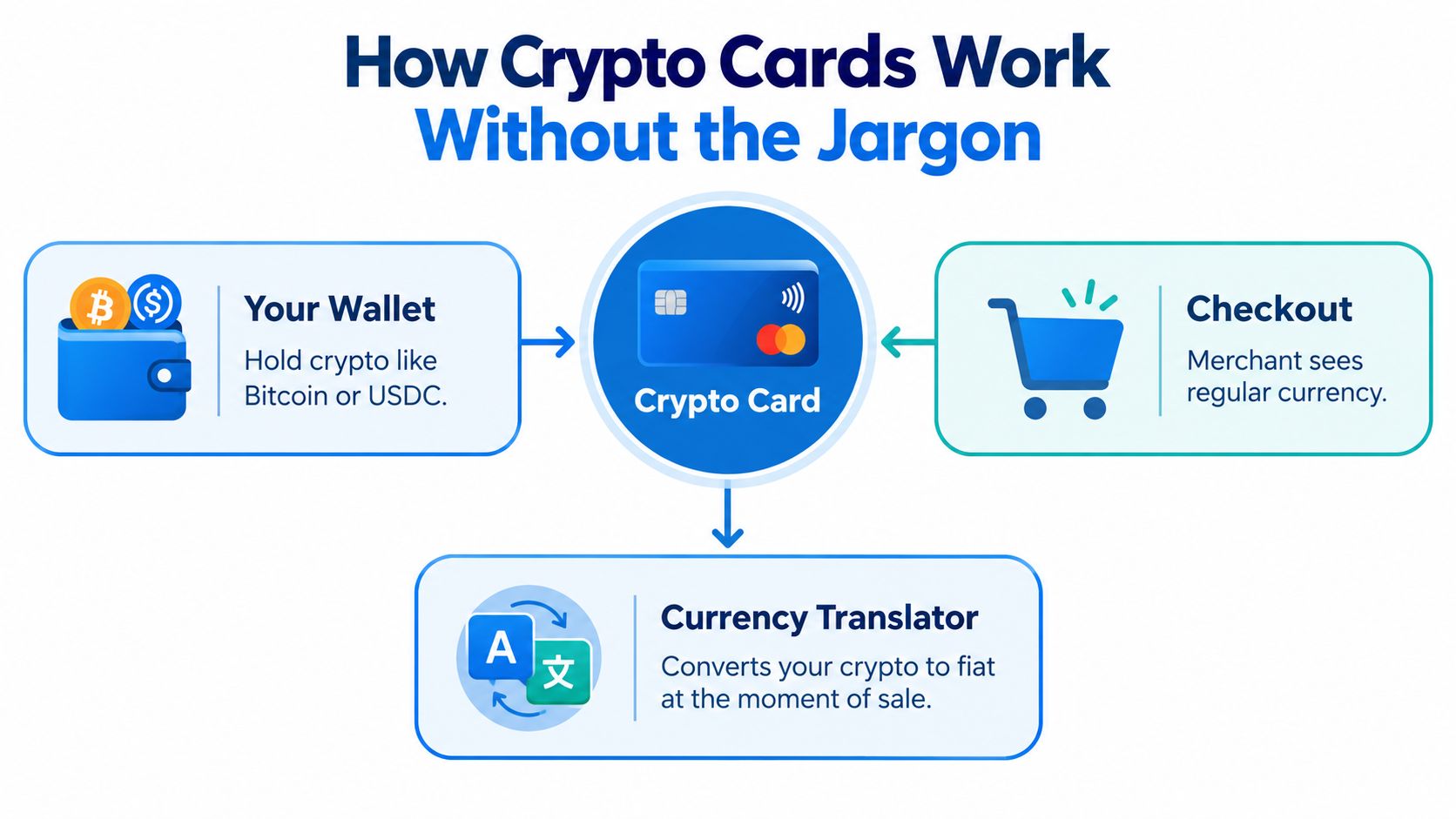
What the merchant sees
The merchant usually doesn't see Bitcoin, Ether, or stablecoins. They see a regular card transaction routed over Visa or Mastercard rails. That's why acceptance is often driven more by the network than by the asset you hold.
If a store takes Visa or Mastercard, your crypto card may work there because the merchant is not being asked to become a crypto specialist. They're just accepting a card payment the same way they would from any other customer.
What happens in the background
Different programs handle this in different ways, but the broad pattern is familiar:
- Prepaid model. You load value in advance, then spend from that balance.
- Debit model. The card pulls from a linked crypto balance when you make a purchase.
- Credit or secured model. Less common, but some programs let you borrow against collateral or use secured structures.
The key phrase is spend-time conversion. That means the card turns crypto into fiat at the moment you pay, instead of requiring you to sell separately, move money out, and then spend later.
That's where the convenience comes from. It removes a step that used to make crypto feel awkward for everyday purchases.
A quick visual helps before we go further.
The two choices people underestimate
Most confusion around crypto cards comes from two structural choices, not from the card design itself.
Custody
Some cards are custodial. An issuer, exchange, or app controls the funds until you spend them. That's often easier for mainstream users, but it adds counterparty risk and gives you less direct control.
Other cards are tied more closely to self-custody or on-chain setups. Those can align better with users who don't want funds sitting with a centralized provider, but they may involve more setup and different limitations.
KYC level
Some programs ask for full identity verification. Others ask for less. That choice affects what benefits you can access, how broadly the card works, and sometimes what spending limits or features are available.
Think of a crypto card as a familiar card shell wrapped around an asset-conversion engine. Once you see that, the rest of the trade-offs become easier to evaluate.
The Core Benefits That Make Crypto Cards Worth Using
The strongest crypto card benefits are not abstract. You feel them at the exact moment where crypto would otherwise be inconvenient.
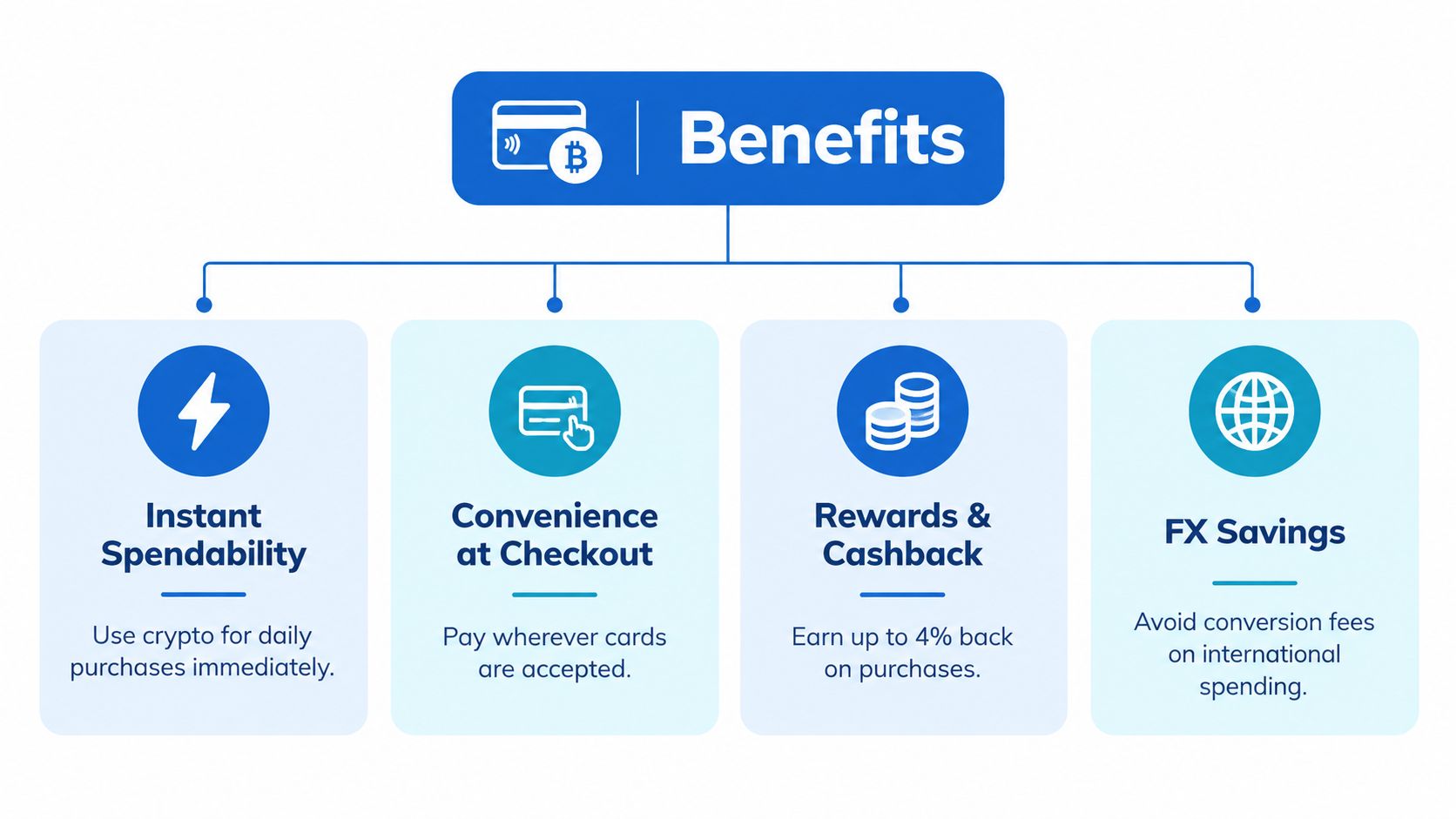
The first benefit is straightforward. You can spend digital assets without a separate manual off-ramp. That doesn't sound glamorous, but it solves one of the oldest practical problems in crypto. Holding value is one thing. Turning it into everyday purchasing power is another.
Surveys of crypto-card users help explain why that matters. In a global survey published in 2025, 60.6% of respondents said they already used crypto cards, 65% named ease of use as the top benefit, 56% highlighted cashback or other rewards, and 43% pointed to flexibility as a key advantage according to Coingape's crypto card insights. The same study found that the most common use cases were online transactions at 66% and everyday purchases at 61%, with an average transaction size in Europe of €40.
Instant spendability matters more than it sounds
If you've ever had to sell crypto, wait for transfer settlement, and then move cash to a spending account, you already know why this is useful. A crypto card compresses that chain into one checkout action.
That's especially handy for people who hold a working balance in stablecoins. Instead of treating those funds as “invested money” that must be manually extracted before use, the card turns them into spendable balance on demand.
Convenience is not a weak benefit
Some readers dismiss convenience as a soft perk. It isn't.
Payments live or die on friction. If using crypto requires extra steps every single time, users won't use it for routine purchases. The same survey data above shows that users already rely on these cards for online shopping and ordinary daily spending, not just one-off experiments.
The best convenience feature is the one you stop noticing. Tap, confirm, and move on.
Global card acceptance is the hidden unlock
Another major benefit is reach. Crypto cards ride on existing card infrastructure, so acceptance depends largely on whether the merchant takes the network, not whether they understand crypto.
That's a powerful shift. It means you don't need to hunt for “crypto-friendly” merchants in daily life. You can often use the same payment habits you already have.
Rewards can be meaningful, but only in the right setup
Cashback and loyalty-style perks are one reason people pay attention to crypto cards in the first place. Rewards can improve the economics of ordinary spending, especially if the card doesn't burden you with heavy lockups or nuisance fees.
But rewards are only a real benefit if your card use is frequent enough, your fee profile is sane, and the reward structure matches how you spend. A card with flashy rewards can still be poor value if the fine print eats the gain.
FX savings are where travelers often feel the difference
For people who spend across borders, crypto card benefits can become more tangible. Major-market analysis described by Spark's stablecoin debit card market research places typical cross-border FX markup at about 1% to 3% for conventional debit rails, while crypto-card programs often compress that to roughly 0% to 1.5% depending on the issuer.
The reason is practical. The card can convert crypto or stablecoins into fiat at spend time, which may help users avoid a separate manual conversion step and reduce the chance of paying both exchange spread and bank FX markup on the same transaction.
That doesn't mean every crypto card is automatically cheaper abroad. It means cross-border users have a real reason to compare cards carefully.
Privacy KYC and Custody Choices That Shape Your Benefits
Some of the most important crypto card benefits never appear on the front page. They sit underneath the product in the form of identity requirements and fund control.
A card can have solid rewards and broad acceptance, then still be the wrong fit because it asks for more personal data than you're comfortable sharing. Or it can look privacy-friendly, but come with enough restrictions that the practical benefit shrinks fast.
Three common verification paths
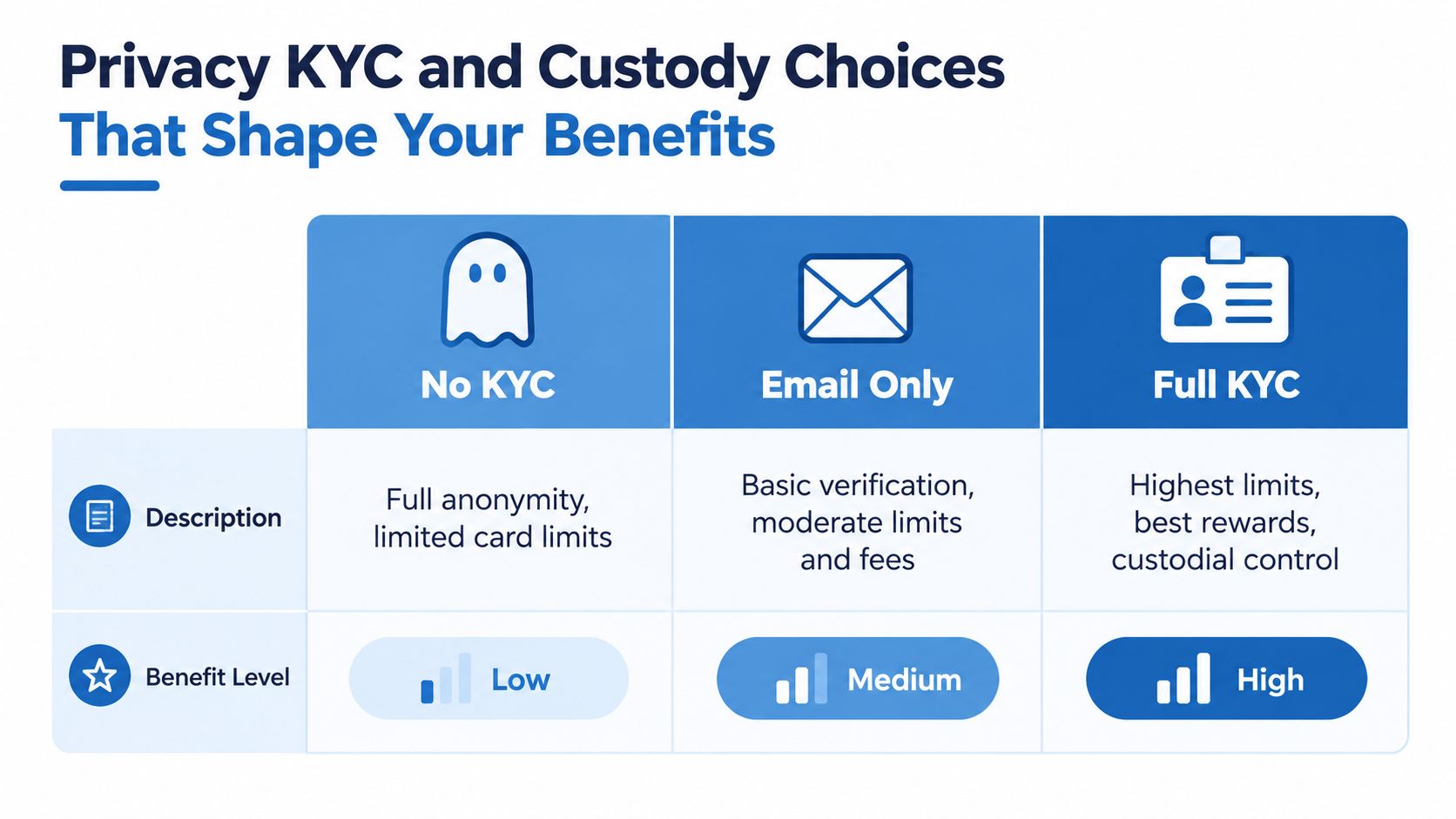
Most cards fall into one of these broad experiences:
| Verification path | What it usually feels like | Typical trade-off |
|---|---|---|
| No KYC | Faster access, less identity sharing | Fewer features, tighter constraints, or narrower availability |
| Email only | Lighter signup friction | A middle ground that may still limit some functions |
| Full KYC | More complete feature access | More data disclosure and more reliance on issuer compliance |
Readers often assume privacy and usability move together. They don't always. A card can be easy to get but awkward to use. Another can ask for full onboarding but work more smoothly once active.
Custodial versus self-custody is a different question
Verification tells you who you must identify yourself to. Custody tells you who controls the funds before spending.
If a card is custodial, you're trusting the issuer or linked platform to hold value and process spending. That can be simpler. It may also provide smoother support, easier app flows, and broader mainstream features.
If a card leans toward self-custody or on-chain control, you keep a closer relationship with your funds. That tends to appeal to users who came to crypto precisely to avoid centralized custody. The trade-off is that setup, recovery, and support can feel less forgiving.
A more detailed primer on that distinction is this guide to custodial vs self-custody crypto cards.
Privacy isn't one setting. It's a bundle of choices about identity, counterparty trust, and how much convenience you're willing to trade for control.
Security concerns look different in card land
Privacy-minded users often focus on wallet security, but card exposure creates a separate risk surface. If card data is leaked, attackers don't care whether the original funding source was fiat or crypto. They care that the card works.
That's why it helps to understand adjacent tools and threat models, including services built around white-label dark web monitoring for resellers. Even if you never run such a service yourself, the underlying lesson is useful: card credentials live in a different security environment than on-chain addresses, and that affects how you evaluate risk.
Which user should care most
- Privacy-first users should focus on KYC level, virtual card controls, and whether the setup minimizes unnecessary data exposure.
- Self-custody users should prioritize cards that don't force idle balances onto a centralized platform unless that trade-off is worth it.
- Mainstream convenience users may accept full KYC if it provides smoother support and broader utility.
This is one area where a comparison tool can save time. NomadCards aggregates card data with filters for KYC level, custody model, network, and supported features so users can compare options side by side without piecing terms together across issuer pages.
Rewards and Fees What Your Cashback Is Really Worth
Cashback is where marketing gets loud.
A card advertises a headline reward. You start doing mental math on your groceries, travel, subscriptions, and daily spend. It looks attractive. Then the small frictions show up. FX markup. Conversion spread. Top-up fee. Annual fee. ATM charge. Staking requirement. Reward cap. Token lockup.
That's why the right lens isn't “what's the reward rate?” It's what survives after the friction?
Independent comparison coverage discussed by MetaMask's review of global crypto cards notes that pages often advertise 1% to 5% cashback, while under-explaining the costs that can reduce effective value, including FX markups, top-up or conversion fees, ATM fees, annual fees, and the opportunity cost of staking or locking tokens.
A better way to read a rewards page
Treat crypto card rewards like airline fares. The number on the ad is only the starting point. Real cost depends on baggage, timing, route, and restrictions.
For cards, the equivalent questions are:
- Where do you spend most? Domestic and cross-border patterns can produce very different outcomes.
- How often do you spend? A casual user may never earn enough to offset recurring fees or setup friction.
- What do you have to lock up? If a better reward requires tying up capital or holding a token you wouldn't otherwise own, that cost belongs in the calculation.
- What asset are rewards paid in? Stable reward assets behave very differently from native platform tokens or thinner assets.
Net Cashback Value by Spending Pattern
| Spending Pattern | Headline Cashback | Typical Frictions | Net Value Signal |
|---|---|---|---|
| Domestic everyday spender | Looks attractive on paper | Annual fee, reward caps, conversion spread | Good only if fees stay low and the cap doesn't choke value |
| Frequent traveler | Reward plus FX angle can stack | Regional fees, ATM charges, issuer FX policy | Often strongest if the card keeps cross-border costs low |
| Small monthly spender | Cashback sounds meaningful | Fixed fees and lockups can outweigh rewards | Weak unless the card is very light on ongoing costs |
| High-volume optimizer | Can extract more from the program | Tier rules, staking, reward caps, token volatility | Strong only if the structure fits your exact pattern |
| Privacy-focused user | Rewards may be secondary | Reduced features, tighter limits, fewer premium perks | Evaluate convenience and control before cashback |
Worth asking: If this card paid no rewards at all, would the fee structure still make sense for how I spend?
Don't ignore the opportunity cost
Locking funds for card status can be easy to overlook because it doesn't always feel like a fee. But economically, it can act like one. If capital must sit idle, remain exposed to a token you don't want, or be committed mainly to obtain perks, that affects your true return.
The same logic applies to “smart spending” habits more broadly. Anyone comparing card rewards with more active crypto strategies may also want a separate framework for risk and execution, such as copyfomo's copy trading guide, because passive card rewards and active trading returns are solving very different problems.
For a dedicated breakdown of this exact question, this guide on whether crypto card cashback is worth it is a useful next step.
Real World Use Cases Where Benefits Pay Off Most
The cleanest way to understand crypto card benefits is to stop thinking in product categories and start thinking in people.

The traveler
A frequent traveler keeps part of their working balance in stablecoins, books transport online, and pays in multiple currencies over the course of a month. For this person, the biggest benefit usually isn't cashback. It's reduced payment friction when moving between countries and merchants.
The card becomes useful because it turns a border-crossing money problem into a familiar card tap. What this user needs to watch is fee layering. A card that looks travel-friendly can lose its edge if ATM policies, conversion spreads, or issuer markups are buried in the fine print.
The privacy-conscious holder
This user cares less about premium perks and more about minimizing exposure. They may prefer lighter verification, virtual card options, and structures that don't leave more personal data or centralized balances than necessary.
For them, the benefit is selective access to card rails without fully abandoning crypto-native habits. The trade-off is that privacy-friendly setups may involve narrower functionality or less generous rewards. In practice, this user often gets more value from control and compartmentalization than from headline cashback.
People in this camp also tend to appreciate practical security habits around online spending. A guide on how virtual cards protect you can be useful here because disposable or segmented card details can reduce exposure when paying unfamiliar merchants.
The rewards optimizer
This person wants every payment to do double duty. Bills, subscriptions, groceries, travel, and online shopping all become candidates for cashback extraction.
Crypto cards can work well for this profile, but only when the person stays disciplined about net value. A flashy rewards page is not enough. The optimizer has to monitor caps, asset type, lockup requirements, and whether the reward token behaves like a bonus or like an extra risk position they never intended to hold.
The same card can be great for one user and mediocre for another. Utility depends on what problem the card is solving in your life.
A quick shortcut for choosing priorities
If you see yourself in one of these profiles, focus here:
- Traveler: prioritize FX policy, supported regions, and broad merchant acceptance.
- Privacy-conscious holder: prioritize KYC level, virtual options, and custody model.
- Rewards optimizer: prioritize net return after fees, caps, and lockup costs.
Choosing Your Card and Getting More From Every Swipe
A good crypto card should fit your spending life, not just your curiosity about crypto.
Start with a short checklist:
- Fees first: look for annual fees, conversion costs, ATM charges, and any funding friction.
- Rewards second: check caps, payout asset, and whether better rates require lockups you don't want.
- Custody fit: decide whether you're comfortable with issuer-held balances or prefer a setup closer to self-custody.
- Verification level: match the KYC requirement to your privacy threshold.
- Asset support: make sure the card works with the coins or stablecoins you use.
- Regional reality: verify country availability, virtual versus physical issuance, and where the card can be used.
If you want a broader shortlist before comparing individual programs, this guide to the best crypto cards in 2026 is a practical place to start.
The most honest way to judge crypto card benefits is to test them against your own routine. A traveler should model travel spending. A domestic spender should model ordinary monthly purchases. A privacy-minded user should decide how much convenience is worth the data trade-off.
The headline perk matters less than the total system around it. When the structure matches your use case, a crypto card can save effort and sometimes money. When it doesn't, the benefit was mostly marketing.
If you want to compare cards without jumping across issuer pages, NomadCards lists crypto-linked debit and credit card programs in a standardized format with details on fees, rewards, custody, KYC, supported assets, and regional availability. Use it to filter for the benefit you care about, then compare the fine print before you commit to your next swipe.