Visa's Economic Empowerment Institute found that crypto-linked card payment volume grew about elevenfold between January 2021 and its peak in April 2022, with Europe and North America each representing just under half of volume at the peak, according to its analysis of crypto-linked cards. That spending record puts the 2026 choice in perspective: a custodial exchange card, a self-custody wallet card, or a program that's no longer open to new applicants may all carry familiar logos, but they aren't the same product.
If you already hold crypto, start with three questions: Can the card be issued where you live? Who holds or converts the balance? Which legal company handles the payment? Compare rewards only after those answers are clear. A headline cashback rate won't help if the card can't be delivered to your address or if the product's custody model doesn't suit you.
Table of Contents
- Why a Crypto Card in Europe Is Still a Bank Card
- Europe Crypto Card Snapshot for 2026
- Check Issuance in Your Country
- Where the Real Cost of Spending Crypto Sits
- Who You Can Claim Against If the Card Fails
- What Stays Visible After a Light Signup
- Match the Card to How You Actually Spend
- Confirm the Issuer Before You Apply
Why a Crypto Card in Europe Is Still a Bank Card
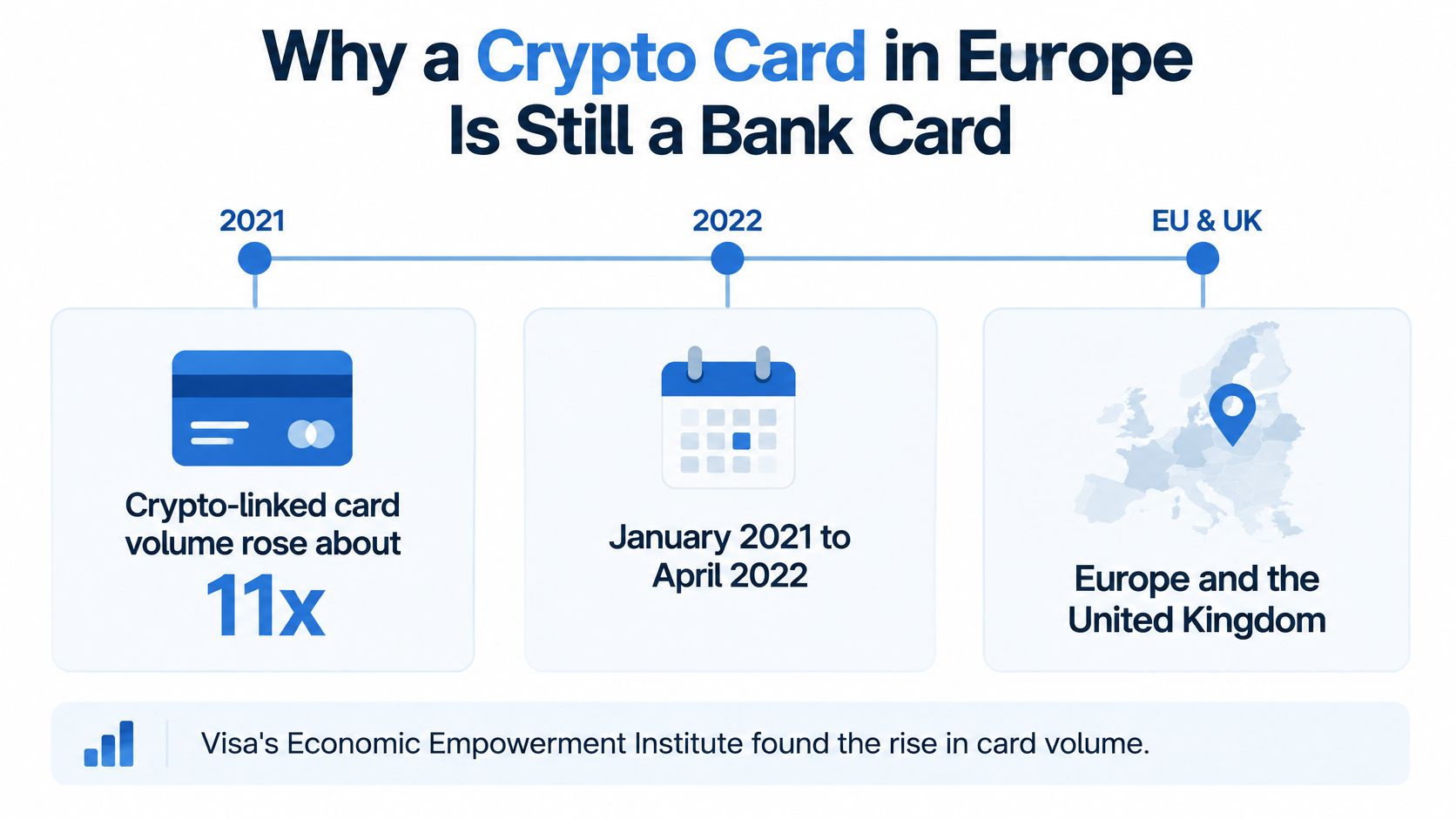
A stablecoin purchase at a grocery checkout usually travels through familiar card-network rails. The merchant accepts a card payment, while the card program converts, transfers, or deducts the crypto-related balance according to its setup.
In 2023, cards handled nearly 70 billion transactions in the EU, or 54% of all non-cash payments, according to the European Central Bank's payment statistics. That figure describes the broader card market, not crypto-card use. It shows how much these products depend on existing payment infrastructure: a crypto balance does not make the merchant's checkout a crypto payment.
Visa's figures track spending volume, not cardholder numbers. Its indexed crypto-card payment activity levelled off after its early expansion and remained well above the January 2021 baseline. The global Visa figure shows how quickly this spending channel grew, without establishing a Europe-specific rate.
For a useful comparison, separate the card scheme from the payment institution and the crypto custodian. A familiar Visa or Mastercard logo identifies the network, not necessarily the company holding funds, converting assets, or handling a payment dispute. Those roles may belong to different entities, and the arrangement affects what happens when a transaction fails.
Custodial exchange cards can make spending straightforward, while self-custody cards may let you keep assets in a wallet you control. Neither removes the payment institution or card infrastructure from the transaction. Privacy also depends on the full spending path, including the wallet, conversion and payment records, not just the KYC badge shown at signup.
Practical rule: Identify the scheme, payment entity and custodian before comparing cashback.
Europe Crypto Card Snapshot for 2026
Start with the row that can be issued in your country, then compare rewards. The table is a shortlist of products people commonly compare, not a guarantee of current eligibility. A brand can be visible across Europe while its card application, physical delivery, or particular spending mode is restricted in your country.
| Program | Network | Custody | KYC | Typical assets | Europe reality |
|---|---|---|---|---|---|
| Crypto.com Visa | Visa | Custodial exchange | Full KYC | CRO, BTC, ETH, USDC and other exchange balances | Widely issued in the EEA; cashback often tied to a CRO stake |
| Coinbase Card | Visa | Custodial | Full KYC | USDC, BTC, ETH | EEA country list changes; check your country before applying |
| Gnosis Pay | Visa | Non-custodial, on-chain account | KYC for card and IBAN | EURe and Gnosis-ecosystem assets | Built for EU residents; virtual and physical rollout can differ |
| MetaMask Card | Mastercard | Self-custodial wallet | KYC to order | Linea assets such as USDC and WETH | Shorter country list; not every EU state is included |
| Wirex | Visa | Custodial | Full KYC | Major coins and stablecoins | Long-running European program; tier affects fees |
| Nexo Card | Mastercard | Custodial balance or collateralised credit | Full KYC | Major assets held as balance or collateral | Credit mode and eligibility depend on country |
| Binance Card | Visa historically | Custodial | Full KYC | Exchange balances | Largely closed to new EEA applicants; don't treat it as currently issuable |
| Revolut | Visa or Mastercard by country | Custodial app balance | Full KYC | In-app crypto sold to fiat, then spent | Broad EU coverage, but it's an app that sells crypto before spending |
Start with the everyday custodial options
Crypto.com and Wirex are exchange-linked choices, so review the balance the card spends and the tier conditions attached to its advertised benefits. Coinbase Card's country list needs a fresh check, even if USDC spending is the feature you're looking for. Nexo's credit mode is a different proposition from spending down a balance: confirm that the mode is offered to residents in your country before treating it as an option.
Separate wallet control from account convenience
Gnosis Pay and MetaMask Card are more relevant if you want a card connected to a wallet-based setup rather than a conventional exchange balance. That doesn't mean the application is anonymous or that every EU resident can order one. KYC, supported assets, card format, and country rollout still matter.
Binance Card belongs in the comparison as a warning row, not a recommendation. Revolut is useful as a point of comparison for people who want a familiar app and broad coverage, but it sells crypto to fiat inside the app before card spending. If your decision also involves staying connected while moving between countries, digital SIM plans for European travel can help with mobile data, but they don't change which card programs can issue to your residence.
Treat every entry as a starting point. Virtual and physical issuance can differ, and a card's advertised network doesn't settle who holds the funds or how spending is processed.
Check Issuance in Your Country
Check each program's own country list first, not its marketing map. Complete the following checks for every card you might apply for, and record the result before looking at rewards.
| Check | Where to verify | What goes wrong |
|---|---|---|
| Issuance | Supported-country page on application day | Country lists change; virtual and physical availability can differ |
| MiCA transition | Authorisation status in your Member State | A transition period may run to July 2026, and protection may be missing |
| Physical delivery | Shipping country list on the card page | The card may not ship to your address |
| Smaller EEA state or tax visitor | Application eligibility and delivery terms for your residence status | The brand appears available, but issuance fails |
Confirm the card can be issued to your country of residence. Check whether you'll get a virtual card, a physical card, or both. Don't assume that eligibility in one EEA country applies across the EEA.
Check the provider's authorisation status. The country-level card availability directory can help you narrow down products, but the provider's current terms and the relevant regulator's information are what matter for your application.
Verify delivery, then check your country's terms. A virtual card may be available even when physical delivery isn't. Residents of smaller EEA states and people whose tax residence differs from their current address should confirm eligibility directly in the application flow before transferring funds or relying on the card.
Where the Real Cost of Spending Crypto Sits
Price your own month of spending, not the cashback headline. A euro-zone resident buying groceries with a euro-denominated stablecoin faces a different cost mix from a traveller paying in another currency and withdrawing cash. In either case, the relevant figure is the combined cost of converting the asset, making the payment, and accessing cash.
| Cost line | What it often looks like | Check before you apply |
|---|---|---|
| FX outside the euro | Often advertised from 0% to about 2% | Weekend pricing, scheme fees, and non-euro ATM rules |
| Crypto conversion spread | Can run about 1–3% versus the mid-market price | The BTC or ETH price at the moment of spending, not just cashback |
| ATM withdrawal | Flat fee plus a monthly free allowance | Home euro ATM versus cash abroad |
| Annual or metal fee | Zero on some virtual tiers; paid metal tier on others | Whether a token stake is needed to waive it |
| On-chain gas | Network fee before the card payment | Who pays gas and what happens if settlement fails |
| Top-up or load | Often cheaper in stablecoins than volatile coins | USDC, USDT, or EURe compared with BTC or ETH |
| Inactivity, replacement, delivery | Small flat fees, plus possible shipping limits | Whether a physical card can be sent to your address |
The checkout exchange rate matters
If your card sells BTC or ETH when you tap, compare the sale price with the mid-market price at that moment. A spread can consume the value of a reward before the reward reaches your account. If the card supports a stablecoin balance suited to your spending currency, that can make the conversion easier to assess, although the provider's exchange and payment terms still need checking.
A self-custody card can add a step before the card transaction: your wallet or smart contract may need to execute an on-chain action. Check whether you pay the network fee, what happens if a transaction is delayed, and whether the card can decline while that step is unresolved. A card-network logo won't answer those questions.
Compare a month, not a perk
For a euro-zone user spending a stablecoin at home, the most relevant costs are likely to be the conversion terms and any tier or stake condition. A traveller spending outside the euro should pay closer attention to FX rules and ATM charges. For a clearer view of how an on-ramp can make cross-chain token access possible, Mayan's explanation of MoonPay onramps offers useful context, but it doesn't replace checking the card's own load and settlement costs.
Build a simple monthly estimate using your usual card spend and likely cash withdrawals. Include the card fee, foreign-currency purchases, conversion spread, and any token you'd need to lock up. A guide to crypto card fees that can hide behind the headline rate can help structure that check.
Who You Can Claim Against If the Card Fails
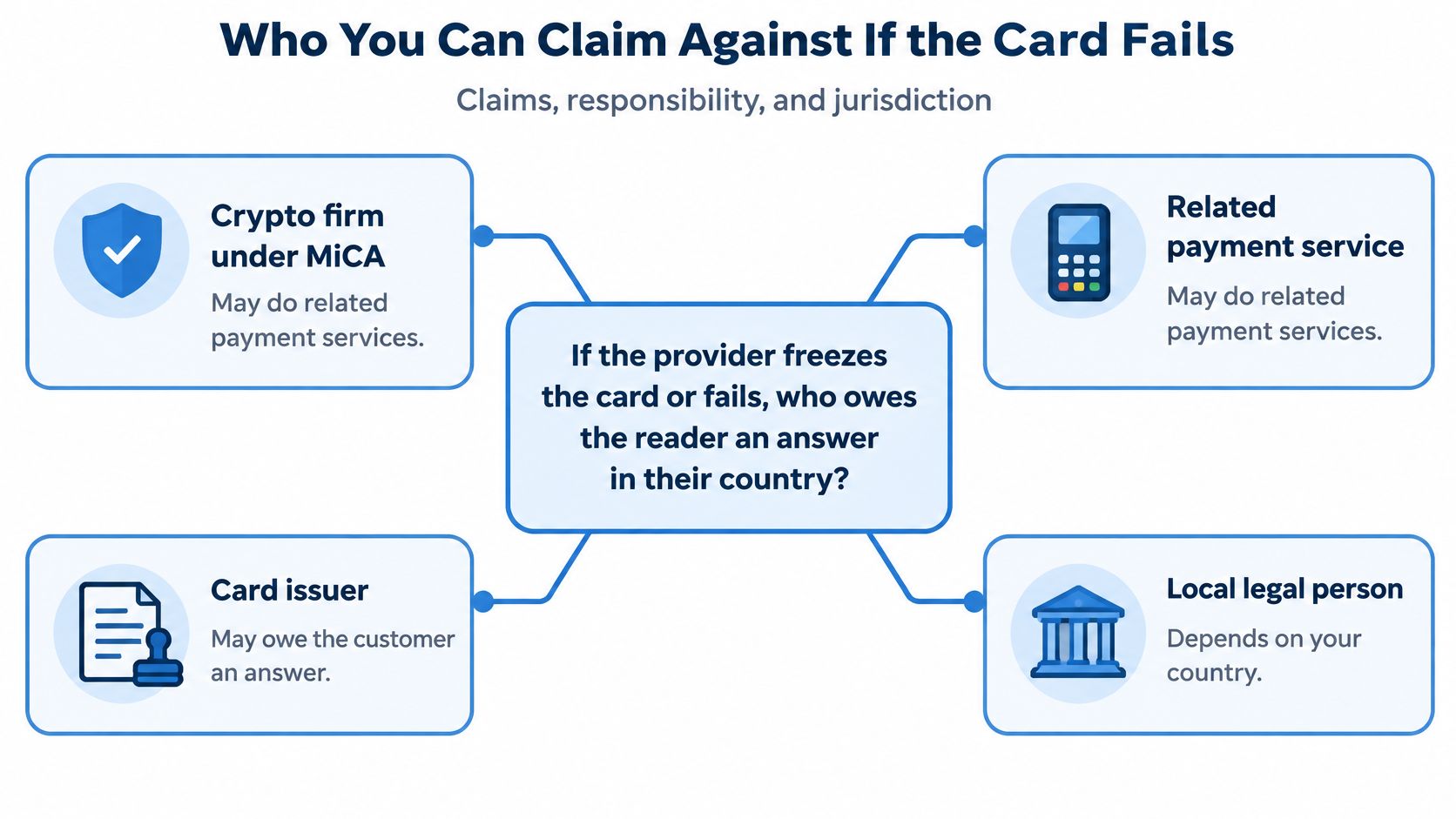
If the provider freezes your card or fails, which legal person owes you an answer in your country? “Available in Europe” and “MiCA-compliant” don't identify that company. One card brand can involve a card scheme, an issuer, a payment institution, and a crypto-asset firm, each with a different role.
The EU's MiCA regulation allows a crypto-asset service provider to offer related payment services itself or through a third party authorised under PSD2. That makes it important to distinguish the crypto provider from the payment provider rather than treating the product name as a single licensed entity.
Map the roles before you apply
- Card scheme: Visa or Mastercard supplies the payment-network rails merchants accept. The scheme doesn't hold your crypto.
- Card issuer: The issuer provides the card. It's a key contact for card disputes and card-account problems.
- PSD2 payment institution: This entity executes payment services and is relevant to how fiat or electronic-money-token balances are handled.
- MiCA crypto-asset service provider: This firm may hold, exchange, or otherwise provide services for your crypto assets.
- Contracting legal entity: This is the company named in your agreement. It helps establish which regulator and complaint route apply to you.
MiCA has applied to certain crypto-assets and crypto-asset services since December 2024, while transitional arrangements in some Member States may allow firms to continue under national law until July 2026. During that period, customers may not have MiCA protection when using a provider that hasn't obtained the relevant authorisation, as EU consumer authorities explain in their notice on crypto-asset protections. The applicable protection can also vary with the service and asset involved.
Self-custody changes who holds the keys; it doesn't prevent a card issuer from freezing a card. And a payment dispute can't restore a lost seed phrase. Before applying, write down the contracting company, its regulator, whether spending triggers an exchange trade or a payment transfer, and where complaints go. If the provider's terms don't make those answers clear, don't rely on the card's branding as a substitute.
What Stays Visible After a Light Signup
A card purchase leaves data across a payment chain. The practical question is who can connect your identity to the purchase, not how little the signup form asks for.
A merchant payment passes through a payment provider and card scheme. A custodial exchange can link the transaction to the verified account holding your balance. With a self-custody card, your assets may stay in a wallet you control, but card providers still process the transaction and the scheme handles the payment.
Follow the data from signup to settlement
Crypto services can involve recordkeeping and information-sharing requirements. That makes “minimal signup means private spending” an unsafe assumption, even when the provider asks for little information at first.
A card linked to a custodial wallet may involve identity checks, transaction monitoring and account-level controls. Strong customer authentication can add a verification step. A self-custody card may require wallet signatures or transaction approvals. Check which providers receive your data, what triggers additional review, how long records are kept and what information may be shared with authorities.
The European Banking Authority's consumer guidance on crypto fraud and scams advises consumers to verify provider authorisation and watch for phishing, lost access, hacking and stolen wallet credentials. Those risks apply whether you begin with an ID check or a wallet connection.
Privacy depends on the whole payment chain, not just the KYC label. The card scheme processes the purchase, the payment institution handles payment services, and a crypto custodian may see account or wallet activity. A light signup does not remove those separate points of visibility.
Account recovery is a useful test. If a provider can restore access to your card or account, recovery is tied to your identity or account details. If access depends only on your wallet credentials, you retain more control, but losing those credentials can mean losing access permanently. Minimal onboarding means less information collected at the door, not an anonymous purchase at a European merchant.
Match the Card to How You Actually Spend
A frequent traveller, a stablecoin spender, and a DeFi user don't need the same card. Pick a fit based on how you move funds and where you use the card, then identify who should skip that setup.
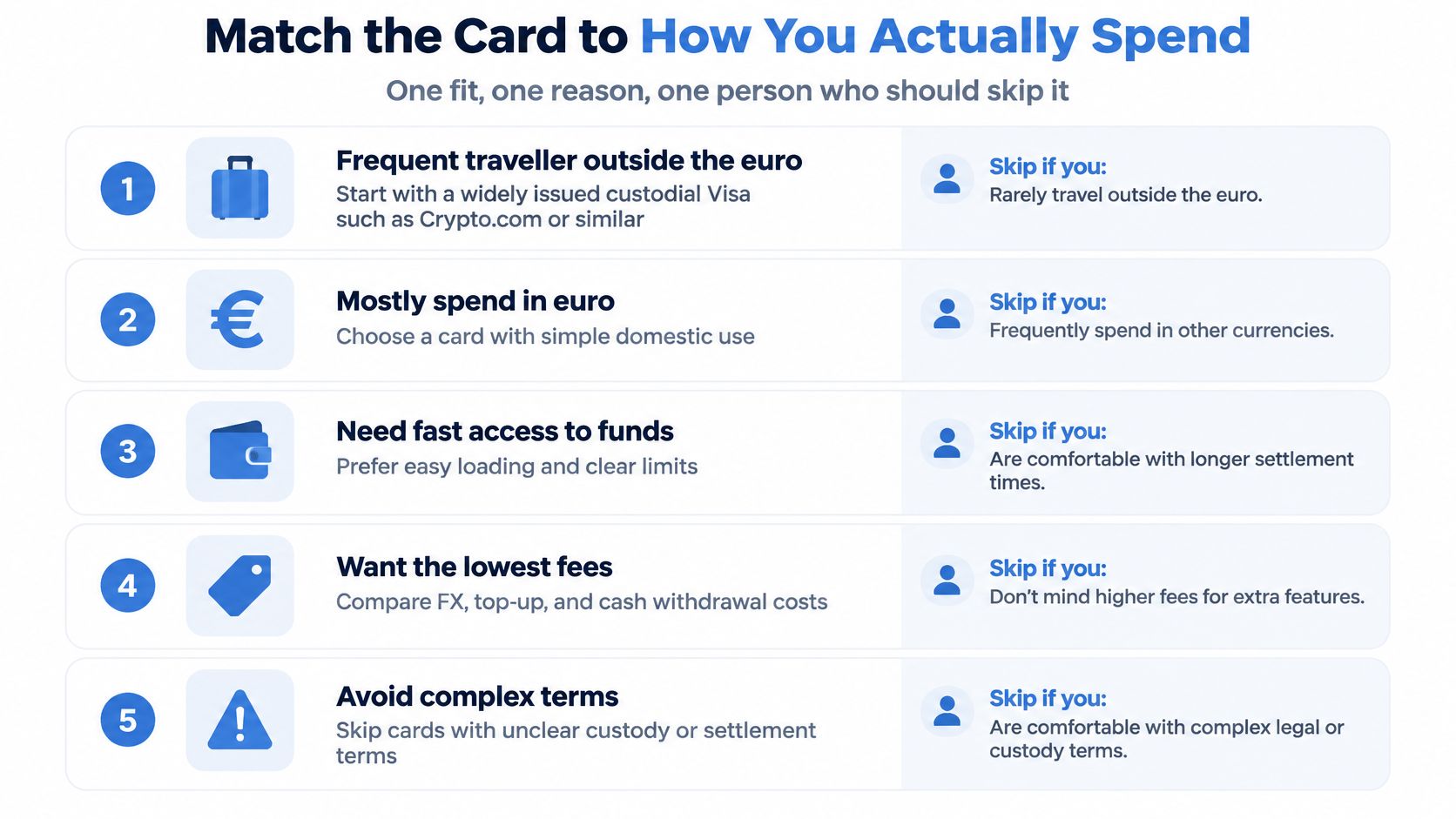
- Frequent traveller outside the euro: Start with a widely issued custodial Visa, such as Crypto.com, or a familiar app such as Revolut. You'll want clear FX terms and reliable card access, not an on-chain step before every purchase. Skip a wallet card with a short country list if your residence or travel needs fall outside its rollout.
- Rewards optimiser willing to hold a stake: A tiered custodial card can fit if you already intend to hold its required token. First compare the stake and card costs with your likely rewards. Skip it if you'd buy or lock the token only to chase cashback.
- Stablecoin spender paying euro expenses: Look for a path built around a stablecoin such as EURe or USDC, such as Gnosis Pay or a Coinbase-style USDC spend where available. Don't route volatile BTC through routine purchases unless you're comfortable with the conversion and resulting asset sale.
- DeFi user who won't leave coins on an exchange: Consider Gnosis Pay or MetaMask Card, but accept that wallet prompts, network costs, and narrower availability can be part of the experience. Skip this route if you need a straightforward recovery desk after losing your wallet credentials.
- Privacy-sensitive resident: Treat lighter onboarding as less information collected at signup, not as anonymous merchant spending. Skip any setup if its data linkage and recovery process exceed the privacy trade-off you're willing to accept.
There's an important edge case: a card can be advertised for Europe yet fail for a resident of a smaller EEA state, or for someone whose current location and tax residence don't match. Your fit is only real once the program confirms issuance and delivery for your specific circumstances.
Confirm the Issuer Before You Apply
Finish with a decision sequence, not a rewards ranking.
- Confirm issuance. Verify that the program accepts your country of residence and whether you'll receive a virtual card, a physical card, or neither.
- Name the companies. Identify the contracting entity, card issuer, and crypto custodian. For background on the EU licensing framework, consult this guide to MiCA-licensed exchanges in Europe.
- Price your real spending. Estimate the monthly cost using the exchange, FX, ATM, and any stake conditions that apply to your expected use.
- Decide on control and recovery. Choose whether you're comfortable with custodial access, wallet responsibility, and the possibility of card restrictions.
- Check the provider's current terms before applying. Card terms can differ by country and tier, so use the provider's own site to confirm the details that apply to you.
Crypto and the cards that spend it can lose funds. NomadCard is not a bank, card issuer, or financial adviser, and a comparison isn't a replacement for the provider's agreement or your own assessment of risk.
Use NomadCards to narrow your options with its five-question card finder, then confirm that the provider will issue the card to your country. Apply only when you can name the company behind the card and are comfortable with its custody and payment terms.