A crypto card offering the highest cashback rate isn't automatically the most rewarding card. That advice ignores the costs that determine what you keep, including staking lockups, token volatility, foreign exchange spreads, withdrawal charges, custody exposure, and whether the card works in your country at all.
The useful figure isn't the advertised rate. It's effective yield, calculated after every condition attached to the reward. A lower flat reward paid without staking can outperform a spectacular token rebate once you account for capital tied up in a volatile asset and fees charged on international spending.
Table of Contents
- The Truth About Crypto Card Rewards
- Calculating the Effective Value of Crypto Cashback
- Custody Models and How Redemption Works
- Hidden Costs That Erase Your Rewards
- Tax and Regulatory Realities
- Real-World Calculation Walkthroughs
- How to Choose the Right Card for Your Priorities
The Truth About Crypto Card Rewards
Crypto card marketing often puts the biggest percentage on the first screen. That number may describe a top tier, a temporary promotion, a reward paid in a platform token, or a rate available only after you stake assets and meet spending conditions. Treating it as the expected return is the first mistake.
Crypto card rewards usually fall into a few practical structures:
- Flat spending rebates: You earn a consistent reward on eligible purchases, often in a stablecoin, fiat-linked balance, or native token.
- Tiered rewards: The rate rises when you hold a larger balance, pay for a subscription, or qualify for a higher card tier.
- Staking-linked rewards: You lock a platform token or other asset to access better benefits, sometimes including airport perks, fee waivers, or boosted cashback.
- Promotional rewards: The issuer temporarily increases the rate for selected merchants, regions, or transaction categories.
The distinction between these models matters more than the headline percentage. A flat reward is easier to forecast because your return depends mainly on eligible spend and fees. A token-based reward adds another variable, the market value of the asset when you receive it and when you sell it.
Why the reward exists
Card issuers can use merchant transaction revenue to support rewards, but that revenue doesn't automatically justify every advertised rate. Industry analysis describes card interchange as the economic foundation of reward pools, while rates above roughly 1% to 2% often require additional support from token treasuries, staking, paid subscriptions, exchange spreads, or locked user capital. The economics of crypto card cashback explains why a generous rebate can be part of a broader customer-acquisition model rather than a self-funded payment benefit.
That model can work for the issuer while producing a poor result for the cardholder. The issuer may earn from your conversion activity, subscription, spread, or staked balance, while you focus on the cashback percentage alone.
Practical rule: Never compare reward rates until you've written down the required stake, reward asset, redemption process, eligible purchases, fees, and country restrictions.
Consumer demand helps explain why issuers promote rewards so aggressively. Visa research cited in the crypto credit card market overview found that 84% of current crypto owners were interested in crypto rewards and 81% were interested in crypto-linked cards. Among people curious about crypto rather than already owning it, interest was 82% for crypto rewards and 78% for crypto-linked cards. The research also reported that interest among current owners stayed at 84% in the later update, indicating durable appeal rather than a short-lived feature trend.
Those figures don't prove that a particular card is good. They show why rewards sit at the center of the category. Users need a practical reason to spend digital assets, and issuers use cashback to supply that reason. Your job is to determine whether the incentive survives the conditions attached to it.
Calculating the Effective Value of Crypto Cashback
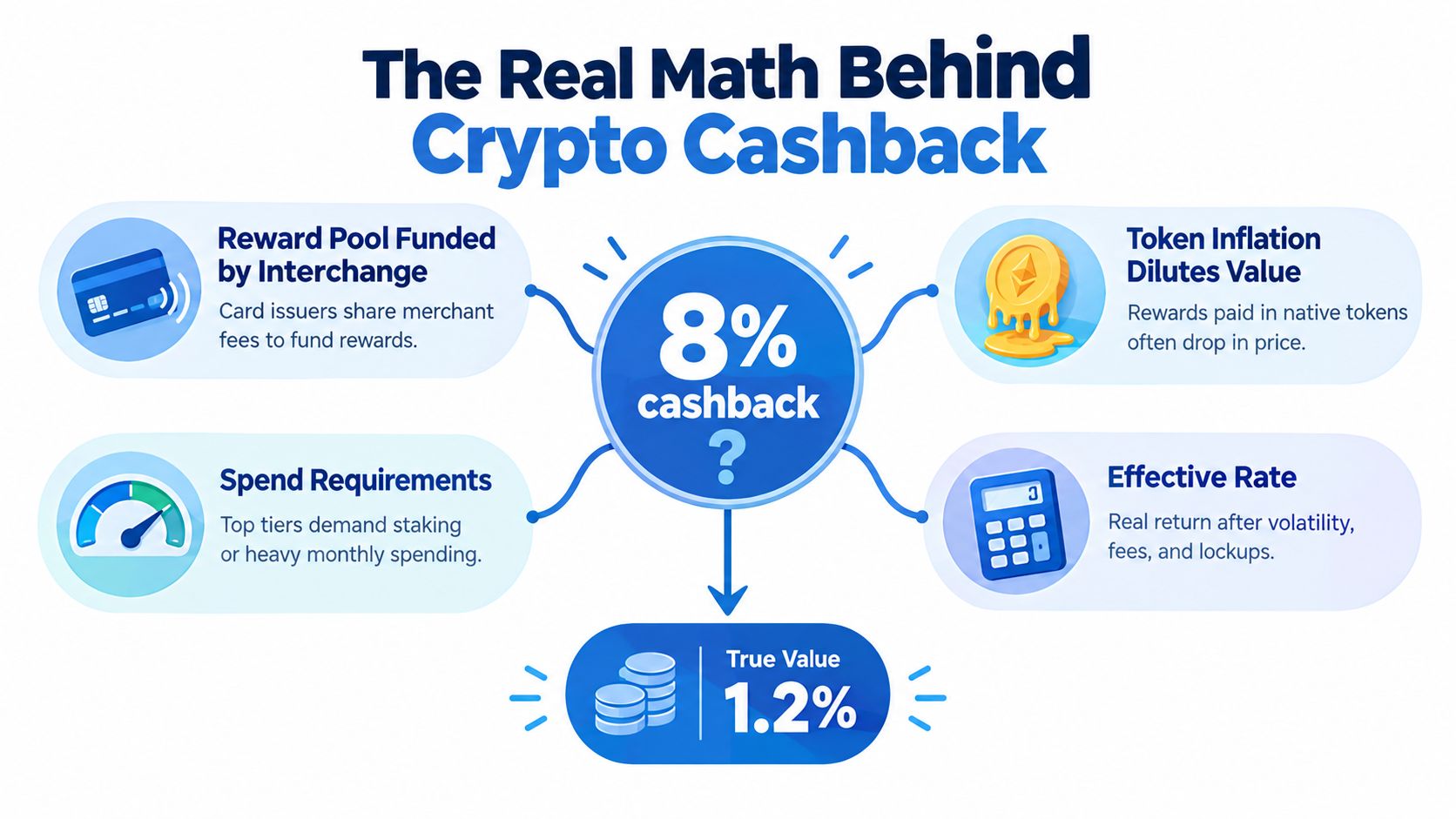
A 5% or 8% cashback rate can look outstanding beside ordinary card rewards. Market summaries commonly place mainstream crypto card rewards around 1% to 5%, while premium staking-based tiers can reach 8% or higher. Some promotional programs have claimed rewards as high as 18%, yet caps, staking requirements, foreign exchange charges, token volatility, and access restrictions can reduce what reaches your wallet. Crypto card rewards statistics and market benchmarks provides useful comparison context.
The issuer does not receive the full purchase value as revenue. Interchange contributes to the reward pool, but regional rules limit that income. A reward materially above transaction revenue needs another funding source, such as a token treasury, subscription revenue, exchange spread, or staking requirement. The advertised rate therefore says little about your effective yield.
Where the headline rate loses value
Suppose a card pays rewards in its own token. The nominal return is recorded when the issuer credits that token, while the economic return depends on what you can obtain when selling or spending it. A falling token price reduces the reward without changing the percentage shown in the advertisement.
Staking adds an opportunity cost. Locked tokens may qualify you for a higher tier, but they remain exposed to price movements and may be unavailable for other uses. The reward can still underperform after accounting for the value lost during the lockup or the return available from holding a more liquid asset.
Foreign exchange spreads create another deduction for international spending. A card can advertise a strong cashback rate while applying a conversion rate that reduces the value of both the purchase and the reward. Compare the amount charged in your funding currency with the merchant's original currency before judging the benefit.
Paid tiers require the same treatment. Add the subscription to your annual card cost, then divide it across qualifying spending. A tier that suits a high-spend traveler may be uneconomic for someone who uses the card occasionally. A practical crypto card cashback analysis offers a useful complement to this unit-economics approach.
Calculate the reward twice: first as advertised, then as cash or stablecoin value after conversion costs, caps, subscription fees, staking exposure, lockups, and excluded purchases.
Independent analyses have found that effective reward rates after fees, conversion spreads, and staking constraints commonly compress to roughly 0.8% to 2.5%. That range is not a promise for any card. It is a warning against treating the promotional percentage as the return in your pocket.
The video below provides another visual explanation of the mechanics and trade-offs.
Custody Models and How Redemption Works
The reward rate tells only part of the risk story. A card's custody model determines who controls the assets behind your spending balance, how quickly you can redeem rewards, and what happens if the provider restricts your account.
A custodial card usually connects to a centralized exchange or financial platform. You deposit crypto into an account controlled by the provider, and the platform handles the conversion when you pay. That workflow is convenient. You don't need to approve a transaction manually for every purchase, and the card can feel similar to a traditional debit product.
The trade-off is counterparty exposure. The provider may control withdrawals, freeze an account, change reward terms, or restrict service in a region. You also need to trust its custody, security, compliance, and liquidity arrangements. A high reward doesn't remove those risks.
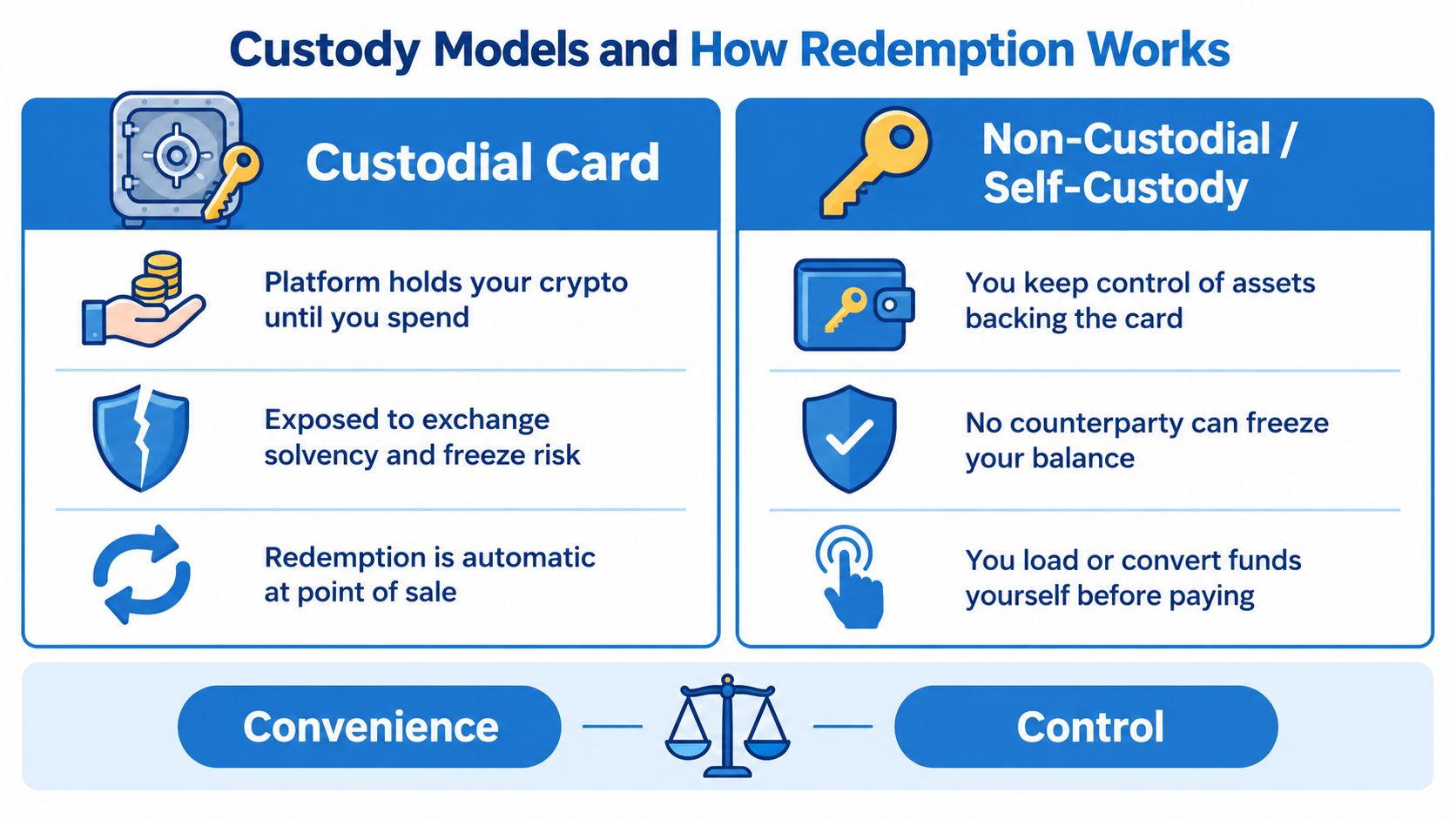
Convenience versus control
A self-custodial or non-custodial card uses a different architecture. The spending balance may remain in your wallet or move through an on-chain contract, and you may need to load funds, approve a conversion, or maintain a supported asset before paying. This preserves more direct control, but it puts more operational responsibility on you.
The redemption experience can differ in several ways:
- Automatic conversion: A custodial platform converts the selected asset at the point of sale. You gain speed, but you must accept the platform's conversion rate and custody arrangement.
- Manual loading: A self-custodial product may require you to convert or load funds before spending. You gain visibility into the transaction, but a payment can fail if the balance or approval isn't ready.
- Reward crediting: Some programs credit rewards immediately in a native token, while others apply them later or require a separate redemption action. Read the rules before assigning a cash value to the reward.
- Asset restrictions: A card may support only selected coins or stablecoins. Holding a popular asset doesn't guarantee that the card can spend it directly.
The custodial and self-custody crypto card comparison helps frame the decision around control and convenience rather than cashback alone. Privacy-focused users may accept more manual work to reduce exchange exposure. Users who prioritize predictable point-of-sale payments may prefer custody with automatic conversion.
Neither model is universally safer or more suitable. A self-custody wallet can reduce reliance on a centralized provider, but poor key management or a mistaken contract approval can create its own problems. A custodial account can simplify recovery and spending, but it concentrates control with the platform.
Hidden Costs That Erase Your Rewards
A headline reward rate is not your return. Effective yield is what remains after FX markups, conversion spreads, withdrawal charges, lockups, and the cost of keeping funds with a provider. A card offering lower cashback can leave more in your pocket if its underlying costs are easier to control.
Foreign spending exposes the first leak. An FX fee is charged against the transaction value before cashback is assessed, so a reward can appear positive while the purchase costs more than expected. Comparisons report foreign exchange fees ranging from 0% to 2.5% across many crypto cards, with ATM charges and physical-card fees adding further friction. This crypto card fee comparison also explains why regional interchange economics limit how much issuers can sustainably return from card transactions alone.
Regional payment economics constrain rewards. Consumer debit and credit interchange caps in the EU, along with the Durbin debit cap in the United States, limit the revenue available from a card transaction. Those rules do not set your final price, but they help explain why a high reward rate may be funded through subscriptions, spreads, token incentives, staking requirements, or other charges.
For a usage-specific review, see this crypto card fees comparison, which helps model FX, ATM, and conversion costs against your spending pattern.
Build the net calculation
Use the same fields for every card so the comparison is normalized:
- Start with rewards credited on eligible spending.
- Subtract FX markups on foreign purchases.
- Subtract ATM charges, card issuance fees, subscriptions, and conversion spreads.
- Discount rewards that may lose value before redemption.
- Include the economic cost of staked funds, lockups, or a required balance.
- Divide the result by total spending, including transactions that earned no reward.
A traveler should rank FX treatment alongside cashback. A domestic user may care more about caps, excluded merchants, and conversion pricing. Someone who withdraws cash should calculate ATM costs separately. A card can perform well for purchases and poorly at cash machines.
The same framework should include custody trade-offs. A higher reward may require holding assets on a platform, accepting withdrawal limits, or keeping capital locked for eligibility. Those conditions reduce effective yield even when the advertised rate stays unchanged.
A reward has value only after conversion, redemption, and fees are accounted for.
Do not treat a zero-FX claim as universal. Check whether it covers purchases, weekend conversions, cash withdrawals, and the currencies you use. Confirm that the provider does not apply its own spread while labeling the explicit FX fee as zero.
Tax and Regulatory Realities
Crypto card spending can create recordkeeping work that ordinary cashback cards usually avoid. The tax treatment depends on your jurisdiction, the asset you spend, how the card converts it, the nature of the reward, and whether the reward is connected to a purchase or paid as a separate incentive.
A practical workflow starts with the transaction record:
- Record the asset disposed of. Note the coin, token, or stablecoin used to fund the payment.
- Capture the acquisition details. Keep the original acquisition date, cost basis, and transaction reference where your local rules require them.
- Record the spending value. Save the fiat value used by the card provider at the time of conversion, along with any fee or spread.
- Separate the reward. Track whether it arrived as a spending rebate, stablecoin, native token, referral payment, or promotional credit.
- Export regularly. Keep card statements, wallet activity, exchange records, and reward distributions together rather than waiting until filing time.
Spending an appreciated crypto asset can be treated as a disposal in some jurisdictions, which may create a capital gain or loss even though you used the asset to buy groceries. That outcome differs from the treatment of the cashback itself. A spending-based reward may be treated as a rebate or price adjustment, while a reward not tied to a purchase can receive different treatment.
Native-token rewards need particular care. The relevant tax event may depend on when you receive control of the tokens, when you redeem them, and whether their value changes before disposal. Don't assume that every reward is automatically income, and don't assume that every reward is automatically tax-free.
For users who want software support, a curated guide to top-rated crypto tax solutions can help compare tracking and reporting tools. Choose a system that imports card transactions and wallet activity, preserves cost-basis data, and lets you review reward credits separately.
Rules vary significantly. Keep the records first, then ask a qualified tax professional how your jurisdiction treats each event. The card's convenience isn't worth losing the evidence needed to explain your transactions.
Real-World Calculation Walkthroughs
A useful comparison starts with the amount that remains spendable after every required cost. Headline cashback is only the first input. Staking lockups, foreign-exchange pricing, conversion spreads, subscription fees, reward caps, and custody risk can all reduce the return shown in an advertisement. The reward and FX ranges used here are documented in the crypto card rewards market comparison and the independent crypto card fee analysis.
Example one with flat rewards
Assume a user spends 1,000 units of their home currency on eligible domestic purchases. A no-staking, self-custodial card pays a flat 1% reward, producing 10 units of nominal value. With no FX fee, staking lockup, or conversion charge, the effective reward remains 10 units.
That result is predictable, but predictability does not make the card suitable for everyone. Another product may offer broader acceptance, automatic conversion, or a reward asset the user actually wants to hold. The comparison should measure the value received, not just the advertised rate.
Example two with a capped reward and subscription
Consider a user spending 2,500 units per month. A card may advertise a high reward rate while applying a monthly cap and charging a subscription fee. Calculate the reward on eligible spending only, then subtract the subscription cost. Spending above the cap earns no additional reward, so the effective yield falls as total monthly spending rises.
The same method applies if the reward requires staking. Record the value of the locked balance, the lock period, and the token's price movement. A reward can look attractive on spending while the qualifying stake loses value or remains unavailable for other uses. That opportunity cost belongs in the user's return calculation, even though it does not appear as a card fee.
Example three with international spending
Now assume the user spends 1,000 units abroad on a card advertising 5% cashback and charging a 2% FX markup. The nominal reward is 50 units, while the FX cost is 20 units. The remaining 30 units represent a 3% result before token-price movement, staking cost, subscription fees, reward limits, or conversion spreads.
| Card archetype | Nominal cashback | FX and hidden fees | Effective yield in the simplified example |
|---|---|---|---|
| No-staking self-custodial card | 1% | 0% FX fee | 1% |
| Centralized exchange card | 5% | 2% FX markup | 3% before token movement and staking cost |
The table is a calculation aid, not a product ranking. It does not assign a universal value to custody, locked capital, or token volatility. Those costs depend on the amount staked, the lock period, price movement, and the user's alternative use for the funds.
The useful comparison is not 1% versus 5%. It's spendable reward minus every cost attached to earning and redeeming it.
Apply the worksheet to actual statements. Separate domestic and international purchases, check eligibility and caps, enter the conversion rate, deduct subscriptions and FX charges, and treat staking exposure as a risk-bearing balance rather than a free qualification step.
How to Choose the Right Card for Your Priorities
There isn't one best crypto card for every user. A frequent traveler, a privacy-focused user, and a rewards optimizer can rationally choose different products because they assign different weights to custody, availability, conversion costs, and operational effort.
Start with the constraints that can disqualify a card before you compare rewards. A product unavailable in your country has no effective yield. A card that requires exchange custody isn't suitable if self-custody is essential. A high tier that depends on staking may be inappropriate if you can't tolerate token volatility or a locked balance.
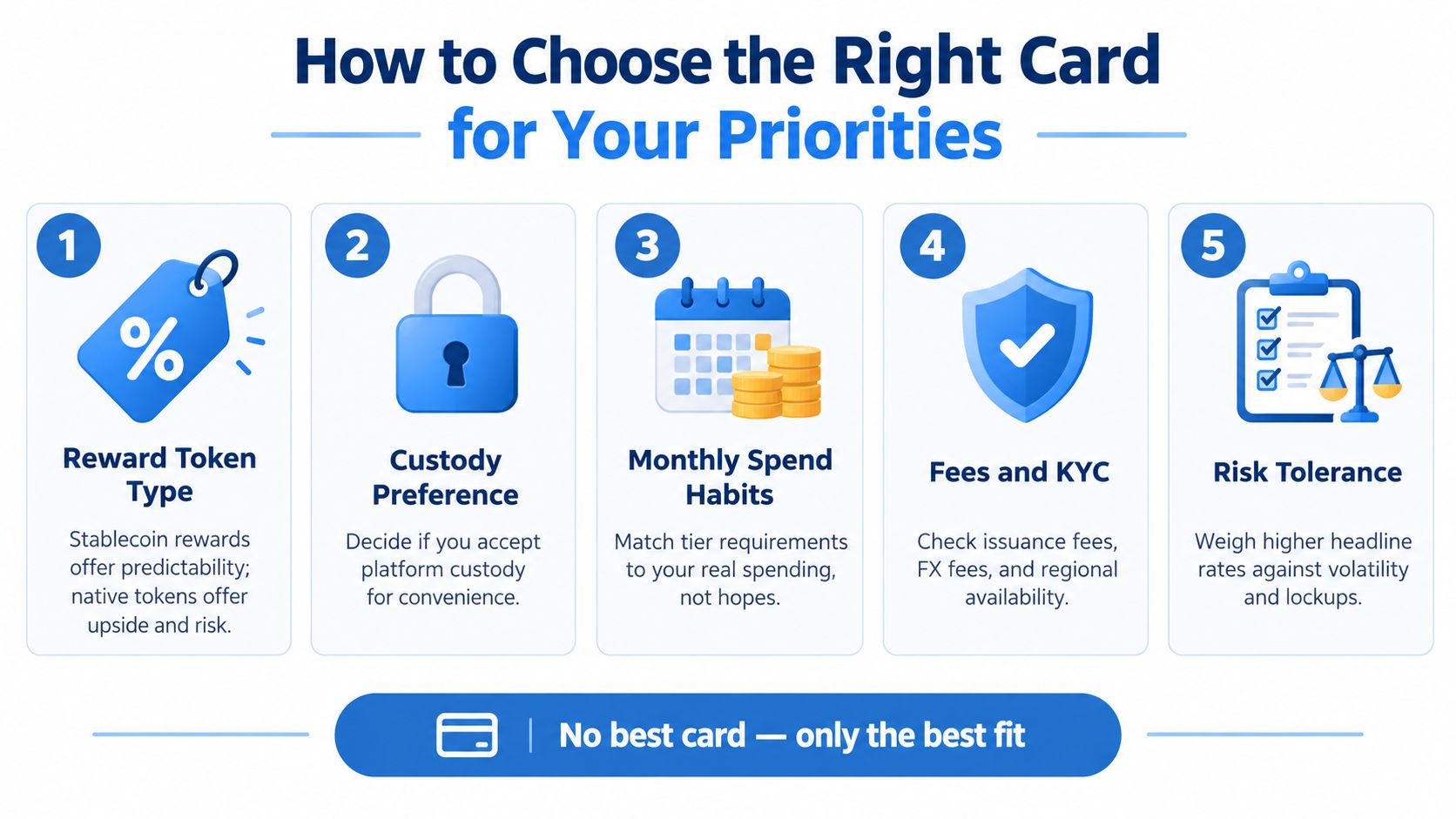
Match the card to the user, not the advertisement
Privacy-focused spender: Filter for the verification level you can accept, then inspect the custody model and supported jurisdictions. A no-KYC or minimal-KYC option may involve lower limits, fewer services, or more manual funding, so compare the whole workflow rather than the label alone.
Frequent traveler: Put FX pricing, ATM terms, supported currencies, and regional availability ahead of the maximum cashback tier. A flat reward with transparent conversion can be more useful than a higher token rebate that loses value on every foreign purchase.
Self-custody user: Confirm where the spending funds remain, whether a smart contract or wallet approval is involved, and how you recover access if the card interface becomes unavailable. Read the redemption instructions before moving assets.
Rewards optimizer: Calculate the break-even spending level for the paid or staked tier. Include the stake's volatility, any lockup, token liquidity, reward caps, merchant exclusions, and the cost of converting rewards into an asset you actually want.
Occasional user: Favor simple terms. A subscription or stake can overwhelm a reward if your eligible spending is modest, even when the advertised rate looks attractive.
Regional availability deserves its own check. Recent market coverage shows that strong reward programs can be limited to markets such as Brazil, the United States, the United Kingdom, the EU, or selected APAC regions. The same coverage describes movement toward simpler flat rewards on self-custodial or low-fee cards, while premium programs remain tied to token dependence, staking, and rollout limitations. This regional crypto card rewards coverage provides useful context for that comparison.
For a like-for-like review, normalize these fields:
- Reward value: Asset, timing, eligibility, caps, and redemption route.
- Total cost: Annual or subscription fees, FX, ATM, conversion, and physical-card charges.
- Capital exposure: Staking amount, lockup conditions, and token volatility.
- Control: Custodial or self-custodial structure, withdrawal access, and account restrictions.
- Availability: Country, card network, supported assets, virtual or physical format, and verification requirements.
Use the card for a small test purchase before moving meaningful funds. Confirm the exchange rate, reward credit, statement description, and withdrawal process. Then calculate effective yield from your own records, not from the promotional banner.
NomadCards aggregates and normalizes crypto card data across rewards, fees, custody models, verification requirements, supported assets, networks, and regional availability. Visit NomadCards to compare cards by the conditions that determine effective yield, not just the highest cashback headline.