The most common advice about choosing a crypto cash back credit card is to pick the highest reward rate. That's the wrong starting point. A useful comparison ranks cards by what you can redeem after costs, not by the percentage displayed before fees, currency conversion, token-price changes and borrowing charges.
The harder question is whether the reward compensates you for the conditions attached to it. A membership fee requires enough eligible spending to recover it. A staking requirement puts capital at risk outside your purchases. A reward paid in a volatile token remains an investment position until you convert or spend it.
Table of Contents
- What Crypto Cash Back Credit Cards Are
- Reward Models Compared Side by Side
- Net Value After Fees, FX and Volatility
- Custody, KYC and Network Differences
- Tax Records for Crypto Rewards
- Pick the Card for Your Goal and Test It
What Crypto Cash Back Credit Cards Are
A crypto cash back card is a payment product, not a single funding model. It returns part of eligible spending as cryptocurrency or a crypto-linked balance, and may also let you spend crypto or stablecoins at merchants that accept Visa or Mastercard. Some cards provide a credit line; others spend from a funded balance. The label alone does not tell you whether a purchase creates debt.
Start by separating three things: how the purchase is funded, how any crypto is converted, and what asset you receive as a reward. Then check who holds each balance. That distinction matters because earning crypto on purchases does not require using existing crypto to pay for them.
Follow the money separately
- Funding: Check whether purchases draw on deposited crypto, a fiat balance or borrowed money.
- Conversion: Find out when crypto is exchanged for fiat and which rate applies.
- Reward settlement: Confirm the reward asset, where it is held and when you can redeem it.
A card can combine these functions in one app, but they remain separate financial decisions. Treat the purchase account and reward account as distinct products.
Practical rule: Wanting crypto rewards does not mean you want to liquidate crypto for everyday purchases.
The Kansas City Fed's payment-use analysis examines how U.S. consumers use cryptocurrency for payments, but payment use alone does not establish how common crypto-reward cards are or which customers they suit (Kansas City Fed payment-use analysis). Visa's analysis reports that crypto-linked card spending reached nearly $4.5 billion globally in the first half of 2025, compared with $100 million in the same period of 2024 (Visa's crypto-linked card analysis). That growth describes transaction volume, not the return an individual cardholder receives.
The headline rate is only the first number. Its practical value depends on the reward model and the card's costs, while custody, identity checks, network, tax records and spending habits determine whether the product fits. A higher advertised rate can deliver less value once those terms are accounted for.
Reward Models Compared Side by Side
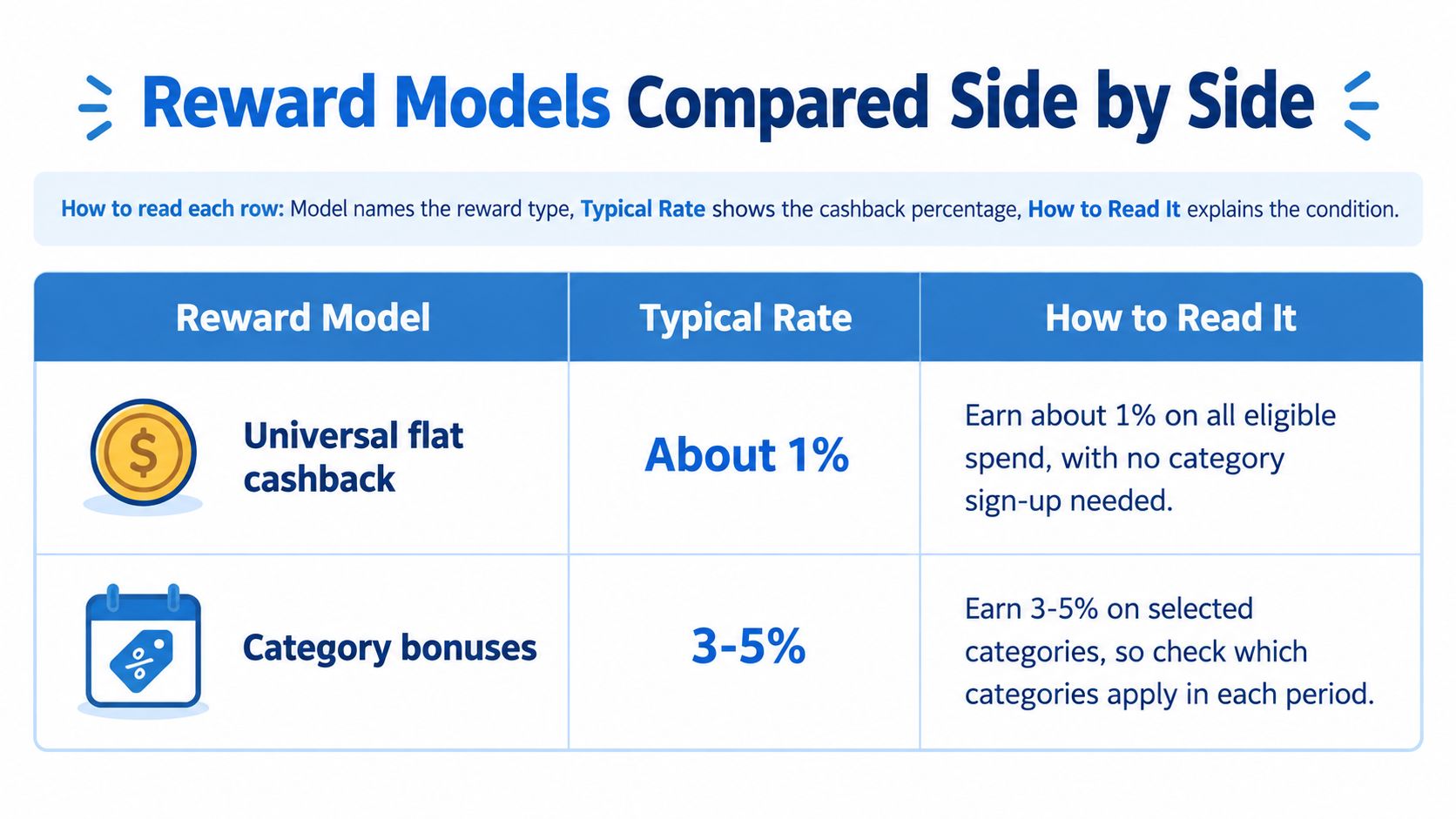
The headline rate only ranks a card before eligibility, fees and reward conditions are considered. The comparison below separates six models by how rewards are earned and what can change their realized value.
Reward models compared on the same criteria
| Reward model | Typical headline rate | Paid in | Main requirement or fee | Main trade-off |
|---|---|---|---|---|
| Universal flat cashback | About 1% on eligible spend | Fiat or stablecoin, depending on program | Eligible purchases; verify fees | Simple to estimate, but the rate may be modest |
| Category bonus | 3–5% on selected categories | Program-selected reward asset | Qualifying categories and applicable caps | Return depends on spending mix and caps |
| Multi-asset cashback | Program-specific; verify current terms | Cardholder-selected crypto | Asset eligibility and redemption terms | Asset choice affects realized value |
| Tiered premium rate | Higher rate at upper tiers; verify current terms | Crypto or stablecoin | Balance or stake requirement | Higher rewards require committed capital |
| Staking-linked reward | Program-specific; current rate unverified | Issuer native token | Stake lock-up | Token-price and liquidity exposure |
| Crypto-backed credit line | Program-specific; current rate unverified | Fiat or stablecoin, where offered | Interest on carried balances | Borrowing costs can outweigh rewards |
The percentage examples are reference structures, not verified current offers. Visa's industry material discusses the economics of crypto-linked card programs, but it does not verify these particular rates as current offers (Visa industry material on crypto-card economics). The multi-asset row is qualitative because no issuer-specific asset count or rate is verified here. Check current issuer terms before comparing products.
Flat rates and category rates need different budgets
A flat-rate model applies one advertised percentage to eligible purchases. A category model pays a higher rate only on qualifying purchases, so estimate its return against your actual spending mix and account for any caps. Applying the category rate to total annual spend overstates the reward whenever some purchases do not qualify.
For general spending, a flat rate is easier to forecast because it depends on fewer eligibility conditions. Category bonuses can return more when a large share of spending falls into eligible categories, but the headline percentage alone does not show that advantage.
Premium rewards aren't just purchase rewards
Tiered and staking-linked offers add a capital commitment to the spending reward. Compare the extra reward with the required balance, lock-up or withdrawal conditions, and exposure to the required asset. A higher rate attached to a stake isn't directly comparable with an unconditional spending rebate.
Multi-asset rewards add a separate investment decision: which asset to receive. Evaluate the card's fees and eligible spending independently of whether you want to hold its available tokens. Choosing a preferred token does not make a costly card more competitive.
A product walkthrough can help identify reward steps to check against issuer terms.
Finally, separate prepaid spending from credit. A funded card draws on money already committed to the account; a credit facility adds a repayment obligation. Compare prepaid cards on payment costs and access. For credit, include borrowing terms, since interest can erase the value of rewards.
Net Value After Fees, FX and Volatility
A headline reward rate can shrink sharply once costs and token-price changes enter the calculation. In an illustrative example, 3% on $12,000 of eligible spending yields $360. Subtracting a $49.99 annual fee leaves $310.01, or about 2.58%, before FX costs, conversion charges or interest. The rates and fee here are assumptions for comparison, not an issuer offer. The Federal Reserve's analysis of credit-card profitability examines card profitability, but it does not establish the figures in this example.
Use the same cost basis across cards:
Net reward = realized reward proceeds − annual or membership fees − FX costs − withdrawal and conversion costs − interest paid.
Net rate = net reward ÷ eligible spending.
The table applies stated assumptions to five cases. The token-price decline is a hypothetical scenario, not a forecast or a sourced market result.
Net reward in five scenarios, budget stated per row
| Scenario | Gross reward | Costs deducted | Net reward | Net rate |
|---|---|---|---|---|
| 3% reward on $12,000 eligible spend | $360 | None | $360 | 3.00% |
| 3% reward with $49.99 membership fee on $12,000 | $360 | $49.99 | $310.01 | Approximately 2.58% |
| 3% reward on $12,000, $49.99 fee, 2% FX on $4,000 foreign spend | $360 | $49.99 fee, $80 FX | $230.01 | Approximately 1.92% |
| 1% universal reward, no fee, on $12,000 | $120 | None | $120 | 1.00% |
| 2% token reward on $10,000, 25% price fall before conversion | $200 | $50 value loss | $150 | 1.50% |
These are illustrative arithmetic scenarios. The 1% and 3% reward rates, $49.99 fee, 2% FX spread and 25% token-price decline are assumptions chosen for comparison, not sourced market statistics. The digital-asset rewards and cost-basis guide is relevant to tracking reward value and cost basis, not evidence for the hypothetical price-fall calculation.
Calculate the spending break-even first
A fixed-fee card beats a fee-free 1% card only when its extra reward earnings exceed the annual fee:
Break-even eligible spending = fixed fee ÷ difference in reward rates.
Using the illustrative $49.99 fee and a 3% versus 1% rate, the break-even is roughly $2,500 in eligible annual spending. This assumes the rates apply to the same purchases, with no caps, exclusions, conversion costs, interest or difference between the token's value at receipt and redemption.
Below that spending level, the fee-free 1% card produces more net reward under these assumptions. Above it, the fixed-fee card can win, provided its higher rate applies to enough spending and other costs do not erase the advantage. A cap or category exclusion lowers the eligible spend used in the calculation.
A fixed fee creates a spending hurdle. A token-holding requirement creates a separate capital-allocation decision. Don't combine them into a single cashback percentage.
Rank realized value, not accumulated tokens
The FX example charges a 2% spread only on $4,000 of foreign purchases, rather than the full $12,000 budget. Applying that cost to every purchase would understate the return; ignoring it would overstate it. Check the card's actual currency-conversion terms and the purchases to which they apply.
ATM withdrawals also need separate treatment. Confirm whether they earn rewards, then subtract any withdrawal fee and relevant conversion cost, including when the withdrawal earns nothing. A crypto-card hidden-fee checklist can help identify charges beyond the advertised reward rate.
Interest belongs in the calculation whenever a balance is carried. Model it against the actual balance and repayment pattern, rather than treating the reward rate as a return independent of borrowing costs. The Federal Reserve paper addresses credit-card profitability, but it does not supply a card-specific interest cost for this comparison.
Rank cards separately for domestic purchases, foreign spending and borrowing. The winner is the card with the highest net value under your actual usage, after fees, FX, conversion, token-price movement and any interest, not the largest reward balance before redemption.
Custody, KYC and Network Differences
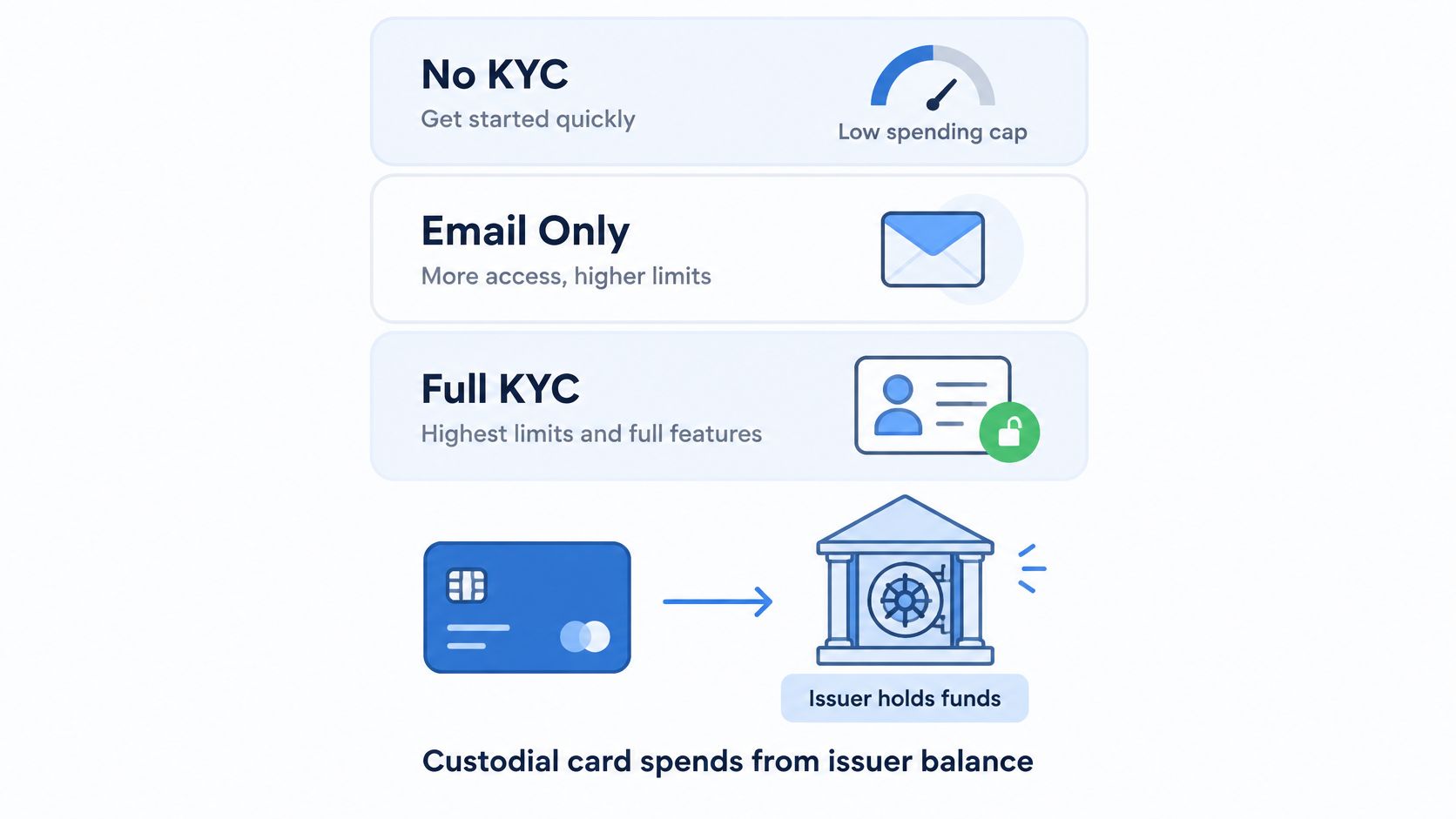
Start with the verification ladder: no KYC, email only and full KYC. Treat these as access labels to investigate, not guarantees of anonymity, unlimited spending or permanent eligibility.
For each label, ask what the issuer requires at registration, at activation and after additional checks. Don't infer custody from verification alone: a wallet-connected product can still depend on an issuer for card access.
The diagram offers a simplified verification comparison, not a substitute for the specific program's conditions.
KYC tier, custody and network by card access type
| Access type | Verification | Custody | Network | Availability limit |
|---|---|---|---|---|
| No KYC card | Confirm whether none or wallet connection suffices | Self-custodial where explicitly offered | Visa or Mastercard, per card | Issuing-country eligibility |
| Email-only card | Email initially; check later verification conditions | Confirm who controls deposited funds | Visa or Mastercard, per card | Country list and spending restrictions |
| Full KYC card | Identity documents and applicable eligibility checks | Exchange-held balance for custodial implementations | Visa or Mastercard, per card | Residency and product rollout |
| On-chain contract card | Wallet connection; verify issuer requirements separately | Contract-based where specified | Confirm the issuing network | Supported chain and issuer access |
This is a due-diligence matrix rather than a claim that every access type has the same architecture. Verify the custody and verification fields independently on the issuer's current documentation.
Separate asset control from payment access
With custodial funding, the provider controls the balance used by the card. Your assessment should include the consequences of an account restriction, withdrawal suspension or provider failure.
With self-custodial funding, inspect exactly what the wallet or contract authorizes. Keeping asset control doesn't necessarily mean you control the card's authorization service, recovery process or continued availability.
Use the custodial versus self-custody card comparison to frame those questions. The practical distinction is who can move funds, who can stop purchases and what recovery route remains if either component fails.
Check regional access before moving funds
- Resident country: Confirm that your actual residence appears on the issuer's supported-country list.
- Card format: Verify that the virtual or physical version you need is available there, rather than merely announced.
- Identity consistency: Check that the application country and documents satisfy the issuer's eligibility rules.
Network branding is another field to verify, not a substitute for checking card-specific restrictions. Confirm whether the product runs on Visa or Mastercard and whether the issuer imposes merchant, transaction or geographic limitations relevant to your plans.
The final question is operational: if the provider freezes the account or goes offline, how do you recover unspent funds? An answer that depends entirely on contacting the same unavailable provider deserves more scrutiny than an attractive reward rate can resolve.
Tax Records for Crypto Rewards
A reward arriving in your wallet creates a recordkeeping problem before you decide whether it creates immediate taxable income. You need enough information to establish what you received, why you received it and what happened when you later disposed of it.
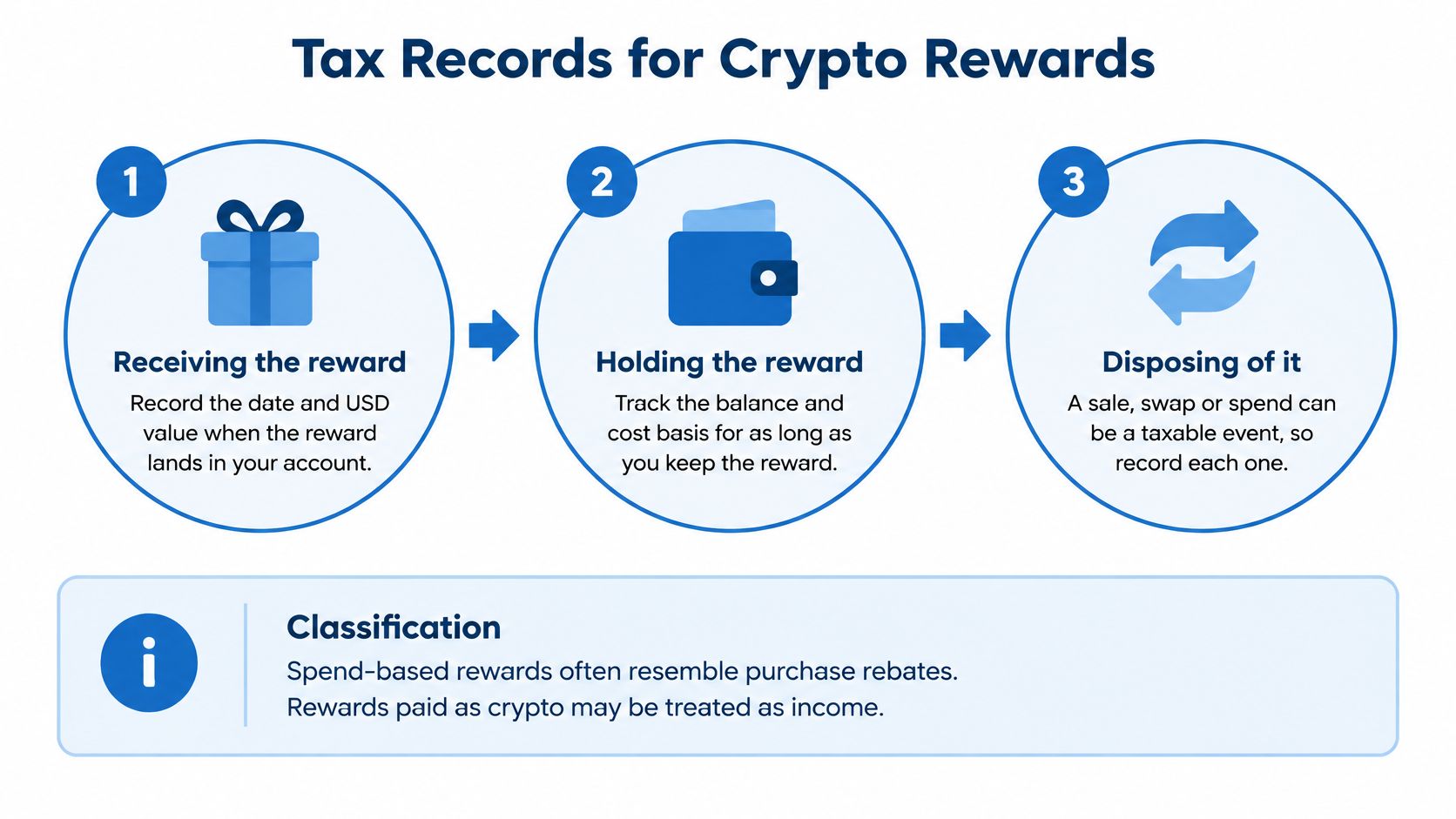
Spending-linked rewards may resemble purchase rebates, while promotional, referral or other rewards without a purchase requirement can require different treatment. Some U.S. reporting describes Form 1099-MISC at $600 of taxable rewards in a calendar year, but that reporting threshold doesn't determine the reward's underlying classification (LegalClarity's explanation of crypto-card fees, taxes and risks).
The visual separates the lifecycle events. Read its classification summary as a prompt for review, not a universal rule that every crypto reward is income.
Keep a transaction-level reward ledger
- Log each receipt. Save the date, time, asset, quantity and fiat value when the reward arrives. Retain the issuer's transaction identifier where available.
- Record the basis treatment. Preserve the valuation evidence and confirm the appropriate cost basis for the reward's classification. Don't assume the app's displayed value resolves the tax question.
- Tag the reason for payment. Separate purchase-linked cashback from promotional bonuses, referrals and staking-linked payments. Similar-looking deposits may arise from different arrangements.
- Export statements regularly. Download monthly activity and reward records rather than relying on continued app access. Check that exports retain individual transactions instead of only aggregate totals.
- Record later disposals. For a sale, swap or purchase using the reward, save the quantity disposed of, proceeds or transaction value, associated fees and relevant basis records.
- Confirm local obligations. Ask a qualified adviser which classification, forms and reporting thresholds apply in your jurisdiction.
Holding the asset preserves the need to retain its records; a later disposal may produce a gain or loss relative to the relevant basis. That's why a reward dashboard showing only the current portfolio value isn't enough.
Recordkeeping test: Before funding a card, download a sample statement. If you can't reconstruct a reward from receipt to disposal, include that administrative burden in your decision.
The guide to tax on crypto-card activity provides a starting point for identifying the events to discuss with an adviser. Your country's rules, the reward's design and its later use matter more than the issuer's choice to call the payment cashback.
Pick the Card for Your Goal and Test It
For a rewards optimizer, the ranking metric is net realized value on planned spending. But the same card can rank well for rewards and poorly for privacy or control. Don't force every objective into a single score before deciding which trade-offs you'll accept.
A useful shortlist starts with hard constraints, then compares economics among the cards that remain. Residency eligibility, acceptable verification and a workable custody model are filters, not benefits to exchange casually for a larger advertised reward.
Buyer priorities by goal
| Goal | Rank by | Check first | Common mistake |
|---|---|---|---|
| Privacy | KYC tier and custody model | Minimal-verification availability and freeze risk | Accepting full identity disclosure for a small reward |
| Rewards | Net rate after fees and FX | Reward asset, redemption threshold and price exposure | Chasing a rate locked behind a stake |
| Travel | FX markup, network acceptance and ATM limits | Foreign-spend costs and issuing network | Choosing a high headline rate without pricing currency conversion |
| Self-custody and DeFi | On-chain model and wallet support | Chain compatibility and recovery setup | Assuming self-custody removes every dependency |
The priorities graphic is useful as a decision prompt, not a universal ordering.
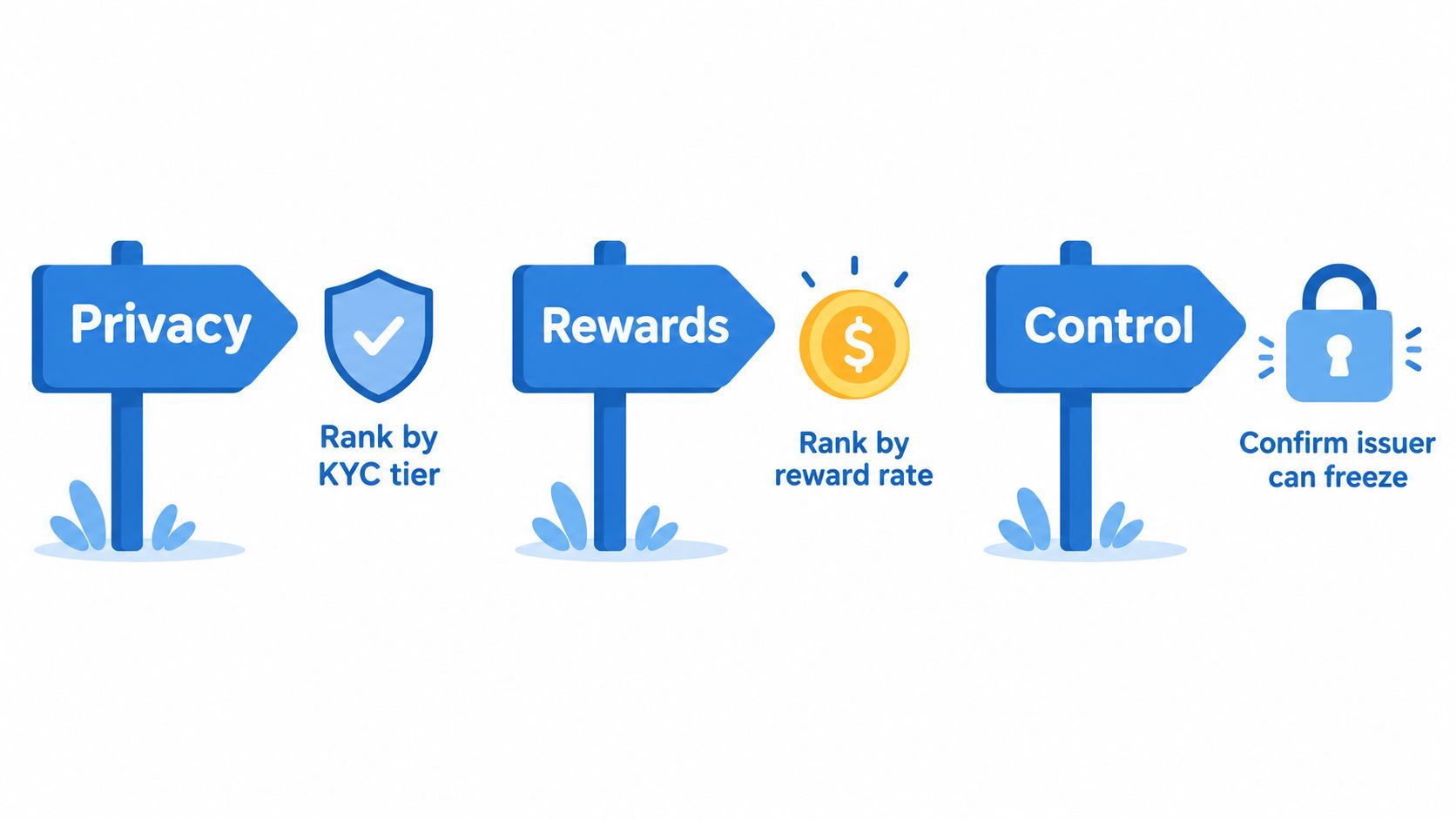
Match the ranking to the job
Privacy-focused users should decide which identity disclosures they're comfortable making before comparing rewards. An email-only label warrants checking later verification triggers and the issuer's ability to restrict access.
Travelers should prioritize the actual foreign-spend economics and access conditions. A card that works well for domestic purchases may be unsuitable if its conversion method, withdrawal restrictions or support process creates friction abroad.
Self-custody users should inspect wallet permissions and recovery arrangements. The relevant question isn't whether the product connects to a wallet, but which spending and access decisions still depend on the provider.
There are also cases where no crypto cashback card belongs on the shortlist. Low eligible spending can make fixed charges difficult to recover; habitual borrowing calls for a financing comparison first. If building credit history is a priority, verify credit-bureau reporting rather than assuming that a card marketed with the word credit will meet that goal.
Test the statement before trusting the projection
- Fund cautiously: Commit only a small amount while you test access and withdrawal arrangements.
- Compare purchase types: Make a domestic purchase and, when practical, a foreign-currency purchase.
- Reconcile the result: Compare the merchant amount, account debit, applied exchange rate, charges and reward-posting time.
- Export the evidence: Confirm that purchase, conversion and reward records are available in a usable format.
Use issuer fee schedules and cardholder agreements alongside a comparison finder. Filters can narrow the field, but the final decision depends on current terms and observed transactions.
Apply only when the net return, custody arrangement and verification requirements fit the job you need the card to do. If the test transaction contradicts the projected economics, revise the ranking before moving more money.
NomadCards compares crypto-linked debit and credit cards across rewards, fees, custody, verification and regional availability. Use its finder to filter by KYC level, network, supported coins and features such as non-custodial spending, IBAN, Apple Pay, Google Pay and virtual cards, then review its methodology and the issuer's current terms before testing your shortlist.