You're at a checkout with two crypto cards in your wallet. Both advertise attractive cashback, both run on a familiar payment network, and both appear to support the assets you hold. One delivers the reward you expected. The other takes value through conversion costs, foreign exchange markup, or a fee triggered by the way you funded the purchase.
That's why a useful crypto credit card review shouldn't be a cashback leaderboard. It should be an all-in cost and trust audit. You need to know what you pay, who controls the funds, what identity checks apply, where the card works, and whether the advertised reward survives the transaction.
Table of Contents
- Why Most Crypto Credit Card Reviews Understate the Cost
- How Crypto Credit Cards Work Behind the Scenes
- The Five Fee Layers Every Honest Review Must Expose
- Custody KYC and Trust Signals That Shape Your Choice
- A Reusable Checklist to Score Any Crypto Card Fairly
- Putting the Framework to Work With Real Comparison Tools
- Choosing the Right Card for How You Actually Spend
Why Most Crypto Credit Card Reviews Understate the Cost
At checkout, two cards can show the same cashback rate and produce very different results. One may convert your crypto at a wide spread, add a foreign exchange markup abroad, or restrict rewards to selected purchases. The other may offer less cashback but publish clearer conversion pricing, impose fewer conditions, and use a custody model you understand.
The second card can deliver more usable value. Its advertised reward is only one input. The transaction's full cost also includes how the asset is priced, when it is converted, which fees apply, and who controls the funds before settlement.
Independent comparison coverage identifies as many as five fee layers: conversion spread, per-purchase fees, FX fees, ATM charges, and annual fees. Reported ranges include conversion spreads of 0.1% to 3%, per-transaction fees of 0% to 1.5%, FX fees of 0% to 3%, ATM fees of roughly $1 to $5, and annual fees from $0 to $500. The CryptoSlate overview of crypto card fees provides the comparison context behind those categories.
Cashback still matters. Treat it as revenue in the calculation, then subtract transaction costs and account for custody risk.
What a trustworthy review should answer
A decision-grade review should answer these questions before praising a reward tier:
- What is the payment source? Determine whether the card spends preloaded fiat, stablecoins, or another crypto asset converted at checkout.
- What does conversion cost? Check the quoted rate, spread, minimum charge, and whether pricing changes by asset or region.
- Who controls the funds? A custodial exchange account creates a different counterparty relationship from a self-custodial wallet.
- What identity checks apply? “No KYC” may describe a limited product rather than a fully usable card.
- Where is it available? Issuance country, supported regions, network acceptance, and local restrictions may differ.
- What happens when something goes wrong? Review support, dispute handling, withdrawal controls, and account-freeze procedures.
NomadCards compares programs by normalizing fields such as fees, rewards, custody, KYC, supported assets, networks, and availability. Standardized fields make promotional claims easier to compare. A useful review shows the reasoning clearly, so you can apply it to your spending instead of selecting a card by its logo or headline reward.
How Crypto Credit Cards Work Behind the Scenes
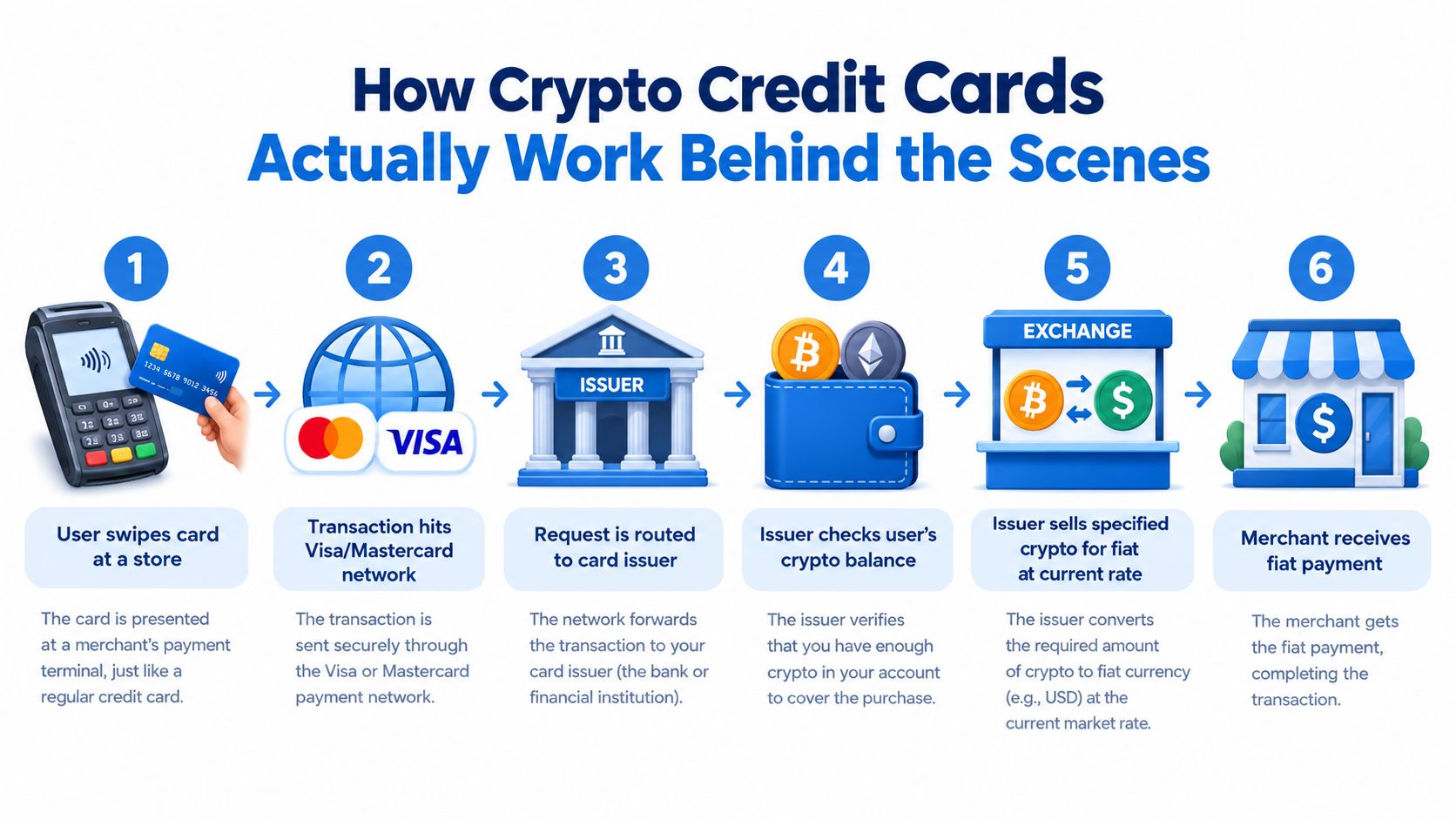
You tap a card at a café, the merchant receives ordinary fiat, and your crypto balance may fund the purchase without the cashier handling a wallet address. The crypto activity occurs behind the card authorization and settlement process.
The card works like a currency exchange booth at the point of sale. You use familiar card rails while the issuer identifies the funding asset, calculates the conversion, and provides the currency the merchant requires.
The transaction flow in plain English
- You tap, insert, or swipe the card. The terminal sends an authorization request to the merchant's payment system.
- The request reaches the card network. Visa or Mastercard routes it through payment rails also used by conventional cards.
- The issuer receives the request. The card program checks its rules, spending limits, merchant restrictions, and available balance.
- The issuer checks your crypto balance. It confirms that the wallet or linked account holds an eligible asset with enough value for the purchase and related charges.
- The issuer converts crypto into fiat. With spend-time conversion, it sells the required amount at the current rate and may reserve liquidity before approval.
- The merchant receives fiat. The store does not need to hold your crypto, connect to your wallet, or wait for a blockchain transfer.
A self-custodial card may spend from a wallet directly, but self-custody still has to meet the speed requirements of card authorization. One implementation guide describes checking the balance, locking an FX quote, and reserving fiat liquidity from a prefunded float in under two seconds. The crypto payment debit card implementation guide explains the coordination required for that process.
The merchant sees a card payment. The issuer manages the bridge between your crypto balance and the merchant's fiat settlement.
Where volatility and settlement risk sit
A preloaded fiat card converts your funds before you spend. Because the balance is already denominated in the payment currency, the issuer faces less price movement during authorization.
Spend-time conversion creates more moving parts. The provider must manage asset volatility, liquidation timing, exchange pricing, and liquidity buffers while approving the transaction. From your perspective, the result may look like a simple debit. Internally, the issuer must choose how much crypto to sell, set the conversion rate, and ensure fiat reaches the merchant.
Stablecoins play a significant role in this model because their value tracks a reference currency more closely than many other crypto assets. A market-tracking report said cumulative deposits loaded onto crypto cards crossed about $10 billion by mid-2026, after rising roughly 82% since January and reaching nearly three times the level of a year earlier. It also reported monthly card volume above $900 million, with about 88% of spending settled in stablecoins. Those figures come from the 2026 crypto card market report.
That mechanism explains why a cashback ranking alone can mislead. A card's real value depends first on its conversion rate, settlement method, custody arrangement, and ability to complete the payment. Rewards matter after those costs and trust conditions are clear.
The Five Fee Layers Every Honest Review Must Expose
A card's effective reward is what remains after the transaction costs. The easiest way to test it is to stack the charges in the order they affect your purchase.
| Fee Layer | Typical Range | Where It Hides |
|---|---|---|
| Conversion spread | 0.1% to 3% | The difference between the displayed market rate and the rate used for your crypto sale |
| Per-purchase fee | 0% to 1.5% | A fixed or percentage charge applied at authorization |
| Foreign exchange fee | 0% to 3% | International purchases, non-local settlement, or currency conversion |
| ATM fee | Roughly $1 to $5 | Cash withdrawals, sometimes combined with the ATM operator's own fee |
| Annual fee | $0 to $500 | Premium tiers, physical cards, or reward-focused plans |
The ranges in this table are reported in CryptoSlate's crypto card comparison coverage. They're comparison points, not guarantees for a particular card. A review still needs to inspect the issuer's current fee schedule and the user's country.
Conversion spread is often the quietest charge
A spread doesn't always appear as a separate line item. Instead, the issuer may give you a less favorable crypto-to-fiat rate than the market reference rate. If you compare only the cashback displayed in the app, you can miss the cost embedded in the conversion.
The same issue applies to stablecoins. A dollar-pegged asset can reduce exposure to token price swings, but it doesn't automatically mean the card converts at zero cost. The relevant question is the rate applied at the moment of authorization.
Per-purchase and FX fees change the outcome
A per-purchase fee can make small transactions disproportionately expensive. An FX markup matters when you spend abroad, even if the card's domestic pricing looks attractive. Travelers should test the complete path, including the card's settlement currency, the asset conversion, and the merchant currency.
ATM fees deserve separate attention because cash withdrawal often has its own schedule. A card that looks inexpensive for online purchases may be less suitable for cash access.
Why the economics differ by region
Crypto card programs usually depend on two economic layers, payment-network or issuer economics and crypto-conversion economics. In the EU, interchange is capped at 0.2% for debit and 0.3% for credit, while U.S. credit interchange averages around 2%, according to Spark Money's crypto debit card market overview. That difference makes cashback-heavy programs easier to support from payment revenue in the U.S. than in the EU.
EU issuers may therefore rely more heavily on conversion spreads, FX markup, subscription tiers, or staking lockups. The same overview cites typical conversion spreads of 0.5% to 2.49% and cross-border FX markups of up to 3%. Those costs can subsidize rewards, but they can also consume them.
Calculate net value instead of admiring the reward
Use a simple transaction-level calculation:
Net value = cashback received minus conversion cost, purchase fee, FX cost, and any allocated annual or subscription cost.
If a card advertises a reward between 4% and 5%, that reward can still be net-negative when stacked spreads, FX charges, and funding costs are high, as comparison coverage cautions. A fair review should show the assumptions rather than treating the reward tier as the result.
For a practical comparison, use a normalized crypto card fees comparison and then verify each material charge against the issuer's own terms.
Custody KYC and Trust Signals That Shape Your Choice
The most important question may not be “How much cashback do I get?” It may be “Who can stop me from accessing the money?”
A custodial CEX-linked card connects spending to an exchange or centralized provider. The provider holds or controls the relevant assets, manages the account, and usually handles conversion. You get a familiar app and a straightforward recovery process, but you also accept counterparty exposure. If the provider pauses withdrawals, freezes an account, changes eligibility, or experiences an operational problem, your access depends on its procedures.
A self-custodial card connects spending to a wallet or on-chain mechanism. You control the private keys, which can reduce dependence on an exchange. The trade-off is operational responsibility. You must protect the wallet, understand signing and authorization, and know what happens if the card provider, smart contract, or liquidity process fails.
Custodial and self-custodial models side by side
The practical difference is control.
- Custodial model: The exchange holds the keys, performs account-level checks, and may provide stronger consumer-style support. You're trusting the provider with access and transaction execution.
- Self-custodial model: You hold the keys and authorize wallet access. You gain greater asset control, but mistakes, compromised keys, or unsupported wallet actions can become your responsibility.
- On-chain spending model: The card may interact with a smart contract or wallet balance while still using an authorization service to approve a fiat card payment. Self-custody doesn't mean the whole payment process happens directly on a blockchain.
For a deeper side-by-side explanation, consult this guide to custodial versus self-custody crypto cards.
KYC is a product condition, not a footnote
Labels such as “no KYC,” “email only,” and “full KYC” often describe different access levels. A lightly verified user may be able to create an account or use a limited feature, while a fully functional card may require identity verification before issuance or higher limits.
In regulated markets, AML rules and Visa or Mastercard network requirements typically require identity verification. As Bleap's analysis of crypto cards without KYC explains, fully functional legal no-KYC cards generally aren't available at scale. That doesn't make privacy preferences unreasonable. It means a review must state precisely what “no KYC” covers.
Trust signals worth checking
A strong review gives more weight to evidence than to reward graphics:
- Legal issuer: Identify the entity issuing the card and the jurisdictions it serves.
- Custody disclosure: Check who holds keys, who controls conversions, and whether assets can be frozen.
- Fee transparency: Look for a complete schedule, not only a promotional summary.
- Security information: Review authentication, account recovery, audits, and incident communication.
- Regional clarity: Confirm availability for your country, not only the provider's global marketing page.
- Support quality: Look for documented dispute and withdrawal procedures.
Privacy, convenience, asset control, and availability pull in different directions. Your review should make that trade-off visible instead of presenting one model as universally superior.
A Reusable Checklist to Score Any Crypto Card Fairly
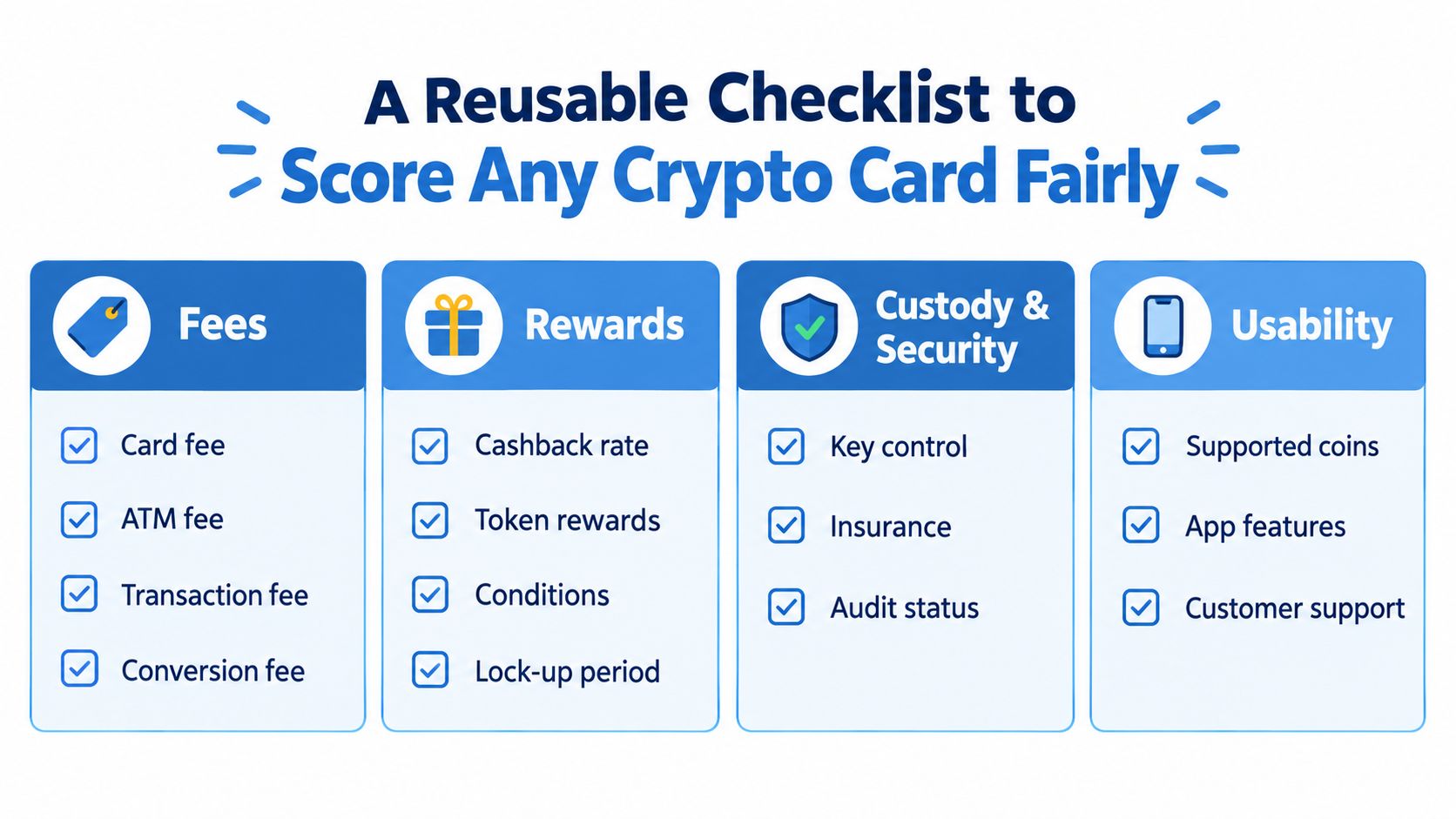
A useful scoring sheet starts with fields you can verify. Don't begin with the advertised reward. Begin with the conditions that determine whether you can use the card and what the purchase costs.
Fees
Record the annual or subscription fee, purchase charge, conversion method, FX markup, ATM pricing, and any funding cost. Capture whether each charge applies to every user or only to a specific region, tier, asset, or transaction type.
Normalize fees into the same spending scenario. A percentage spread and a fixed purchase charge shouldn't sit in separate mental buckets. Estimate their effect on the purchase types you make, such as domestic purchases, foreign transactions, subscriptions, and cash withdrawals.
Rewards
Write down the nominal cashback, but also record the asset paid, eligibility conditions, spending categories, monthly limits, lock-up requirements, and redemption rules. A reward paid in a volatile token carries a different practical risk from a reward paid in a stablecoin or fiat equivalent.
Ask one direct question: does the reward exceed the all-in cost for my normal spending? If you can't answer that from the published terms, the reward deserves a lower confidence score.
Custody and security
Mark whether the card is custodial, self-custodial, or hybrid. Then document key control, account recovery, withdrawal controls, contract permissions, insurance language, audit status, and the provider's response process when transactions fail.
A self-custodial design may reduce exchange dependence, but it doesn't eliminate provider or smart-contract risk. A custodial design may simplify support, but it places more trust in the issuer.
Usability
Check supported coins, networks, card type, digital wallet compatibility, virtual and physical availability, transaction limits, merchant restrictions, and country coverage. A card that supports your asset but not your network may be unusable without an additional transfer or conversion step.
Also check customer support before you need it. Look for clear escalation paths, not only a chat icon.
Turn the sheet into a decision score
You can score each field on a consistent scale, but the weights should reflect your priorities. A privacy-focused user can assign more weight to KYC and custody. A traveler can prioritize FX, acceptance, ATM access, and country availability. A rewards optimizer can give more weight to net reward after conversion and funding costs.
NomadCards publishes weekly refreshed composite scores that incorporate fees, privacy posture, trust, regulatory context, community sentiment, and rewards. Its standardized profiles make it possible to compare cashback, annual fee, supported assets, regions, and networks in the same format. Use any comparison system as a shortlist, then confirm the issuer's live terms before applying.
A score should narrow your search, not replace your judgment. The right weights depend on how you spend and what risk you're willing to accept.
Putting the Framework to Work With Real Comparison Tools
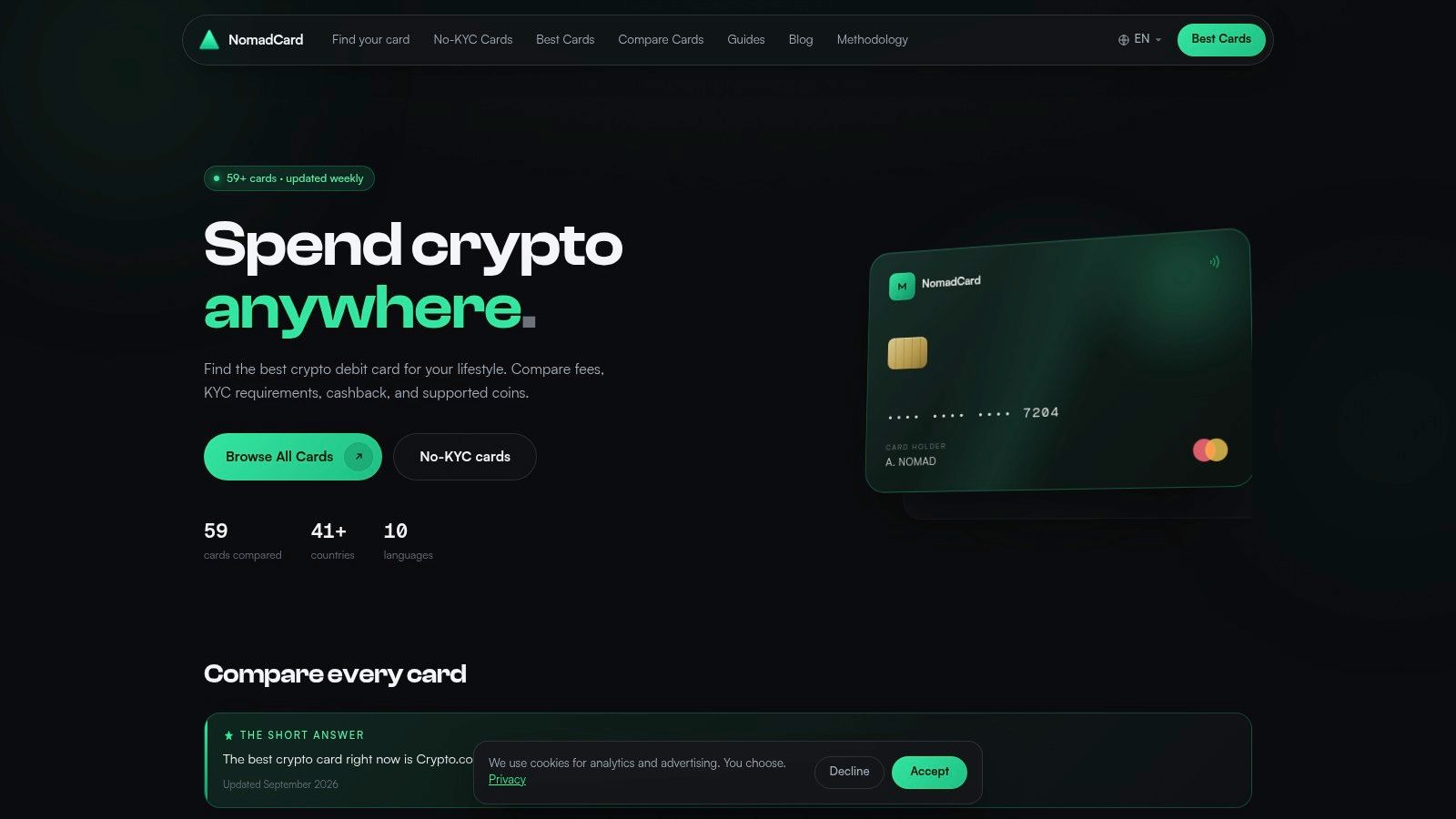
Manual research becomes difficult when each issuer uses different labels for the same concept. An interactive finder can reduce the initial shortlist if you use filters in the right order.
Start with eligibility. Filter by country, KYC level, card network, and card type. A card that cannot be issued where you live shouldn't remain in the comparison because its reward looks attractive.
A practical filtering sequence
- Set your region. Availability often determines the entire result set.
- Choose the verification level. Separate genuine no-KYC or email-only options from cards requiring full KYC.
- Select the network. Visa and Mastercard acceptance may overlap, but issuance and wallet support can differ.
- Add transaction limits. Compare daily, per-purchase, ATM, and monthly restrictions with your expected usage.
- Choose supported assets and networks. Confirm both the coin and the chain you use.
- Apply feature filters. Check non-custodial design, annual-fee status, IBAN access, Apple Pay, Google Pay, and virtual or physical card availability.
Then open the standardized profile rather than relying on the ranking label. Check cashback, annual fee, supported assets, network, regional availability, custody, and KYC. A “lowest fee” list is meaningful only when the methodology explains which charges it includes and how missing information affects the score.
For transaction records and tax treatment, users may also benefit from a practical resource on crypto tax reporting simplified when their card activity creates frequent disposals or conversion records. The card comparison and tax workflow are separate decisions, but both depend on keeping accurate transaction data.
A useful reference point for raw fee fields is the crypto card fees master table. Treat ranked results as a starting point, inspect advertiser disclosures, and verify current issuer terms before moving funds.
Choosing the Right Card for How You Actually Spend
Your best choice depends on the job the card must perform.
Privacy-focused users should start with the exact KYC requirement, not the product label. Confirm whether email-only access applies to card issuance, what limits are imposed, and whether the program is legally available in your region. A lower-verification option may involve narrower asset support or reduced functionality.
DeFi and self-custody users should inspect key control, wallet compatibility, authorization permissions, liquidity handling, and recovery procedures. Don't assume a card is non-custodial because it connects to a wallet. Find out which actions remain controlled by the provider and what happens when a smart contract or authorization service is unavailable.
Travelers should prioritize FX pricing, settlement currencies, ATM terms, acceptance, physical and virtual availability, and regional support. A strong domestic reward may not compensate for repeated international conversion costs.
Rewards optimizers should calculate net value from actual spending categories. Compare the reward asset, lock-up rules, funding costs, conversion spread, and redemption conditions. Stablecoin settlement has become a major part of everyday crypto card use, but that doesn't make every stablecoin-linked card inexpensive.
Before applying, verify the issuer, KYC tier, supported asset and network, regional availability, limits, conversion rate, FX schedule, custody model, and dispute process. A careful crypto credit card review ends with a card that fits your behavior, not the highest number in a rewards box.
NomadCards provides standardized crypto card profiles, filters, ranked comparisons, and methodology notes covering fees, rewards, custody, KYC, supported assets, networks, and regional availability. Visit NomadCards to build a shortlist around your own spending pattern and check the issuer terms before you apply.