Most buying guides tell you to hunt the lightest signup and treat that as anonymity. I would throw that advice out first. A skipped ID form is not spending that nobody can interrupt.
A crypto credit card without KYC usually means the issuer opens the account from an email, a phone number, or a wallet connect. The charge at the till still clears as a card payment. Cash-out, a large top-up, a chargeback, and EU wallet funding are the moments an identity check tends to return. If you only read the signup screen, you will misread the product.
I would score two things before any brand name: verification stability, and exit risk. Stability is whether the trigger for an ID request is written down. Exit risk is what happens to the balance if the card stops. Cashback is a feature you only collect on a good day.
Table of Contents
- What a Crypto Credit Card Without KYC Means
- Signup Tiers Limits and Later Checks
- When a No KYC Card Still Asks for ID
- Merchant Spend Versus Crypto Funding Rules
- What Weak Identity Costs in Disputes and Freezes
- Pick Your Card by the Worst Day
What a Crypto Credit Card Without KYC Means
Signup privacy is not spending anonymity. A crypto credit card without KYC is a claim about the first screen, not proof the issuer, BIN sponsor, processor, or bank partner will never identify you.
The charge still clears as a Visa or Mastercard payment, so anti-money-laundering duties sit in that chain. Dropping the form does not drop wallet screening, sanctions checks, or a later document request.
In its 2024 targeted update, the Financial Action Task Force reported that 70% of surveyed jurisdictions (65 of 94) had passed legislation implementing the Travel Rule, 30% of respondents (29 of 94 jurisdictions, excluding jurisdictions that explicitly prohibit virtual-asset service providers) had not yet passed Travel Rule legislation, and 75% of jurisdictions (97 of 130) were rated partially compliant or non-compliant, while only 32 were largely compliant and one was fully compliant.
Country, transfer size, and custodial versus self-custodial design decide whether that light signup survives.
Do not mix these labels:
- No identity check at signup: no document on the first small load.
- Email-only onboarding: an inbox or phone number issues the card until a cap or a risk signal.
- Full KYC: government ID and address before meaningful spend.
Practical rule: verify "no KYC" against the issuer's written trigger, not against a homepage badge.
The tier table comes before any brand name.
Signup Tiers Limits and Later Checks
Verification models for crypto cards in 2026
| Model | Signup check | When ID often appears | Fee pattern | Continuity trade-off |
|---|---|---|---|---|
| Email or phone only | Email or phone number | Higher balance, cash-out, chargeback or replacement | Often no annual fee; conversion spread and FX dominate | Low friction, higher freeze risk if a risk signal appears |
| No ID until a cap | None on the first small load | After a stated spend or balance threshold | Tight caps; top-up or spread fees on each load | Usable for small merchant spend; funds can pause at the cap |
| Self-custodial wallet card | Wallet connect, sometimes an email | Sanctions or wallet-ownership checks, especially on larger EU funding | Network and gas or swap costs; annual fee varies by program | You keep the wallet, but the BIN sponsor can still halt the card |
| Light custodial exchange card | Minimal account details | Source-of-funds or unusual transactions | Spread plus possible inactivity or ATM fees | Broader acceptance; the exchange holds the balance during review |
| Full KYC baseline | Government ID and address | Ongoing monitoring, not a one-time selfie | Clearer FX and ATM schedules; cashback sometimes tiered | Stronger disputes and cash access; least privacy at signup |
How to read one row
Take the email or phone row and read left to right. The signup check is the marketing win. The next column is the catch. Identity usually arrives on a higher balance, a cash-out, a chargeback, or a replacement card. The fee column is not the annual fee. Many light programs advertise no yearly charge while the cost is the crypto-to-fiat spread, a top-up fee, an FX markup, or a cash-advance fee. There is no honest universal percentage, because published schedules move. The last column is continuity. Low friction pairs with a higher chance the balance pauses when a risk signal appears.
Visa's public rules require a prepaid-card issuer to obtain Visa approval and to comply with anti-money-laundering and counter-terrorist-financing requirements. A no-KYC label is a product-stage claim. It is not proof that checks never occur. Issuer jurisdiction and program structure matter as much as the badge on the signup page. The longer split between those tiers is in how crypto card KYC levels actually differ.
What not to trust
- Cash withdrawal: an email signup often stops being enough the moment you ask for an ATM.
- Card-to-card transfer: sending value to another person is a common enhanced-due-diligence trigger.
- A higher balance: the first small load can pass, then the next top-up asks for ID.
Write down three fields before you fund anything you cannot pause. The exact verification trigger. The per-transaction cap. Whether ATM cash is offered at all. Confirm those three on the issuer page, not on a comparison snippet, before you load more than you can afford to have stuck.
When a No KYC Card Still Asks for ID
A card life runs in order. Signup is only step one, and it is the step marketing pages linger on.
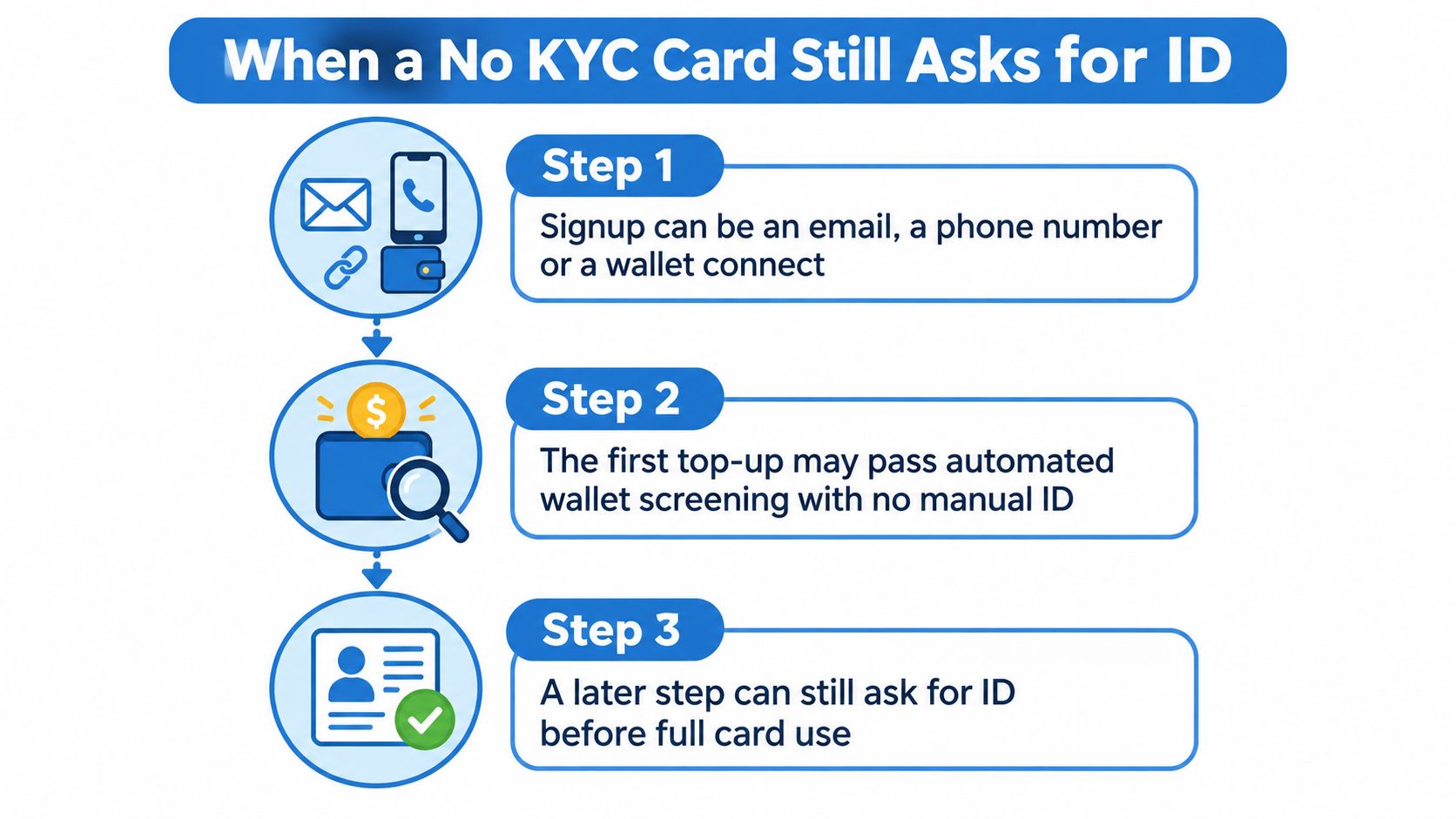
- Signup can be an email, a phone number, or a wallet connect. You can receive a virtual card number. You cannot assume that number will still authorize next month.
- The first top-up may pass automated wallet screening with no document upload. You can buy a small merchant item. You cannot treat that pass as a permanent clearance.
- A higher balance, an ATM attempt, a card-to-card send, or a merchant category the program dislikes can pull enhanced due diligence forward. Spending stops until you answer.
- A chargeback, a replacement card, a new device, or a country change often restarts the file. Travelers feel this first. A virtual card that dies abroad is hard to fix from an email the issuer no longer trusts, even if you have a passport photo ready.
- A compliance review can pause authorizations while the balance sits with the issuer or the exchange. You can wait. You often cannot move the crypto out on your own schedule.
- Closure is the step people skip. Ask whether remaining crypto returns to the original wallet, converts and goes to a bank, or stays held until ID arrives. If that route is missing, you do not have an exit.
FATF standards expect virtual-asset providers to apply customer due diligence, maintain records, report suspicious transactions, and be licensed or registered and supervised. That is why a card sold as no-KYC can still freeze funds through its issuer, BIN sponsor, processor, or underlying crypto service. Less friction up front can mean more uncertainty about continuity, disputes, and access to the balance.
The useful question is not "Does this card require KYC?" It is "At which event can it, and what happens to the balance while you wait?"
Six checks before you load
Score verification stability as a yes or no. A pass needs the condition in the last column, written on the issuer page.
| Check | What to confirm on the issuer page | Pass condition |
|---|---|---|
| Written trigger | Exact event that adds ID or a hold | Named with a threshold, not at the issuer's discretion |
| Stated cap | Per-transaction and balance limits | Numbers published on the page |
| ATM policy | Whether cash withdrawal is offered and under which rules | Stated yes or no |
| Freeze notice | How and when you are told about a hold | Written notice path exists |
| Refund path | How disputes and chargebacks are handled | Documented steps |
| Leftover-balance recovery | Where remaining crypto goes after closure | Documented return route |
Anything short of six passes is a card for money you can leave behind.
Merchant Spend Versus Crypto Funding Rules
Paying a merchant for goods or services is not the same act as funding the card, cashing out, or sending value to another person. Readers treat those as one swipe. They are not.
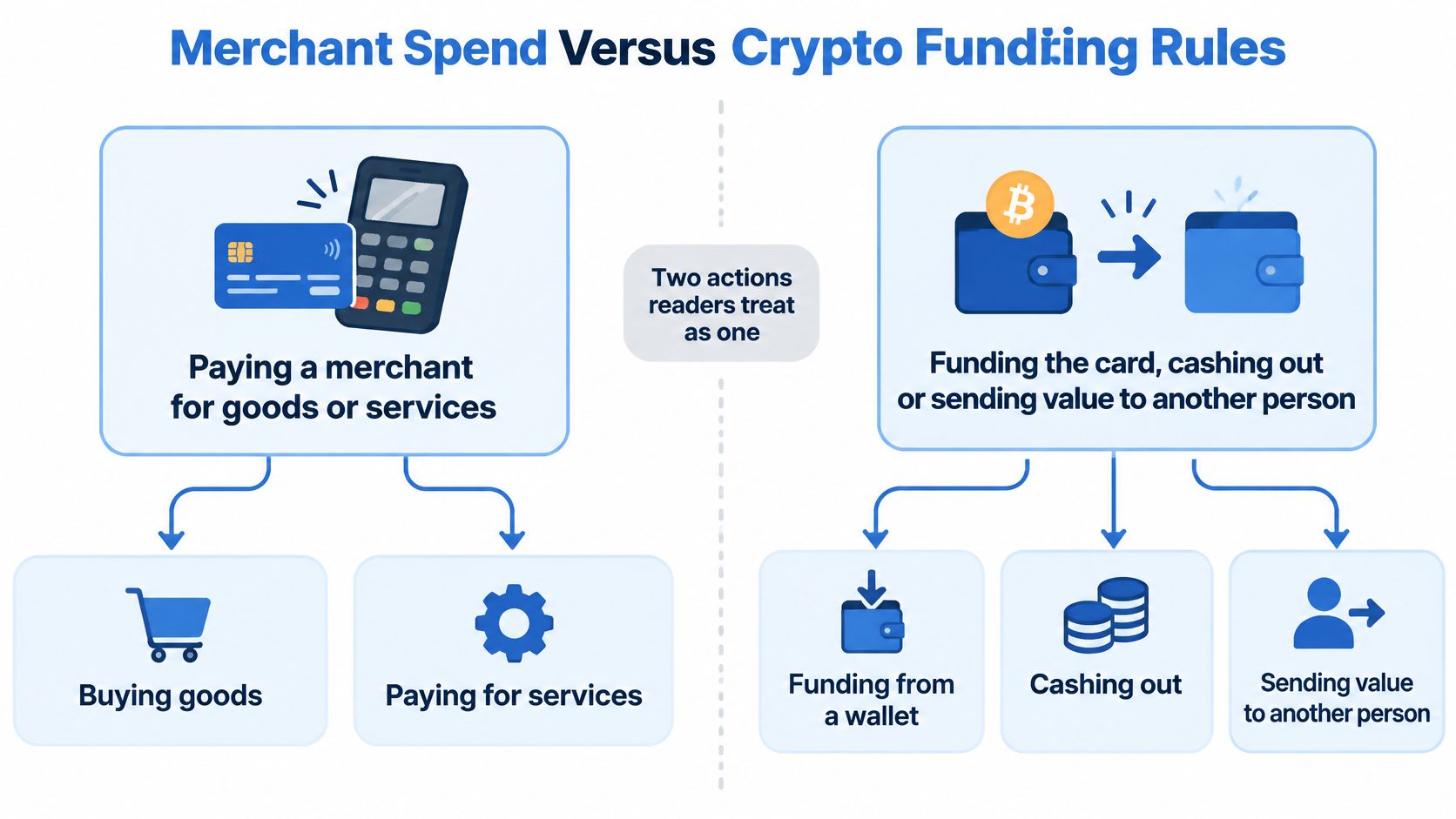
The goods purchase versus the transfer
For EU-linked programs, Regulation (EU) 2023/1113 applies to crypto-asset transfers involving EU-established crypto-asset service providers and requires information on originators and beneficiaries. For transfers exceeding EUR 1,000 that involve a self-hosted address, the provider must verify whether the client owns or controls that address. The regulation sets aside certain card payments used exclusively to purchase goods or services. That carve-out does not generally cover person-to-person transfers or attempts to move value between people through the card.
Apply that split to the two architectures, and only apply the ownership check to funding and cash-out.
A custodial exchange card can screen the deposit when crypto arrives, and again if you withdraw. The exchange holds the coins during any review, so a paused top-up is a paused balance.
A self-custodial card may authorize a coffee purchase without that transfer file. It can still stop a large wallet top-up, a peer transfer, or a cash-out for sanctions, source-of-funds, or ownership checks. You keep the keys. The BIN sponsor can still halt the plastic, or the virtual number, that spends from them.
A practical route for merchant spend that is not a cash-out sits in how to spend crypto without selling it first.
Four answers before you travel
Write these down from the provider, not from a homepage that says the virtual card is offered worldwide.
- Pause rights: can spending stop pending a wallet, sanctions, or source-of-funds check?
- ATM treatment: is cash withdrawal handled as a transfer, with the ownership and information rules that transfers carry?
- Card-to-card sends: are they blocked, capped, or a trigger for ID?
- Issuance countries: which countries cannot be issued a card at all, and is Apple Pay, a physical card, or an IBAN limited to a shorter list than the virtual card?
Regional rollout matters as much as the KYC badge. A virtual card on the marketing page can still ship the features you need only inside a short country list.
What Weak Identity Costs in Disputes and Freezes
Privacy write-ups dwell on fees and cashback. The loss shows up when something goes wrong and the issuer has a thin file on you.
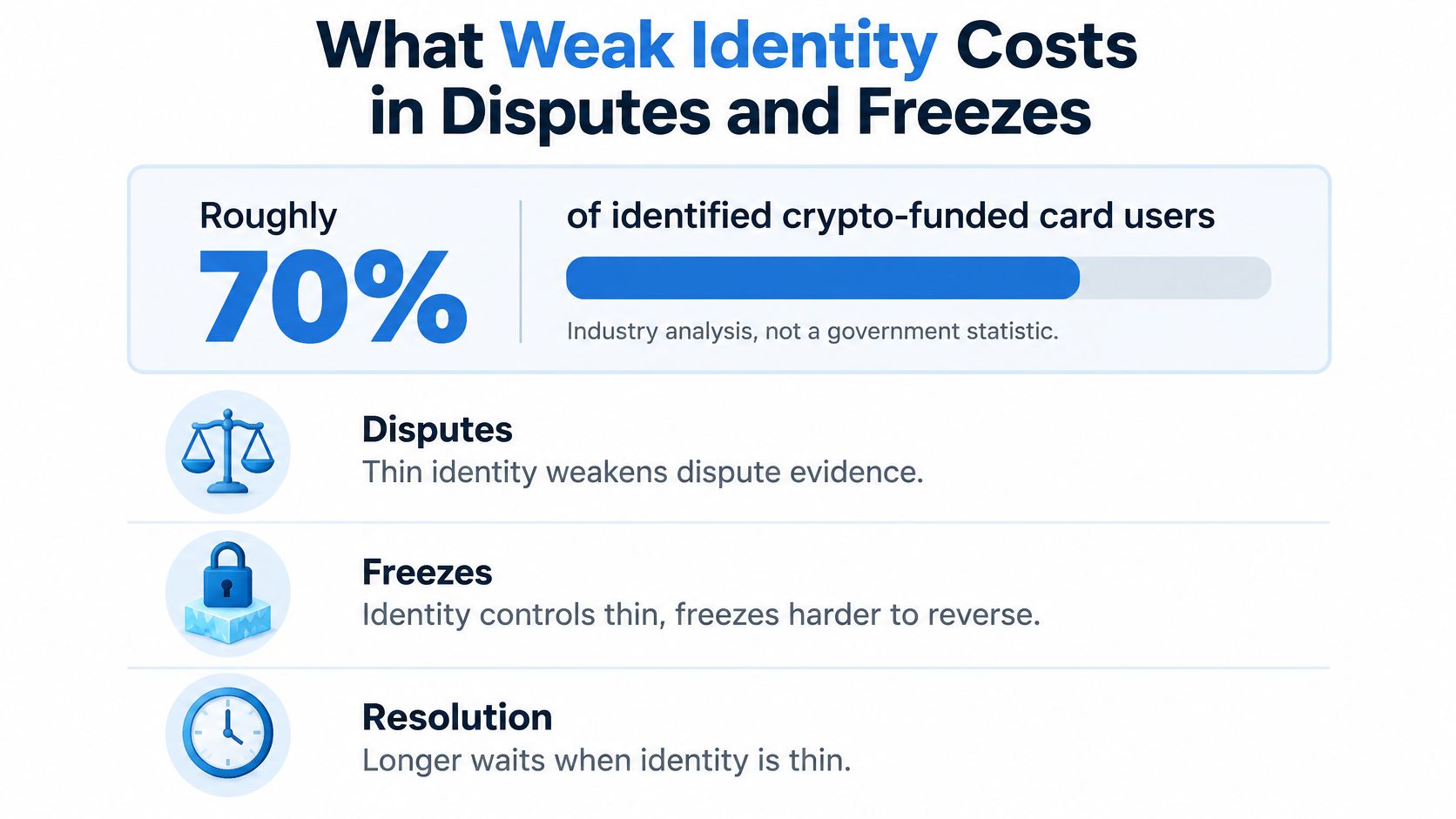
Crystal Intelligence's investigation, which is industry analysis and not a government statistic, reported that roughly 70% of identified crypto-funded card providers used minimal or no identity verification, found more than $1.18 billion in on-chain inflows between 2024 and early 2026, and identified $166.5 million in high-risk inflows linked to scams, mixers, sanctioned entities, darknet markets, and gambling platforms.
What the merchant sees
Once crypto converts and spends through a card, the merchant can see an ordinary card payment. The chain behind that payment can still be screened for the asset's source. A BIN sponsor can shut the whole program. That shutdown hits every customer at once, including people who never triggered a personal review. Programs built this way appear, take inflows, and vanish when the sponsor or the network has had enough.
Thin identity shifts the risk. You gave up less data at signup. You picked up transaction surveillance, sudden deactivation, weaker recourse, and counterparty failure. "No KYC" is not anonymity, and it is not safety.
Recourse gaps to score
- Chargeback rights: on a prepaid program they may be narrow or absent. A disputed subscription can die as a support ticket with no scheme path.
- Stolen virtual numbers: a dispute is weak when the issuer has no reliable identity file tying the card to you.
- Freezes: a hold can trap the balance with no published timeline and no notice path.
- Sponsor exit: one compliance failure upstream turns a working card off for the whole book of customers.
Full KYC is not a magic shield against fraud. Monitoring continues after onboarding. The point of a real identity file, in this product, is a path to recover funds and a program that can survive its sponsor. Privacy that cannot survive a dispute is an expensive discount.
Use the same pass-fail items you already apply to an issuer page, then add who holds the crypto and whether the issuer names its regulated entity. If a decline is what you are staring at today, start with why a crypto card gets declined and what you can still do. I would not keep a serious balance on a program that fails the freeze notice or the leftover-balance route.
Pick Your Card by the Worst Day
Pick for the worst day you face, not for the shortest form.
Weekend spend versus a life on the road
A weekend trip paid in stablecoins, on a virtual card you can afford to lose, can live on email-only onboarding or a capped no-ID load. Small merchant spend is the job those rows are built for. The pick flips the moment you need an ATM, or a freeze would strand the hotel booking. Then I would start with a full KYC baseline, because the cheap signup is the one that fails on Saturday night.
A digital nomad who needs cash, Apple Pay, and a replacement card abroad should choose full KYC, or a program that publishes cash-out rules and a support path you can reach without flying home. Light signup fails at the first ATM request for enhanced due diligence. A new device in a new country restarts the file. If the only login is an email, you are negotiating with a hold from a cafe wifi connection.
Self-custody and anything large
A self-custody user who will not pre-fund an exchange can use a wallet-linked card. You accept swap or gas costs, and you accept ownership checks on larger EU funding. Chargeback comfort will be thinner than on a bank card. That trade is rational when the point is keeping the coins in your wallet between purchases. It is a bad trade when you also want cash and a reliable dispute desk.
Skip no-KYC products for a large balance or for peer transfers. Those are the events that pull ID forward, and they are the events where a missing exit route hurts. The edge case is months of groceries that work, then one foreign ATM or one disputed subscription that locks the account. The groceries did not prove the card. The lock did.
Three checks, then two names
Before you apply, run three checks and ignore the homepage badge until they pass.
- Read the freeze policy and the leftover-balance policy. If either is missing, the card fails exit risk.
- Match the country list, and virtual versus physical availability, to the route you will travel. A worldwide claim that only issues virtual cards in your country is a different product.
- Treat homepage KYC claims as unverified until the issuer page states the trigger, the cap, and the ATM rule.
Our No-KYC Cards section in the main navigation, and the comparison filter for No KYC or Email only KYC, narrows the field. Sort that shortlist by continuity, not by the privacy claim. NomadCard is an independent comparison site, not a bank, card issuer, or adviser. Card terms can differ by country and tier, so confirm current details on the provider's own site before you apply. Crypto and the cards that use it carry risk, including loss of funds. Content here is general information, not financial, tax, or legal advice. Affiliate commissions on some cards are disclosed, and a commission does not justify a weaker exit path.
Shortlist two cards on verification stability, confirm both on the issuer's current page, and load only what a freeze would not ruin.
I would rather carry a fully identified card I can replace abroad than a lighter signup that strands the balance. The form you skip on day one is rarely the form that decides whether you get the money back.
NomadCards compares crypto-linked debit and credit cards on verification level, custody, limits, fees, and country availability, so a crypto credit card without KYC can be judged on exit risk instead of a signup slogan. Filter for no KYC or email-only, then check the worst day you face before you apply. Visit NomadCards, shortlist two programs, and confirm both triggers on the issuer's own page before you load funds.