You're at a coffee shop, card in hand, and the terminal is waiting. Your money isn't in a regular bank account. It's sitting as bitcoin, ether, or a dollar stablecoin, and you'd rather not sell it on an exchange, wait for a bank transfer, and then pay. That's the exact moment a crypto debit card is built for, and also the moment where most explanations stop too early.
Table of Contents
- A Crypto Debit Card in Plain Terms
- How You Fund a Crypto Debit Card
- What Happens at the Moment You Pay
- Custodial, Hybrid, and Self-Custodial Cards Compared
- KYC, Verification, and Who Can Actually Get One
- Networks, Stablecoins, Limits, and Regional Availability
- When a Crypto Card Transaction Fails or Gets Frozen
- Picking the Right Crypto Debit Card for You
A Crypto Debit Card in Plain Terms
You tap the card. The barista sees an approved Visa or Mastercard payment, the receipt prints, and you leave with your coffee. The shop didn't accept crypto, didn't open a wallet, and won't receive any tokens later.
Behind that ordinary tap, something less ordinary happened. A crypto debit card is a normal network card on the front and a crypto conversion system on the back. Instead of pulling from a checking account, it pulls value from a crypto or stablecoin balance and turns enough of it into local currency to cover the bill.
The Actors in One Tap
Think of five roles. You hold the balance and initiate the payment. The program manager runs the app you see, checks your balance, and handles conversion. The issuer, usually a regulated bank or licensed partner, issues the card and carries legal responsibility for the program. The network, Visa or Mastercard, moves the authorization between banks. The merchant receives fiat.
That split matters because problems rarely live in one place. A decline might come from the network, the issuer, or the crypto layer that priced your balance a second before the tap.
The merchant-facing side stays deliberately boring. Most of the complexity, cost, and risk sits upstream, between your balance and the issuer.
Why Not Just Sell First
Selling on an exchange works, but it's slow and manual. You sell, withdraw, wait for settlement, and hope the bank doesn't flag the transfer. A card compresses those steps into the payment itself.
The funding source usually takes one of two broad shapes. Some cards spend directly from an exchange or fintech balance, while others spend from a wallet you control. Either way, merchants usually receive local fiat without integrating wallets or blockchain accounting, a design explained in how crypto conversion moves upstream of the card network.
Demand is real but still small beside conventional cards. Monthly crypto-card volume grew from approximately $100 million in early 2023 to more than $1.5 billion by the end of 2025, according to Artemis-linked data on crypto-card payment growth. Most of that spending now comes from stablecoin balances, not volatile coins people hope will rise while they're buying lunch.
How You Fund a Crypto Debit Card
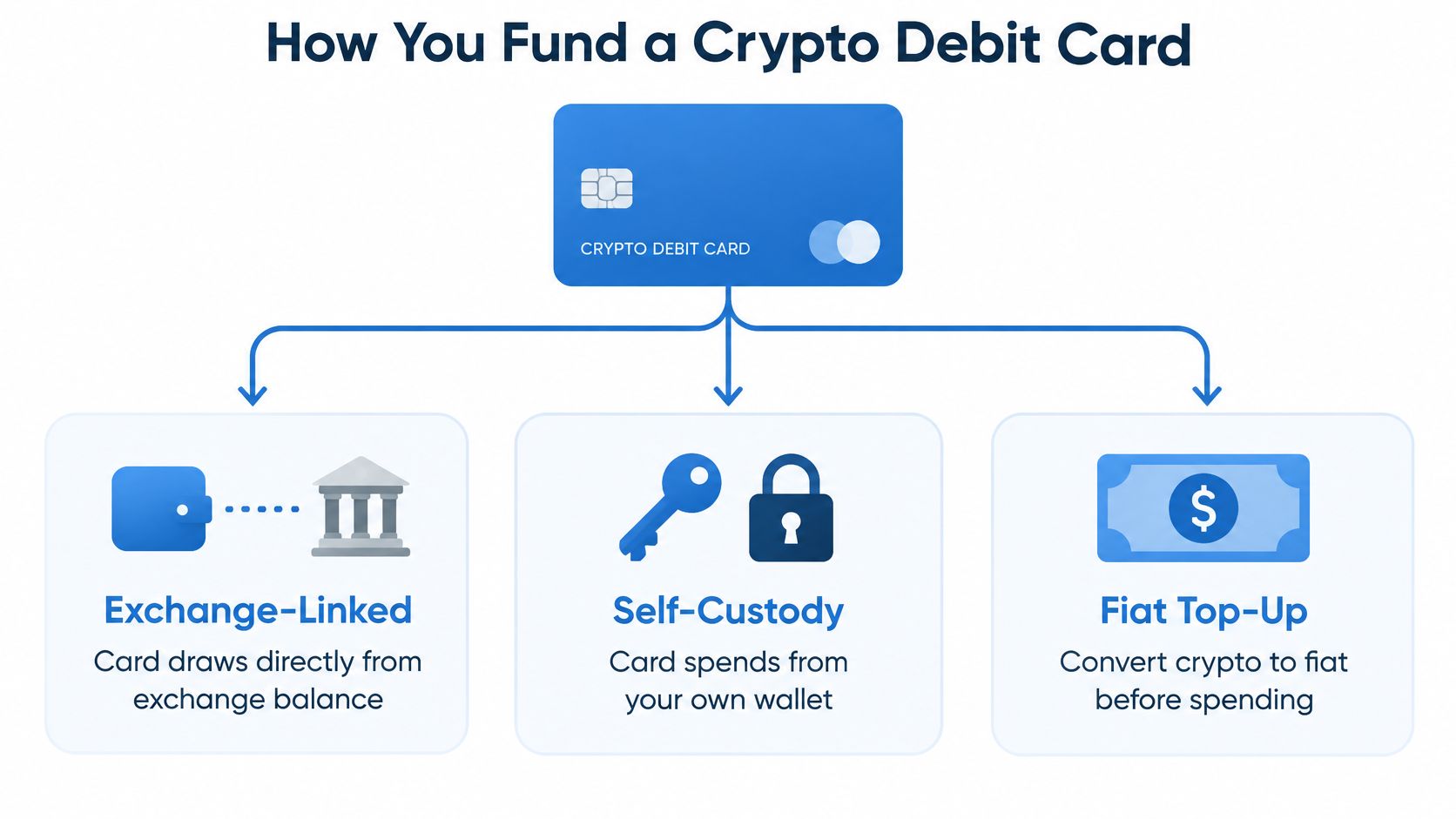
Funding decides who controls your money before you spend it. Two cards can look identical in Apple Pay and behave completely differently when you top up, get locked out, or try to withdraw what's left.
The diagram below maps the three routes you'll meet most often.
Exchange-Linked Balances
Cards from platforms such as Crypto.com or Coinbase draw from the balance already sitting in your exchange account. There's no separate top-up transfer, and onboarding is usually the same full identity check you did to trade. That convenience comes with custodial risk. The platform holds the keys, can freeze withdrawals during a review, and becomes your counterparty if it fails.
Stablecoin Accounts and Fiat Top-Ups
A second model keeps value in a fintech account denominated in a stablecoin such as USDC, or in fiat you created by converting crypto in advance. You transfer stablecoins in, the app shows a dollar or euro balance, and the card converts to local currency when you pay abroad. Pre-converting to fiat removes price movement between top-up and purchase, but it also means you've already sold, which is why some holders first read about ways to spend crypto without selling it outright before choosing this route.
If that pre-funded balance feels familiar, it's because prepaid value works in a similar way in other products. The Approved Experiences Traveler's e-gift card guide is a useful plain-language comparison for how stored value is loaded, held, and then redeemed at checkout.
Self-Custodial Wallets
Cards linked to wallets such as MetaMask or Gnosis Pay spend from an account you control with your own keys. You approve a spending arrangement, and the card system draws against that wallet when you pay. You keep custody until the moment of spending, but you also carry recovery responsibility. Lose access to the wallet and there's no support desk that can reset your keys for you.
What Happens at the Moment You Pay
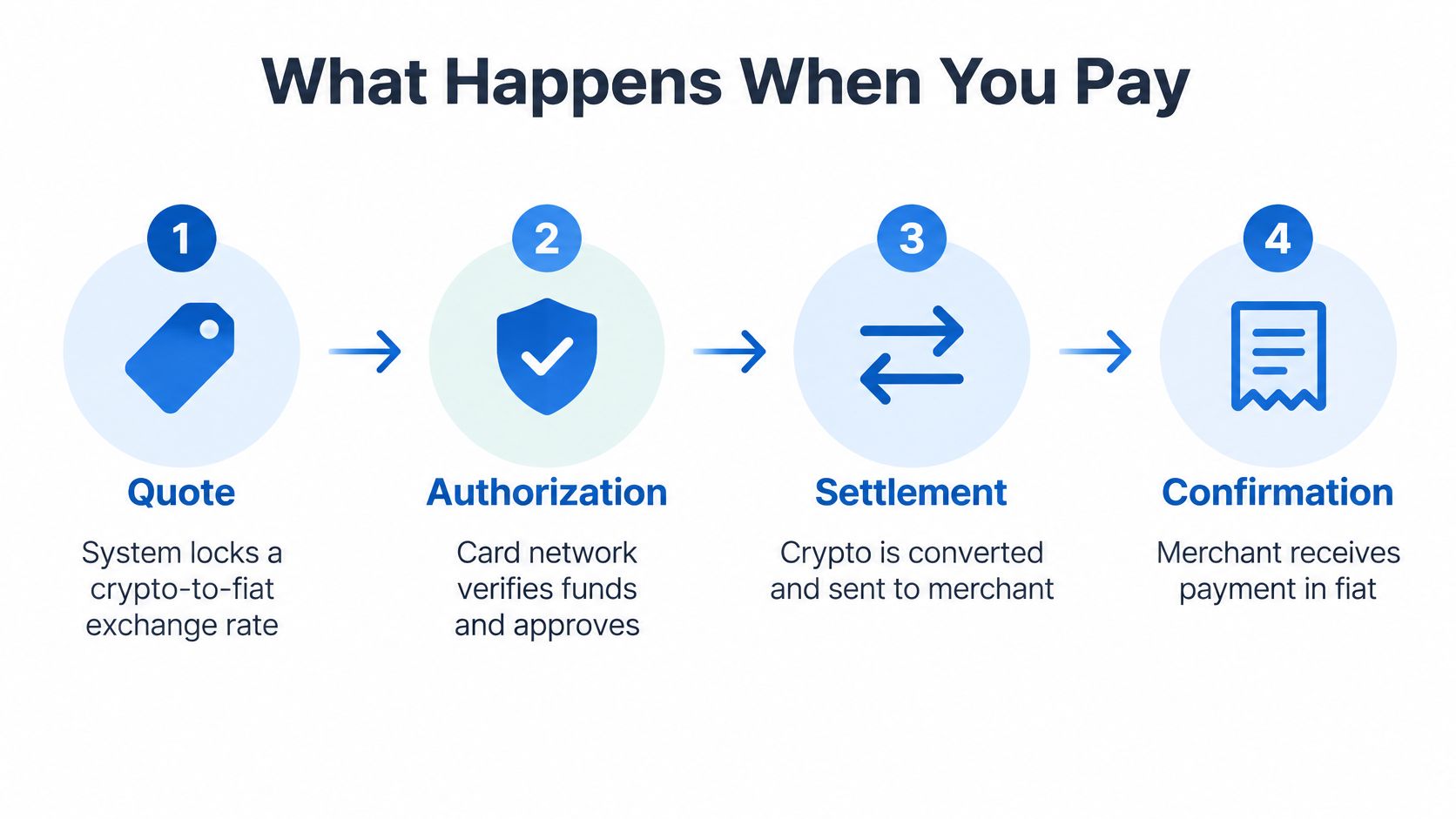
Four steps happen between your tap and the merchant getting paid. Once you can name them, most odd app notifications and declined payments stop looking mysterious.
This sequence shows where each step sits.
Quote and Conversion
- Quote: The issuer or processor checks your balance and calculates how much crypto or stablecoin covers the fiat amount.
- Spread: The rate you're offered may differ slightly from a public market price, and that difference is often the conversion cost.
- Reservation: The required amount is converted or held so the authorization doesn't fail if the price moves a moment later.
A claim of no foreign-exchange fee doesn't mean conversion is free. You might pay nothing as a separate line item and still pay through the spread, a foreign-currency markup, or a network fee when funds move on-chain. Always compare the rate inside the app with the amount that leaves your balance.
Authorization and Settlement
Next, Visa or Mastercard runs a normal authorization. It checks that the card is valid, that the merchant category is allowed, and that the issuer approves the amount. A payment can fail here even with enough balance if the quote expired, liquidity for that asset is thin, the merchant category is restricted, or a hotel deposit exceeds a card limit.
Clearing and settlement come later. Traditional card settlement commonly runs through cycles of roughly 24 to 48 hours, while blockchain transfers can reach finality within seconds, a contrast set out in research comparing card settlement with blockchain finality. Some stablecoin settlement pilots let selected issuers settle seven days a week, but that mainly speeds up movement between financial institutions. It doesn't make your coffee purchase settle instantly, and it doesn't remove compliance, liquidity, or foreign-exchange costs.
The short walkthrough below shows that authorization moment from the terminal's point of view.
Custodial, Hybrid, and Self-Custodial Cards Compared
Custody answers one question. Who can move, freeze, or lose your money when you're not spending it?
Fully custodial cards keep both keys and balance with the issuer or platform. Login recovery is familiar, support can investigate mistakes, and you don't manage seed phrases. The trade-off is direct counterparty exposure. If the holder restricts withdrawals or becomes insolvent, your balance may be a contractual claim rather than property you can move yourself.
Hybrid cards split the jobs. An exchange or custodian holds the crypto, while a separate fintech and issuing bank run the card rail. That specialization can improve card features, but it also multiplies the parties you must identify in a dispute.
Practical rule: Write down the legal entity holding your funds, separate from the brand printed on the card. That name matters more than the logo when money gets stuck.
Self-custodial cards leave keys with you and treat the card as a spending view onto your wallet. No platform can lend out or freeze the underlying wallet balance in the usual custodial way. Operational risk shifts to you instead, including wallet approvals, device security, and keeping enough of the right asset on the right network.
How to Choose Between Them
- Control: Custodial is simplest, self-custodial gives you the most direct control, and hybrid sits between them.
- Recovery: Custodial accounts can usually restore access through support. Self-custody depends on your own backup.
- Failure exposure: Custodial and hybrid balances depend on other companies staying solvent and cooperative. Self-custody reduces that exposure but raises personal error risk.
- Daily friction: Exchange-linked cards usually work immediately after signup. Wallet-linked cards demand more setup and more attention at each top-up.
None of these is automatically safest. A careful self-custody user and a user who'd lose a seed phrase face opposite risks, so the honest comparison starts with your own habits.
KYC, Verification, and Who Can Actually Get One
Eligibility is decided before cashback, limits, or supported coins become relevant. The card brand markets the product, but an issuing bank and its compliance partners decide who passes.
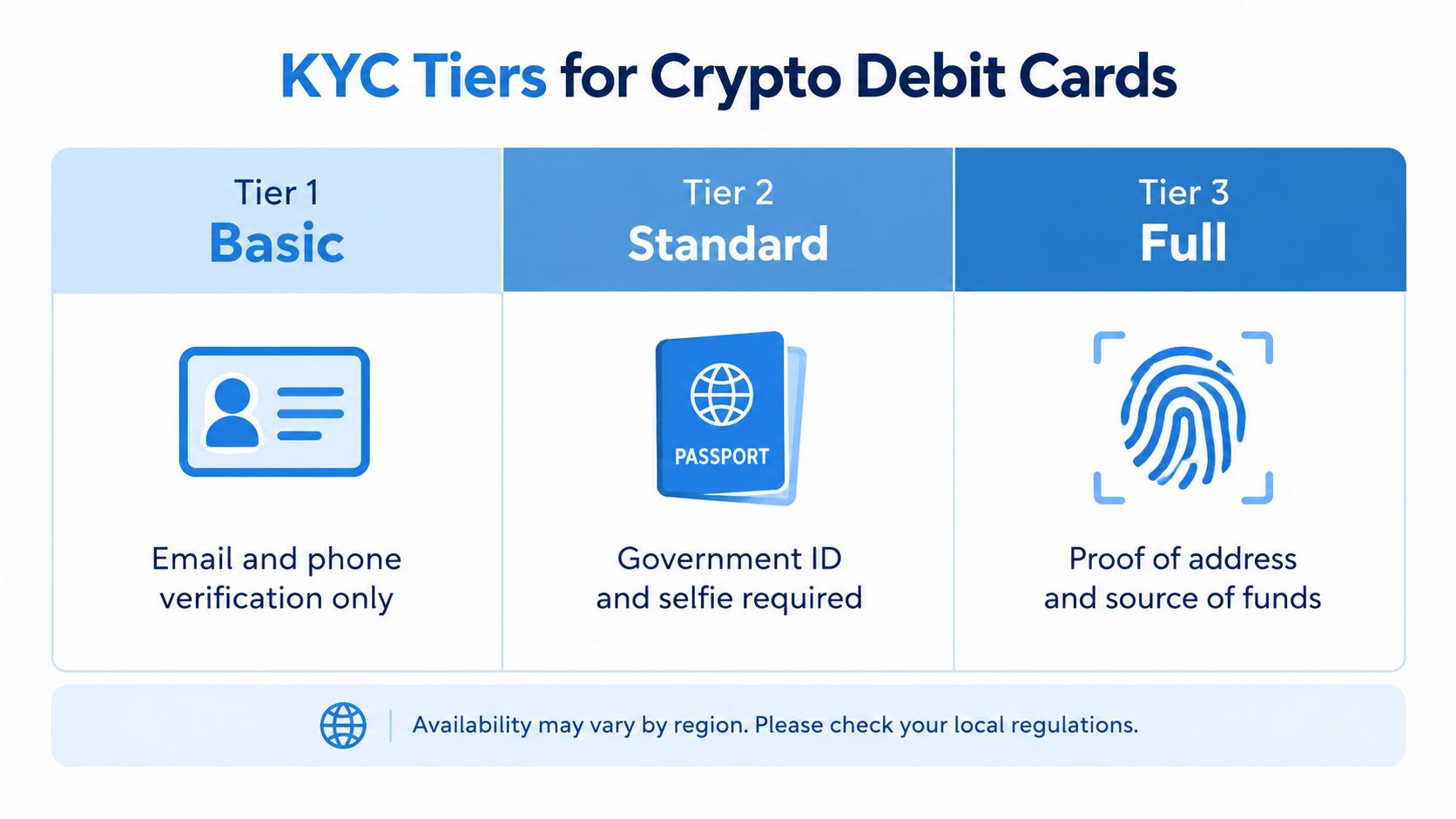
The tiers below show what verification usually asks for.
What Each Tier Unlocks
- No KYC or email only: Signup may need little more than contact details, but spending, ATM access, and top-ups are typically tightly limited or unavailable.
- Standard KYC: A government ID and selfie usually enable a physical card, higher balances, and normal everyday spending.
- Full verification: Proof of address and, for larger activity, source-of-funds information can raise limits and satisfy banking partners in stricter markets.
Even a card marketed on privacy sits inside an issuer's anti-money-laundering framework. The app may collect less from you at signup, but the issuer still monitors transactions and can request documents later, especially after unusual activity or a limit increase.
Geography cuts across every tier. Your residence, citizenship, the issuer's licensed countries, and the card's shipping list are separate filters, and passing one doesn't guarantee the others. Before applying, have a valid ID, a proof of address in your name, and basic records showing where larger deposits came from. Those documents and tier differences are broken down further in this explanation of crypto card KYC levels, which helps you check whether a low-verification promise will survive real use.
Networks, Stablecoins, Limits, and Regional Availability
A card can advertise worldwide acceptance and still fail on your actual trip. Network acceptance, issuance country, asset support, and merchant rules are four different questions.
Mastercard describes crypto cards as usable across more than 150 million acceptance locations, while Visa reported approximately $5.2 billion in stablecoin-linked card volume in 2025, up 319% year over year, across more than 130 programs in over 50 countries, figures summarized on Mastercard's crypto card program page. That reach is substantial, yet availability remains specific to each program, country, asset, and issuer.
Crypto Debit Card Capability Snapshot
| Card Type | Network | Typical Assets | Per-Tx Limit | KYC Tier |
|---|---|---|---|---|
| Exchange-linked | Visa or Mastercard | BTC, ETH, major stablecoins | Set by issuer and account level | Full |
| Stablecoin account | Visa or Mastercard | USDC and other dollar or euro stablecoins | Varies by verification tier | Standard to Full |
| Self-custodial | Visa or Mastercard | Stablecoins held in wallet | Set by wallet approval and issuer | Email to Full |
| Prepaid top-up | Visa or Mastercard | Fiat converted from crypto | Usually the loaded balance | Basic to Standard |
Reading the Table Like a User
Stablecoin support matters more than coin count. A long asset list helps only if the card reliably quotes and settles those assets at authorization. Many products accept numerous coins for top-up but spend from fiat or a short list of stablecoins in practice.
Limits also layer on top of each other. A per-transaction cap, a daily cap, an ATM cap, and a foreign-currency rule can all apply to the same purchase, and verification level often decides which set you get. Hotels and car rentals deserve special caution because deposits and pre-authorizations can lock more than the final bill. Offline terminals on planes or transit systems can also behave differently from a normal chip or contactless sale.
For travelers, check three places separately. Confirm the card is issued to residents of your country, confirm it authorizes in your destination currency, and confirm cash withdrawals and refunds work there. A network logo answers only the middle question, and even then, local rules and merchant categories can still block a payment.
When a Crypto Card Transaction Fails or Gets Frozen
Most buyers compare rewards first. The more useful test is what happens on the bad day, when a purchase declines in public, a refund lands short, or an account freezes during review.
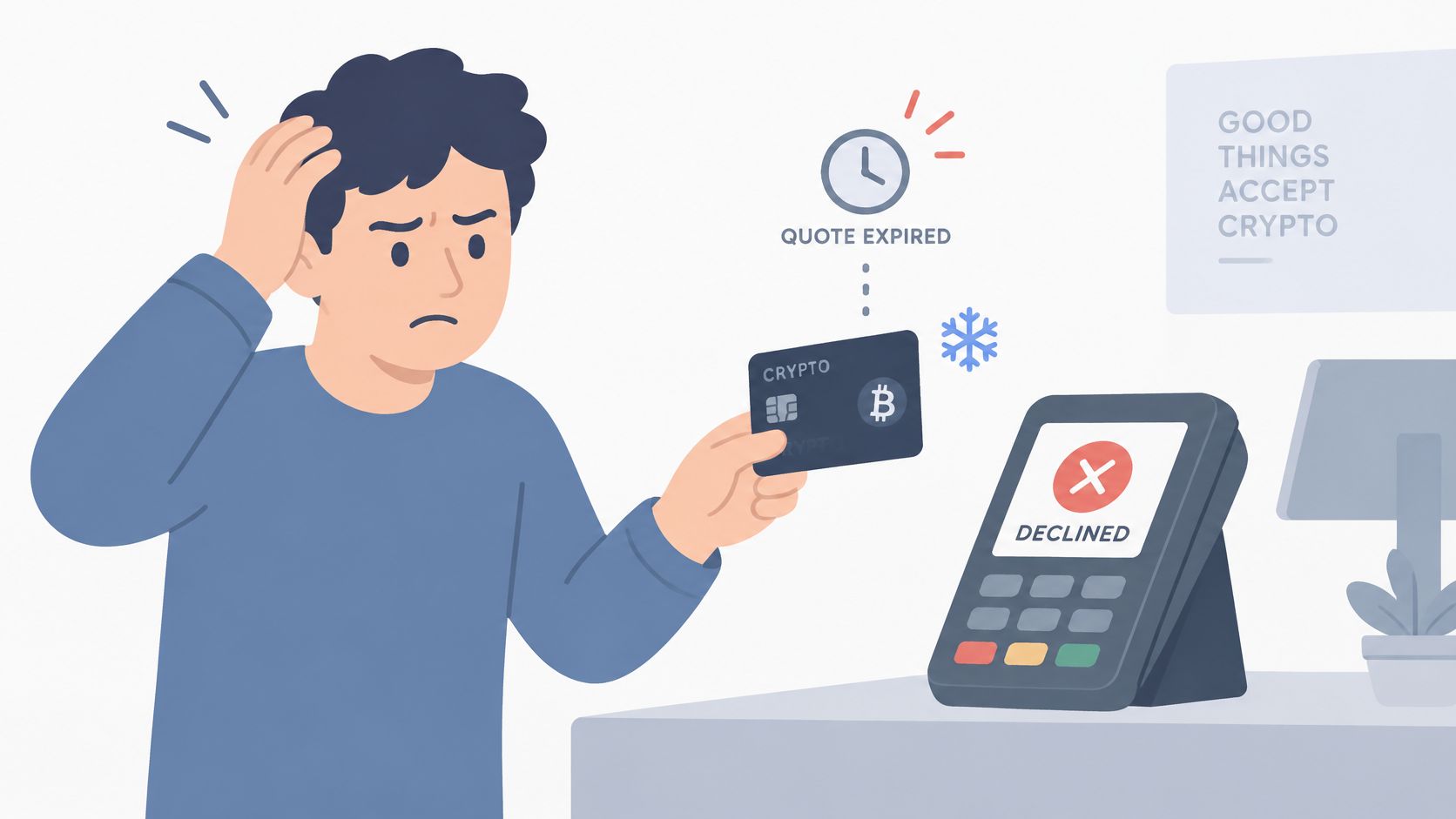
That bad day isn't rare enough to ignore. A CFPB complaint analysis found that users reported being unable to make purchases, having difficulty closing accounts, being denied reimbursement for fraudulent charges, and not receiving advertised rewards, as documented in the CFPB complaint bulletin on crypto-assets.
Why Protection Feels Uneven
Visa or Mastercard acceptance doesn't automatically give you the same practical recourse as a bank debit card. The network provides the payment rail and dispute rules, but the program manager, issuer, and custodian control the funding layer. If crypto was converted at authorization and the purchase is later refunded, you may receive fiat, stablecoins, or a different amount of crypto than you spent. If the custodian freezes the account, a valid card network dispute won't by itself release the underlying balance.
Common failure points include expired quotes, compliance reviews, unsupported merchant categories, insufficient funds after spread, and pre-authorizations that exceed a limit. If you're diagnosing a live decline, this guide to crypto card decline reasons and fixes helps separate balance problems from issuer and merchant blocks.
A Self-Defense Checklist
- Identify the fund holder: Find the legal entity holding your balance, not just the app brand.
- Identify dispute responsibility: Confirm who reimburses unauthorized transactions and where complaints go.
- Test small first: Make a tiny purchase, a refund, and a withdrawal before relying on the card for travel.
Picking the Right Crypto Debit Card for You
Run five questions against any product page. What asset funds authorization? Who holds that balance? Who handles a fraud dispute? What's the all-in cost after spread, foreign-exchange markup, ATM, and network charges? Does it work where you live and where you'll spend?
Market history explains why those answers change. Visa's indexed volume rose to roughly eleven times its January 2021 level by April 2022, fell back through the crypto winter, and recovered to about nine times that baseline by the end of 2025, according to Visa historical tracking of crypto-card payment volume. Products launched in different cycles carry different assets, partners, and assumptions.
Use NomadCards as one comparison option to check normalized fields for custody, KYC, network, fees, and regional availability side by side. Headline cashback is the least informative number on the page. The card that fits your custody preference, geography, and spending pattern, and still works when a payment goes wrong, is the better pick.
Ready to compare cards by custody model, KYC tier, spread, stablecoin support, and country availability instead of headline cashback alone? Visit NomadCards to filter active crypto debit card programs against the five questions above and shortlist the options that fit how and where you spend.