Crypto debit cards have moved from a niche off-ramp to a measurable payments category. Monthly crypto-card payment volume rose from approximately $100 million in early 2023 to more than $1.5 billion by late 2025, a 15-fold increase and an estimated 106% compound annual growth rate, according to Artemis data reported by Yahoo Finance. Yet even that late-2025 run rate remained tiny beside Visa and Mastercard, which together process roughly $24–25 trillion in annual payments. The important conclusion isn't that crypto cards are replacing banks or card networks. They're becoming a bridge that lets people fund familiar card payments with crypto and stablecoins.
The marketing page usually emphasizes cashback, supported coins, and a Visa or Mastercard logo. The more important questions sit underneath: what happens at authorization, when does conversion occur, who controls the balance, and how much value disappears in the spread and foreign-exchange markup? Those mechanics determine whether a card is useful for everyday spending or merely attractive in a comparison table.
Table of Contents
- The Scale and Definition of Crypto Debit Cards
- How a Crypto Card Authorizes and Settles
- What Assets and Networks Crypto Cards Support
- Fees, FX Markup, and the Real Cost of Spending Crypto
- KYC Levels, Custody, and Regional Availability
- Where a Crypto Debit Card Makes Sense
- Choosing a Card With NomadCards Filters and Scores
- Risks, Open Questions, and What to Watch Next
The Scale and Definition of Crypto Debit Cards
Visa's stablecoin-linked card spending reached an estimated $3.5 billion annualized run rate in the fourth quarter of 2025, according to the Yahoo Finance report on crypto-card spending. That figure matters less as a share war and more as a clue about card design. The spending mix is shifting toward assets that behave more like spending balances than speculative holdings.
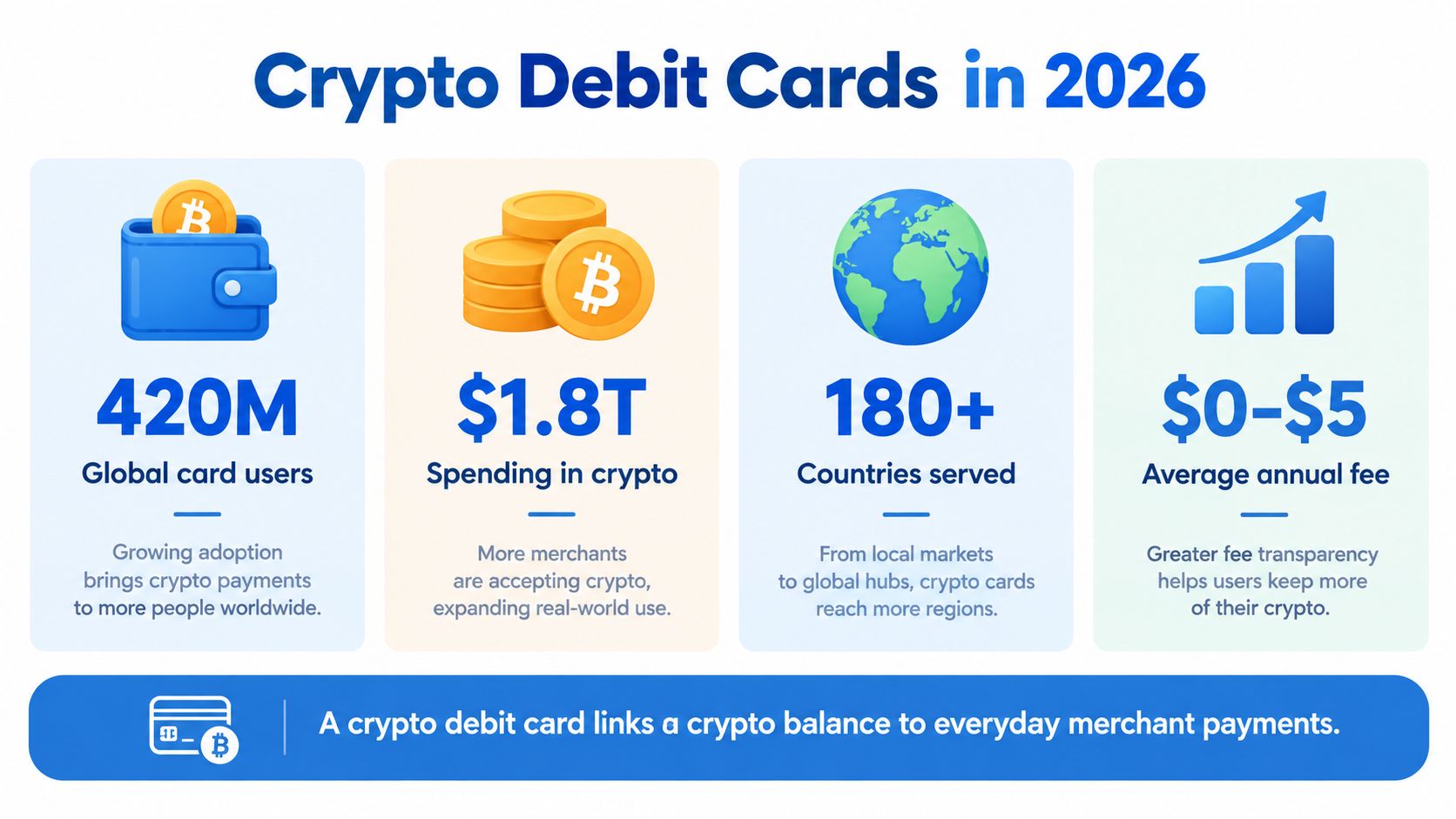
A practical definition keeps the category clear. A crypto debit card links a crypto balance to ordinary merchant payments, so the cardholder funds a purchase with digital assets while the merchant still receives fiat through the standard card stack. The merchant does not need to accept Bitcoin, USDC, or any other token directly. The issuer, processor, or program manager handles conversion and settlement behind the scenes, then sends the transaction through Visa or Mastercard infrastructure.
That operating model explains why stablecoins now matter so much. Everyday card use works best when the funding asset has low volatility, predictable unit value, and fewer tax and accounting surprises at the moment of sale. A user buying groceries or paying for a hotel usually wants spending certainty, while the issuer wants fewer edge cases between authorization and settlement. Stablecoins fit that pattern better than assets whose value can move materially between the card swipe and final clearing.
Growth doesn't equal replacement
The right comparison is functional, not ideological. Crypto cards ride on conventional payment rails, merchant acquirers, local settlement currencies, and existing dispute processes. That is why they can scale without asking merchants to install new hardware or change checkout behavior.
Their historical importance sits in distribution and conversion. They give users a way to hold crypto or stablecoins until purchase time, then translate that balance into a normal card payment that merchants already know how to handle. The card network logo tells you where the card can be presented. It does not tell you which asset gets liquidated, whether conversion happens at authorization or later, how the issuer sets the exchange rate, or how much value disappears before any advertised cashback is applied.
The useful mental model is simple. A crypto debit card is usually a conversion service with a card interface. Once you define it that way, evaluation criteria change. You stop focusing on logos and reward headlines, and start asking about balance location, quote timing, spread policy, FX markup, and whether the issuer can still approve a purchase when the underlying crypto transfer has not fully settled.
How a Crypto Card Authorizes and Settles
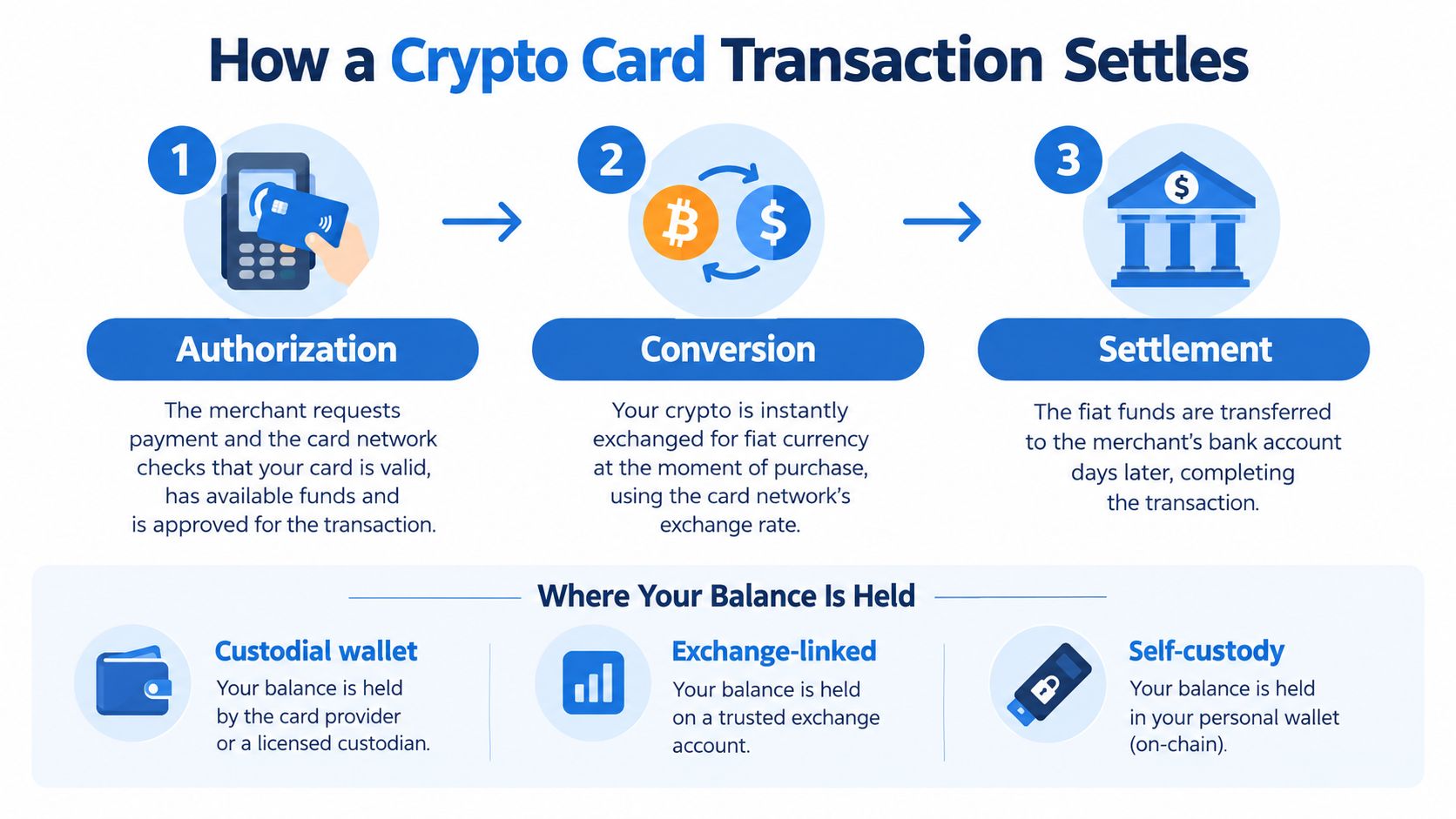
A card tap feels immediate, but several ledgers and pricing decisions sit behind that approval. The issuer has to confirm spendable value, decide how much crypto to earmark or sell, approve the authorization request on card rails, and later complete merchant settlement in fiat.
Step one is authorization
At the terminal, the merchant sends an authorization request through the card network. The issuer then checks card status, controls, and the balance it is willing to treat as spendable for that moment. That sounds simple, but the answer depends on where the funds sit. A card can draw from an exchange account, a hosted wallet, an issuer-managed ledger, or a self-custodial wallet linked through smart-contract permissions.
With a custodial card, the issuer usually reads its own ledger and places an immediate hold on value. That makes approval more predictable because the same operator controls balance visibility, reservation, and card decisioning. Exchange-linked cards often work similarly, even if the funds are sitting in a trading account rather than a separate card wallet.
Self-custodial designs are harder to engineer. Before approving, the program may need to confirm wallet permissions, check whether funds are already committed elsewhere, account for gas and network conditions, obtain a quote, and reduce the risk of double spending. The Visa explanation of stablecoin-linked cards and money movement describes the split between blockchain-based balance operations and conventional card settlement.
Step two is conversion
After authorization, or close to it, the issuer or program manager turns the required crypto amount into fiat for card settlement. The useful mental model: a crypto debit card is a conversion service wearing a card interface. The cardholder experiences a crypto-funded purchase, while the merchant still sees a normal card payment.
Timing drives cost. If the quote is fixed at authorization, the issuer absorbs some market risk until clearing. If conversion waits until later, the user bears more exposure to price movement between approval and settlement. Stablecoins have become central to card spending because they narrow that volatility window and simplify pricing, but they do not remove spread, FX markup, or issuer policy choices.
Step three is settlement
The merchant is paid through standard card rails in fiat, and the acquirer receives local currency through the normal clearing and settlement process. Blockchain infrastructure can support balance checks or funding transfers, yet the merchant checkout flow remains the same.
That is why the right questions are operational ones: where the user's funds are held, when authorization is granted, when conversion is priced, and what currency the merchant's acquirer receives. Those details determine latency risk, custody exposure, reversibility, and the gap between advertised cashback and the card's real economics.
What Assets and Networks Crypto Cards Support
The asset menu on a crypto card matters less than the funding path the issuer uses at the point of sale. Many programs advertise broad token support, but everyday spend depends on which assets can be converted predictably, in which countries, and whether the user can choose the debited balance instead of accepting the issuer's default route.
Tracked usage now centers on stablecoins. Paymentscan data cited in CoinDesk's report on stablecoins and everyday card purchases recorded $759 million in July 2026 across tracked crypto-card spending, up from $306 million in July 2025. The same dataset recorded nearly 9 million purchases in July 2026 versus about 5.2 million a year earlier, with an average transaction of approximately $86. That pattern fits card economics. For low and mid-sized purchases, users and issuers both prefer assets that reduce intraday price risk and simplify authorization logic.
| Asset | Share of tracked volume | Notes |
|---|---|---|
| USDC | About 58% | The largest tracked funding asset in July 2026, with strong relevance for everyday dollar-denominated spending. |
| USDT | About 26% | The second major stablecoin, with significant regional variation in practical availability. |
| USDC and USDT combined | Near 84% | Dollar-backed stablecoins dominated tracked volume. |
| EURe | Less than 2% in July 2026 | Its share fell from approximately 88% in early 2024, showing the shift away from euro-denominated digital money. |
The collapse of EURe reflects MiCA-driven reissuance and the pull of dollar-denominated spending across European card programs. All figures in the table come from the same Paymentscan dataset. The coverage tracks participating programs rather than every card globally, so it is useful for direction and mix, not as a full market-share table.
Practical assets versus nominal support
USDC and USDT are usually the practical spending balances because they fit how card programs quote and settle transactions. BTC and ETH may be available, but support on a marketing page does not mean equal economics at checkout. A program can accept those assets, convert them through an internal trading path, and still expose the user to wider spreads or more volatile pricing than a stablecoin-funded transaction.
Regional differences are material. Reporting summarized by CoinMarketCap Academy on stablecoin card spending noted that USDC represented 50.8% of tracked July 2025 volume and USDT 20.3%. The same coverage described USDC as unusually strong in India and Argentina, where it approached parity with USDT.
For country-level screening, start with USDC crypto cards by country. Then check the operating details that decide real usability: which asset is debited, whether the card is issued in your jurisdiction, and whether conversion happens directly into fiat or through another asset first. The Visa or Mastercard badge identifies the payment rail. It does not tell you which token the issuer supports as a primary spending balance.
Fees, FX Markup, and the Real Cost of Spending Crypto
The headline transaction fee is often the least revealing number on a crypto card. The main cost may be embedded in the crypto-to-fiat exchange rate, where the issuer deducts more crypto than the market value of the purchase would suggest.
Industry comparisons place crypto-conversion fees for some programs between 0.5% and 2.49%, while cross-border foreign-exchange markups can range from zero to roughly 3%, depending on the issuer, asset, currency pair, and card region, according to Spark's stablecoin debit-card market research. For comparison, consumer debit interchange is capped at 0.2% in the European Union, while U.S. debit cards issued by large banks are generally capped at $0.21 plus 0.05% under the Durbin framework.
Why “no transaction fee” can mislead
Suppose a card advertises 2% cashback and no transaction fee, but applies a 2.5% conversion spread. The reward doesn't create a net gain. Before considering any other charges, the spread is larger than the cashback, producing a negative difference of 0.5 percentage points. That example comes directly from the fee comparison data, and it illustrates why rewards must be evaluated after conversion costs.
Other charges can change the result further:
- Conversion spread: Compare the fiat amount charged with the market value of the crypto deducted.
- FX markup: Check whether the card adds a separate cost when the merchant charges in another currency.
- ATM pricing: Separate issuer fees, network fees, and operator surcharges.
- Subscription charges: Include recurring card-plan costs even when individual purchases show no fee.
- Reward clawbacks: Check whether the issuer removes cashback after refunds, chargebacks, asset conversions, or account closure.
A reusable calculation
Use this basic method for each test transaction:
Effective cost = fiat amount charged minus market value of crypto deducted, plus FX costs and flat fees, minus rewards retained.
Run the test with the same asset, purchase amount, merchant currency, and settlement conditions across cards. Don't compare a stablecoin purchase on one product with a volatile-token purchase on another. The cleanest benchmark isolates the card's pricing rather than the asset's price movement.
The crypto card fees comparison guide can help organize the visible fee fields, but the decisive number still comes from the issuer's quoted rate and the amount deducted. A large cashback percentage can't rescue an opaque spread.
KYC Levels, Custody, and Regional Availability
Verification status shapes more than onboarding. It affects who can receive a card, how the issuer handles disputed transactions and account recovery, and whether the spending balance sits inside a custodial ledger or stays connected to a wallet the user controls.

A no-KYC label only describes one part of the setup. It may mean lighter identity collection, but it can also mean lower limits, tighter monitoring, fewer supported jurisdictions, or weaker recovery procedures. Email-only products sit in the middle. Full KYC usually supports a wider compliance perimeter and a clearer path to restoring access after a lockout. Those labels do not tell you, by themselves, whether a card is private in practice, available in your country, or compatible with self-custody.
Custody changes the operating model. With a custodial card, the provider or its partner controls the balance used for authorization and can freeze funds, adjust internal ledger entries, or restore access through standard support procedures. With a self-custodial design, the user keeps more direct control over keys or wallet permissions, but also takes on more execution risk. Failed approvals may trace back to wallet permissions, gas, chain conditions, oracle inputs, or contract logic rather than a simple issuer-side balance check.
Regional availability is just as important. A card may appear on a global marketing page and still be impossible to issue in a specific country. The constraints are practical: licensed issuing partners, shipping coverage, supported fiat currencies, sanctions screening, local rules, and card-network restrictions. In Europe, users should also check whether a program's structure and authorization flow still fit current regulatory requirements. A country checker or availability page is more useful than a broad claim that a product works worldwide.
Before applying, verify a few operational points:
- Identity requirements: Is access based on no-KYC, email-only onboarding, or full KYC?
- Custody: Does the card spend from an exchange account, a hosted wallet, or an on-chain wallet connection?
- Asset access: Are the promoted assets spendable where you live?
- Card issuance: Is there a virtual card, a physical card, or both?
- Recovery: What happens if you lose the phone, wallet approval, or account login?
For a closer comparison of these tradeoffs, see the guide to custodial and self-custody crypto cards.
A visual explanation can help separate the labels from the actual mechanics:
Privacy and convenience reflect different risk allocations. Less identity collection can reduce exposure to the provider. Custodial control can make refunds, failed authorizations, and account recovery easier to resolve.
Where a Crypto Debit Card Makes Sense
A crypto debit card earns its place in a narrow set of payments. It works best when the user already holds a spendable asset, usually a stablecoin balance, and the merchant only needs a standard card authorization. In that setup, the card is a conversion and acceptance tool, not a crypto-native payment rail.
Good fits
Travel can be compelling if funds are already parked in stablecoins and the alternative is a manual off-ramp before booking or paying on arrival. The convenience is real, but so are the edge cases. Hotel preauthorizations can tie up more than the final bill, refunds may take time to post, and cross-border pricing can include both asset conversion spread and foreign-exchange markup. A headline cashback rate does not cancel those costs if the card converts at a weak rate.
Recurring subscriptions are another sensible use case. Card credentials fit the way streaming services, software tools, and other merchants bill. A stablecoin-funded card can keep those payments running without first moving funds into a bank account. The tradeoff sits in failure handling. If an issuer pauses the account, rotates the card, or declines a renewal after a balance or compliance check, the merchant sees an ordinary card failure, not a crypto-specific exception.
Everyday local spending can also work well, especially for routine purchases where speed and merchant acceptance matter more than crypto settlement finality. Here the key test is cost discipline. If the supported asset is liquid, the spread is tight, and domestic settlement is reliable, the card can be a practical spending layer. If not, small purchases absorb hidden conversion costs surprisingly fast.
Cases where a traditional or on-chain payment may win
Direct on-chain payment is better when both sides want settlement in crypto, wallet-to-wallet transparency, or programmable payment logic. It removes the card network from the flow. It also gives up broad merchant acceptance and the familiar dispute process that card users expect.
Traditional fiat cards remain stronger for users who want established refund handling, clearer FX treatment, credit features, or direct spending from salary and bank balances. Crypto cards add extra moving parts: depeg exposure, conversion slippage, issuer controls, and refunds that may come back in fiat or platform credit instead of the original asset.
The practical conclusion is simple. Choose a crypto debit card for merchant compatibility and convenient conversion when those benefits outweigh spread and FX costs.
Choosing a Card With NomadCards Filters and Scores
A ranking only helps after you remove the cards you cannot use. Start with country availability, then screen for custody model and KYC level. Those three filters usually change the decision faster than network badges or feature checklists, because many programs that look competitive on a comparison page disappear once regional eligibility, onboarding rules, or funding method are applied.
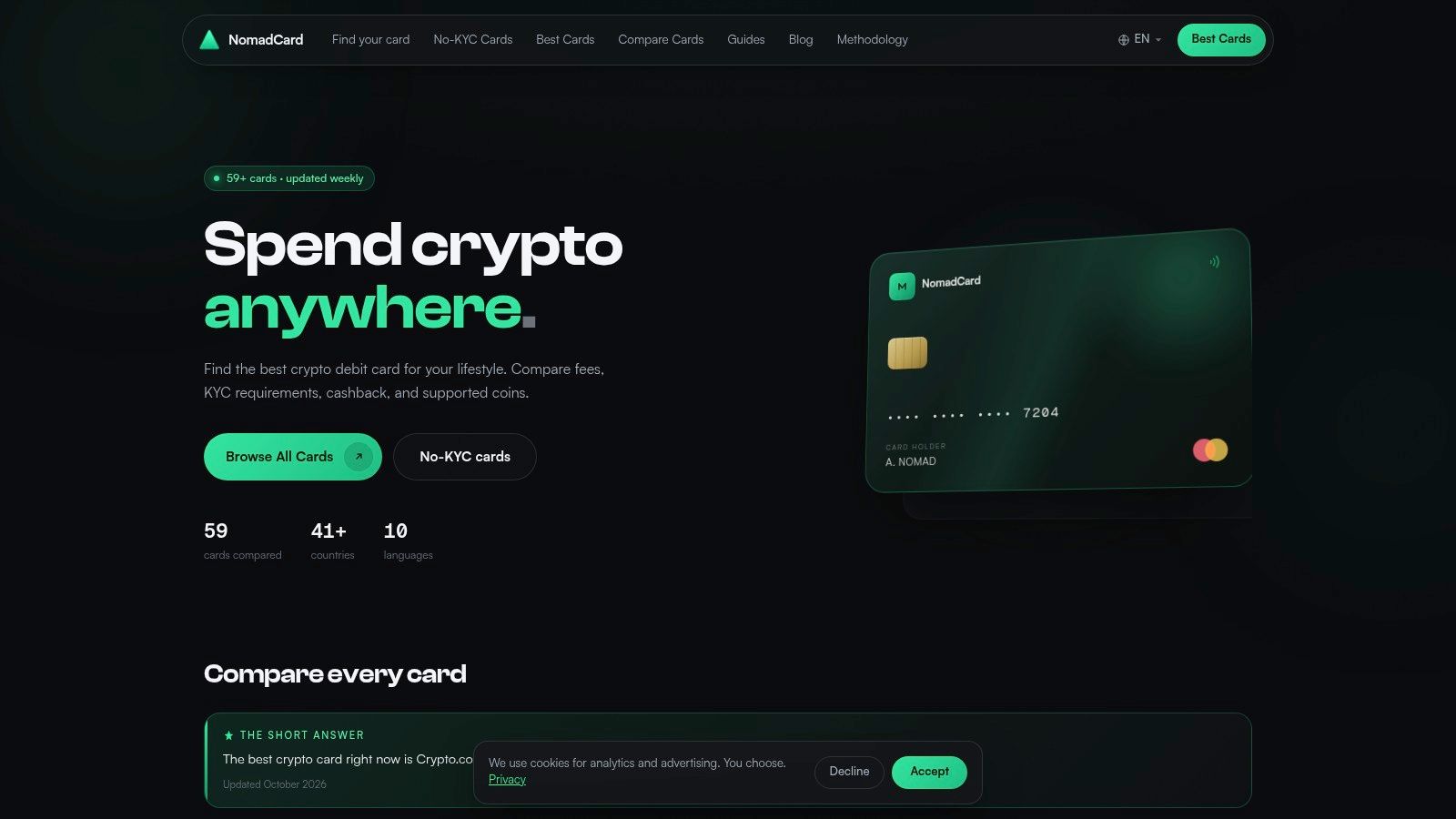
NomadCards organizes card data into a score weighted at 30% fees, 20% privacy, 20% trust, 20% community, and 10% rewards. Treat that weighting as a lens for reading the table. A reader focused on spending cost should still inspect the fee fields directly. A reader focused on identity minimization should put more attention on verification requirements, custody, and recovery rules than on cashback.
A worked comparison makes the score more useful. Suppose two cards are both available in your country and both support the asset you plan to spend. One card advertises rewards, but applies a wider conversion spread. Another card offers lower visible fees and weaker rewards. If your regular use is point-of-sale spending in a foreign merchant currency, the true comparison is spread plus FX markup, then any reward on top. A headline cashback rate can look attractive while still leaving the transaction more expensive in net terms.
That is why preset views need context. A low-fee preset is usually the right starting point for users who care about predictable card economics. A privacy-oriented preset can be valid too, but lower-friction onboarding often comes with tighter limits, narrower regional support, or more manual account recovery if something breaks.
Self-custody users should read the authorization details with extra care. The decision point is whether the card can access wallet funds reliably at the moment of authorization, what approvals or contract permissions are required, and what happens if the authorization fails or settles later than expected.
Finish with a manual check. Use the same asset, the same merchant currency, confirm country eligibility, and calculate the effective cost before applying.
Risks, Open Questions, and What to Watch Next
The category's main risks are practical. Conversion spread can outweigh rewards, stablecoin depegging can change the value available for spending, refunds may not return the original asset, and self-custodial cards can introduce smart-contract and authorization risks. Regulatory changes can also alter which programs serve a country or which assets they support.
Several questions remain open. Will self-custodial cards make authorization fast and reliable without weakening user control? Will regional liquidity make USDC or USDT more useful in one country than another? Will issuers keep broad asset lists, or concentrate on a smaller number of liquid stablecoins? Users evaluating volatile tokens can also consult an AI-powered meme coin safety resource before linking speculative assets to a spending product.
The broader conclusion is easy to miss. Crypto debit cards aren't replacing Visa, Mastercard, banks, or merchant acquirers. They're using those systems to make crypto and stablecoins spendable at ordinary points of sale. Their value depends less on the word “crypto” than on the quality of the conversion, authorization, custody, and regional compliance layers underneath.
Recheck the card's supported assets, custody model, KYC rules, spreads, FX markup, refund policy, and country availability regularly. Ranked lists and product terms change as issuers update programs and regulations shift.
NomadCards brings card terms into one comparison workflow, including fees, rewards, KYC, custody, supported assets, networks, limits, and regional availability. Use the NomadCards comparison tools to shortlist products, then test the actual spread and settlement conditions before connecting a crypto balance.