The most popular advice about a crypto prepaid card is also the least useful: find one with no annual fee, minimal verification, and attractive rewards. That checklist ignores the mechanics that determine what you really pay, who controls the funds, and whether the card can legally operate where you live.
A prepaid crypto card isn't a magic privacy tool or a direct on-chain payment instrument. In most cases, you sell crypto into a fiat balance first, then spend that balance through a card network. The important questions are therefore practical: when does conversion happen, what spread applies, where does the money sit, what verification is required, and which merchants will accept the card?
Table of Contents
- The Shift From Niche Perk to Payment Infrastructure
- How Preload Mechanics and Custody Models Work
- Unpacking Fees, FX Markups, and Top-Up Timing
- The Reality of Privacy, KYC, and Incoming Regulations
- Security Risks, Limits, and Network Acceptance
- Choosing the Right Card for Your Spending Profile
- Final Thoughts on Integrating Crypto Into Daily Life
The Shift From Niche Perk to Payment Infrastructure
Crypto cards are no longer just exchange loyalty benefits. Artemis-reported monthly payment volume grew from about $100 million in early 2023 to roughly $1.5 billion by the end of 2025, equivalent to more than $18 billion on an annualized basis, according to CoinGecko's analysis of crypto card payment volume. The same coverage describes an approximate 15-fold increase in monthly volume over the period and cites secondary commentary estimating compound annual growth of around 106%.
That shift matters because payment volume measures behavior, not marketing interest. People may sign up for a card because of a launch bonus, but sustained volume requires repeated purchases, successful authorizations, usable funding rails, and merchants willing to accept the network. Stablecoin activity and ordinary spending have helped move crypto cards toward that role, rather than leaving them as a novelty for traders.
Visa's earlier research also showed that crypto-linked card ownership rose from 10% of surveyed crypto owners in 2021 to 16% in 2022, a 60% relative increase in one year, as documented in its consumer cryptocurrency attitudes and usage research. Visa separately reported that crypto card payment volume on its network had increased about elevenfold by April 2022 compared with January 2021, showing that expansion began well before the more recent acceleration.
Practical implication: A crypto card deserves the same scrutiny as any payment account. Treating it as a promotional add-on is how users miss conversion spreads, balance restrictions, and regional limitations.
The use case is also becoming more ordinary. A 2025 survey reported by Changelly found that 60.6% of respondents already used crypto cards, with online transactions at 66% and everyday purchases at 61% among the leading use cases. The survey reported an average European transaction size of €40, though survey methods differ and shouldn't be treated as a universal spending benchmark. For anyone tracking household spending, a tool such as Fintrack automated finance insights can help put card activity into a broader budget, rather than evaluating rewards in isolation.
How Preload Mechanics and Custody Models Work
Before you compare rewards, identify what happens between your wallet and the merchant terminal. A typical crypto prepaid card uses a preload-and-spend arrangement. You convert crypto into a fiat balance, the card program records that balance, and the merchant receives local currency through Visa or Mastercard settlement.
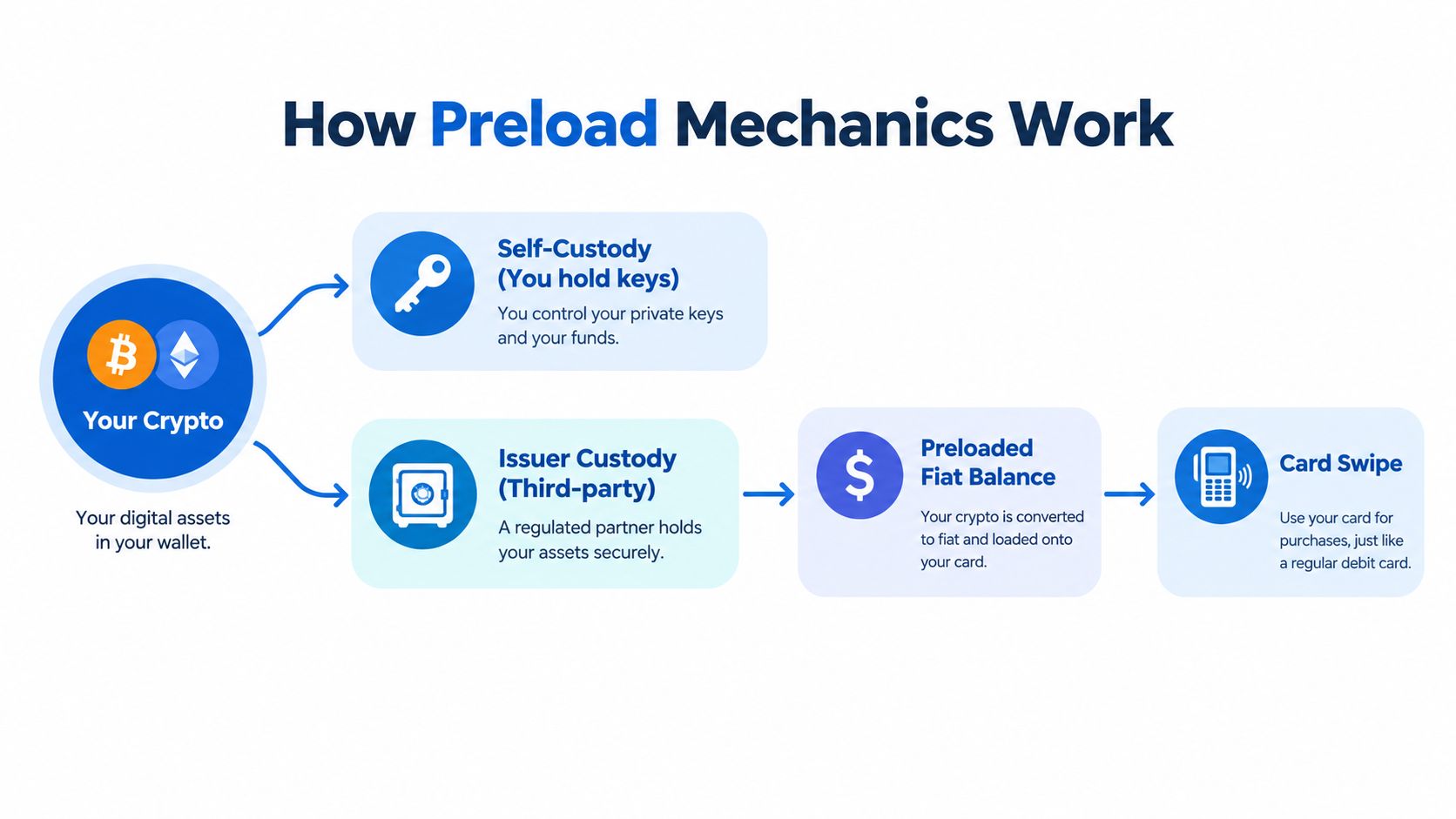
This is different from real-time on-chain spending. The card normally doesn't ask a blockchain to settle the coffee purchase. Instead, your crypto is sold or converted when you top up, and the resulting fiat float pays for later card transactions. The value is usually locked at top-up, so market exposure shifts from checkout timing to the moment you fund the card.
The float is the product
The fiat balance is operationally important. While it remains on the card, you aren't holding the original crypto position, and the issuer or program structure controls how that balance is safeguarded, reconciled, and made available for authorization. A card can therefore feel instant at the terminal while relying on a conversion that happened earlier.
The model also explains why fees can appear in several places. A provider may apply a conversion spread during the crypto sale, a loading charge during funding, and separate maintenance, inactivity, ATM, or foreign exchange charges. The right comparison isn't the headline card fee. It's the cost of converting, holding, and spending according to your actual routine.
Custodial and self-custody paths
Most products use one of two broad custody models:
- Custodial cards keep the relevant assets or balances under issuer control. The provider handles conversion in its ledger, which generally simplifies authorization and checkout, but increases counterparty exposure.
- Self-custody cards leave wallet control with the user until a transaction triggers a sale, collateral draw, or other funding action. This can reduce dependence on an issuer holding private keys, but it adds wallet, liquidity, and on-chain execution complexity.
The distinction affects more than security philosophy. It can change authorization latency, KYC requirements, spread exposure, and whether funds sit in an exchange account, a program float, or a wallet controlled by the user. Traditional custodial products commonly settle the merchant payment through fiat rails even when the app shows a crypto deduction.
For a deeper technical comparison, use this guide to custodial versus self-custody crypto cards before treating the two models as interchangeable.
The practical test is simple. Ask whether you can identify the exact event that sells your crypto, the entity that holds the resulting fiat, and the condition that can delay or reject a card authorization.
Unpacking Fees, FX Markups, and Top-Up Timing
A card advertising no annual fee can still be expensive. The cost often appears as a chain of smaller deductions connected to funding and usage, not as one obvious charge on the pricing page.
A conversion spread reduces the amount of fiat created from your crypto. A loading or top-up fee reduces it again. Maintenance and inactivity fees matter when the balance sits unused, while ATM and foreign exchange charges can affect cash withdrawals or spending abroad. The result is a product whose effective cost depends on how often you top up, how long you hold the float, and where you spend.
The hidden cost breakdown
| Fee Type | When It Triggers | Impact on User |
|---|---|---|
| Conversion spread | When crypto becomes fiat | You receive less spending value than the quoted market price |
| Loading or top-up fee | When you fund the card | Each funding event reduces the usable balance |
| Maintenance fee | According to the program's recurring terms | A dormant balance can gradually become more expensive |
| Inactivity fee | After a defined period without qualifying activity | Casual users may pay more than frequent spenders |
| ATM fee | When supported cash withdrawal is used | Cash access can cost more than card purchases |
| FX fee or markup | When spending in another currency | The final purchase cost can exceed the displayed merchant amount |
The timing issue deserves separate attention. Suppose you convert crypto into euros before a planned purchase and the asset rises afterward. You've avoided checkout volatility, but you've also sold before that rise. If you wait and the asset falls, the same planned purchase may require a larger crypto sale. Preloading creates certainty in the fiat budget, not certainty in the opportunity cost of the crypto you sold.
Timing rule: Top up for a defined spending window, not simply because the app makes conversion convenient.
Stablecoins may reduce price volatility between funding and spending, but they don't eliminate conversion spreads, issuer exposure, network restrictions, or regulatory obligations. Nor does a low advertised fee prove that the provider offers a competitive exchange rate. Compare the fiat amount credited after every deduction, not just the fee label.
Your spending cadence changes the answer. A frequent spender may value predictable conversion and a low friction top-up flow. Someone who makes occasional purchases may be hurt more by maintenance or inactivity terms. A traveler also needs to inspect FX treatment and ATM conditions rather than assuming that Visa or Mastercard acceptance means low-cost international use.
For a like-for-like review of these fields, consult the crypto card fees comparison, then verify the issuer's current terms before funding an account.
The Reality of Privacy, KYC, and Incoming Regulations
“No KYC crypto card” is one of the market's most misleading search terms. A card that holds meaningful value, authorizes ordinary purchases, and operates through established payment rails generally needs customer identification and financial-crime controls. Privacy at checkout does not mean anonymity from the issuer.
Some products offer email-only onboarding, limited functionality, or narrow prepaid exemptions. Those features do not make them equivalent to fully functional anonymous spending accounts. The current analysis of crypto cards without KYC explains why fully operational crypto cards without identity verification are generally unavailable in regulated markets, and why privacy claims have narrowed.
Why the exemption doesn't solve the problem
EU rules allow only limited prepaid-card exemptions. They do not create a general right to anonymous crypto spending, particularly when a product crosses thresholds involving funding, transfers, geography, or payment functionality. Treat “no KYC” as an onboarding description or restricted use case until the issuer explains the limits in writing.
The regulatory direction is also tightening. The upcoming AMLR is scheduled to prohibit anonymous accounts and anonymous prepaid cards issued outside the EU from being accepted from 1 July 2027. That is a projected compliance milestone, not proof that every current product follows the same process. Issuers may also apply stricter checks before that point because payment partners and local rules can impose additional requirements.
Privacy has practical boundaries
A provider can shield selected customer details from merchants while collecting substantial information itself. Depending on the program, verification may involve identity, residence, transaction history, source of funds, device signals, and transaction-risk indicators.
A virtual address can create a separate eligibility problem. The issuer may require evidence that the applicant resides at the stated address, so review the Cloud Residents bank address guide before treating an address service as a solution.
Before registration, ask:
- What is verified: Email, identity document, address, source of funds, or several of these?
- What stays restricted: Top-ups, withdrawals, merchant categories, countries, or balance size?
- Who receives the data: The issuer, payment processor, exchange, and compliance partners may all handle it.
- What changes by jurisdiction: Availability, verification, and permitted features can differ by country.
The useful comparison is the verification level, retained data, permitted functionality, and legal status of the program. NomadCards' guide to crypto card KYC levels provides a practical framework for separating those categories. Also check how long fiat funds may sit between conversion and settlement, since regulatory reviews or account restrictions can leave that float unavailable when you expect to spend it.
Security Risks, Limits, and Network Acceptance
A crypto prepaid card adds a new balance to your financial stack. That balance can be convenient, but it also creates dependence on the issuer's operations, payment partners, compliance systems, and security controls.
Custodial programs concentrate risk in the provider. If an issuer experiences an outage, freezes an account, delays reconciliation, or becomes insolvent, your ability to spend may stop even if the underlying blockchain is operating normally. Self-custody designs reduce the need to leave assets with a centralized provider, but they can introduce smart-contract, wallet-signing, liquidity, and transaction-execution risks.

Reduce operational surprises
Use a small initial top-up and test the full path. Check the credited fiat amount, a low-value purchase, a virtual or physical card authorization, and any ATM or foreign-currency behavior you expect to use.
Then document the limits before moving more funds:
- Read authorization limits. Per-transaction and daily spending caps can make a card unsuitable for rent, travel bookings, or larger purchases.
- Check ATM conditions. Withdrawal availability, fees, and country restrictions vary by program.
- Test important merchants. A network logo indicates broad network participation, not universal approval for every merchant category.
- Keep a backup payment method. Issuer outages, compliance reviews, and terminal failures can all produce declines.
- Separate spending funds from long-term holdings. A prepaid float should contain only the amount you can tolerate having temporarily unavailable.
Visa and Mastercard acceptance usually makes these cards usable at many ordinary merchants, but the underlying program can still restrict gambling, crypto exchanges, cash-like transactions, or other merchant categories. A decline may therefore come from the issuer's risk policy rather than a technical failure at the terminal.
Operational safeguard: Don't use a crypto prepaid card as your only payment method until you've tested both the issuer and the merchants that matter to you.
Choosing the Right Card for Your Spending Profile
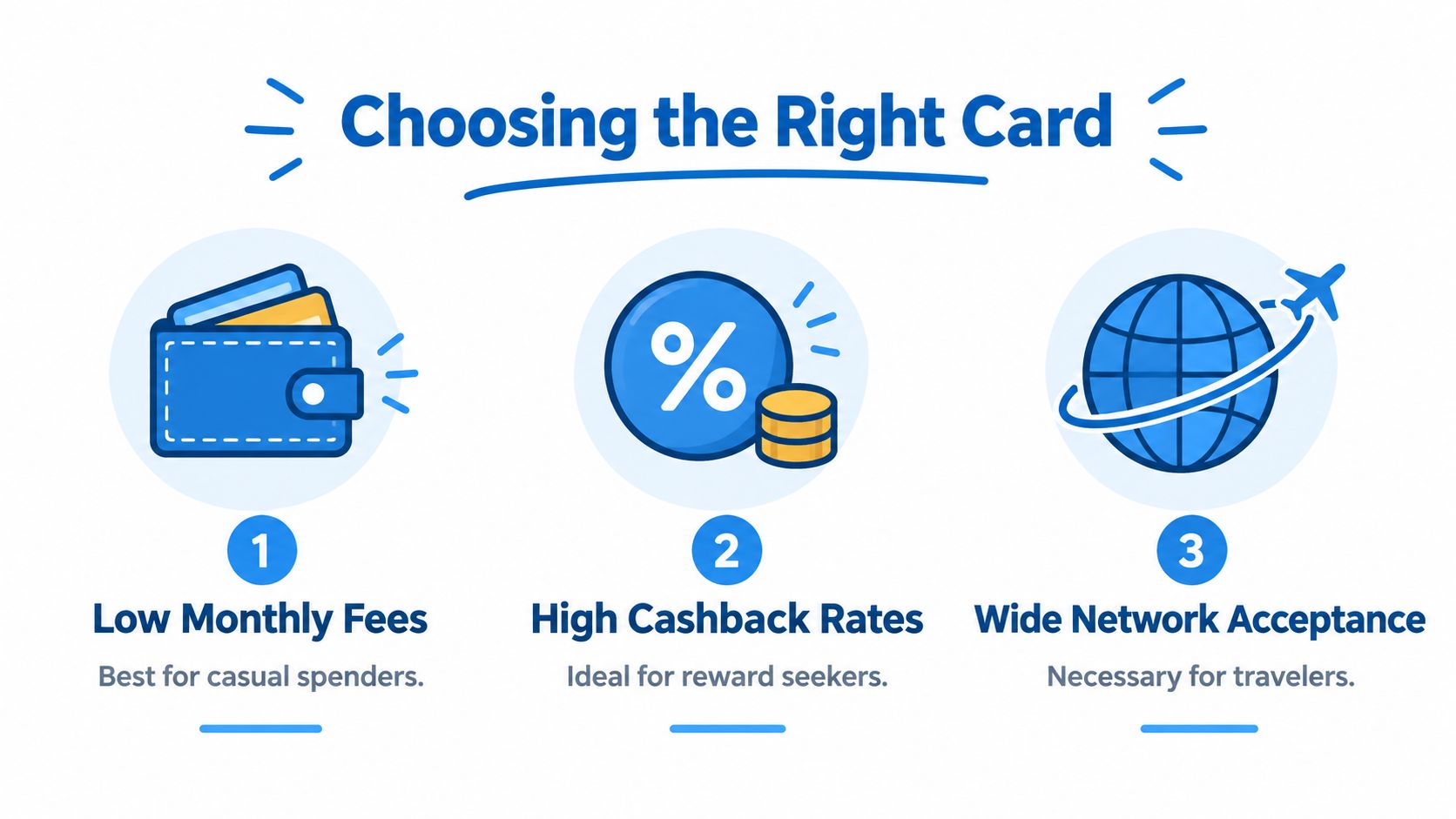
The right card depends less on the logo and more on the way you spend. Start with the funding event, then evaluate the custody model, verification, supported assets, limits, rewards, and geographic availability.
Match the mechanism to the user
A rewards-focused user may accept issuer custody if the cashback structure offsets conversion and FX costs. That calculation only works when rewards are measured against actual spending and the program's eligibility conditions, not against a promotional headline.
A privacy-focused user should compare verification depth and regional legality. A lower-friction signup may come with lower limits, fewer assets, restricted withdrawals, or a future compliance review. “Email only” is a product condition, not a permanent guarantee of anonymous use.
The self-custody purist has a different priority. A wallet-controlled card can limit exposure to a centralized float, but the user must understand collateral rules, transaction signing, liquidity, and what happens if an on-chain action can't complete in time.
Normalize the comparison
Use the same questions for every product:
- Cost: What fiat value arrives after spread and top-up charges?
- Custody: Does the issuer control keys, balances, or neither?
- Funding: Is conversion performed at top-up, authorization, or through a collateral mechanism?
- Verification: Is the account email-only, partially verified, or fully KYC-checked?
- Assets: Which coins and stablecoins can fund the card?
- Access: Is the card virtual, physical, or both, and where is it issued?
- Network: Does it use Visa or Mastercard, and are important merchant categories excluded?
- Limits: What restrictions apply to purchases, withdrawals, balances, and top-ups?
- Rewards: Are rewards paid in crypto, subject to conditions, or offset by higher costs?
NomadCards is one comparison option that aggregates card data across fees, rewards, custody, KYC requirements, supported assets, networks, and regional availability. Its filters and standardized profiles can help you compare unlike products, but issuer terms should still be checked before you top up.
A good choice is the card whose compromises match your routine. A frequent traveler may prioritize FX handling and merchant coverage. A casual spender may prefer a simple fiat preload with low inactivity exposure. A self-custody user may accept more operational work to avoid leaving funds in an issuer-controlled balance.
Final Thoughts on Integrating Crypto Into Daily Life
Using a crypto prepaid card day to day feels less like spending directly from a blockchain and more like managing a specialized fiat wallet funded by crypto. You choose an asset, convert it, watch the fiat balance, and spend through ordinary card rails. The convenience is real, but so are the trade-offs around timing, custody, fees, verification, and acceptance.
The most reliable setup is deliberately boring. Fund only what you expect to spend, record the fiat amount credited, make a small test purchase, and keep another payment method available. Review the transaction history afterward so you can see the conversion rate, any spread or fee, and whether the final merchant charge matches your expectation.
Don't choose a card because it promises anonymity or because the annual fee is zero. Choose it because its custody arrangement, KYC process, funding timing, supported assets, limits, and network rules fit your jurisdiction and spending habits. A prepaid card can be a useful bridge between digital assets and everyday commerce, but it isn't a substitute for understanding where your money sits.
NomadCards helps you compare crypto-linked debit, credit, prepaid, and secured cards across fees, rewards, supported assets, custody, KYC requirements, networks, and regional availability. Visit NomadCards to filter the options against your actual spending profile before making your first top-up.