You're sitting on crypto you'd rather spend than sell, or you're already routing everyday purchases through a card and wondering why the rewards can't go back into your portfolio. The pitch sounds simple: swipe normally, earn crypto, keep your upside. It's less tidy. Rewards are real, but the advertised rate often isn't your net rate.
A crypto rewards credit card can charge an annual fee, apply an FX markup, convert rewards through a spread, require a token stake, or exclude the exact transaction you wanted to make. Some programs pay straightforward purchase-linked cashback. Others pay a token grant whose value depends on market price and lockup conditions. This guide separates those models and uses custody, KYC, network access, and normalized comparison fields as the practical decision framework.
Table of Contents
- Why a Crypto Rewards Credit Card Now
- What a Crypto Rewards Credit Card Actually Is
- How Rewards Work Behind the Swipe
- Cashback vs Token Rewards Compared
- Fees, FX and the True Cost of Spending
- Custody and KYC Trade-Offs
- Networks Availability and Where Cards Work
- Choosing the Right Card for Your Priorities
Why a Crypto Rewards Credit Card Now
You can earn crypto on routine spending, but the card's headline rate is only useful if you can keep the reward. BlockFi reported that its Rewards Credit Card launched in July 2021 and reached over 70,000 cardholders by December 2021. Users had accumulated more than 235 BTC in rewards, valued at over $11 million at the time. The milestone, recorded in BlockFi's card launch announcement, showed that crypto-linked spending rewards could attract substantial adoption quickly.
The field now spans exchange-linked cards, secured products, and wallet-connected designs. A purchase may look like any Visa or Mastercard transaction, while the reward could arrive as Bitcoin, a stablecoin, a native token, or an in-app balance that requires conversion before you can use it.
The headline rate is only the starting point
Many crypto card programs advertise rewards from 1% to 5%, while top staking tiers promote as much as 8%, according to crypto card rewards statistics. Treat the highest figure as a conditional offer, not your expected return. It may require locking a token, holding a balance, spending in selected categories, or accepting price volatility.
Staking tiers deserve one clear warning: a larger advertised rate can reflect the cost and risk of holding the issuer's token, rather than better everyday cashback.
Start with the amount left after every fee and condition. A modest flat reward can beat a larger token grant when it has no lockup, stable valuation, and fewer conversion steps. Use NomadCards' standardized fields to compare the same details across cards, especially reward asset, funding conditions, custody, KYC, fees, and withdrawal rules.
My rule: If you can't explain how the reward is funded, credited, valued, and withdrawn, you don't know the card's real reward rate.
The category's growth has also concentrated spending around particular programs. Reported crypto-linked card volume increased by 525% in 2025, from $14.6 million to $91.3 million across major partner cards. EtherFi's Visa card contributed about $55.4 million, or roughly 60%, according to the same industry report. Those figures show where activity gathered, not that every high-rate card offers good value. Judge the product by the reward you can retain and withdraw, not by its most visible tier.
What a Crypto Rewards Credit Card Actually Is
At the point of sale, the transaction usually looks ordinary. You tap the card, the merchant authorizes a purchase in fiat, the card network routes the authorization, and the issuer settles the merchant's amount. The crypto component typically appears afterward, when the issuer calculates a reward and credits it to your account or wallet.
Think of it as a coffee loyalty stamp attached to a normal card swipe. Instead of receiving a tenth coffee, you receive a crypto amount calculated from the fiat value of the purchase. The key distinction is that the purchase currency and the reward currency are often different.
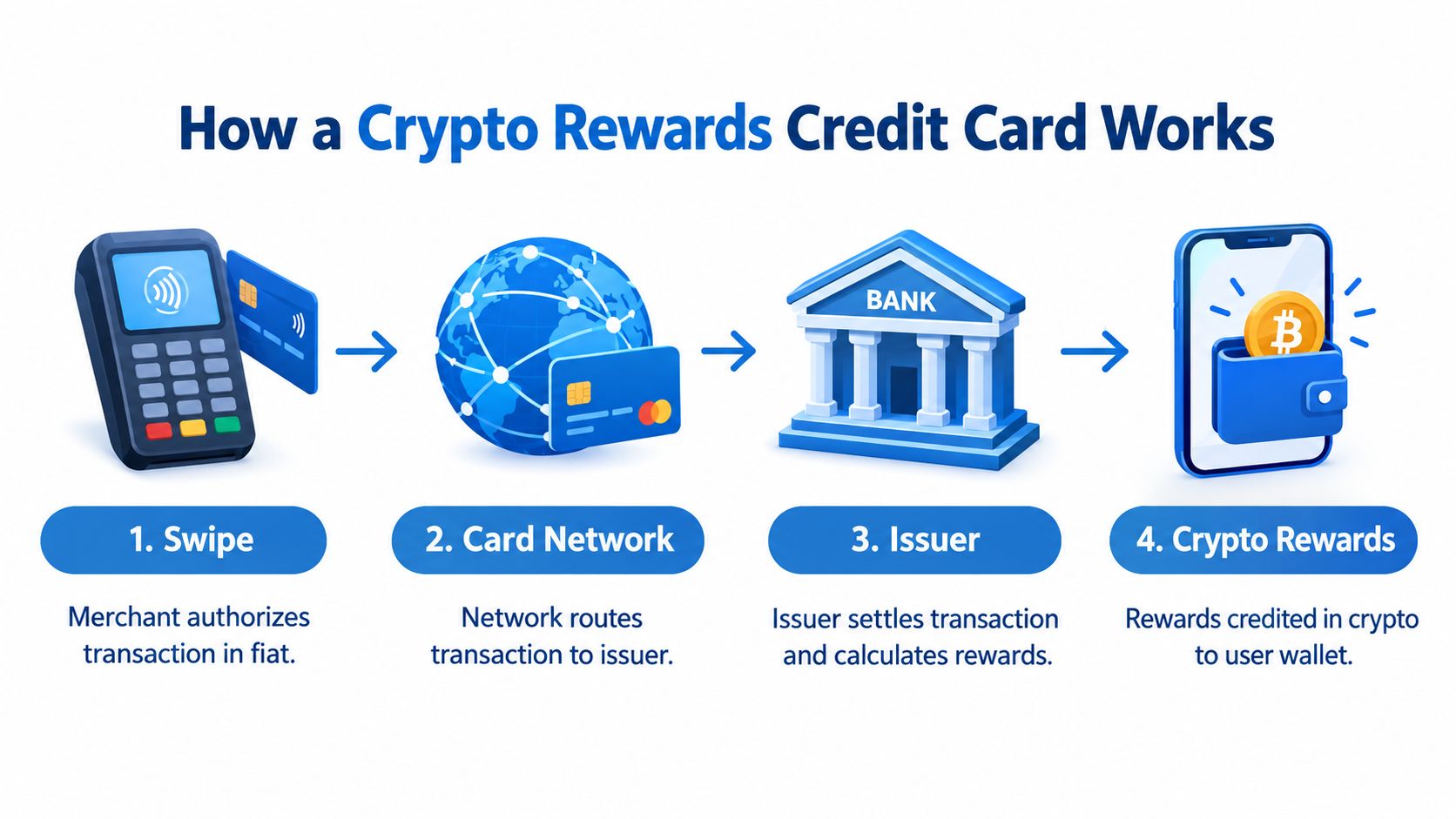
The transaction flow
- Merchant authorization: The terminal requests approval for a fiat purchase.
- Network routing: Visa, Mastercard, or another rail passes the authorization to the issuer.
- Issuer settlement: The issuer pays the merchant and applies its transaction rules.
- Reward crediting: The program issues cashback, a token grant, or a tier-based bonus.
That reward can follow several paths. A custodial exchange may credit it to an in-app balance controlled by the provider. A self-custodial program may connect spending to your wallet through an on-chain mechanism. A secured card may use deposited assets as collateral while presenting a conventional card interface.
Credit, debit, and wallet checkout aren't interchangeable
A crypto rewards credit card generally lets you spend against a credit facility or a secured credit arrangement, then receive a crypto reward. A crypto debit card may sell or draw down deposited crypto as you spend. A wallet checkout rail may authorize payment through a crypto app rather than through a conventional card purchase. Those products can feel similar at checkout, but their funding, chargeback, reward, and tax mechanics differ.
For Web3 businesses evaluating a card rather than a consumer rewards product, this overview of the Avalanche Card for Web3 startups provides useful context on how specialized programs can fit operational spending. Don't treat every product that accepts crypto as the same category. The reward structure matters more than the word “crypto” in the product name.
How Rewards Work Behind the Swipe
A flat reward is easy to understand. Spend $100 at a 2% rate and the program credits roughly $2 in reward value, assuming the purchase qualifies and the issuer values the reward at the same amount. A tiered card might pay 1% on one category and 4% on a promoted category, subject to program rules and a cap.
Token rewards add another layer. The issuer calculates the fiat reward, converts that value into a token amount at a spot rate, and credits the token. A stated 4% token reward is worth 4% at issuance, but its market value can move before you sell, swap, or spend it. The reward rate is therefore partly a payment rate and partly an exposure to the reward asset.
A worked comparison
Consider two hypothetical structures:
- Card A: 3% flat cashback, no stake requirement.
- Card B: 5% token rewards, requiring a $400 stake and a 180-day lockup.
Card B offers the larger headline rate. It doesn't automatically offer the larger economic return. You must account for the value of capital tied up in the stake, the token's price movement, any conversion spread, and whether the high tier applies to your purchases. If the token falls after rewards are credited, the realized reward can be below the advertised rate. If you wouldn't hold the token without the card, the stake is a cost, not a free bonus.
| Card Model | Headline Rate | Stake Required | Net Annual Reward (USD) | Breakeven vs No Stake |
|---|---|---|---|---|
| Flat cashback | 3% | None | Depends on qualifying spend | No staking hurdle |
| Token tier | 5% | $400 | Depends on spend, token price, and fees | Must offset stake opportunity cost and volatility |
The important comparison is not 3% versus 5%. It's net reward after eligibility, lockup, price movement, and fees. Category exclusions, geographic limitations, monthly resets, and in-app redemption rules can all reduce the amount you keep.
Before applying, ask for the reward terms, not just the landing page. Then check whether crypto purchases themselves qualify, because a card that pays crypto cashback on groceries may exclude a direct exchange purchase entirely.
Cashback vs Token Rewards Compared
Flat cashback wins on clarity. The issuer applies a fixed percentage to eligible spending and credits a stablecoin, Bitcoin, or another crypto asset. You still face price risk after receiving the asset, but the formula is easier to audit because it does not depend on a staking tier.
Token and staking programs can advertise higher rates, often between 3% and 8%. The top tier may require a native-token balance, a lockup, or specific spending conditions. Geography and changing program terms can reduce access. A user spending $1,000 per month would earn roughly $10 to $20 at a 1% to 2% flat rate. A tiered card advertising 4% to 8% would produce roughly $40 to $80 before staking costs and other deductions. Treat those figures as headline amounts, not guaranteed cash value.
The trade-off in plain English
| Feature | Flat Cashback | Token / Staking-Tier |
|---|---|---|
| Valuation | Easier to estimate | Depends on token price and conversion |
| Requirements | Usually simpler | May require staking or balances |
| Lockup | Often absent | Can restrict access to capital |
| Reward ceiling | Usually more conservative | Can be higher at qualifying tiers |
| Main risk | Exclusions and fees | Volatility, tier changes, and lockups |
| Best fit | Predictable everyday spending | Users already comfortable holding the token |
The useful comparison is net reward after eligibility, lockup, price movement, and fees. NomadCards' standardized fields make that comparison easier: check the reward asset, advertised rate, staking requirement, lockup, and conversion rules side by side. Category exclusions, geographic limits, monthly resets, and in-app redemption rules can all reduce what you keep.
The common mistake is treating the token amount as cash. A reward that vests weekly can lose value before you claim it. A tier can disappear when you no longer meet its balance requirement. A program may also apply different terms outside its primary market. The advertised rate matters only when you can maintain the conditions without changing spending or holding behavior you would not otherwise choose.
Tax treatment creates another dividing line between purchase rebates and token grants. Crypto reward tax guidance explains that spend-linked cashback is often treated like a purchase discount, while sign-up, referral, or staking-style rewards are more often treated as ordinary income at fair-market value when received. Finland's tax authority, for example, treats card cashback as tax-exempt when it is a minimum credit on purchases and does not require staking or lockup. Other structures can be taxable capital income.
I would choose flat cashback unless you already want the required token and understand the lockup. If you are deliberately building exposure to that asset, the higher tier may fit. If you are chasing a headline number, skip it.
For a practical test of whether the reward covers its restrictions, use this guide to whether crypto card cashback is worth it.
Fees, FX and the True Cost of Spending
A reward rate is only the starting point. What matters is the amount left after annual fees, foreign exchange markups, conversion spreads, network charges, ATM fees, and the opportunity cost of locked staking funds.
A card with no annual fee can still be expensive if its advertised rate requires a paid or staked tier. Domestic spending may look attractive, while purchases in another currency lose value through an FX markup or conversion spread. Those costs affect ordinary card payments, not only cash withdrawals.
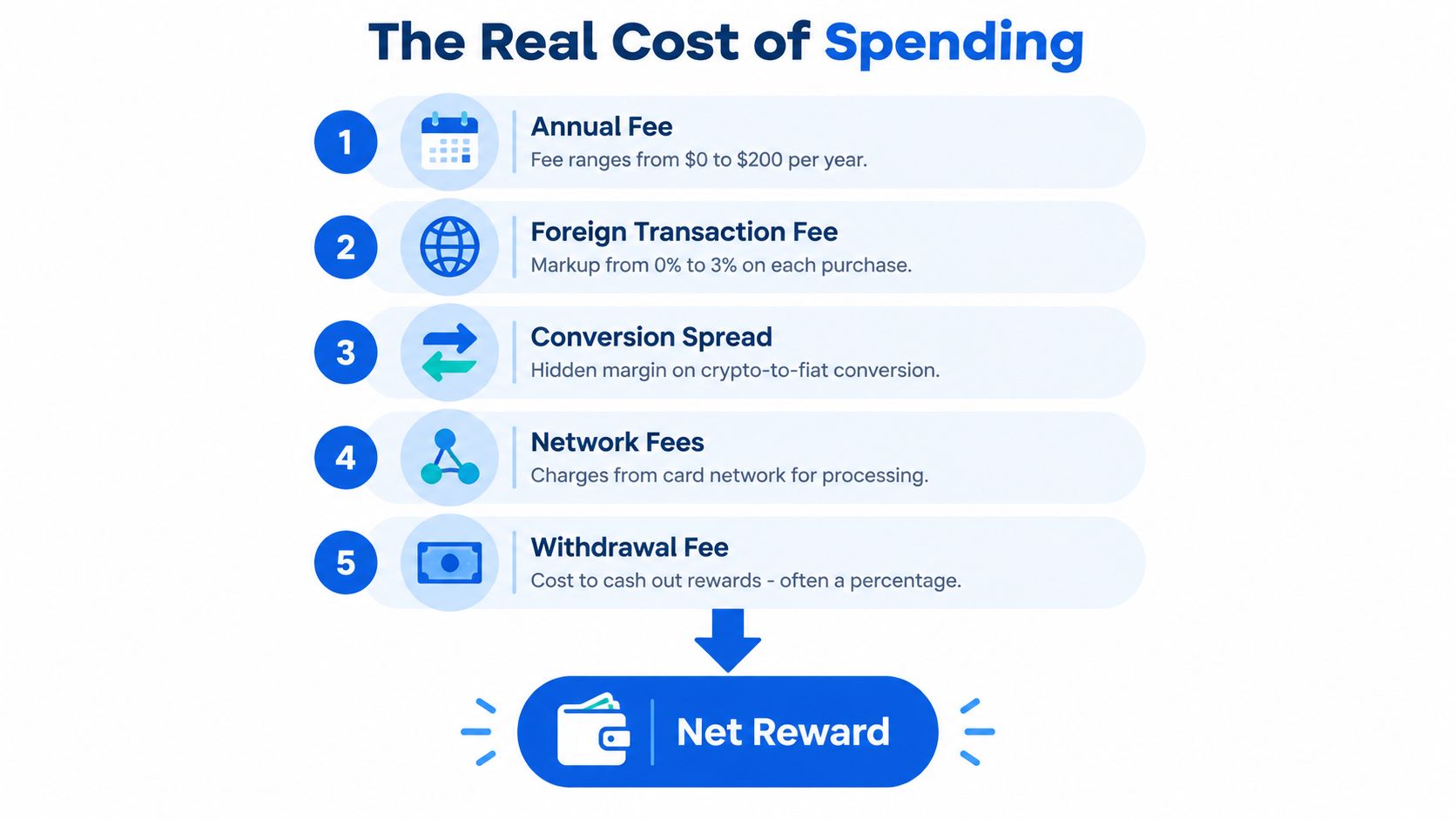
Calculate total ownership cost
Run the calculation in this order:
- Start with qualifying rewards. Remove purchases that the terms exclude.
- Subtract annual charges. Include the fee for the tier behind the advertised rate.
- Subtract FX and conversion costs. Check the spread, not just the stated transaction fee.
- Add withdrawal costs. ATM withdrawals may carry charges from both the issuer and the network.
- Price the lockup. Funds committed to a staking tier cannot be used elsewhere during the lock period.
A 3% token reward can shrink quickly after a 1.5% FX spread, a $95 annual fee, and the opportunity cost of $500 locked for a staking tier. For a $10,000 annual spender, the result may sit far below the headline rate and closer to a low single-digit net return. This is only an example of the method. Your transaction mix and the token's price determine the actual result.
Practical rule: Count every fee against the reward, and assign a cost to every lockup.
Use the same cost test for custody and KYC. A custodial card may make recovery easier while leaving the provider in control of the balance. A self-custodial card can preserve wallet control but requires more careful operational management. Minimal-KYC products may reduce data sharing while limiting availability, support, or payment flexibility.
NomadCards' 2026 crypto card fees report provides standardized fields for comparing these charges. Check the complete fee schedule, then apply it to your actual spending pattern. A reward that works only when every condition is met is not a bargain.
Custody and KYC Trade-Offs
Custody and identity verification are separate questions, but crypto cards often tie them together. A custodial program holds the crypto balance for you and commonly requires a full KYC process before issuing the card. A self-custodial program lets you retain control of the wallet, but the card issuer can still require identity verification because the payment rail and compliance obligations remain.
The convenient option is custodial. If you lose a password, the provider may offer an account recovery path. The trade-off is counterparty exposure. The provider can restrict access during a fraud review, and your crypto sits under its operational control.
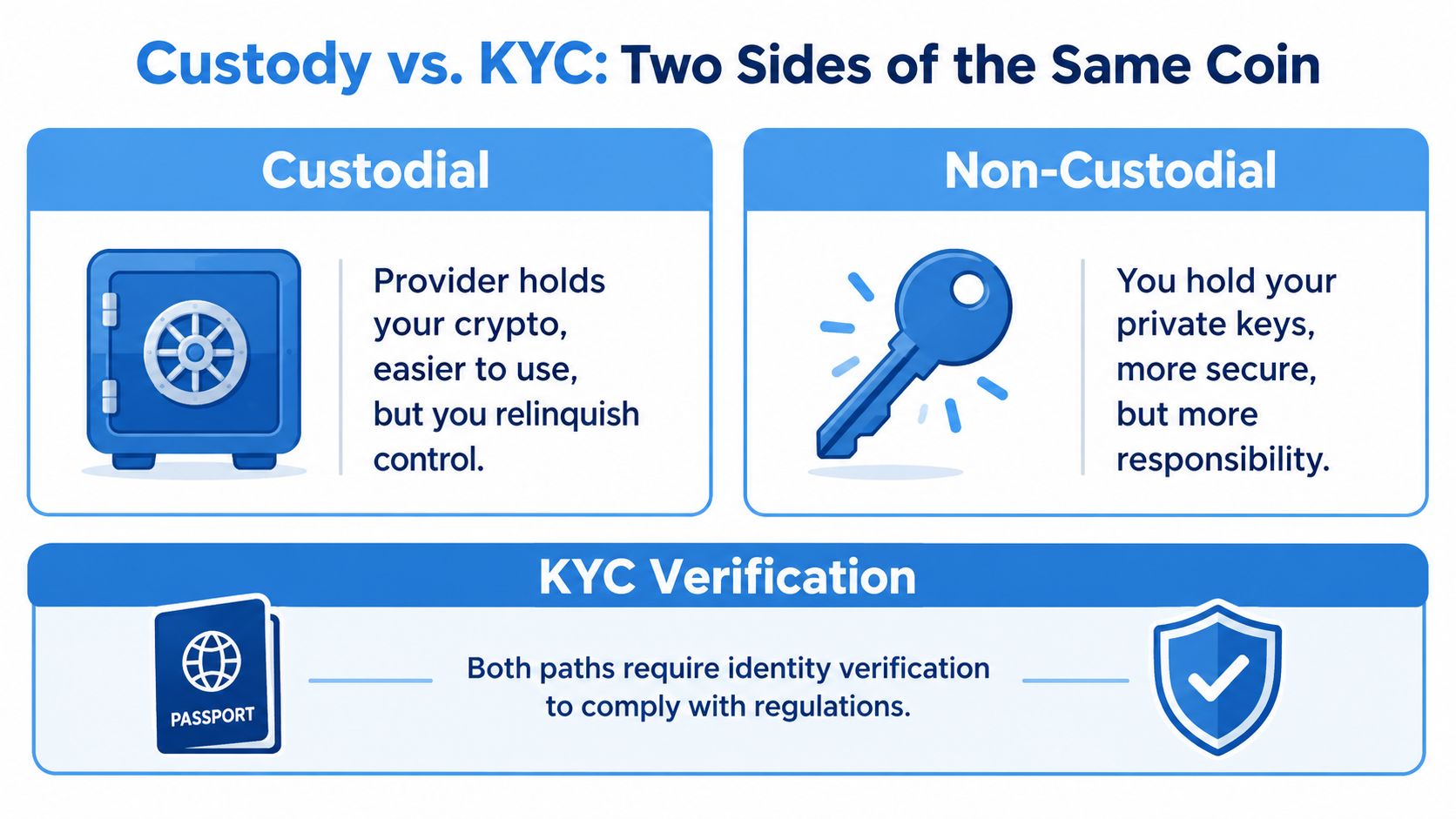
Match the model to your tolerance
- Custodial: Best for users who prioritize a familiar app, simple recovery, and low operational effort.
- Self-custodial: Better for users who won't hand over private-key control and can manage wallet permissions carefully.
- Minimal-KYC: Suitable only when privacy matters more than broad availability, support, and payment flexibility.
Self-custody removes the provider from direct control of your keys, but it doesn't remove responsibility. A mistaken signature, compromised wallet, or incorrect authorization can create a problem customer support can't reverse. A no-KYC product can reduce identity exposure, but it may also provide weaker recourse if the card is lost or a transaction goes wrong.
The assumption I'd challenge is that self-custody means no KYC. In practice, the card and the wallet are different layers. The wallet can remain yours while the issuer still verifies you.
Another assumption deserves equal suspicion: every crypto-related swipe earns rewards. Direct crypto purchases can use special merchant category codes and identifiers. Chase's rewards terms explicitly exclude cryptocurrency and other cash-like transactions from earning points. Some wallet-based flows may instead be coded as ordinary digital goods, creating a loophole where a crypto-related purchase appears to qualify under normal card rules. Recent reporting on card-network rules and wallet checkout shows why the checkout path matters.
Don't rely on the card's name. Check the merchant category exclusions and test a small transaction before assuming your strategy works. For a structured custody comparison, see custodial versus self-custody crypto cards.
Networks Availability and Where Cards Work
The payment rail determines much of the experience. Visa and Mastercard cards generally offer familiar merchant and ATM acceptance, while regional debit networks can be more geographically specific. Direct wallet checkout rails work differently because the payment authorization happens through a wallet or platform rather than a standard card swipe.
That difference affects more than reach. The rail can influence FX handling, chargeback expectations, merchant coding, and whether a purchase appears eligible for rewards. A conventional card may inherit the network's acceptance footprint but also inherit exclusions for cash-like transactions. A wallet checkout can avoid some merchant-code classifications, but it may not offer the same protections or universal acceptance.
Compare the rail, not only the logo
| Network / Rail | Geographic Reach | FX & Conversion | Reward Treatment |
|---|---|---|---|
| Visa | Broad card and ATM acceptance where issued | Issuer and network terms apply | Merchant coding and issuer exclusions matter |
| Mastercard | Broad card acceptance where issued | Issuer and network terms apply | Eligible spend depends on program rules |
| Regional debit networks | Varies by region | Often tied to local settlement | May have narrower reward coverage |
| Wallet checkout | Limited to participating merchants and apps | Wallet conversion rules apply | Can differ from ordinary card coding |
Availability is a separate screening problem. A card may be marketed internationally but issue only in selected countries, restrict physical cards to certain regions, or offer a virtual card where a user expected plastic. Regional regulation can also affect onboarding and rollout. Travelers should verify issuance country, supported currencies, ATM access, and mobile-wallet support before moving funds.
I prefer a standardized comparison over issuer marketing pages because issuer pages usually emphasize the attractive feature first. A useful profile should place reward model, custody, KYC, fees, supported assets, network, and regions next to one another. That makes it harder for a high reward number to hide a narrow rollout or an inconvenient funding model.
Filter for your residence first, then your travel destinations. A card that works beautifully at home but applies poor conversion terms abroad isn't a travel solution. A wallet rail that handles crypto purchases elegantly but fails at ordinary merchants isn't a replacement for a general-purpose card.
Choosing the Right Card for Your Priorities
Start with the priority you won't compromise on. Don't begin with the biggest percentage because that turns the comparison into a marketing contest. Begin with whether you want maximum net rewards, wallet control, privacy, or low travel costs.
If rewards come first
Choose a flat cashback card if you value predictable accounting, or a staking-tier card if you already want the underlying token and can accept the lockup. For a high spender willing to complete KYC, compare qualifying categories, reward asset, tier conditions, conversion costs, and the fee required to access the advertised rate.
If self-custody is non-negotiable
Look for a non-custodial implementation that connects to your wallet rather than requiring you to deposit assets with the issuer. Check how authorization works, which assets can fund the card, what happens when the wallet is unavailable, and whether the reward lands in your wallet or an internal account.
If privacy matters most
Prioritize the lightest verification level available in your region, but don't assume minimal KYC means equivalent service. Check transaction limits, supported assets, physical-card availability, customer support, and chargeback options. A privacy-first product may be acceptable for controlled spending, but it can be a poor choice for salary-sized balances or essential travel.
If you travel often
Focus on FX terms, conversion spreads, ATM costs, network acceptance, and local availability before cashback. A lower reward with cleaner foreign spending can beat a high token rate that loses value through conversion and withdrawal charges.
Use the same fields for every shortlist:
- Reward model: Flat cashback, token grant, staking tier, or promotional bonus.
- Custody: Provider-held, self-custodial, or mixed.
- KYC level: Minimal verification or full identity checks.
- Cost: Annual fee, FX markup, conversion spread, ATM charges, and lockup.
- Reach: Issuing countries, supported regions, network, virtual or physical card.
- Tax records: Whether the program separates purchase rebates from promotional or yield-based rewards.
Tax records deserve attention from day one. Crypto rewards generally create a basis at fair-market value when received, and a later sale, swap, or purchase can create a separate capital gain or loss. Crypto debit and credit card tax guidance explains why reward receipt and later disposal should be tracked as separate events.
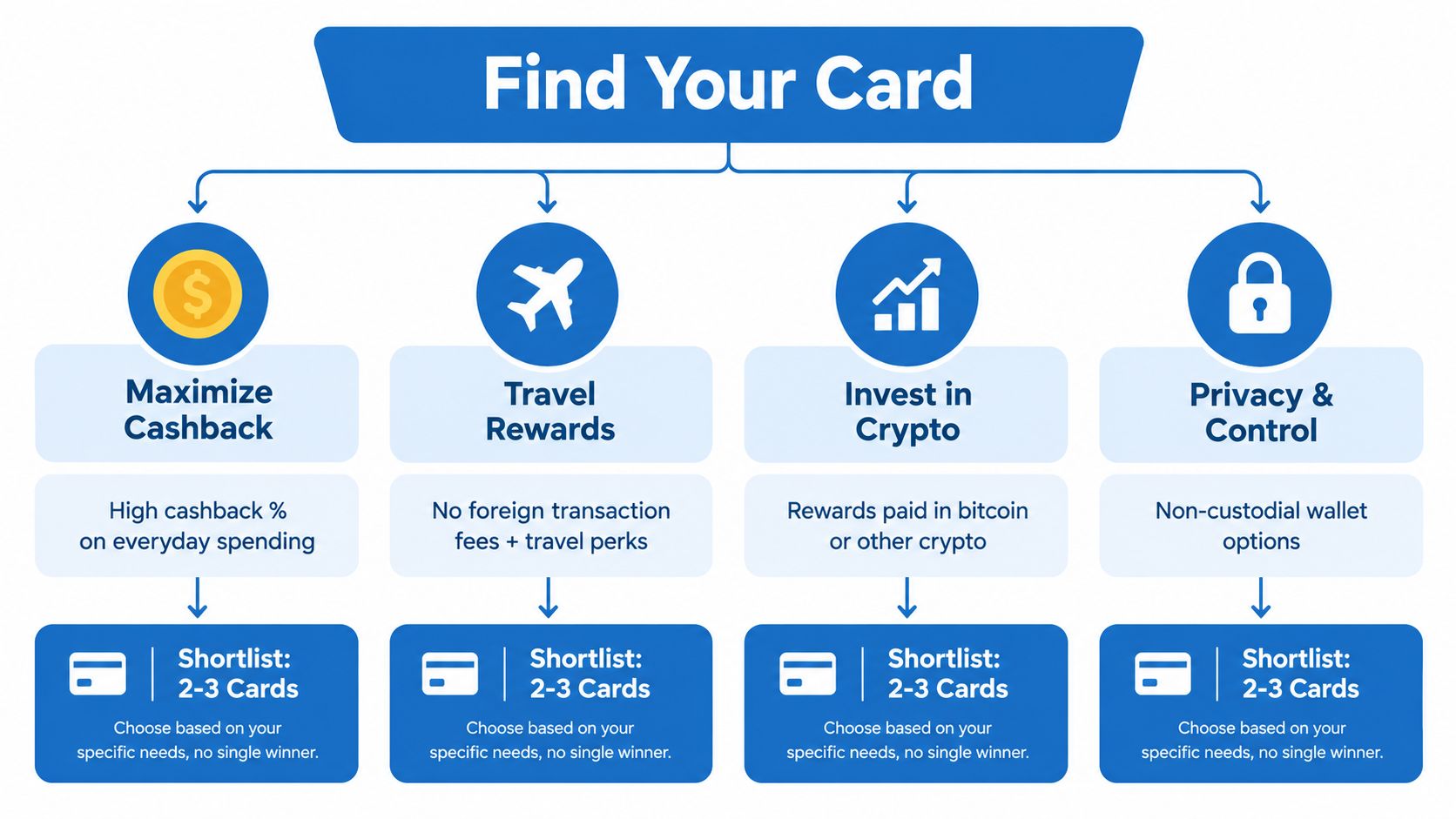
Don't search for one universal winner. Build a shortlist of two or three cards, compare the same fields, and reject any product whose reward depends on conditions you won't maintain.
NomadCards standardizes crypto card details across rewards, fees, custody, KYC, supported assets, networks, and regional availability. Visit NomadCards to filter cards around your actual priority, compare a short list side by side, and verify the terms before you apply.