You're at checkout with Bitcoin, Ethereum, or stablecoins in your wallet. The merchant accepts Visa and Mastercard, but not cryptocurrency. Your balance is real, yet it lives in a system the checkout can't read.
A crypto spending card solves that mismatch by translating between your digital-asset balance and conventional card payments. You tap, the merchant receives ordinary settlement currency, and the crypto conversion happens behind the scenes. The experience can feel like a debit card, but the machinery, risks, and costs are different.
The market moved faster than many people noticed. Visa reported approximately $1 billion in crypto-linked-card payment volume during the first six months of 2021, then reported $2.5 billion in quarterly spending by the fiscal first quarter ending December 31, 2021, equal to about 70% of the company's total crypto-linked-card volume for the full 2021 fiscal year. Those figures measure processed payments, not registrations or survey interest, as reported by CNBC's coverage of Visa's crypto-linked-card usage.
The important question isn't whether a card advertises cashback. It's what happens when you tap, who controls the funds, when conversion occurs, what the transaction really costs, and whether you can reconstruct the resulting tax records.
Table of Contents
- Introduction
- What a Crypto Spending Card Does
- Custodial vs Self-Custodial Card Models
- Fees and FX Mechanics Behind Every Tap
- KYC and Verification Tradeoffs
- Risks Most Card Comparisons Skip
- How to Choose the Right Crypto Spending Card
- Conclusion and Next Steps
Introduction
The problem surfaces at checkout. You have crypto in a wallet, stablecoins set aside, or payment received in digital assets. The hotel, retailer, or subscription service accepts familiar card brands, but offers no blockchain address.
A crypto spending card connects those systems. It may draw from a custodial exchange balance, a prepaid account, or a self-custodial wallet. The merchant usually receives fiat through the card network, while the issuer or payment provider manages the asset conversion.
Visa's reported crypto-linked-card activity showed that this was becoming a meaningful payment use case, not merely an account-registration trend. Its reported volume reached $2.5 billion in one fiscal quarter ending December 31, 2021, representing about 70% of its crypto-linked-card volume for the entire 2021 fiscal year. The figure measures processed payments, as described in Visa's reported payment-volume milestone.
The important mechanics begin before the merchant is paid. At authorization, the issuer decides whether the transaction can proceed and may reserve funds, quote a conversion, or sell the required crypto. Settlement happens later through the card network, and the final amount can differ if the provider's conversion timing, spread, or rules apply between those stages. A card that feels like a normal debit card can therefore produce a very different economic result.
Rewards do not settle that question. A high advertised rate may be offset by a conversion spread, limited eligibility, or rewards paid in a volatile asset. A no-KYC product may impose lower limits and weaker dispute support. A self-custodial card can reduce dependence on one platform while leaving recovery, approvals, and transaction records to you.
This guide evaluates crypto cards as payment infrastructure. It covers effective cost, custody, verification, tax-lot consequences when assets are spent, and why stablecoin card value often concentrates in emerging markets where local payment access and currency stability are bigger constraints.
What a Crypto Spending Card Does
A crypto spending card connects two separate payment systems. Your wallet or account records token balances, transfers, smart-contract activity, and network confirmations. The card network handles authorization, merchant categories, issuer decisions, clearing, and settlement. The card program coordinates the handoff between them.
A typical purchase follows this sequence:
- You present the card. The merchant sends an authorization request through Visa or Mastercard.
- The issuer checks the payment. It reviews available funds, spending limits, fraud signals, and geographic or merchant restrictions.
- The provider handles the balance. Depending on the product, it converts, reserves, or sells crypto or stablecoins during authorization.
- The card transaction proceeds through the network. The issuer, acquirer, network, and settlement institutions process it through the conventional four-party model.
- The merchant receives ordinary settlement currency. It does not need a wallet or support the token used to fund the purchase.
That structure lets a card work at a standard terminal even when the merchant has no crypto infrastructure. The mechanics are outlined in this explanation of stablecoin payment networks and Visa and Mastercard.
Key takeaway: “Instant crypto spending” usually means instant card authorization. It does not mean final blockchain settlement occurs instantly.
Conversion timing changes the economics
Some providers require a fiat top-up before you spend. Others convert at authorization. A third model uses an on-chain or smart-contract account that maintains a payment balance and converts when the transaction is processed.
The timing affects quoted exchange rates, spreads, failed payments, reversals, liquidity requirements, and tax records. If the provider sells your asset during top-up, the disposal occurs then. If it sells during authorization, the relevant record may align with the purchase. If funds are reserved first and settled later, the transaction history should show how that reserve became a completed conversion.
This is also where the effective cost becomes more useful than a cashback headline. Review the amount spent, the crypto value removed, the quoted rate, the spread, network or card fees, and the value of any reward. A reward can look attractive while the conversion path creates a higher total cost.
Spending crypto may also create a taxable disposal, depending on your jurisdiction and the asset's cost basis. The card statement should let you identify the asset sold, acquisition lot, disposal value, and transaction date. Treating every tap as ordinary debit-card spending can leave incomplete records.
Blockchain transfers can reach cryptographic finality quickly, but network fees, confirmation delays, and irreversible-transfer risk still apply. Card authorization is generally immediate for the shopper, while conventional settlement is deferred and netted through the network.
The distinction matters for specialist purchases too. For a private jet charter with crypto, confirm whether the provider accepts direct digital-asset payment or whether the card converts funds into a card-network transaction. Those routes have different operational and recordkeeping consequences.
A card can feel instant while several financial steps remain pending. Before comparing rewards or designs, identify where the balance sits and exactly when conversion occurs.
Custodial vs Self-Custodial Card Models
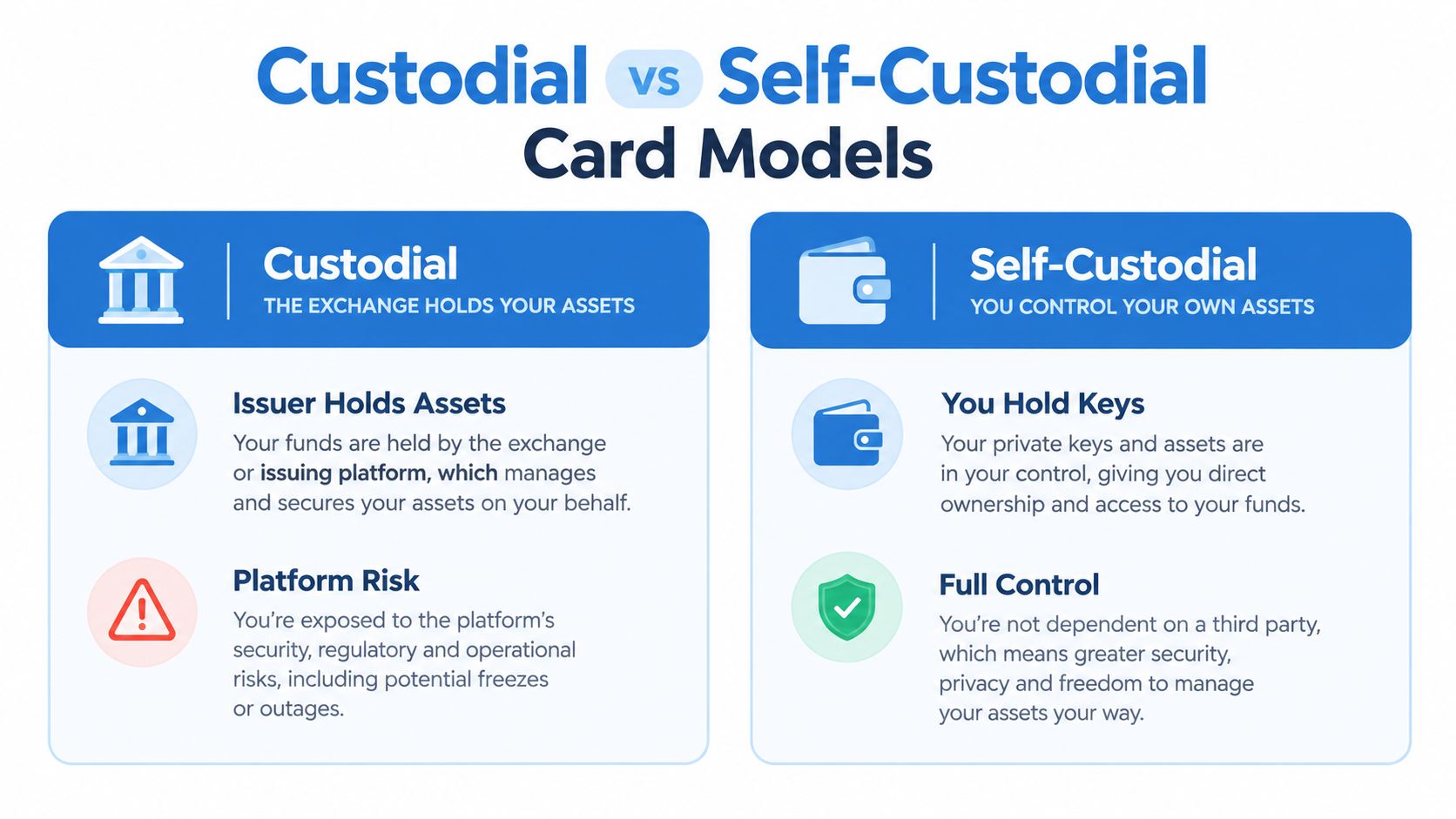
The custody decision determines who controls the funds before the payment and who carries the operational burden when something goes wrong.
With a custodial card, your crypto remains with an exchange or payment provider. The card draws against that account, and the issuer manages conversion, liquidity, compliance, fraud screening, and network obligations. You get a familiar account experience, and many users prefer the convenience of having card controls, transaction history, and balances in one application.
The trade-off is counterparty exposure. If the platform freezes withdrawals, delays a conversion, changes eligibility, or becomes insolvent, your ability to spend may disappear even if the blockchain itself continues operating. Your private keys aren't the only relevant control point. The provider's internal ledger, liquidity position, risk policy, and banking relationships matter too.
A self-custodial card connects to a wallet or on-chain payment account. You retain control of the keys, while a card program handles authorization and merchant settlement. In a smart-contract design, funds may remain on-chain until a payment instruction triggers the required conversion or deduction.
The failure scenario is the real comparison
Custody can seem abstract until a payment fails. Consider the practical differences:
| Situation | Custodial model | Self-custodial model |
|---|---|---|
| Issuer pauses service | Spending and withdrawals may be restricted by the platform | Card spending can still stop, even if wallet funds remain under your control |
| You lose account access | Recovery depends on the provider's verification process | Recovery depends on your seed phrase, key management, or wallet procedure |
| Conversion fails | The provider may decline, reverse, or delay the payment | The smart contract, liquidity route, or card provider may reject the transaction |
| Fraud dispute | The issuer controls much of the investigation and account action | You retain wallet control, but card disputes still depend on the issuing program |
| User error | Support may be able to reverse or investigate an internal ledger action | An irreversible on-chain transfer may be difficult or impossible to recover |
Neither model removes trust. Custody concentrates trust in the platform. Self-custody shifts trust toward software, wallet security, smart-contract design, liquidity providers, and your own operational discipline.
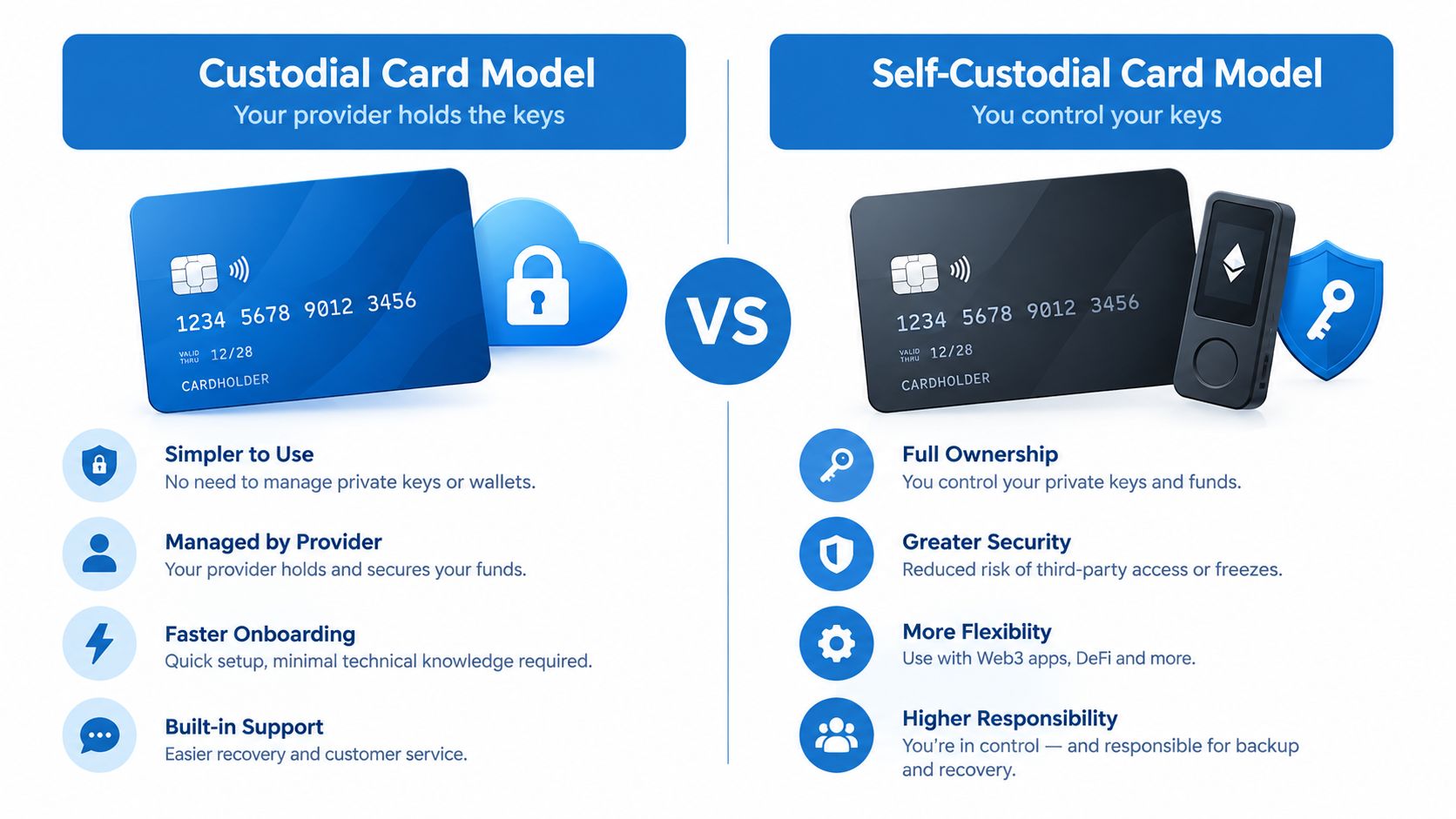
A useful custodial versus self-custody crypto card guide should be read alongside the issuer's terms, not treated as a substitute for them. Check whether the card is linked to your wallet, whether a separate payment account is created, and whether you can move funds independently of the card.
Choose custodial when simplicity, support, and predictable account management matter most. Choose self-custodial when key ownership and reduced platform dependence matter more than setup convenience. For either choice, verify what happens to funds during suspension, reversal, fraud review, and issuer failure.
Fees and FX Mechanics Behind Every Tap
The fee shown in an app is rarely the complete cost of spending crypto. A single purchase can combine card-network economics, issuer pricing, currency conversion, crypto conversion, and funding or withdrawal charges.
The layers usually include:
| Fee Layer | What It Covers | Typically Regulated? |
|---|---|---|
| Network assessment | Network-level processing and assessment economics | Often subject to network rules and regional frameworks |
| Issuer and acquirer economics | Card issuance, authorization, merchant acquiring, and account operations | Varies by jurisdiction and card classification |
| Crypto conversion spread | Difference between the quoted crypto-to-fiat rate and an external reference price | Usually disclosed through pricing rather than a simple line item |
| Foreign-exchange markup | Conversion between the transaction currency and your funding or settlement currency | Depends on provider terms and applicable regulation |
| Top-up or withdrawal fee | Moving funds into or out of the card account | Provider-specific |
| Blockchain fee | Network cost for an on-chain transaction | Depends on the network and transaction route |
| ATM fee | Cash withdrawal charge from the issuer, operator, or both | May be regulated in some contexts, but varies widely |
Regional rules change the baseline. In the European Union, consumer-card interchange is capped at 0.2% for debit transactions and 0.3% for credit transactions, according to this overview of crypto debit-card market economics. In the United States, large-issuer debit interchange is subject to a Durbin Amendment cap of $0.21 plus 5 basis points, while credit interchange is generally uncapped at the federal level.
Those figures aren't your total cost. An issuer can recover expenses through a spread, ATM charge, subscription tier, exchange-rate markup, reward restriction, or unfavorable conversion route. A card with “no transaction fee” can still be expensive if its conversion price is consistently worse than the reference rate.
Calculate the outcome, not the headline
Use this practical formula:
Effective cost = conversion spread + explicit transaction, FX, and ATM fees minus realized rewards
The word realized does the important work. Cashback may apply only to eligible merchants, arrive later, vest over time, carry a cap, or be clawed back after a refund. If rewards are paid in a volatile token, their displayed value can change before you use them.
Test the card against your own spending pattern. Separate domestic purchases, foreign-currency purchases, ATM withdrawals, subscriptions, and large one-off transactions. Then ask whether the rate shown at authorization matches the rate used in the final record.
A crypto card fee comparison is useful only if it separates explicit charges from conversion pricing. If a profile shows one “fee” field but hides the spread, it doesn't provide a complete cost comparison.
KYC and Verification Tradeoffs
Privacy-focused users often start with a simple rule: less KYC must be better. That rule is too blunt for payment products.
The first tier is full verification. The issuer usually requests identity documents and may ask for residence, source-of-funds, or additional information. In return, the product is more likely to support a broader account structure, higher operational limits, physical-card issuance, and a clearer compliance path.
The second tier may use email or limited account verification. These cards can be easier to open, but the provider may restrict spending, geography, funding methods, or card type. A virtual prepaid product isn't equivalent to a fully verified debit card, especially when a merchant requires recurring billing, offline authorization, or stronger dispute handling.
The third tier is marketed as no-KYC. That can reduce the amount of identity information you initially provide, but it doesn't eliminate risk. Providers may impose lower limits, restrict countries, use prepaid rails, offer fewer consumer protections, or disappear faster when regulators, banks, or card networks change their policies.
Match verification to the job
Use this decision test:
- Small online purchases: Limited verification may be sufficient if the card supports your merchants and you can tolerate lower limits.
- Travel and accommodation: Full verification may be more practical because hotels, car rentals, offline terminals, and deposits can stress prepaid products.
- Business or recurring spending: Confirm legal-name matching, transaction records, support procedures, and account continuity before funding the card.
- Privacy-sensitive self-custody: Check exactly what the card provider can see. A self-custodial funding model doesn't automatically mean an anonymous card account.
A guide to crypto card KYC levels should help you compare the verification label with the actual product structure. Filter for KYC level alongside network, supported assets, card type, mobile-wallet support, and regional availability.
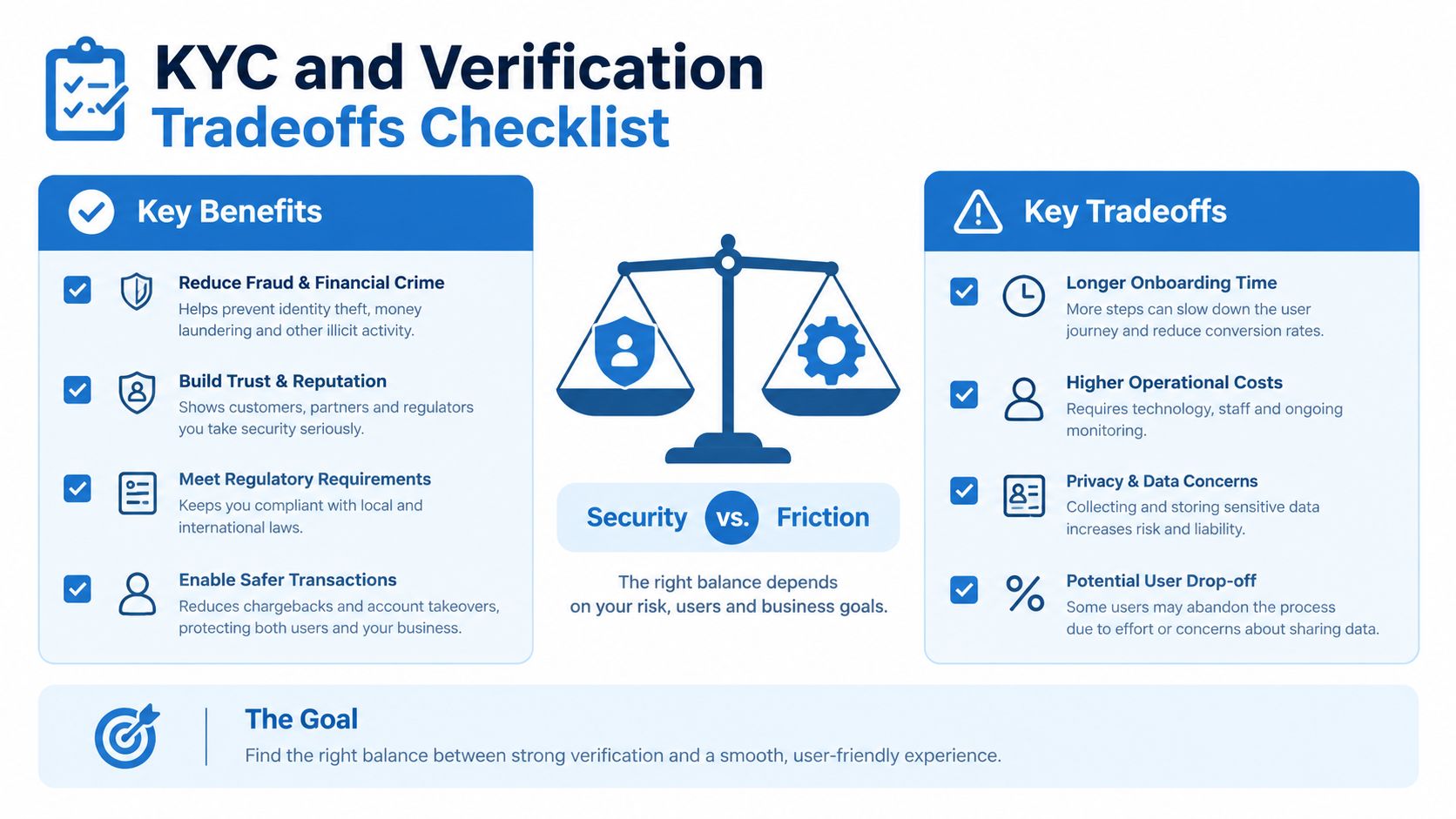
Ask yourself what you're protecting. If your priority is minimizing data collection for occasional spending, limited verification may fit. If you need reliable travel payments, substantial limits, recurring charges, and a durable dispute process, stronger verification may be the more sensible trade.
Risks Most Card Comparisons Skip
The largest risks usually sit outside the reward box.
Start with tax. In the United States, spending crypto generally represents a disposal of the asset, not an ordinary card purchase. Each disposal can require fair-market-value proceeds, acquisition cost, and capital gain or loss calculations, so one active card can create hundreds of tax-lot events, as discussed in this overview of U.S. crypto tax treatment.
The conversion timestamp determines which records matter. A top-up model may create the disposal when you load the card. An authorization model may create it when the issuer converts the asset for a purchase. A delayed or reversed payment can create a second reconciliation problem if the first authorization and final settlement don't match.
Practical rule: Don't choose a card until you know whether you can export every disposal with its timestamp, asset amount, fiat value, fee, exchange rate, and cost-basis information.
Stablecoins simplify one problem, price volatility, but they don't automatically remove reporting, source-of-funds, or transaction-history obligations. A stablecoin-funded purchase still needs an auditable path from the funding wallet or account to the merchant transaction.
Issuer risk deserves the same attention. Ask who holds the balance, who provides liquidity, who can freeze the account, how reversals work, and whether a failed authorization leaves funds reserved. The blockchain may be functioning perfectly while the card program rejects transactions because its issuer, bank partner, fraud system, or settlement route has stopped serving you.
Regional utility isn't evenly distributed
The strongest use case may not be replacing a bank card in the United States or Western Europe. It may be receiving cross-border income, handling remittances, paying international merchants, or protecting spending power where local-currency instability makes conventional access less useful.
A 2026 market analysis estimates that Latin America, Southeast Asia, the Middle East and North Africa, and Sub-Saharan Africa together represented 93% of stablecoin-card volume, compared with 7% for developed markets, as reported in Bruegel's analysis of stablecoin risks and market development. Treat that as a market signal, not a promise that every card works reliably in every country.
Country lists can conceal the important details. Check local issuance, fiat settlement, ATM access, exchange rates, cross-border markups, mobile-wallet support, and whether the card is available to residents or merely usable by visitors.
How to Choose the Right Crypto Spending Card
Start with the transaction you need to complete. A card for occasional coffee purchases has a different specification from a card used for travel, contractor income, or business expenses.
For travelers and digital nomads
Prioritize regional issuance, foreign-exchange pricing, ATM rules, merchant acceptance, and replacement procedures. A card that works online may fail at a hotel deposit or offline terminal. Confirm whether the merchant receives fiat, whether your balance is converted at authorization, and whether local support exists if a payment is reversed.
If you also compare conventional business products for travel expenses, a separate guide to business credit cards for travel can provide useful context. Don't assume a crypto card's rewards compensate for weak foreign-exchange terms or limited cash access.
For privacy-focused users
Filter by verification tier first, then inspect the consequences. Compare identity requirements with spending limits, physical versus virtual availability, prepaid versus debit classification, data retention, and dispute procedures. A lower-KYC option is only useful if it can handle the purchases you intend to make.
For self-custody advocates
Look for wallet-linked or on-chain spending models. Verify the supported network, token, smart-contract permissions, recovery flow, and whether funds remain under your control before authorization. Read the failed-payment and approval language carefully. Self-custody protects against some platform risks, but it doesn't make the card issuer irrelevant.
For rewards optimizers
Model rewards after restrictions. Record eligible categories, vesting, reward denomination, caps, clawbacks, annual charges, and conversion spread. Then subtract the realized reward from your actual cost instead of comparing promotional percentages in isolation.
An interactive finder is more useful than a static ranking when it lets you filter by KYC level, Visa or Mastercard network, per-transaction limits, supported coins, debit or prepaid classification, and Apple Pay or Google Pay support. It should also show country availability and distinguish a virtual card from a physical one.
NomadCards provides a comparison engine with normalized fields for fees, rewards, custody, KYC, supported assets, networks, card types, and regional availability. Its published methodology and advertiser disclosure are worth checking before you rely on any composite score. Weekly refreshed rankings can help surface changes, but you should still open the issuer's profile and verify the terms before funding an account.
The strongest selection process is simple:
- Define the job. Travel, online spending, remittances, business purchases, or self-custody.
- Filter hard constraints. Country, KYC, network, card type, supported asset, and limits.
- Calculate effective cost. Include spread, explicit fees, ATM charges, and realized rewards.
- Inspect failure handling. Review freezes, reversals, refunds, and support access.
- Test cautiously. Start with a small top-up and export the resulting transaction data.
Conclusion and Next Steps
Return to the checkout screen with the right mental model. Your crypto balance and the merchant's card terminal don't need to speak the same language. The crypto spending card handles the translation, but the details behind that translation determine whether the product is useful or merely convenient until something goes wrong.
The key decisions are practical:
- Custody matters more than branding. Decide whether you're comfortable with platform exposure or prefer wallet control.
- Conversion timing affects both cost and tax. Find out whether the provider converts at top-up, authorization, or another stage.
- Rewards are only valuable after restrictions. Apply the effective-cost formula to your real spending, not the headline offer.
- Availability is local. Verify issuance, settlement currency, ATM access, mobile-wallet support, and regional restrictions.
Before committing, use a comparison finder to filter for your country, preferred network, KYC level, custody model, supported assets, card type, and spending limits. Open the card's profile and confirm the fee fields against the issuer's current terms. Then make a small test top-up, complete a modest purchase, and export the transaction record.
That final step tells you more than a banner ever will. You'll see the exchange rate, the fee treatment, the reward timing, the transaction description, and whether the records are detailed enough for reconciliation. If the card can't explain one small purchase clearly, it won't become easier to explain after months of spending.
NomadCards offers an interactive way to compare crypto-linked cards by fees, custody, KYC, supported assets, networks, limits, and regional availability. Visit NomadCards to filter the options around your actual spending needs, then verify the selected card's terms before you fund it.