In 2025, 92% of centralized crypto exchanges were fully KYC compliant, and average automated verification fell to 3.5 minutes. For card applicants, that speed matters less than choosing a card whose verification tier matches your spending, withdrawal, and privacy needs.
The modern crypto verification process isn't a single pass or fail checklist. It's a ladder. At the bottom, a product may accept an email address and impose tight restrictions. At the top, the issuer asks for government ID, address evidence, biometric liveness, and sometimes information about your funds.
Crypto cards make this distinction especially important. The card provider often inherits compliance requirements from an exchange, custodian, banking partner, or e-money institution. A card that looks crypto-native can still operate inside conventional financial controls.
My advice is simple: don't complete full KYC just because a provider presents it as the default. First decide what you need the card to do. Then select the lightest verification tier that provides those features.
Table of Contents
- What the Crypto Verification Process Looks Like in 2026
- How Crypto Verification Got Here
- The Three Verification Tiers at a Glance
- Inside a Full KYC Flow for Crypto Cards
- How Long Verification Actually Takes
- Privacy Versus Friction in Crypto Verification
- Matching Verification Tiers to Real Crypto Cards
- Picking the Right Verification Level for You
What the Crypto Verification Process Looks Like in 2026
In 2025, 92% of centralized exchanges were fully KYC compliant globally, up from 81% in 2024, while North America reached 90%. Average verification time fell to 3.5 minutes, compared with 7 minutes in 2023, and 23% of exchanges achieved instant checks through AI and OCR, according to Crypto verification compliance data.
Those figures describe automated exchange checks, not a guaranteed card approval time. A readable document, matching personal details, and clear screening results can produce a fast decision. Regional rules, the banking partner's risk controls, and the card's spending features can still require more review.
Start with the card, not the form
Choose the card first, then identify the lightest tier that supports it. Check four points before submitting a passport or other identity document:
- Spending level: Estimate your normal monthly use, rather than an unlikely maximum.
- Fiat access: Decide whether you need crypto converted into a bank-linked balance or only want to spend a prepaid allocation.
- Card format: Virtual cards, physical cards, ATM withdrawals, and rewards may require different verification levels.
- Geography: A tier offered in one country may be unavailable or more restrictive elsewhere.
A lighter tier suits occasional spending if its limits cover your use. It fails as a long-term choice when restricted withdrawals or unavailable fiat conversion force you to keep another account.
Practical rule: Choose the lowest verification level that provides the features you will use. Then read the issuer's privacy policy before submitting identity data.
The tradeoff is straightforward. More verification can support broader card functions, higher limits, and additional access, but it also creates an ongoing relationship with the issuer and its compliance vendors. Verification determines how the card operates after approval, not only whether the application passes.
How Crypto Verification Got Here
The regulatory shift started before crypto cards became mainstream. In 2013, the U.S. Financial Crimes Enforcement Network classified cryptocurrency exchanges as Money Services Businesses, bringing registration and KYC obligations into the sector. That guidance pushed the industry away from lightly regulated Bitcoin-era activity and toward formal customer identification and transaction monitoring. (FinCEN and crypto KYC history)
By the 2015–2018 period, major exchanges including Coinbase, Kraken, and Gemini had adopted KYC to preserve banking access in the United States. That history explains why a card issuer can require strict verification while marketing crypto convenience. The card may depend on an exchange or custodian whose banking partners require documented customer identity.
Travel Rule pressure changed the account relationship
The FATF Travel Rule added another compliance layer. Under the modern framework, virtual asset providers may need to share identity information with one another for qualifying transfers. Identity checks therefore extend beyond account creation. A transfer can create information-sharing duties between the providers handling it.
That matters to card users because card spending often begins with a custodial balance. The issuer or platform can connect card activity to an identified exchange account, a funding wallet, or a regulated payment relationship. A separate-looking card interface may still operate inside the same compliance perimeter as trading and withdrawals. The FATF and virtual asset compliance overview explains this broader virtual asset compliance framework.
Cards inherit the issuer's risk model
The practical flow is layered. Providers collect identity information, inspect documents, compare biometric signals, screen customers, and monitor activity after approval. A crypto card does not bypass those controls because the asset is digital or the product carries a non-bank brand.
The key point is easy to miss: regulatory pressure did not arrive with crypto cards. Cards inherited it. If you want banking access, fiat conversion, ATM functionality, or high spending capacity, expect the provider to request evidence that supports those privileges. Choose the card first, then select the lowest verification tier that provides the functions you will use.
The Three Verification Tiers at a Glance
The market is often described as KYC versus no KYC. That framing is too crude for card shopping. In practice, products tend to fall into three useful categories: no KYC, email-only, and full KYC.
The first tier avoids identity documents but usually comes with severe restrictions. The second verifies contact details and may support modest use. The third asks for identity, address, and liveness evidence, then enables the broadest card functions.
| Tier | Required Data | Typical Monthly Limit | Supported Regions | Card Features Unlocked |
|---|---|---|---|---|
| No KYC | No identity document, usually wallet or basic account details | Around $250 to $1,000 daily spending in products that publish such limits | Select jurisdictions and prepaid programs | Basic crypto-to-fiat spending, usually limited card functionality |
| Email-only | Verified email, sometimes phone number | Around $2,000 to $5,000 | Region-dependent, often narrower than full-KYC products | Basic virtual card access, limited spending, restricted or absent ATM use |
| Full KYC | Government ID, proof of address, selfie or liveness check | Around $10,000 to $50,000 monthly | Broadest availability, subject to issuer and local rules | Physical and virtual cards, higher limits, withdrawals, rewards, and expanded account functions |
The figures in this comparison reflect the tier ranges described in the brief, not a promise from every issuer. A provider can set lower limits, remove a feature, or require additional checks based on jurisdiction and risk.
What each tier really buys you
No KYC is best understood as a prepaid spending experiment. It can suit someone who wants to spend a small crypto balance without creating a conventional identity profile, but it won't usually provide the account depth of a regulated banking product.
Email-only is the compromise tier. It reduces onboarding friction, yet the missing ID check often comes back when you request higher limits, ATM access, fiat conversion, or a physical card.
Full KYC makes sense when the card is part of your regular financial setup. You give up more privacy, but you gain a better chance of receiving the functions people usually mean when they say they want a crypto card.
For a more detailed explanation of how providers structure these levels, compare the crypto card KYC levels explained before applying. Treat the advertised tier as a starting point, then read the issuer's actual eligibility terms.
Inside a Full KYC Flow for Crypto Cards
Full KYC is a sequence of checks tied to the card features you want. The provider collects identity details, verifies a government ID, matches your face to the document, confirms your address, and screens your profile for financial-crime risk. Choose the card first, then prepare the evidence its verification tier requires.
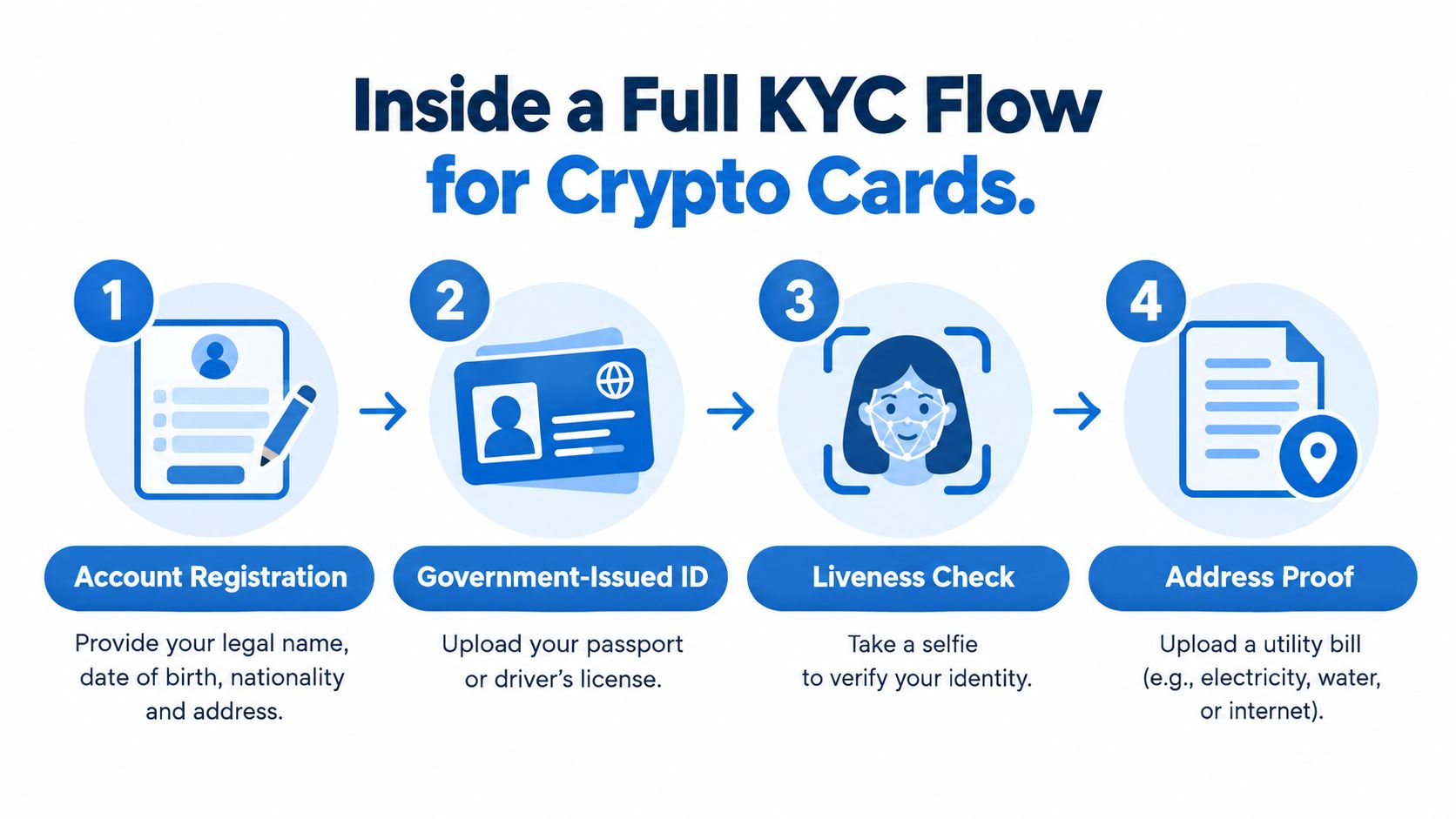
The evidence you submit
Account registration: Enter your legal name, date of birth, nationality, and residential address exactly as shown on your documents. A shortened first name or an old address can send the application to manual review.
Government-issued ID: A passport is usually the safest choice for cross-border applications because it is widely recognized. Depending on the jurisdiction, a national identity card or driver's licence may also qualify. The provider checks security features, validity, image quality, and machine-readable data.
Proof of address: Utility bills and bank statements are common options. The document normally needs your name, address, issuer, and date clearly visible. Identity evidence alone does not prove residence.
Selfie and liveness: Follow the camera prompts so the system can distinguish a live person from a photograph or replayed video. Document authentication and facial liveness checks help reduce impersonation attempts. (Layered crypto KYC workflow)
Why applications fail
Blurry images, glare across a passport number, cropped edges, and expired IDs cause routine failures. Non-Latin scripts may require extra handling, including translation in some workflows. Inconsistent address formatting can also trigger manual review.
Sanctions and politically exposed person screening may lead to questions about your source of funds or transaction purpose. That request does not automatically indicate wrongdoing. It means the automated review could not establish a clear enough risk profile.
A successful upload is not approval. The issuer still decides whether your identity, residence, funding pattern, and transaction risk fit its card program.
The verification system also connects document checks with account and transaction controls. Readers seeking technical context can review how providers verify tokens and protocols. Use that information to judge whether a card's requested evidence matches its spending and withdrawal features.
After activation, monitoring continues. Providers can revisit your profile, request updated information, or pause activity if later transactions conflict with the account history you supplied. Full KYC is an ongoing compliance relationship, not a one-time upload. Applicants planning regular card use should therefore submit consistent records from the start, because a successful first review does not remove later checks.
How Long Verification Actually Takes
A clean automated review can finish in minutes, while manual checks may take several days. OCR extracts document fields, biometric systems compare your face, and screening services return a result when no warning appears. The practical range depends on the verification tier attached to the card, not just the upload itself. (Crypto KYC review timelines)
A fast identity check does not equal immediate card approval. Card issuance, funding review, regional eligibility, and manual escalation can each add waiting time. Treat the timing below as a planning guide, then check the provider's stated requirements before choosing a card.
| Scenario | Typical Time | Common Cause of Delay |
|---|---|---|
| Clean automated review | A few minutes | OCR, biometric match, and screening produce consistent results |
| Manual document review | Several hours | Glare, poor image quality, expired ID, or script differences |
| Identity or address mismatch | A day or more | Selfie mismatch, inconsistent fields, or unclear residence evidence |
| Enhanced due diligence | Several days | Source-of-funds questions, unusual activity, or higher-risk combinations |
What sends an application out of the fast lane
Document quality causes many avoidable delays. An old utility bill, a bank statement that does not clearly identify the issuer, or a screenshot instead of an original document can start another review cycle. Photograph the entire document in good light, keep every corner visible, and copy the legal details exactly as shown.
Cross-border applications often take longer. The provider may need to interpret an unfamiliar document format, validate a country-specific identity document, or resolve differences between address conventions. Non-English documents may require translation under the provider's policy, so confirm the accepted format before submitting.
Before you upload: Use a current document, match every field precisely, and submit the format the provider requests. Good documentation is faster than repeated resubmission.
Weekends and public holidays can slow manual queues. If the provider requests more evidence, send one complete response instead of partial files across several messages. A complete submission gives the reviewer fewer uncertainties and gives you a better chance of staying within the expected timeframe.
Privacy Versus Friction in Crypto Verification
Verification depth buys access, but it also expands the amount of information connected to your spending. An email-only account may require little more than contact details. Full KYC can connect your legal name, residence, identity document, biometric verification, funding records, and card transactions inside one provider relationship.
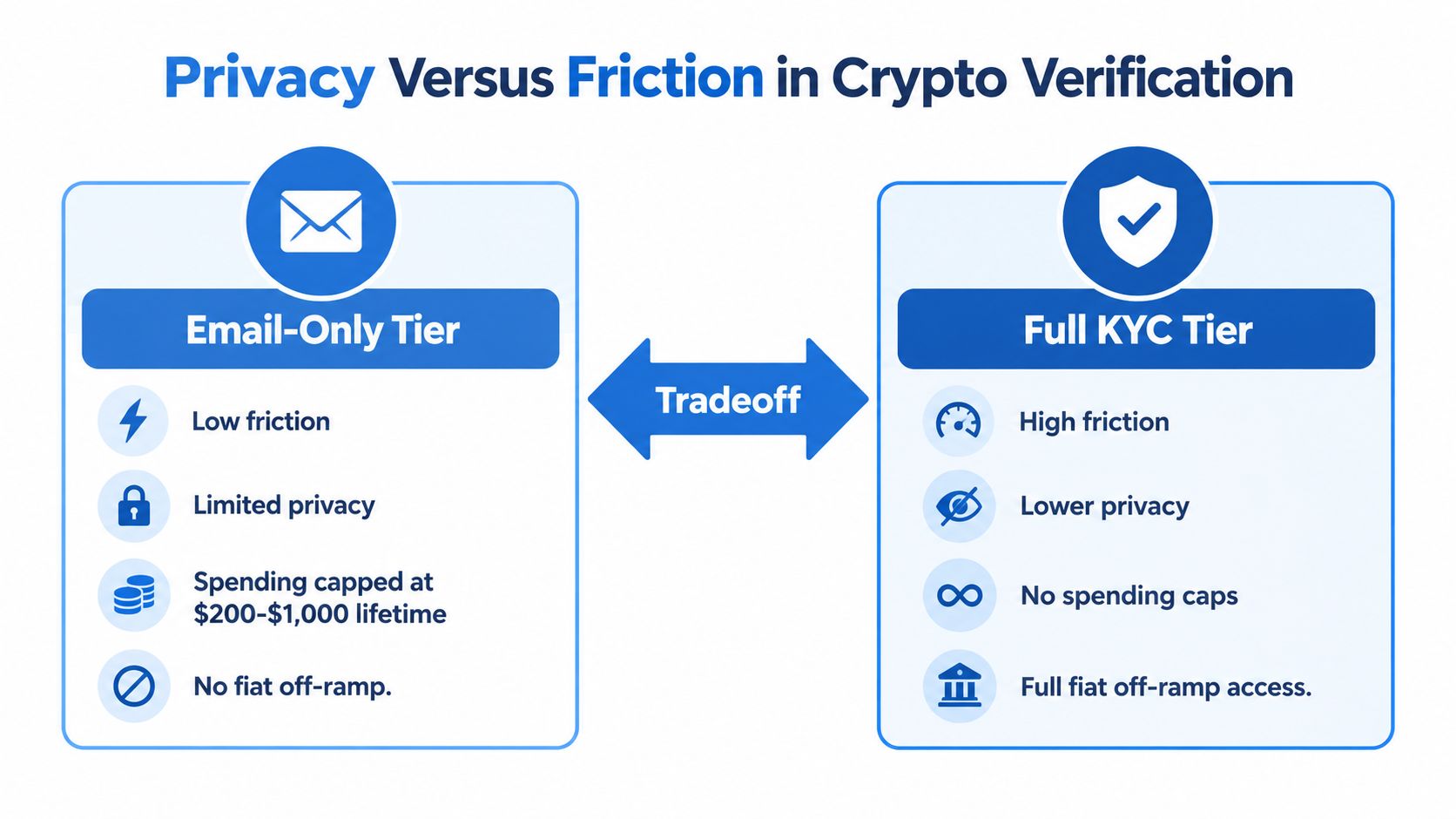
The tradeoff isn't “privacy good, KYC bad.” A low-verification product can expose you to different risks, including weaker customer support, fewer recovery options, limited dispute handling, and no practical route to larger withdrawals. A full-KYC product can offer a clearer account relationship, but it creates a larger data trail and subjects your activity to ongoing monitoring.
Ask what the card unlocks
Use this decision test:
- Small, occasional purchases: A lighter tier may cover your needs if you don't need ATM access or fiat conversion.
- Regular travel spending: Check whether the product supports physical cards, merchant acceptance, and cash withdrawals in your destination.
- Large or recurring inflows: Expect full KYC and possible questions about the origin of funds.
- Long-term privacy: Consider whether linking everyday purchases to an identified wallet undermines your reason for holding crypto privately.
A card funded from an identifiable exchange account won't preserve meaningful pseudonymity, even if the card itself advertises minimal onboarding. The funding route can identify you before the payment reaches a merchant.
The provider's retention and data-sharing terms deserve as much attention as the KYC label. Read which entities receive your documents, where processing occurs, how long records are retained, and what happens after account closure. Don't assume that an offshore issuer, an EU-based vendor, or a U.S. partner follows the same data-residency practices.
For a structured way to compare onboarding friction before you submit documents, use this KYC friction ranking for crypto cards.
The right question is not “Can I avoid KYC?” It's “What information am I willing to share for this card's actual utility?” If the answer is only a small spending balance, full verification may be excessive. If the card replaces a substantial part of your banking routine, the added access may justify the data cost.
Matching Verification Tiers to Real Crypto Cards
Real crypto cards fit a tiered decision matrix, not one universal verification rule. A card may offer light onboarding in one market and require full identity checks in another. Issuers also revise limits, supported countries, and card availability. Treat product examples as categories to verify before applying, not permanent promises.
No-KYC and prepaid crypto debit products usually suit small, controlled spending. Some EEA products, including the Bybit Card in the brief, may offer a lighter route under specific regional conditions. Eligibility still depends on residence and issuer policy. These cards usually trade traditional banking functions for easier access, so they fit limited spending rather than a complete banking replacement.
Email-only products occupy the middle tier. Services such as Wirex Lite or KuCoin Pay may allow quick account creation, but basic signup does not guarantee higher limits, ATM access, staking rewards, or fiat off-ramp functionality. Choose this tier for convenience and modest use. Do not treat it as proof that the card can support a full banking routine.
Full-KYC products, including Crypto.com Visa, Coinbase Card, and Bitpanda Card, serve users who need broader functionality. They generally request identity and address evidence and may add checks when activity changes. Issuer and partner locations also affect the rules. A program connected to Lithuania, Singapore, or the United Kingdom may follow a different regulatory framework and availability map.
| Card | Verification Tier | Monthly Spend or Withdrawal Limit | Card Fee | Supported Regions |
|---|---|---|---|---|
| Bybit Card, EEA example | No KYC or regional low-KYC route, where offered | Product and region dependent | Check current issuer terms | Selected EEA markets |
| Wirex Lite | Email-only or basic tier, where offered | Product and account dependent | Check current issuer terms | Selected supported markets |
| KuCoin Pay | Email-only or basic account route, where offered | Product and account dependent | Check current issuer terms | Region dependent |
| Crypto.com Visa | Full KYC | Product and region dependent | Check current issuer terms | Selected supported markets |
| Coinbase Card | Full KYC | Product and region dependent | Check current issuer terms | Selected supported markets |
| Bitpanda Card | Full KYC | Product and region dependent | Check current issuer terms | Selected supported markets |
The correct tier depends on the card's actual job. If you need only controlled purchases, review no-KYC crypto cards first. If you need larger spending capacity, regular withdrawals, or broader fiat functions, start with full-KYC products and confirm the documents required.
Do not copy another user's application strategy. A U.S. resident may not qualify for an EEA-issued card, while an EEA resident may lack access to the U.S. equivalent. One brand can also operate separate card programs by jurisdiction.
Before submitting documents, open the issuer's current terms. Check the card network, custody model, fees, limits, supported assets, and withdrawal rules together. A low-KYC label provides little value if the product cannot serve your country or match your spending pattern.
Picking the Right Verification Level for You
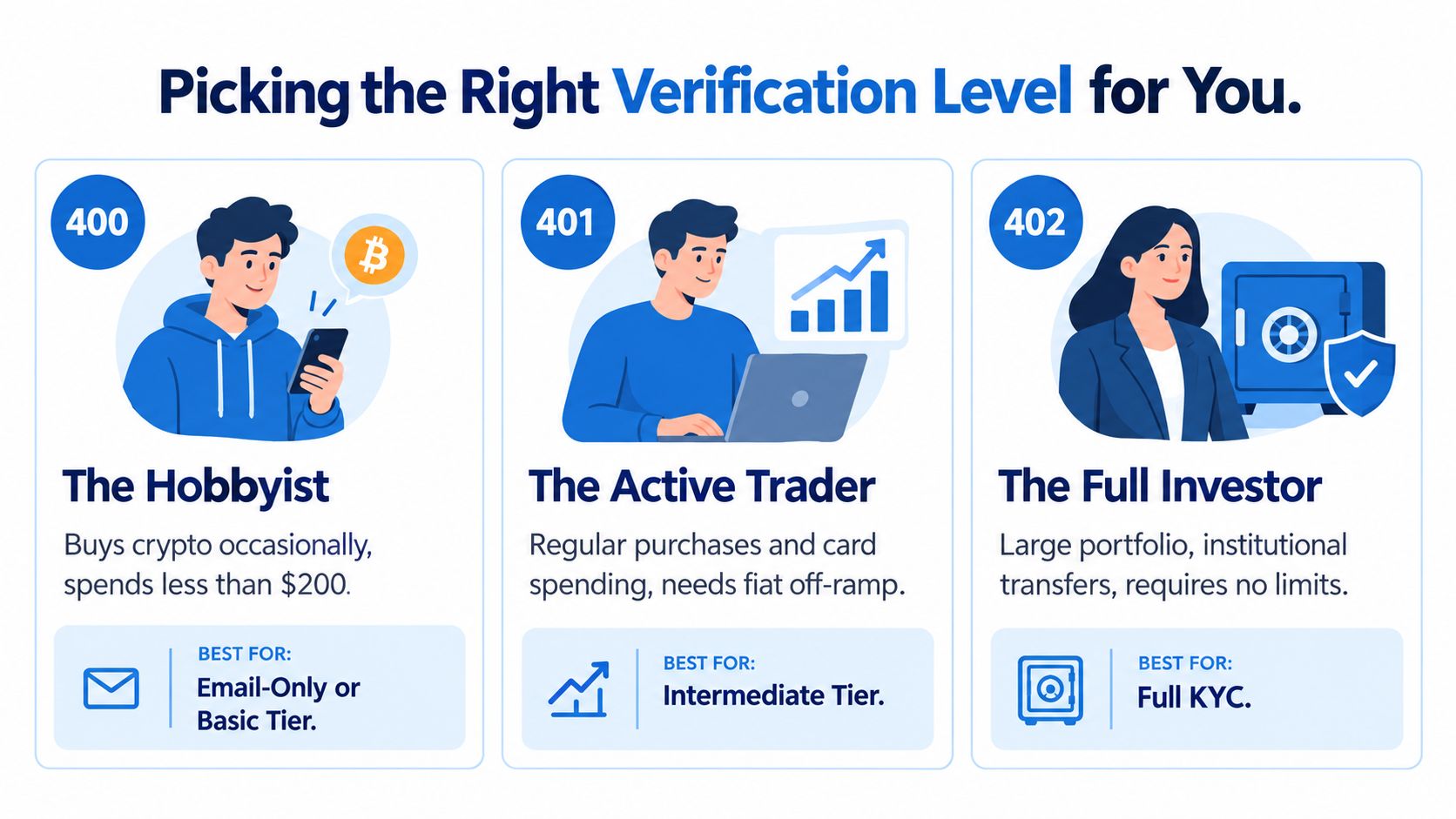
Full KYC isn't automatically the smartest choice. It's the right choice when the card's utility depends on identity-backed limits, fiat access, physical issuance, or sustained activity. For a small use case, it can be needless exposure.
Consider three users:
- The occasional traveler: Someone spending around €400 per month on coffee and small purchases may not need full KYC if an email-only card supports the relevant merchants and region. The user should accept lower functionality rather than surrender more identity data for features they won't use.
- The international freelancer: Someone receiving €8,000 per month from overseas clients needs a serious review of limits, settlement, source-of-funds requirements, and fiat conversion. Full KYC is the practical choice because a light tier is likely to become a bottleneck.
- The privacy maximalist: Someone holding Bitcoin for the long term should question whether a card is necessary at all. A non-custodial spending alternative may preserve more control, although it can introduce its own operational and issuer risks.
Before applying, answer five questions:
- How much will you spend each month? Use your normal pattern, not an optimistic ceiling.
- Do you need a fiat off-ramp? If yes, eliminate products that only support prepaid conversion.
- Which issuers can serve your jurisdiction? Geography can decide the tier before privacy preferences enter the discussion.
- Are you comfortable sharing ID with a third-party KYC provider? Read the processing and retention terms first.
- Do rewards justify the data trail? Cashback and staking benefits aren't free if they require a much deeper identity relationship.
The best crypto verification process is the one proportionate to your use case. Don't chase no-KYC branding if it leaves you unable to withdraw or spend when needed, and don't hand over a passport for a card that only handles occasional purchases.
NomadCards lets you compare crypto-linked cards by KYC level, supported regions, fees, custody model, network, and card features before you apply. Visit NomadCards to narrow the options to a verification tier that fits your spending and privacy requirements.