Most advice about crypto Visa card cashback starts with the wrong question. It asks which card advertises the highest percentage, even though the percentage may apply only to a capped slice of spending, require a paid plan or locked tokens, and lose value through foreign-exchange costs or token volatility. A headline rate is a starting point, not a return.
The useful comparison is net cashback per unit of actual spending. That means separating the reward rate from the fee schedule, checking where the cap applies, measuring the cost of converting currencies, and assigning a value to capital that must remain locked. A card showing a generous rate can therefore underperform a flat fiat card once its conditions are included.
| Variable | What to inspect | Why it changes the result |
|---|---|---|
| Reward rate | Base and tiered cashback | The advertised rate may apply only at a specific plan or staking level |
| Spending cap | Monthly amount eligible for the rate | Spending above the cap may earn less or nothing |
| Card costs | Subscription, annual, top-up and conversion fees | Fixed costs reduce the return for lower spending |
| FX pricing | Issuer markup and conversion spread | Foreign-currency purchases can consume the reward |
| Reward asset | Fiat, BTC, CRO or another token | The value can change after the reward is credited |
| Locked capital | Staking or other eligibility commitment | The opportunity cost belongs in the calculation |
Table of Contents
- Why Headline Crypto Visa Card Cashback Rates Mislead
- How Cashback Works on Crypto Visa Cards
- Calculating Your Effective Cashback Rate
- Comparing Top Visa Crypto Cards by Real Cashback Value
- Which Card Fits Your Spending Profile
- Custody, KYC and Regional Availability Trade-Offs
- Choosing Your Card and Rechecking the Math
Why Headline Crypto Visa Card Cashback Rates Mislead
A 5% cashback rate isn't automatically better than a 1% fiat reward. The comparison fails if the crypto card charges for access, applies the rate only to a limited monthly amount, adds an FX markup, or requires a sizable token lockup. The nominal reward measures what the issuer credits. The effective rate measures what remains after the costs needed to earn it.
Crypto.com illustrates the problem clearly. Its Visa card has used multiple tiers, with published versions ranging from 0% to 1.5% CRO back at the entry level and reaching 3.5%, 4.5%, 5%, and as much as 6% or 6.5% in later US credit-card configurations. Some premium tiers have been associated with CRO lockups as high as $500,000. These figures come from the card's published reward history and should be read alongside the conditions, not separated from them. (US News' account of Crypto.com's reward changes)
Practical rule: Treat every cashback percentage as conditional until you've found the required plan, eligible spend, cap, payout asset and exit terms.
Four variables decide the outcome:
- Access cost. A subscription or annual fee is a fixed subtraction from rewards. The same fee has a very different effect on a light spender and a heavy spender.
- Eligible spend. A monthly cap can make a high rate attractive for ordinary spending but weak for someone who spends far beyond the cap.
- Transaction friction. FX markups, conversion spreads and top-up charges reduce the amount that reaches the user.
- Capital exposure. A staking requirement ties up tokens that could otherwise remain liquid or be used elsewhere.
The calculation isn't complicated, but it has to be complete. Start with the reward earned on eligible spending, subtract card and transaction costs, then divide the result by total spending. For a structured way to compare those inputs, use this crypto card fees comparison rather than relying on the most prominent number on an issuer's landing page.
How Cashback Works on Crypto Visa Cards
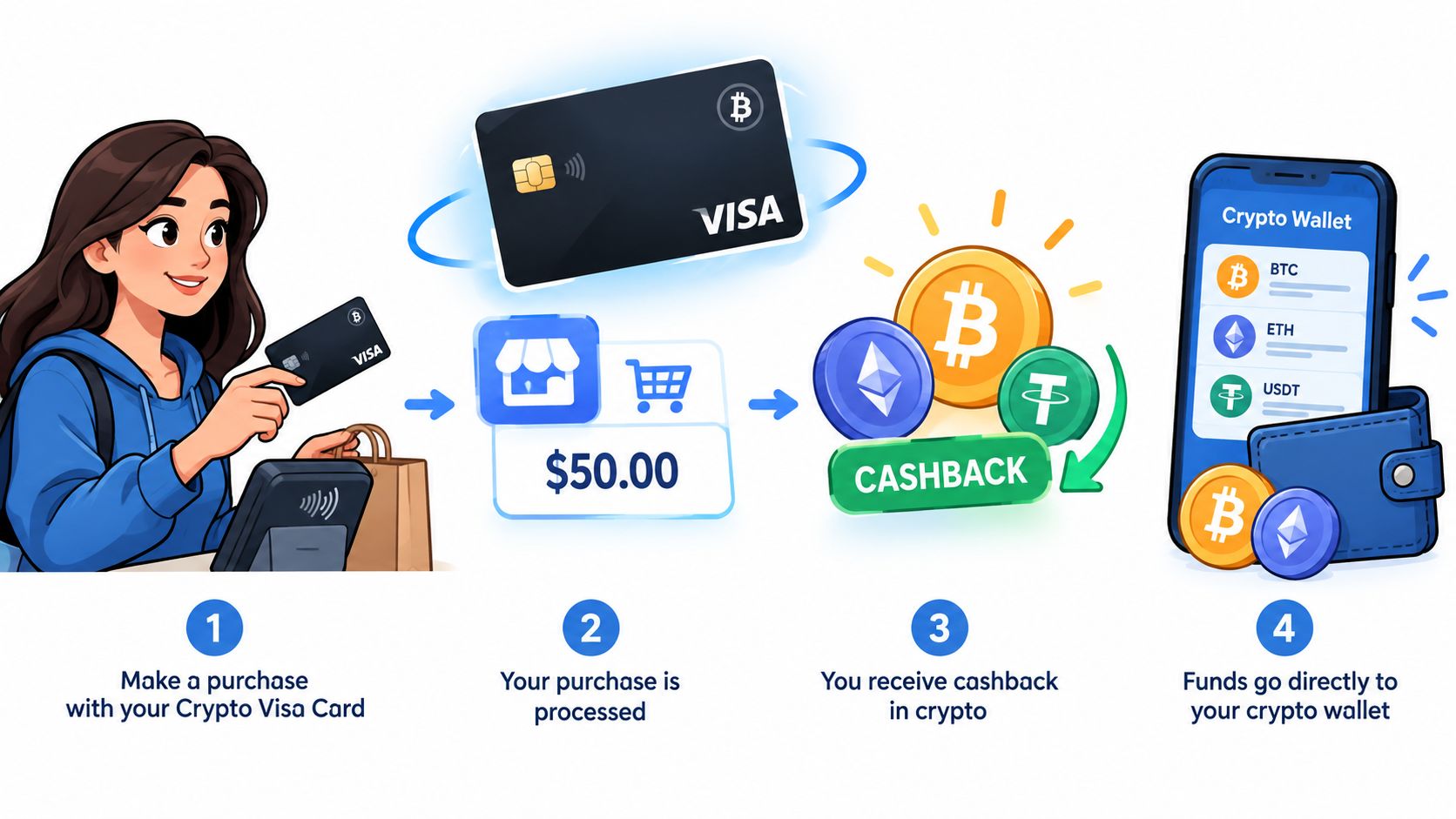
Crypto Visa cashback usually follows a familiar payment chain. You pay a merchant through the Visa network, the issuer receives payment-related revenue, and the card program shares part of its economics with you as a reward. The user sees cashback, but the reward isn't free money. It's one component of a product designed around card usage, balances, subscriptions, trading or staking.
The first question is what you receive. Some programs pay in fiat, while crypto-linked products may credit BTC, CRO or another token. A reward paid in a token can rise or fall in fiat value after the purchase. That creates a distinction between the nominal reward rate, calculated at the time of credit, and the realized reward value, calculated when you hold, sell or spend the asset.
Read the reward schedule as a set of conditions
A card's rewards page should answer five operational questions:
- Which tier applies? The base rate may be available without a commitment, while higher rates require staking or a paid subscription.
- What spending qualifies? Issuers may exclude categories, cash-like transactions or particular merchant types.
- Where does the cap apply? A cap may limit the amount of monthly spending that receives the headline rate, not the total amount you can spend.
- When is the reward credited? Immediate, monthly and post-verification payouts produce different exposure to price movement and reversals.
- Which asset arrives? BTC, CRO and other tokens create different liquidity, volatility and accounting considerations.
Crypto.com's later BTC-rewards structure demonstrates how far these programs have moved from a simple rebate. Its published 2026 Visa Signature configuration listed 1.5% on Basic, 3.5% on Plus, 4.5% on Pro, 5.0% on Private Icy, and 6.0% on Obsidian/Prime, with the monthly calculation applying to the first $250, $500, $1,000, $5,000 and $10,000 of spending respectively. (Crypto.com's BTC rewards card announcement)
That structure means two users can hold the same brand's card and receive very different outcomes. One may spend below the cap and capture most of the advertised value. Another may pay for a higher tier but spend outside the eligible range, leaving part of the subscription or locked-capital cost unsupported by rewards.
Terms can also change abruptly. In the earlier prepaid structure, Crypto.com's May 2022 changes reduced several rewards, including Midnight Blue from 1% to 0%, while some other tiers moved to 0% without active stake and Obsidian changed from 8% to 5% without active stake. (US News' coverage of those reductions) The lesson is structural, not historical: a reward rate is a policy decision, and staking doesn't guarantee permanence.
A practical guide to the decision process is this crypto card cashback analysis, but the issuer's current terms should always control the final calculation.
Calculating Your Effective Cashback Rate
The simplest formula is:
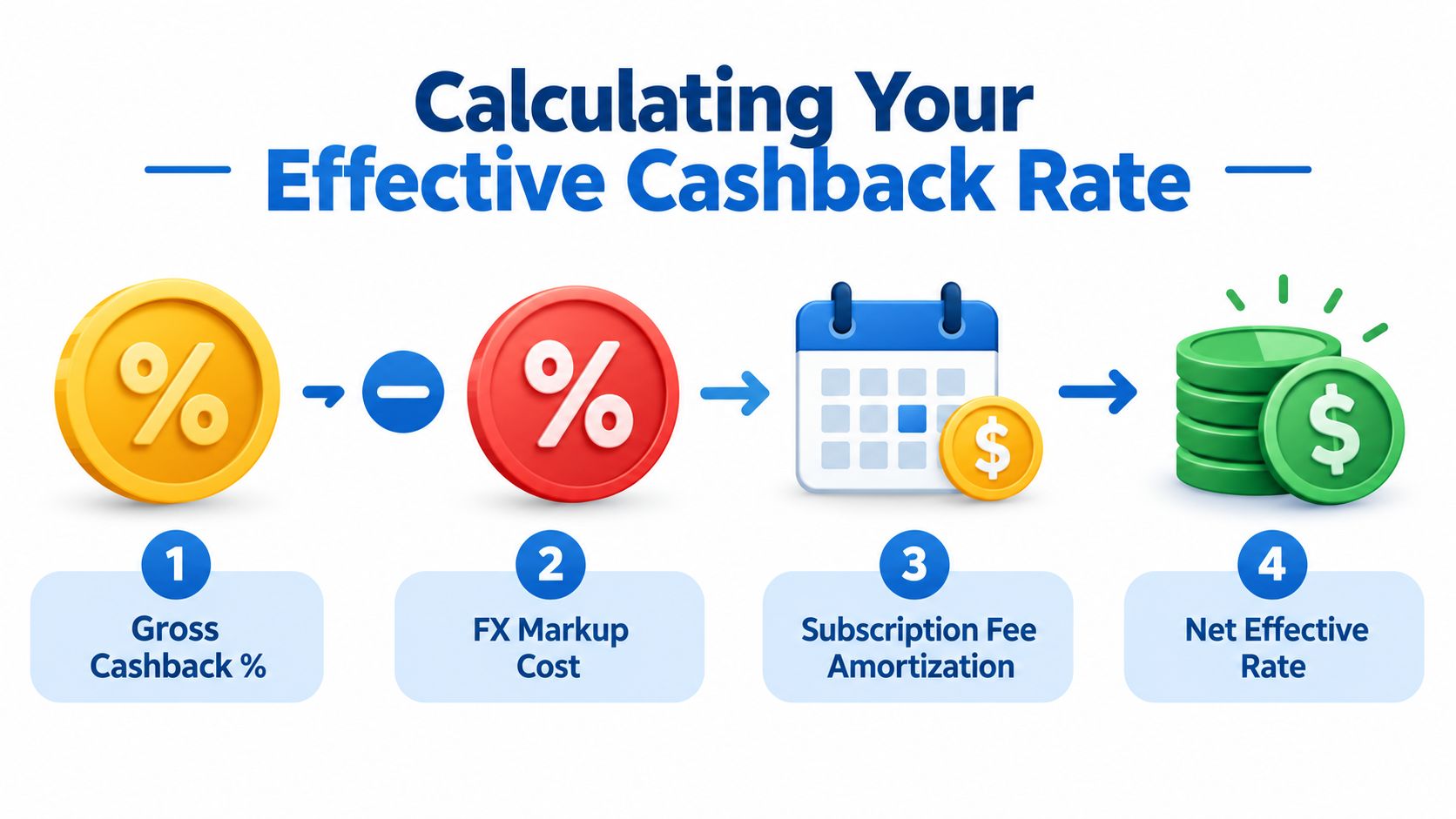
Net effective rate = (cashback value minus all attributable costs) ÷ total card spending × 100
The difficult part is defining “all attributable costs.” At minimum, include the subscription or annual fee, FX markup on foreign-currency purchases, conversion or top-up charges, and the economic cost of any locked token requirement. If the reward is paid in crypto, calculate its value at the time you choose to measure the return, and state that valuation clearly.
Step one, calculate gross eligible rewards
Separate total monthly spend from capped eligible spend. If a plan pays 3.5% only on the first $500 of monthly purchases, the gross reward is calculated on $500 when spending exceeds that amount, not on the entire monthly total.
For a worked illustration, assume a mid-tier plan with a 3.5% headline rate and a $500 monthly eligible-spend cap, using the published Crypto.com structure as the reference point. (Crypto.com's published BTC rewards tiers) If monthly spending is $1,000, gross rewards are 3.5% of the eligible $500, while the remaining $500 produces no equivalent high-rate reward under that cap.
The gross reward is therefore not 3.5% of total spending. It is $17.50 on $1,000, equivalent to 1.75% before fees. That difference is the cap effect, and it appears before considering subscriptions, FX or lockups.
Step two, subtract FX and access costs
Suppose the same $1,000 includes foreign-currency spending. Apply the issuer's actual FX markup only to the affected portion, rather than treating all spending as foreign. Independent 2026 comparison data reports that roughly half of Visa crypto cards advertise 0% issuer FX markup, while some charge 0.4% to 2.5%. (SpendNode's Visa crypto-card comparison)
If the applicable markup is 2.5% on $400 of foreign-currency spending, the FX cost is $10. The reward falls from $17.50 to $7.50 before the subscription fee, reducing the running return to 0.75% on total spending. This is why a frequent traveler can rationally prefer a lower headline rate with no issuer FX markup.
Now amortize the access fee. Crypto.com's Europe pricing for Plus has been listed at €3.99 per month or €39.90 per year, with higher tiers carrying more cost. (CryptoSlate's crypto rewards-card analysis) Convert the fee into the same currency used for your worksheet, then divide it across the months in which you plan to use the card.
Step three, price locked capital
A staking requirement isn't a conventional fee, but it still has a cost. The locked tokens may lose value, remain unavailable for another use, or expose you to a volatile asset while you pursue a payment reward. Your worksheet should therefore include an opportunity-cost estimate based on your own alternative use of that capital, not a generic market assumption.
| Calculation Step | Example Value | Impact on Effective Rate |
|---|---|---|
| Gross cashback | 3.5% on the first $500 | $17.50 gross reward on $1,000 spend |
| Cap effect | $500 eligible of $1,000 total | Running rate falls to 1.75% |
| FX cost | 2.5% on $400 foreign spend | Subtracts $10, leaving $7.50 |
| Subscription fee | Monthly plan cost | Subtract the prorated fee from $7.50 |
| Lockup cost | Required token capital | Subtract the estimated opportunity cost |
| Net effective rate | Remaining value ÷ $1,000 | The figure worth comparing |
The exact result depends on the card's current terms and your spending mix. A card-fees master table can help organize the inputs, but it shouldn't replace checking the issuer's fee schedule, reward exclusions and lockup rules.
Comparing Top Visa Crypto Cards by Real Cashback Value
A clean comparison needs normalized fields. The available published data doesn't provide a complete, like-for-like dataset for every leading Visa product across custody, KYC and regional eligibility, so the table below separates verified reward and fee observations from terms that require individual confirmation.
| Card | Cashback Range | Card Fee | FX Markup | Custody | KYC |
|---|---|---|---|---|---|
| Crypto.com Visa | 0% to 5% CRO in an independent 2026 comparison, with other published configurations reaching higher rates | $0 card fee in the cited comparison, while plans and tiers can add costs | Verify by region and product | Exchange-linked in the cited card structures | Verify by region |
| Crypto.com Visa Signature BTC rewards | 1.5% to 6.0% across published plans and tiers | Plan pricing applies by configuration | Verify by region | Issuer-linked | Verify by region |
| Other Visa crypto cards | Some free cards advertise up to 4% to 8% cashback | Varies | 0% for some, 0.4% to 2.5% for others | Custodial or self-custodial models vary | Varies |
The 0% to 5% CRO range and the $0 card fee with 0% issuer FX in one independent 2026 comparison describe a specific comparison framework, not a universal promise for every applicant or country. (Eco's 2026 crypto debit-card ranking) Product names can share a network while using different reward assets, caps, plan prices and eligibility rules.
Crypto.com's BTC version deserves separate treatment because its reward schedule ties rates to both plan level and monthly spend limits. A high tier can look dominant in a headline comparison, yet a user spending below the lower tiers' cap may not recover the additional cost or locked capital. Conversely, a high spender can hit the cap quickly and discover that the marginal spending earns little additional reward.
The wider market has the same trap. Independent comparisons identify free cards advertising up to 4% to 8% cashback, while also warning that FX pricing can range from no issuer markup to meaningful additional charges. (SpendNode's Visa card fee comparison) The card with the largest visible percentage isn't necessarily the card with the highest net yield.
For a conventional benchmark, compare the complete economics against a flat fiat card, including the certainty of its reward asset. A focused comparison of a traditional Amazon Visa and Crypto.com's Visa Signature card can add useful context, especially for users deciding whether token rewards compensate for crypto-specific conditions. (CreditCardCult's Amazon Visa versus Crypto.com comparison)
Which Card Fits Your Spending Profile
The right card depends less on the maximum advertised rate than on where, how much and in which currency you spend. Use monthly spending as a behavioral input, not as a reason to qualify for a tier you won't use.
The frequent traveler
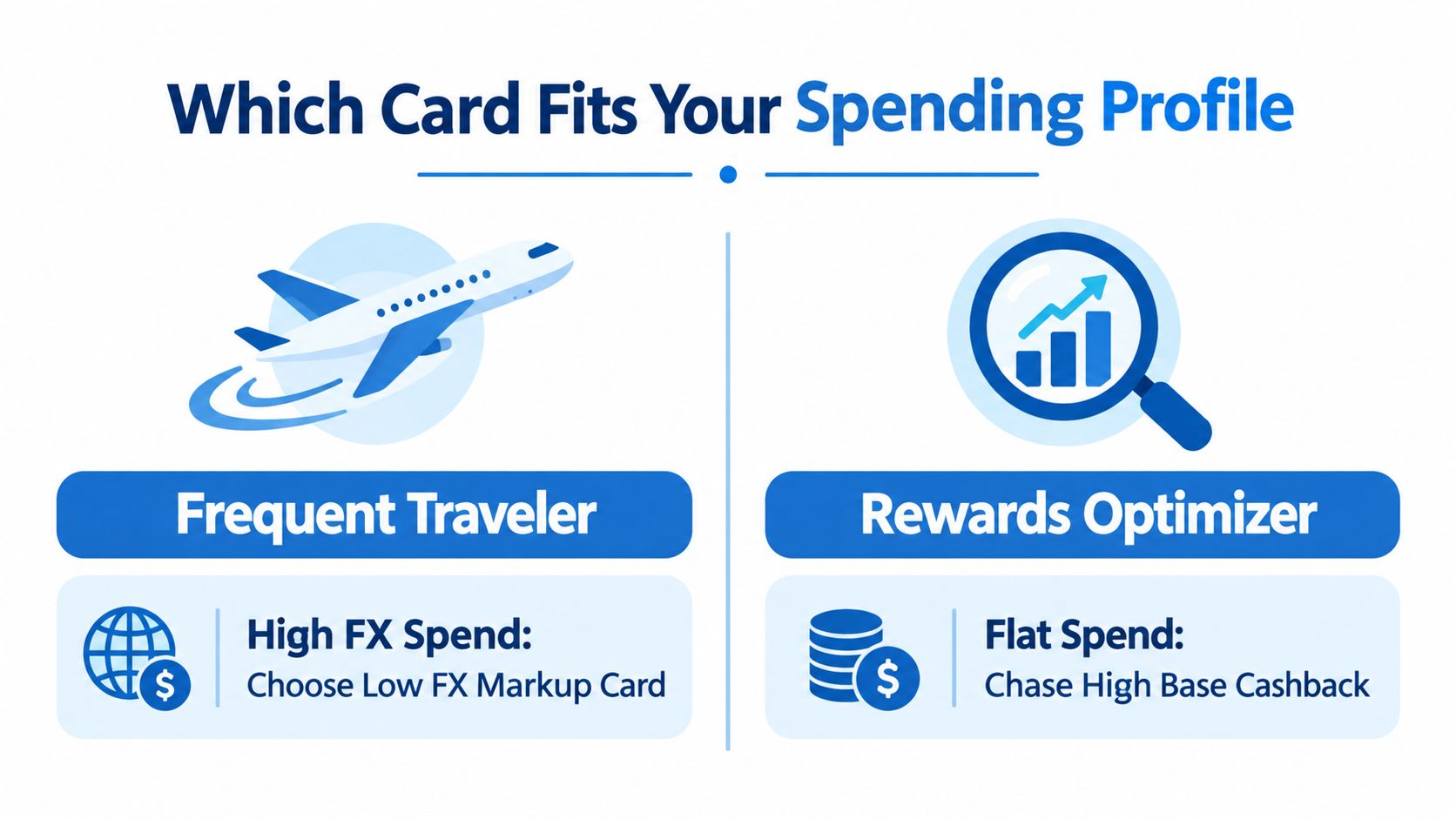
If much of your spending occurs in foreign currencies, start with FX markup. A card offering 0% issuer FX can beat a higher-rate alternative once conversion charges are applied. The relevant calculation is reward on eligible spending minus FX cost on foreign spending, not the rate shown beside the card logo.
Spend location also matters more than the token label. If you travel often but use a card with a low cap, the reward may cover only a small part of your travel budget. Choose the product with the strongest combined result for your foreign-currency share, cap and access cost.
The rewards optimizer
A high-spend user should map monthly purchases against each tier's cap. Crypto.com's published BTC rewards schedule applies different rates to the first $250 through $10,000 of monthly spending depending on the plan and tier. (Crypto.com's BTC rewards schedule) If your ordinary spend exceeds the eligible amount, calculate the blended rate across all purchases, not the reward rate on the capped portion.
The best tier is the one whose extra reward exceeds its extra fee and capital requirement.
The casual spender
For a light spender, fixed costs can dominate. A monthly subscription that appears small in isolation may consume most of the reward generated by ordinary purchases. Compare the annualized access cost with the gross reward from your actual eligible spend, then test the result against a no-fee alternative.
The privacy-focused user
Minimal-KYC or email-based options may appeal to users who don't want full identity verification, but lower verification can coincide with lower limits, fewer supported regions or reduced rewards. Treat privacy as a primary selection criterion, then accept that the financially optimal card may not be the operationally acceptable one.
Custody, KYC and Regional Availability Trade-Offs
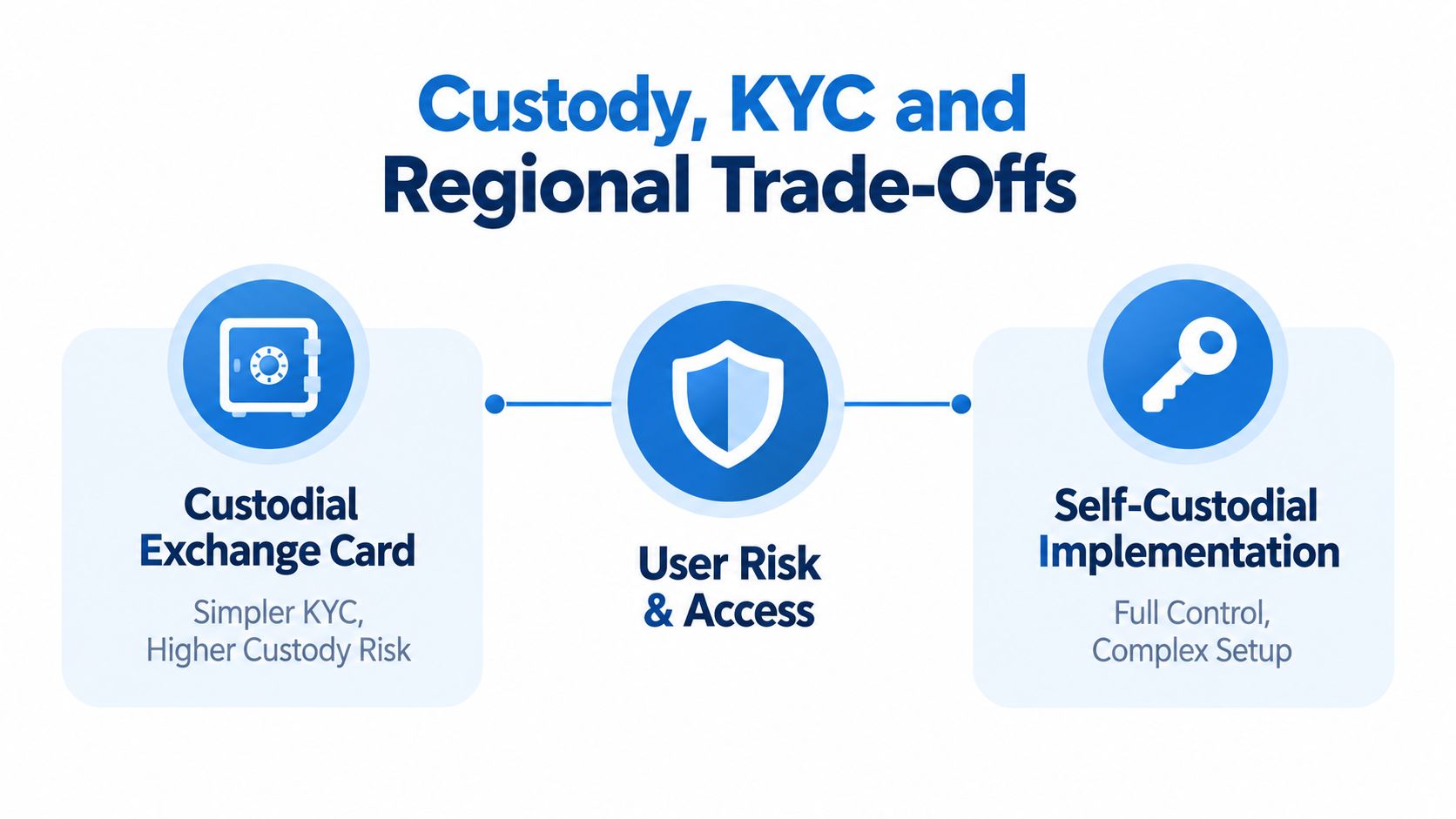
Cashback doesn't describe the whole risk profile. A custodial exchange-linked card can make funding and spending straightforward, but the issuer or exchange controls important account functions. A self-custodial implementation can keep assets in a wallet or on-chain account, giving the user more direct control while adding setup, transaction and operational complexity.
The distinction affects how you should value rewards. A token payout held inside a custodial platform may be convenient to spend or convert, but access depends on the account and region. A self-custodial model may reduce reliance on an exchange, yet the user remains responsible for wallet security, network selection and transaction execution.
Verification is part of the product
KYC isn't a decorative label. Full verification can determine whether the issuer can onboard you, while lower-friction routes may come with narrower functionality. Regional eligibility can eliminate an apparently attractive card before you compare rates, because Visa availability, issuer licensing, supported assets and reward terms differ by country.
A privacy review should also include the provider's information practices, not only the onboarding label. Resources covering data protection in financial services provide useful context for assessing how financial platforms handle identity and transaction data.
Token rewards add a second layer of uncertainty
When the reward arrives in CRO or another cryptoasset, the advertised percentage describes the quantity credited at a particular valuation, not a guaranteed fiat return. The user may keep the token, convert it, or spend it, and each choice can create different costs and reporting questions.
For US users, Kraken's 2026 tax guide says spend-based crypto-card cashback is generally treated as a purchase rebate rather than income under current IRS guidance. (Kraken's guide to crypto rewards taxation) That treatment shouldn't be generalized worldwide. Staking rewards, promotional incentives and later disposal of a token can follow different rules, so the post-tax calculation requires local advice.
Choosing Your Card and Rechecking the Math
Choose a crypto Visa card in this order:
- Measure your spending. Record monthly total spend and the share settled in foreign currencies.
- Apply the cap. Calculate cashback only on the amount that qualifies for the headline rate.
- Subtract costs. Include subscriptions, annual fees, FX markups, conversion charges and top-up costs.
- Price the lockup. Estimate what the required token capital costs you while it remains unavailable.
- Filter access preferences. Remove cards whose custody model, KYC requirements or regional availability don't fit.
- Check the payout asset. Decide whether you want fiat certainty or exposure to BTC, CRO or another token.
Recheck the terms before committing funds. Look specifically for recent reward changes, revised lockup rules, new caps, altered payout assets and regional pricing. Card programs can change, so a quarterly review is more reliable than a one-time comparison.
The decisive number isn't the maximum cashback rate. It's the net value produced by your own spending pattern after every condition is applied.
Use NomadCards to compare crypto-linked cards by cashback, fees, FX pricing, custody, KYC and regional availability. Enter your real spending profile, run the net-yield calculation, and revisit the shortlist before locking tokens or paying for a subscription.