The best crypto Visa card in Europe depends on what you're optimizing. A frequent traveler may care more about foreign-exchange costs and ATM rules than cashback. A privacy-focused user may prioritize KYC requirements, while a self-custody holder may reject a card that requires funds to sit with an exchange.
This comparison ranks seven Visa-branded or Visa-linked options by regional access, fees and limits, supported assets, verification burden, custody model, card format, and reward mechanics. It also uses NomadCards as a comparison framework, because issuer pages rarely present those fields in a consistent format. NomadCards provides normalized card profiles, KYC filters, issuer links, methodology documentation, and rankings refreshed weekly. It's free to use and discloses its affiliate relationships.
Terms can change quickly, especially as European crypto regulation develops. Treat every ranking as a shortlist, then verify the live issuer conditions, country eligibility, fees, limits, and rewards before applying.
Table of Contents
- 1. NomadCards
- 2. Crypto.com Visa Card
- 3. Bitpanda Visa Debit Card
- 4. Wirex Card
- 5. Plutus Visa Debit
- 6. Ledger CL Card powered by Baanx
- 7. Gnosis Pay-powered Visa cards such as MiniPay
- 7-Way Comparison: Crypto Visa Cards in Europe
- Choose by Trade-Off, Then Verify the Issuer Terms
1. NomadCards
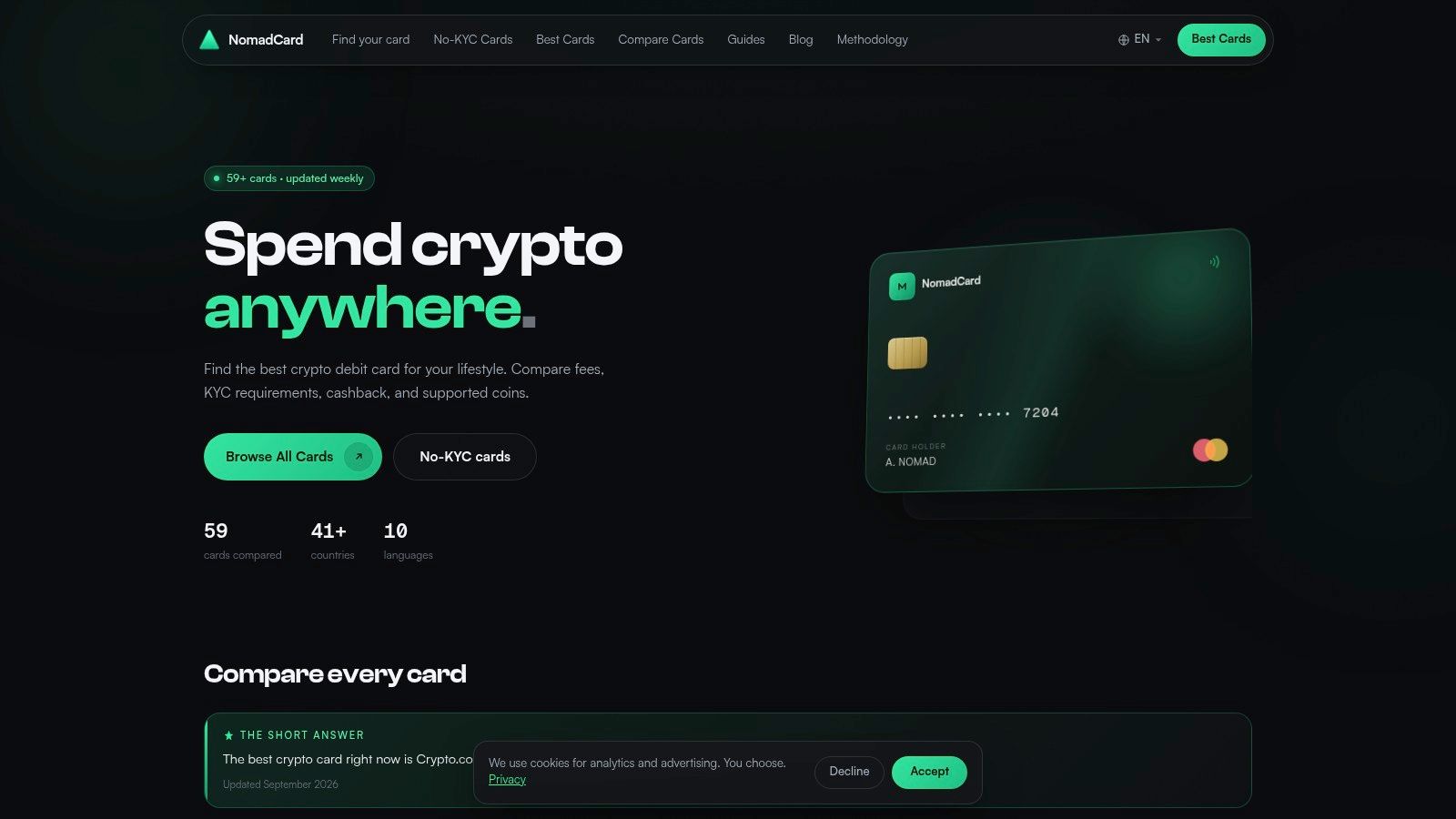
NomadCards is not an issuer, so it should not be judged like a card product. Its role is to standardize the information European applicants need before they compare individual Visa programs. Instead of reconciling separate fee pages and inconsistent reward definitions, users can review annual fees, supported coins, card network, card format, regional access, and rewards in one interface.
The finder organizes the practical filters that determine eligibility and usability. Users can sort by No KYC, email-only, or full KYC, then check Visa or Mastercard support, available assets, transaction limits, IBAN access, Apple Pay, Google Pay, virtual or physical cards, and non-custodial functionality. These filters expose trade-offs that reward tables often hide. A card with attractive rewards may still be unavailable in a user's country, require full verification, or depend on a custody model they do not accept.
Practical rule: Use a comparison engine to narrow the field, then use the issuer's legal and fee documents before making the final decision.
NomadCards includes custodial products as well as self-custodial implementations connected to wallets or on-chain accounts. Its rankings cover categories such as overall suitability, cashback, fees, country coverage, and no-KYC availability. The scoring model considers fees, privacy, trust and regulatory context, community sentiment, and rewards. That produces a broader comparison than ranking cards by cashback alone, although applicants still need to verify the underlying issuer terms.
Why it works as a research layer
Profile pages link to issuers, allowing readers to check the terms behind each listing. NomadCards also publishes methodology documentation and an advertiser disclosure stating that affiliate links may generate commissions while rankings remain editorially independent.
Regional access, partner issuers, KYC rules, and reward conditions can vary by residence and may change after launch. The platform helps identify those differences, but its aggregated profiles cannot replace the application flow, current fee schedule, or cardholder agreement.
Best for: crypto holders comparing multiple products, privacy-conscious users, travelers, rewards optimizers, and self-custody users assessing custody alongside convenience.
Main limitation: it aggregates public issuer information. Confirm the current fee schedule, supported country, card type, and reward conditions before signing up.
The live finder and current Visa listings are on the NomadCards site referenced above.
2. Crypto.com Visa Card
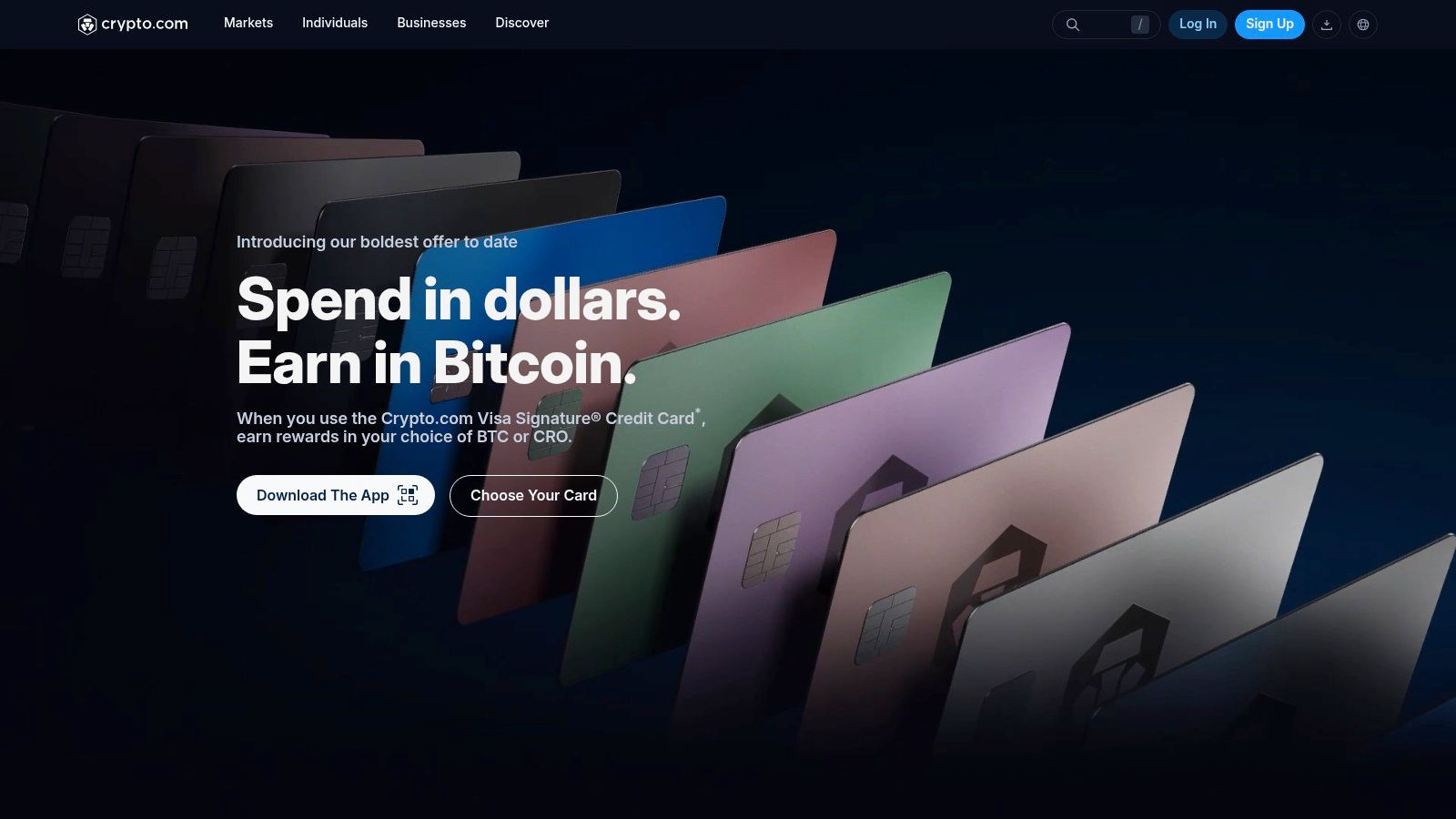
Crypto.com's Visa card is a custodial prepaid card connected to the Crypto.com App. The product converts supported crypto to fiat for card spending, so the user manages the balance and conversion process inside the app rather than spending directly from a personal hardware wallet.
Its strongest advantage is maturity. Crypto.com publishes Europe-specific documentation covering fees, limits, availability, and card usage, giving applicants more material to review than they'll find with newer programs. The card is designed for use wherever Visa is accepted, and the program supports Apple Pay and Google Pay.
The reward structure is tiered. Users gain different benefits by staking CRO, which creates a direct trade-off between card perks and exposure to the value and lock-up conditions associated with the CRO strategy. A headline reward can look appealing, but it should be evaluated against staking requirements, spending patterns, conversion costs, and the possibility that the cardholder doesn't use enough benefits to justify the arrangement.
Where the economics can change
Crypto.com's European fee documentation illustrates why issuance fees don't tell the whole story. The card can apply inactivity charges after twelve months, uses different foreign-transaction pricing inside and outside the EU or UK, and lists further fee updates for October 2026 in its published terms. Crypto.com's European card fee schedule is essential reading for occasional users and travelers.
For occasional spenders, dormancy and foreign-exchange rules may matter more than cashback.
The product fits users who already keep assets on Crypto.com and value an established app ecosystem. It's less suitable for people who want self-custody, minimal platform exposure, or rewards without staking-related conditions. For a direct comparison with Wirex, use this Crypto.com Visa versus Wirex comparison.
Best for: existing Crypto.com users who want a mature, app-linked prepaid Visa card and are comfortable with custodial balances.
Trade-off: tiered benefits may require CRO staking, while inactivity, FX, ATM, and other usage charges can affect the effective cost.
3. Bitpanda Visa Debit Card
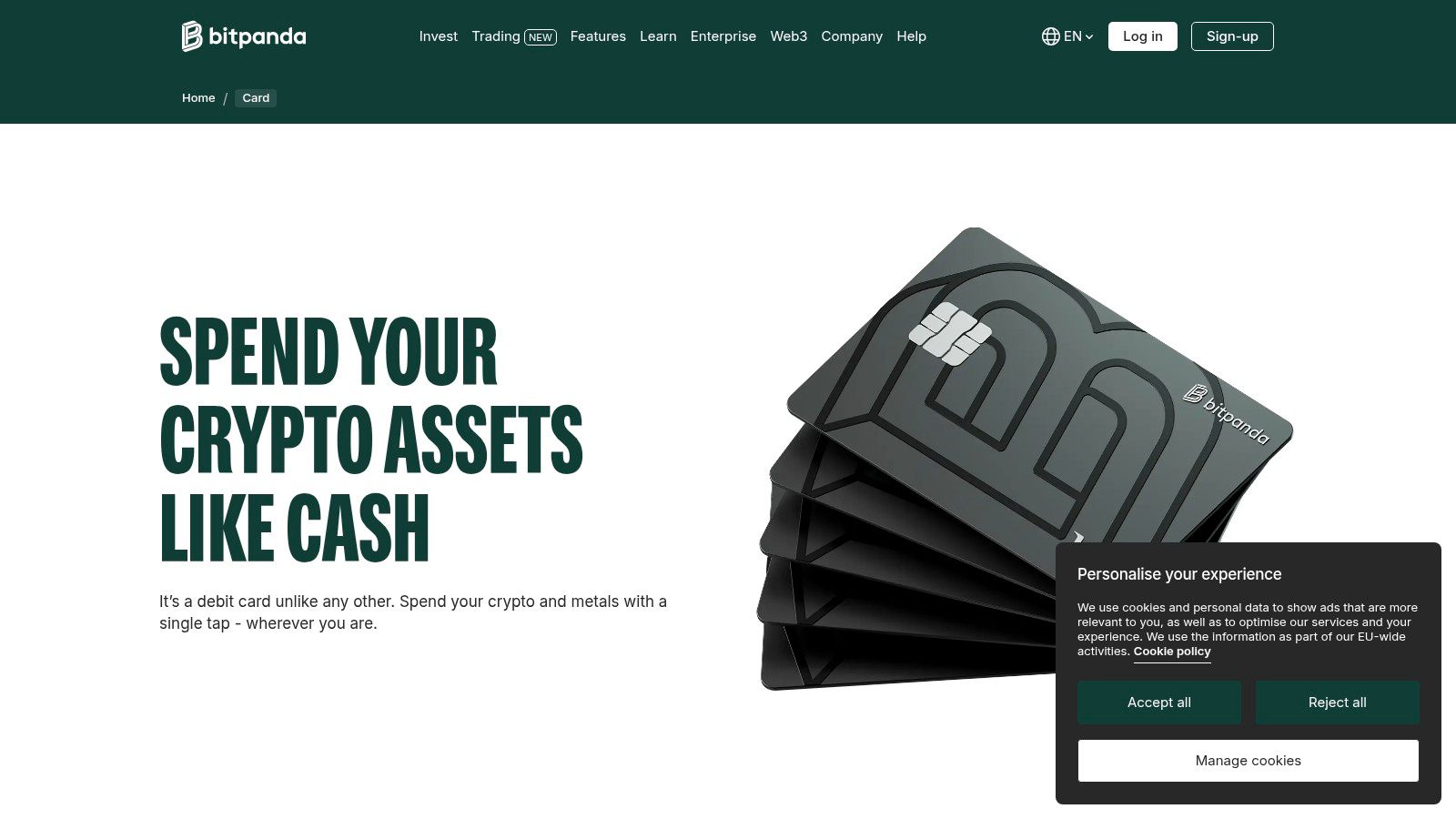
The Bitpanda Visa Debit Card makes the most sense for users who already manage their portfolio through Bitpanda. It lets cardholders select whether to spend from crypto, metals, or fiat balances, with conversion handled at the time of purchase. That portfolio integration reduces the need to move assets between separate wallets and payment apps.
Bitpanda manages activation and card controls through its app. The card is issued by Transact Payments Malta Limited under Visa Europe, giving applicants a clearly identified European issuing structure to review. It's available to eligible EEA customers, but country access and product conditions still need confirmation during onboarding.
The practical appeal is simplicity. A Bitpanda customer can choose an asset in the app, use the card at Visa merchants, and keep the payment relationship within the same account. That convenience comes with a conventional platform trade-off. Users must maintain a Bitpanda account and complete full KYC, so this isn't a fit for people seeking an email-only or no-KYC route.
What to verify before applying
Bitpanda says it covers Visa transaction fees on its side, but the relevant fees and limits are surfaced mainly in the app. That makes the product easy to use after approval, but less transparent for someone comparing total costs before opening an account.
Check the available spending assets, conversion treatment, ATM rules, foreign-currency terms, and limits in the live app or agreement. The fact that a card supports crypto and metals doesn't mean every asset in the broader Bitpanda ecosystem will be eligible for card spending under identical conditions.
Best for: existing Bitpanda customers who want one account for portfolio management and everyday Visa spending.
Trade-off: full KYC and custodial platform dependence are required, while important fee and limit details may need in-app verification.
For a side-by-side view against another established program, see this Bitpanda Card versus Crypto.com Visa comparison.
4. Wirex Card
Wirex takes a broader regional approach than a single-product card issuer. Depending on the market, customers may receive Visa or Mastercard products, with access to virtual and physical cards, a multicurrency wallet, and mobile controls. That makes Wirex relevant to European users who want payment and wallet features in one consumer app.
The product's main comparison challenge is regional variation. Wirex publishes country-by-country availability information for accounts, cards, and crypto features, but the exact combination can differ by residence. Cashback, supported rails, card format, and account functions may not be identical across European markets.
A good fit for users who need flexibility
Wirex supports Apple Pay and Google Pay, and its wallet structure is designed for holding and converting multiple currencies and crypto assets. The availability matrix and consolidated fee resources make it easier to identify the relevant program before applying, although the applicant should still confirm the result against the current country-specific terms.
That regional approach is both the product's strength and its weakness. A user may find a compelling feature set in general documentation, then discover that a particular card, reward, or crypto function isn't offered in their country. The network itself also deserves attention. Don't assume that a Wirex account in one European jurisdiction will produce the same Visa experience as an account elsewhere.
Country eligibility is a product feature. Compare the program offered at your address, not the brand's broadest feature list.
Best for: users who value a multicurrency wallet, virtual and physical card options, mobile payments, and broad European distribution.
Trade-off: card network, benefits, and features vary by region, so the country matrix is part of the application research.
Wirex's official platform is the place to confirm current availability and account terms.
5. Plutus Visa Debit
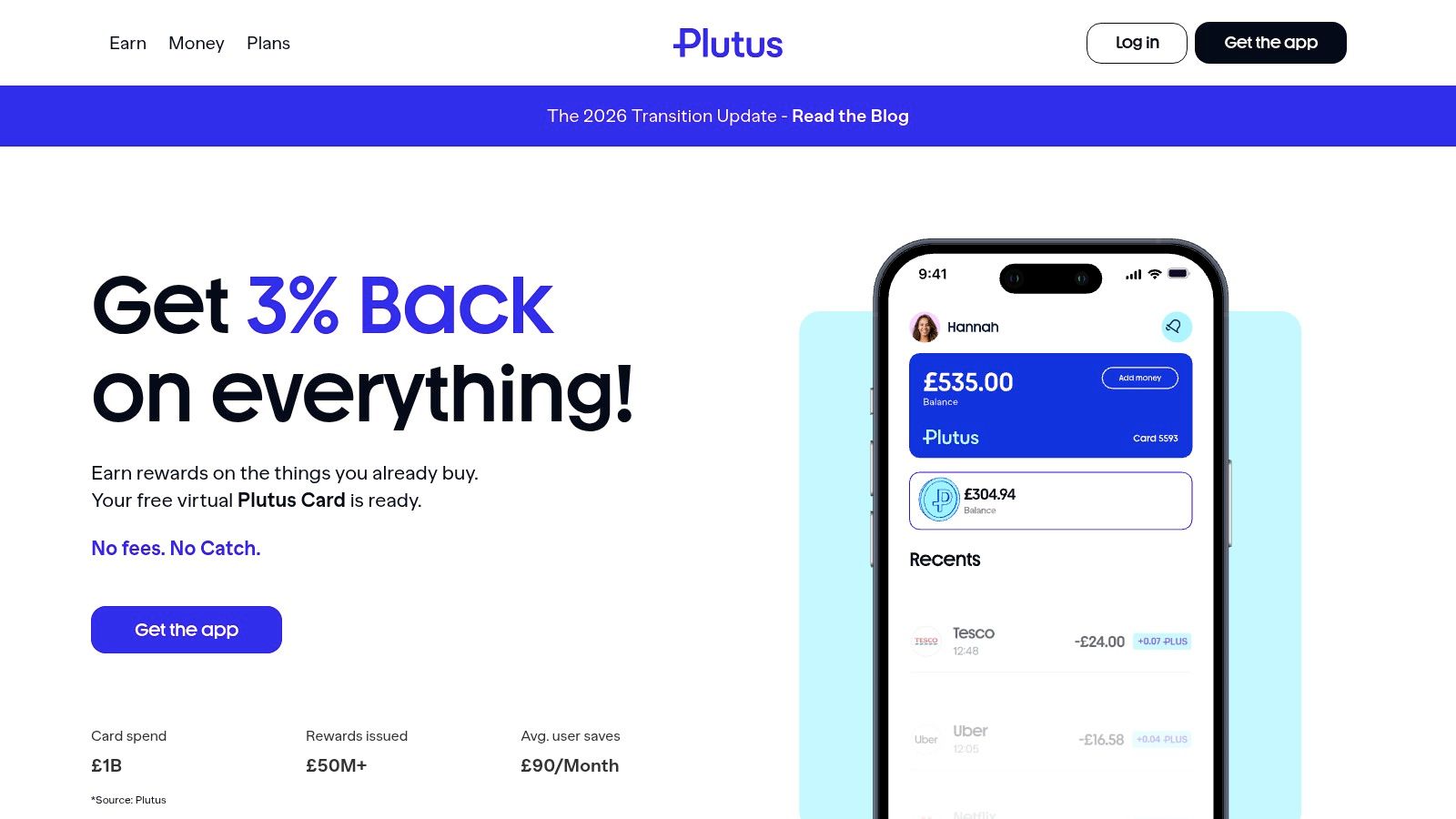
Plutus targets a different buyer from the low-friction prepaid card. Its Visa debit product combines a crypto-fiat account with a subscription-based benefits model, where users choose a plan and receive PLU token rewards and related perks under the applicable conditions.
That structure can work for frequent spenders who use enough of the available rewards to offset the subscription cost. It's less compelling for someone who uses a card occasionally, because a recurring plan adds a fixed cost before conversion fees, FX charges, and any other usage conditions are considered.
The product publishes fee and limit resources, which helps users model the arrangement before joining. However, Plutus has changed fees and product terms over time, so older reviews can mislead applicants. Use the live information on the Plutus website, not a cached reward summary or a promotional comparison copied from an earlier period.
Rewards require a usage calculation
PLU rewards aren't the same as guaranteed cash savings. Their practical value depends on the current reward rules, eligibility, redemption conditions, and the user's ability to use the available perks. A plan that looks attractive at a high spending level may not make sense for a low-balance user or someone who doesn't regularly use the listed benefits.
Review the subscription tier, spending limits, reward mechanics, supported assets, and withdrawal or conversion costs together. Don't evaluate the cashback headline in isolation.
Best for: frequent spenders and rewards optimizers who understand subscription economics and are comfortable receiving PLU-based rewards.
Trade-off: higher benefits require a paid plan, and historical fee changes make live-term verification particularly important.
6. Ledger CL Card powered by Baanx
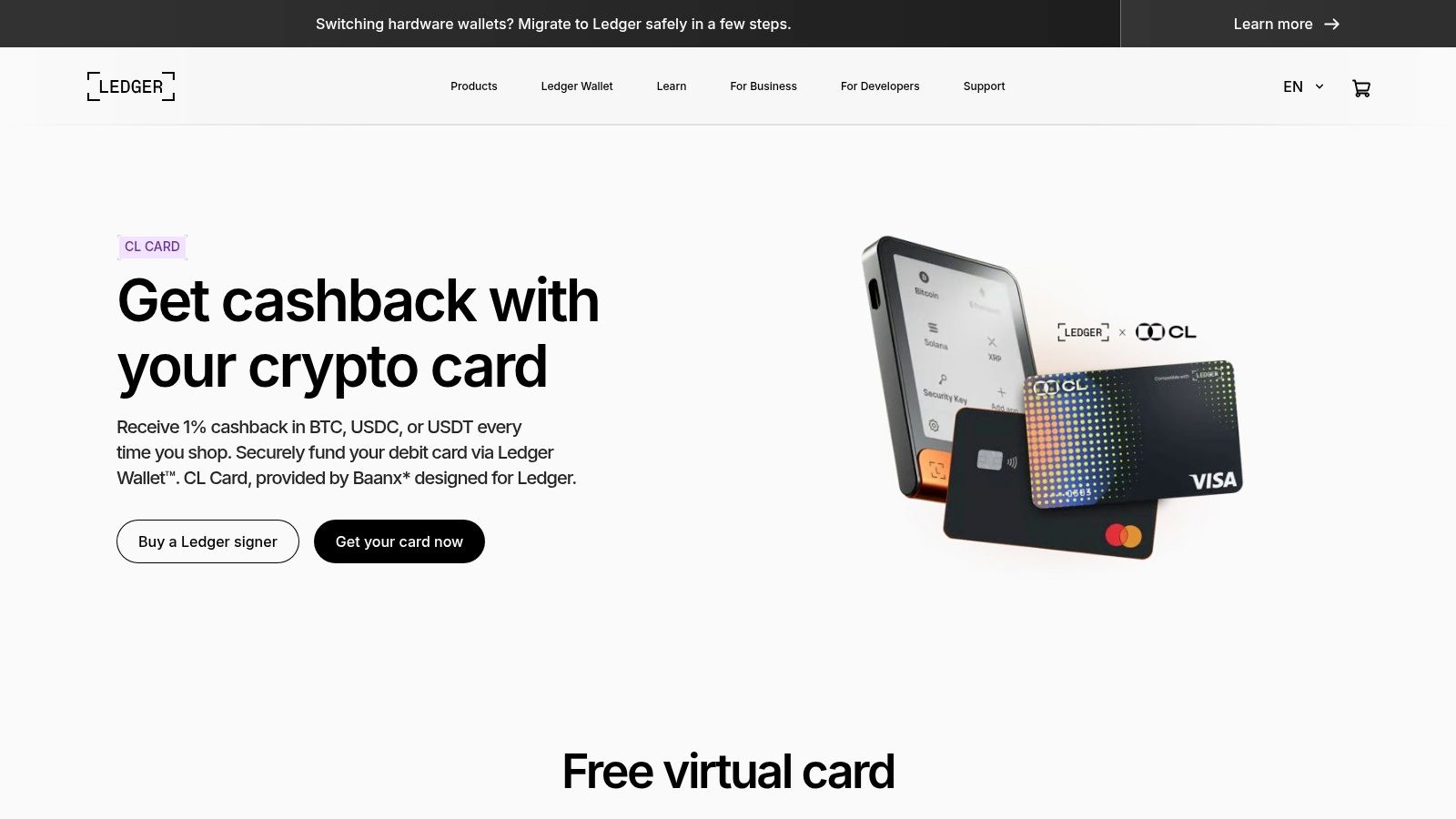
Ledger CL Card is built for users who already prefer Ledger hardware wallets and want card functionality inside Ledger Live. The program connects Visa spending with Ledger's wallet environment, while issuance and program management are handled by Baanx and regional partners.
The key distinction is custody preference. Ledger users can access spending or collateralized features without treating the card as just another exchange-linked balance. That doesn't make every function fully self-custodial, and it doesn't remove the role of the card program provider, but the integration is more naturally aligned with users who want to keep their core assets in a hardware-wallet ecosystem.
The published cashback headline is 1% in BTC or USDT, as described by the product materials. Ledger's CL Card page should be checked for the current eligibility, supported assets, program terms, and regional conditions because partner-operated card services can differ from Ledger's core hardware-wallet support.
Separate wallet security from card operations
A user may trust Ledger for hardware custody while still needing to deal with Baanx for card support, payment issues, limits, ATM rules, and FX charges. That division matters when something goes wrong at the payment layer. Read the custodial versus self-custody crypto card guide before treating the Ledger brand as proof that every card balance remains under direct hardware-wallet control.
Best for: Ledger users who want an integrated Visa experience and place a high value on hardware-wallet workflows.
Trade-off: Baanx and regional partners operate the card program, and standard issuer fees for ATM, FX, and usage apply under the relevant agreement.
7. Gnosis Pay-powered Visa cards such as MiniPay
Gnosis Pay-powered cards serve users who want a closer connection between on-chain balances and everyday card payments. The model links Safe smart-account wallets to Visa card programs, allowing eligible users to spend stablecoins or other supported on-chain balances while the merchant receives local-currency payment through the card network.
This is materially different from an exchange-linked prepaid card. The user's experience still resembles ordinary Visa spending, but the underlying account architecture is designed around wallet connectivity and self-custody. The exact custody and transaction flow depend on the partner program, the supported network, and the relevant account structure, so applicants should read the partner terms rather than rely on the Gnosis Pay name alone.
Partner rollout changes the availability question
Gnosis Pay powers partner-branded rollouts, including MiniPay in selected European markets. The program has been transitioning from Gnosis-branded cards toward partner cards, which means eligibility, issuance, card format, supported assets, and fees can vary by partner and country.
That creates a different kind of verification burden. A traditional issuer may have one public fee page for a regional product. A partner-powered card may require checking the partner's onboarding flow, local terms, wallet requirements, and availability page separately. Gnosis Pay's official site is the appropriate starting point for identifying the current partner offering.
Best for: DeFi users and self-custody holders who want card spending connected to Safe accounts and on-chain assets.
Trade-off: the technical model offers stronger wallet alignment, but partner-specific availability and terms make direct comparisons harder.
7-Way Comparison: Crypto Visa Cards in Europe
| Product / Service | Implementation complexity 🔄 | Resource requirements ⚡ | Expected outcomes 📊 | Ideal use cases 💡 | Key advantages ⭐ |
|---|---|---|---|---|---|
| NomadCards | Low, web-based aggregator with weekly scoring | Minimal for users; site needs data aggregation & editorial upkeep | Faster, like-for-like card selection and transparent rankings | Researching/comparing many crypto cards; privacy-first filters | Comprehensive normalization, KYC labels, interactive finder |
| Crypto.com Visa Card | Low, app-managed prepaid Visa with tier logic | Requires CRO staking for top tiers; custodial app balance | Broad acceptance with tiered cashback and perks | Users wanting widely accepted card and reward tiers | Established EU program, clear docs, Apple/Google Pay support |
| Bitpanda Visa Debit Card | Low, in-app card with real-time conversion | Requires Bitpanda account and full KYC | Seamless spending from crypto/metals/fiat with portfolio integration | Existing Bitpanda customers wanting tight wallet integration | Real-time asset selection, EU issuer disclosure |
| Wirex Card | Low–moderate, regional program differences and rails | Account plus region-specific requirements and programs | Multicurrency wallet + virtual/physical card availability | Users needing multicurrency support and broad regional access | Country matrices, published fees, robust app support |
| Plutus Visa Debit | Low, subscription-based tiers for benefits | Monthly subscription for higher limits/perks | Higher limits and rewards for paying subscribers | Frequent spenders/rewards optimizers who offset subscription | Clear tier structure, PLU token rewards, published fees |
| Ledger CL Card (Baanx) | Moderate, integrated into Ledger Live; partner-managed issuance | Ledger hardware recommended; partner account for card ops | Self-custody-friendly spending with modest BTC/USDT cashback | Ledger hardware users prioritizing self-custody card options | Ledger integration, self-custody posture, partner disclosures |
| Gnosis Pay–powered Visa cards | High, on‑chain wallet–card integration via partners | Safe smart‑accounts and partner rollout per country | On‑chain control with fiat merchant settlement via partners | Users prioritizing true self‑custody with card convenience | Direct Safe wallet linkage, preserves on‑chain custody |
Choose by Trade-Off, Then Verify the Issuer Terms
There isn't one universally best crypto Visa card in Europe. The strongest choice depends on the account structure you're willing to use, the assets you hold, how often you spend, and where you live.
Start with country eligibility. A card can be widely marketed across Europe while offering different networks, rewards, virtual-card access, or crypto features by jurisdiction. MiCA has created a uniform EU framework, but the transition still involves authorization and implementation details. The European Commission's MiCA implementing and delegated acts page shows that operational details continue to matter for firms and users.
Then compare the following:
- KYC level: Decide whether full identity verification is acceptable. Products with reduced verification may have narrower access or functionality, while regulated European programs increasingly rely on formal KYC and AML controls.
- Custody model: Confirm whether assets remain with an exchange, move into a card balance, or stay connected to a self-custodial wallet. “Non-custodial” shouldn't be treated as a blanket guarantee. Read how payment accounts, smart contracts, and recovery work.
- Supported assets: Check the exact coins, stablecoins, networks, and spending balances supported by the card. A platform's trading list isn't automatically the same as its card-spending list.
- Total cost: Include issuance, annual or subscription fees, inactivity charges, ATM withdrawals, non-EUR conversion, network markups, and tier requirements. Crypto.com's European documentation shows how costs can vary by usage pattern.
- Reward mechanics: Identify whether cashback requires CRO staking, a Plutus subscription, a particular asset, a spending category, or a partner condition. Reward percentages alone don't establish value.
- Card format and limits: Check virtual versus physical issuance, Apple Pay and Google Pay support, per-transaction limits, ATM access, and any balance or monthly allowances.
- Issuer responsibility: Find out who handles card support, disputes, compliance, and account restrictions. A wallet brand, card program manager, and regulated issuer may be different companies.
NomadCards is useful for narrowing the shortlist because it presents fees, KYC, custody, assets, networks, rewards, and regions in normalized fields. After that, open the linked issuer or partner page and verify the current terms at your address. The best crypto Visa card Europe users can choose today is usually the one whose restrictions and total costs they understand before applying, not the one with the most attractive headline reward.
Use NomadCards to filter European crypto Visa cards by KYC, custody, fees, supported assets, rewards, and country availability. Build a shortlist first, then follow each issuer link to confirm the live terms before you apply.