There is no single crypto Visa card fee. On a $1,000 overseas spend the all-in hit is usually a conversion spread of about 0.9% to 1%, plus an FX markup of 0% to 2%, and ATM or merchant currency conversion on top, not the annual charge.
You are at a hotel desk with a crypto Visa in your hand and the clerk is waiting. The page you saved last month showed a $0 yearly charge, so the tap feels free. It is not. Roundups lead with the membership line because it is easy to screenshot. The balance that moves is set when the issuer sells crypto into the settlement currency, then again if the bill is not in that currency, and again if the terminal offers to charge you in dollars.
I would ignore any ranking that sorts cards by the yearly membership alone. Price the rows that fire on the trip you are really taking.
Table of Contents
- Crypto Visa Card Fees at a Glance
- Why Issuers Charge Fees You Never See
- The Spread Hiding Inside a Zero Fee Card
- What a $1,000 Spend Costs and How to Cut It
- Cashback That Fails the Break Even Test
- Confirm the Live Fee Before You Apply
Crypto Visa Card Fees at a Glance
The hotel charge posts overnight and the app debit is larger than the folio. The annual fee, if this card even has one, has not billed yet.
These are the crypto Visa card fees in the order they hit, not in alphabetical order.
| Fee type | When it hits | Typical 2026 range | How often |
|---|---|---|---|
| Issuance | Ordering a physical or virtual Visa | $0 to $50 physical; virtual often $0 | One-time |
| Annual or monthly | Keeping the card or a paid tier | $0 to $150, or a token-stake tier | Recurring |
| FX markup | Spending in a non-settlement currency | 0% to 2% on top of Visa's rate | Per foreign purchase |
| ATM | Withdrawing cash | About 2% plus $1 to $3; caps are common | Per withdrawal |
| Transaction | Paying a merchant | Usually 0%; some prepaid cards 0.5% to 1% | Per purchase |
| Top-up | Loading crypto or fiat onto the card | 0% to 1%, plus network gas if on-chain | Per load |
| Conversion spread | Selling crypto to settle the spend | About 0.9% to 1%, often undisclosed | Per crypto-funded spend |
| Inactivity or replacement | Dormant, lost, or reissued card | A flat dormancy or reissue charge on the issuer schedule | Occasional |
Issuance is a one-time plastic or virtual-card charge. Many virtual Visas are $0. A metal or shipped card is the line that can reach $50.
Annual or monthly is the number most tables lead with. A cash tier in the $0 to $150 band is easy to see. A token-stake tier is not a free substitute. You have tied up an asset that can fall.
FX markup is the issuer's add-on when you spend outside the settlement currency. It sits on Visa's rate. It is not Visa's rate. A printed 0% FX fee only says the issuer is not adding its own percent.
What the headline leaves off
Visa names a foreign-currency conversion charge its International Service Assessment (ISA). For a typical U.S.-dollar card purchase made in another currency and converted into USD, that assessment is 1.0%, about $10 on a $1,000 purchase before any issuer spread, crypto liquidation fee, card fee, or dynamic currency conversion, according to GSA SmartPay guidance on Visa's international assessment. The issuer can absorb that network cost, pass it through, or stack a markup on it. Visa's rules also require issuers to disclose fees that may apply to international transactions or currency conversion, so the schedule beats the slogan.
ATM is where a "free card" gets expensive in percent terms. About 2% plus $1 to $3 is common, and free cash usually stops at a monthly cap. Transaction fees on ordinary purchases are usually 0%, though some prepaid programs take roughly 0.5% to 1% per tap. Top-up runs about 0% to 1%. If you fund on-chain, gas is a network cost the issuer does not set.
The row readers skip is the conversion spread, often about 0.9% to 1%, and often missing from the public fee page. Inactivity, replacement, and decline charges are occasional extras, not a reason to pick or reject a card by themselves.
Merchant-to-issuer interchange never appears as a line on your statement. Add only the rows your trip triggers. Treat a 0% FX claim as unfinished until the spread cell is filled. If you are also weighing a points card against a cash fee, you can evaluate rewards value with Fintrack on the same dollars you expect to spend.
Why Issuers Charge Fees You Never See
Interchange is the wholesale price between the merchant's bank and the card issuer. It is not a second line in the app.
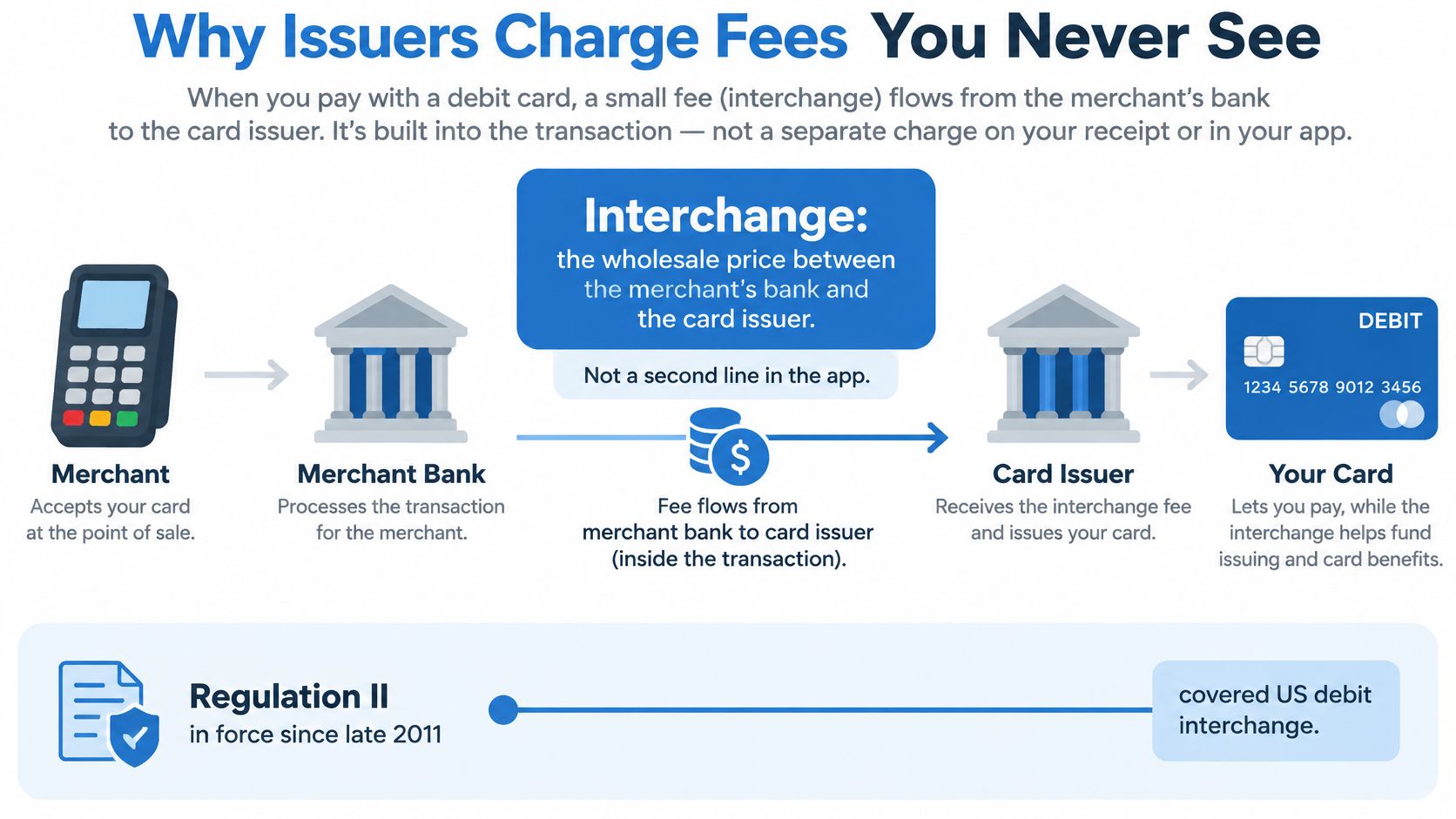
The Federal Reserve's Regulation II interchange data is the U.S. benchmark. Regulation II took effect in the fourth quarter of 2011. For covered debit, the cap is $0.21 plus 0.05% of the transaction, with an extra $0.01 fraud-prevention adjustment for eligible issuers. On a $100 purchase that regulated formula is about $0.26, and you pay none of it directly. In 2023 the average interchange fee across U.S. debit and general-use prepaid transactions was $0.34, equal to 0.73% of value, while prepaid averaged $0.57, or 1.54%.
Practical rule: A rewards promise the wholesale fee cannot fund has to be paid for somewhere else on your statement.
Prepaid and unregulated crypto Visa programs sit on different wholesale economics. A 2% cashback rate, free ATM withdrawals, or a $0 annual fee still has a cost. The program recovers it through a monthly tier, the conversion spread, withdrawal charges, or a partner subsidy. Cashback near or above available interchange is fragile, especially on low-margin debit and on cross-border spend.
Separate the lines you pay from this wholesale layer before you compare rewards. Check whether the product is debit, prepaid, custodial, or issued abroad. Those labels change which wholesale schedule the issuer lives on, which is why two "free" Visas can price the same coffee differently.
The short walk-through below shows that merchant-to-issuer flow without turning it into a cardholder line item.
The Spread Hiding Inside a Zero Fee Card
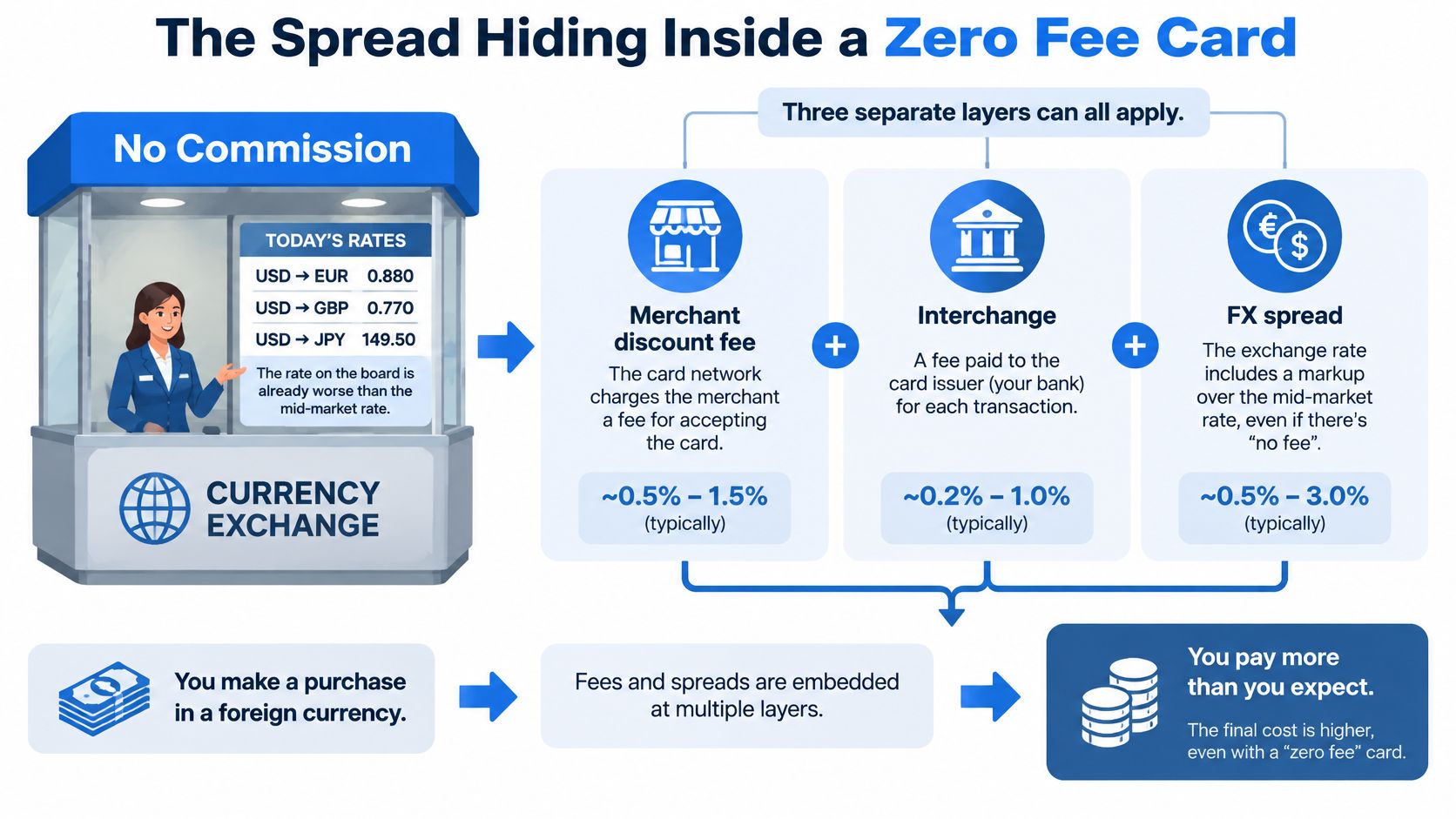
Airport exchange booths taught this lesson years ago. The sign says no commission. The rate on the board is already worse than the mid-market rate. A crypto Visa with "zero transaction fees" often works the same way. The purchase line is $0. The rate used to sell your coins is not the rate you would get on a transparent market.
Three separate layers can land on one tap. They are not the same fee with three names.
Three layers on one tap
Layer one is the issuer's crypto-to-fiat spread. Independent crypto card fee coverage puts reported conversion costs around 0.9% to 1%, with foreign-exchange markups commonly around 0.5% to 2%, and ATM withdrawals that may add roughly 2% plus a fixed charge. The same coverage notes that only 23 cards disclosed a conversion spread. A blank cell is not a free cell. An undisclosed spread cannot safely be written down as zero.
Layer two is the card program's FX markup. That percent sits on top of Visa's own exchange rate. It is not the network assessment. The issuer may absorb the network charge, pass it through, or add its own markup. A schedule that says 0% only answers the issuer's slice.
Layer three is dynamic currency conversion. The terminal asks if you want to be charged in your home currency. If you accept, the merchant sets the rate. That rate is often worse than letting Visa convert. DCC is optional. Declining it is the whole defense.
What actually triggers each layer
Test three facts on every charge: settlement currency, merchant country, and transaction currency. A fee can key off any of them.
Say you hold a dollar stablecoin and the card settles in dollars. A domestic tap may trigger only the spread. Take that same card abroad and pay in local currency, and FX joins the spread. Accept the terminal's offer to bill your home currency, and DCC stacks on both.
A domestic stablecoin spend is the cleanest test of the issuer's honesty, because almost nothing else is in the way. If that rate is already off the mid-market print, the card is not a zero-fee product. Travel just adds layers.
Headline zero transaction fees describe the purchase line only.
For a trip, read how a crypto card handles travel FX against the three triggers above, not against the annual fee. Record the settlement currency in your notes before you leave. If the fee page never says how the crypto sale is priced, do not assume the missing number is zero.
What a $1,000 Spend Costs and How to Cut It
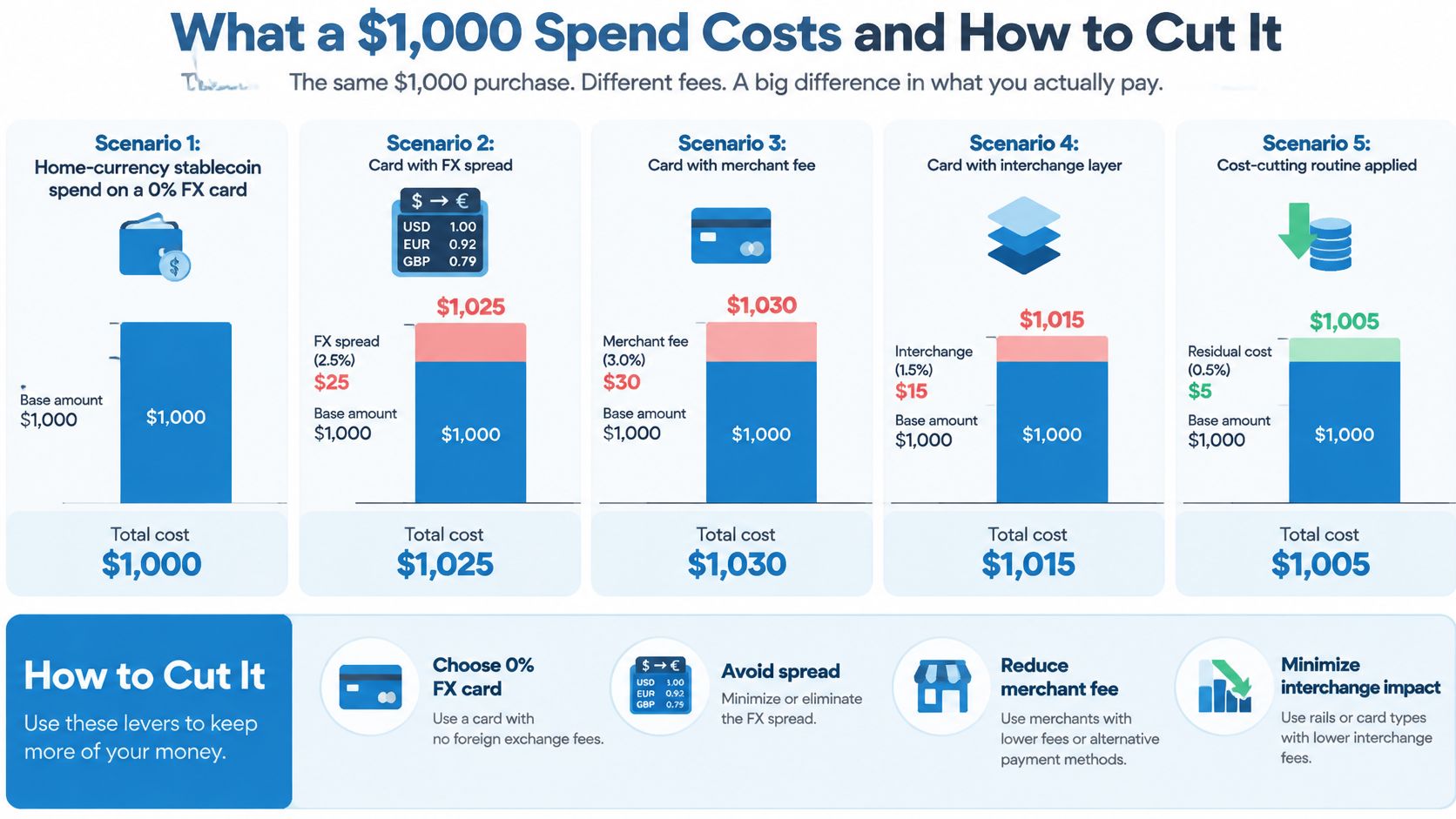
Same thousand dollars, five checkouts. The lever that moves the bill is the checkout choice, not the card's marketing name.
| Checkout choice | FX markup | Conversion spread | Extra layer | Approx. all-in |
|---|---|---|---|---|
| Home stablecoin spend, 0% FX card | 0% | About 0.9% to 1% ($9 to $10) | None | About $9 to $10 |
| Abroad in local currency, 0% stated FX | 0% stated | About 0.9% to 1% ($9 to $10) | Visa ISA about 1% ($10), absorbed or added | About $9 to $20 |
| Abroad with 2% issuer FX | 2% ($20) | About 1% ($10) | No DCC | About $30 before any network pass-through |
| ATM cash instead of a card tap | May still apply | About 1% of amount converted | About 2% plus $1 to $3 | Highest percent on small withdrawals |
| Terminal charges home currency (DCC) | Issuer FX may still apply | About 1% | Merchant-set rate | Usually the worst of the five |
How each version lands
Home stablecoin, stated 0% FX. You are only paying the sale of crypto into the settlement currency. About $9 to $10 on $1,000 is the honest floor when the spread is near 1% and nothing else applies. This is the checkout I would use for groceries, transit, and anything billed in the card's home currency.
Abroad in local currency, 0% stated. The spread is still there. The network assessment of about $10 is either inside the issuer's rate or added on top. Until the schedule says which, the range is about $9 to $20. "0% FX" does not close that gap by itself.
A 2% issuer markup. Twenty dollars of FX plus about $10 of spread is roughly $30 before any network pass-through. That is a bad card for a month of nomad spend, even if the annual fee is zero. On $3,000 of travel it is about $90, which is the membership charge people thought they had avoided.
ATM cash. About 2% plus $1 to $3 makes a $200 stop costlier in percent than a $1,000 tap. Pull cash only inside a free monthly cap, and pull it in one withdrawal rather than three.
DCC at the terminal. The merchant sets the rate, and issuer FX may still apply. This is usually the worst of the five. The prompt feels helpful. It is a second exchange desk.
The formula is simple. Amount times spread, plus amount times FX markup, plus any fixed ATM fee, plus DCC only if you accept it.
A routine that uses those levers
- Decline the home-currency prompt. DCC is the layer you can refuse in the moment, and it is often the largest one.
- Prefer a disclosed spread. Write the percent in your notes. Never record a blank as zero.
- Spend stablecoins on everyday taps when fee control is the goal. A volatile coin adds a price move on top of the spread.
- Read the 0% FX sentence twice. Confirm whether the issuer absorbs the network assessment or only skips its own markup.
- Use ATMs inside the free cap. A small withdrawal has the worst percent because the fixed dollars do not shrink.
- Batch larger top-ups when on-chain gas applies. Five small loads can cost more in gas than the card fee you were trying to dodge.
- Skip a token-stake tier unless cashback still wins after a price drop you can tolerate.
- Rerun the formula on monthly spend, not on the annual fee. A $0 card that costs $30 per thousand is not free at $2,000 a month.
Do the math on your own pattern before you order plastic. A domestic stablecoin user and a weekly ATM user should not pick the same card.
Cashback That Fails the Break Even Test
People subtract the annual fee from a cashback percent and call the rest profit. That arithmetic flatters the headline.
A 2% reward on $1,000 is $20. If the tier required you to buy and lock a volatile token, a modest price drop erases that $20 and more. The lockup also has an opportunity cost versus holding the asset you spend. Recent analysis of crypto card fees treats the value and market risk of reward-tier tokens as a separate cost, not as a footnote to the cashback rate.
Costs the reward page skips
Break-even spending has to include more than the yearly charge.
- Token lockup: Capital sits still, and a decline can exceed the cashback.
- Caps, vesting, and clawbacks: A rate that stops mid-month, pays late, or reverses is not the rate in the ad.
- Spread on the spend itself: About 0.9% to 1% is roughly $9 to $10 per $1,000, which consumes a large share of a 2% reward before any other friction.
- Reward conversion: A fee to turn the reward token into something you can spend is part of the net.
A card with 0% cashback and a disclosed sub-1% spread can beat a 5% headline once the stake, the cap, and the spread sit in the same sum. I would take the dull card when the stake is a coin I do not already want to hold.
Tax is not a line on the fee page
Spending crypto can be a disposal or exchange, depending on where you file, even when the card fee is zero. Stablecoins or e-money tokens may be treated differently from other crypto. Reporting on Italy's 2026 treatment describes a split between euro stablecoin and e-money-token transactions and ordinary crypto, including different tax rates and different treatment of euro-to-token conversion. That is a jurisdiction example, not your bill. Do not copy a tax rate from a card review into a return.
The highest nominal cashback can be the lowest risk-adjusted result.
That shows up for anyone who must buy a tier token, sell rewards, or report frequent disposals. Compare the advertised rate with an effective figure after spread and stake risk. Issuer fees and your tax obligations are different columns. A comparison that merges them into one "profit" number is marketing. A longer walk-through of whether crypto card cashback is worth it belongs next to your own monthly spend, not next to the sticker percent.
Confirm the Live Fee Before You Apply
Choose the card whose disclosed spread, FX, and ATM fees are cheapest for the pattern you have. Mostly domestic stablecoin spending benefits from a tight, published spread. Frequent foreign transactions suggest a card that specifies how the network assessment is handled. Cash withdrawals depend on the free ATM limit, not on cashback.
Before you apply, check three items on the issuer's own page. Country and tier change the numbers.
Conversion method. How does the issuer price the crypto sale, and is that percent written down?
Foreign markup. Do foreign purchases add a percent on top of Visa's rate, or does "0%" only skip the issuer's slice?
ATM cap. How much cash is free each month, and what is the percent plus fixed charge after that?
Run monthly spend through the formula, amount times spread plus amount times FX plus fixed ATM plus DCC only if accepted. Compare that all-in result, not the headline cashback. A blank spread cell means the card is unfinished until the issuer fills it in.
We publish a crypto-card fees report built from primary data across every card we track, and results can be sorted by best overall, highest cashback, lowest fees, or most countries. Start from our card fees master table if you want the rows side by side. Card terms can differ by country and tier, so confirm current details on the provider's own site before you apply. Crypto and the cards that use it carry risk, including loss of funds. We are not the issuer, and a comparison page is not a substitute for that schedule.
NomadCards compares crypto Visa and other crypto-linked cards on the fee lines that move a balance, including conversion, FX, and ATM, not just the annual charge. You can sort for lowest fees or highest cashback and then open the issuer's schedule before you apply. Visit NomadCards and price the card against the spend you already make.