The popular advice is simple: tap your crypto Visa card, Visa converts your coins, and fiat appears in your wallet. That's not how the money moves. With most crypto Visa card to fiat wallet routes, an issuer or liquidity partner sells the asset first, then Visa carries fiat. If you don't know which party converts, when it converts, and what quote it uses, you can't judge the fee, the delay, or who fixes a failed transfer.
Table of Contents
- Which Flow Turns Your Crypto Into Fiat
- Verifications and Limits Before Your First Transfer
- How to Move Funds to Your Fiat Wallet Step by Step
- What the Full Conversion Chain Really Costs
- Declined, Delayed or Reversed Transfers and Who Pays
- Pick Your Route Before You Load the Card
Which Flow Turns Your Crypto Into Fiat
Your card doesn't hand Bitcoin or USDC to Visa and wait for Visa to change it into euros. The Visa crypto payments white paper states that crypto-to-fiat conversion occurs outside Visa's system, while Visa transmits fiat through mechanisms such as an Original Credit Transaction or Account Funding Transaction.
The Five Stage Sequence
First, you fund a custodial account or authorize a spend from self custody. Second, the issuer, exchange, or liquidity provider checks your balance and applies risk controls. Third, it sells crypto for the settlement currency, such as USD or EUR, before or during authorization.
Fourth, the issuer, acquirer, and Visa process the card payment in fiat. Fifth, the issuer settles fiat with the merchant. The weak points sit before Visa gets involved: expired quotes, thin liquidity, unsupported chains, confirmation delays, and issuer risk rules can all stop a payment that looks funded in the app.
Supported flows by card model
| Flow | When Crypto Becomes Fiat | Extra Step Needed | Main Risk |
|---|---|---|---|
| Sell at authorization | During the card payment | None | Quote can expire or slip when prices move |
| Prefunded fiat balance | Before spending, as a separate conversion | Convert balance to fiat first | Extra step and a possible conversion spread |
| Withdrawal to fiat wallet or bank | After the card account is funded | Bank or wallet transfer | Off-ramp and receiving bank fees |
| Self-custody spend from wallet | At on-chain swap or authorization | Wallet signing and confirmations | Blockchain delays and unsupported chains |
The distinction that matters most is timing. Selling during checkout feels effortless, but you're accepting quote risk at the till. Converting in advance adds friction, yet you know the fiat amount before you spend and you remove execution risk from the payment itself.
Quick test: Open the card app. If it asks you to convert or withdraw before spending, you're using a prefunded or withdrawal flow. If it lets you spend directly from a crypto balance, conversion likely happens at authorization or through an on-chain swap.
I would identify the flow before loading meaningful funds. The label in the app matters less than the moment your crypto becomes someone else's fiat liability.
Verifications and Limits Before Your First Transfer
Verification and limits by card case
| Case | Verification Expected | Practical Note |
|---|---|---|
| No-KYC card | None or email only | Fewer options and often stricter review of withdrawals |
| Email-only card | Email address | Confirm withdrawal rules before loading funds |
| Full-KYC card in the EU | Identity document and proof of address | Check the provider holds a MiCA authorization |
| Full-KYC card in other regions | Identity document and sanctions screening | Confirm the card is available in your country |
| Self-custody wallet route | Wallet ownership check where required | Travel Rule checks may apply to larger transfers |
Verification isn't paperwork for its own sake. Providers screen customers against sanctions lists, classify source wallets and transaction risk, and screen blockchain exposure before converting. They also need an auditable record linking the wallet transaction, conversion quote, card authorization, and fiat settlement.
Under the FATF Travel Rule guidance, virtual asset service providers and financial institutions must obtain, retain, and securely transmit originator and beneficiary information. FATF's 2024 update reported that nearly one-third of surveyed jurisdictions had not yet enacted Travel Rule legislation, so the checks you'll face depend heavily on where the issuer and wallet provider operate.
What to Prepare
Don't treat the headline limit as your usable limit. Read the daily, per-transaction, and withdrawal limits attached to your KYC tier, then check whether conversion and bank withdrawal need separate approvals. Our guide to crypto card KYC levels helps you compare those tiers before you choose a card.
Keep your identity document and proof of address ready, even if signup only asks for an email. A provider can permit small card payments and still demand full identity checks when you try to withdraw fiat, raise a limit, or connect an unhosted wallet.
Expect the first transfer to receive closer review than later ones. The provider is testing the wallet history, your identity match, and the destination account name. A mismatch in any one of those can hold funds even when your card balance looks fine.
If a transfer stops, check the app for a review request before opening duplicate tickets. Answer within the stated window and provide exactly what compliance requested. Sending extra, unstructured documents usually slows the review rather than clearing it.
How to Move Funds to Your Fiat Wallet Step by Step
The sequence below works whether you're converting in the card app or withdrawing converted fiat to a bank or wallet. Start with a small amount. A clean test exposes currency, chain, and account-name problems while the cost of a mistake is still low.
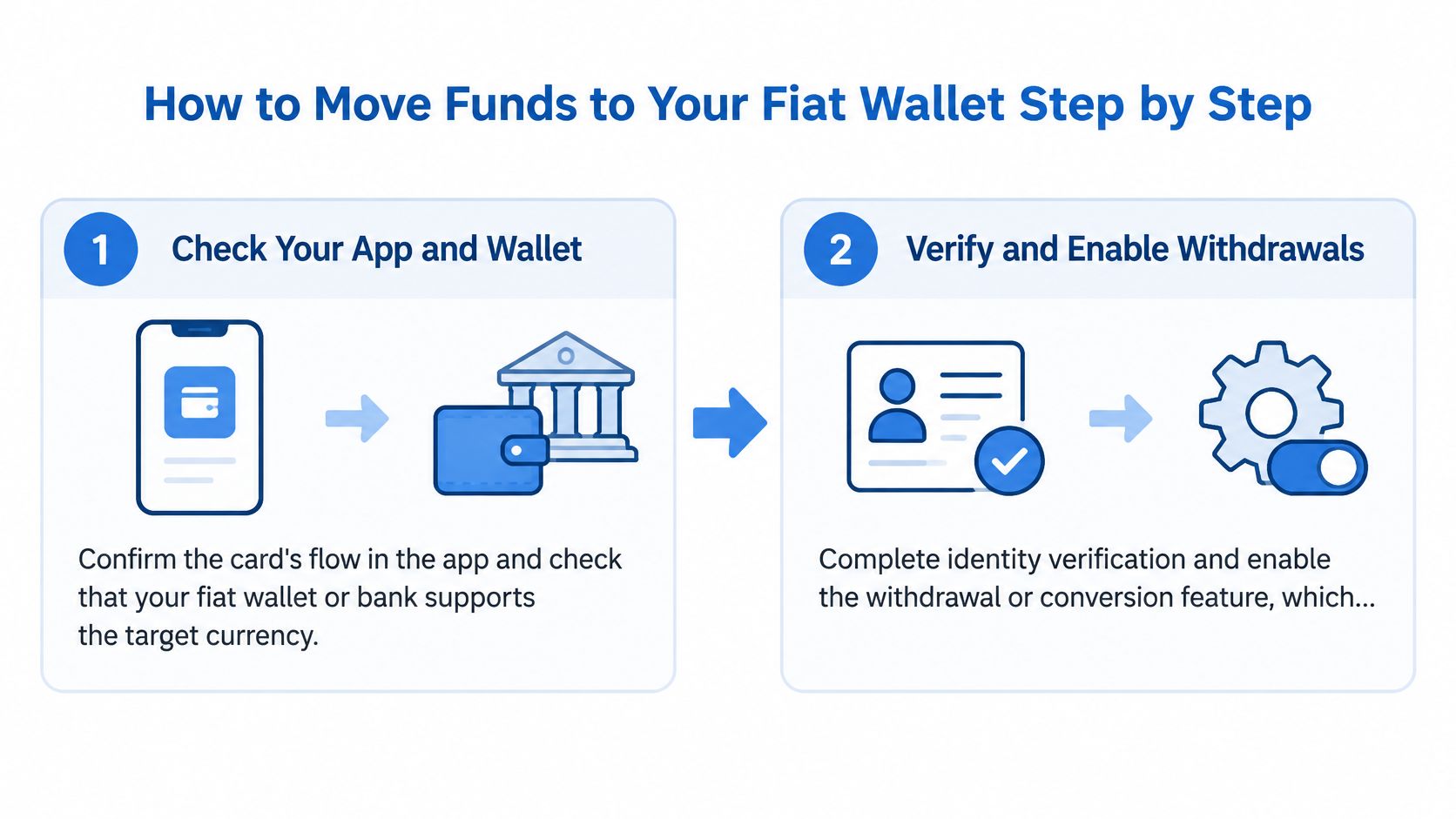
The infographic below shows the opening checks that prevent most failed transfers.
Prepare the Route
Confirm the flow and target currency. Check whether the app sells at authorization, requires a prefunded fiat balance, or supports a separate withdrawal. Then confirm your fiat wallet or bank accepts the exact currency, because an unwanted automatic conversion at the destination adds another spread.
Complete verification and enable withdrawals. Finish identity checks before you fund the card, not after you need the money. Withdrawal and conversion features often sit behind a separate approval, so open those settings and confirm they're active.
Match the asset and network. If you hold USDC, USDT, BTC, or ETH, check the receiving service supports both the asset and the selected chain. A stablecoin sent on the wrong network can become stuck or unrecoverable, even when the address format looks familiar.
Execute and Reconcile
Request a quote and note the lock duration. Screenshot the rate, fees, crypto amount, and expected fiat amount. If the quote expires, the provider can requote at a worse price, so don't approve a refreshed quote without reading it.
Convert or send, leaving a fee buffer. Don't move the full balance if the sending wallet pays its own network fee. Leaving a small reserve prevents a failed transaction and keeps funds available if a second confirmation or retry is needed.
Withdraw to the fiat wallet or bank. Use the account name and details exactly as registered. Card-side conversion at authorization is usually immediate, while a bank withdrawal can take longer, so judge progress against the provider's stated settlement window rather than the instant card notification.
Reconcile both sides. Compare the crypto debited, execution rate, itemized fees, and fiat received. Save the card authorization reference and blockchain transaction ID together. If those records don't tie to the same event, support will struggle to trace the transfer.
The walkthrough below is useful if you want to see the screens and confirmation points before you start.
A clean transfer has a simple paper trail. You can search the transaction ID on the network explorer, the destination wallet shows the expected fiat amount, and the difference between quote and receipt matches disclosed fees and spread.
If the withdrawal is still pending after the stated window, look up the transaction ID, confirm the chain matches the receiving wallet, and open one support request with the quote screenshot attached. Don't resend the funds while the first transaction remains unresolved.
What the Full Conversion Chain Really Costs
A near-zero blockchain fee says little about the total cost of cashing out. Crypto usually isn't converted inside Visa's network. The charge can instead pass through an on-chain transfer, a card provider's conversion, a fiat withdrawal, and the receiving bank, with fees or spread at several points.
The diagram below separates those layers for a $100 purchase converted to EUR.
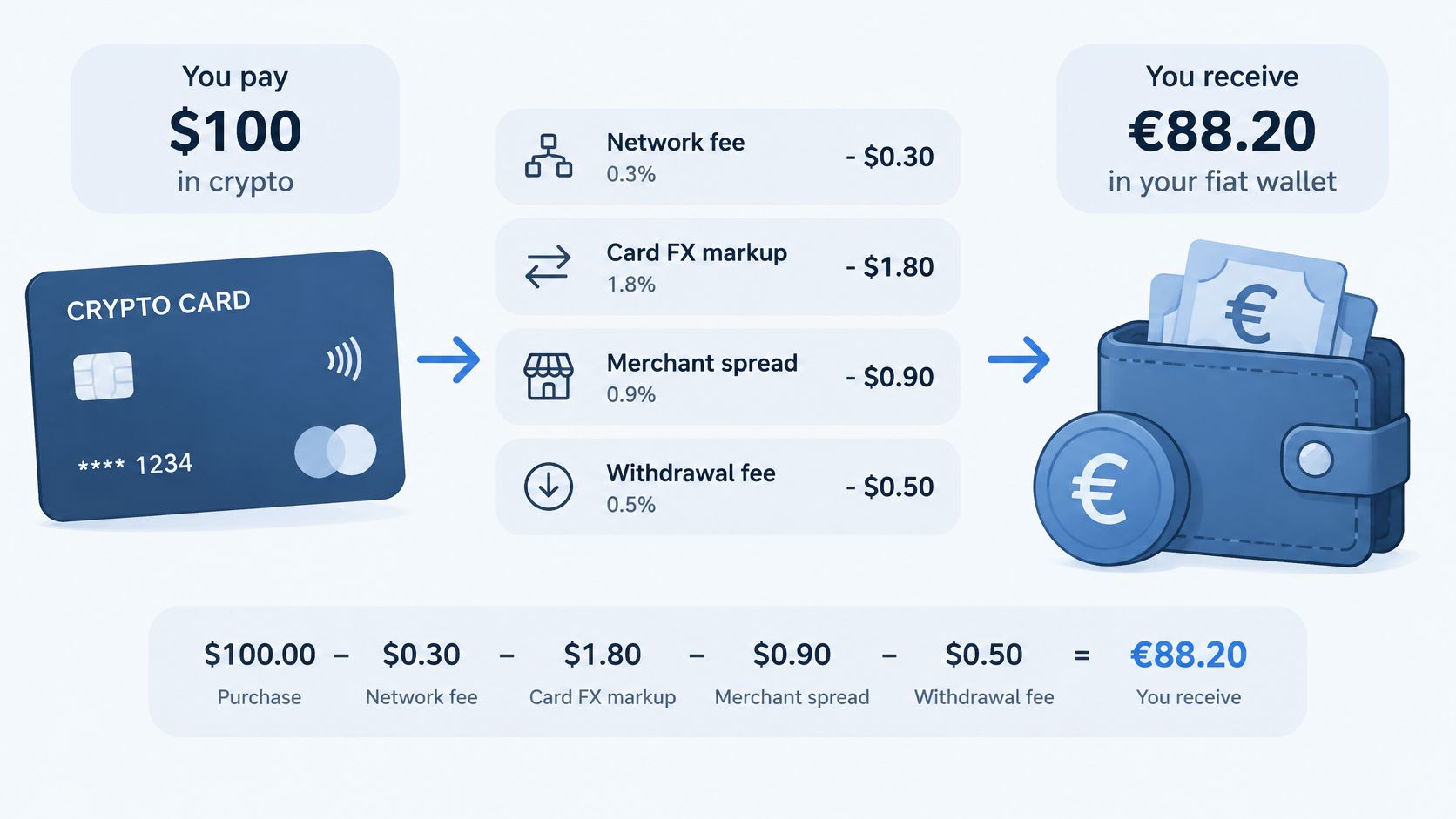
Cost layers on a $100 card purchase converted to EUR
| Cost Layer | Where Charged | What to Check |
|---|---|---|
| Blockchain network fee | When moving assets on-chain | Chain choice and current congestion |
| Card FX markup | Non-settlement currency spend | Read the card's FX terms before spending |
| Conversion spread | Quoted rate versus mid-market rate | Compare the quote with a live market rate |
| Off-ramp or withdrawal fee | Moving fiat to a bank or wallet | Flat fee plus any percentage charge |
| Receiving bank fee | Destination bank or payment provider | Fee schedule for incoming transfers |
| Effective fiat received | Net after all layers | Compare with the advertised rate |
Run the Numbers Yourself
Suppose a card applies a 2% FX markup to a $100 purchase. That adds $2 before any network, off-ramp, or receiving-bank charges. Your card may charge less; compare its quoted rate with the final credit to find the actual cost.
After a test transfer, convert the fiat received back into the purchase currency. Subtract that value from the $100 starting amount, then divide the difference by $100. The result is your effective cost, regardless of how the app labels individual charges.
Compare effective fiat received, not advertised network fees.
Authorization and settlement may show different figures. Crypto can be debited before the fiat wallet receives its final amount, which may reflect a later settlement rate. BTC or ETH routes can expose you to rate changes during that gap; stablecoin routes can still include spread, FX markup, or a redemption fee under the provider's regional terms.
Keep dated quotes, debits, and fiat receipts for troubleshooting and tax reporting. For help organizing tax records, see this practical guidance on cryptocurrency taxation.
NomadCard's editorial team verifies every published fee across 59 crypto cards against issuer documentation and shows the verification date on each figure. Its breakdown of hidden crypto card fees explains where charges can appear. Check the issuer's current terms before loading the card.
Declined, Delayed or Reversed Transfers and Who Pays
Failure states, who to contact and what comes back
| Failure State | Contact First | Asset Returned |
|---|---|---|
| Failed authorization | Card issuer | None, balance unchanged |
| Duplicate charge | Card issuer, then merchant | Reversal in the card's settlement currency |
| Partial refund | Merchant, then card issuer | Fiat or stablecoin under provider terms |
| Card cancellation | Card issuer | Remaining balance under the provider's terms |
| Provider insolvency | Provider, then the regulator | Claim outcome set by the custody model |
| Wallet freeze | Wallet provider compliance team | Held until the review clears |
These aren't rare edge cases. Visa's annual report message reports 1.9 million stablecoin-denominated cards generated $3.7 billion in payment volume across more than 200 countries and territories during the reported year. At that scale, refund handling and frozen balances deserve the same attention as cashback.
The hard part is responsibility. The wallet provider controls wallet screening, the card issuer controls authorization, the processor moves messages, the merchant acquirer serves the merchant, and the fiat wallet provider controls the destination account. Each party can truthfully say its own leg completed while your money still hasn't arrived.
Protect Your Position
A refund doesn't always come back in the asset you spent. It may arrive as fiat, stablecoins, or the card's settlement asset. If the provider converts again on the return leg, you can bear price movement and another spread even though the merchant refunded the full purchase amount.
Card-network dispute rights don't automatically unwind the crypto sale at your original rate. The underlying conversion may sit outside ordinary deposit or e-money protections. Keep transaction IDs, quote screenshots, authorization amounts, and dated support messages so you can prove what was promised at execution.
For a decline with no debit, start with the issuer and ask for the decline code. For a merchant refund, get the merchant's refund reference first, then give it to the issuer. Our guide to declined crypto cards and fixes helps you separate balance, risk, and merchant-category declines.
Crypto and the cards that use it carry risk, including loss of funds. NomadCard is not a bank, card issuer, or financial adviser, so disputes belong with the provider named in your card terms and, if needed, its regulator.
Pick Your Route Before You Load the Card
Choose from your actual use, not the card's headline reward. How often will you spend, which currency do you need, and must the money land in a bank account or can it stay in a fiat wallet? Your tolerance for identity checks narrows the field just as quickly.
Sell at authorization suits frequent small purchases when convenience matters more than locking a rate in advance. A prefunded fiat balance suits planned spending because you control the conversion moment. Bank withdrawal suits rent, payroll, and other payments that need account details, while self-custody spend suits holders who accept signing and confirmation delays to retain control on-chain.
Before loading, compare the KYC tier, transfer limit, FX markup, and withdrawal fee together. Our site lets you compare crypto debit cards on fees, KYC requirements, cashback, and supported coins, and you can filter cards by KYC level, network, per-transaction limit, coin, card type, and features.
Then run one small test transfer. Record the quote, crypto debited, fiat received, and both transaction IDs. I would scale up only when the effective fiat received matches the quote after every charge is included.
Compare Visa and other crypto cards by cash-out flow, KYC tier, supported coins, FX terms, and withdrawal fees before you load a balance. Visit NomadCards to shortlist cards that fit your currency and custody preferences, then run your first small test transfer with confidence.