Choosing a cryptocurrency credit card by its cashback rate is the wrong starting point. First, find out whether you're borrowing money or spending crypto you already own. Then examine the conversion rate, foreign-currency costs and transaction records, because an attractive reward won't necessarily cover what you pay to use the card.
Table of Contents
- What a Cryptocurrency Credit Card Actually Is
- Custodial or Non-Custodial, and Who Holds the Keys
- How a Crypto Card Payment Settles at Checkout
- Where Crypto Cards Work and Which Coins They Spend
- The Real Cost of Fees, FX and Conversion Spread
- Privacy, KYC and the Tax Records You Inherit
- Risks and Regulation to Check Before You Spend
- Three Illustrative Card Profiles
- Choose the Right Card and Confirm Its Terms
What a Cryptocurrency Credit Card Actually Is
A cryptocurrency credit card is usually a crypto-funded debit or prepaid product, despite the name people use when searching for one. A genuine credit card involves an issuer lending money that you repay later. Don't assume a crypto card offers that arrangement unless its agreement explicitly describes a credit line.
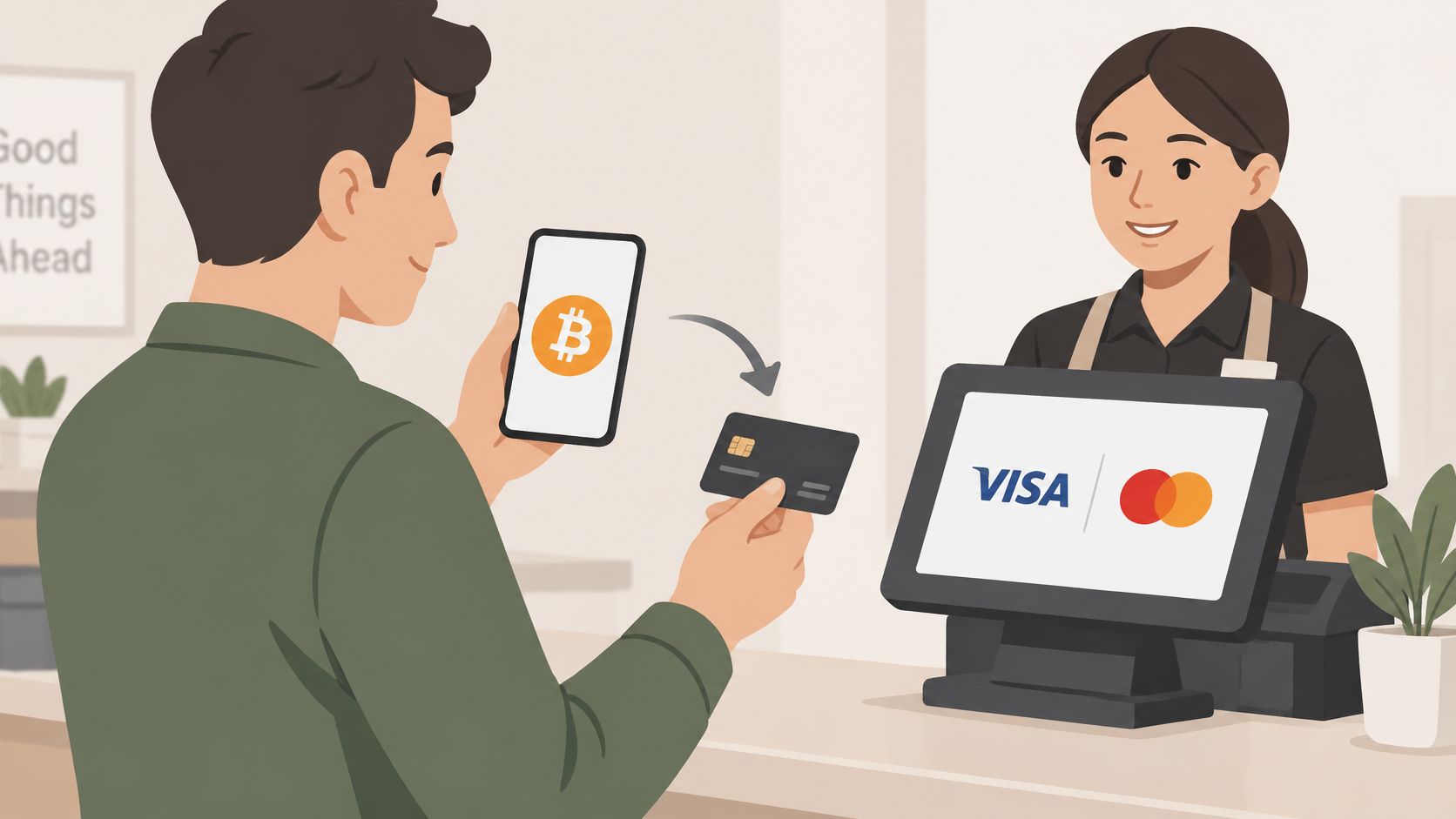
Say you hold Bitcoin and want to buy groceries at a checkout that accepts Visa or Mastercard. With a crypto-funded card, the program arranges the conversion needed to pay through the ordinary card system. The merchant typically receives conventional money, known as fiat currency, rather than Bitcoin.
Think of it as a travel card loaded with digital assets instead of your home currency. The shop uses its familiar terminal; the unfamiliar part sits behind your card balance.
Identify what you're actually spending
The useful distinction is the source of payment, not the artwork on the card.
- Crypto-funded debit: Purchases draw against assets you already hold.
- Prepaid: You load a spendable balance before making purchases.
- Credit: The issuer lends money under repayment terms.
- Secured credit: Collateral supports a borrowing arrangement, rather than serving as a spending balance.
For market context, Paymentscan figures cited by a16z and described in Lumx's regional stablecoin-card analysis put tracked monthly crypto-card volume at approximately $759 million in July 2026, versus $306 million in July 2025, an industry sample rather than a complete global count.
Payment volume, typical purchase size and funding assets help distinguish routine spending from promotional interest. They're more useful context than a reward rate without its eligibility rules.
Start with the contract: Write down the product type and funding asset before comparing rewards.
Also distinguish a card that spends cryptocurrency from a conventional card that merely pays rewards in cryptocurrency. Those arrangements can create very different payment and record-keeping obligations.
Custodial or Non-Custodial, and Who Holds the Keys
Who controls the private keys? That question tells you who can authorize movement of the underlying crypto and what recovery might look like if something goes wrong.
With a custodial card, an issuer or exchange controls the keys and debits your internal account. With a non-custodial card, you retain the keys, while wallet permissions or smart contracts enable spending. Stablewatch's crypto payment-card market review explains that this distinction changes the dominant risks, rather than removing them.
Custodial and non-custodial cards compared
| Factor | Custodial card | Non-custodial card |
|---|---|---|
| Who controls the private keys | Issuer or exchange | The user, through a wallet |
| Funding source | Pre-funded internal account | Wallet balance or on-chain contract permission |
| Main failure mode | Provider insolvency, breach or fraud-control failure | Key loss, wallet-signing error or smart-contract fault |
| Recovery if access is lost | Account recovery through the provider | Wallet backup or configured recovery method; often no provider reset |
| Disputes and reversals | Handled by the provider within card-network rules | Processor and provider terms govern card disputes; on-chain reversal isn't assured |
Custody can make ordinary account recovery easier. But a working password won't help if the provider freezes withdrawals, suffers a security incident or becomes insolvent. Your practical access relies on the business as well as its software.
Self-custody gives you greater direct control over your assets. It also makes backup quality and signing discipline part of your payment security. A support agent generally can't undo an incorrectly approved blockchain transaction just because you explain the mistake.
Check permissions, not just labels
Before connecting a wallet, inspect the spending allowance and the contract receiving permission. Check whether you can restrict access to a dedicated spending balance, revoke approval and understand who can upgrade the contract.
Gas requirements and transaction approval methods matter, too. A wallet can contain sufficient spending assets while still lacking what the program needs to execute an on-chain operation.
Non-custodial doesn't mean provider-independent. The card still needs operational payment infrastructure, and a card dispute doesn't automatically reverse its blockchain funding transaction.
Ask for clear answers to these questions: who holds the keys, whether a pre-funded custodial balance is necessary, and how a disputed payment is resolved across the card and blockchain layers. An unclear answer is a reason to delay funding.
How a Crypto Card Payment Settles at Checkout
A tap at the terminal starts a process, not an instantaneous final transfer. Lumx's explanation of stablecoin-card settlement separates ordinary card authorization and clearing from the crypto funding arrangements behind them.
This visual summarizes the checkout-facing part of that process.
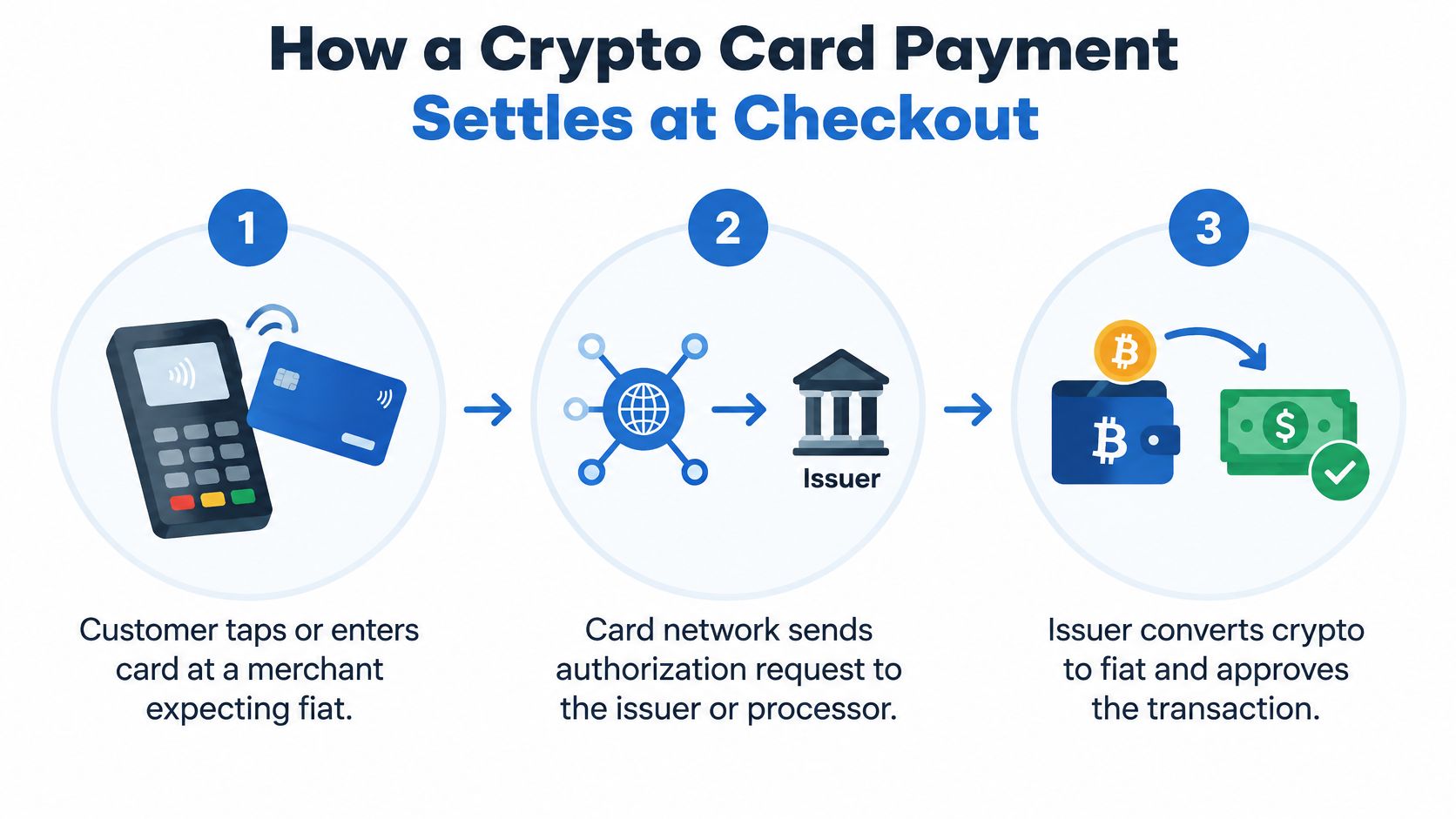
- You present the card. The merchant submits a purchase in its accepted fiat currency.
- The network requests authorization. The issuer or processor evaluates whether it can approve the payment.
- The program checks funding. It may quote a crypto-to-fiat rate, verify the available balance and lock the required assets.
- The merchant receives approval. Its payment proceeds through the conventional card system, with fiat rather than cryptocurrency reaching the merchant.
- Clearing establishes the final charge. The program reconciles the cleared purchase against the amount reserved.
- Settlement fulfills the payment obligation. Stablecoin funding can move outside banking hours, but network clearing, liquidity and issuer controls still matter.
Why a pending hold can look wrong
An authorization hold reserves spending capacity. It isn't necessarily the amount ultimately charged.
A program funding purchases with volatile assets may reserve a conversion buffer. The merchant's final submitted amount can also differ from its initial authorization, so the pending balance and receipt needn't match immediately.
Record the card's funding asset, quote-lock timing, settlement currency, hold policy and conversion point. Conversion at authorization creates a different rate exposure from conversion when the transaction clears. Don't assume that an app's preview rate is a guaranteed final quote.
For a complementary explanation of the payment process, watch this video.
When a hold exceeds your receipt, save the receipt and authorization details, then check whether the transaction is still pending. Compare it with the issuer's hold-release policy before treating the difference as a permanent fee. If a cleared charge remains incorrect, use the provider's dispute process and keep the transaction identifier.
Where Crypto Cards Work and Which Coins They Spend
A card-network logo describes the payment network, not a guarantee that every attempted purchase will succeed. It doesn't establish your eligibility, permitted destinations or supported merchant categories.
The distinction matters because direct crypto acceptance remains different from card acceptance. Penningtons Manches Cooper's discussion of Visa's global ecommerce report says only about 10% of surveyed merchants across 38 countries accepted cryptocurrency directly at checkout.
Match the asset to the job
USDC and USDT are dollar-pegged stablecoins designed to track the dollar. That makes their intended price behavior better suited to predictable spending than an asset whose market price can change substantially. Dollar-pegged doesn't mean guaranteed, and spending in another currency still introduces an exchange-rate question.
BTC and ETH are price-volatile assets. If a program allows them as funding sources, the amount needed for a purchase can change with the conversion quote, and the issuer may require extra available balance.
Also check the supported blockchain, not just the token name. A supported asset on an unsupported network isn't necessarily a usable deposit.
A decline may arise from regional restrictions, merchant-category controls, unavailable conversion liquidity, insufficient usable balance or a compliance hold. The terminal's error message might not identify which layer failed.
Test your actual merchant mix
Before relying on a card while traveling, work through practical checks:
- Ordinary checkout: Make a small purchase and inspect the cleared record.
- Offline terminals: Establish whether purchases require live authorization.
- Hotels and car rentals: Read deposit and preauthorization rules.
- Cash withdrawals: Check ATM support, limits and charges.
- Refunds: Confirm the currency or asset returned and how it appears in your history.
- Chargebacks: Read eligibility and evidence requirements rather than assuming every purchase is protected.
Our guide to where you can use a crypto card helps separate network reach from program restrictions.
Choose for the countries and merchants you use. A broad availability claim isn't a substitute for supported residency, permitted travel destinations, and workable deposit policies.
The Real Cost of Fees, FX and Conversion Spread
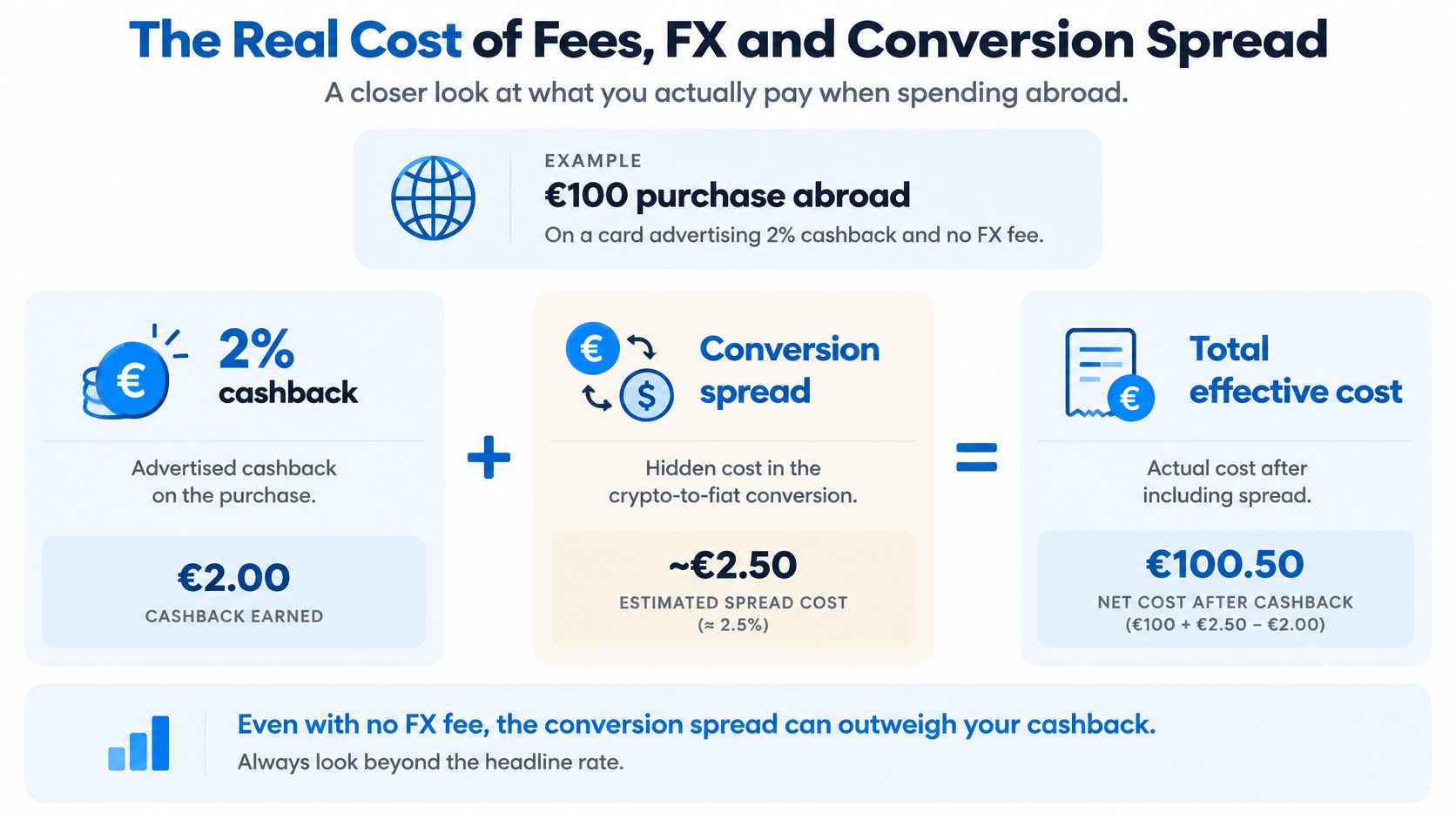
Suppose a card advertises cashback and no foreign-exchange fee. You buy something abroad, but the issuer converts your crypto at a less favorable rate than the comparable market quote. You can receive the promised reward and still finish worse off than with a conventional payment card.
The missing line is the conversion spread, the difference embedded in the exchange price. A zero-fee label doesn't establish that the conversion itself is free.
The illustration below shows why rewards and conversion costs need to be assessed together, rather than treated as separate decisions.
Cost lines to check on any crypto card
| Cost line | Where it appears | What to verify |
|---|---|---|
| Card or network fee | Per transaction or monthly | Whether advertised zero fees cover every transaction type you need |
| Conversion spread | Crypto-to-fiat rate at authorization or clearing | The applied quote against a comparable market rate at the same time |
| FX markup | Purchases in another currency | Whether it stacks on top of the network exchange rate |
| Annual or plan fee | Monthly or yearly | Whether eligible cashback offsets the fee at your spending level |
| Cashback or rewards | Credited after purchase | Payout asset, token-stake requirements and value at payout |
Compare the amount actually debited
Use the cleared transaction, not just the terminal receipt. Record the crypto quantity spent, its fiat equivalent, separately charged fees and the reward credited. Match the comparison exchange quote to the conversion time so you don't mistake market movement for a spread.
If the merchant offers to convert the purchase into your card's currency, inspect that offer separately. Otherwise, you may compare the issuer's terms while overlooking a conversion chosen at checkout.
Cashback also needs realistic valuation. A reward paid in a volatile token can lose or gain value before you use it, and spending exclusions or reward caps can make the advertised rate an unreliable estimate of your return.
Practical rule: Compare costs and rewards in the same currency, over the same spending period.
Use this formula:
Effective cost rate = (fees + conversion spread cost + FX markup − cashback value) ÷ purchase spending
Allocate recurring plan fees to the period being compared, and avoid counting a spread twice if it's already included in your measured conversion cost. Our guide to crypto-card hidden fees provides additional context for checking the less visible charges.
Run the calculation across a shortlist using your own spending pattern. A grocery-focused card and a travel card may produce different results even when their advertised rewards look similar.
Privacy, KYC and the Tax Records You Inherit
No-KYC doesn't mean no records. A program might request less identity information at enrollment while still generating card-payment records, account activity and blockchain transactions. Privacy is a question of what each participant collects and can connect, not whether you uploaded a passport.
Verification labels also need careful interpretation. Email-only registration isn't equivalent to full identity verification, but neither label tells you everything about later checks, funding requirements or account restrictions.
Read verification requirements literally
- No KYC: Check what information is collected at enrollment and what could trigger verification later.
- Email only: Establish whether email registration is sufficient for both funding and continued spending.
- Full KYC: Expect identity verification, and read the document, residency and source-of-funds requirements before transferring assets.
Don't infer limits or country coverage from the label alone. Read the actual restrictions attached to the program and account tier.
The broader regulatory direction also matters. The Signal's guide to using a crypto wallet like a bank notes that MiCA is fully applicable in the EU, while the OECD Crypto-Asset Reporting Framework is designed to increase cross-border reporting and identity transparency. These aren't interchangeable frameworks, and neither makes a no-KYC marketing claim a promise of anonymity.
Test whether you can reconstruct a disposal
Spending crypto may constitute a disposal that creates a capital gain or loss under your jurisdiction's rules. Your cost basis, meaning the acquisition value used for tax calculations, can therefore matter as much as the purchase price.
A card export should let you identify:
- Asset movement: The token, quantity, transaction status and relevant identifiers.
- Purchase value: Fiat value, currency, timestamp and fees.
- Acquisition history: Information needed to connect the spent assets to their cost basis.
- Adjustments: Refunds, reversed charges and rewards as distinguishable entries.
Stablecoin spending doesn't automatically remove record-keeping obligations. Nor does a card statement necessarily contain acquisition information from an external wallet or exchange.
Use our guide to tax on crypto-card spending to frame the questions that apply to your payment arrangement. If you need help reconciling wallet and card activity, you can find crypto accounting support through Nanak Accountants and Associates.
A low-fee card with unusable exports can cost more in accounting work than a higher-fee card with clean records.
Download a sample export before committing regular spending to the account.
Risks and Regulation to Check Before You Spend
Crypto and the cards that use it carry risk, including loss of funds. Decide how much operational dependence you're comfortable placing on a payment program before treating it as your main spending account.
A custodial provider can suffer insolvency or a breach. A self-custodial arrangement can fail through lost keys, unsafe approvals or faulty contracts. Volatile funding can create a shortfall before a transaction completes, and ordinary card fraud remains possible regardless of how the purchase is funded.
Verify the entities behind the card
The app brand, crypto service provider and card issuer may perform different roles. An authorization relevant to a crypto service doesn't, by itself, explain the protections attached to your card balance.
Use this checklist before funding:
- Read the risk disclosure: Identify what happens to customer assets if the provider fails.
- Identify the issuing entity: Record the legal name in the cardholder agreement, not just the app's trading name.
- Check authorization: Verify the relevant status through the appropriate official register for your country.
- Confirm availability: Check supported residency and any restrictions on use abroad.
- Plan an exit: Understand withdrawal, account-closure and remaining-balance procedures.
- Keep independent records: Save funding transfers, purchase histories and the terms you accepted.
Programs can also close or withdraw from a region. Keep an alternative payment method available and avoid leaving money in the account solely because moving it feels inconvenient.
Know what protection you're relying on
Look for explicit terms about safeguarding, insurance, deposit protection and dispute rights. Don't assume that familiar banking protections apply to every balance shown in a crypto app.
Our content on NomadCard is general information only, not financial, investment, tax or legal advice, and isn't a recommendation to buy any product. Confirm your specific obligations and protections with a qualified professional where necessary.
Three Illustrative Card Profiles
These are hypothetical decision profiles, not endorsements or claims about particular issuers.
A stablecoin card for household spending
A custodial USDC debit-style card could suit someone budgeting for groceries and transport in their home country. The important checks are its funding conversion, recurring charges and whether transaction exports show usable fiat values.
Confirm the debit arrangement, make a small home-currency purchase and inspect the cleared entry before moving routine expenses onto it.
A wallet-linked card for DeFi users
A non-custodial card may suit someone who already manages wallet permissions confidently. Before approving access, inspect the allowance, gas requirements, contract upgrade authority and available revocation method.
Use a dedicated spending wallet if the design permits it. Keep your recovery material secure and understand how support handles a failed funding operation alongside a pending card payment.
A verified card for travel
A full-KYC travel profile should be evaluated around destinations, foreign-currency pricing, cash access and deposit handling. Identity verification alone doesn't establish better limits or broader coverage.
Compare its realistic monthly cost with a conventional travel card, including ATM use and recurring fees. Then inspect the export: a card that works well overseas but leaves you unable to reconcile transactions may be a poor fit for frequent spending.
Choose the Right Card and Confirm Its Terms
The right card is the one whose operating model matches your needs, not the one with the most eye-catching reward. Start by identifying your priority, then reject products that fail a requirement you can't compromise on.
Match your priority to the right criteria
| Your priority | Look for | Avoid or check |
|---|---|---|
| Everyday stablecoin spending | Dollar-pegged funding and a low conversion spread | Volatile-only funding for daily purchases |
| Frequent travel abroad | Low FX markup and acceptance in your regions | Unknown regional availability |
| Privacy | No-KYC or email-only options | Assuming no-KYC means no reporting or records |
| Self-custody and DeFi | Non-custodial model with clear key recovery | Treating non-custodial as risk-free |
| Tax-heavy use | Downloadable history with fiat values at purchase | Cards with no exportable records |
Make decisions in a deliberate order: product type, custody model, total fees, verification requirements, export quality and practical acceptance. This prevents an attractive feature from distracting you from a disqualifying condition.
For example, rewards can't compensate for ineligibility in your country. A self-custody label isn't enough if you don't understand its permissions. A low recurring fee won't solve an export that your accounting workflow can't use.
Use comparisons as a shortlist, not a contract
At NomadCards, we're an independent comparison site, not a bank or card issuer. Our finder lets you compare crypto debit cards on fees, KYC requirements, cashback and supported coins, with filters for KYC level, network, per-transaction limit, coin, card type and features.
The platform brings those criteria together for side-by-side evaluation.
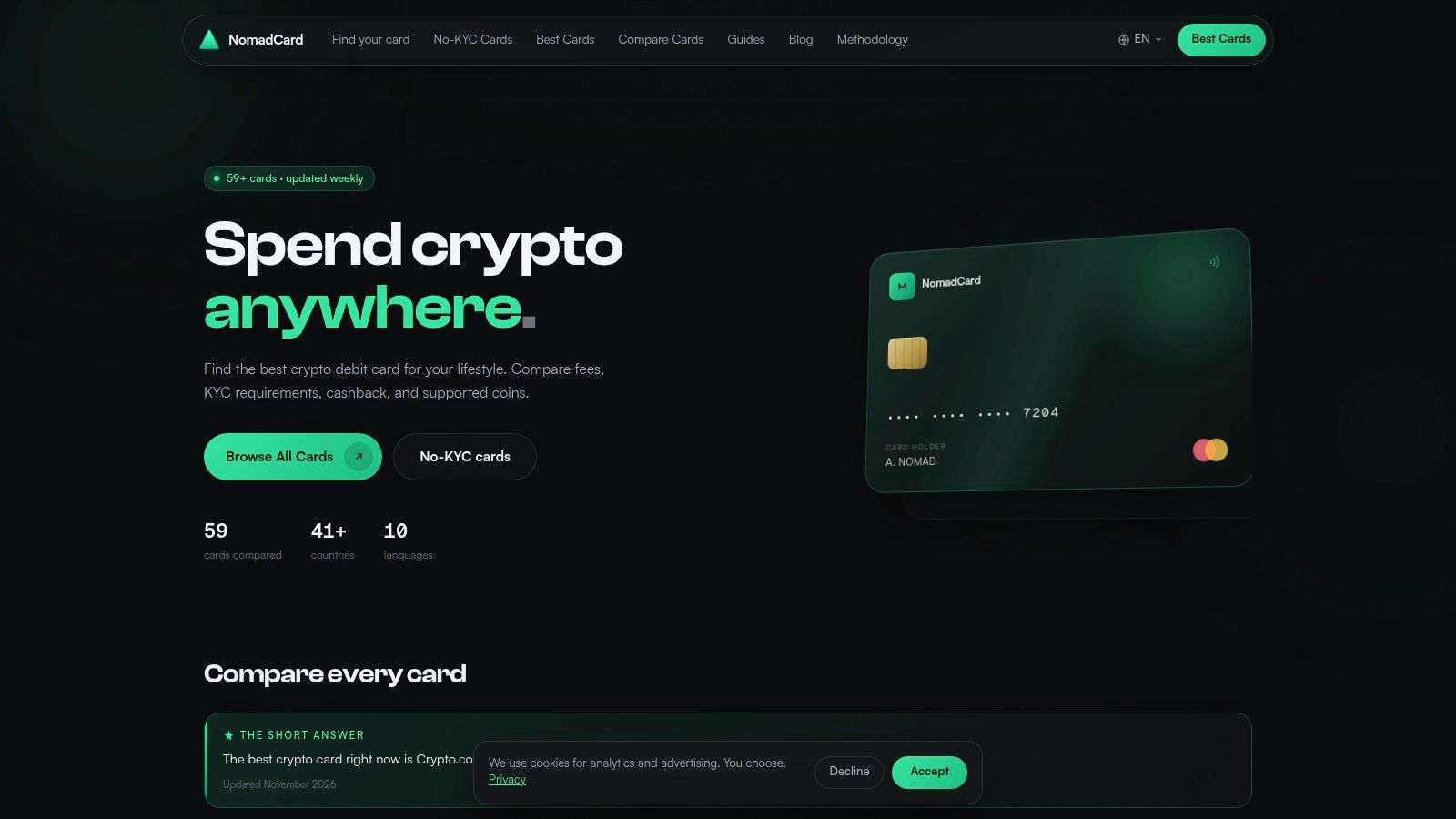
Our NomadCrypto editorial team verifies every published fee across 59 crypto cards against issuer documentation and shows the verification date on every figure. That date helps you judge how recently a term was checked; the issuer's current agreement still needs to match what you expect before applying.
We earn affiliate commissions on some cards, and these are always disclosed. A comparison is a research aid, not a guarantee of approval, ongoing availability or suitability.
Keep your shortlist focused on your top priority. Save the current fee schedule and cardholder agreement, and resolve unclear terms before moving funds.
Visit NomadCards to compare crypto-linked cards by funding asset, fees, verification requirements and card type. Shortlist three that match your main use case, then verify every fee against the issuer's current terms before applying.