The most popular advice about a cryptocurrency rewards card is often the least useful: choose the card with the biggest cashback percentage. That figure tells you what a program advertises, not what you'll keep after fees, eligibility rules, reward limits, and the cost of accessing your funds.
A practical comparison starts with your spending habits and asks what remains after every applicable charge. The table below outlines the trade-offs to investigate before treating any reward rate as real value.
| Card priority | What to compare first | Main trade-off |
|---|---|---|
| Lower total cost | Conversion route, fees, and any recurring charge | A modest reward may be easier to retain |
| Bigger advertised reward | Tier rules, token conditions, and spending caps | The highest rate may require money or activity you wouldn't otherwise commit |
| Travel spending | Foreign-exchange costs, regional access, and merchant acceptance | A card that works at home may cost more or be unavailable abroad |
| Privacy | Verification requirements and issuer terms | Fewer verification steps may come with different limits or restrictions |
| Self-custody | Wallet control, supported assets, and spending flow | Greater control can bring more responsibility for security and transfers |
Table of Contents
- Why Headline Cashback Is Not the Real Reward
- How Cryptocurrency Rewards Cards Work
- Comparing the Main Cryptocurrency Card Models
- Cashback Fees Assets and Redemption Compared
- Choosing a Card for Real Spending Scenarios
- Calculate Effective Rewards Before You Apply
- Best Cryptocurrency Rewards Card for Your Priority
Why Headline Cashback Is Not the Real Reward
A high advertised rate doesn't automatically make a cryptocurrency rewards card the better choice. The useful question is how much value you retain after conversion costs, foreign-exchange charges, annual or subscription fees, spending caps, redemption conditions, and any token or staking requirement. Those terms can turn an eye-catching offer into a poor fit for an otherwise ordinary spending pattern.
Separate the reward into three stages. Earned is what the card calculates from an eligible purchase. Available is what you can access after applying the program's rules. Retained is what remains after costs and any loss in value before you use or convert the reward. Comparing only the first stage can hide the difference between advertised cashback and net value.
Practical rule: Treat every reward rate as conditional until you've checked the fees, eligibility, and redemption terms that apply to your own transactions.
Conversion deserves particular scrutiny. Slash's explanation of crypto-card mechanics notes that conversion fees commonly fall around 0.5%–2%, with additional foreign-exchange or embedded spread costs possible. A card's displayed reward rate therefore can't be evaluated in isolation, especially if purchases require converting a digital asset to settle.
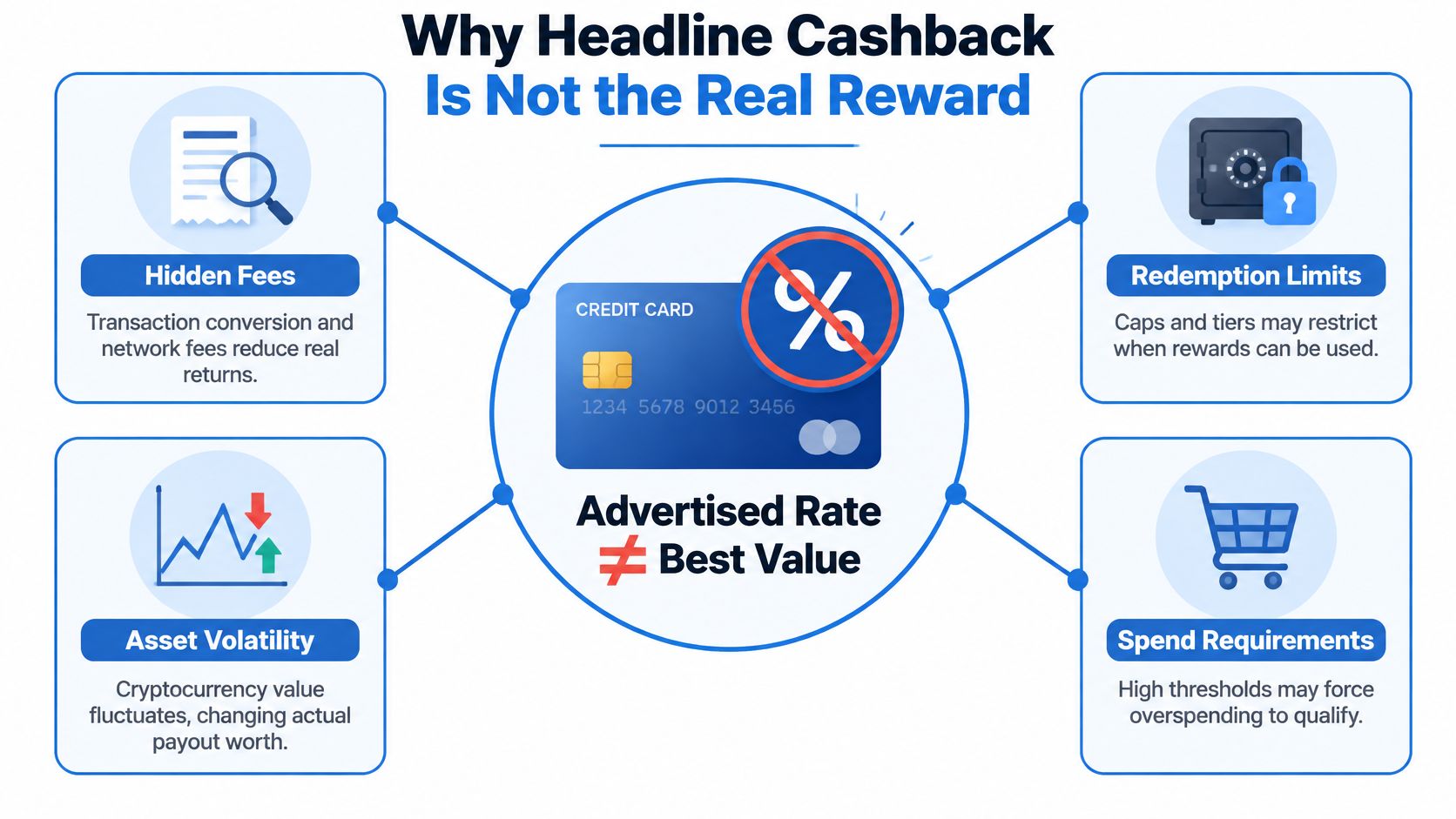
Programs also differ in how they deliver rewards. Some credit cryptocurrency directly; others let customers convert cash rewards later, or offer rewards only under a paid tier or token-holding condition. Meanwhile, an exchange-linked card, a wallet-connected card, and an on-chain implementation can differ in who holds the funds and what the user must do to access them.
The comparison standard should be consistent: estimate net rewards using the same spending behavior, then check whether the card's operating model and access rules suit you. A card with a lower nominal rate may be more useful if its costs and conditions fit your real transactions better. A bigger offer can still win, but only if its requirements don't consume the advantage.
How Cryptocurrency Rewards Cards Work
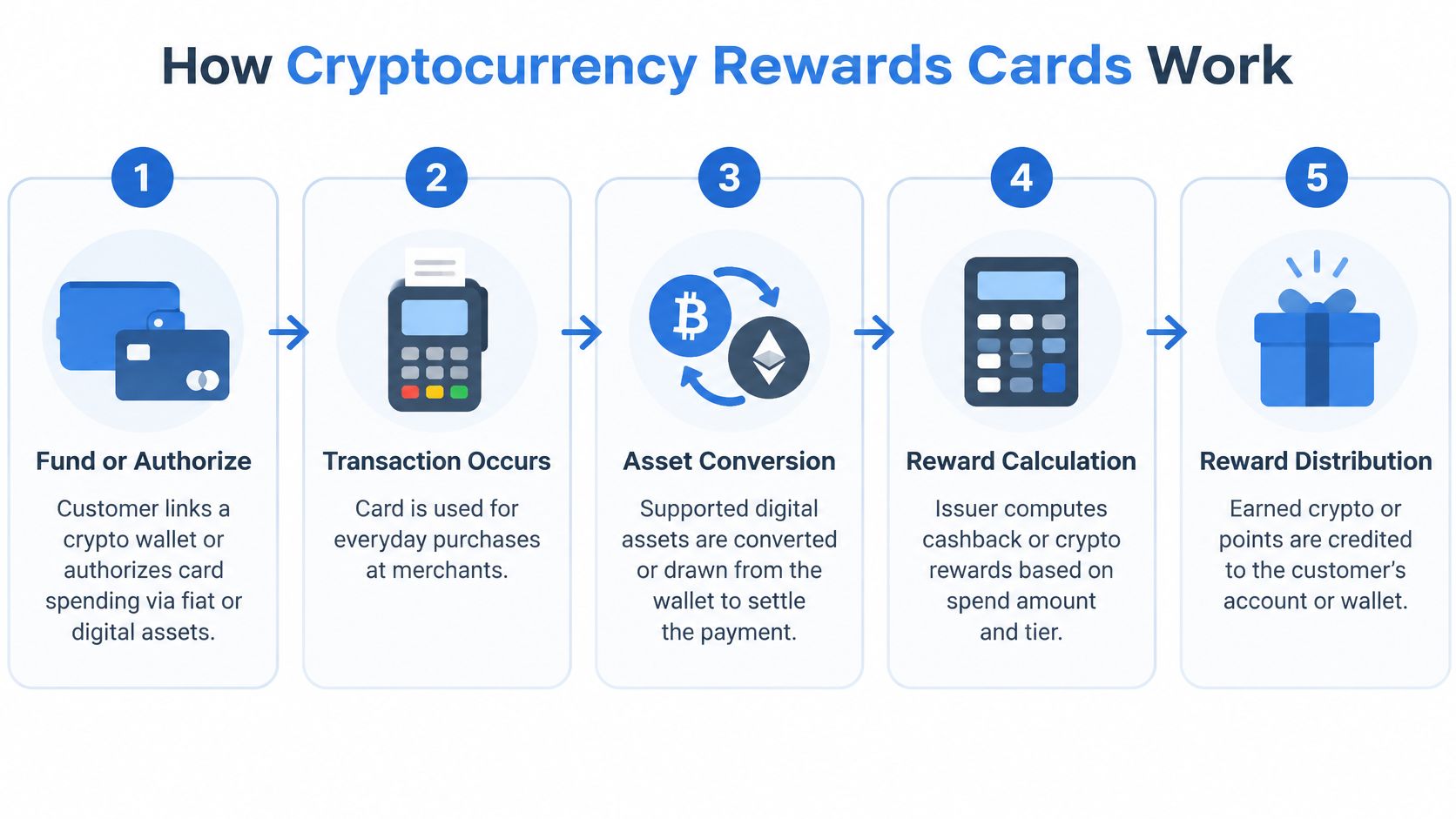
The card network and the cryptocurrency arrangement perform different jobs. A merchant can accept a card payment through familiar payment rails even if it doesn't accept cryptocurrency directly. The card program handles the relationship between the customer's funding source, the transaction, any conversion needed for settlement, and the reward credited afterward.
Follow the money through a purchase
Start by identifying how the card is funded or authorized. A debit or prepaid product may draw on a balance the customer has already loaded or holds with a provider. A credit card instead uses a credit line, while a secured card may link access to funds held as security. The product label alone doesn't tell you which assets are supported, whether they're converted at purchase, or what fees apply.
When a customer pays, the merchant sees a card transaction rather than a direct wallet-to-merchant crypto payment. Depending on the program, the provider may convert a supported digital asset, draw from a fiat balance, or use a linked account to settle the transaction. Check who controls the funds at that moment and which conversion route the card uses.
Trace the reward to a usable balance
After the transaction is processed, the issuer or program calculates any eligible reward. That calculation may depend on the purchase category, card tier, merchant, or other program rules. The resulting reward might arrive as cryptocurrency, points, or cash that can later be converted, and the program may limit where or how it can be redeemed.
This means a user should follow the complete path, not just the checkout. Ask whether rewards can be withdrawn to a wallet, sold, used for spending, or kept only within the provider's app. If rewards arrive in a volatile asset, the value you can eventually use may differ from its value when credited.
Watch the video below for a visual overview of the card process.
A simple purchase makes the distinction clear. A customer pays with a card linked to a crypto account, the program authorizes the transaction, and the provider uses its stated funding and settlement route. The reward is then calculated under the card's terms and credited to the destination the program supports. At each step, the user should be able to identify who holds the asset, when any conversion occurs, and what restrictions apply.
“Debit,” “credit,” “prepaid,” “secured,” “custodial,” and “self-custodial” describe different aspects of a product. They aren't interchangeable labels: one describes how spending is funded or borrowed, while another describes control of the underlying assets. Read both dimensions in the issuer's terms before deciding what you're applying for.
Comparing the Main Cryptocurrency Card Models
Two cards can share a payment network and advertise similar rewards while giving users very different control over their funds. Compare the funding arrangement, custody, eligibility, and access to rewards, rather than assuming a familiar card label guarantees a familiar experience.
Custodial and exchange-linked products
An exchange-linked card places the account relationship with a provider that holds or manages the balance. This can make funding and reward crediting feel straightforward, but the user relies on the provider's account access, asset support, and operating rules. Verify whether a reward stays on the platform or can be transferred elsewhere, and whether the program requires a particular balance or tier.
Custodial doesn't automatically mean credit, just as debit doesn't automatically mean self-custody. A card can draw on an account balance while the provider manages that balance, or it can offer credit under separate terms. Check the funding method and custody arrangement independently.
Wallet-connected and on-chain designs
A self-custodial card can connect spending to a wallet the user controls, or use an on-chain mechanism to authorize or route transactions. That structure may appeal to users who don't want to hold assets on an exchange, but it shifts more responsibility to the wallet owner. Supported networks, asset compatibility, wallet security, and the spending authorization process all matter.
A guide to custodial and self-custody crypto cards can help clarify the difference in control. Still, don't infer a product's exact mechanics from a general model. Review its own terms for how it handles transaction approval, settlement, fees, and reward distribution.
Funding method is a separate decision
| Model dimension | What it tells you | What to verify |
|---|---|---|
| Debit or prepaid | Spending generally draws on funds already available to the user | Where the balance sits and how it's replenished |
| Credit or secured | Purchases involve a credit arrangement or funds held as security | Eligibility, repayment, and account conditions |
| Custodial | A provider manages the relevant balance or account | Withdrawal access, supported assets, and account restrictions |
| Self-custodial | The user retains control of the wallet or assets until spending | Network support, authorization steps, and security duties |
| On-chain or wallet-connected | A blockchain or wallet forms part of the spending route | Conversion method, transaction handling, and available merchants or regions |
Convenience and control aren't the same thing. A user who wants a familiar account flow may accept reliance on an exchange or issuer, while a wallet user may prefer direct control even if the setup and security work require more attention. The fit depends on the user's priorities and the exact implementation, not the label on the card.
Cashback Fees Assets and Redemption Compared
A meaningful comparison needs to preserve the differences between programs while putting them against the same criteria. A flat reward, a capped offer, and a tiered promotion don't have equivalent value if one applies automatically and another depends on a paid subscription, token balance, or staking commitment.
| Comparison criterion | What to verify | Lowest-cost fit | Highest-reward fit | Privacy-focused fit | Self-custody fit |
|---|---|---|---|---|---|
| Reward structure | Flat or tiered, capped or uncapped, eligible categories | Simple terms with no paid tier | Higher rate only if conditions fit existing behavior | Check whether verification affects reward eligibility | Confirm where rewards are credited |
| Total cost | Conversion, FX, annual, subscription, and other charges | Low recurring and transaction costs | Compare the larger reward against every charge | Check what account features are restricted | Include wallet or network-related costs shown in terms |
| Asset support | Which coins or stablecoins can fund spending and receive rewards | A supported asset you already use | Required reward token and any holding conditions | Determine whether asset choices affect access | Confirm wallet and network compatibility |
| Verification | Identity checks and account requirements | Apply only if the requirements are acceptable | Confirm tier eligibility before relying on the rate | Read the issuer's exact verification policy | Check whether wallet connection still requires account verification |
| Redemption | Withdrawal, conversion, spending, and expiry rules | Rewards that can be used without extra steps | Make sure the larger reward is actually accessible | Consider how the provider manages account access | Verify transfer and wallet-control options |
| Network and access | Visa or Mastercard, country availability, virtual or physical card | Choose an available format and network | Confirm the offer works in your region | Don't equate reduced verification with unrestricted access | Check supported regions and transaction routes |
The reward rate must be read beside its qualifying conditions. Mainstream cashback is described in market coverage as around 2%–5%, while double-digit offers generally require staking, paid tiers, or substantial balances. These ranges aren't a promise about any particular card; they're a reason to inspect what sits behind the headline. A higher offer may be worthwhile if the user already meets the conditions, but less attractive if they must pay for access or acquire a token they don't otherwise want.
Caps change the result, too. An uncapped reward can keep applying across eligible spend, while a capped offer may stop earning at a threshold or apply different terms above it. A tier can also create a break-even question: does the added reward from expected spending outweigh the subscription, required balance, or other costs? Calculate that using realistic spending, not a best-case month.
Compare what you can use, not just what the app displays. A reward locked behind conversion, withdrawal, or tier rules may be less accessible than its balance suggests.
Asset support and network acceptance are separate checks. A card may support a particular asset for funding but pay rewards in another form, and network branding doesn't establish that the card is available in every country or works with every merchant. Verify whether the product is debit, credit, prepaid, or secured, and check its country coverage, KYC requirements, virtual or physical availability, mobile-wallet compatibility, and any IBAN feature directly in current issuer terms.
For a more detailed comparison of charges, review this crypto-card fee comparison. Treat any comparison as a shortlist, then confirm each issuer's current fee schedule and redemption rules before applying.
Choosing a Card for Real Spending Scenarios
A card's value changes with the transaction mix. These short scenarios show why the same headline reward can lead to different decisions.
Domestic everyday spending
A user who spends mostly with local merchants should first check whether the card converts assets on every purchase or draws on an existing balance. If conversion applies, include its cost in the calculation; then check whether the reward is limited to eligible categories or requires a particular tier. A lower headline rate can be preferable if the user can earn and access it without conditions that don't match their routine.
International travel
A traveler should test the card against both the destination and the currency of purchases. Foreign-exchange markups, issuer settlement routes, regional restrictions, and local merchant acceptance can all change the economics. Check where a crypto card can be used, then confirm coverage and foreign transaction terms with the issuer. Don't assume a card that works for a domestic purchase will behave the same way abroad.
Low-volume use
Someone who uses the card occasionally should compare the value of expected rewards with recurring charges. An annual or subscription fee continues to matter even when spending is low, while a paid tier may offer little practical value if the user's normal purchases don't qualify or won't reach the relevant threshold. In this case, avoiding a fee can matter more than maximizing a nominal rate.
Privacy-sensitive spending
A label such as “No KYC” or “Email only” isn't a complete account of a card's requirements. Read the issuer's terms to understand what verification is needed, where the card is available, what limits apply, and what recourse the user has if access is interrupted. Less verification may suit someone's preference, but that choice should be weighed against the provider's trust and regulatory context.
DeFi and self-custody spending
A wallet-focused user should confirm that the card supports the assets and networks they hold, and understand how a purchase moves funds. Self-custody can reduce reliance on a custodial account, but it makes wallet security and transaction handling part of the user's responsibility. If the product relies on a conversion path or an on-chain mechanism, check what happens when the supported asset, network, or route isn't available.
The best card changes with the use case. Choose the one that fits the spending, access, and custody requirements you can verify, not the biggest number in an advertisement.
Calculate Effective Rewards Before You Apply
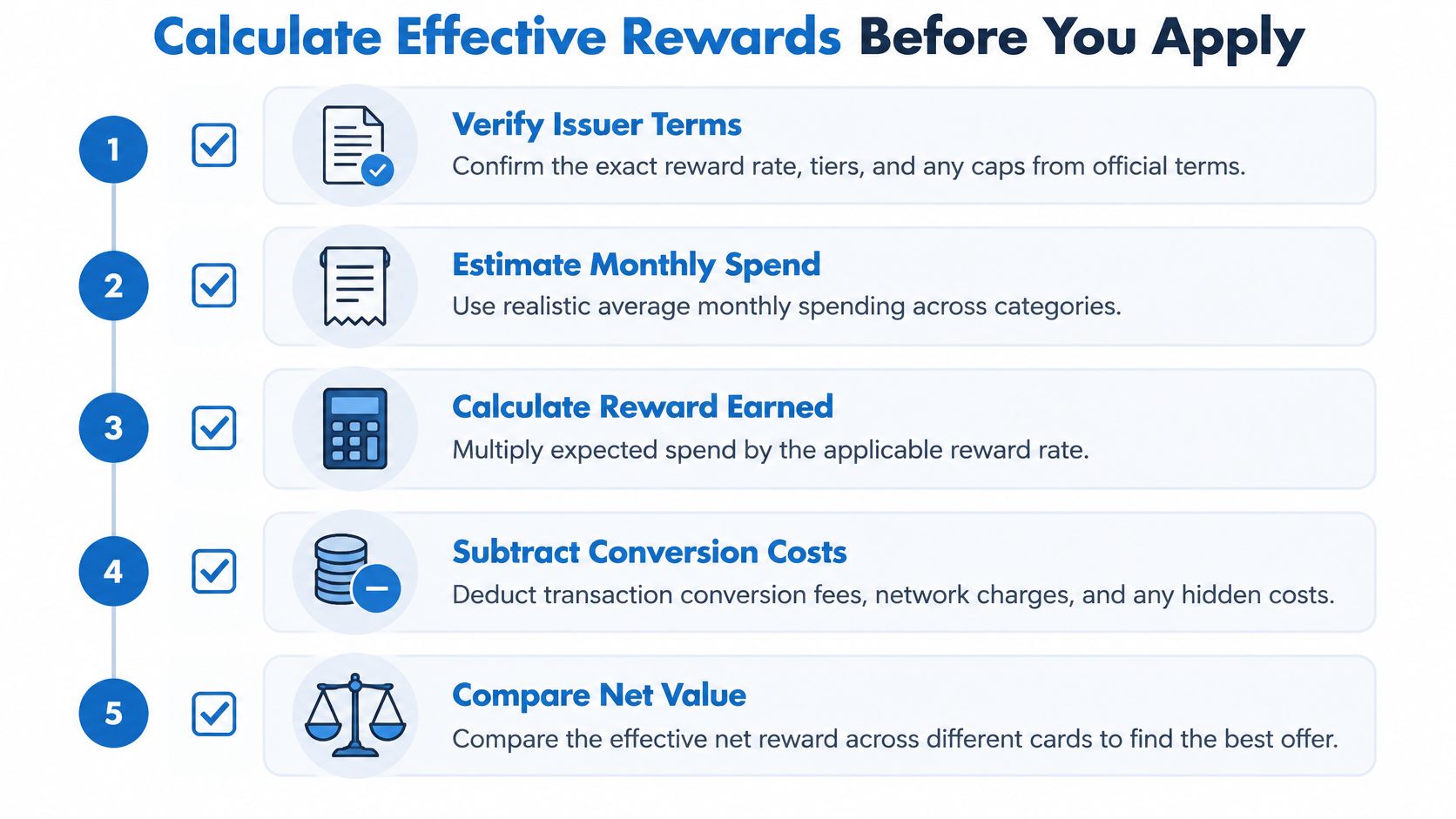
Build the comparison from issuer terms and your own expected spending. Don't start with a ranking or a promotional rate, because neither tells you whether you qualify, whether your purchases earn rewards, or what the program deducts before you can use them.
Use a repeatable calculation
- Verify the offer. Find the issuer's current terms and confirm the reward rate, qualifying categories, tiers, caps, and redemption rules.
- Estimate ordinary spending. Use a realistic month and separate domestic purchases from cross-border spending if their costs differ.
- Calculate eligible rewards. Apply the relevant rate only to purchases that qualify. If the program changes rates by tier or category, calculate each portion under the matching rule.
- Subtract costs. Include conversion charges, FX markups, annual fees, subscription costs, and other applicable transaction charges.
- Compare what remains. Repeat the calculation for each card and for the spending situations that matter to you.
Keep token requirements outside the ordinary fee total. A required token balance or stake can tie up assets and expose the user to price risk, so it has an opportunity cost even when the issuer doesn't call it a fee. Only count a higher tier as worthwhile if the additional reward justifies the commitment under assumptions you're comfortable with.
Next, test the break-even point for each tier or cap. Work out how much eligible spending is needed for the added reward to cover any additional subscription or annual charge, then consider whether your normal spending reaches that level. Repeat the test for local purchases, international transactions, and low-volume use rather than assuming one scenario represents them all.
If you're evaluating a staking requirement, a resource that helps you browse staking yield prediction figures can provide context for thinking about the commitment. It shouldn't replace your own assessment of token price risk or the card's issuer terms.
Before applying, confirm supported assets, country eligibility, verification requirements, reward caps, and how rewards can be redeemed or withdrawn. Those checks turn a nominal ranking into a personal break-even comparison.
Best Cryptocurrency Rewards Card for Your Priority
There isn't a universal winner. The right choice depends on which compromises you're willing to accept and whether the card's real operating rules match your spending.
For low total cost, prioritize transparent conversion terms and minimal recurring charges, even if the advertised rate is more modest. For everyday rewards, look for a straightforward structure that applies to your actual purchases and doesn't require a tier you'd otherwise avoid. For travel, verify destination availability and foreign-exchange treatment before weighing cashback.
A privacy-focused user should compare the issuer's exact verification requirements with the account limits and regional access that come with them. A self-custody user should prioritize supported assets, wallet control, and a clear spending route, while accepting responsibility for wallet security. Someone seeking credit access should focus on whether the card is a credit product and review its eligibility and repayment terms rather than assuming every crypto-linked card extends credit.
If you need a specific asset, start with compatibility and redemption. A generous reward in a token you can't use as intended may be less valuable than a simpler reward you can access. Similarly, a card's network, virtual or physical availability, and country coverage can determine whether its rewards are practical at all.
Use this decision checklist before you apply:
- Net value: What remains after applicable fees and conversion costs?
- Access: Can you use the card and redeem its rewards where you live and spend?
- Conditions: Do caps, paid tiers, staking, or token balances change the offer?
- Control: Who holds your funds, and what security responsibilities do you accept?
- Fit: Does the card support your actual spending and preferred assets?
The best cryptocurrency rewards card is the one whose net value, access requirements, and operating model fit your real spending. NomadCards offers a comparison finder and standardized card profiles covering factors such as fees, rewards, custody, verification, supported assets, and regional availability. Visit NomadCards to compare options, then verify the current terms with the issuer before applying.