Choosing the crypto card with the highest cashback is a poor starting point. A generous reward can leave you worse off once the issuer's conversion spread, foreign-exchange markup and reward restrictions are deducted. The better question is how much spending value you retain, and what you can recover if something fails.
A debit card for crypto connects digital assets to ordinary card payments. But cards with similar branding can give you very different pricing, wallet control and dispute rights. Compare the funding model first, calculate the net return second, and treat protection for the purchase separately from protection for the crypto balance.
Table of Contents
- What a Crypto Debit Card Is and the Three Models
- Real Cost of Each Card After Fees, Spreads and Cashback
- What Happens Between Your Tap and the Merchant Payout
- Verification Tiers, Custody and Who Covers a Failed Payment
- Supported Assets, Networks and Where Cards Actually Work
- Choosing a Card by Your Situation
- Verify Terms on the Issuer Site Before You Apply
What a Crypto Debit Card Is and the Three Models
Choose where your spending balance sits before choosing a brand. A crypto-linked debit card lets you fund ordinary purchases with digital assets, while the card program handles the conversion or settlement needed to pay the merchant. The network logo doesn't tell you who controls those assets.
The useful starting comparison is the funding model, not a rewards leaderboard.
| Model | Where spending funds sit | When conversion happens | Main decision |
|---|---|---|---|
| Prepaid | In a loaded card balance | During loading or conversion into fiat | How much to convert in advance |
| Custodial exchange | In an exchange-controlled account | When the program funds a purchase | Whether to accept exchange custody |
| Non-custodial | In a user-controlled wallet | Through the wallet-connected spending arrangement | Whether wallet control justifies added technical responsibility |
These aren't interchangeable implementations. Sumcap's crypto-card history traces the progression from ANX's Bitcoin prepaid card in July 2014 and exchange-linked products such as Coinbase's 2019 launch to Gnosis Pay's 2023 Visa card, which enabled stablecoin spending from a user-controlled Safe wallet.
Choose the balance you want to control
Prepaid cards separate funding from shopping. You decide when to load the card, but you need to establish whether loading leaves you holding crypto or converts your funds into a fiat balance. That distinction changes your exposure between funding and spending.
With a custodial exchange card, the exchange holds the funding assets. This can make account management convenient, but the exchange's withdrawal controls and account restrictions become part of your payment setup.
A non-custodial card connects spending to a wallet you control. Keeping the keys changes the custody relationship, but it doesn't mean the payment service has no permissions, restrictions or dependencies.
For business spending, separate the crypto conversion from the currency conversion. Zaro's guide to managing FX on business debit cards provides useful context for evaluating the latter rather than treating every deduction as a single crypto fee.
Selection rule: Identify who holds the assets, what authorizes spending and when conversion occurs before comparing rewards.
Real Cost of Each Card After Fees, Spreads and Cashback
Headline cashback is gross income, not net savings. Your usable reward has to exceed every incremental cost of making the payment.
The LegalClarity explainer on crypto-card fees estimates crypto-to-fiat conversion spreads of roughly 0.5%–2.5% per transaction, enough to erase nominal cashback before other charges. Treat that estimate as a reason to inspect an issuer's execution pricing, not as a quote for a particular card.
Cost stack to check before comparing headline cashback
| Cost line | Typical range | Where it hides | Question to ask |
|---|---|---|---|
| Conversion spread | Roughly 0.5%–2.5%, as estimated above | Between the reference and executed rate | What is the executed rate against the mid-market rate? |
| Foreign-currency markup | Issuer's currency and transaction rules | Cross-border purchase terms | Is FX charged on top of the conversion spread? |
| Annual or issuance fee | Free, one-off or recurring under the plan | Card tier or subscription terms | Is there a spending-based waiver? |
| Top-up or funding fee | Fixed or percentage-based under the funding rules | Deposit or conversion step | Is stablecoin funding priced differently from BTC funding? |
| ATM withdrawal fee | Fixed, percentage-based or both under the cash rules | Withdrawal schedule and allowance | Is there an allowance, and what happens after it? |
| Headline cashback | Published tier rate, subject to eligibility and caps | Rewards schedule and token terms | Is the reward cash, spendable crypto or an issuer token? |
The non-numeric entries are deliberate. There's no defensible universal fee range for every line, and an unsupported market average won't help you price your own purchases.
A lower reward can produce a higher return
Consider a hypothetical purchase of $1,000 using the spread and reward rates discussed above. These are worked examples, not current card offers.
| Hypothetical card | Cashback earned | Conversion cost | Net before other fees |
|---|---|---|---|
| Higher headline reward | 2% = $20 | 2.5% = $25 | −$5 |
| Lower headline reward | 1% = $10 | 0.5% = $5 | +$5 |
The lower-reward card wins because it takes less during conversion. Neither result includes FX, funding charges, subscription costs or cash withdrawals.
Don't double-count the spread. If you're measuring it from the difference between the reference value and the executed conversion, don't also add the same difference as an explicit conversion fee. Add a separate fee only when the issuer charges one.
Count rewards at a realizable value
A token reward isn't equivalent to cash just because the app displays a currency value. Check whether you can sell it, what selling costs, whether a lockup applies and whether maintaining the reward tier requires holding the issuer's token.
Use this calculation:
Effective cashback = (realizable rewards − transaction costs − allocated fixed fees) ÷ purchase spending.
For an initial comparison, value rewards at what you could receive after selling them. Record locked rewards separately rather than treating them as immediately available savings. Don't invent a precise risk discount when you can't justify one.
Run separate calculations for a domestic purchase, a cross-border purchase, an ATM withdrawal, stablecoin funding and volatile-asset funding. For ATM use, compare total cash-access cost rather than assuming the withdrawal earns rewards.
Our guide to crypto-card hidden fees provides a companion checklist for identifying deductions that don't appear in the headline rate. The practical objective is a transaction record you can reconcile, not a cashback percentage you have to trust.
What Happens Between Your Tap and the Merchant Payout
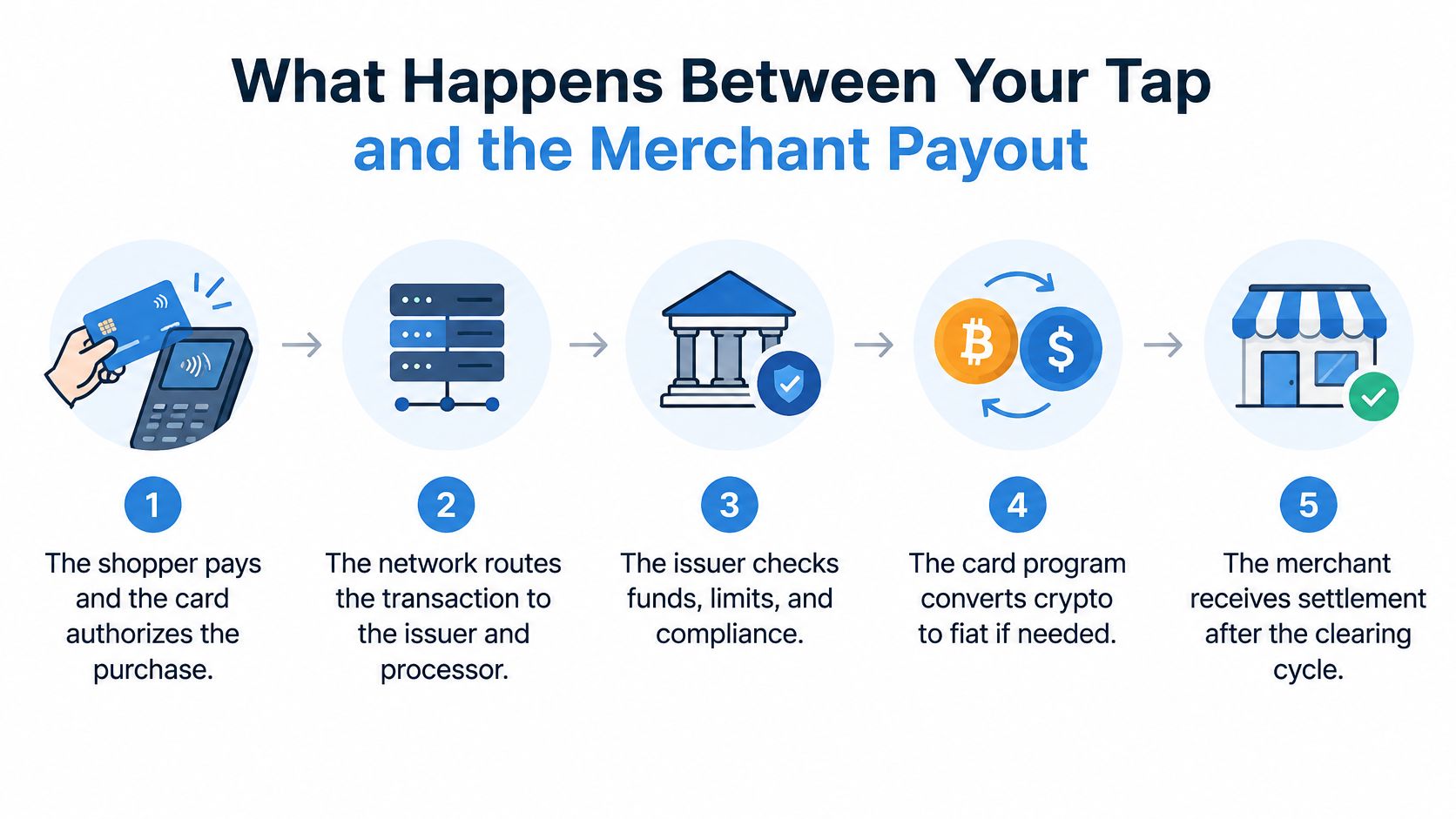
You tap once, but the payment involves authorization, funding, conversion and settlement. Those events aren't the same thing, and a successful authorization doesn't tell you that every later stage has completed.
Visa's explanation of stablecoin settlement distinguishes conventional crypto-to-fiat funding from arrangements in which eligible issuers settle with the network in supported stablecoins, including seven-day operational availability. Merchant payouts can still be made in conventional money.
Follow the conventional funding path
- The shopper pays and the card network sends an authorization request. The risk is a decline under the issuer's authorization rules even when the wallet appears funded.
- The card program checks the wallet balance through an API or smart-contract integration. A service outage or integration failure can prevent access to otherwise available funds.
- It reserves the crypto amount needed for the transaction. Check how the issuer handles a reservation that expires or remains after a failed purchase.
- The crypto is sold or converted to fiat at a quoted rate. Pay attention to the conversion spread and determine whether the quoted rate is guaranteed through execution.
- The issuer settles the merchant through existing banking rails. Settlement dependencies remain even though the customer-facing payment has already been authorized.
Pre-funded fiat cards don't necessarily sell crypto during each purchase. Their conversion happened earlier, which is why the transaction history must distinguish loading activity from merchant spending.
Stablecoin settlement changes the issuer's funding path
In the emerging arrangement, an eligible issuer can deliver supported stablecoins to the network rather than relying entirely on conventional bank funding schedules. The network or its digital-custody infrastructure handles the path to merchant payout.
That can improve operational availability for the issuer. It doesn't establish that the customer receives cheaper conversion, immediate refunds or unrestricted spending.
Normalize these fields when comparing programs:
- Settlement asset: What the issuer sends into settlement.
- Conversion point: When your asset becomes payment money.
- Wallet-control model: Who can authorize movement.
- Funding method: Per-purchase liquidation or a pre-funded fiat balance.
- Authorization mechanism: What permissions and balance checks the program requires.
The distinction matters because a fast settlement rail and a good consumer card are different propositions.
Verification Tiers, Custody and Who Covers a Failed Payment
A Visa or Mastercard logo doesn't guarantee recovery of your crypto balance. Purchase protection and asset protection are separate questions, even when both appear inside the same app.
The Spark crypto-debit-card overview describes the central mismatch: a card purchase can receive a standard chargeback while the crypto funding transaction remains irreversible. The issuer, or potentially the customer under the applicable terms, must absorb that difference.
Identity checks aren't a protection policy
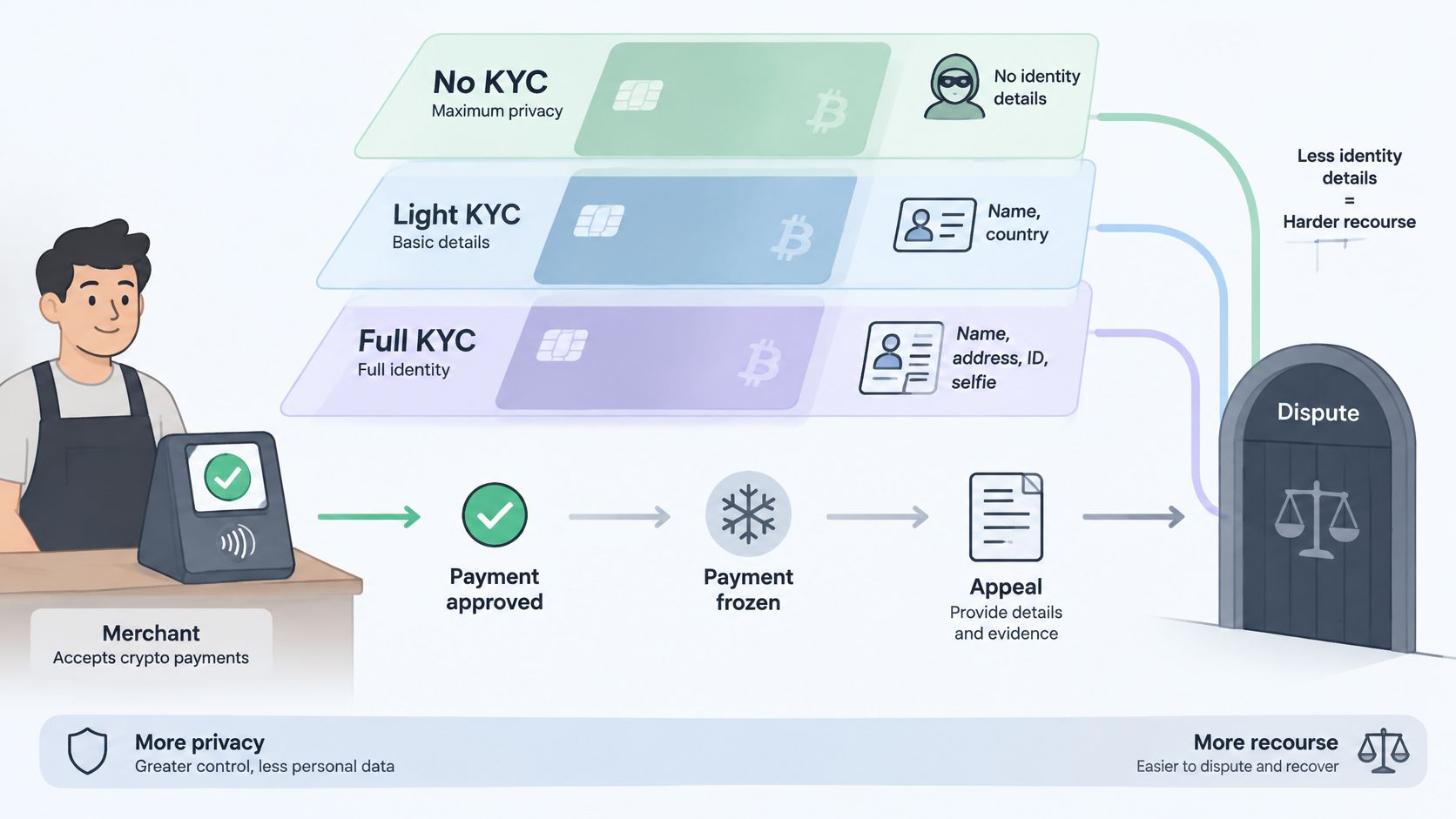
Don't infer spending limits or legal rights from a verification label alone. No-KYC, email-only and full-KYC labels describe onboarding, but the issuer's contract and applicable jurisdiction determine the actual limits and complaint route.
Verification tiers and the recourse each one leaves you
| Verification tier | What you submit | Typical limits | Recourse if something fails |
|---|---|---|---|
| No KYC | No identity documents under the advertised onboarding | Program's published unverified-account caps | Establish whether support can authenticate ownership and accept complaints |
| Email only | Email address under the advertised onboarding | Program's email-account caps | Check purchase-dispute eligibility and crypto-funding treatment separately |
| Full KYC | Identity documents and any required address evidence | Approved country and account-tier caps | Documented identity doesn't itself guarantee reimbursement or asset protection |
A privacy-sensitive reader should assess the information collected throughout the relationship, not just at signup. Check whether additional verification can be required before a withdrawal, refund or account review.
Trace the loss before assuming who pays
Say a merchant dispute succeeds after crypto has already been sold to fund the purchase. Establish whether the issuer returns fiat to the card account, repurchases crypto or follows another reimbursement rule. A refund of the purchase amount doesn't necessarily restore the asset quantity originally spent.
Apply the same scrutiny to unauthorized payments, frozen accounts, failed refunds and insolvency. Each involves a different question: whether the purchase is reimbursable, whether funds remain accessible, or whether you have an enforceable claim against a failed provider.
Custody changes which failures you need to investigate. A custodial balance requires scrutiny of the entity holding it and the treatment of customer assets. A self-custodial arrangement requires scrutiny of spending permissions, smart contracts and wallet recovery.
Our custodial versus self-custody card guide helps distinguish those control arrangements without treating either as a blanket guarantee.
Ask for the reimbursement currency, the responsible legal entity and the complaint-escalation route. A general promise of security doesn't answer any of them.
The decisive test is specific: if the dispute succeeds, can you recover the fiat purchase value, the crypto used to fund it, or only one of those?
Supported Assets, Networks and Where Cards Actually Work
Crypto-card growth doesn't establish that a particular card works for your residency, wallet network or destination. Availability has to be checked at the program level.
Artemis figures reported by CoinGecko's crypto-card analysis put monthly payment volume at approximately $100 million in early 2023 and about $1.5 billion by the end of 2025, while also noting that one service reportedly represented more than half of crypto-card transactions. That concentration makes category-wide popularity a weak substitute for checking an individual issuer.
Compare the asset and its funding route
A supported ticker isn't enough. Establish which blockchain deposits the issuer accepts, what it credits to the spending account and whether conversion occurs before shopping.
Supported assets and what each one does at the till
| Asset | How the card spends it | Main risk | Best fit |
|---|---|---|---|
| Bitcoin (BTC) | Converted into spending money under the program's rules | Price exposure before conversion; disposal records to assess | Holders who deliberately want to reduce BTC holdings |
| Ethereum (ETH) | Converted from an account balance or funded through an on-chain route | Price exposure and any applicable blockchain funding cost | Users already managing ETH funding |
| USDC | Used through a supported stablecoin funding arrangement | Issuer, reserve and depeg exposure | Readers seeking less funding-asset price fluctuation |
| USDT | Used where the program supports the asset and deposit network | Issuer exposure and regional eligibility | Users whose existing funding route supports it |
| Monero (XMR) | Requires an explicitly supported funding or conversion route | Mistaking a listed asset for direct card-spending support | Privacy-focused users willing to verify the full route |
The stablecoin risk distinction matters. The BIS analysis of cryptoasset financial-stability risks identifies legal, financial and operational risks in crypto payment arrangements and notes that stablecoins retain a risk of capital loss despite their intended stability.
Separate issuance from acceptance
Eligibility to receive a card isn't the same as acceptance of an issued card. A provider may support your destination for purchases without offering accounts to residents there.
For travel, verify merchant acceptance, ATM access, foreign-currency rules and any excluded transaction categories. Check whether your eligible region receives a physical card, a virtual card or both. A virtual card that works online may not meet your cash-access needs.
Our guide to where you can use a crypto card provides a practical acceptance checklist. Before relying on a card abroad, confirm the issuer's country list, transaction caps and daily limits, then retain an independent payment method.
Choosing a Card by Your Situation
Shortlist the card that maximizes usable value for your actual spending pattern, subject to a risk limit you can accept. Your monthly activity determines whether fixed charges, conversion pricing or foreign-currency costs deserve the most attention.
An occasional spender shouldn't accept a subscription merely to access a reward tier they won't use. A frequent traveler shouldn't optimize domestic cashback while leaving destination-currency pricing unexamined.
Card type to shortlist by reader situation
| Situation | Priority | Card model to shortlist | Trade-off to accept |
|---|---|---|---|
| Rewards optimiser spending in one currency | Net rewards after execution costs | Exchange card with transparent conversion pricing | A smaller advertised reward for a verifiable net return |
| Privacy-focused user | Minimal identity collection | Minimal-verification program with explicit terms | Account-access and complaint procedures require careful checking |
| Frequent traveller | Destination-currency cost and acceptance | Card with clear FX pricing and suitable destination support | Travel usefulness may matter more than rewards |
| DeFi or self-custody user | Retaining wallet control | Non-custodial wallet-linked card | Responsibility for permissions and recovery |
| Holder avoiding liquidation of long-term assets | Spending from a separate payment balance | Stablecoin-funded or fiat-prefunded card | The funding asset still has its own risks and recordkeeping |
| Occasional small spender | Minimal fixed costs | Card without annual or loading charges under the intended funding route | Fewer rewards or features may be acceptable |
Don't confuse funding choice with tax treatment
A stablecoin-funded card can let you leave a separate BTC holding untouched. It doesn't establish that acquiring, exchanging or spending the stablecoin has no tax consequences. Likewise, pre-funding a fiat balance moves the conversion earlier; it doesn't make the earlier disposal disappear.
If avoiding an asset sale is a hard requirement, a debit-card comparison alone won't answer it. Identify the exact funding transaction and assess its treatment under your local rules before choosing the payment product.
Use a disqualifier before a score
Start with conditions that would make a card unusable: unsupported residency, an incompatible funding network, unclear withdrawal rights or a missing dispute procedure. Remove those programs before weighing rewards.
Then compare the remaining candidates using your own transaction mix. Someone paying local household bills needs a different test from someone making frequent ATM withdrawals abroad.
These are starting shortlists, not verdicts. Don't award a card credit for a feature you won't use, and don't overlook an operational weakness because an aggregate score looks attractive.
Verify Terms on the Issuer Site Before You Apply
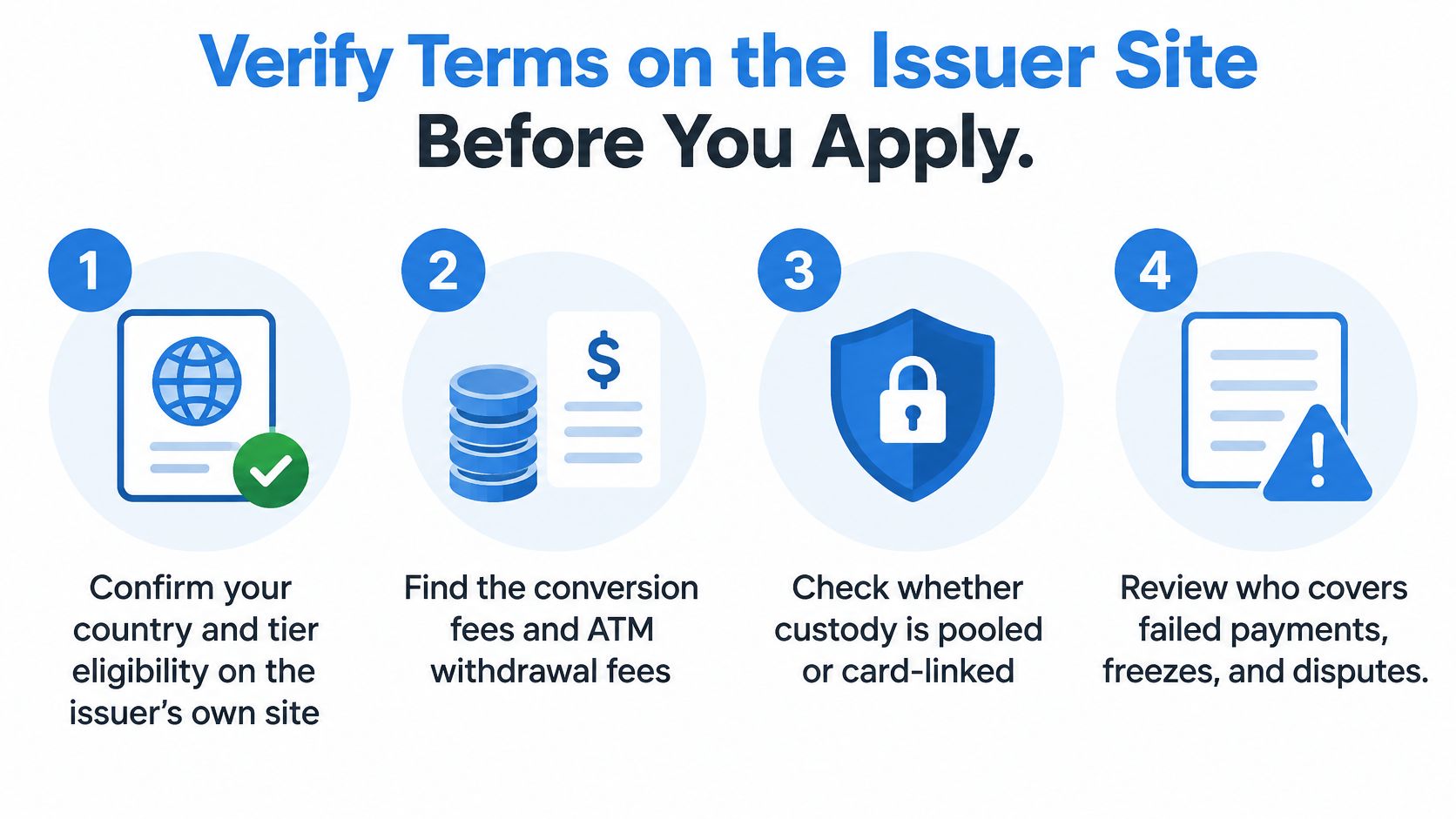
Complete the final check with the issuer's fee schedule, cardholder agreement and country-eligibility page open together. Card terms can differ by country and tier, so confirm the current details on the provider's own site before applying.
Save the terms you actually accept
- Confirm country and tier eligibility. Match your residency and intended account tier to the issuer's current rules, not a general availability claim.
- Find conversion and FX pricing. Read the fee schedule and execution policy rather than relying on the marketing page.
- Identify the funding event. Establish whether purchases trigger sales or draw from a previously converted fiat balance.
- Read dispute, freeze and refund terms. Record the responsible entity and who controls the assets while a complaint is open.
- Check verification dates. Recheck stale figures, especially when a comparison page and the issuer disagree.
- Test with a small amount. Make a domestic purchase and, if relevant, a foreign-currency purchase before committing a substantial spending balance.
- Reconcile monthly. Compare realized rewards and all deductions against your existing payment method.
Save a dated copy of the relevant terms and your test transaction records. That gives you a concrete basis for questioning an unexpected deduction rather than trying to reconstruct the offer later.
Use comparisons to narrow the search
We let readers compare crypto debit cards by fees, KYC requirements, cashback and supported coins, with filters for network and other practical requirements. Our comparison can narrow the shortlist, but the issuer's applicable terms govern the account.
We earn affiliate commissions on some cards, and these are always disclosed. We're not a bank, card issuer or financial adviser.
Crypto and the cards that use it carry risk, including loss of funds. Keep the initial spending balance small enough that a freeze or service failure wouldn't prevent you from meeting essential expenses.
Visit NomadCards to compare crypto debit cards by fees, verification requirements, custody features and supported assets. Build a shortlist around your funding route and spending currencies, then verify the issuer's current terms and test the net cost before committing a larger balance.