You can move about $100 million a month in early 2023 to about $1.5 billion by the end of 2025, but a DeFi debit card still has to ride through Visa or Mastercard before a merchant sees payment. That means the card is a bridge layer, not magic on-chain spending, even when the marketing says self-custody.
I've been in the checkout line with assets on a wallet and a terminal that only wants plastic. The frustration is real, because the card can feel like the cleanest answer until you look at who holds the keys, who does the conversion, and who can freeze the transaction.

Table of Contents
- From Bitcoin to Groceries in Five Minutes
- The Two-Layer Architecture Behind the Card
- Self-Custody vs Custodial Models Explained
- Hidden Fees, FX Spreads, and Real Costs
- Market Scale, Network Dominance, and Usage
- Using Comparison Tools to Find Your Card
From Bitcoin to Groceries in Five Minutes
You're standing in a grocery line in Lisbon, the basket is full, and your wealth is sitting in USDC or ETH. The cashier scans the last item, looks at the terminal, and says it only takes Visa, Mastercard, or cash. That's the moment most crypto users discover that ownership and spendability are not the same thing.
For years, the practical workaround was clumsy. You sold on an exchange, waited for conversion, moved cash to a bank account, and then spent dollars like everyone else. That path adds delay, creates extra steps, and often means more recordkeeping than people expected when they first moved into crypto.
A DeFi debit card changes the last mile, not the whole payment stack. It lets you present a card at a regular merchant while a conversion layer turns your crypto into fiat behind the scenes, so the merchant still gets the currency the terminal expects.
That's why the product matters and why the hype gets sloppy. If a card gives you self-custody, the key question isn't whether you can tap. It's where the funds sit before tap, what triggers the conversion, and who can stop the payment.
Practical rule: if the merchant accepts only card rails, your crypto is never “spent on-chain” in the casual marketing sense. It's routed through a settlement path that ends in fiat.
The best way to think about it is simple. A good card removes friction at checkout, but it doesn't remove the underlying trade-offs around custody, liquidity, fees, and failed authorizations. That's the key difference between a useful product and a shiny wrapper.
The Two-Layer Architecture Behind the Card
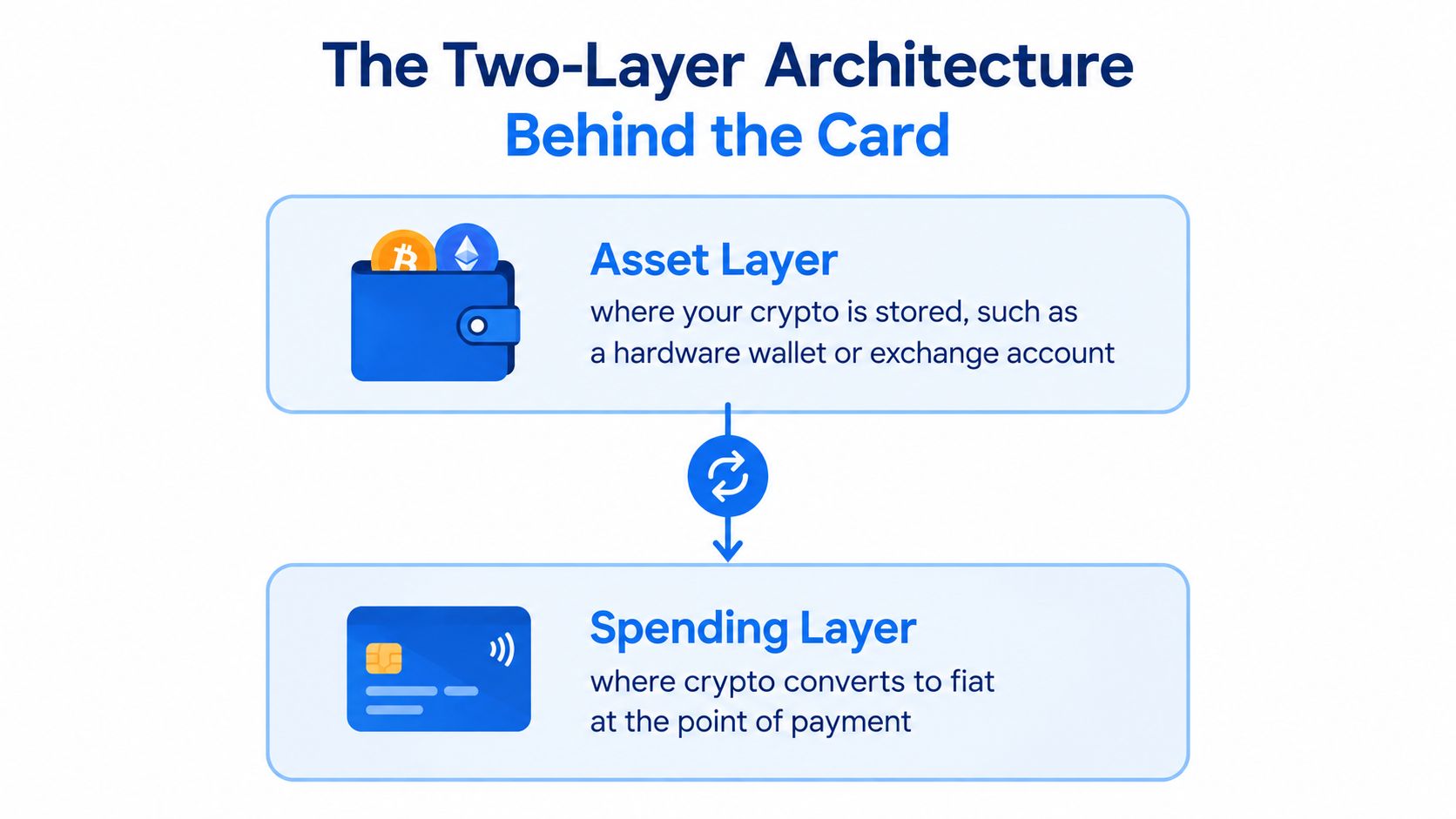
A DeFi debit card is easiest to understand as two systems stacked together. The first is the asset layer, where your crypto lives. The second is the card-network authorization layer, where Visa or Mastercard approves the merchant payment in fiat terms.
That split matters because the logo on the card doesn't tell you who controls conversion. A card can look non-custodial at the wallet level and still rely on a third-party liquidity venue to turn your assets into spendable fiat the moment you buy coffee. The asset may stay in your control until the transaction, but the payment itself still depends on off-chain settlement infrastructure.
The U.S. Treasury has already pointed out that distributed-ledger systems bring distinct risks, including governance, interoperability, scalability, smart-contract vulnerabilities, cybersecurity, and nonstandard custody and settlement processes, and it defines settlement risk as the possibility that payment settlement won't occur as expected (Treasury stablecoin report). That matters here because a card transaction can fail for reasons that have nothing to do with the merchant and everything to do with routing, timing, or conversion liquidity.
What actually happens at checkout
When you tap or insert the card, the product has to do all of this in sequence:
- Authorize spending, usually against a prefunded balance, a liquidity pool, or a smart contract allowance.
- Convert the asset, often from stablecoins or another token into fiat.
- Settle the merchant payment, so the acquiring side sees a normal card transaction.
The practical question isn't whether this can happen. It can. The question is who owns each step. If the issuer owns the liquidity, the issuer has more control. If the wallet owner controls the contract, the user keeps more sovereignty but also inherits gas costs, smart-contract risk, and execution failures.
A card that looks simple on the front end can hide a very complicated back end.
That's why architecture beats branding every time. A card should be judged on its payment path, not on whether it uses the word “decentralized” in the product page.
Self-Custody vs Custodial Models Explained
A custodial card works like a normal money app with a crypto skin. You move assets to the provider, the provider converts them, and you spend the resulting fiat balance. It's clean, familiar, and usually easier for first-time users who don't want to manage wallet permissions or on-chain approvals.
A self-custodial model looks different. Your Web3 wallet stays connected, and the card interacts with your funds through permissions or smart-contract logic rather than a provider-owned account. That preserves more control, but it also means the payment path is less forgiving when something breaks.
| Feature | Custodial Model | Self-Custodial Model |
|---|---|---|
| Who holds the funds | The issuer or platform | The user, until spending is authorized |
| Spending setup | Account balance and app controls | Wallet connection and smart-contract or permission flow |
| Convenience | Higher | Lower to moderate |
| Operational complexity | Lower | Higher |
| Failure points | Provider risk, account freezes, settlement controls | Gas, approvals, liquidity, chain congestion, contract errors |
| Best for | Users who want simplicity | Users who care about control and wallet ownership |
The compliance trade-off is just as important as the technical one. A card that claims to be non-custodial still needs transaction monitoring, sanctions screening, fraud controls, and settlement integrity. The European Commission's MiCA review report makes the broader point that self-custodial wallet software is not the same thing as a financial service when it doesn't hold unilateral control or execute the underlying transaction (EC MiCA review report).
That distinction is where the marketing gets slippery. A product can truthfully say you keep your keys and still rely on a conversion venue, delegated allowance, or issuer-controlled settlement account behind the scenes. The words sound decentralized, but the operational reality can still be hybrid.
If you want a deeper breakdown of that split, the cleanest shorthand is this: wallet ownership is not the same as payment execution. One tells you who can move the asset. The other tells you who can make the merchant payment go through.
| Decision point | Ask this |
|---|---|
| Asset control | Do I hold the keys, or does the issuer? |
| Payment path | Does the card spend from my wallet, a prefunded balance, or a custodial account? |
| Failure handling | Who eats failed-auth, depeg, gas, or slippage costs? |
| Recovery | What happens if approvals are revoked or keys are lost? |
For a practical glossary-style reference on custody trade-offs, see the custodial vs self-custody crypto card guide.
Hidden Fees, FX Spreads, and Real Costs
The fee sheet is where most crypto card marketing stops being honest. A zero annual fee can still hide a conversion spread, and a cashback headline can still leave you worse off once gas, slippage, and foreign exchange markup are added together.
The important thing is to separate the visible fee from the effective fee. Visible fees are the ones printed on the website. Effective fees are what you pay after conversion, routing, and network costs hit the transaction.

What usually adds cost
- Conversion spread: The issuer or liquidity venue may quote a worse rate than the spot price when your crypto turns into fiat.
- Gas fees: Self-custodial spending can require on-chain activity, and you pay the network cost whether the merchant charge is large or tiny.
- Slippage: Fast conversion in thin liquidity can move the execution price against you.
- Emergency routing premiums: If the provider has to source liquidity quickly, the final cost can jump even if the card fee looks low on paper.
The mistake is assuming the advertised card fee is the whole story. It usually isn't. A card with a low base fee can still cost more than a “more expensive” card if the execution path is cleaner and the spread is tighter.
For a practical way to compare these details, the fleet card security features explained piece is useful because it shows the same underlying idea from another angle, security and controls only make sense when you inspect the operating model, not just the headline pitch. The analogy holds well for crypto cards too, because spending controls, permissions, and settlement rules matter more than the brochure language.
If you want to sanity-check fee language across products, keep one question in mind: what happens to $100 of crypto when I try to spend $100 of fiat? That question forces the provider to reveal the spread, the conversion path, and any extra charges hiding between those two values.
The crypto card fees report is useful for this kind of comparison because it forces cost fields into one place instead of making you decode each issuer's marketing page separately.
Market Scale, Network Dominance, and Usage
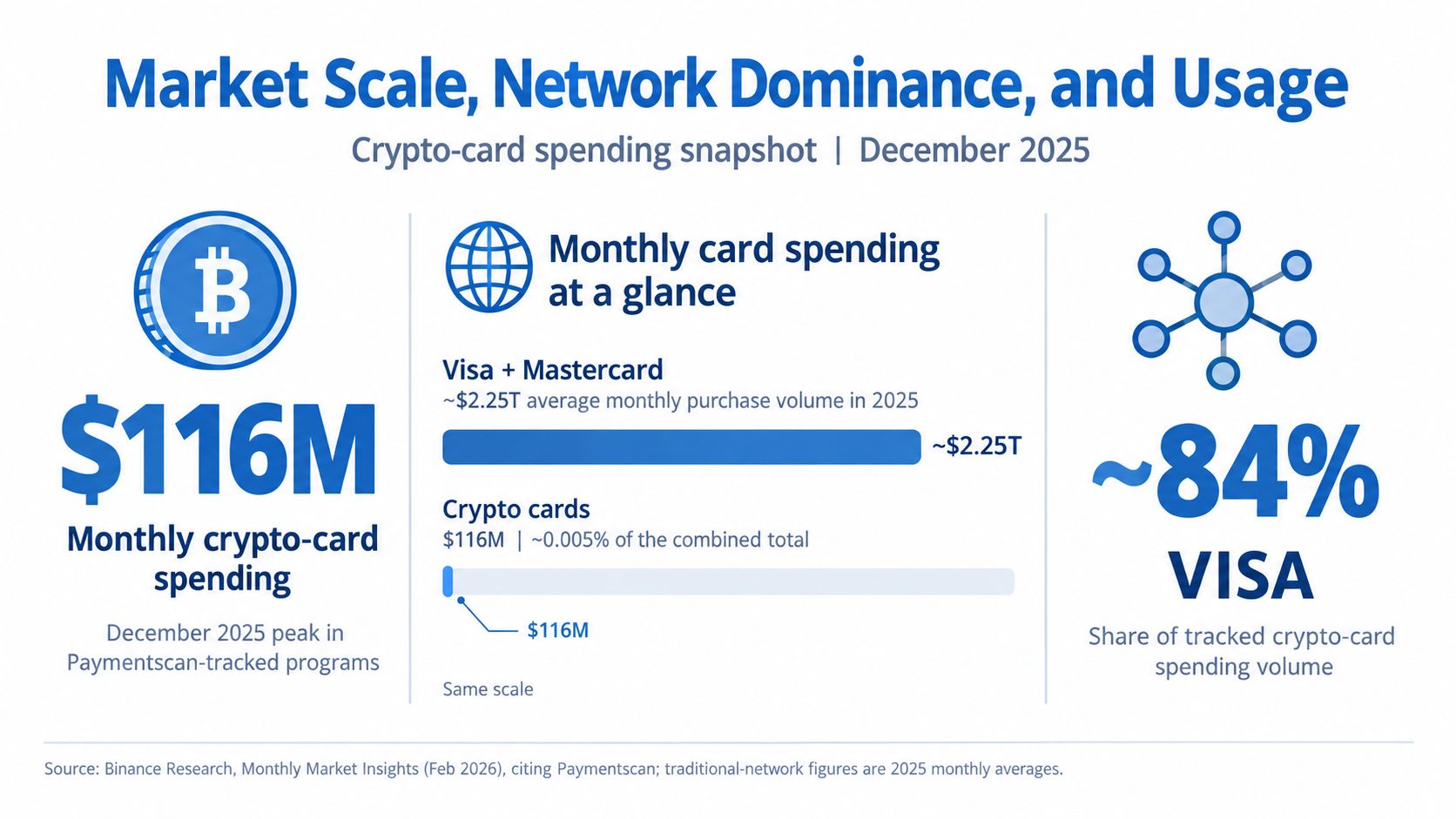
A DeFi debit card can feel niche at the checkout counter, yet the market behind it is no longer tiny. Paymentscan data reported monthly crypto-card volume rising from roughly $100 million in early 2023 to about $1.5 billion by the end of 2025, which puts the channel on a run rate above $18 billion (Paymentscan data). That is real usage, even if it is still small next to mainstream payment rails.
Network concentration is just as striking. Mastercard reportedly accounted for 100% of tracked crypto-card volume from March through October 2023, then Visa took about 85 to 90% after entering the tracked market around November 2023, and roughly 95 to 97% by 2025 to 2026 (Paymentscan data). In practice, the asset may sit on-chain, but the spend path still depends on familiar card networks.
What the usage data really means
Visa economic insights show that retail-sized stablecoin transfers below $250 reached $69.8 billion in 2025, across 1.3 billion transactions, while still making up only about 0.1% of U.S. cashless payments and 0.6% of adjusted stablecoin volume (Visa economic insights). That gap separates payment experimentation from everyday checkout behavior.
The same Visa material also cites BCG's estimate that only $4.2 trillion of roughly $62 trillion in gross 2025 stablecoin transfers reflected economic activity, with crypto-card payments around $15 billion (Visa economic insights). The volume is real, but a lot of it still looks like movement between wallets, exchanges, and payment layers rather than grocery trips or rent payments.
That is why the better question is not whether adoption is growing. It is growing. The useful question is what kind of spending is growing, and how much of it reaches a merchant with a clean conversion path. For a plain-English read on that point, explaining crypto card adoption is a helpful companion.
Using Comparison Tools to Find Your Card
Manual research breaks down fast in this category because the products look similar until you inspect the details. One card is custodial but cheap, another is self-custodial but limited by region, and a third looks private until you notice the conversion account sits with the issuer.
That's where structured comparison helps. The NomadCards finder organizes active card programs into fields you can compare, including KYC level, network, supported coins, card type, and features like non-custodial access or Apple Pay support. It's useful because it forces the product to answer the same questions every time.
A good comparison flow should start with your actual use case, not with rewards. If you care most about privacy, filter for low-verification options first. If you want merchant reach, check the network and region availability before you look at cashback.
A practical selection order
- Start with control: Decide whether you want a custodial balance or direct wallet spending.
- Check acceptance: Confirm whether the card runs on Visa or Mastercard, and whether it's available where you live.
- Inspect the rails: Look at supported assets, settlement path, and whether a bridge or swap is involved.
- Price the trade-off: Compare visible fees, likely conversion spread, and any gas exposure.
- Read the failure rules: Find out how freezes, disputes, and reversed authorizations are handled.
The best comparison is the one that shows where the risk sits before you apply.
NomadCards also keeps ranked lists and standardized product pages, which helps because card terminology is messy across issuers. A “debit” card may be prepaid, a “self-custody” card may still use a centralized conversion leg, and a “no KYC” card may still have geographic limits or transaction caps that matter in practice.
If you're serious about using crypto for everyday spending, don't shop by slogan. Compare custody model, supported assets, network access, and settlement path, then choose the product that matches how you spend.
If you want a cleaner way to compare crypto cards without decoding each issuer's wording, visit NomadCards and use its card profiles, finder, and comparison fields to map custody, fees, networks, and verification requirements side by side. It's the fastest way to see which DeFi debit card fits your risk tolerance before you move any funds.