You're at a coffee shop in Lisbon. The terminal asks for euros, but your wallet holds Bitcoin and a stablecoin. Paying directly with crypto means opening an exchange, converting funds, finding a compatible QR workflow, and hoping the merchant accepts it before the price moves. That's a terrible checkout experience.
A crypto debit card solves the awkward middle step. You fund the card with digital assets, and the issuer or payment account handles the conversion when you pay. The merchant receives ordinary card-network payment, while you spend from a crypto balance.
The market is no longer a curiosity. One industry tracker reported monthly crypto-card volume rising from about $100 million in early 2023 to more than $1.5 billion by late 2025, with cumulative volume exceeding $11.61 billion by August 2026 (ForkLog's crypto-card market report). The practical question now isn't whether you can get crypto debit card access. It's whether the card's total cost, custody model, privacy requirements, and regional support fit how you spend.
Table of Contents
- Why You Might Want a Crypto Debit Card in the First Place
- What to Compare Before You Pick a Card
- Choosing and Applying for the Right Card
- Funding and Activating Your Card
- The Full Cost Stack Most Guides Skip
- KYC Levels and the Privacy Trade-Off
- Troubleshooting the Stuff That Goes Wrong
Why You Might Want a Crypto Debit Card in the First Place
Raw crypto is excellent for holding and transferring value, but it's clumsy at an ordinary checkout. A merchant usually wants a card authorization in local fiat, not a volatile asset transfer that requires wallet support and a confirmation workflow. Even stablecoins don't automatically solve the problem, because the merchant still needs compatible infrastructure and a process for handling the payment.
A crypto debit card acts as a bridge between those systems. You keep assets in a supported account or wallet, then the card program converts or debits the relevant balance when you swipe, insert, or tap. Depending on the design, the card may sell crypto for fiat, draw from a stablecoin payment account, or use another issuer-managed settlement process.
Spend digital assets where cards already work
The most obvious reason to apply is convenience. A card connected to a major payment network can make crypto usable for groceries, subscriptions, transport, hotels, and online purchases without asking each merchant to accept crypto directly.
Network adoption supports that shift. Visa reported that crypto-linked card payment volume on its network was about 11 times higher in April 2022 than in January 2021, while later reporting cited Visa crypto-card net spending growing from $14.6 million to $91.3 million in 2025 (Visa's crypto-linked card overview). Those figures don't make every card reliable, but they show the product is moving through established payment rails.
Earn crypto instead of conventional rewards
Some users want rewards paid in Bitcoin, a stablecoin, or an issuer token rather than airline miles or bank points. That can make everyday spending more aligned with a crypto portfolio, especially if you already understand the asset you're receiving.
Don't treat cashback as free yield. Conversion spreads, foreign-exchange charges, ATM fees, and account fees can cost more than the rewards return. A card with a smaller advertised reward and cleaner pricing may leave you with more value.
Use stablecoins as a spending balance
Stablecoins can provide a practical budgeting layer for people who earn, save, or move money in crypto. You can keep a dedicated spending balance separate from long-term holdings, then use the card for predictable expenses.
That separation matters. You don't want a coffee purchase to expose your entire wallet, and you don't want a compromised card account connected to every asset you own. A dedicated wallet or payment balance limits the blast radius.
Practical rule: Treat the card as a spending tool, not as your main custody solution or a replacement for a bank account.
Funding, conversion, rewards, verification, and geographic access all introduce trade-offs. Before you apply, compare the cost stack and decide how much identity data you're willing to provide.
What to Compare Before You Pick a Card
Choose a crypto debit card by its total cost and privacy posture, not by the biggest cashback figure. Fees, limits, custody, verification, and regional access determine whether the card works after the first swipe.
| Criterion | What It Controls | Key Question to Ask |
|---|---|---|
| Fees | Conversion cost, FX leakage, ATM access, account overhead | Which fees apply to my normal spending pattern? |
| Rewards | The value and usability of cashback | Is the reward paid in an asset I actually want, or in a token I must convert? |
| KYC tier | Limits, features, jurisdiction access, and privacy | What documents are required before I can spend at my expected level? |
| Custody | Who controls funds and how the payment balance is held | Does the issuer hold the assets, or does the card spend from my wallet? |
| Region support | Eligibility, shipping, merchants, and ATM use | Is the card issued to residents of my country, and where will it work? |
Fees come before rewards
Read the full fee schedule before comparing rewards. Check monthly and annual charges, conversion spreads, foreign-exchange markups, ATM fees, inactivity rules, replacement-card fees, deposit costs, and any limits that change the price. A reward rate matters only after these deductions.
Frequent travelers should focus on foreign-exchange and ATM pricing. Cross-border spending can expose conversion spreads, FX markups, withdrawal charges, and inactivity fees that reduce or eliminate the advertised reward. Test the card against your actual spending route, including where you will withdraw cash and which currency you will use.
Rewards must match your behavior
A flat reward is easier to value than a tiered program with several conditions. Confirm whether rewards arrive in the coin you spend, a stablecoin, or an issuer token that requires another conversion. Check excluded merchant categories, payout delays, caps, and account-status requirements.
Cashback also affects privacy indirectly. A program that requires more account activity, wallet linking, or identity information may offer a higher headline return while creating a less private spending setup. Decide whether that exchange fits your use before applying.
KYC, custody, and region are linked
Minimal verification can come with restricted balances, ATM withdrawals, physical-card access, or country support. A custodial product may be simpler because the issuer holds the payment balance. A self-custodial design gives you more wallet control, but network fees, supported-chain limits, and additional technical responsibility remain with you.
Use a normalized comparison such as the crypto-card comparison tool to narrow the field. Then verify every important term on the issuer's website, including fee triggers, KYC requirements, custody arrangements, and supported regions. Rankings help with discovery, but the issuer's contract decides what you can use.
Choosing and Applying for the Right Card
Apply in a controlled sequence. Rushing straight from a cashback advertisement to a deposit is how people end up with funds in an account they can't use.
1. Shortlist suitable issuers
Choose two or three programs that match your country, preferred network, supported assets, custody preference, and spending pattern. Check the issuer's supported-countries page before creating an account, because availability can differ by residence, card type, and feature.
2. Pull the actual fee schedule
Ignore the summary banner until you've found the formal pricing page. Write down the charges that affect you, including monthly fees, ATM limits, foreign-exchange treatment, conversion pricing, inactivity rules, and top-up costs.
3. Prepare for verification
Most regulated programs require identity verification before first use. Practical checks can include a government ID, liveness or selfie verification, sanctions and politically exposed person screening, adverse-media review, and source-of-funds checks for larger deposits (crypto debit-card infrastructure guidance).
Have your government ID and proof of address available if the issuer requests them. Don't assume an email-only signup will get you the limits or physical card you want.
4. Create the account and complete approval
Use an email address you'll retain long term. Install the official app, enable strong account security, complete verification, and read the account agreement before depositing assets.
5. Order the card
A virtual card may be available quickly after approval, while a physical card requires delivery and activation. Confirm the shipping address, delivery coverage, replacement policy, and whether the physical version has a separate fee.
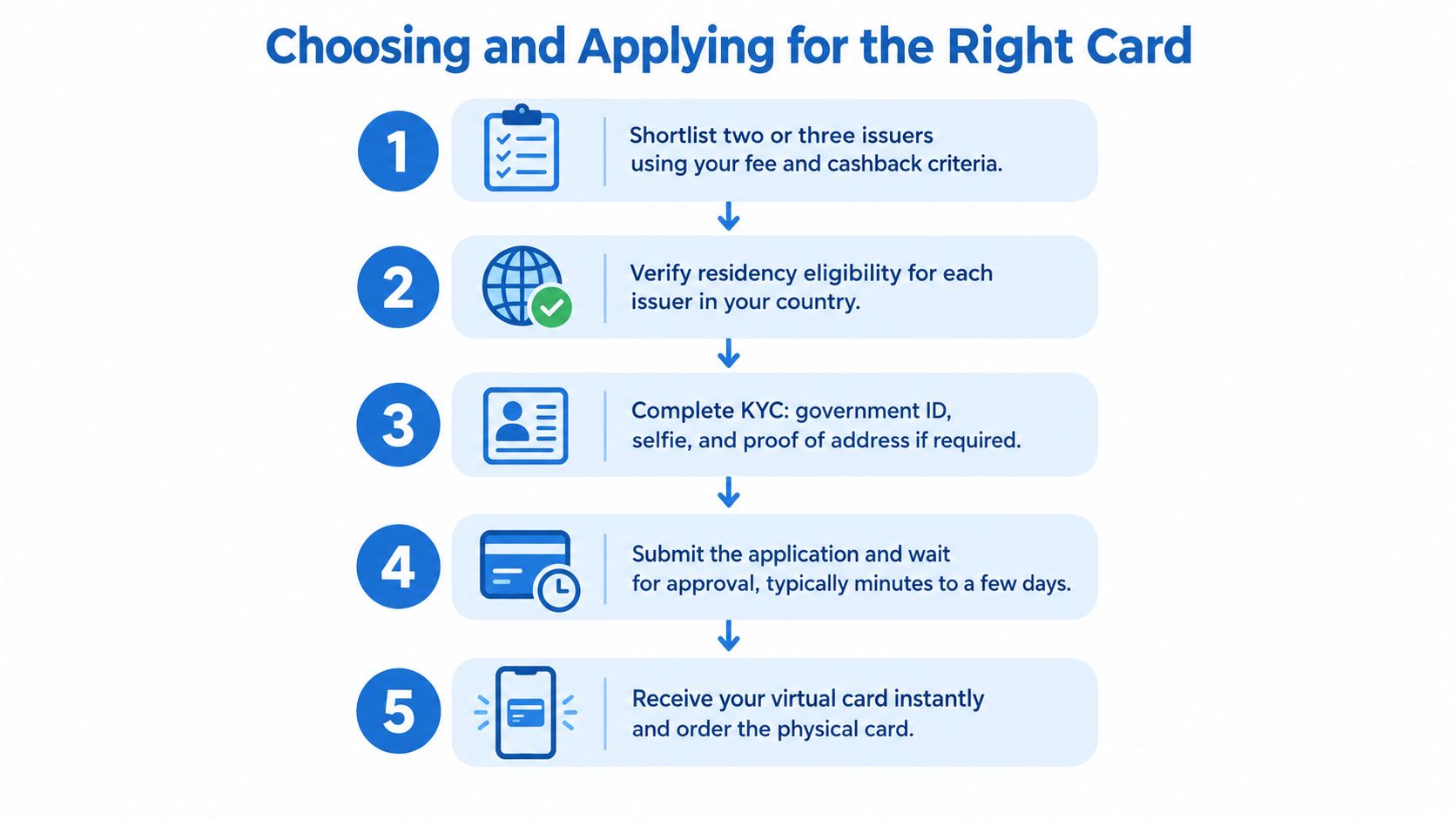
Don't fund the account before verification is complete and the card is usable. If the issuer pauses onboarding, changes regional eligibility, or rejects the application, you don't want assets trapped in an unusable payment wallet.
Funding and Activating Your Card
Once approval is complete, open the app and identify exactly where the spending balance lives. Some programs use a custodial account, while others connect a payment function to an external or self-custody wallet. That distinction determines who controls the funds and how transactions settle.
Complete the account setup
If verification wasn't finished during application, complete it before adding meaningful funds. Confirm your legal name, residence, supported country, and account limits. Then review whether the program accepts a bank transfer, debit-card purchase, direct crypto deposit, or wallet connection.
A direct on-chain top-up needs the correct asset, network, and destination address. A wrong chain can create recovery problems, and network activity can add gas costs. Check minimum load thresholds before sending a small amount that falls below the issuer's acceptance rules.
Understand the conversion path
The point-of-sale mechanism matters more than the word “crypto” in the product description. One card may pre-convert a balance into fiat, another may debit a stablecoin payment account at the time of purchase, and another may pull from a pooled issuer balance. Each structure creates a different mix of price exposure, spread, settlement timing, and custody risk.
Keep volatile assets away from an unplanned spending balance unless you understand when the sale occurs. A stablecoin balance can make budgeting easier, but it still carries issuer, network, and regulatory risks.
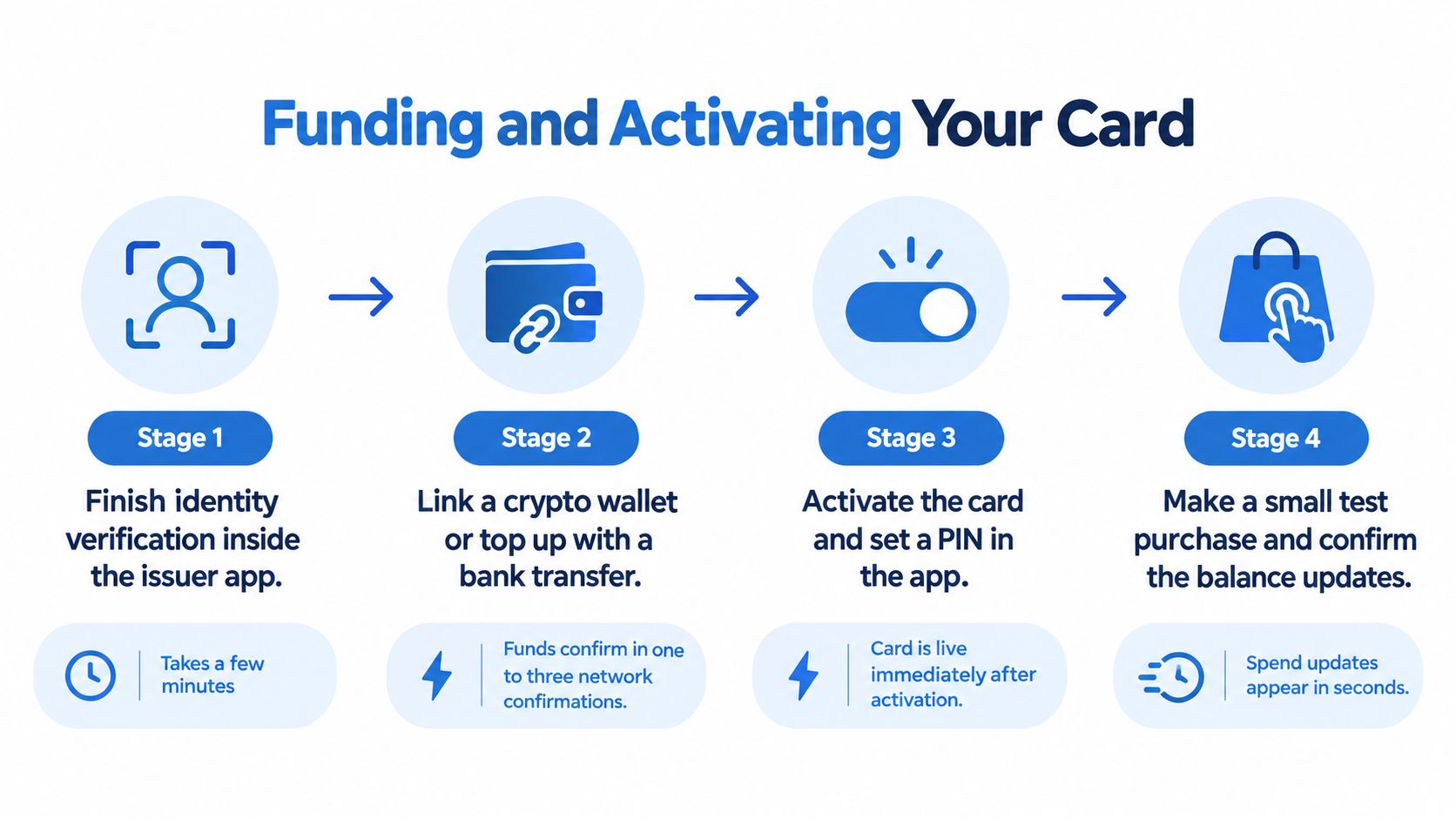
Activate, secure, and test
Activate the physical card in the app, set the PIN, and add the virtual or physical card to Apple Pay or Google Pay if supported. Make a small test purchase first. Check that the authorization appears, the crypto or fiat balance updates correctly, and the fee shown in the app matches the terms you read.
Physical delivery times vary by issuer and destination, so don't build an important trip around an untested card. Keep a backup payment method until the first successful transaction and settlement are complete.
The Full Cost Stack Most Guides Skip
Cashback is the visible number. Total cost determines whether the card saves you money.
Start with the conversion spread. If the issuer gives you a weaker crypto-to-fiat rate than the market rate, every purchase includes a hidden deduction. Add a foreign-exchange markup for non-domestic spending, then check monthly charges, ATM fees, inactivity fees, and network costs when you reload from a self-custody wallet. These deductions matter more than a headline reward when you use the card often.
Build your own break-even view
A reward rate does not prove value. A hypothetical card offering a 4% reward may look attractive, yet a wide conversion spread and overseas FX markup can absorb that return. Calculate from the issuer's fee schedule and your actual transaction mix. Run your numbers against our crypto-card fees comparison before you commit.
| Cost Line | Card A, Low Fee | Card B, High Reward |
|---|---|---|
| Conversion pricing | Check the quoted rate against the issuer's stated spread | Check whether the reward compensates for a wider spread |
| Foreign purchases | Review the FX markup and settlement currency | Review FX pricing before counting cashback |
| Account fee | Confirm whether the account has recurring charges | Confirm whether reward access requires a paid tier |
| ATM use | Check withdrawal pricing and limits | Check whether higher rewards exclude cash withdrawals |
| Reloading | Review blockchain and deposit costs | Check whether frequent top-ups reduce the reward value |
| Inactivity | Confirm when dormancy charges begin | Confirm whether unused rewards or balances expire |
A traveler spending across currencies should prioritize clear FX pricing and reasonable ATM terms. A domestic user who rarely withdraws cash may care more about conversion spreads and the quality of the reward asset. One card can be affordable for one spending pattern and expensive for another.
Cut avoidable leakage
Top up with a stablecoin when the program supports that route and it fits your budgeting needs. Reject terminal prompts offering dynamic currency conversion when your card or issuer can process the transaction currency more efficiently. Consolidating regular spending onto one card can also make fee and reward thresholds easier to track.
The UK is placing more focus on payment-fee disclosure. Regulatory changes include 2026 card-scheme transparency remedies from the UK Payment Systems Regulator and Visa and Mastercard fee-disclosure requirements for UK transactions beginning in 2027. Better disclosure should make comparisons easier, but it does not replace reading the issuer's terms. Check the rate used at conversion, the fee charged at settlement, and the conditions attached to every reward.
KYC Levels and the Privacy Trade-Off
A fully anonymous, fully functional crypto debit card isn't a realistic expectation in regulated markets. Issuers operate within card-network rules, anti-money-laundering obligations, sanctions controls, reporting requirements, and banking-partner requirements. Programs that promise unrestricted legal card access with no identity checks are usually offering limited functionality, operating outside regulated frameworks, or taking compliance risks that can eventually affect users (analysis of anonymous crypto debit cards).
The practical verification spectrum
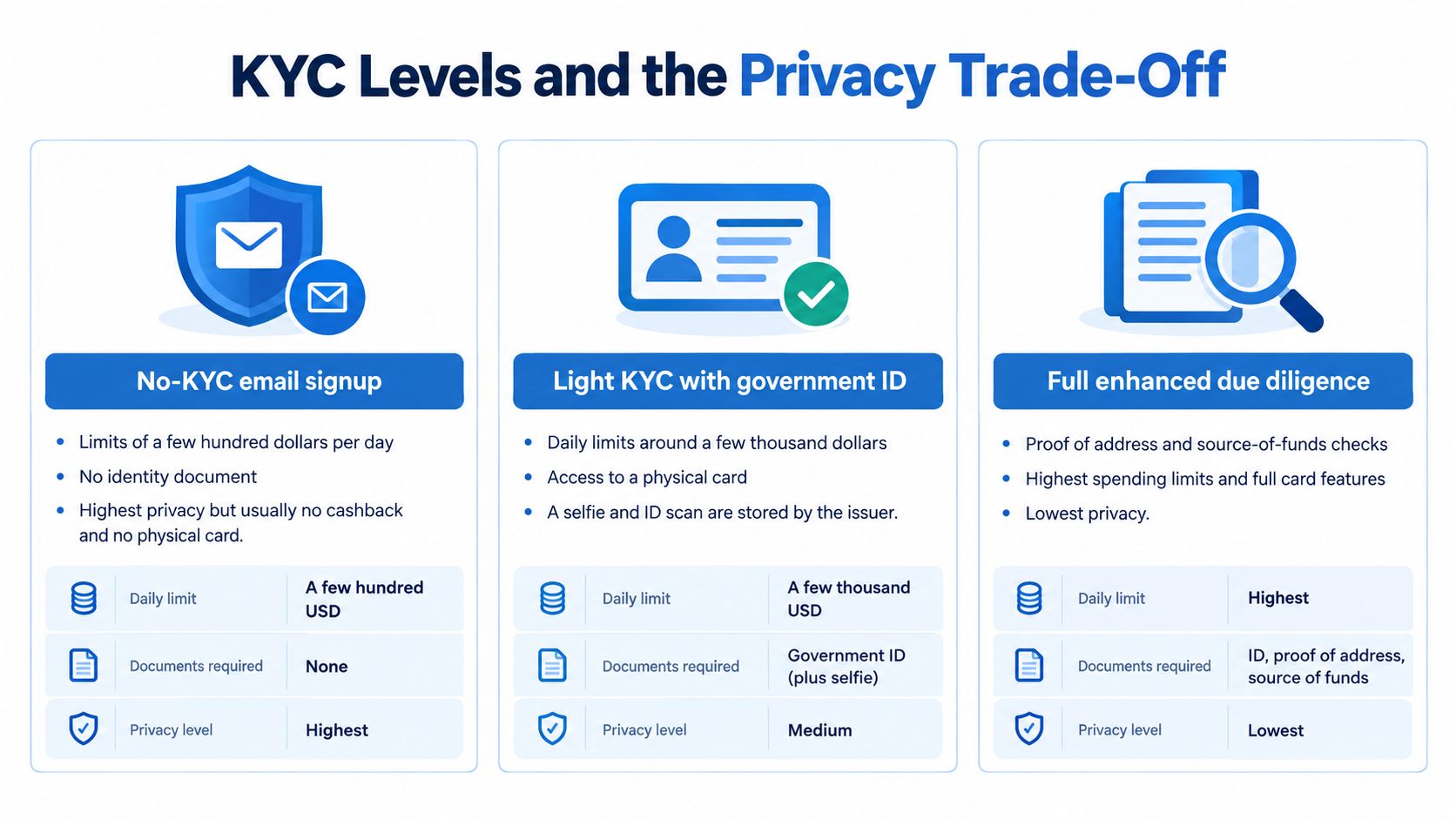
An email-only account may let you explore an app or hold a restricted balance, but it generally isn't equivalent to full card access. Light verification usually adds a government ID and may allow broader spending or physical-card functionality. Enhanced review can add proof of address, source-of-funds questions, transaction monitoring, and further checks when your activity or requested limits require them.
The precise thresholds vary by issuer and jurisdiction. Don't rely on labels such as “no KYC” without asking what happens at the first top-up, ATM withdrawal, physical-card order, or limit increase.
Decide how much privacy you need
Full verification makes the features most ordinary users expect available, but it creates a direct identity link between your card activity and your account. That doesn't automatically expose every wallet you own, yet you should assume the issuer can associate verified account activity with deposits, withdrawals, and payment records under its retention and disclosure policies.
Use a dedicated email address and a separate spending wallet if that fits your risk model. Read the issuer's privacy notice before submitting documents, especially its data-retention periods, service-provider sharing, regulatory disclosures, and account-closure procedures. For adjacent privacy-conscious mobile connectivity, a no KYC eSIM activation guide can help you understand how identity requirements differ across services, but an eSIM isn't a substitute for payment-card compliance.
For a deeper breakdown of verification categories, use this guide to crypto-card KYC levels. My rule is simple: choose the lightest tier that legally supports your intended spend, but accept full KYC when you need reliable limits, ATM access, and regional availability.
Troubleshooting the Stuff That Goes Wrong
Most early failures are operational, not mysterious. The card works when the issuer, payment network, wallet balance, merchant category, location, and security checks all agree.
A declined payment
First check the available spending balance, card status, merchant category, and offline or online setting. Some issuers require a buffer above the merchant's authorization amount, especially where a merchant places a temporary hold. If you're spending a thin-liquidity token, switch to a supported base asset or stablecoin balance rather than waiting for a conversion route to fail.
A top-up stuck as pending
Confirm the asset and network, then find the transaction reference in the app. On-chain deposits may need network confirmations, while bank or debit top-ups can be held for issuer review. Don't send the same deposit again until support confirms whether the first one is delayed, rejected, or already credited.
A restricted merchant
Card programs often block categories such as gambling, certain financial services, or other restricted activity. Review the issuer's merchant-category policy, then contact support with the transaction reference if an ordinary purchase was incorrectly declined. Repeated retries can trigger additional security checks.
A region-locked card
A card's BIN and issuing country can affect acceptance, even when the card network is widely recognized. Disable your VPN before identity reverification, make sure your app profile matches your actual residence, and confirm that the merchant accepts cards issued in your region.
An ATM reversal
An ATM may show a completed authorization and then reverse it after the operator fails to dispense cash or the issuer rejects the withdrawal. Use an in-network ATM where possible, save the receipt, and contact support with the withdrawal reference. Avoid repeated attempts, because each attempt can create a separate hold or fee.
Before traveling, run this checklist:
- App readiness: Update the issuer app and confirm you can sign in.
- Security: Enable two-factor authentication and store recovery details safely.
- Backup payment: Carry another card or payment method.
- Merchant access: Review restricted categories and test the card locally.
- Cash access: Confirm ATM support and withdrawal pricing in your destination.
- Wallet balance: Keep enough available funds for authorization holds and network costs.
NomadCards helps you compare crypto debit cards by fees, KYC requirements, custody model, supported assets, payment network, and regional availability. Visit NomadCards to narrow your shortlist, verify the trade-offs, and choose a card you can use after the cashback headline fades.