You're standing at a checkout with Bitcoin or stablecoins in your wallet, but the terminal offers only Visa or Mastercard. You tap a crypto card, the payment is approved, and the cashier receives ordinary local currency. Nothing about the purchase looks like a blockchain transaction.
That apparent simplicity is the main trick behind a crypto card. The card doesn't usually ask the merchant to accept Bitcoin, Ethereum, or another digital asset directly. Instead, the issuer or payment processor checks your available crypto balance, converts the amount needed for the purchase, and sends the card network a normal fiat authorization. Mastercard's Crypto Card Program describes this conversion before the payment reaches the network, allowing the program to work across 100 million+ acceptance locations worldwide.
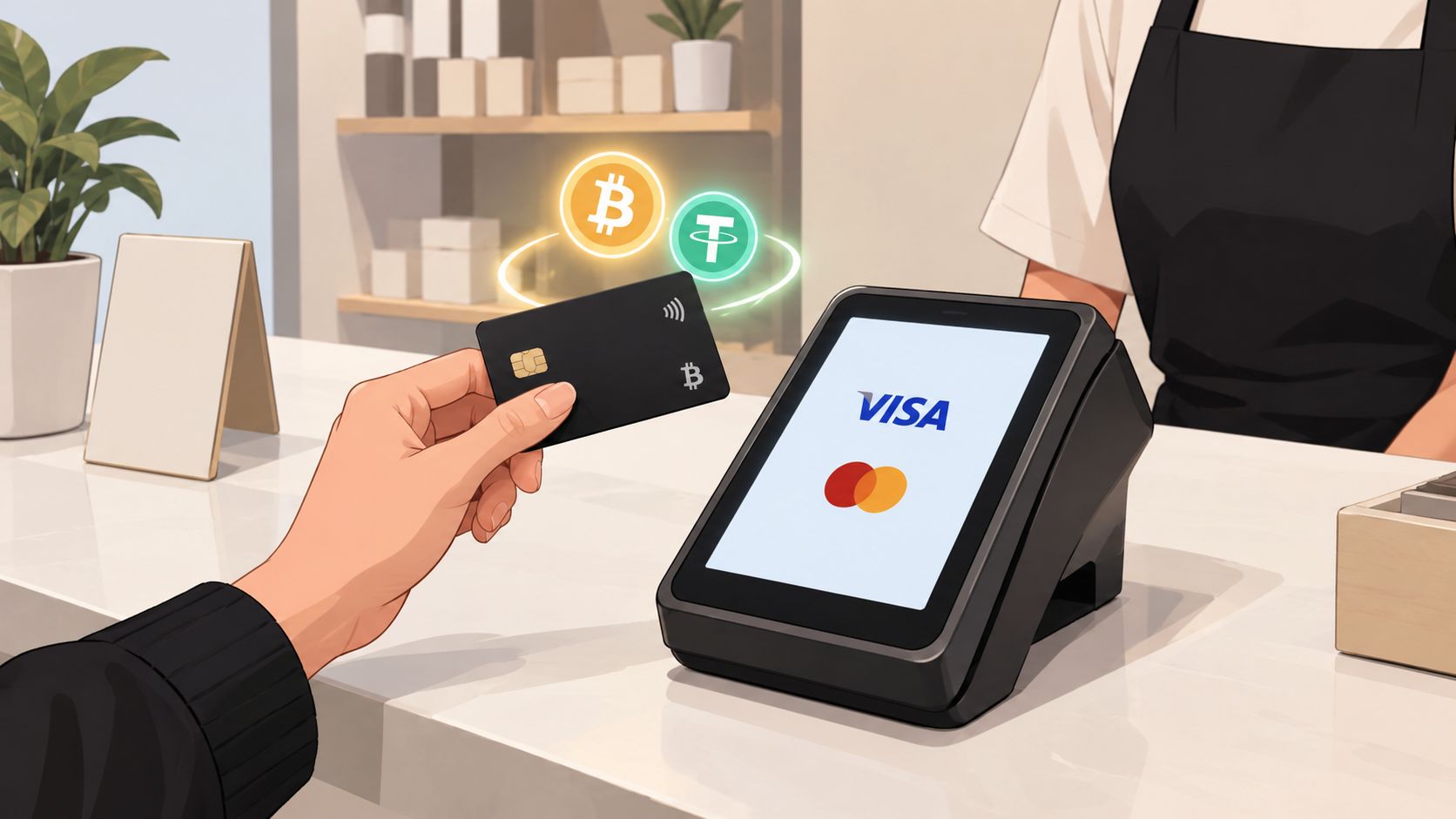
That bridge makes crypto spending feel familiar, but the details still matter. Your crypto may remain with an exchange, sit in a self-custody wallet, or move into a separate payment balance. Conversion spreads, foreign-exchange markups, ATM charges, and reward limits can also change the actual cost of a purchase, even when a card advertises no annual fee.
For broader context on the move from crypto holdings to everyday purchases, The Coin Course on card spending offers a useful companion resource. You can also see how acceptance works in practice with this guide to where you can use a crypto card. The sections below follow the money from funding to checkout, then compare custody models, authorization, settlement, fees, real-world use, and card selection.
Table of Contents
- What a Crypto Card Actually Does Behind the Scenes
- Custody Models and Funding Flows Explained
- How Authorization and Settlement Work Step by Step
- Fees FX Markups and Rewards That Affect Real Value
- Using Your Crypto Card in Real Life
- Choosing the Right Crypto Card and Next Steps
What a Crypto Card Actually Does Behind the Scenes
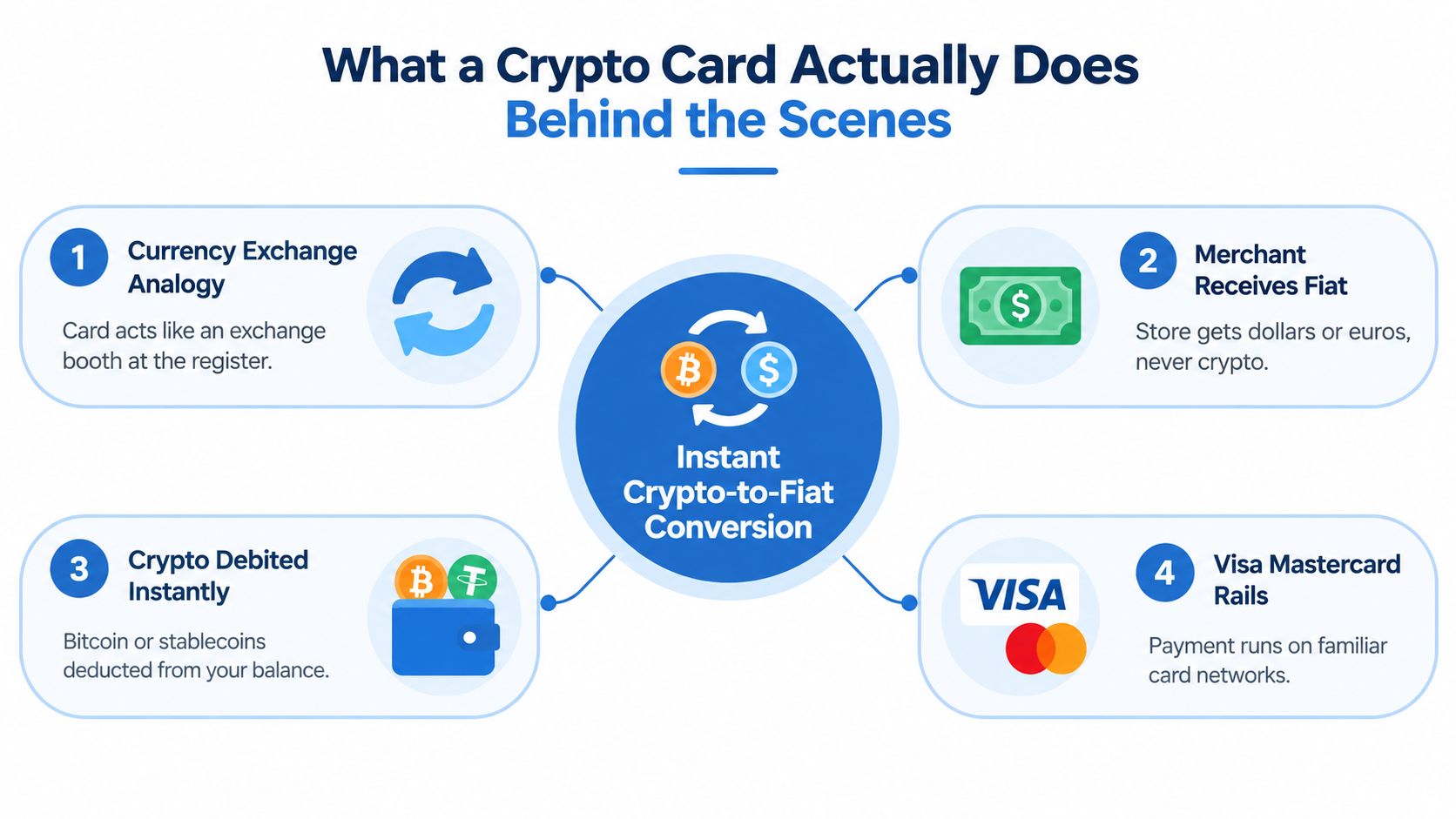
The easiest analogy is a currency exchange booth placed inside the checkout process. You hand the card terminal a payment request in fiat, while the card provider exchanges enough crypto to cover it. The shop receives dollars, euros, or another supported local currency, not a token from your wallet.
The process normally looks like this:
- The merchant requests a fiat payment. The terminal sends a conventional Visa or Mastercard authorization for the purchase amount.
- The card provider checks your spending source. It looks at a linked crypto balance, a prepaid stablecoin balance, or an approved credit facility.
- The provider converts or deducts value. It sells only the amount required, or removes the equivalent amount from a funded payment balance.
- The card network processes the purchase. The merchant receives a familiar card transaction and settles through ordinary card infrastructure.
The merchant sees fiat, not crypto
This distinction answers the most common question about how does crypto card work. A merchant doesn't need a crypto wallet, blockchain integration, token-price management, or a method for accepting on-chain transfers. The merchant accepts the card network already installed at the register.
That's why a crypto card can fit into an existing payment environment. Mastercard says its crypto card structure converts crypto into fiat before the transaction reaches the network, and the program can operate across its broad acceptance footprint. The provider absorbs the complexity that would otherwise sit between your wallet and the store.
The card itself can take several forms:
- Crypto-linked debit card: Spending draws on your crypto or stablecoin balance, with conversion handled by the provider.
- Prepaid card: You fund a separate fiat or crypto-linked balance before spending.
- Crypto-backed credit card: The issuer provides credit, often with collateral, repayment rules, and approval requirements.
These products can look identical at checkout, but they create different risks. A debit or prepaid card usually limits spending to available funds. A credit structure introduces borrowing, collateral, repayment, and possible interest.
Core idea: The card doesn't turn the merchant into a crypto business. It turns your crypto balance into the fiat payment the merchant already knows how to process.
The operational design also creates a specialized payments role. People exploring the industry side of card infrastructure may find this staff product manager role at Nium helpful for understanding the kind of product work involved in issuing and managing payment cards.
Custody Models and Funding Flows Explained
The most important question isn't only what asset you spend. It's who controls the funds before the purchase. A custodial card and a self-custodial card can both produce a normal card payment, yet the funding journey and responsibility are different.
Custodial cards prioritize convenience
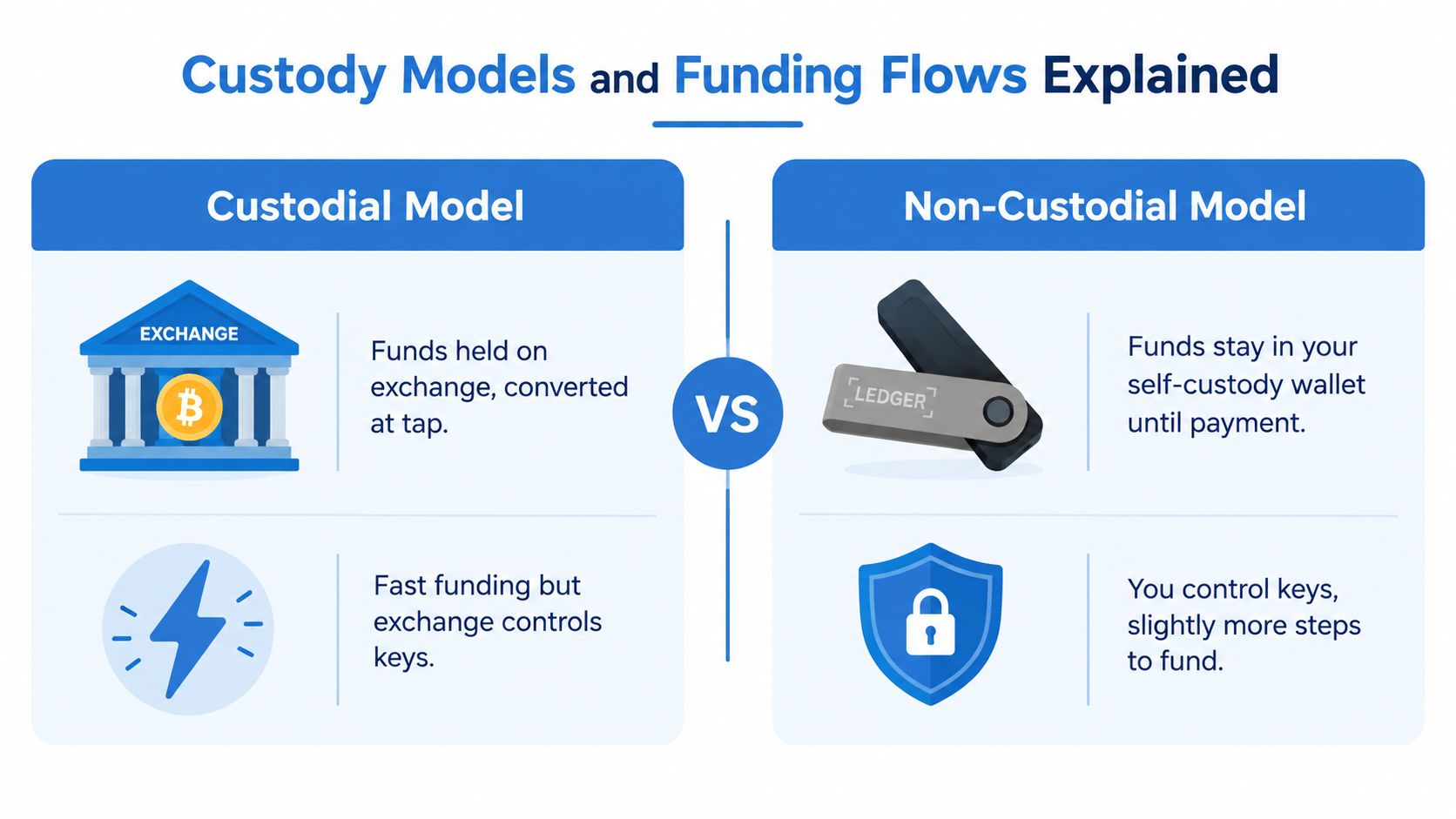
With a custodial model, the provider or exchange holds the crypto and controls the operational wallet. You may transfer assets into the account, select a spending asset, and let the provider handle conversion when you pay. The experience resembles using an exchange account with a payment card attached.
The advantages are straightforward. Funding is usually simple, recovery may be handled through account support, and the provider can manage conversion, compliance checks, and payment operations in one system. The trade-off is control. You depend on the provider's availability, account rules, asset support, withdrawal policies, and security procedures.
A custodial flow may look like this:
- You deposit Bitcoin, Ethereum, USDT, USDC, or another supported asset with the issuer.
- The provider records the balance in its internal system.
- You make a purchase.
- The provider converts the required amount and authorizes the card payment.
- The merchant receives fiat through the card network.
Self-custody keeps control closer to the wallet
A non-custodial or self-custodial design leaves the user in control of the wallet keys. The payment service may connect to a wallet, a smart contract, or a dedicated on-chain spending account. Funds can remain on-chain until the payment process calls for the required amount.
This arrangement reduces reliance on an exchange holding your assets, but it adds responsibility. You must protect keys, approve funding actions when required, use the correct network, and understand what happens if a wallet connection fails. A useful background comparison of these architectures appears in this custodial versus non-custodial wallet guide from Blocsys Technologies.
Just-in-time conversion versus preloading
A just-in-time model converts crypto around the payment authorization. You hold the asset until you spend, and the provider calculates the required amount at the relevant rate.
A preloaded model asks you to move funds into a payment balance first. That balance might hold fiat or a stablecoin, and the card then draws from it at checkout. Preloading can make spending more predictable, while just-in-time conversion can keep more of your assets in their original form until needed.
The blockchain may appear in the funding stage without appearing in the merchant settlement stage. An on-chain transfer can move funds into the spending account, while the final card payment still travels through Visa or Mastercard rails. Off-chain internal balances can make the user experience faster, but they also mean the provider's ledger, rather than a public transaction, records part of the movement.
For a deeper comparison of control and convenience, see the guide to custodial and self-custody crypto cards.
How Authorization and Settlement Work Step by Step
At the terminal, a crypto card behaves like a conventional card because the merchant starts with a fiat request. The crypto-specific work happens alongside that request, inside the provider's authorization system.
The five moments behind one tap
- You tap or swipe. The terminal reads the card and sends the purchase amount to the merchant's acquiring bank.
- The network requests authorization. Visa or Mastercard receives a normal fiat authorization request.
- The provider checks funding. The card program checks whether your crypto-backed balance or prepaid balance can cover the amount.
- The provider converts value. It converts only what's needed, or deducts the amount from the relevant fiat or stablecoin balance.
- The merchant settles in fiat. The merchant receives the currency used by its card-processing arrangement, while your crypto balance reflects the deduction.
Authorization and settlement aren't the same event. Authorization must respond quickly enough for the terminal to approve or decline the purchase. Settlement follows the ordinary card process after approval, so the merchant's receipt can appear immediately even though the final movement between payment institutions happens later. Coverage of crypto debit card mechanics describes this practical difference between near-instant approval and conventional merchant settlement.
If your balance can't cover the requested amount, the provider can decline the authorization. A decline may also result from unsupported assets, regional restrictions, a spending limit, a merchant category rule, an offline terminal, or a temporary risk check. The merchant generally sees a declined card payment, not the internal reason that your crypto conversion failed.
The payment may feel like direct wallet spending because the deduction appears quickly in the app. That doesn't mean the merchant received an on-chain transfer. The two-layer design keeps the customer interaction familiar while the provider manages the crypto-to-fiat conversion behind the scenes.
Stablecoins often fit this workflow more comfortably than volatile assets because their value is designed to track a fiat reference. Market reporting says USDT and USDC represented roughly 90% of crypto card transaction value, while annualized volume reached about $18 billion by early 2026 according to Spark Money's crypto debit card market overview. Those figures are reported market estimates, not a guarantee that every card supports either asset.
Fees FX Markups and Rewards That Affect Real Value
The annual fee is only one line in the cost stack. A card can advertise 0% annual fee and still charge you through conversion pricing, foreign-exchange treatment, ATM usage, or a paid membership tier.
The first cost to inspect is the conversion spread, the difference between the provider's crypto price and a reference market price. Independent coverage places commonly reported hidden conversion spreads around 0.9% to 2.49%, while the same coverage says some market analyses put median foreign-exchange fees at 1.00% across a broad sample of cards. See this crypto card fee analysis for the reported ranges and their practical implications.
Compare the full cost, not the headline
| Fee Type | What to Check | Impact on You |
|---|---|---|
| Conversion spread | Compare the provider's quoted crypto rate with a credible market reference | You may receive less fiat value than the displayed market price suggests |
| Foreign-exchange markup | Check whether the purchase currency falls outside the issuer's supported currency zone | Travel purchases can cost more even when the card has no annual fee |
| ATM charge | Review the issuer fee, operator fee, and any conversion treatment | Cash withdrawals can create several charges in one transaction |
| Membership or annual fee | Check whether rewards or premium features require payment | A recurring fee can outweigh occasional cashback |
| Reward cap | Read the maximum eligible spend and excluded categories | The advertised reward rate may apply only to part of your spending |
| Asset conversion route | Confirm which asset is sold first and whether a swap is required | Extra conversion steps can add spread or execution risk |
Rewards need the same scrutiny. A cashback percentage is useful only after conversion costs, FX markups, caps, subscription charges, and asset requirements. Some programs also require staking or holding a particular token, which adds market exposure and ties the reward to conditions beyond your card purchases.
For a traveler, the correct comparison is not “Which card offers the biggest cashback?” It's “What do I keep after every cost attached to this purchase?” For a domestic user, the conversion route and reward cap may matter more than international FX. A person who withdraws cash should examine ATM terms separately rather than assuming card purchase pricing applies to cash.
A practical test is to record the provider's quoted debit, the merchant's fiat amount, and every visible charge for a small purchase. That gives you a personal effective cost before you commit more funds. You can then compare offers using this crypto card fees comparison guide.
Using Your Crypto Card in Real Life
The card is most useful when you treat it as a payment tool with operating conditions, not as a magic off-ramp. Before booking a flight, paying a hotel deposit, or starting a subscription, check whether the merchant type, location, asset, and wallet balance all fit the card's rules.
Common spending situations
Flights and hotels can involve preauthorizations, deposits, delayed final amounts, and foreign currencies. Keep extra available balance and check how the provider handles an authorization that changes later. A card that works for a grocery purchase may still handle lodging holds differently.
Groceries and physical retail are usually straightforward when the terminal supports the card network and contactless payments. A virtual card may work online, while a physical card can be more practical at stores that require chip or magnetic-stripe interaction.
Subscriptions deserve an extra check because recurring merchants may retry a failed payment or verify the card before billing. Maintain the required balance in the supported asset and monitor notifications rather than assuming every recurring debit will convert automatically.
Cash withdrawals abroad can involve issuer fees, ATM operator fees, currency conversion, and regional restrictions. Confirm the card's cash policy before relying on it as your only travel payment method.
Reduce avoidable declines
- Use a supported asset and network. Stablecoins such as USDT and USDC dominate reported crypto card usage, but each issuer sets its own asset list and network rules. The market overview from Spark Money reports their combined dominance in transaction value, not universal support.
- Check verification requirements. No-KYC, email-only, and full-KYC products can have different limits, geographic coverage, and funding rules. Don't assume a card with lighter onboarding will offer the same spending range or features as a fully verified account.
- Keep a volatility buffer. If you spend Bitcoin or Ethereum, the required crypto amount can change as the asset price moves. A stablecoin balance can make the spending amount easier to anticipate, though it still has issuer, network, and conversion considerations.
- Test mobile wallet compatibility. Confirm whether the issuer supports Apple Pay or Google Pay in your region, especially if you're using a virtual card.
- Track limits before travel. Review transaction, daily, ATM, and merchant-category limits in the app. A decline at home is inconvenient. A decline at a hotel or transport desk can disrupt an entire trip.
Visa and Mastercard acceptance helps with reach, but it doesn't guarantee issuance in your country, support for every merchant, or identical treatment across currencies. Regional availability, KYC policy, supported coins, physical-card delivery, and mobile-wallet access should all be checked before funding the account.
Choosing the Right Crypto Card and Next Steps
The right card depends on the problem you're solving. If convenience matters most, a custodial card linked to an exchange may be easier to fund. If key ownership matters more, a self-custodial design may better match your preferences, provided you're comfortable managing wallet security and funding steps.
Use this checklist before applying:
- Custody: Decide whether an exchange-held balance or self-custody fits your risk tolerance.
- Funding: Confirm whether the card converts at authorization or requires a prepaid balance.
- Costs: Compare conversion spreads, FX charges, ATM terms, membership fees, and reward caps.
- Privacy: Check whether the product requires no KYC, email verification, or full identity verification.
- Assets: Confirm support for the exact coin, stablecoin, and blockchain network you intend to use.
- Acceptance: Check Visa or Mastercard coverage, regional issuance, online use, contactless payments, and mobile-wallet support.
- Testing: Fund a modest amount, make a small purchase, and review the statement for the actual conversion rate and charges.
NomadCards is one comparison option for this research. Its finder organizes cards by KYC level, network, supported coins, limits, custody model, fees, rewards, and features, while its card profiles normalize terms for like-for-like evaluation. Use those fields to narrow the list, then verify the issuer's current terms before applying.
Understanding the background conversion is what makes the product easier to judge. You're not asking whether a merchant accepts crypto. You're asking where conversion happens, who controls the funds, what the full cost is, and whether the card's rules match the way you spend.
NomadCards helps you compare crypto-linked cards by custody model, KYC requirements, supported assets, networks, fees, rewards, and regional availability. Visit NomadCards to filter the options, check the details, and choose a card you can test with confidence.