You're at a checkout with a declined mobile wallet, a payment app that won't cooperate, and no obvious way to pay. Searching for a Mastercard debit card feels like the straightforward fix, but the search phrase hides the most important detail: Mastercard usually isn't the company issuing your card.
Mastercard runs the payment network. A bank, fintech, prepaid program manager, or crypto-linked card provider opens the underlying account, checks your identity, sets limits, applies fees, and decides whether you qualify. That distinction determines whether onboarding takes minutes or requires several documents, whether your balance sits in a bank account or a wallet, and whether “free” really means free.
This guide explains how to get a Mastercard debit card through four practical routes, bank-issued, fintech-issued, prepaid, and crypto-linked. It also covers eligibility, KYC, funding, activation, digital wallets, fees, and the regional restrictions that can derail an application.
Table of Contents
- Why Getting a Mastercard Debit Card Is Not What You Think
- Types of Mastercard Debit Cards You Can Apply For
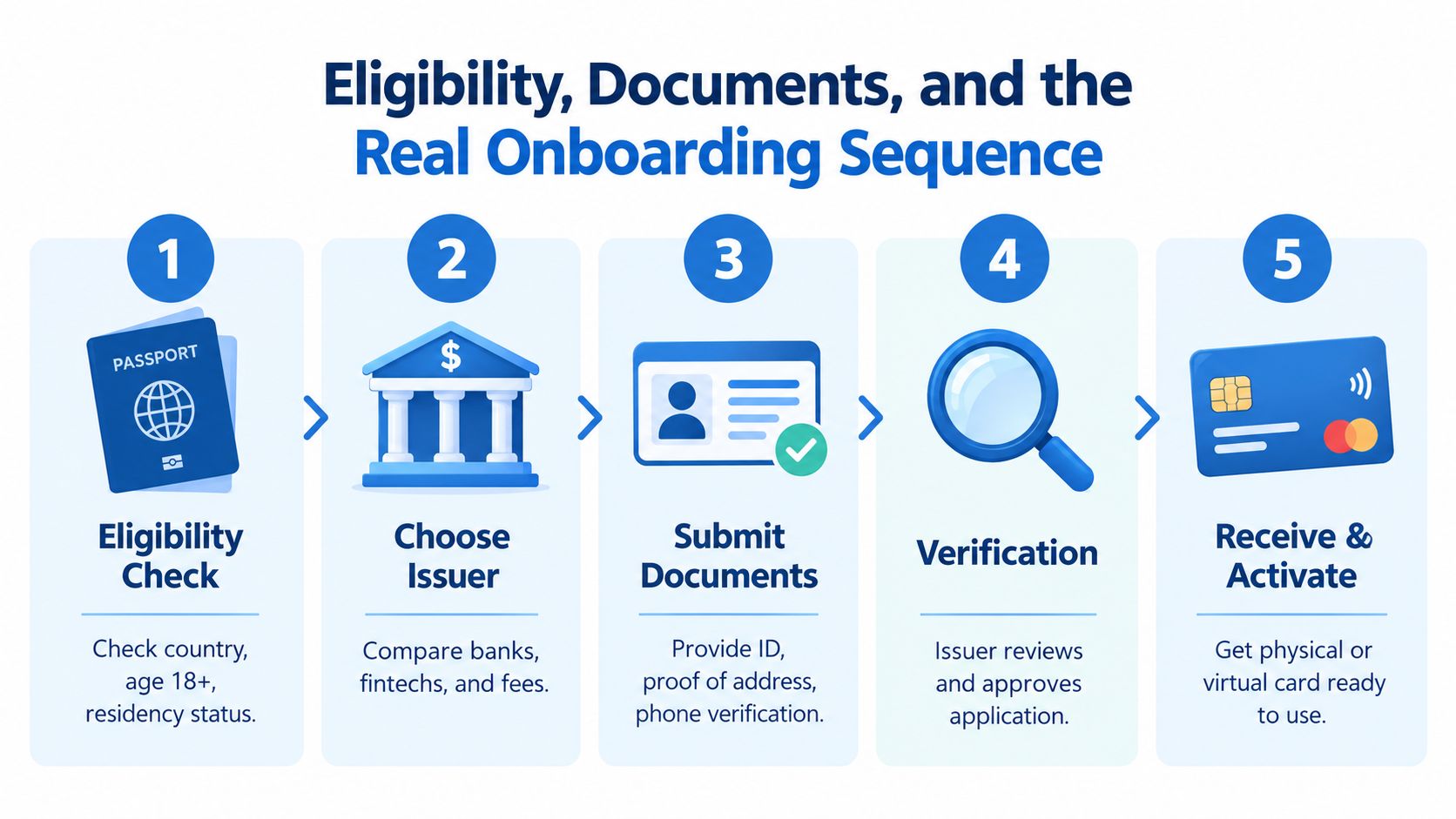
- Eligibility, Documents, and the Real Onboarding Sequence
- Fees, Limits, and What a Free Card Actually Costs You
- Activation, Wallet Linking, and First Use Without Surprises
- KYC, Privacy, and Crypto-Linked Mastercard Options
- Choosing the Right Mastercard Debit Path for Your Situation
Why Getting a Mastercard Debit Card Is Not What You Think
The logo on the card may be the same, but the experience behind it can be completely different. A conventional bank may issue a Mastercard debit card only after you open a transaction account. A fintech may let you apply through an app and issue a virtual card quickly. A prepaid provider may let you load funds without opening a traditional checking account, while a crypto-linked provider may convert digital assets into fiat when you spend.
Mastercard's role is the network layer. It routes authorized transactions between the issuer and the merchant. The issuer owns the customer relationship, performs onboarding, determines account rules, and handles questions about activation, disputes, balances, and fees. Mastercard itself directs consumers to contact their bank or credit union for a standard debit card, as reflected in the published Mastercard rules and consumer guidance.
That separation matters because acceptance and eligibility are different questions. Mastercard-branded cards are widely used globally. At the end of 2023, cards carrying global network brands reached 17.45 billion in circulation worldwide, up 5.0% from 2022, while Mastercard-branded cards were reported at 3.7 billion globally in 2026, according to Nilson Report market data. Those figures describe the scale of the network, not your likelihood of approval.

Practical rule: Choose the issuer first and the network second. The issuer determines whether the card fits your country, identity documents, funding method, and spending habits.
The four routes have different trade-offs. Bank cards suit people who want a conventional account and local banking services. Fintech cards prioritize app-based onboarding and flexible money management. Prepaid cards can work for limited-purpose spending, while crypto-linked cards suit users who already hold digital assets and accept conversion or custody conditions.
Types of Mastercard Debit Cards You Can Apply For
A Mastercard debit card isn't one uniform product. The logo tells you where the payment can be routed, but the funding model tells you how the account works.
Bank-issued debit Mastercard
This is the traditional route. You open a checking or transaction account with a bank or credit union, pass its identity checks, and receive a card linked to that account. It's usually the most suitable option for salaried users, direct deposits, recurring bills, local ATM access, and people who want a branch or established dispute process.
The trade-off is paperwork and eligibility. The bank may check residence, tax status, age, and account purpose before issuing the card. U.S. market concentration illustrates how mainstream this model is. The top 50 debit card issuers held 687.7 million debit and prepaid cards in circulation in 2023, and Bank of America, Wells Fargo, and JPMorgan Chase each recorded annual purchase volume of roughly $467 billion to $468 billion, according to issuer and network market data.
Fintech-issued Mastercard
Digital banks and e-money institutions offer an app-first alternative. You typically create an account remotely, submit identity documents, and manage the balance, card controls, and notifications in the app. This path suits digital-first applicants, travelers, and people who value instant virtual cards or granular controls.
Approval still depends on the provider's license, country coverage, and KYC policy. A quick interface doesn't mean no verification. Some providers may ask for residence evidence, tax information, or an explanation of funding.
Prepaid Mastercard
A prepaid card is funded before use. It may be sold through a retailer, distributed by a program manager, or connected to a limited account rather than a conventional bank account. This can suit one-off spending, controlled budgets, gifts, or users who don't need salary payments and overdraft features.
Read the fee schedule carefully. Prepaid products can charge for loading, replacement, inactivity, ATM use, or international spending. They may also have narrower limits and fewer account features than bank or fintech products.
Crypto-linked Mastercard
A crypto-linked card connects spending to a custodial exchange balance, a crypto account, or a self-custody wallet. Depending on the design, the provider may sell or convert crypto into fiat when you make a purchase. This route suits crypto holders who want everyday spending access without first transferring assets to a traditional bank.
The compromises involve volatility, conversion pricing, asset support, custody, and regulatory checks. A card that spends from a wallet isn't automatically anonymous or available in every country.
| Card Type | Underlying Account | Typical KYC Level | Best For |
|---|---|---|---|
| Bank-issued | Checking or transaction account | Full issuer verification | Salaried users and conventional banking |
| Fintech | Digital bank or e-money account | Digital identity verification, often with additional checks | App-first users and travelers |
| Prepaid | Pre-funded card balance | Varies by program and limits | Controlled spending and limited use |
| Crypto-linked | Custodial balance or connected crypto wallet | Varies, but regulated programs may require substantial checks | Crypto holders and self-custody users |
Eligibility, Documents, and the Real Onboarding Sequence
The first screening question isn't your credit score. It's whether the issuer serves your country of residence, age group, residency status, and tax-residency profile. A provider may accept citizens but reject applicants living abroad, require a valid residence permit, or limit applications to people with a local address.
Prepare the documents before you start. Most issuers repeatedly ask for a government photo ID and proof of address. Some also request a second identity document, a selfie, or a liveness check. Use the exact legal name and address format shown on your documents. A shortened street name, old address, or inconsistent transliteration can send an otherwise valid application into manual review.
The sequence that usually works
- Check eligibility. Confirm residence, age, supported document types, and whether the issuer accepts your funding method.
- Choose the issuer and open the underlying account. Specify the intended account or card type where the application asks for it.
- Verify contact details. Confirm your email address and phone number before uploading documents.
- Submit KYC materials. Provide ID images, address evidence, and any requested selfie or tax information.
- Wait for approval and configure the card. The issuer may set transaction, ATM, transfer, or currency parameters before issuing a physical or virtual card.
- Fund and activate. Add money through the permitted method, then create a PIN and enable the card.
This sequence reflects the operational pattern described in Mastercard debit-card issuing rules: open the account, pass verification, configure card parameters, fund the account where required, and activate it. If you're comparing crypto programs, this guide to crypto card KYC levels can help separate identity requirements from funding and custody requirements.
The most common delays happen when the issuer can't reconcile your information. Address mismatches, blurry document images, unsupported residence permits, and sanctions-screening reviews can all pause an application. Don't submit repeated applications while one is pending, because duplicate profiles can create another review.
Online onboarding dominates, but branches still matter in markets where local identity verification or an in-person account opening is required. If the app rejects your documents, check whether the issuer offers a branch route rather than assuming Mastercard itself can resolve the issue.
Fees, Limits, and What a Free Card Actually Costs You
A “free Mastercard debit card” usually means one visible fee is waived. It doesn't guarantee free withdrawals, foreign spending, replacement, inactivity, loading, or account maintenance.
Start with the issuer's complete schedule. Look for the card fee, monthly account fee, ATM withdrawal charge, overseas cash fee, replacement cost, foreign-currency conversion terms, funding fee, and any inactivity rule. Some issuer disclosures list new-card issuance, annual, replacement, and overseas cash-withdrawal charges, with waivers limited to particular account segments, as shown in this published debit-card fee disclosure.
Network fees generally aren't billed to you as a separate line item. They sit within the wider economics paid by issuers and merchants. Published schedules include small transaction-level charges, such as a card validation code fee of about $0.0025 and assessment-style fees of roughly 0.1275% to 0.1475% plus a fixed amount in some cases, based on the same issuer fee document. Your practical concern is the issuer's pass-through pricing, not the network assessment itself.
| Fee Type | Bank-Issued | Fintech | Prepaid | Crypto-Linked |
|---|---|---|---|---|
| Card issuance | May be waived by account tier | Often promotional or account-dependent | Commonly program-dependent | May apply to physical cards |
| Monthly or annual fee | Linked to account package | Depends on plan | May include maintenance or inactivity fees | May depend on custody or plan |
| ATM use | Local and overseas charges may apply | Often tiered by plan and region | Frequently limited or fee-bearing | May combine issuer and operator charges |
| Foreign spending | Bank FX policy applies | Rate and markup vary | Often less favorable | Conversion spread or crypto-sale cost may apply |
| Replacement | Usually charged after loss or damage | Depends on plan | Often charged | May include delivery costs |
Calculate cost from behavior, not the headline. List your expected ATM withdrawals, foreign purchases, physical-card replacements, and months of inactivity, then apply the issuer's schedule. The “free” option may be sensible for card-only domestic spending but poor for frequent cash use or cross-border purchases. For crypto products, compare the entire conversion and custody model using this crypto card fees comparison, not just the advertised card fee.
Activation, Wallet Linking, and First Use Without Surprises
Approval doesn't mean the card is ready for every transaction. Open the issuer app or activation instructions and follow the exact sequence. Depending on the provider, you may create the PIN in the app, through an automated phone system, or during the first ATM transaction.
Online payments can require 3D Secure enrollment. Complete the issuer's verification prompt before you travel or attempt a large purchase. If the card supports Apple Pay, Google Pay, Samsung Wallet, Garmin Pay, or a smartwatch wallet, add it from the issuer app or wallet interface. The wallet creates a tokenized payment credential, so the number displayed in the wallet may not match the number printed on the physical card.
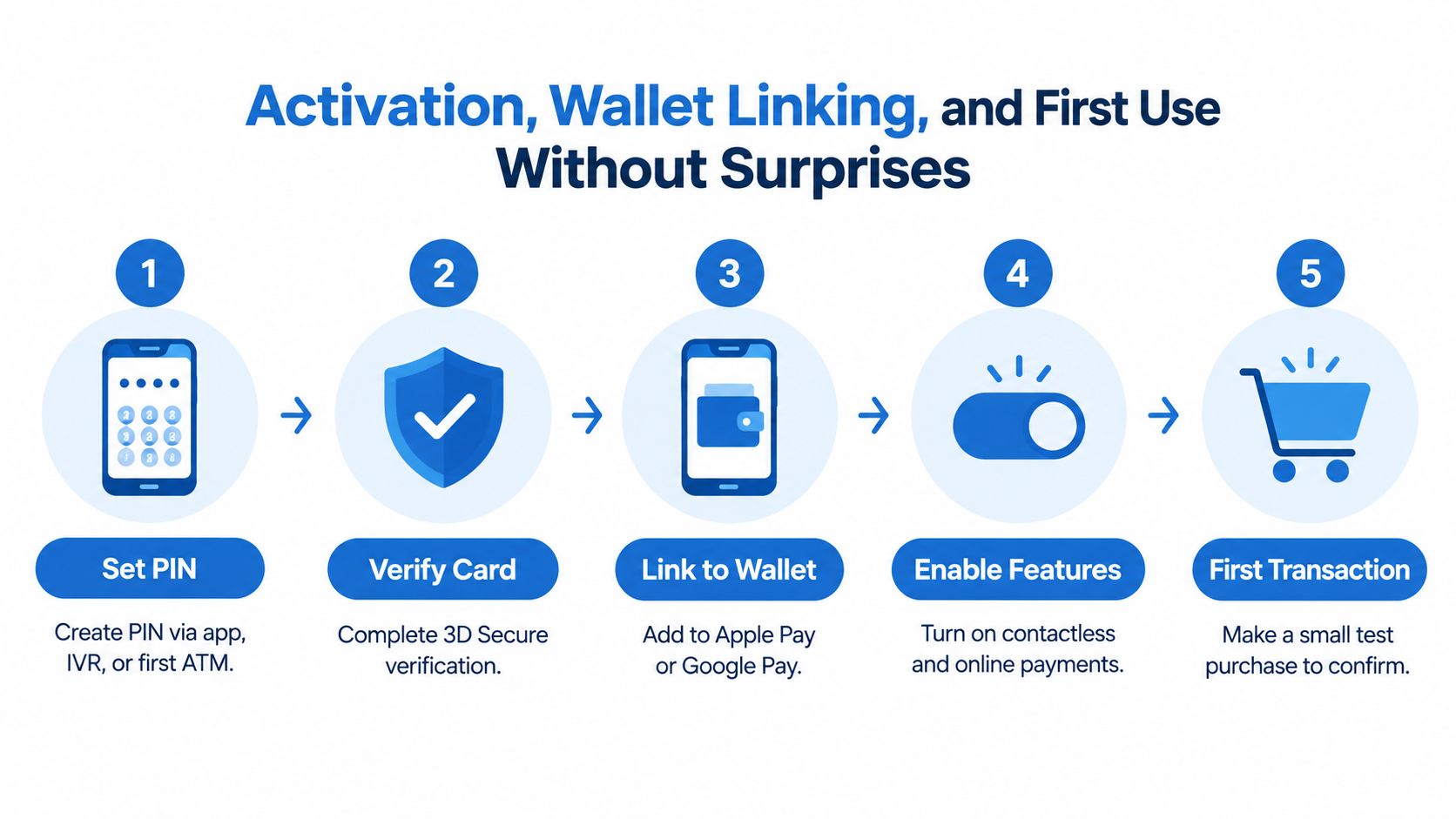
Contactless payment may be disabled until the first chip-and-PIN transaction. Terminals abroad can also ask for chip insertion and PIN even when contactless worked at home. Keep the physical card and PIN available, especially when a merchant or transit terminal doesn't support your wallet token.
A fast first-transaction diagnostic
- Online purchase declined: Check that online payments and 3D Secure are enabled, then confirm the billing address and postal code match the issuer's records.
- ATM doesn't dispense cash: Check the withdrawal setting, available balance, local ATM compatibility, and daily limit. Cancel rather than retrying repeatedly if the machine behaves unexpectedly.
- Foreign-currency prompt appears: Review the conversion screen and avoid accepting a merchant's conversion automatically if your issuer provides a different rate.
- Fraud hold appears: Open the issuer app or contact the support channel shown on the card. Don't keep retrying a transaction that the issuer has blocked.
- Wallet link fails: Confirm the card and device region are supported, update the issuer app, and try adding the card through the issuer rather than typing the printed details.
Run a small test purchase before relying on the card for a hotel, flight, or major purchase. It confirms activation, balance availability, online controls, and notification delivery while you still have time to contact the issuer.
The following video provides a visual walkthrough of common card setup steps:
KYC, Privacy, and Crypto-Linked Mastercard Options
Not every Mastercard debit product uses the same identity process. A conventional bank normally performs full KYC, which can include photo identification, address verification, tax information, and questions about the source or purpose of funds. A fintech may make the process feel lighter through electronic verification and a selfie, but the underlying compliance obligation hasn't disappeared.
Prepaid and crypto-linked products sit across a broad spectrum. Some lower-limit programs may start with contact details and limited verification, while others require full identity checks before loading, withdrawing, or using the card internationally. The benefit of lighter onboarding is convenience or reduced document sharing. The cost can be lower funding limits, restricted countries, fewer fiat features, weaker recovery options, or no conventional bank account.
Crypto holders should separate self-custody funding from anonymous spending. A self-custody-friendly card may let a provider convert assets from a connected wallet at the point of payment, but the card issuer, program manager, or regulated partner may still need to identify you. Custody also matters. A custodial card can be convenient because the provider manages conversion and settlement, while a wallet-connected design may reduce the need to pre-fund a centralized balance but can introduce different transaction and support considerations.
Privacy-friendly doesn't mean verification-free. Ask exactly what the provider checks, when it checks it, and what happens if your account reaches a higher usage threshold.
The phrase “no KYC” deserves skepticism. Issuers face identity, sanctions, and transaction-monitoring responsibilities, and a product that appears lightly verified can tighten its rules after launch or restrict certain countries and transaction types. A practical crypto card compliance guide is useful for understanding why card programs apply these controls. For comparison purposes, review no-KYC crypto card options as a category, then read each issuer's current terms rather than relying on a label.
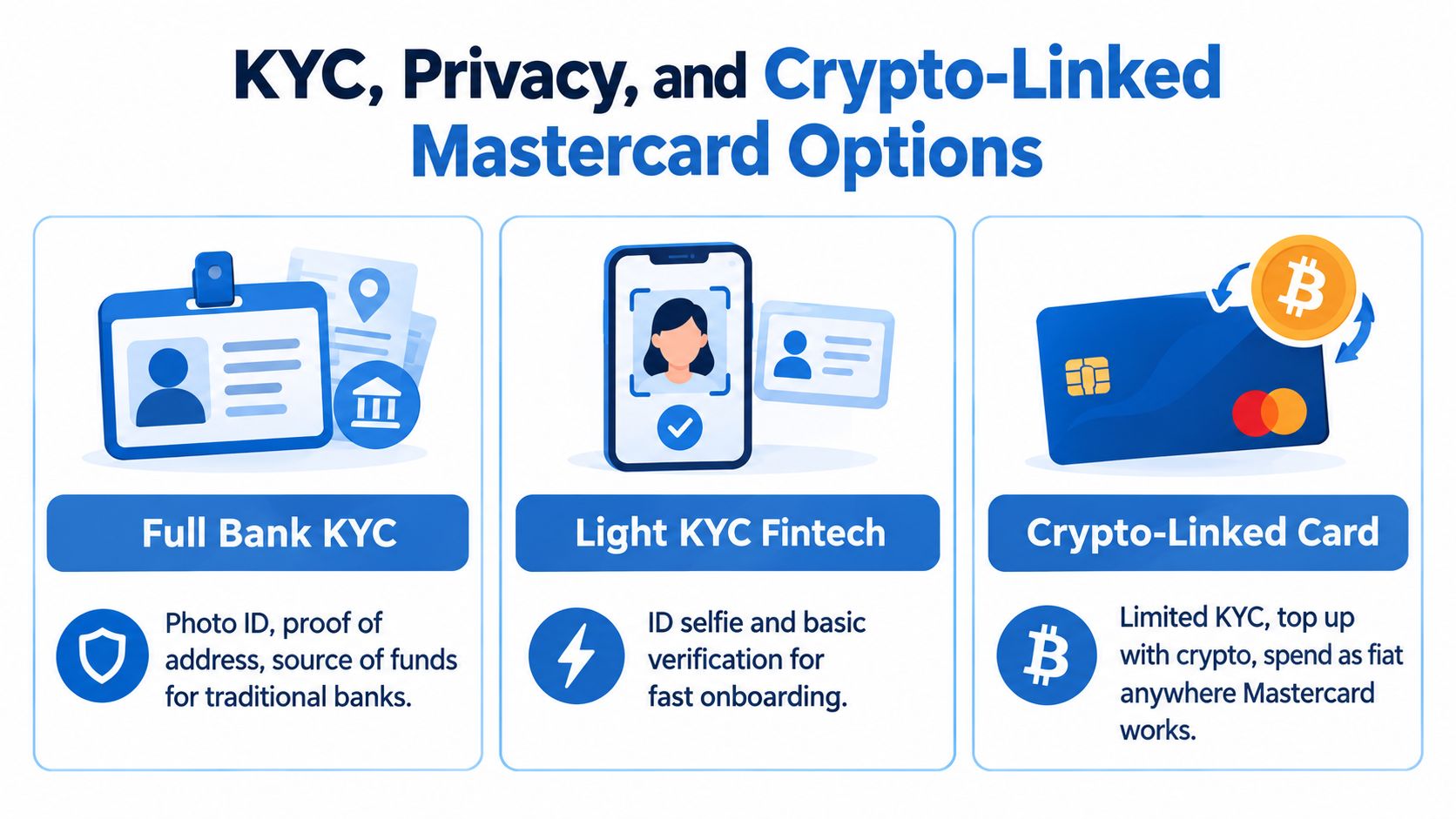
Privacy-sensitive applicants should decide which information they can realistically provide. If you can't provide proof of residence, a fully regulated bank route may fail immediately. A prepaid or wallet-linked route may offer a different starting point, but you should accept that lower verification can come with narrower access, funding restrictions, and less predictable availability.
Choosing the Right Mastercard Debit Path for Your Situation
Start with geography. A Mastercard network can operate across borders, but issuers decide where they onboard residents. Check your country, local address requirements, residence permit rules, supported currency, and delivery availability before completing an application. Country-specific restrictions can include residence or visa conditions, age requirements, linked account rules, and limits on overdraft or currency denomination.
Next, decide whether you need a real transaction account or only a spending instrument. If your salary, bills, and regular transfers need to flow through the account, a bank-issued card is usually the clearest fit. If you want app-based controls, a virtual card, or travel-oriented money management, a fintech may be more practical. If you only need a controlled balance for limited spending, evaluate prepaid products. If your funds already sit in crypto and you understand conversion and custody, a crypto-linked card may remove an unnecessary transfer step.
Your KYC tolerance is the third filter. Full bank verification offers the broadest conventional account functionality, while lighter processes may impose tighter limits or fewer services. Don't choose a provider solely because an advertisement says “no KYC.” Confirm what happens at application, funding, card delivery, withdrawals, and account closure.
A pre-application checklist
- Residence: Does the issuer accept your current country and document type?
- Account model: Are you opening a bank, e-money, prepaid, custodial crypto, or wallet-connected account?
- Funding: Can you use your preferred bank transfer, card, or crypto wallet?
- Wallet support: Does the physical or virtual card work with the mobile wallet and device you use?
- Cash access: Are compatible ATMs available in your home country and travel destinations?
- Cost ceiling: What monthly, annual, ATM, FX, replacement, and inactivity charges could apply?
- Exit policy: Can you close the account easily, and how will you withdraw or recover remaining funds?
A bank-issued card is usually the least surprising choice for conventional income and domestic banking. A fintech card fits applicants who prioritize remote management. Prepaid works when the use case is narrow, and crypto-linked cards make the most sense when the funding source and custody model already match your habits.
NomadCards compares crypto-linked debit and credit programs by network, KYC requirements, custody model, supported assets, fees, wallet support, and regional availability. Visit NomadCards to compare the available Mastercard paths before you submit documents or move funds.