Most full-KYC crypto card applications begin with a government-issued photo ID, and many also request proof of address, a selfie or liveness check, and further financial or source-of-funds information. The exact combination depends on the issuer, your country and residency status, the card type, and the limits attached to your account.
The popular advice that “you just need a passport” is incomplete. A crypto card provider may accept a passport, national identity card, or driving licence for identity, then ask for a recent address document, tax identifier, bank evidence, or an explanation of where your funds come from. Credit products and higher-risk reviews can add more questions, while prepaid products may request less information.
A practical KYC documents list should therefore separate the documents that establish who you are from the evidence that explains where you live, how you earn money, and how you intend to use the card. The United States Customer Identification Program provides a useful baseline, requiring a customer's name, date of birth, address, and identification number, alongside defined identity-verification documents such as government-issued photo identification. The federal CIP rule also allows formation and ownership records for non-individual customers.
Requirements vary by jurisdiction, card tier, custody model, and product availability. Privacy-sensitive users may prefer email-only or no-KYC alternatives, but those labels don't automatically guarantee broad access, high limits, or anonymity. NomadCards provides a comparison point because its filters distinguish No KYC, Email only, and full KYC, alongside regions, supported assets, networks, and custody models. For background on the wider verification process, see this digital identity guide.
Table of Contents
- 1. Government-Issued Photo ID
- 2. Proof of Address
- 3. Proof of Income or Employment
- 4. Bank Account Details and Statements
- 5. Tax Identification Number or Social Security Number
- 6. Selfie or Liveness Verification
- 7. Source of Funds Declaration or Questionnaire
- 8. Video Verification Call or Enhanced Due Diligence Documentation
- 8-Item KYC Documents Comparison
- Choose the Verification Level You Can Live With
1. Government-Issued Photo ID
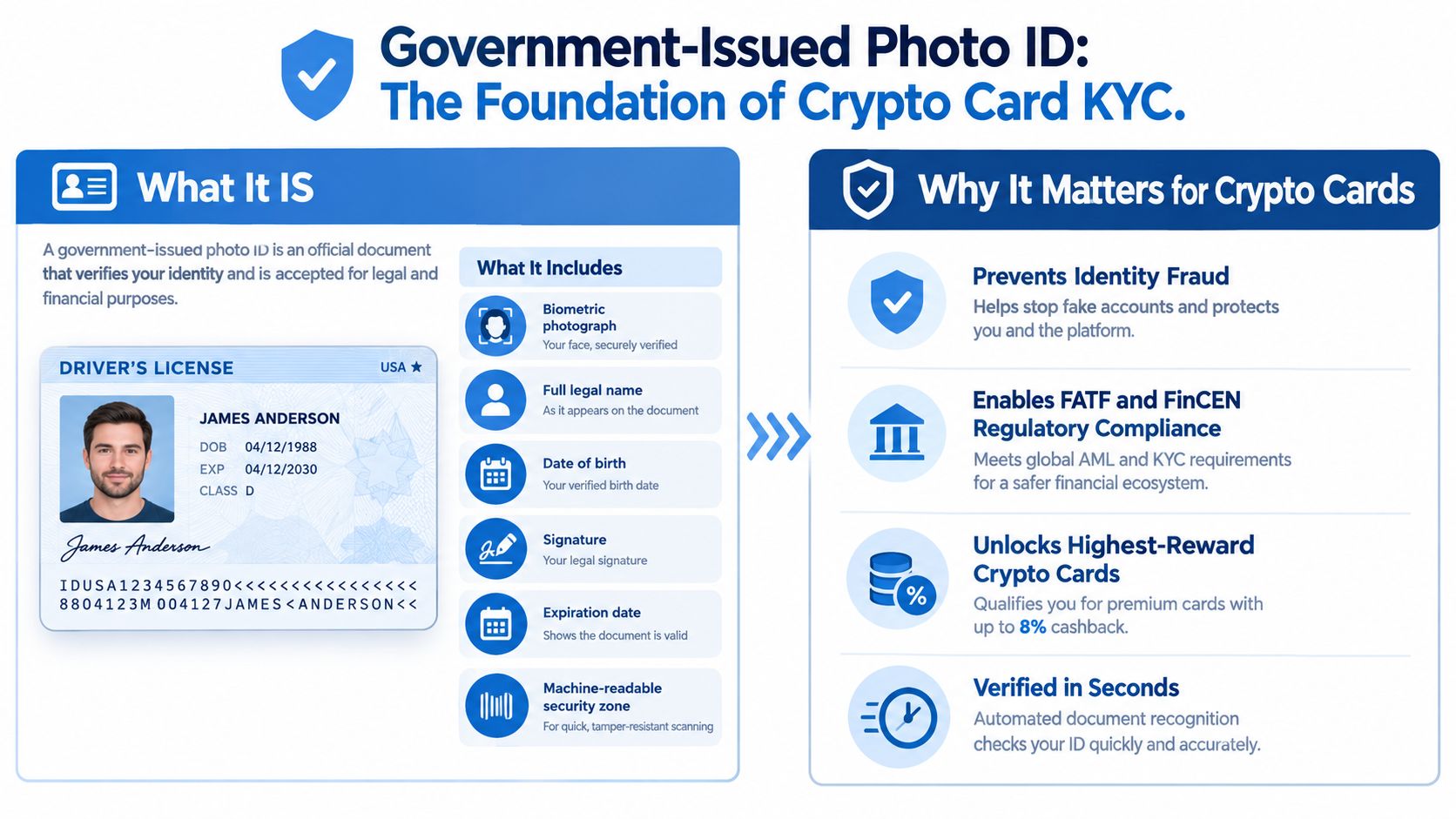
A photo ID establishes who is applying, but it does not explain where that person lives or how funds will be used. Crypto card issuers commonly request a passport, national identity card, driving licence, or residence permit showing your legal name, date of birth, photograph, and document number. Some documents also show a signature or nationality. Acceptance varies by issuer, country of application, and residency status.
The United States Customer Identification Program illustrates the structure behind this request. Covered banks must collect a customer's name, date of birth, address, and identification number, then define the documents accepted for identity verification. For individuals, the rule identifies unexpired government-issued identification showing nationality or residence and a photograph, such as a passport or driving licence. The FFIEC rule text provides a useful reference for this onboarding model, although a crypto card program may apply different operational checks.
What to check before uploading
Automated document review can reject an otherwise valid application when the image is blurry, glare covers the machine-readable zone, corners are cropped, or the document has expired. Keep your legal name consistent with later proof of address and bank records. A mismatch can create manual review even when the ID itself is valid.
Practical rule: Check the issuer's accepted document types for your country and residency status before taking a photograph. Identity evidence accepted in one market may not qualify for a particular card program.
Use a secure device, and avoid storing identity images in an unprotected camera roll or shared cloud folder. Nomads should separate nationality evidence from residence evidence. A passport may confirm citizenship while leaving the issuer to request another document for current residence, custody access, or product limits.
The crypto card KYC friction ranking compares flows labelled No KYC, Email only, and full KYC, along with regions, supported assets, networks, and custody models. Treat it as a comparison aid, not an approval promise. The issuer's current document list and review decision remain decisive.
2. Proof of Address
Proof of address answers a different question from photo ID. It shows where you currently live, which can determine the legal entity responsible for your account, the markets where the card can be issued, and whether the provider can deliver a physical card. It can also help the issuer assess whether your application is consistent across identity and jurisdiction data.
Common examples include a bank statement, utility bill, mortgage statement, council tax bill, rental document, or government correspondence. UK public guidance reflects the broadly convergent pattern used across many KYC flows: one primary identity document with a photograph and signature, plus recent address evidence. The guidance says bank statements should generally be dated within the last 3 months, mortgage statements within the last 12 months, and utility bills generally less than 3 months old. The UK KYC guidance gives the clearest practical examples of document age and type.
The nomad problem
Digital nomads often have a genuine residence but weak conventional evidence. A virtual office, hotel booking, or mailing address may not satisfy a card issuer's residential-address requirement. A lease, government letter, or statement from a regulated financial institution may be more useful, but you'll need to check the product's rules rather than assume every alternative works.
Make sure the address is complete and consistent. Differences in transliteration, apartment numbers, abbreviations, or a former residence can trigger a request for another document. A recent digital statement may be easier to submit than a paper scan, but it still needs to show your name, address, issuer, and date clearly.
3. Proof of Income or Employment
Income evidence isn't part of every basic card application. It becomes more plausible when the product involves credit, when the provider is assessing repayment capacity, when transaction limits are raised, or when the compliance team needs to understand expected account activity.
A provider may accept a payslip, employment contract, tax return, employer letter, business registration record, or bank statement showing regular deposits. Freelancers and self-employed applicants face a different documentation problem from salaried employees. They may need to connect income to a registered business, tax filing, client payments, or another credible record rather than produce a conventional payslip.
Match the document to the income source
The strongest submission tells one consistent story. If your stated occupation is freelance design, but the supporting evidence shows only unrelated transfers, expect questions. If your funds come from several sources, explain each material source and provide the relevant evidence only when requested.
- Employees: A recent employer record or payroll document may establish both employment and recurring income.
- Freelancers: Tax records, contracts, invoices, or an accountant's confirmation may better explain irregular payments.
- Business owners: Incorporation or registration documents can establish the business, while statements or accounts show its financial activity.
- Crypto earners: Exchange records or blockchain transaction history may help explain trading, staking, mining, or other activity, but acceptance is issuer-specific.
Don't upload more sensitive financial material than the provider asks for. A prepaid card may not need an income assessment, while a credit-linked product can require deeper affordability or risk checks. Treat the request as a signal about the product's structure, not as proof that every crypto card follows the same process.
4. Bank Account Details and Statements
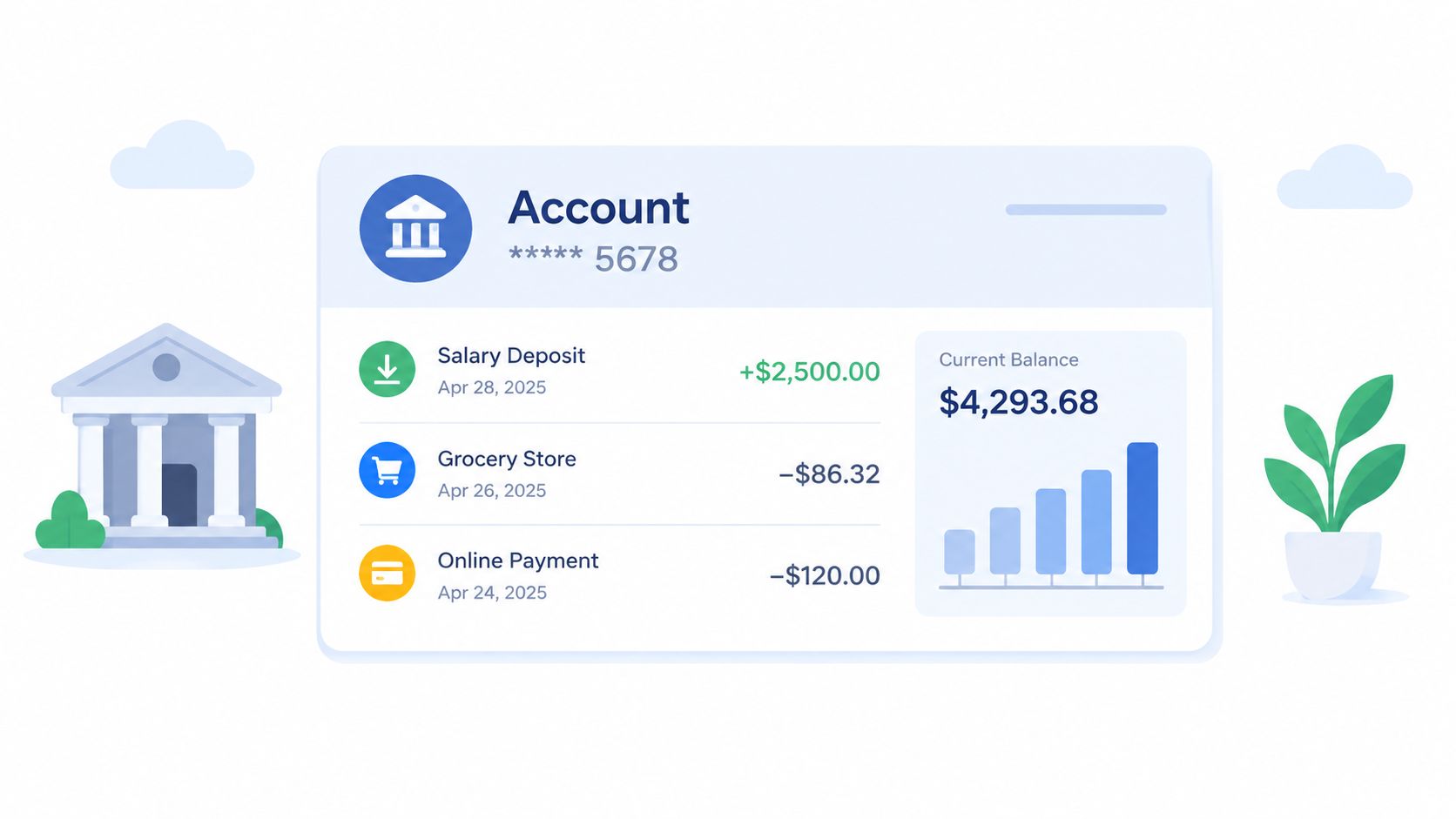
Bank evidence can serve several purposes at once. It may confirm your name and address, show how money enters the account, support a transfer into the card balance, or help the issuer understand whether your declared financial profile matches actual activity.
A statement from a licensed bank or accepted payment institution commonly shows the account holder, account details, statement date, and transaction history. An account-verification letter may establish ownership without exposing a full transaction record, but some providers will ask for more if a transfer or source-of-funds review is underway.
Protect the financial trail
Don't edit a statement to hide inconvenient transactions. Redaction may be appropriate when the issuer expressly allows it, but altering dates, balances, or transaction descriptions can undermine the document's credibility. If a large transfer is legitimate, keep the supporting explanation available, such as a sale agreement, investment statement, or exchange withdrawal record.
A fintech account may work for one card provider and fail for another. Check whether the issuer accepts electronic-money institutions, payment processors, or exchange-linked accounts before you connect one. You should also make sure the account name matches your identity documents exactly, including middle names where applicable.
For privacy-focused users, the trade-off is straightforward. A no-KYC or email-only product may avoid this type of financial disclosure, but it may not provide the same funding methods, limits, card features, or regional access. NomadCards' guide to safe no-KYC crypto cards is relevant for comparing that exposure against the practical limits of reduced verification. If a statement requires translation, use a provider focused on accurate financial document translation.
5. Tax Identification Number or Social Security Number
A tax identification number links the customer to a national tax-reporting system. In the United States, this may be a Social Security number or another taxpayer identifier. Elsewhere, the equivalent could be called a TIN, national identification number, or individual taxpayer reference.
Not every crypto card uses the same tax fields, and the timing can differ by country and product. A provider may request the identifier during onboarding, before enabling particular features, or when tax reporting obligations apply. For a business account, the company's tax details may sit alongside the personal information of directors or beneficial owners.
Treat this as high-sensitivity data
A TIN or SSN deserves more caution than an ordinary marketing form. Before submitting it, confirm that you're dealing with the issuer or its named verification partner, review the privacy notice, and understand whether the data is transferred across borders or retained after a decision.
- Check jurisdiction: Use the tax identifier issued by the country relevant to the account and tax relationship.
- Check spelling: The name and date of birth should align with the rest of your application.
- Check purpose: Look for a clear explanation of tax reporting, regulatory identification, or account administration.
- Check security: Review the provider's stated controls, retention practices, and data-sharing disclosures.
Don't assume that providing a tax number makes your crypto activity tax-free or automatically taxable. Tax treatment depends on the relevant law and the nature of the transaction. The document's purpose is identification and reporting, not a promise about your personal tax outcome.
6. Selfie or Liveness Verification
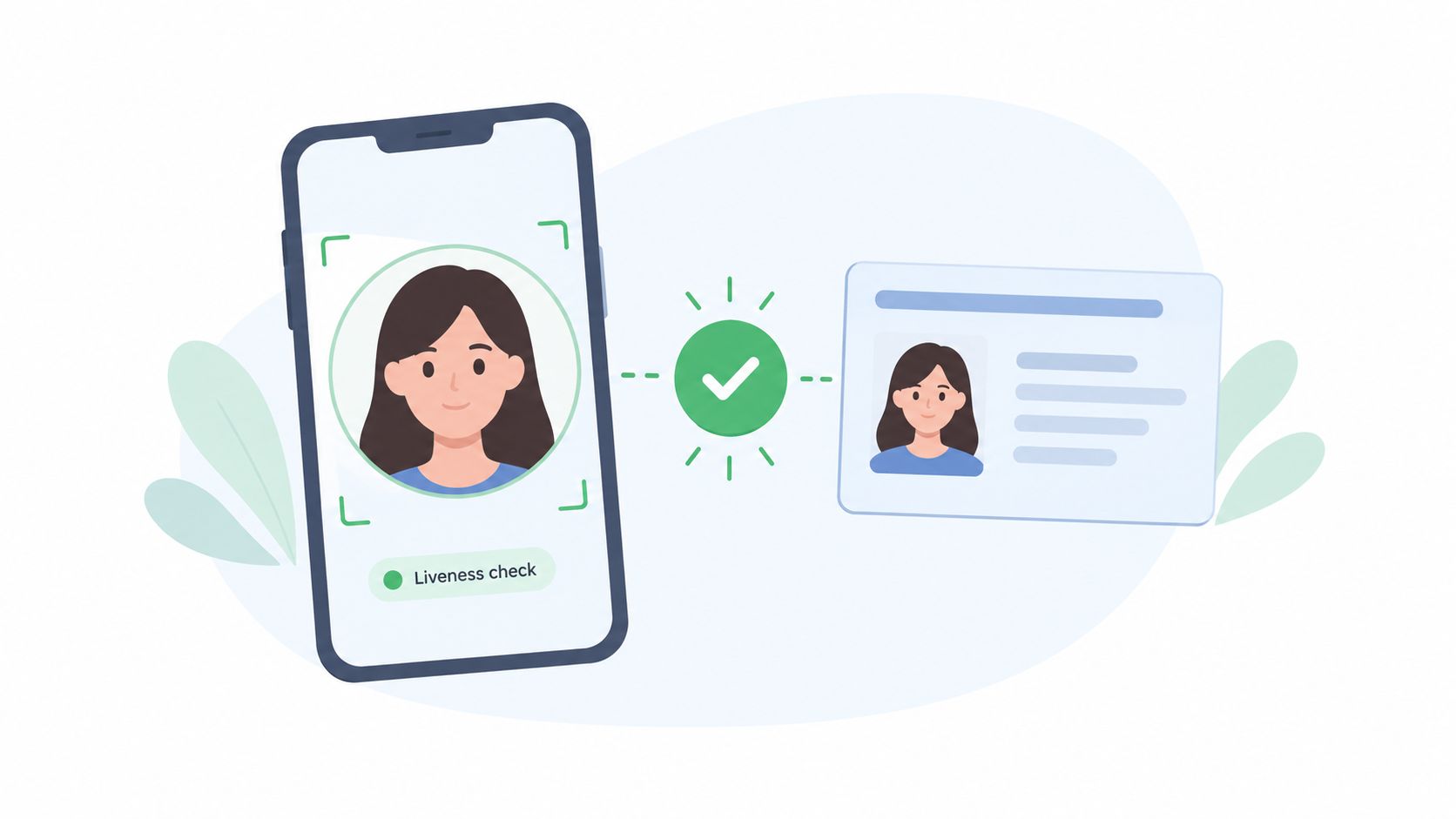
A selfie or liveness check connects the person holding the device to the identity document submitted earlier. The process may ask you to take a live selfie, turn your head, follow an on-screen prompt, or hold your document in view. The provider is testing whether a real person is present and whether that person resembles the photograph on the ID.
This step changes the privacy calculation. You aren't only disclosing an identity document. You may also be processing facial imagery through a verification vendor, with rules about storage, retention, deletion, and reuse that differ by provider and jurisdiction.
Why older scans may fail
Verification systems increasingly look for stronger authenticity signals rather than relying only on a printed image. A report cited by BetaNews on digital identity fraud says Veriff flagged 4.18% of digital identity checks in 2025 as fraudulent. The same report says Sumsub identified ID cards as 72% of detected fraudulent documents in 2025, while liveness-style checks grew by more than 338% year over year. These figures help explain why issuers may reject screenshots, insist on live capture, or route applicants to NFC-enabled passport checks.
Good lighting, a clean camera lens, and an uncovered face can reduce avoidable failures. Remove sunglasses, hold the ID steady, and follow the movement prompts exactly. If the check fails, changing the lighting or camera angle may help, but repeated failures should lead you to contact the provider rather than repeatedly uploading sensitive images.
7. Source of Funds Declaration or Questionnaire
A source-of-funds questionnaire asks how you obtained the money or crypto you plan to use. Typical categories include employment, business revenue, investments, inheritance, trading, staking, mining, or other digital-asset activity. The question isn't necessarily an accusation. It helps the issuer compare your expected use with later transactions and decide whether additional evidence is needed.
A source-of-funds explanation is different from proof of income. Income describes how you regularly earn money. Source of funds describes the origin of the particular money entering or moving through the account. An investor may have little employment income but substantial documented assets. A trader may need exchange statements and a clear account of how the assets were acquired.
Consistency matters more than polished wording
Answer plainly and accurately. If you earn crypto through several activities, describe the relevant activity instead of choosing a vague category that doesn't fit. If a transfer comes from a business account, explain the business relationship and beneficial ownership rather than presenting the payment as personal salary.
A source-of-funds answer should explain the transaction you expect, not merely repeat your job title.
Follow-up questions can cover the purpose of the card, expected activity, counterparties, or the reason for a large transfer. Politically exposed persons and applicants connected to higher-risk jurisdictions may face enhanced review, but you shouldn't infer that a request means rejection is inevitable. The best response is a coherent explanation supported by documents the issuer can verify.
8. Video Verification Call or Enhanced Due Diligence Documentation
Enhanced due diligence is the escalation path for applications that need more than routine document matching. It may involve a live video call, additional beneficial-owner information, transaction-purpose questions, background screening, or further evidence about wealth and funds.
This review can arise from a higher-risk profile, a cross-border situation, unusual transaction activity, a politically exposed person connection, or inconsistencies in the initial submission. It can also happen because the product's compliance model requires human review for a particular applicant. Avoid assuming that every provider uses a fixed transaction threshold, because those thresholds and triggers are issuer-specific.
Prepare for a human conversation
Have your submitted ID, address evidence, bank records, and source-of-funds explanation available. The reviewer may ask you to explain your occupation, expected card use, funding route, or relationship to a business account. Answer directly, and ask for clarification if a question is unclear.
Don't send an interviewer documents through an unverified channel. Use the provider's official application or support process, and check whether the call is recorded, how biometric or video data is retained, and which verification vendor processes it. Guidance on detecting deepfakes in video KYC is useful background for understanding why live interaction and authenticity checks are becoming more common.
NomadCards' explanation of crypto card KYC levels provides a useful way to think about layered verification. Email-only access may sit at the lightest end, while full KYC and enhanced review add identity, address, biometric, and funds information as the account's risk or functionality increases.
8-Item KYC Documents Comparison
| Document | UX & Speed ★ | Privacy Risk ★ | When required / Typical use | 👥 Target | ✨ Unique notes / 🏆 |
|---|---|---|---|---|---|
| Government‑Issued Photo ID | ★★★★☆, fast automated checks | ★★★★☆, biometric data stored | Full KYC; card issuance & identity proof | 👥 All users seeking full‑KYC cards | ✨ Machine‑readable, widely accepted; 🏆 unlocks top rewards |
| Proof of Address | ★★★☆☆, moderate (depends on doc) | ★★★★☆, reveals residence | Enhanced KYC; card delivery; regional eligibility | 👥 Residents, card delivery recipients, some nomads | ✨ Digital proofs accepted by many issuers; important for regional features |
| Proof of Income / Employment | ★★☆☆☆, slower, document heavy | ★★★★★, sensitive financial data | Credit cards, high limits, rewards tiers | 👥 Credit applicants; high‑limit seekers | ✨ Enables higher credit & rewards; 🏆 required for premium credit products |
| Bank Account Details & Statements | ★★★★☆, fast with bank APIs | ★★★★★, reveals transaction history | Funding/withdrawals; source‑of‑funds; AML checks | 👥 Users linking fiat banks or fintech accounts | ✨ Instant bank verification; 🏆 essential for fiat on/off ramps |
| Tax ID (TIN / SSN) | ★★★★☆, simple input but high consequence | ★★★★★, most sensitive identifier | Tax‑reporting jurisdictions; long‑term accounts | 👥 Residents in tax jurisdictions; long‑term users | ✨ Enables tax reporting (1099); ⚠️ filter for "No TIN required" users |
| Selfie / Liveness Verification | ★★★★★, instant mobile onboarding | ★★★★☆, biometric storage concern | Standard onboarding; ID match & fraud prevention | 👥 Mobile‑first users wanting fast approval | ✨ Liveness detection reduces fraud; 🏆 fastest approvals |
| Source of Funds Declaration / Questionnaire | ★★★☆☆, quick form; may trigger review | ★★★★☆, personal financial details | AML checks; crypto income scrutiny; high‑value tx | 👥 Crypto earners, high‑value transactors | ✨ Simple but can prompt EDD; useful audit trail |
| Video Verification Call / EDD Documentation | ★☆☆☆☆, time‑consuming (scheduled) | ★★★★★, deep privacy intrusion | High‑risk accounts, PEPs, very high limits | 👥 HNWIs, flagged users, PEPs | ✨ Highest confidence verification; 🏆 required for largest limits; 💰 resource‑intensive |
Choose the Verification Level You Can Live With
Start with the issuer's accepted documents for your country, citizenship, and actual residence. Don't begin by scanning every record you own. First confirm whether the provider accepts your passport, national ID, or driving licence, then identify which recent address documents it accepts and whether the address must match a particular jurisdiction.
Next, identify the card's structure. A prepaid card, debit card, credit card, secured card, and self-custodial card can create different verification expectations. A product that spends from a linked wallet may handle custody differently from one tied to a centralized exchange account, while a credit product may need income or affordability evidence that a prepaid product doesn't request.
Then look for possible second-stage requirements. The core application may ask only for identity and a selfie, but the provider can later request proof of address, a tax identifier, bank evidence, or source-of-funds information. A clear KYC documents list should therefore include both the documents requested at sign-up and the evidence that could reasonably follow if you change your limits, funding pattern, country, or product tier.
Document-upload onboarding deserves special attention because it can lose applicants at the point where they photograph or submit their records. Independent research summaries place abandonment at about 15% to 30% at the identity-document step and 30% to 68% across document-upload implementations. The cited onboarding-friction summary identifies unclear requirements, capture errors, and re-upload loops as practical causes of abandonment. For applicants, the lesson is simple: prepare the exact document type, use clear original images, and avoid submitting a substitute until the issuer confirms it works.
Regional eKYC can change the experience substantially. A 2026 India benchmark reported Aadhaar eKYC accuracy above 99% for OTP authentication and above 97% for biometric authentication. The benchmark discussion suggests why products with access to government-backed eKYC rails may reduce manual document handling, while globally distributed issuers may still require passport, selfie, and address uploads.
India also shows why country-specific rules matter. Full-KYC onboarding can involve proof of identity, proof of address, a separate PAN card, and photographs, while the RBI-recognized valid document set is narrowly defined. The regional document guidance lists Aadhaar, passport, voter ID, driving licence, an attested NREGA job card, and an NPR letter among the relevant documents. A document can therefore be valid identity evidence and still be insufficient for the complete account-opening process.
Email-only and no-KYC cards may reduce exposure to identity documents and biometric data, but the trade-off can include narrower regional availability, lower functionality, different custody arrangements, or issuer-specific limits. Don't treat a privacy label as a guarantee of anonymity. Verify the current terms, card network, supported assets, funding method, fees, and withdrawal conditions before moving funds.
NomadCards can help you compare verification labels, regions, networks, supported assets, fees, custody models, and availability in a standardized way. Use it as a research layer, then open the issuer's own terms and accepted-document page before applying, because card programs and geographic access can change.
NomadCards brings crypto-linked card information into one comparison view, including No KYC, Email only, and full KYC labels, regional availability, supported assets, networks, fees, and custody models. Visit NomadCards to narrow the options that fit your privacy preferences and prepare the right documents before you apply.