No-KYC crypto means a service that asks for no conventional ID, such as a passport, at signup, but identity checks can still appear when you fund, spend from or withdraw from it. The useful question isn't whether a product carries a no-KYC label, but whether it remains usable when a regulated partner asks who you are.
Popular advice starts with finding the service that requests the least information. That's incomplete. A privacy-conscious choice also needs a workable exit, clear limits and a recovery process you can actually use.
Table of Contents
- What No-KYC Crypto Actually Means
- Where Identity Checks Actually Happen
- No-KYC Cards, Exchanges and Wallets Side by Side
- Custody Models and Who Controls Your Funds
- Legal and Privacy Risks Worth Knowing
- Regional Rules and Choosing a Setup Without Getting Frozen Out
What No-KYC Crypto Actually Means
No KYC is a verification status, not a legal category or an anonymity guarantee. It describes what a provider doesn't collect at a particular stage. It doesn't establish what the provider may request later, what its partners require or whether your activity remains visible elsewhere.
Historically, self-custody wallets, decentralized exchanges and peer-to-peer markets offered alternatives to the identity-based onboarding used by centralized financial services. Those alternatives serve legitimate privacy preferences, but regulated providers also face financial-crime risks. CNBC's reporting on Chainalysis estimates put cryptocurrency transfers linked to illicit activity at approximately $24.2 billion in 2023, based on addresses identified at that time.
That amount measures identified illicit activity, not no-KYC usage. It explains compliance pressure without establishing that privacy-seeking users are criminals.
Verification levels and what each one asks for
Think of a club. Some venues check a name at the entrance, others require ID before opening a bar tab, and others ask for documents only when someone requests a larger tab.
Crypto services can place their checks at similarly different points. These labels describe illustrative entry tiers, not standardized promises.
| Verification level | What you hand over | Typical services | Main trade-off |
|---|---|---|---|
| No KYC | Wallet address or wallet connection, without conventional ID | Self-custody wallets and decentralized exchanges; some advertised prepaid programs | Limited fiat access and fewer provider-based protections |
| Email only | Email address; sometimes a phone number | Some prepaid cards and entry-level exchange accounts | Restricted spending or withdrawals until an upgrade |
| Light KYC | Name, date of birth and an ID-document check | Exchange and card-program onboarding tiers | More access, but an identity record |
| Full KYC | ID, with address and source-of-funds evidence where requested | Regulated issuers and enhanced-review accounts | Broader service access with more disclosure |
Practical rule: Treat every verification label as a description of a specific service stage, not a permanent exemption.
For cards, exchanges and wallets, the same distinction matters: a document-free beginning doesn't describe the whole relationship.
Where Identity Checks Actually Happen
A building can have an open front door and a locked vault. Opening an account tells you little about the conditions for moving money out.
The Legal 500's analysis of crypto-card regulation describes overlapping crypto, payment-services and anti-money-laundering obligations. It identifies why verification can arise through the card issuer or payment partner even when the wallet itself never requests identification.
The timeline below separates account access from access to the payment infrastructure.
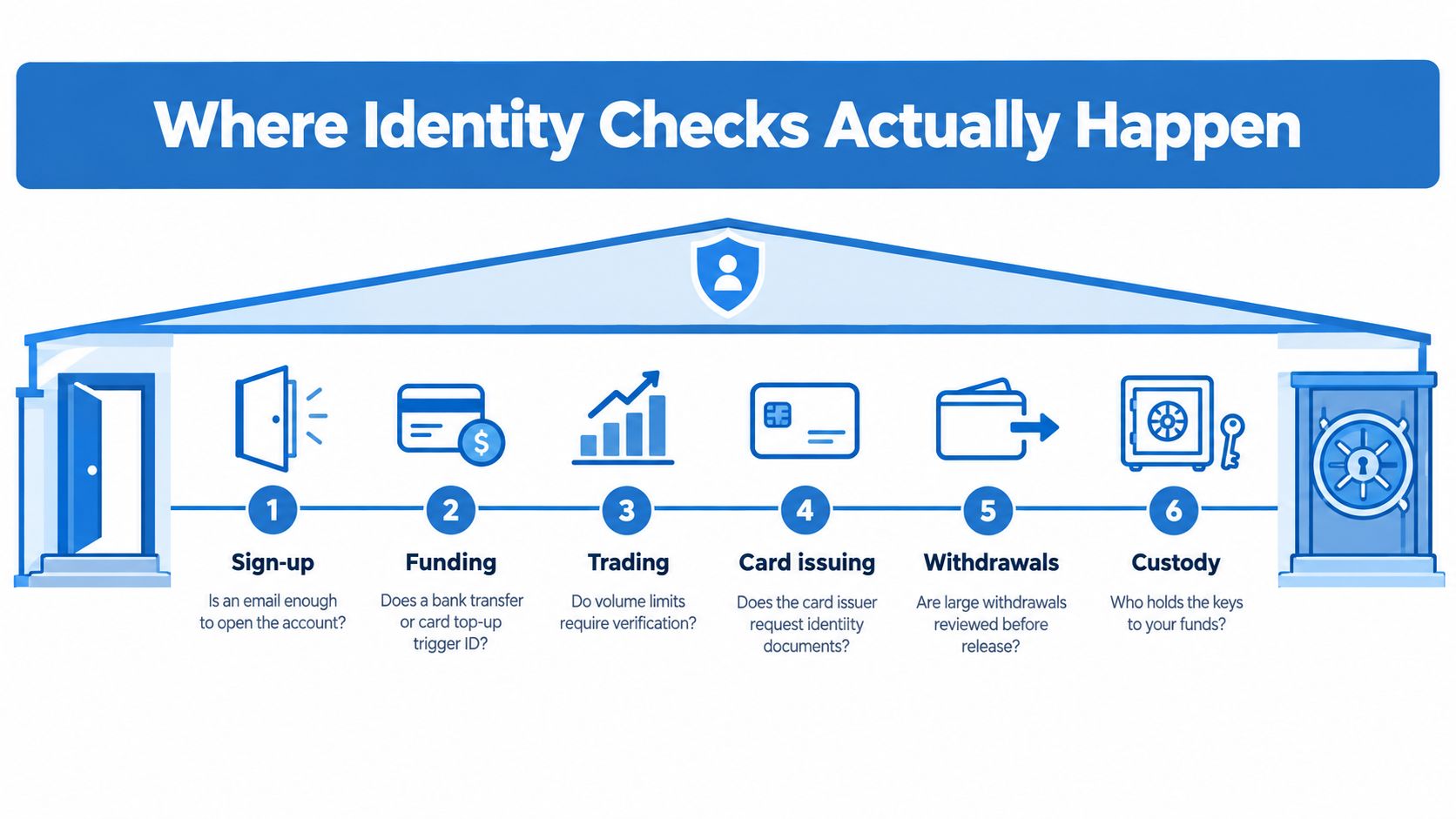
Follow the verification triggers
- Signup: Check whether email access is enough, whether a phone number is mandatory and how account recovery works. If you're considering virtual phone numbers from quackr, confirm that the platform permits them and that you can retain access for recovery. A rented number isn't a substitute for required identity verification.
- First top-up: Establish whether funding passes through a bank, card processor or regulated conversion partner. Read deposit conditions before sending assets, especially if refunds require verification.
- Higher spending or trading volume: Look for cumulative limits as well as individual transaction limits. Ask whether crossing a tier blocks only additional activity or also prevents withdrawals.
- Physical-card requests: Check eligibility before paying issuance or delivery charges. A virtual account's entry requirements don't establish the requirements for a physical card.
- Transaction reviews: Find out what evidence the provider may request, including source-of-funds records. Preserve exchange statements and transaction hashes rather than trying to reconstruct them during a review.
- Transfers needing additional screening: Ask what happens when the provider can't establish sufficient information about a sending address. The important distinction is whether it rejects the transfer, holds it or offers a documented return process.
Separate the wallet from the payment service
Say you connect a self-custody wallet to a card, then the issuer requests ID before activating spending. You still control the wallet, but you don't have a document-free payment experience.
A KYC-friction comparison can help organize the questions, but the issuer's current terms should determine your funding decision.
Before depositing, ask: What information is collected? What event triggers more verification? Can I recover my money if I decline? Also record who monitors transactions, which limits apply and whether the wallet provider or card issuer makes the final access decision.
No-KYC Cards, Exchanges and Wallets Side by Side
Product families solve different jobs. Use this comparison to distinguish ordinary spending, custodial account access and on-chain swaps before comparing individual offers.
| Product family | Typical verification | Typical limits | Fiat access | Best fit |
|---|---|---|---|---|
| Prepaid crypto card, email only | Email and sometimes phone verification | Issuer-set spending and balance caps; check the published tier | Crypto-funded card spending, not necessarily bank withdrawals | Occasional online and point-of-sale purchases |
| Non-custodial card linked to a web3 wallet | Wallet signature; issuer may also require full KYC | Card-program caps plus contract permissions | Through the card's conversion and payment arrangement | Wallet users seeking card spending |
| Custodial exchange account, entry tier | Account credentials; ID where required for an upgrade | Provider-set trading and withdrawal tiers | Bank transfers where supported and verified | Exchange trading and custodial holding |
| Decentralized exchange with a self-custody wallet | Wallet connection rather than conventional onboarding | Protocol rules, liquidity and transaction execution | Usually requires a separate off-ramp | On-chain token swaps |
These categories describe transaction routes rather than interchangeable accounts.
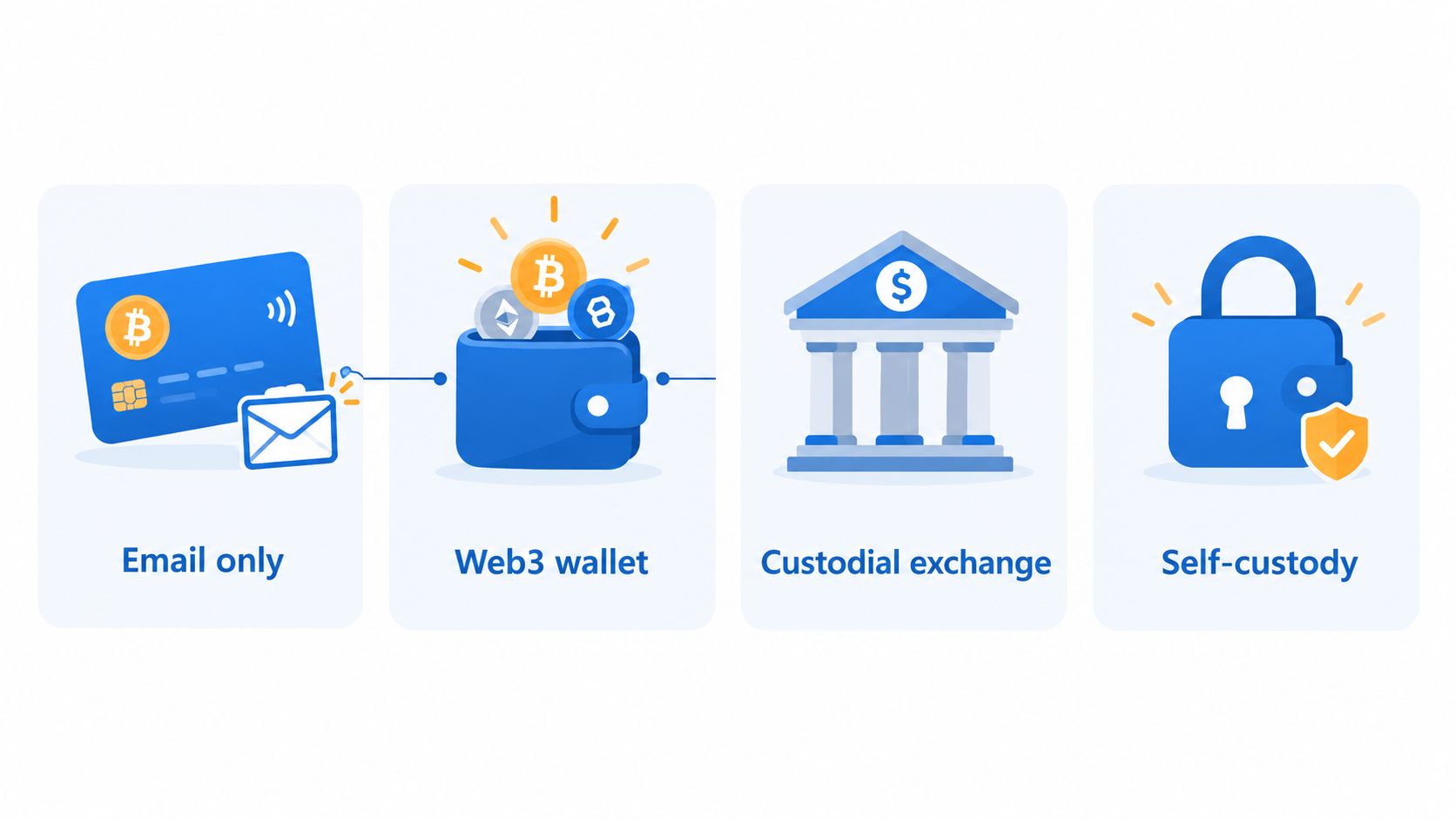
Match the product to the transaction
Consider a prepaid card loaded with a stablecoin for a hotel abroad. Verify that the hotel accepts that card type and that the program supports authorization holds. Email-only signup won't answer whether a deposit, refund or larger authorization can be processed.
For a wallet-linked card paying a subscription, inspect the spending permission you grant. Determine whether the card debits the wallet at purchase, requires a separate funded balance or uses a smart contract. Those arrangements create different exposure even if the interface looks identical.
An entry-tier exchange account might let you explore the platform but require ID before the withdrawal you need. Check withdrawal eligibility before depositing, rather than treating successful account creation as proof that the complete transaction is available.
A decentralized exchange swap can exchange tokens without delivering money to a bank account. If the eventual goal is rent or travel spending, evaluate the off-ramp first. A successful swap doesn't establish that the destination service will accept the resulting funds.
The video below provides another format for considering crypto-card options.
Compare the complete conversion cost
Spending crypto and converting crypto into fiat aren't the same operation. Identify who sells the asset, what balance the merchant receives and which intermediary can interrupt settlement.
Record these fee lines separately:
- Card load fee: Confirm the deposit charge and any network cost; mark an undisclosed charge as not disclosed.
- FX markup: Check the conversion method for purchases in another currency, not just the advertised card fee.
- Off-ramp cost: Include the asset sale, spread and bank-withdrawal charge where applicable.
Don't interpret a missing fee as zero. Filter candidates by verification level, network and card type first, then compare the cost of your intended transaction.
Custody Models and Who Controls Your Funds
A safe-deposit box illustrates the difference between ownership and access. If another party controls the key, it can refuse entry; if only you hold the key, you also carry the recovery responsibility.
For crypto, custody concerns control of the private keys. Payment control is a separate question: an issuer can stop a card transaction without controlling every asset in the connected wallet.
| Custody model | Who holds the keys | If access is blocked or the provider fails | Privacy from the provider |
|---|---|---|---|
| Custodial exchange account | The provider | Withdrawals may stop; recovery follows the provider's review or insolvency process | Provider sees account and trade history, plus any collected identity |
| Custodial prepaid card | Issuer or its custody partner holds the loaded balance | Card use and access to the balance may be blocked together | Issuer sees card transactions and account information |
| Non-custodial card linked to a wallet | User controls wallet keys; issuer controls card access | Card may stop while uncommitted wallet funds remain accessible | Issuer sees spending; public wallet activity may also be visible |
| Self-custody wallet with no card | The user | No custodial account to unlock; recovery requires valid keys or backups | Less onboarding disclosure, but public-chain activity remains observable |
Self-custody doesn't mean invisible custody
Chainalysis's explanation of blockchain analytics describes how public transaction records can support address attribution and connections to real-world entities. Addresses, amounts and transaction relationships can expose more than a document-free signup suggests.
A card issuer needn't hold your keys to inspect the public balance of a known wallet. Likewise, address reuse and deposits to identified exchange accounts can create links between activity and identity.
Yield Seeker's guide to understanding self-custody in DeFi is useful for examining the key-control distinction. For card-specific arrangements, compare the permissions described in this custodial versus self-custody crypto-card guide.
Control of wallet keys doesn't guarantee access to a payment network.
Recovery is part of the custody decision
With self-custody, losing a seed phrase isn't automatically fatal if you still have working keys or another valid backup. Losing every usable key and recovery method can make funds permanently inaccessible. A wallet-support team can't recreate a secret it never held.
A custodial freeze has a different recovery path. You can submit evidence and pursue the provider's appeal process, but you can't sign an on-chain withdrawal using keys the provider controls.
Before using a wallet-linked card, inspect approvals and committed balances. The relevant question is what remains independently recoverable if the card operator disappears, not whether the product merely calls itself non-custodial.
Legal and Privacy Risks Worth Knowing
Illicit activity is real, and aggregate crime estimates still say little about any individual no-KYC user. Chainalysis's introduction to its 2025 Crypto Crime Report estimated that illicit addresses received $40.9 billion in 2024, about 0.14% of total on-chain transaction volume, while cautioning that later address identification could push the total toward $51 billion.
That gap between a large absolute figure and a small share explains provider behavior: monitoring is economical because the dollar exposure is material, even though measured illicit volume stayed a minor fraction of activity. It also means risk labels can change after onboarding, when new attribution or a counterparty cluster alters how a transfer is scored.
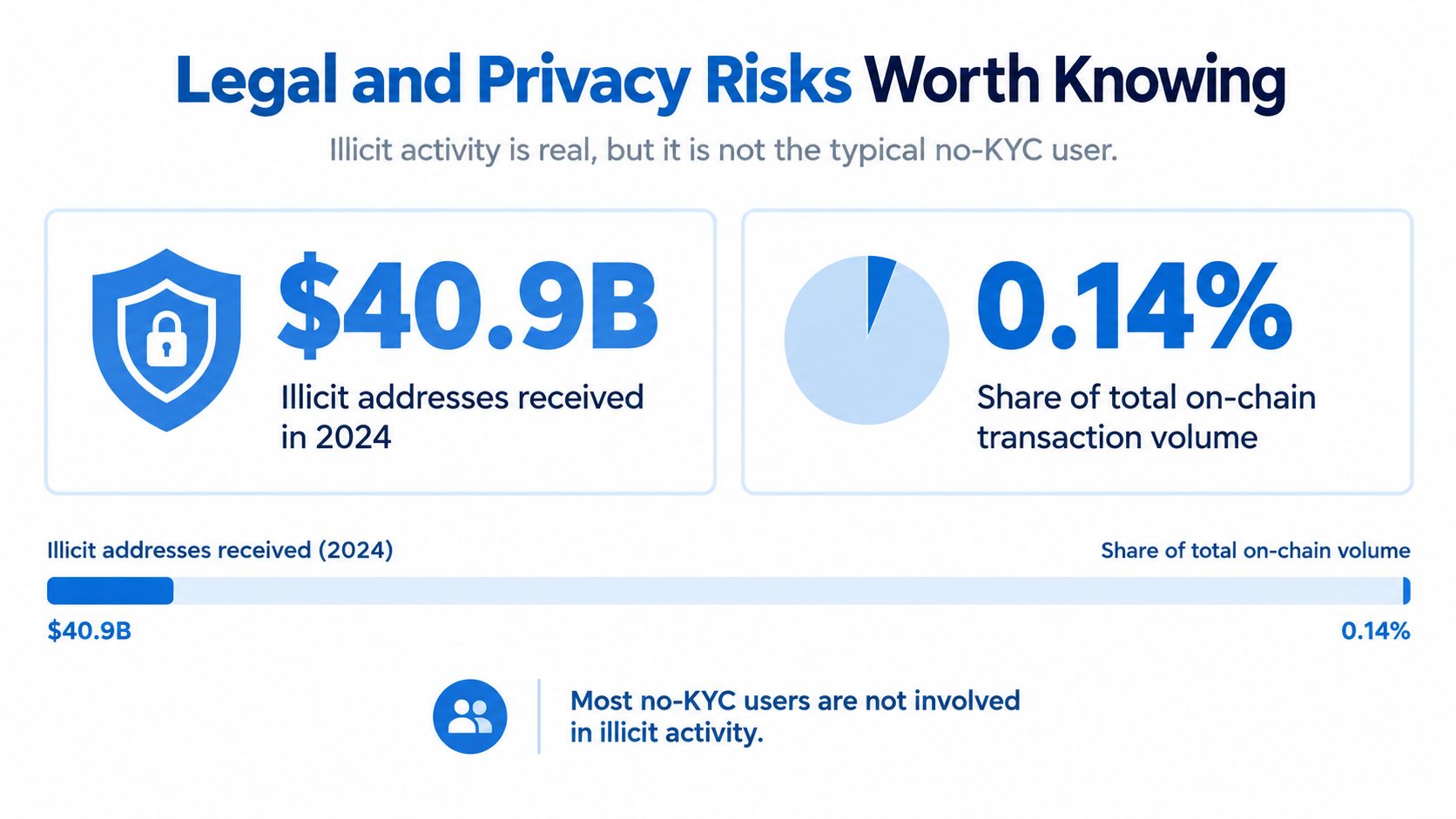
Read crime estimates within their scope
Chainalysis found that stablecoins accounted for 63% of illicit crypto transaction volume in 2024, as reported by The Block. That is a share of identified illicit activity, not evidence that stablecoin use in general was illicit.
Historical estimates also change. The original Chainalysis report on 2023 activity gave illicit activity's share as 0.34% of total transaction volume. Treat the totals as moving measurements: if attribution can be revised after publication, a history that looked clean at signup can be questioned during a later card request, top-up, review or regulated off-ramp.
Plan for practical failure modes
Industry guidance on FATF-related risks points to the compliance attention around stablecoins and unhosted wallets. The practical response is to map where checks reappear, then test whether funds remain portable if one provider pauses service.
- Flagged funding: A card may work at checkout while a later top-up faces address screening.
- Residence changes: Moving countries can affect eligibility even when an existing account remains accessible.
- Compliance reviews: Sanctions or transfer-information checks may delay withdrawals while the provider requests evidence.
- Scams: A deceptive transfer can settle before the counterparty is exposed, and the provider may be unable to reverse the payment.
- Local obligations: Document-free onboarding does not remove tax or reporting duties; establish what your residence and transactions require with a qualified local adviser.
For a legitimate user, the central risk is losing access, funds or portability at the moment those capabilities matter most.
Regional Rules and Choosing a Setup Without Getting Frozen Out
| Region | Main rules | Effect on no-KYC access | Check before buying |
|---|---|---|---|
| EU | MiCA, Transfer of Funds Regulation and payment-services rules where applicable | Regulated participation can require customer and transfer information, including checks involving self-hosted addresses | Verify the relevant authorization and permitted services |
| UK | AML/CFT and payment-services obligations | Wallet access doesn't establish eligibility for regulated card or exchange services | Confirm issuer registration, residence eligibility and virtual-card availability |
| Singapore | Payment Services Act licensing and AML controls | Licensed payment services remain subject to customer checks | Confirm the licence and the activities it covers |
| United States | Check applicable federal money-services and state licensing requirements | Don't assume a document-free crypto interface establishes card or fiat eligibility | Request the issuer's legal entity, applicable registrations and state availability |
| Other countries | Local financial-services, payments and AML requirements | Obtain country-specific terms rather than relying on global marketing | Ask for written confirmation before funding |
The table is a due-diligence map, not a legal determination for an individual product. Different entities can provide the wallet, conversion service and card, so a licence held by one participant doesn't establish authorization for every service.
Under the EU Transfer of Funds Regulation, transfers involving self-hosted addresses remain subject to information requirements when a crypto-asset service provider participates; for transfers exceeding EUR 1,000, the provider must take adequate measures to assess whether the customer owns or controls the self-hosted address.
That threshold isn't a general permission to transact anonymously below it. Nor does it make self-custody itself a regulated account.
Verify the provider before transferring assets
Run separate checks for authorization, residence eligibility and card format. Search the relevant regulator's public register using the legal entity's name, then compare the listed permissions with the service being offered.
For European candidates, a guide to MiCA-licensed exchanges can help organize your shortlist. Make the regulator's current record, rather than a comparison page or licence badge, the decisive check.
Next, confirm that the issuer accepts your actual country of residence. A website accepting visitors from your location isn't confirmation that it can legally issue you a card.
Finally, distinguish virtual from physical availability. Ask whether the available format supports the purchases you intend to make, including subscriptions, travel bookings and refunds.
Build a setup you can recover from
Name the job and expected monthly usage. Decide whether you need to spend, hold or swap. Don't move long-term holdings into a prepaid balance just because the signup is convenient.
Document the verification triggers. Save the relevant product terms and record identity collection, timing, monitoring, transaction limits, source-of-funds requests and the party controlling access. Ask support to clarify missing conditions in writing.
Complete the regional checks. Confirm the legal entity, authorization, residence eligibility and available card format. If the provider won't identify the issuer, postpone funding.
Choose custody deliberately. Separate money needed for immediate purchases from funds you need to retain independently. Review contract approvals before authorizing a wallet-linked product.
Test the complete route with a small amount. Test funding, a purchase and the available withdrawal or refund route. Record actual charges, processing conditions and any verification prompt; a successful deposit alone proves little.
Keep an independent backup. Maintain another usable payment method or exchange route. Prefer arrangements that don't obviously depend on the same issuer or processor, since shared dependencies can undermine redundancy.
Keep your own records. Save transaction hashes, statements, conversion receipts and support correspondence. Use those records to establish source of funds and meet applicable local obligations.
Decision rule: Choose the least identity-heavy setup that still gives you a credible way to recover or redirect your money.
Score resilience alongside privacy
Before committing a meaningful balance, mark each item as documented, unclear or unacceptable: supported jurisdictions, issuer and processor dependencies, supported stablecoins, address-screening policy, freeze procedures, appeal routes and maximum permitted balance.
Add an exit test: can you recover unspent funds without the card operator, or must that operator approve every withdrawal? For a smart-contract arrangement, identify which permissions you can revoke and which funds have already moved outside your control.
Don't award an overall pass merely because signup requires no passport. An unclear refund policy or unidentified custodian can outweigh a privacy advantage.
NomadCards offers crypto-card comparisons with filters for KYC level, network, card type and regional availability, alongside fee and custody information. Visit NomadCards to shortlist a setup that matches your privacy requirements, then verify the issuer's live terms and test the complete payment route before committing a larger balance.