A non-custodial wallet is widely used, but it is not the right fit for everyone. You control the private keys that authorize transfers, which gives you direct control over your funds and responsibility for keeping those keys safe.
Consider a wallet app, a paper recovery phrase, and a card that calls itself “non-custodial” but asks for your passport. These details can seem contradictory. The app is a tool, the card may involve identity checks, and custody is a separate question: who controls the keys?
Crypto-wallet use is also growing. In 2024, 33% of people familiar with Web3 reported using a crypto wallet, up 6 percentage points from the previous year, according to the Consensys Global Survey on Crypto and Web3.
The wallet app, blockchain address, and private key each play a different role. The app helps you interact with the wallet, the address receives funds, and the key authorizes transfers. Understanding that distinction makes it easier to judge what a wallet or card's custody claims mean.
Table of Contents
- What a Non-Custodial Wallet Means in Practice
- Custodial vs Non-Custodial Wallets Side by Side
- How Control Works Through Keys, Signatures and Seed Phrases
- Wallet Types From Hardware to Smart-Contract Wallets
- Who Self-Custody Suits and What Stays Regulated
- How to Set Up and Spend From a Non-Custodial Wallet
What a Non-Custodial Wallet Means in Practice
Suppose the service displaying your crypto balance closes tomorrow. Can you still move the funds? With a non-custodial wallet, you can if you control the keys needed to authorize transactions and have kept your recovery materials safe.
The wallet app is the tool you use, the address is where funds are recorded, and the private key authorizes transfers. These are different things. A familiar app does not guarantee that you control its keys, and a payment card does not tell you who controls the crypto behind it.
Why the model exists at all
Mt. Gox's 2014 bankruptcy left customers unable to recover balances they had been shown. The episode illustrated a basic distinction: seeing a balance on a company's dashboard does not mean you hold the keys that control those funds.
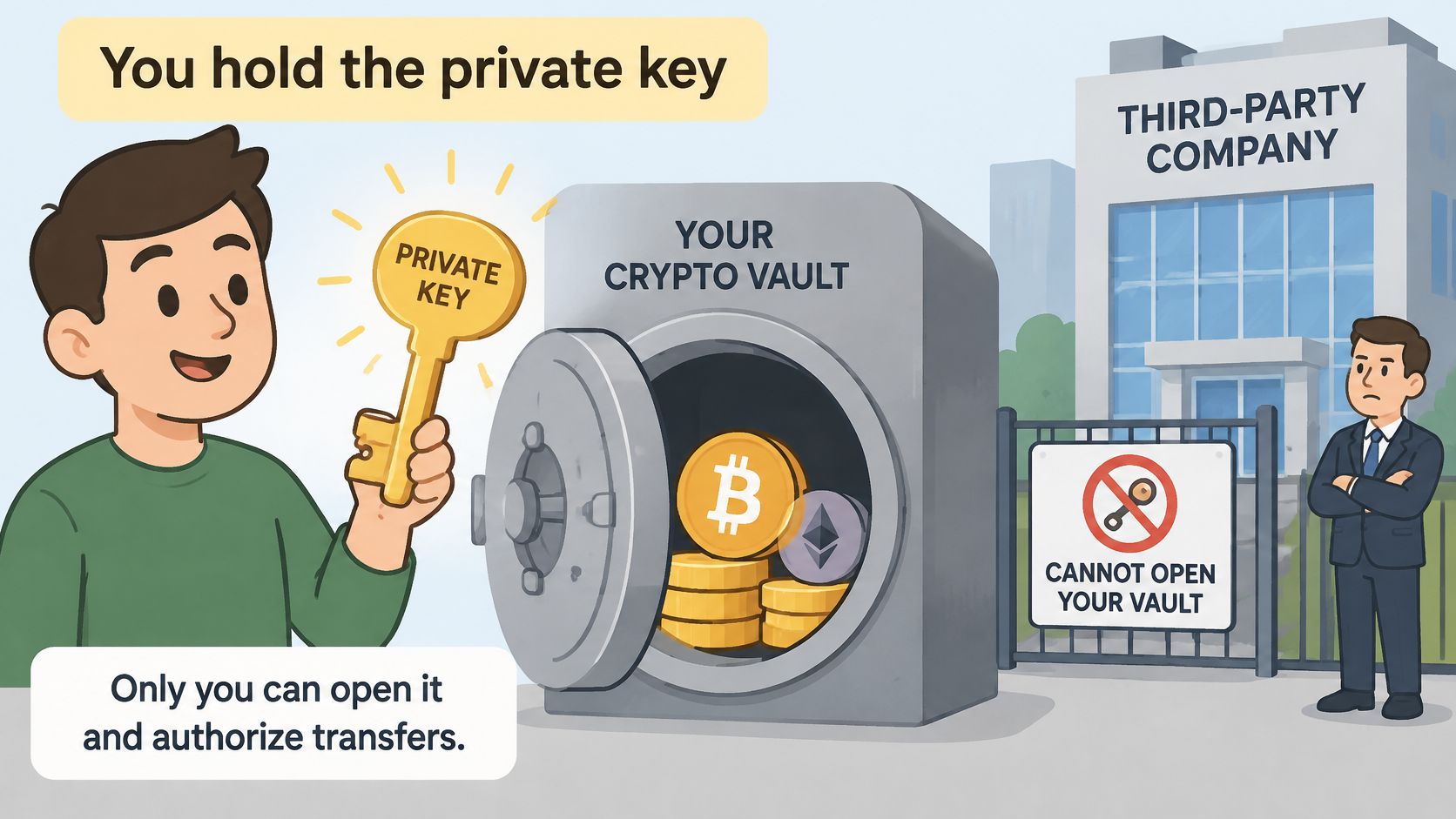
Ask yourself: if the company behind your wallet closed tomorrow, could you move your funds using only recovery materials you control?
Self-custody shifts responsibility as well as control. A phishing page, a copied address changed by malware, a lost backup, or a transfer sent on the wrong network can cost you funds, with no support team able to reverse the mistake. A Crypto Wallet Tracker can help you view activity associated with a public address. It does not need your private key to do so.
Self-custody suits people who value direct control and can protect their recovery materials. For someone holding a small balance, the extra effort may outweigh the practical benefit. The choice is a trade-off: less reliance on a provider, more responsibility for access and security.
Custodial vs Non-Custodial Wallets Side by Side
Almost every product you'll compare sits on one of two models, and the differences that decide your day-to-day experience are narrower than the marketing suggests.
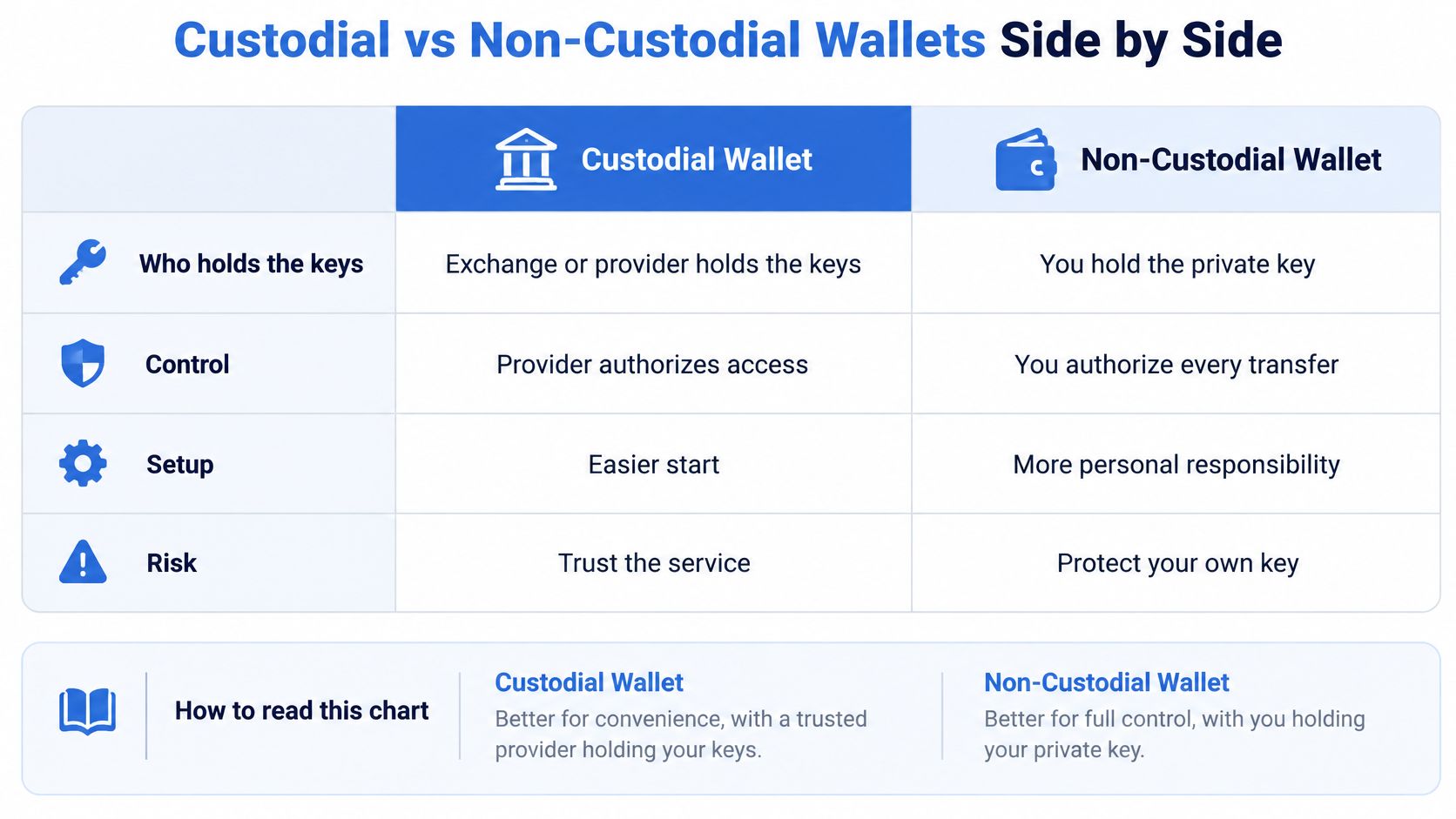
The table below lays both models out on the six rows that change how your money behaves.
| Feature | Custodial wallet | Non-custodial wallet |
|---|---|---|
| Who holds the private key | Exchange or provider | You alone |
| Access if the provider fails | Depends on the provider's solvency and legal process | Continues as long as you hold the recovery phrase |
| Account recovery | Support team or password reset | Recovery phrase or backup key |
| Transaction approval | Provider can approve, delay or block | You sign each transaction |
| Responsibility for a lost key | Provider, within its terms | You alone |
| Identity checks at signup | Usually required | Often none for the wallet itself; a linked card or exchange may still verify identity |
How to read the two rows that matter
Recovery is where the models part company most sharply. Under custody, a forgotten password means a support ticket and a wait. Under self-custody, a forgotten phrase means the funds stay on the blockchain, visible to anyone who has the address and spendable by nobody.
Approval is the second divergence. A provider can hold, review or block a withdrawal request internally, and sometimes that protects you. In a self-custody wallet there's nobody to ask, because a transfer either carries your signature or it doesn't.
Identity checks follow the service, not the wallet model. A fresh non-custodial wallet can be created without giving anyone a name, but the moment you attach a card or an exchange account to it, that counterparty runs its own verification. Privacy claims belong to the card program and its jurisdiction, not to the word printed on the wallet.
Neither model is the fringe option. In 2024, the non-custodial wallet segment was valued at USD 8.3 billion, while the custodial-wallet segment was valued at USD 5.52 billion, according to Market Research Future.
Custodial wallets trade control for convenience and support. Non-custodial wallets trade convenience for control and personal responsibility.
If you'd rather watch the two models explained than read them, this short walkthrough covers the same ground.
Spending adds a third layer on top of custody, and it's the layer most comparisons skip. Our guide to custodial vs self-custody crypto cards separates who holds the keys from who authorizes the payment.
How Control Works Through Keys, Signatures and Seed Phrases
Control sounds abstract until you trace what happens during a single transfer. Three layers do all the work, and a weakness in any one of them is enough to lose funds.
Layer one, the key that signs
A non-custodial wallet gives you direct control of the cryptographic private key instead of delegating signing authority to an exchange or card provider. An externally owned account authorizes a transaction by producing a digital signature with that private key, and the network verifies the signature against the corresponding public address before accepting the transfer. NIST's guidance on cryptographic key management draws the line clearly: private keys and other secret key material require confidentiality protection, while public keys generally don't.
Because no intermediary sits in the path, no company can unilaterally freeze or delay a withdrawal. The failure risk moves to how you store the key, how you back it up, and how deliberately you sign.
Layer two, the phrase that regenerates everything
Setup hands you a recovery phrase of 12 or 24 words, and every key the wallet will ever use is derived from it. Whoever holds that phrase controls every address the wallet generates. Lose it and the funds are locked out of reach permanently. Expose it and an attacker takes everything in a single transaction, with no support line to call.
Practical rule: keep the phrase on paper or metal, in two separate physical locations, and never type it into a website, an email, a chat, or a cloud note.
Layer three, the checks before you sign
Match the destination address and the network character by character before confirming, especially on the first transfer to any new address. A valid signature authorizes an irreversible transfer, and it will authorize one to an attacker's address just as willingly as one to your own. Sending also needs a little of the network's native currency for gas, such as ETH on Ethereum, so a wallet funded only with stablecoins can sit there unable to move.
Four fields are worth recording for any wallet you compare:
- Who signs: you, on every spend, or a provider acting on your behalf.
- Who can reach the funds: whether any party holds a key share or a standing approval.
- Which chains and assets: the networks that settle, not just the ones listed.
- Who pays gas: you, the card program, or a paymaster contract.
Wallet Types From Hardware to Smart-Contract Wallets
Wallet categories differ in one practical way: where the key lives and how exposed it is to the internet. Modern self-custody traces back to BIP32 in 2012, which let a single master seed derive many addresses, and to the Trezor Model One on July 29, 2014, which generated keys on the device and signed transactions offline, as Bitcoin Magazine's history of the hardware wallet recounts. The same device popularized recovery phrases written as 12 or 24 words.
| Wallet type | Who holds the key | Typical use | Main risk |
|---|---|---|---|
| Software wallet (phone or desktop) | You, on an internet-connected device | Everyday spending and DeFi | Malware and phishing on the device |
| Hardware wallet | You, on an offline device | Larger balances and long-term storage | Losing the device without a backup, or buying a tampered unit |
| Paper wallet | You, printed on paper | Cold storage of fixed amounts | Physical damage, loss, or exposure during printing |
| Smart-contract wallet | Programmable rules set by you, with backup or multiple signers | Multi-signature or recovery-based control | Contract bugs, upgrade risk, misconfigured recovery |
| MPC wallet | Key split across shares held by you and a provider or devices | Shared or business control | Trust in how the provider handles its share |
What smart-contract wallets change
This is the category readers understand least, and it behaves differently from everything above. Ethereum's account abstraction documentation describes a contract account that defines its own validation logic. It can use backup or replacement keys, demand multiple signatures for high-value transfers, restrict sends to approved addresses, and let a paymaster cover fees or accept payment in another token.
The trade-off runs in both directions. Programmable rules can shrink the damage from a stolen phone or a leaked key, because a single compromised signature may not be enough to drain the account. The same rules make your access depend on the correctness of the contract, its upgrade policy, and whether the recovery configuration was right the first time you set it.
Pick the category before the brand
Consider a traveler who keeps a phone wallet with a modest balance for daily spending and a hardware device holding the savings, with the phrase stored somewhere that isn't the same bag as the device. That arrangement is chosen by category first: an online key for convenience, an offline key for storage.
"Non-custodial" therefore splits into at least two technical families. In an externally owned wallet you hold one private key and sign directly. In a smart-contract wallet, control is mediated by code you configured, and someone else's code may execute it.
Who Self-Custody Suits and What Stays Regulated
Self-custody is usually sold as a pure upgrade. It isn't one. It's a swap: you remove a provider's ability to block you and take on responsibilities no one can perform for you.
The gap between preference and practice
Preference and behavior tell different stories. In 2025, approximately 59% of global crypto-wallet users preferred non-custodial wallets, compared with 41% preferring custodial wallets, according to CoinLaw's self-custody wallet statistics. Actual use is far thinner: only 12% of U.S. adults reportedly use self-custody wallets, and people earning more than $100,000 are three times more likely to use one than those earning $40,000 or less, as reported in MercuryOS's discussion of the self-custody gap. Demand also varies by region, with 81% of respondents in Africa expressing interest in self-custody wallets in the Consensys and YouGov global survey.
Those numbers point at cost and usability, not ideology. A hardware device, a second secure location for a backup, gas on every settlement, failed transactions, bridging between networks, stablecoin conversion: each adds friction that weighs heaviest on small balances. Someone moving $40 a week can spend a meaningful share of it on fees that a salaried holder with a $20,000 balance never notices.
Where regulation still lands
A regulated firm handling your money doesn't lose its duties because your wallet is self-custodial. When a card issuer or exchange interacts with a self-custodial wallet, that firm generally remains responsible for customer due diligence, sanctions screening, transaction monitoring and Travel Rule obligations, as recent regulatory analysis of enforcement trends sets out. Controlling your keys is not the same as being legally permitted to spend or receive a particular asset.
Practically, that means a card issuer can ask for identity documents even when the funds originate in your own wallet, and a transaction can be delayed or reviewed on the strength of wallet history. Cross-border rules stay fragmented, so the same wallet can behave differently in the EU, the United States and the UK. If you travel and spend across jurisdictions, 2026 crypto compliance frameworks maps where the requirements diverge, and our guide to MiCA and Europe-licensed exchanges covers what a licensed European route requires.
Crypto and the cards that use it carry risk, including loss of funds, so the identity question and the recovery question belong in the same conversation rather than in separate ones.
Five questions before you move real money
- Do I hold the keys, and can I recover without a provider? If the answer depends on a support desk, you don't.
- Can any party approve, delay or block my spending? Read the card terms, not the wallet page.
- Which identity checks apply on the card or exchange route? The wallet may be anonymous while the payment rail isn't.
- Are gas and conversion fees affordable at the size I pay? Run the arithmetic on a typical week.
- Which networks and assets does the spending route support? A card that can't settle your chain is decoration.
Decision rule: if you hold the keys, can recover without help, and transact in amounts that justify the fees, self-custody fits. If you make small, frequent payments or you know an irreversible mistake would hurt, a custodial route with clear terms may serve you better.
How to Set Up and Spend From a Non-Custodial Wallet
A non-custodial wallet gives you control of the keys, but that control also makes setup and recovery your responsibility. Move through these steps before using it for regular spending. Skipping basic safeguards can lead to lost funds.
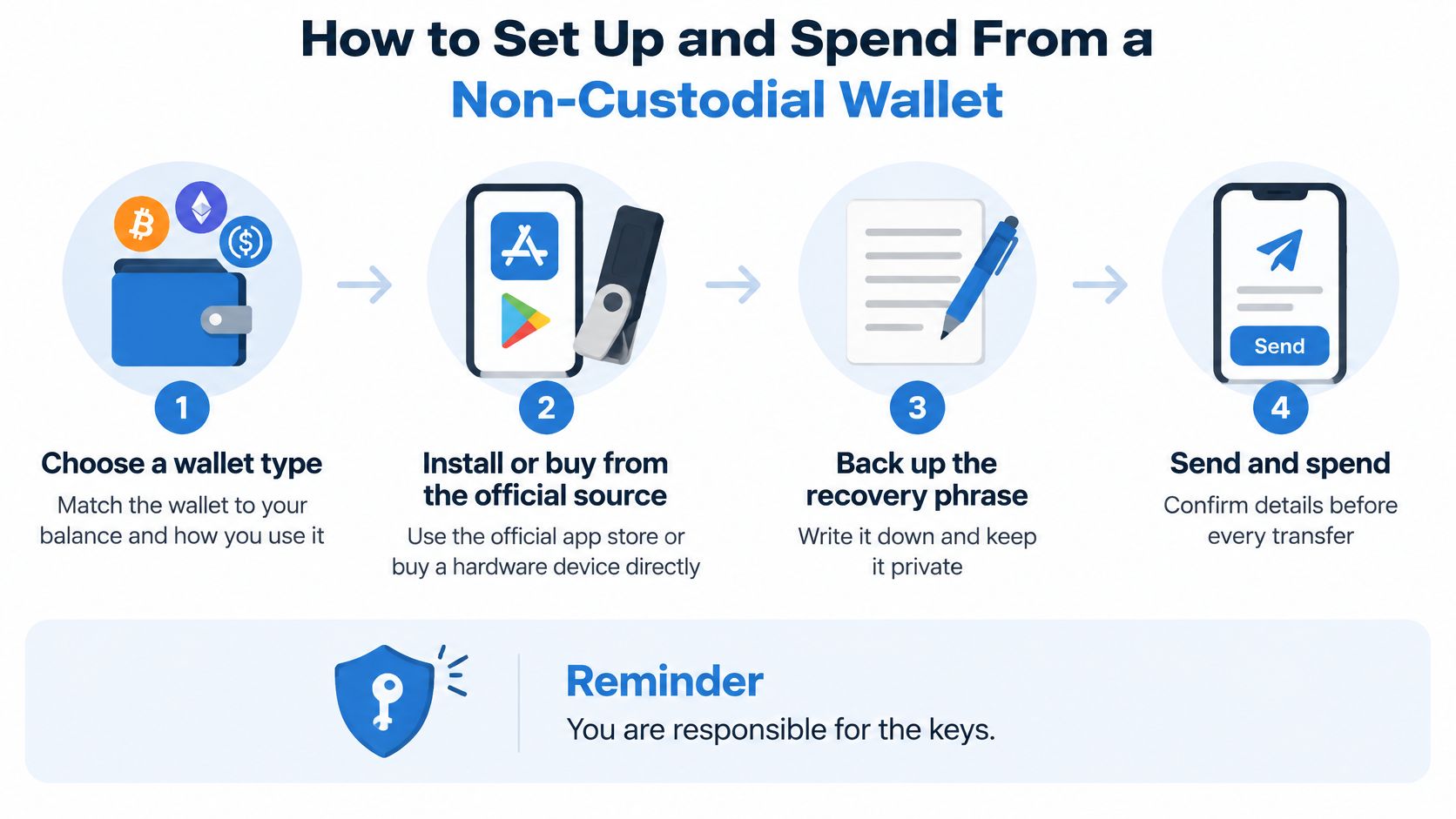
- Match the wallet type to the balance. A phone wallet can suit money you plan to spend; consider a hardware wallet for funds you intend to hold. The right choice depends on how often you need access and how much loss you could tolerate.
- Install or buy through an official source. Use the wallet app's official listing or the manufacturer's own store. Avoid secondhand hardware wallets: you cannot know whether someone else has handled the device or its recovery materials.
- Create the wallet and record its recovery phrase. Write the phrase on paper and store copies in separate secure locations. A photo can be copied to a synced camera roll, creating another place it might be exposed.
- Check the backup during setup. Wallets may ask you to re-enter some words. Never enter the recovery phrase on a website or share it by email or chat, even if the request looks official.
- Fund the wallet with a small test amount. Include the network's native currency if you will need it for transaction fees. A token balance alone may not be enough to send a transaction.
- Test a transfer before sending more. Confirm the recipient address and network, then check that the test arrives. A wrong address or network can leave funds difficult or impossible to recover.
- Check the spending route. A card or payment service connected to an on-chain wallet may support only certain networks and assets. Read what permissions you grant and revoke approvals for services you no longer use. For the mechanics of paying by card, see our guide to spending crypto without selling.
- Keep recovery instructions current. If you replace a device or change wallets, update the backup. Make sure a trusted person can find instructions for handling your affairs if you become unavailable, without giving them access to the recovery phrase itself.
When something goes wrong
A lost recovery phrase usually cannot be reset by the wallet's developer. If a transfer goes to the wrong address, it cannot be reversed on the network. If the recipient is a service you recognize, contact it with the transaction details; whether it can help depends on its controls.
A successful test is straightforward: the transaction confirms, the balance updates in your wallet, and the saved recipient address matches the one you intended.
When you are ready to compare cards, NomadCard's comparison lets you filter by KYC level, network and non-custodial features. It is an independent comparison engine, not a card issuer, so check the card provider's terms before applying.
NomadCard compares more than 60 crypto cards side by side, including options with different custody models, fees, KYC levels and supported coins. If you have decided where your keys should live, compare cards that fit that choice. You can also review Solana memecoin scam warning signs before connecting a wallet to a token-related service.