You're about to receive payment from an overseas client, move abroad, or keep savings in another currency. A foreign bank account seems practical, until the application asks for your tax residences, identification numbers, and source of funds. Before choosing a bank, work out what you'll need to report and whether you can keep the records to support it.
Table of Contents
- What an Offshore Bank Account Is and Why People Use One
- Reporting Thresholds You Must Check First
- Automatic Exchange and the Real Benefits and Risks
- Choosing a Jurisdiction and Opening Requirements
- Documentation, Verification and Pre-Application Checks
- How Crypto Card Users Fit Into Offshore Banking
What an Offshore Bank Account Is and Why People Use One
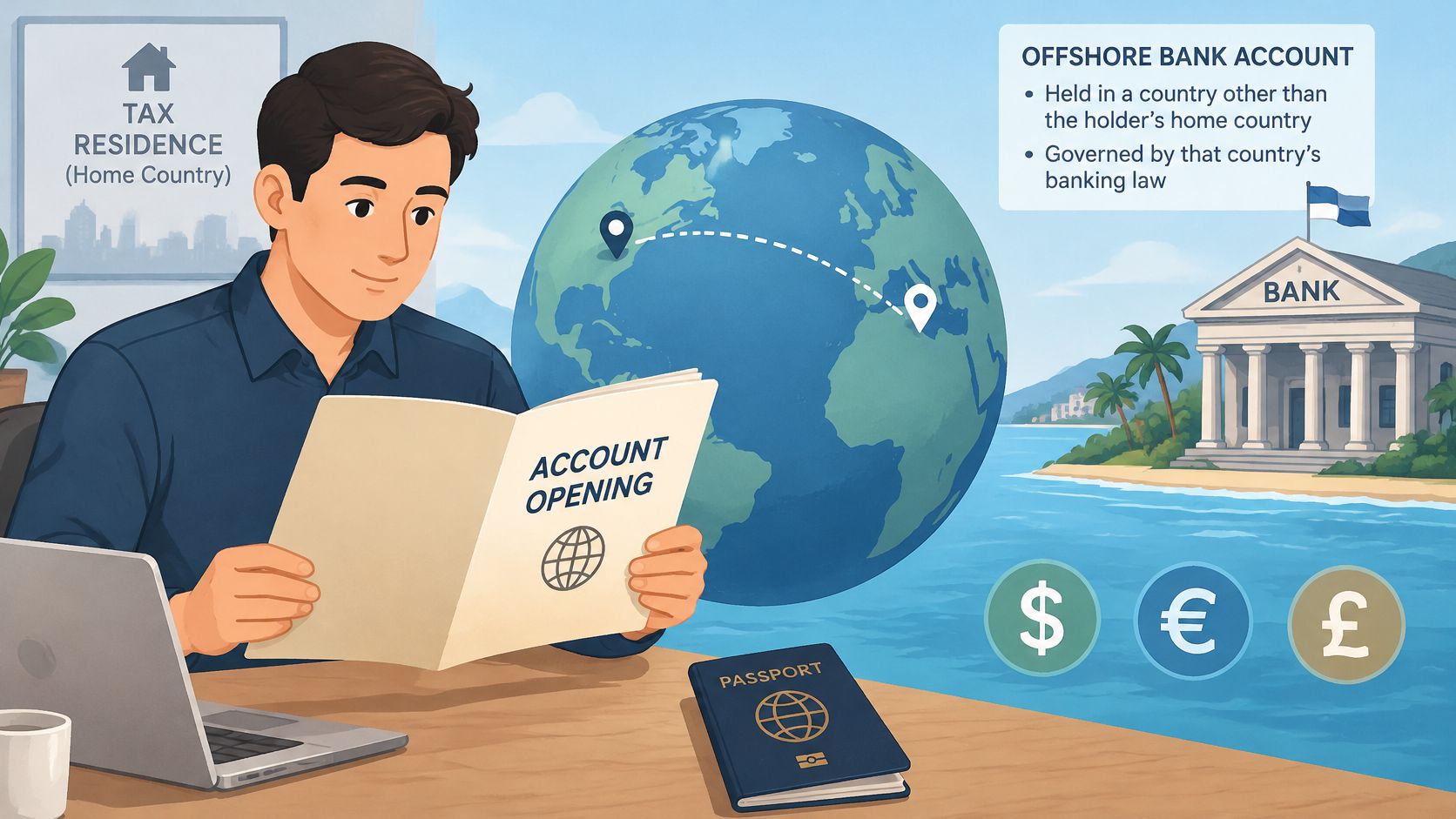
An offshore bank account is an account held at a bank outside the holder's home country. The bank operates under its country's banking rules, but the owner's tax obligations don't disappear when money crosses a border. Think of the account as sitting in a foreign building with its own rulebook, while you still have paperwork to complete at home.
Say you're a freelance designer living abroad and receiving payments from international clients. A local account can help you receive income, pay rent, and avoid converting money every time you spend. That's cross-border banking, even if the word offshore sounds more elaborate.
The application usually starts with ordinary identity and financial documents.
What People Actually Use It For
Legitimate purposes include:
- Currency management. Keep money in the currency you expect to spend rather than converting every incoming payment.
- Overseas work and living. Receive salary and pay household expenses where you live.
- International business. Collect client payments and maintain clearer records of foreign operations.
- Investment access. Use an eligible international platform when suitable services aren't available locally.
Historically, offshore centres also served wealth management and asset structuring. A Tax Justice Network analysis cited a 2004 estimate of approximately US$2.7 trillion in offshore bank deposits against US$14.4 trillion worldwide, roughly one dollar in five. That's a historical estimate, not a current count or proof that every offshore arrangement served a legitimate purpose.
Start With Your Situation, Not a Country Name
An employee relocating overseas, a business owner receiving foreign revenue, and someone managing inherited assets need different banking arrangements. A prestigious jurisdiction won't necessarily suit all of them.
Lawfulness depends on the arrangement and your obligations, not the country's name alone. Tax residence, ownership, reporting, and applicable restrictions matter. Start by identifying who will own the account, where that person is taxable, and what the account will do.
Reporting Thresholds You Must Check First
| Reporting rule | Trigger | Who it applies to | Filed with |
|---|---|---|---|
| FBAR, FinCEN Form 114 | Aggregate maximum value above $10,000 at any point in the calendar year | US persons with reportable foreign accounts, including relevant signature authority | FinCEN |
| Form 8938, unmarried, US resident | More than $50,000 at year-end or $75,000 at any time | Unmarried US taxpayers living in the US | IRS, with tax return |
| Form 8938, unmarried, living abroad | Overseas-resident asset thresholds under the Form 8938 instructions | Unmarried US taxpayers meeting the overseas-residence conditions | IRS, with tax return |
| Form 8938, joint filers, US resident | Joint-return domestic asset thresholds under the Form 8938 instructions | Married couples filing jointly in the US | IRS, with tax return |
| Form 8938, joint filers, living abroad | Joint-return overseas asset thresholds under the Form 8938 instructions | Married couples filing jointly who meet the overseas-residence conditions | IRS, with tax return |
| CRS reporting | Reportable status under local CRS rules, rather than a universal personal filing threshold | Relevant nonresident account holders identified by participating institutions | Bank reports to its tax authority for exchange |
The IRS summary of FATCA reporting sets out the FBAR threshold above $10,000 and the general Form 8938 thresholds for unmarried US-resident taxpayers of more than $50,000 at year-end or $75,000 at any time, with higher thresholds for qualifying overseas residents and joint filers. Use the instructions matching your filing status and residence conditions before relying on a higher threshold.
Calculate Accounts Before Choosing Forms
For FBAR, don't inspect each foreign account separately and stop because each looks modest. Establish each reportable account's maximum local-currency value, apply the required currency-conversion method, and perform the aggregate calculation.
A brief balance increase matters. Salary, sale proceeds, or a transfer awaiting investment can affect the calculation even if you spend or move the money before year-end.
Signature authority also deserves attention. You may need to assess an employer's or another entity's account even when the money isn't yours. List that authority separately from accounts you own so an adviser can assess the correct treatment.
Keep the Reporting Tests Separate
Form 8938 concerns specified foreign financial assets, not just the bank accounts you happen to use for everyday spending. FBAR and Form 8938 aren't substitutes: completing one doesn't establish that you've satisfied the other.
CRS works differently again. It concerns information collected and reported by financial institutions under applicable local rules, rather than a form you select using the US thresholds.
Practical rule: Check maximum annual balances, account ownership, and signature authority before deciding which filings apply. A year-end screenshot isn't a complete reporting record.
Create a worksheet listing the institution, account location, owner, currency, maximum balance, year-end balance, and conversion method. Keep account disclosure separate from the calculation of taxable income.
Automatic Exchange and the Real Benefits and Risks
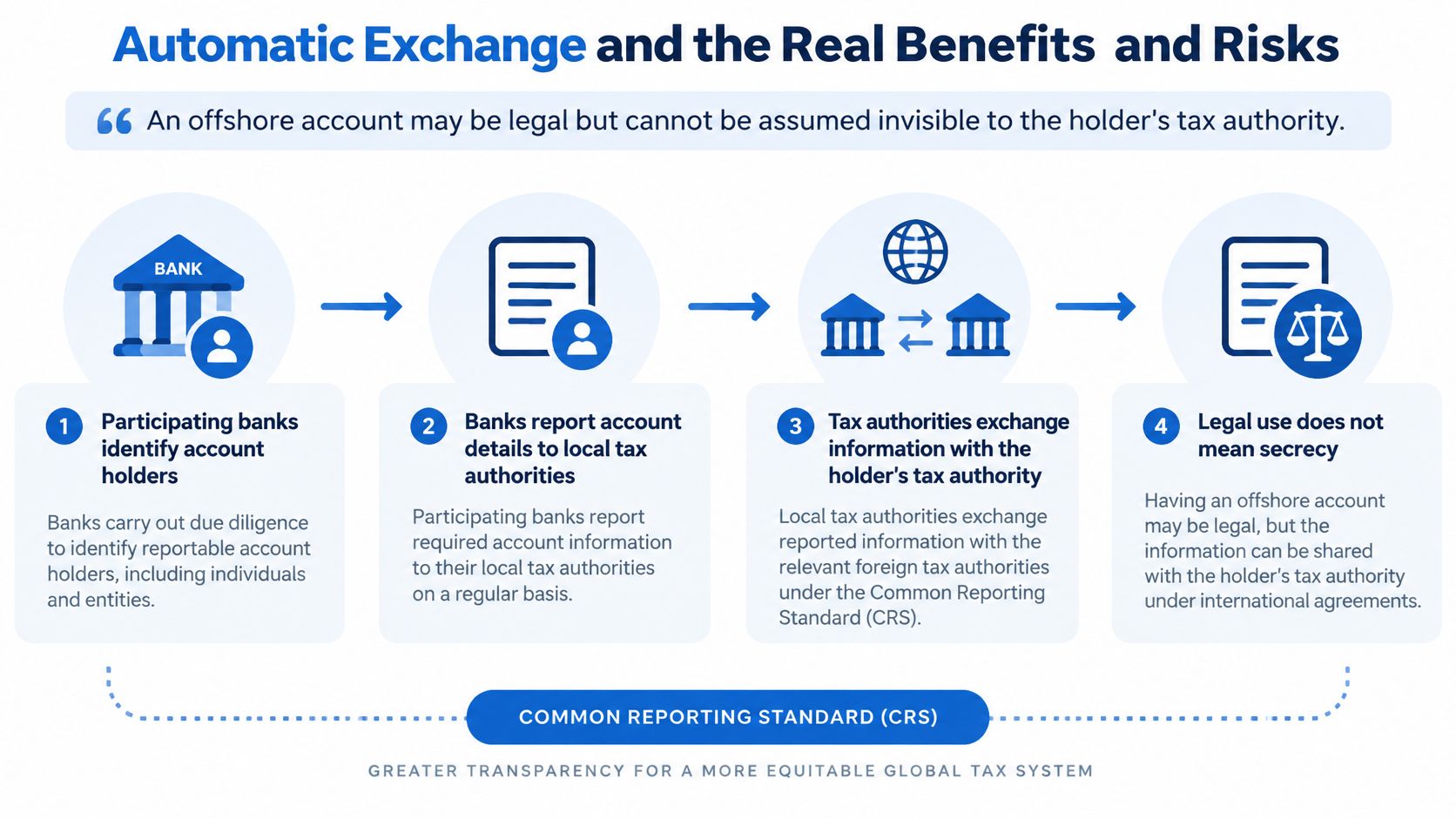
An offshore account may be legal but cannot be assumed invisible to the holder's tax authority.
Under the Common Reporting Standard, participating financial institutions identify relevant nonresident account holders and collect information such as identity, address, tax residence, account balance, and relevant income. They report through their local tax authority, which exchanges information with the relevant residence jurisdiction.
The reporting path is a bank-to-authority process, not a public list of customers.
The Tax Justice Network's account of automatic exchange describes how, by 2019, nearly 100 jurisdictions had exchanged information on 84 million offshore accounts worth about EUR10 trillion. The OECD's subsequent peer review reports that in 2024, authorities exchanged information on more than 171 million financial accounts worth nearly EUR13 trillion.
Weigh the Benefit Against the Operational Cost
| Use case | Realistic benefit | Main risk | Documentation burden |
|---|---|---|---|
| Currency diversification | Holds balances in another currency | Exchange-rate losses and conversion fees | Conversion records and statements |
| International payments | Sends and receives cross-border transfers | Transfer delays and enhanced checks | Invoices and payment narratives |
| Business revenue abroad | Separates foreign client income | Source-of-funds reviews on large inflows | Contracts, invoices, entity documents |
| Investment access | Reaches international investment platforms | Restrictions if activity appears unusual | Investment statements and source records |
| Asset structuring | Separates assets under lawful structures | Reporting obligations and structural scrutiny | Trust or company documents, beneficial-owner records |
| Tax-residency transition | Supports banking during relocation | Overlapping residence obligations | Residency certificates and day counts |
Currency diversification is useful when it matches future spending, but it isn't protection against every exchange-rate movement. International payments and business banking offer practical access, provided you can explain the transactions. Investment access and asset structures require attention to eligibility and ownership, while relocation calls for careful residence records.
For an Australia-related move, Everglow Prosperity's resource on managing overseas savings from Australia offers planning context. For digital-asset activity, our guide to DAC8 crypto reporting changes addresses a separate reporting consideration.
Privacy Isn't Tax Secrecy
A 2025 DIW Berlin study, using CRS information from 16 countries representing about 30% of the OECD-reported global total, found that reported foreign wealth represented approximately 9% of household financial wealth, while estimated household offshore wealth was at least 30% higher than CRS-reported amounts. Incomplete coverage isn't a sound basis for expecting your account to remain undisclosed.
Confidentiality from strangers or competitors differs from concealment from tax authorities. Companies and trusts also require attention to the people who ultimately own or control them, rather than just the name on the account.
The accompanying video provides another way to approach the topic.
Test any sales pitch by removing its promises of secrecy. If the remaining payment, currency, or investment benefit isn't useful, reconsider the account.
Choosing a Jurisdiction and Opening Requirements
Compare banks, not just jurisdictions. A country may permit nonresident banking while an individual bank declines your residency, business activity, or expected transaction pattern. Eligibility is a bank-level decision, not an entitlement attached to a destination.
Start with a shortlist and request the same information from each institution. Don't spend money on document certification until you know the bank accepts applicants in your circumstances.
Build a Side-by-Side Shortlist
| Decision criterion | What to establish before applying |
|---|---|
| Residency eligibility | Whether the bank accepts your actual residence and tax status |
| Reporting arrangements | Relevant CRS exchange relationships and treatment of US persons |
| Regulation | Which legal entity holds the account and who regulates it |
| Currency | Available account currencies and conversion arrangements |
| Deposit requirements | Opening deposit, ongoing balance requirements, and charges |
| Application method | Remote verification, branch attendance, and certification requirements |
| Account functionality | Transfers, payment access, and statements you can export |
Check the exact legal entity, not only the brand displayed on the website. A banking group can offer different products through different entities, with different conditions.
For a Dubai shortlist, Smart Classic Business Hub's overview of Dubai offshore banking costs and eligibility can help you identify questions to take to the bank. Confirm the current terms directly rather than treating a jurisdiction guide as an approval promise.
Understand What Happens During Onboarding
A typical application asks for personal details, identity verification, proof of address, tax-residency information, and an explanation of the account's purpose. The bank may request supporting evidence before providing funding instructions or activating payment functions.
- Confirm document acceptance. Ask which address evidence, translations, or certified copies the bank accepts.
- Describe expected activity. Explain likely payment sources, destinations, and currencies accurately.
- Clarify funding instructions. Establish whether the opening transfer must come from an account in your own name.
- Keep an alternative payment route. Don't make essential expenses depend on an application being approved.
Approval and activation aren't necessarily simultaneous. Follow-up questions can delay access, and a bank may decline an application without a detailed explanation.
Before proceeding, compare your shortlisted banks on residency acceptance, reporting arrangements, currency support, and deposit conditions. A reputation for confidentiality doesn't compensate for an account that can't perform the job you need.
Documentation, Verification and Pre-Application Checks
Approval isn't the end of verification. A usable offshore account needs records that continue to explain who controls it and where its money comes from. The Medici Expert offshore-account guide describes customer identification, beneficial ownership, relationship purpose, and ongoing monitoring as central parts of bank due diligence.
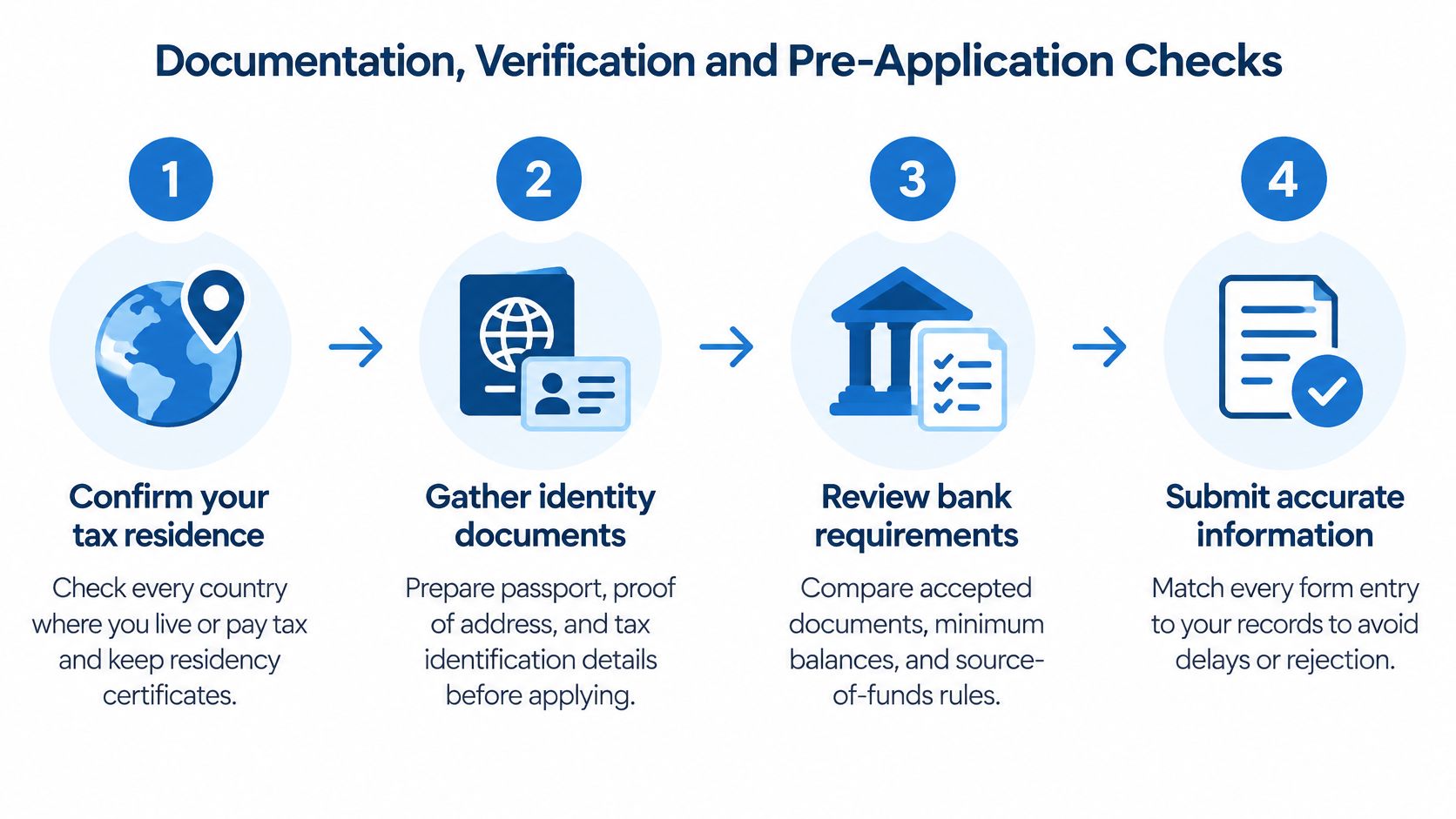
Prepare the core application file before submitting forms.
Build a File You Can Maintain
Confirm your tax residences. Record every country where you live or may have tax obligations, and obtain residency certificates where appropriate. Paying tax somewhere doesn't automatically settle your residence status, so resolve overlapping claims before completing self-certifications.
Map the legal owner, controlling persons, and beneficial owners, including the classification of any company or trust. Keep incorporation documents, ownership charts, trust documents, and supporting identification together so the account application matches the legal arrangement.
Document the source of incoming money. Match salary to payslips, business receipts to contracts and invoices, property proceeds to sale and settlement documents, and inherited money to estate papers. For investment or digital-asset proceeds, preserve the sequence showing acquisition, disposal, and transfer into the bank.
Keep identity and address evidence current. If conventional utility bills aren't available, Cloud Residents discusses address verification options for non-residents, but the receiving bank decides which evidence it accepts. Use your genuine residential circumstances rather than an address selected merely to pass verification.
Preserve balance and conversion records. Download statements in a usable format and retain transaction histories where statements don't establish peak balances. Record the exchange-rate method alongside the calculation so someone else can reproduce it.
Write a short explanation for transfers that could look unusual against your declared activity. A property-sale receipt, an owner's capital contribution, and an investment withdrawal need different supporting documents, even when all arrive as ordinary bank transfers.
Reconcile the file with annual filings. Match ownership, balances, and reportable income to the relevant FBAR, Form 8938, and home-country tax return analysis. Investigate differences instead of assuming the bank's reporting and your personal filings cover identical information.
Our explanation of crypto-card KYC levels can help distinguish identity requirements when a spending card is also involved. Our card comparison supports filters for No annual fee, Non-custodial, IBAN, Apple Pay, Google Pay, Virtual, and Physical; these describe product features, not exemptions from bank documentation or reporting.
Keep the Account Usable After Opening
An enhanced due diligence request is a compliance review, not automatically an accusation. Answer the question asked, attach the relevant evidence, and keep a dated record of the request and your reply.
If the bank asks about a sale, send the contract and evidence of settlement rather than an unrelated collection of financial documents. Where money passed through an exchange or another account, include the records connecting those stages.
Operating safeguard: Keep evidence with the transaction when it happens. Reconstructing a payment trail after access is restricted is much harder.
Protect the file with secure storage and controlled access. Retain both the original documents and the versions submitted to the bank so you can explain changes in addresses, ownership, or circumstances.
Pass These Gates Before Applying
- Residence gate. Can you identify every country that treats you as tax resident?
- Reporting gate. Have you established which forms apply using your expected maximum balances?
- Evidence gate. Can you document each substantial inflow in your recent transaction history?
- Purpose gate. Does the account serve a concrete payment, currency, investment, or relocation need?
If an answer is no, resolve that gap first. If you can answer each question confidently, take the file to a cross-border tax adviser familiar with both relevant countries and request a review of reporting, beneficial ownership, and onboarding documents.
How Crypto Card Users Fit Into Offshore Banking
A crypto card doesn't make spending invisible. It's a payment tool, while an offshore account is a banking relationship. Linking the two doesn't determine the tax treatment of either.
A card might spend from an exchange balance, draw from a fiat account, or interact with a self-custody wallet. Those arrangements can produce different records and involve different legal entities, even when the checkout experience looks identical.
Follow the Legal Relationship
Before treating a card as a substitute for a foreign bank account, establish:
- Who provides the service. Identify the issuer, any banking partner, and the entity holding customer balances.
- Where the relationship sits. Check the relevant entity's jurisdiction and licensing position.
- What the account provides. Distinguish an IBAN or account details from card-only spending access.
- Who controls the assets. Separate third-party custody from a wallet where you retain control.
A balance held by a foreign custodian may need assessment as a foreign financial account or asset, depending on its legal classification and the rules applying to you. Don't classify it solely from the app's marketing language.
The OECD beneficial-ownership toolkit explains why authorities seek the natural persons behind legal arrangements. The broader OECD transparency framework also extends attention to digital assets through the Crypto-Asset Reporting Framework, alongside CRS. Using a company, wallet interface, or payment card doesn't answer the underlying ownership question.
Reconcile Spending With Its Funding Source
Export card statements, exchange histories, wallet transaction records, and conversion details together. Match each card funding event or spend to the asset source, retaining transaction identifiers where they help connect on-chain and platform records.
For example, if you move assets from a wallet to an exchange before funding a card, preserve the wallet transfer, exchange receipt, conversion, and card statement. A merchant receipt explains what you bought, but not necessarily how you funded it.
Our guide to tax when using a crypto card provides general context for that distinction. Spending records and account-reporting records solve different problems, so don't discard one because you have the other.
NomadCard is an independent comparison website, not a bank, card issuer, or financial adviser. Our content is general information only, not financial, investment, tax, or legal advice, and not a recommendation to buy a product.
Treat every stage, custody, conversion, transfer, and spending, as something you may need to explain. Convenient payment access doesn't remove the need for a coherent financial record.
Visit NomadCards to compare crypto-linked debit and credit cards by fees, KYC requirements, custody model, and regional availability. Use those comparisons alongside your offshore-account checklist to distinguish useful spending features from the banking and tax obligations you still need to verify.