You're checking into a hotel after a long trip. Your crypto card is in your phone, but the terminal asks for a physical card. Later, you try to pay an online subscription with the plastic card in your wallet and discover that the checkout only works with a different credential. The problem isn't that one card format is universally better. It's that each one can fail in a payment context the other handles well.
The useful question is which combination minimizes payment failure across the places you spend, the ways you pay, and the situations where your phone, wallet app, or issuer's service isn't available. A virtual card can make online spending quick and controllable. A physical card can cover terminals, travel, and cash access. Neither format is a complete backup for every other one.
| Decision layer | Virtual card | Physical card |
|---|---|---|
| Issuance | Often available in the issuer's app after approval | Produced and delivered by mail |
| Online checkout | Built for remote card payments | Can be used if the merchant accepts its details |
| In-person payment | Usually requires mobile-wallet provisioning | Works at supported card terminals |
| Cash access | Generally unavailable without a linked physical card | May support ATM withdrawals, subject to issuer terms |
| Common failure point | Wallet, device, or online acceptance issue | Missing card, delivery delay, or limited remote controls |
Table of Contents
- The Question Most Comparisons Get Wrong
- What Physical and Virtual Crypto Cards Actually Are
- How Issuance, Activation, and Limits Compare
- Acceptance, Online Volume, and the Real-World Mix
- Which Format Wins Each Use Case
- Security, Tokenization, and What Each Format Actually Protects
- Fees, FX, and Rewards by Format
- Matching the Right Setup to Your Profile
The Question Most Comparisons Get Wrong
A traveler may have a virtual crypto card ready before boarding, then find that a hotel desk needs a card presented at the terminal. An online subscriber faces the reverse problem: a physical card may work at checkout, but it's less convenient to replace or restrict if its details are exposed. Those aren't edge cases. They're reminders that the payment setting matters as much as the card format.
Comparisons that ask only “physical or virtual?” flatten two separate decisions into one. Issuance format describes how the card credential is created and delivered. Payment context describes where a merchant can accept it, whether a wallet is involved, and what happens if the preferred route fails. A virtual card may be instantly available, but it doesn't automatically work at every terminal. A physical card may offer broad in-person utility, but it isn't a substitute for the controls some virtual products provide for online spending.
A better test is to list the moments when a payment needs to succeed: online checkout, recurring billing, travel, point-of-sale terminals, ATM withdrawals, and unexpected device or service failures. Then check whether the card program supports a primary method and a credible fallback for each. If you're comparing crypto-linked products, don't assume the two formats share the same network, assets, fees, limits, geographic availability, or wallet support.
For additional context on evaluating crypto-related services and market commentary, HeliosNet LLC's blog offers a place to broaden your research beyond a simple format comparison. Keep the decision practical, though: your best setup is the one that still gives you a workable payment route when your first choice isn't accepted.
What Physical and Virtual Crypto Cards Actually Are
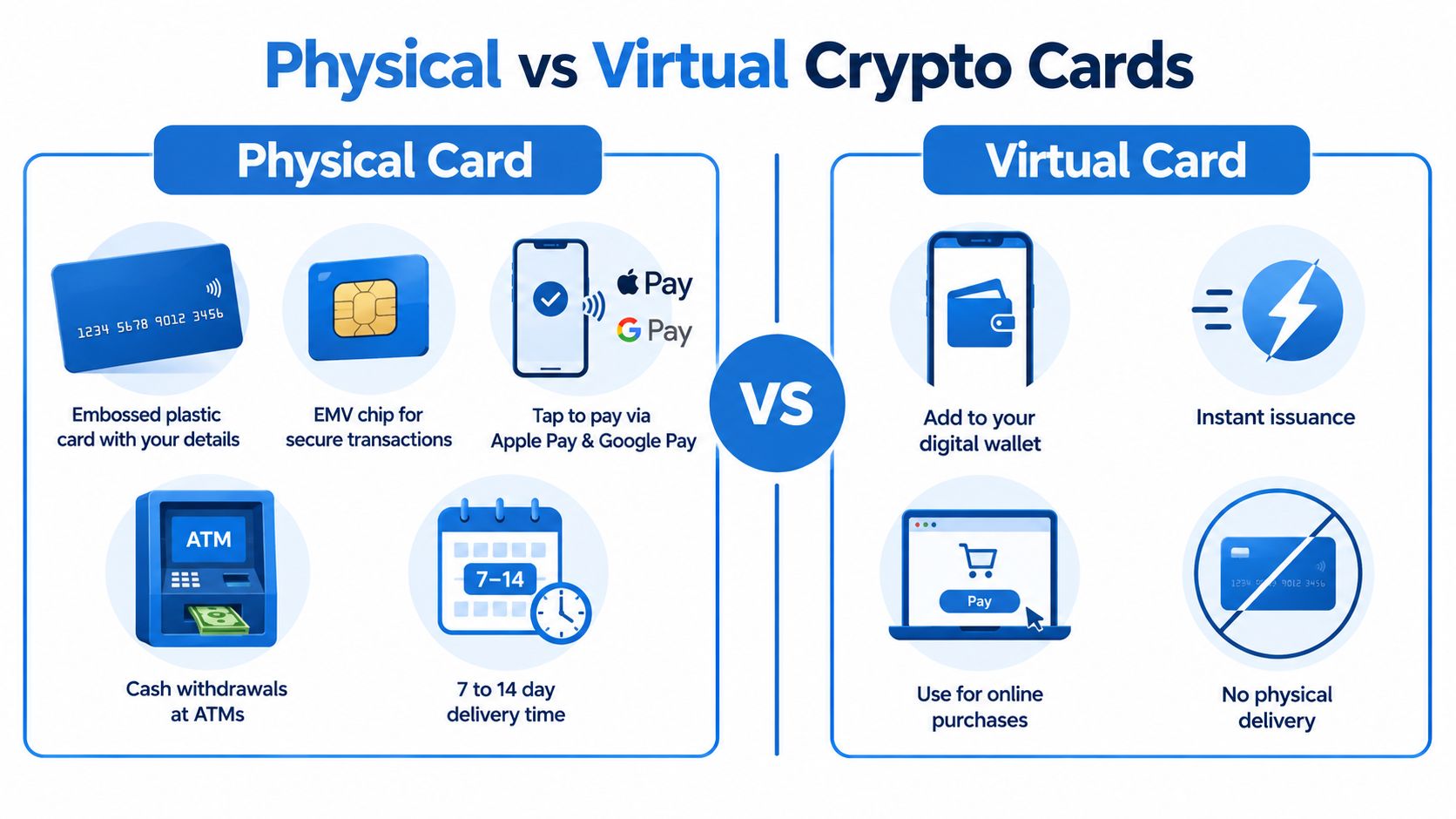
A physical crypto card is a payment card issued by a provider and linked to a crypto-funded or crypto-linked account. The card typically includes an EMV chip for use at compatible terminals. Depending on the issuer, it may also be possible to add the card to a mobile wallet such as Apple Pay or Google Pay. Some programs support ATM withdrawals, while others restrict that feature or make it subject to separate fees and limits.
Issuance generally involves applying through the card provider, completing any required verification, and waiting for the card to be produced and delivered. The planned comparison below uses a typical shipping estimate, but actual delivery time depends on the program and destination. Once the card arrives, follow the issuer's activation instructions before relying on it for purchases.
How virtual issuance works
A virtual crypto card is a digital card credential available through an issuer's app or account. Once the provider issues it, you can use its details for eligible online purchases, and, where supported, add it to a mobile wallet for contactless payments. A virtual card doesn't arrive in the mail, but that doesn't mean every product is issued instantly or skips verification. Timing depends on the issuer's review and onboarding process.
Some programs let users create additional virtual cards with tighter controls, such as merchant restrictions, spending caps, expiration windows, or single-use behavior. Those features are not universal. Check whether the card is virtual-only or whether the provider also issues a physical companion tied to the same balance and spending settings. The answer can affect how easily you can switch from online checkout to an in-person purchase.
The essential distinction is straightforward: a virtual card is a credential for remote payments and, where available, mobile-wallet use; a physical card is a tangible credential for supported terminals and potentially ATM access. Compare what the actual program issues and supports, not what “virtual” or “physical” sounds like in isolation.
How Issuance, Activation, and Limits Compare
A virtual card is often quicker to access because it doesn't need to be manufactured and shipped. That advantage only matters if the issuer has approved the account and activated the card. Physical issuance adds delivery and activation steps, but it gives you a card you can carry independently of your phone.
| Format Mechanics at a Glance | Virtual | Physical |
|---|---|---|
| Issuance speed | May be available in the issuer's app after approval | Requires production and delivery |
| Activation effort | App or account activation, depending on issuer | Activation after delivery, following issuer instructions |
| Per-transaction limits | Set by the card program and account terms | Set by the card program and account terms |
| ATM access | Usually depends on a linked physical card and issuer support | Available only if the issuer and card support withdrawals |
| Wallet provisioning | Depends on issuer, network, country, and device | May be available through supported wallet services |
Don't mistake a format characteristic for an issuer rule. KYC requirements, spending caps, and activation steps vary by program, and verification isn't automatically lighter just because the card is virtual. Check the card's own terms for daily and monthly spending limits, eligible assets, countries served, and any separate restrictions on cash withdrawals.
Wallet support deserves its own check. A physical card may be eligible for Apple Pay or Google Pay, while a virtual card may not be supported by either wallet in a particular region or on a particular device. Even when both are supported, provisioning can depend on the card network and issuer settings. Confirm support before you travel rather than finding out at the checkout.
Practical rule: Treat issuance speed, activation, limits, and wallet compatibility as issuer-level questions. The format tells you how a credential is delivered, not every condition that governs its use.
Acceptance, Online Volume, and the Real-World Mix
Physical acceptance still matters because card spending isn't only online. In the euro area during the first half of 2025, consumers made 44.0 billion card payments worth approximately €1.7 trillion. The European Central Bank reported that 81% of transactions by volume were non-remote, while remote payments accounted for 19% of volume but 30% of value. The average card payment was approximately €38 (ECB payment statistics for the first half of 2025).
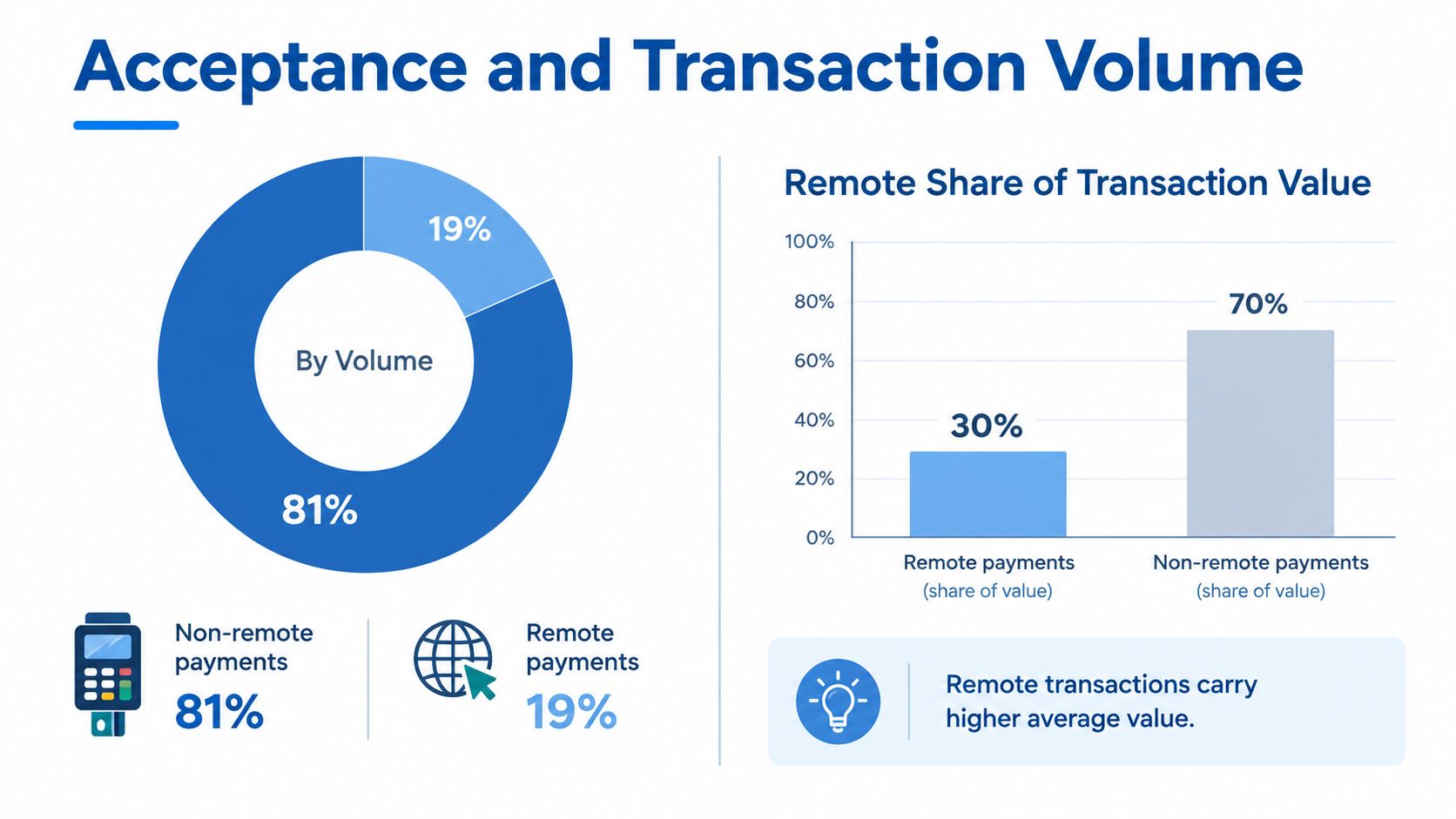
That split shows why “online is growing” doesn't mean physical payment options are obsolete. Remote payments represent a larger share of value than of transaction count, so they matter commercially. But in-person transactions still make up most card-payment activity in this major market. The ECB also counted 29.6 billion contactless card payments at physical terminals during the same period, underscoring that a physical card can mean tapping rather than inserting or swiping.
U.S. household behavior points in the same direction: the Federal Reserve's 2024 Diary of Consumer Payment Choice found that 22% of non-bill payments were made online or remotely, up from 19% in 2022 (Federal Reserve 2024 Diary of Consumer Payment Choice). That increase doesn't belong to virtual cards alone. Remote payments can use bank accounts, digital wallets, or ordinary debit and credit cards.
The practical verdict is clear: virtual credentials suit online checkout, recurring billing, and fast digital access, while physical cards cover a broader range of terminal-based situations. Acceptance also varies by merchant, location, issuer, and wallet support. For country- and merchant-specific questions, use a crypto-card acceptance guide as a starting point, then verify the issuer's terms for your destination.
Which Format Wins Each Use Case
A trip makes the physical card's advantage easy to see. You may be able to pay by mobile wallet at many terminals, but a hotel, car-rental desk, or other merchant may ask for a card-present payment or a physical card. Verdict: physical leads for travel resilience. A supported mobile wallet is a useful companion, not a guarantee that every terminal will accept your phone.

Online shopping and recurring subscriptions are more natural territory for virtual cards. If the issuer supports merchant-specific or single-use credentials, you can limit how a card is used and replace an exposed credential without waiting for a new physical card. Verdict: virtual leads for online control and convenience. Keep a physical or wallet-based option for services that reject the virtual credential or require another payment route.
ATMs call for a physical-card check. A virtual card alone generally won't get you cash from a standalone machine; the issuer must support withdrawals and provide a compatible physical card. Fees, limits, and local acceptance can change the value of that option, so don't count on ATM access until you've checked the specific program's terms. Verdict: physical wins when cash access is part of the plan.
DeFi and self-custodial spending need a different test. The key question is how the card connects to the funds and authorizes spending, not whether the card is plastic or digital. A virtual card can suit online purchases from a supported wallet-linked program, while a physical companion can help when spending moves offline. Neither format proves that a product is self-custodial. Check the custody model, asset support, authorization flow, and fallback if the wallet or issuer app is unavailable. The custodial and self-custody crypto-card guide can help you frame those questions.
The video below offers another look at crypto-card use in everyday payment settings.
Security, Tokenization, and What Each Format Actually Protects
Physical and virtual cards protect different parts of the payment journey. At a compatible in-person terminal, an EMV chip generates a transaction-specific cryptographic value. That means copied magnetic-stripe data cannot be reused to create a valid chip transaction. Contactless EMV uses the same underlying chip authentication over NFC; the difference from chip-and-PIN is primarily how you interact with the terminal (EMV security overview).
That protection doesn't carry over to online purchases. A remote merchant can't access the card's physical chip, so fraud prevention depends on controls such as network tokenization, 3-D Secure, merchant risk checks, and issuer authorization rules. A physical card's PAN still matters if you type it into a website or save it with a merchant.
Virtual cards can reduce exposure by using substitute credentials, merchant restrictions, spending caps, expiration windows, or single-use behavior where the issuer offers them. These controls can make an exposed credential less useful and give the issuer a way to block transactions outside the card's permitted use. Visa describes tokenized transactions as producing a 30% reduction in online fraud compared with transactions using the raw 16-digit PAN (Visa tokenization materials).
Physical security is strongest at the terminal. Virtual-card controls are most useful for managing remote credentials. Neither replaces sound issuer authorization, secure devices, or careful account access.
Score security features separately from payment access. Check for tokenization, merchant controls, single-use options, 3-D Secure, and clear issuer procedures for freezing or replacing a card. If you're assessing exposed credentials or related risks, a credential exposure intelligence platform can provide context on the wider credential-security problem. For everyday use, enable device security and wallet authentication where available, and know how to lock the card promptly.
Fees, FX, and Rewards by Format
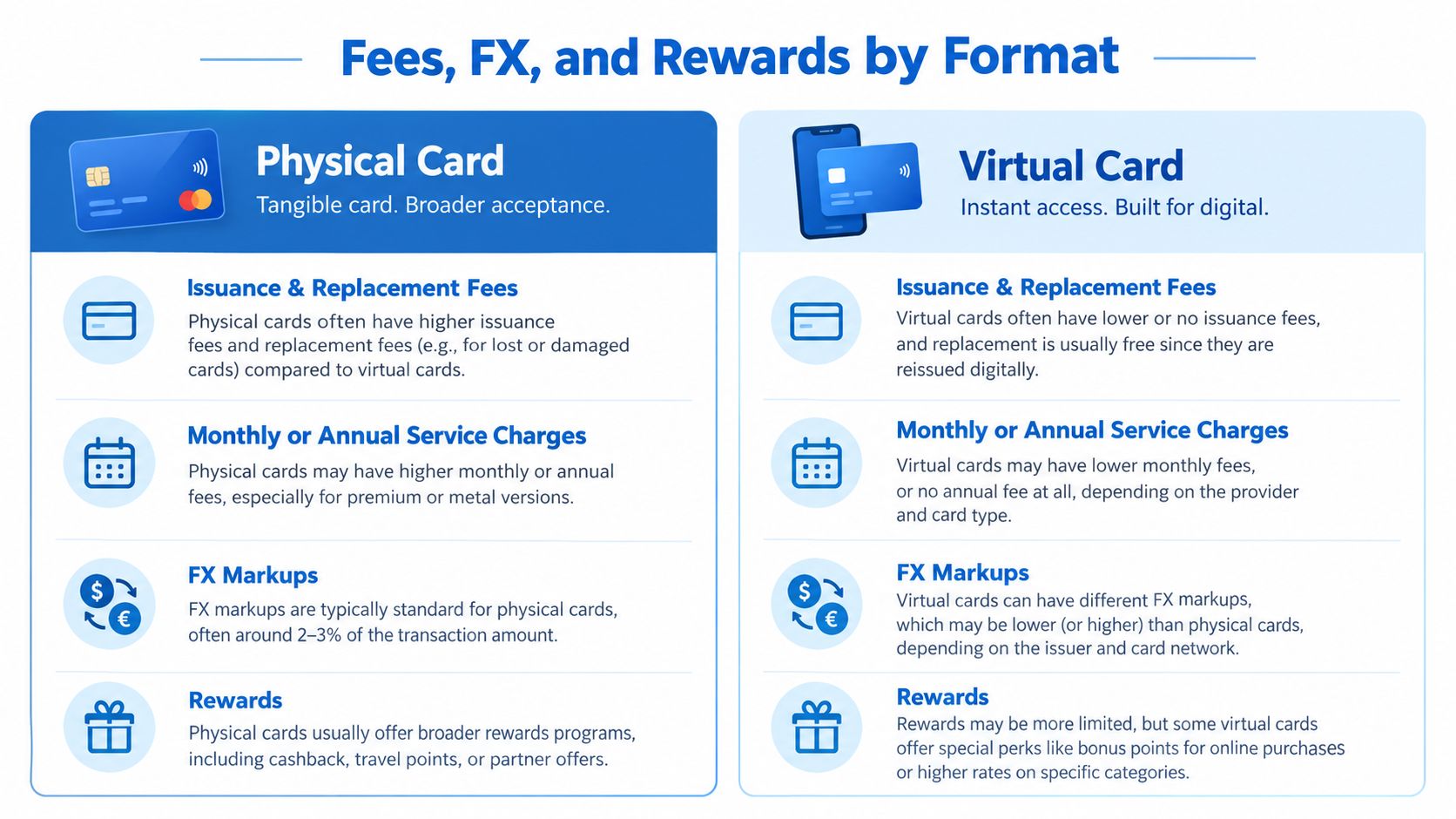
There isn't one universal fee difference between virtual and physical crypto cards. Some issuers charge for physical issuance or replacement, while others make the physical card free but charge for currency conversion, account services, or cash withdrawals. A virtual card can have its own pricing, too, including format-specific FX terms or exclusions from a reward program.
Compare the charges line by line
Start with issuance and replacement costs. A free virtual credential may still require a paid physical card for terminal or ATM use, and replacing a lost card may incur another charge. Then review monthly or annual service fees. Don't assume those apply identically across card formats or account tiers.
FX markup deserves particular attention if you spend in currencies other than the card's billing currency. Compare the markup for the format you'll use, and check whether weekend, conversion, or settlement terms alter the cost. ATM withdrawals are a separate line item: confirm both the issuer's charges and any restrictions on where the card can withdraw cash.
Rewards can distort the comparison. A provider may advertise cashback but limit eligibility by merchant category, transaction type, region, or card format. Read the program rules for the exact credential you'll use, including whether the issuer excludes ATM, wallet, or selected online transactions. For a like-for-like review, use a crypto-card fee comparison and confirm each figure against the issuer's current terms.
Before applying, pull these five details from the product terms:
- Issuance and replacement: Check whether the virtual credential, physical card, and replacement card carry separate charges.
- Service charges: Confirm monthly or annual fees for the account and card tier.
- FX markup: Compare the charge on the format you expect to use most.
- ATM costs: Check withdrawal fees, limits, and any location restrictions.
- Reward eligibility: Verify that your preferred card format earns the advertised rewards.
Matching the Right Setup to Your Profile
Choose a setup by identifying your likely failure points, not by treating one format as the default winner. A card that works well for online subscriptions may be a poor fit for frequent travel if there's no physical fallback. A physical card can solve terminal access but still leave you with weaker controls for recurring online charges.
| Your profile | Best starting setup | Fallback to verify |
|---|---|---|
| Online-first subscriber | Virtual card, with tighter controls where available | Physical card or another supported payment method |
| Frequent traveler | Physical card as the primary credential | Mobile-wallet provisioning and issuer freeze controls |
| DeFi or self-custody user | A virtual card from a program that clearly explains its wallet connection | Physical companion for offline spending |
| Privacy-focused user | A virtual option, if the program's verification terms fit your needs | Whether the same issuer offers a physical card |
| Rewards optimizer | Whichever format earns rewards on the purchases you actually make | A second format if the reward rules exclude your primary use |
The table is a starting point, not a substitute for the card terms. A “no-KYC” label, for example, shouldn't be treated as a guarantee of universal access or identical limits across formats. Verify identity requirements, eligible countries, supported networks and assets, wallet provisioning, and whether the same balance and controls apply to both credentials.
For a traveler, ask what happens if the phone is lost or the wallet app fails. For a virtual-first user, find out how quickly the issuer can freeze and replace a compromised credential, and whether a physical card can be issued as a backup. For everyone, check whether you can still spend if the issuer app or authorization service is unavailable. Those are the questions that turn a card comparison into a practical failure plan.
NomadCards is a comparison directory that lets readers review card format alongside fees, rewards, custody model, verification requirements, supported assets, networks, and regional availability. Use it to build a shortlist, then verify the issuer's current terms for the country where you'll apply and spend. The strongest setup is the one with a dependable primary method and a usable fallback, not the one with the fastest issuance.
NomadCards organizes crypto-card options so you can compare virtual and physical availability alongside costs, rewards, custody, and regional access. Build a shortlist around your real spending needs, then visit NomadCards to compare the details and check the issuer terms before applying.