The most popular advice about crypto cards is also the least useful: choose the highest cashback rate. That shortcut treats a marketing maximum as if it were guaranteed everyday value, while ignoring whether you can obtain the card, fund it, use it in your region, and keep control of your assets.
A credible scoring methodology should answer a harder question. What remains valuable after verification, conversion, merchant acceptance, custody exposure, privacy loss, and operational friction are included? Composite scoring has a long institutional history, from early judgment-based credit rules to statistical scorecards and regulated financial models, which shows why a score should be treated as documented analytical infrastructure rather than an editorial impression (academic history of scoring methods).
Table of Contents
- Why Headline Rewards Fail the Real-World Test
- Data Inputs and the Normalization Pipeline
- The Weighting Framework and Composite Formula
- Evaluating Privacy and Custody Models
- Real-World Usability and Access Friction
- Data Sources and the Weekly Update Cadence
- Limitations and Edge Cases in Card Scoring
- Quick Reference Guide to Interpreting Scores
Why Headline Rewards Fail the Real-World Test
A cashback figure describes only one route to value. It doesn't tell you whether the reward requires staking, a particular token, a spending category, a geographic market, or a level of activity that doesn't fit your habits. It also says nothing about whether the issuer converts your crypto at a reasonable rate, liquidates assets automatically, or accepts the transaction when a merchant places a temporary authorization.
That distinction matters because theoretical value and usable value are different variables. A card can advertise an attractive reward while imposing restrictions that make the reward difficult to access. A card with no headline cashback can be more useful if it has transparent fees, broad eligibility, dependable funding, and fewer conditions attached to ordinary spending.
The score must model the whole journey
NomadCards approaches the comparison as a composite model. Each product receives a single rating built from measured sub-scores for fees, privacy, trust, community, and rewards, while the underlying fields remain available for inspection. The point isn't to hide complexity behind one number. The point is to make a ranking that can be traced back to the conditions a user faces.
A transparent model also needs documented limits. Banking-supervisor guidance on model documentation calls for the procedures, rationale, applications, limitations, personnel, milestones, and validation results to be recorded (FDIC model documentation guidance). For a public card ranking, the equivalent is clear disclosure of the components, weighting logic, update conditions, and cases where the score shouldn't be used on its own.
Practical rule: Treat a cashback rate as one input, not as the conclusion.
Why friction can reverse a ranking
Suppose one card offers a high reward but requires a staking balance, supports only selected regions, and converts spending through a token that you don't want to hold. Another card offers no comparable reward but has a simpler funding path, fewer restrictions, and reliable mobile-wallet use. The first card may win a rewards-only table, while the second can produce more dependable utility for a traveler or a privacy-focused user.
This is why a sound scoring methodology penalizes hidden access friction. Approval difficulty, country eligibility, top-up mechanics, wallet compatibility, subscriptions, pre-authorizations, and merchant edge cases belong in the analysis because they determine whether the advertised product survives contact with daily spending. Independent crypto-card coverage increasingly includes availability, setup friction, funding rails, and spend reliability rather than ranking reward rates alone (crypto-card comparison coverage).
Data Inputs and the Normalization Pipeline
Raw card data arrives in incompatible forms. One issuer may publish an annual fee, another may describe a monthly charge, and a third may bury conversion costs in a fee schedule. Supported assets, KYC requirements, wallet support, card type, regional availability, network, top-up methods, and ATM terms also vary in both meaning and presentation.
A defensible pipeline therefore separates collection, standardization, and normalization. The model shouldn't compare a prepaid stablecoin card and a crypto-backed credit product as if their raw fields were already equivalent. It should first define what each field means, validate the issuer's terms, and then translate comparable observations onto a common scale.
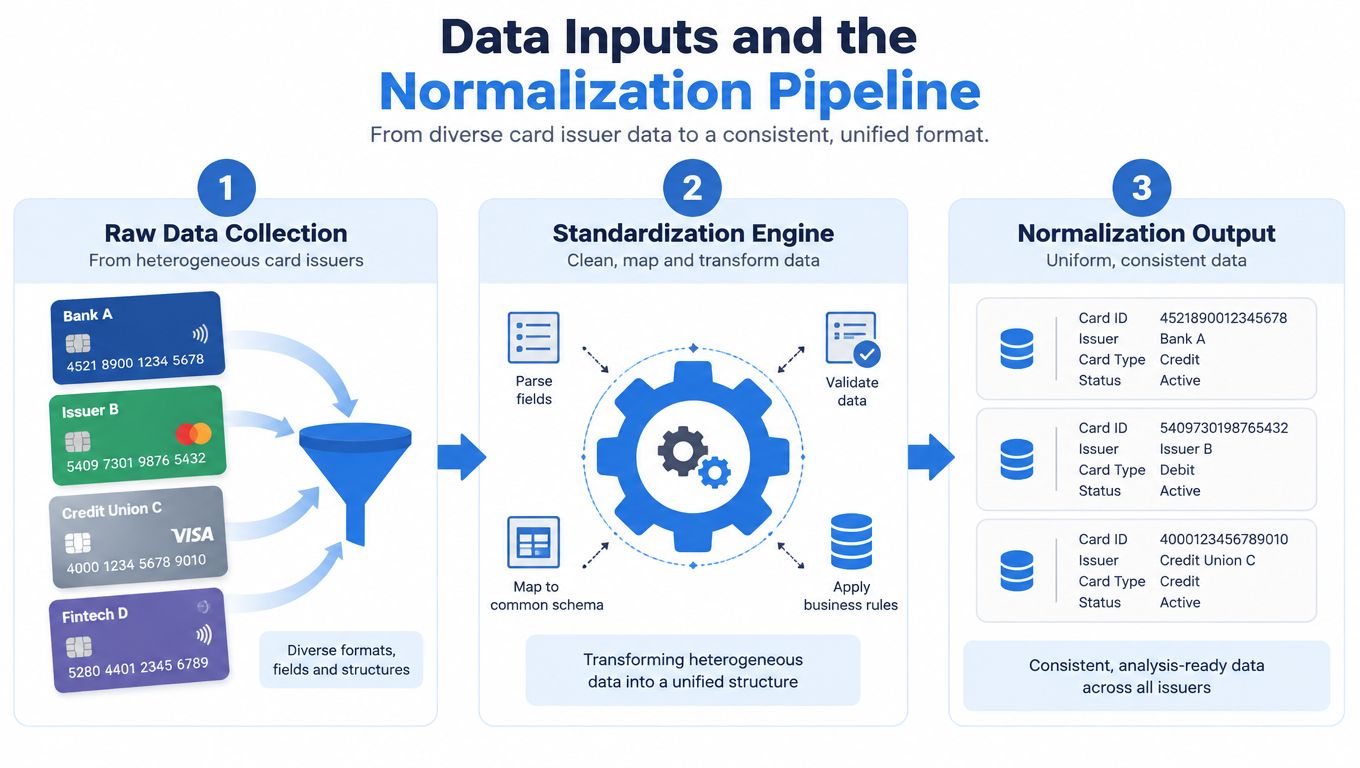
Stage one collects evidence
The first stage gathers issuer documentation, fee schedules, product pages, eligibility statements, app information, and operational notices. Data collection should preserve the original wording and date, because a normalized value without its source context is difficult to audit.
The fields can include:
- Direct costs: issuance, annual or monthly fees, top-up charges, ATM charges, conversion costs, foreign-exchange markup, and reward deductions.
- Access conditions: supported countries, approval requirements, KYC level, minimum funding conditions, and issuance status.
- Technical compatibility: Visa or Mastercard network, virtual and physical availability, Apple Pay or Google Pay support, supported assets, and wallet connectivity.
- Risk structure: debit, credit, prepaid, secured, custodial, or self-custodial design, plus collateral and liquidation conditions.
A public card data directory is useful when it exposes the same fields across products rather than presenting each issuer in a different format. For readers interested in the broader problem of turning application information into consistent decisions, Matil's underwriting automation guide offers relevant context on structured decision workflows.
Stage two standardizes definitions
Standardization prevents false comparability. A monthly fee can be converted into an annualized field for internal comparison, but the original billing rule must remain visible. A reward that applies only to selected merchants shouldn't be treated as a universal cashback rate. A “no KYC” label also needs a defined scope, because identity checks may still arise at funding, withdrawal, or regional thresholds.
Categorical variables require explicit encoding. KYC can be represented as ordered levels, while custody model, card type, network, and mobile-wallet support can be represented as separate indicators. Missing information shouldn't silently become a favorable value. It should be marked as unavailable, assigned a documented treatment, or excluded from a sub-score when the evidence isn't sufficient.
Stage three normalizes values
The technical pattern is straightforward. Raw variables are placed on a common scale, weights are applied, and the results are aggregated into a composite score. Ranking guidance describes this pipeline as data acquisition and validation, indicator normalization, scaling or transformation, and weighted aggregation, with sensitivity checks, explicit missing-data handling, and choices such as min-max or z-score normalization depending on outlier behavior (composite-indicator methodology guidance).
For a cost variable, lower fees should produce a higher benefit score. A min-max transformation can map the observed range to a 0 to 10 scale, reversing the direction for costs. A product at the expensive end receives less benefit than one at the inexpensive end, but the model must document which comparison set defines that range. Otherwise, the same fee could receive different scores when the dataset changes.
The output isn't “objective” merely because it uses mathematics. It becomes more trustworthy when every transformation is reproducible, each category has a defined interpretation, and the raw evidence remains available for review.
The Weighting Framework and Composite Formula
A composite score is a policy decision expressed mathematically. The formula doesn't discover what “best” means by itself. It encodes a view about which trade-offs matter most, then makes that view visible enough for readers to challenge or adapt.
The NomadCards model uses five measured categories. The provided methodology summary identifies the categories, while a public ranking model should also publish the exact current coefficient for each one and preserve the version used when a score was calculated. Without that versioning, readers can see a result but can't reliably reconstruct it after weights or data change.
The components should answer different questions
| Variable category | Weight allocation | Primary metrics included |
|---|---|---|
| Fees | Published model coefficient | Issuance, recurring, conversion, FX, ATM, top-up costs, and cashback offset |
| Privacy | Published model coefficient | KYC level, identity-data requirements, and privacy trade-offs |
| Trust | Published model coefficient | Custody exposure, regulatory context, operational transparency, and product structure |
| Community | Published model coefficient | Documented user sentiment and recurring service concerns |
| Rewards | Published model coefficient | Cashback design, eligibility, asset or staking conditions, and reward usability |
The final value can be represented as:
Composite score = (fees × w₁) + (privacy × w₂) + (trust × w₃) + (community × w₄) + (rewards × w₅)
The weights must sum to the model's full allocation, and each sub-score must use the same direction. A higher fee score should mean better cost performance, while a higher privacy score should mean less privacy compromise. Mixing “risk” values and “benefit” values without reversing one of them can produce a mathematically neat but conceptually broken result.
Why economics shouldn't dominate by default
Fees matter because they affect every transaction path, not just a promotional reward. A public total-cost calculation can include issuance, recurring charges, conversion fees, foreign-exchange markup, ATM fees, top-up fees, and cashback, which is more informative than comparing a single fee in isolation. This is especially important when a reward is conditional or when the conversion path determines the effective cost.
Privacy deserves explicit influence for a different reason. A full-KYC custodial product and a self-custodial spending design can deliver similar payment functionality while exposing the user to different identity, counterparty, collateral, and regulatory risks. Recent crypto-card comparisons increasingly separate access models and include KYC level, country availability, and self-custody in the ranking itself (crypto and Bitcoin card methodology coverage).
Rewards should remain visible, but they shouldn't erase structural disadvantages. A high rate can be offset by a narrow eligibility rule, forced asset conversion, or a requirement that introduces risk the user never intended to accept.
Weighting needs auditability
Readers should be able to change the coefficients mentally or through a calculator and understand why a ranking moves. A useful methodology page should show the weight distribution, each sub-score, the raw inputs, the date of collection, and the effect of missing information.
For data teams, the Scrapeway testing methodology provides a useful reminder that collection quality and validation rules are part of the analytical product. A score built on stale or inconsistently parsed terms can't be rescued by an advanced formula.
Evaluating Privacy and Custody Models
Privacy and custody aren't decorative labels. They describe who holds assets, who controls the transaction path, what identity information the issuer receives, and what can happen if the provider changes its rules or becomes unavailable.
A custodial card generally routes funds through a third party. That may simplify spending, conversion, support, and compliance, but it introduces counterparty exposure and usually requires a more extensive identity process. A self-custodial model can preserve greater control over assets, yet it may involve more setup, narrower compatibility, smart-contract dependencies, or additional operational responsibility.
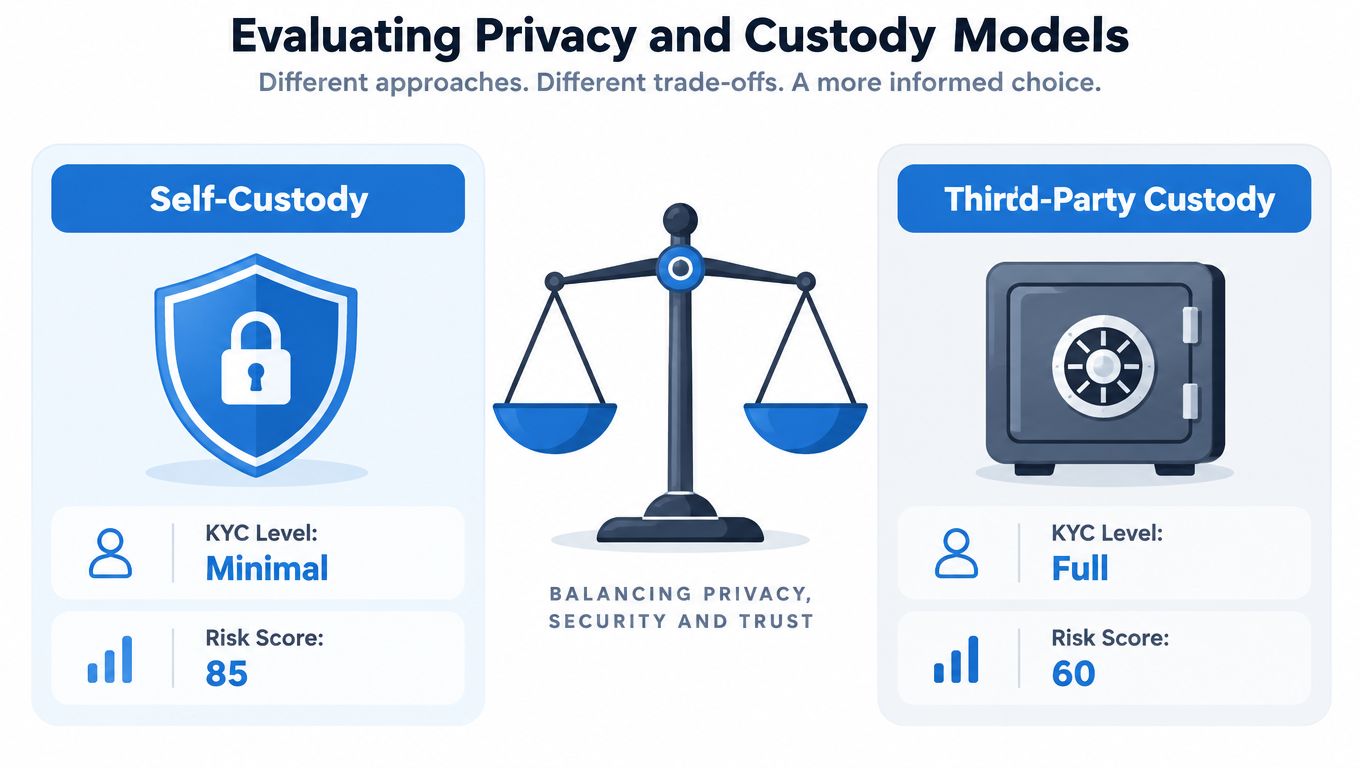
Compare the trade-off, not the label
| Question | Third-party custody | Self-custody |
|---|---|---|
| Who controls the balance? | The provider or its custody arrangement | The user or connected wallet structure |
| What creates friction? | Verification, account controls, and provider policies | Wallet setup, compatibility, and transaction responsibility |
| What creates exposure? | Counterparty, regulatory, and withdrawal constraints | Contract, key-management, and integration risks |
| What should the score capture? | Convenience against custody and privacy cost | Control against operational complexity and technical risk |
A privacy score shouldn't just reward the least KYC. Minimal verification can be valuable to some users, but it doesn't automatically establish safety, availability, or durability. The model should distinguish privacy preservation from access reliability, then let the trust category reflect regulatory and operational concerns.
The same applies to custody. A self-custodial card shouldn't receive an automatic bonus if the spending mechanism has difficult funding rails or unreliable merchant behavior. Conversely, a custodial card shouldn't receive an automatic penalty if a user prioritizes convenience and accepts the counterparty relationship. The score should expose the trade-off instead of deciding that one preference is universally correct.
Readers who want the operational differences laid out in more detail can consult this guide to custodial versus self-custody crypto cards.
The following video can add useful conceptual context before a reader compares individual products.
The central analytical question is simple: what does the user give up to obtain payment convenience? That may include identity privacy, control of funds, exposure to collateral rules, or the ability to avoid forced liquidation at checkout. A first-class variable makes those costs visible rather than burying them in footnotes.
Real-World Usability and Access Friction
A card can look attractive in a spreadsheet and still fail at the point of use. The relevant question is not only what it rewards, but whether a qualified user can complete the path from application to payment without hidden barriers. Verification delays, restricted regions, unsupported funding methods, and merchant-specific failures can erase the value of favorable terms.
The scoring model therefore treats practical value as a sequence of conditions. A product must be available to the user, accessible after verification, compatible with a workable funding route, and reliable across ordinary payment situations. Each condition can reduce the score when it creates a meaningful chance of failure.
Access starts before checkout
The model records friction at each stage:
- Eligibility: Can residents of the user's country apply, and is issuance currently available there?
- Verification: What identity information is required, and when does the issuer request it?
- Funding: Can the user add funds through the assets, bank rails, or wallet connections already available to them?
- Conversion: Does spending require a conversion that introduces cost, delay, price exposure, or unwanted liquidation?
- Payment: Does the card support mobile wallets, subscriptions, hotel deposits, fuel-station holds, and other pre-authorizations?
These stages are sequential. Failure early in the process prevents later benefits from being realized, while failure during payment can make an apparently available card unreliable in practice. Independent crypto-card usability comparisons provide useful context, but the ranking assigns these constraints directly instead of leaving them as informal observations.
A product's access score should also reflect whether the friction is visible before application. Promotional material may describe supported assets or rewards without making country restrictions, funding conditions, or hold behavior equally clear. Hidden conditions receive greater scrutiny because they create a gap between the advertised product and the experience a user can reasonably expect.
Reliability belongs beside rewards
A virtual card's usefulness depends partly on mobile-wallet support and merchant acceptance. Subscription compatibility may matter more to a recurring-bill payer than a modest reward difference. Pre-authorizations test whether the balance remains usable and whether temporary holds are handled predictably.
Regional eligibility requires the same treatment. A network may be supported in principle while issuance, physical cards, assets, or particular features remain unavailable in a user's country. The score should distinguish theoretical functionality from accessible functionality.
The KYC friction ranking guide belongs alongside the score because verification affects access, time, personal-data disclosure, and sometimes the ability to fund or retain an account. Privacy and custody constraints therefore remain first-class variables, not footnotes added after the usability result.
A reward matters only after the user can qualify, fund the card, and complete the payment.
Hidden friction functions as a discount on every other benefit. It lowers the probability that rewards, fee terms, or asset support will translate into completed spending, which is why the final score makes that discount visible.
Data Sources and the Weekly Update Cadence
Crypto-card terms change through issuer decisions, regional rollouts, network changes, support updates, and temporary issuance pauses. A score is therefore a time-sensitive observation, not a permanent property of a product.
The weekly refresh cycle should begin by identifying changed source material. Fee pages, terms, eligibility notices, app documentation, network announcements, and issuer status messages each answer different questions. Community feedback can add operational context, but it needs careful separation from verified product terms because sentiment describes user experience rather than contractual pricing.
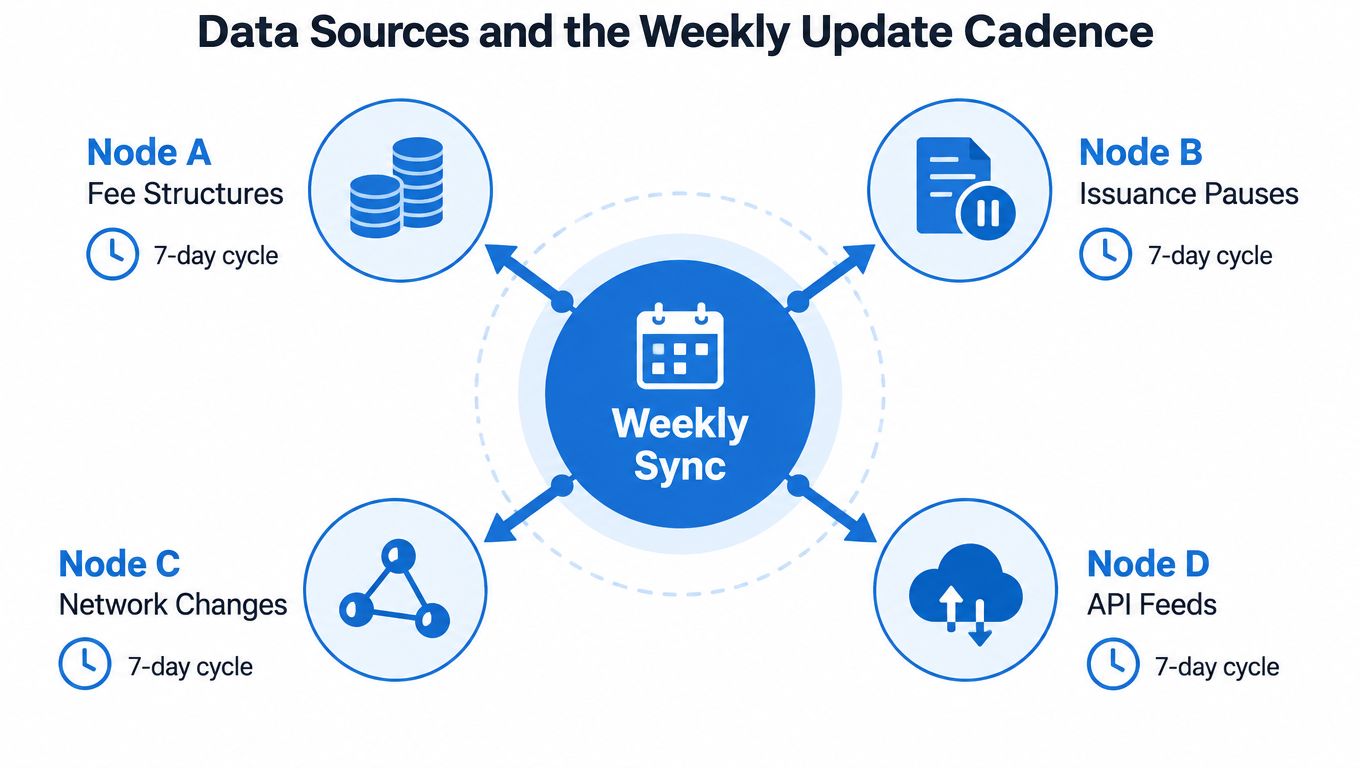
What happens during a refresh
A disciplined cycle can follow this order:
- Fee structures: Compare current issuance, recurring, conversion, FX, ATM, top-up, and reward terms with the prior record.
- Issuance pauses: Check whether applications, physical cards, or specific regions have been suspended.
- Network changes: Confirm Visa or Mastercard status, mobile-wallet support, virtual-card availability, and merchant-use constraints.
- API and product feeds: Reconcile structured fields with the latest issuer documentation and flag conflicts for review.
The important control is not merely collecting new text. It is preserving the old value, recording what changed, and recalculating only the affected fields. If an issuer changes a conversion rule, the fees sub-score should change for a documented reason. If a country becomes unsupported, the access field should change without altering unrelated rewards data.
Separate evidence from sentiment
Community sentiment can reveal recurring declines, delayed support, or confusing funding behavior that official pages don't describe. It shouldn't override a published fee schedule without evidence, but it can trigger a review of the relevant usability or trust field.
The same principle applies to regulatory developments. A change in compliance posture may affect availability, KYC, custody, or trust, but the update should identify the affected region and product version rather than applying a broad penalty to every card associated with an issuer.
A weekly cadence doesn't guarantee perfect freshness. It does create a visible operating discipline. Readers should know when the score was last checked and whether a material change is awaiting validation.
Limitations and Edge Cases in Card Scoring
A composite score can be accurate yet unsuitable. It summarizes the evidence selected for the model, not every condition that determines whether a card works for a particular person. Standardization makes products comparable, but it can hide access friction, custody restrictions, and privacy requirements that matter more than broad rewards or fee results.
A DeFi user may need one wallet integration or a rarely supported asset. A cross-border traveler may depend on a regional route, a specific network, or predictable pre-authorizations. Another user may reject custodial storage or require a defined KYC level. If the dataset omits that requirement, the score can appear precise while answering the wrong question.
Missing data creates model risk
Issuers may not disclose the formula behind an FX markup, the full conditions for rewards, or how temporary holds behave. Recording an undisclosed term as zero cost biases the result. Assigning the worst possible value claims more evidence than the issuer has provided.
The model should therefore:
- Flag unknowns: Mark unavailable fields instead of filling them with favorable assumptions.
- Separate confidence: Distinguish a score supported by complete terms from one based on partial evidence.
- Use bounded alternatives: Test reasonable treatments for missing values and show whether the ranking changes.
- Preserve the raw field: Let readers inspect the issuer wording and its date.
Normalization and composite-indicator guidance supports explicit missing-data treatment and sensitivity checks for changes in weighting. These checks do not remove uncertainty. They reveal whether the ranking remains stable or depends heavily on one assumption.
When the aggregate should lose authority
A mandatory requirement should override the aggregate score. Filter first for country access, wallet compatibility, supported assets, custody model, privacy conditions, and other constraints that determine whether the product can be used. If only one card meets the requirement, its overall rank should not disqualify it. A product can score well across the market and still fail the intended use case.
Access friction deserves the same treatment. A card may advertise broad availability while requiring an unsupported funding route, repeated verification, a particular wallet, or a network unavailable to the user. Those barriers reduce practical utility even when the published rewards and fees look attractive.
Rapid changes create another limitation. A weekly refresh provides a defined review process, but an issuer may pause a service, revise a policy, or introduce an app failure before the change is captured. The score can then be less representative than the profile notes suggest.
Analytical caution: A single score summarizes evidence. It does not replace the fields that produced it.
Use the composite result to narrow viable options, then inspect fees, access, custody, KYC, funding, privacy, and supported assets directly. The more unusual the requirement, the more authority should shift from the aggregate score to the underlying evidence.
Quick Reference Guide to Interpreting Scores
A score becomes useful when it supports a decision without pretending to make the decision for you. Start with constraints, then compare the remaining products according to the risks and costs you accept.
The order matters. Filtering for country, card type, network, supported assets, KYC level, wallet compatibility, and transaction limits removes products that can't serve the use case. Only then should the composite score help rank the viable options.
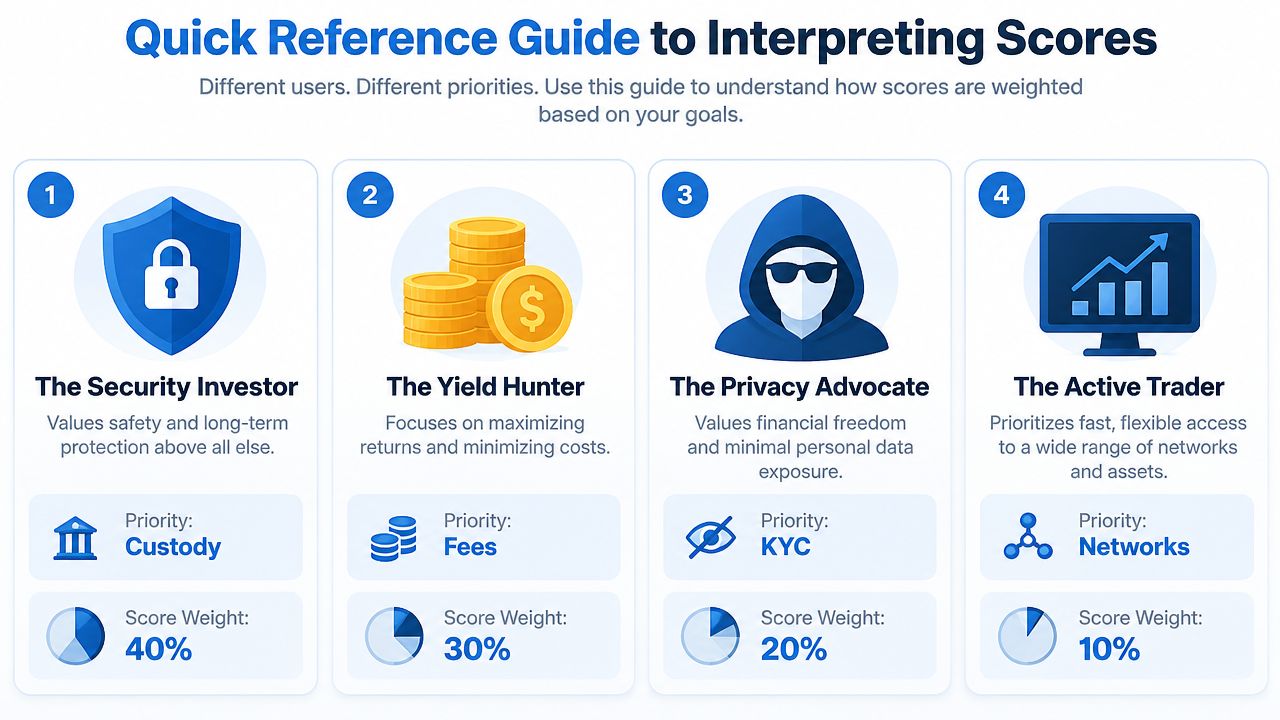
Match the score to the user
The privacy-focused nomad should begin with country availability, KYC level, custody, and mobile-wallet support. A slightly lower general score may be preferable if it preserves the user's privacy requirements and remains usable across the places they visit.
The rewards optimizer should inspect the reward conditions rather than the displayed rate alone. Check staking, eligible categories, supported assets, conversion costs, caps, and whether the reward is paid in a volatile or restricted asset.
The DeFi-native user should prioritize self-custody implementation, wallet compatibility, funding rails, contract dependencies, and the consequences of failed or reversed transactions. A high convenience score from a custodial product may have little relevance if control of funds is essential.
The cost-sensitive spender should calculate the complete path from funding to purchase. Issuance, recurring charges, conversion, FX, ATM, top-up, and reward offsets can produce a different conclusion from an annual-fee comparison.
Use a decision sequence
- Remove impossible options. Exclude cards unavailable in your country or incompatible with your required network, asset, card type, or wallet.
- Set hard privacy and custody constraints. Decide whether full KYC, third-party custody, collateral, or forced conversion is acceptable.
- Compare total cost. Review recurring and transaction-level fees together, not as isolated fields.
- Test the funding and spending path. Consider top-ups, conversion, mobile wallets, subscriptions, pre-authorizations, and ordinary merchant acceptance.
- Use the composite score as a tie-breaker. Prefer the higher-scoring product only when it still meets your essential conditions.
- Read the update date. Terms can change, so confirm that the profile reflects the current product state.
The most important distinction is between a market score and a personal score. The market score applies one documented framework across products. Your personal score changes the priorities, exclusions, and acceptable trade-offs according to how you spend and what risks you refuse.
NomadCards provides normalized card fields, filters for access and product characteristics, profile-level terms, and documented composite rankings that can support this process. Use those tools to inspect the evidence behind a score, not just the position of a card in a list.
NomadCards helps you compare crypto-linked cards through standardized fields covering fees, rewards, custody, KYC, supported assets, networks, and regional availability. Visit NomadCards to filter products around your real constraints, then review the underlying terms before choosing a card.