Spending crypto online usually starts with a crypto-linked debit card loaded with stablecoins such as USDC or USDT, which acts as a bridge to Visa and Mastercard acceptance. In July 2026, crypto card volume reached roughly $1.04 billion across nearly 9 million purchases, showing that this workaround has become a practical payment route rather than a niche experiment.
You know the moment. You've accumulated Bitcoin or Ethereum, find something you want to buy, and reach checkout expecting a crypto option. Instead, the page shows Visa, Mastercard, PayPal, and perhaps a local bank transfer. Your crypto is valuable, but it isn't immediately usable.
The usual response is to sell the asset, withdraw fiat, and pay normally. That works, but it adds conversion steps, possible spreads, custody transfers, record-keeping, and potentially a taxable disposal depending on your jurisdiction. A crypto card changes the sequence. You fund a card or its connected wallet, the provider converts the asset when required, and the merchant receives a payment through an established card network.
The important distinction is that owning crypto and spending crypto are different experiences. The first is mainly about custody and price exposure. The second is about acceptance, settlement, identity checks, exchange rates, refunds, and regional availability.
Table of Contents
- Why Spending Crypto Online Feels Harder Than It Should
- The Four Ways to Spend Crypto Online
- Crypto Cards, the Mainstream Bridge
- Choosing the Right Crypto Card for Your Needs
- Setting Up and Using Your Crypto Card
- Avoiding Hidden Costs and Common Pitfalls
- When Crypto Cards Aren't the Answer
Why Spending Crypto Online Feels Harder Than It Should
You can hold Bitcoin securely for years and still be unable to use it at an ordinary online checkout. A retailer may accept card payments without accepting blockchain transactions, because card networks already handle authorization, fraud controls, reversals, and merchant settlement. The checkout isn't rejecting your crypto personally. It isn't connected to your wallet.
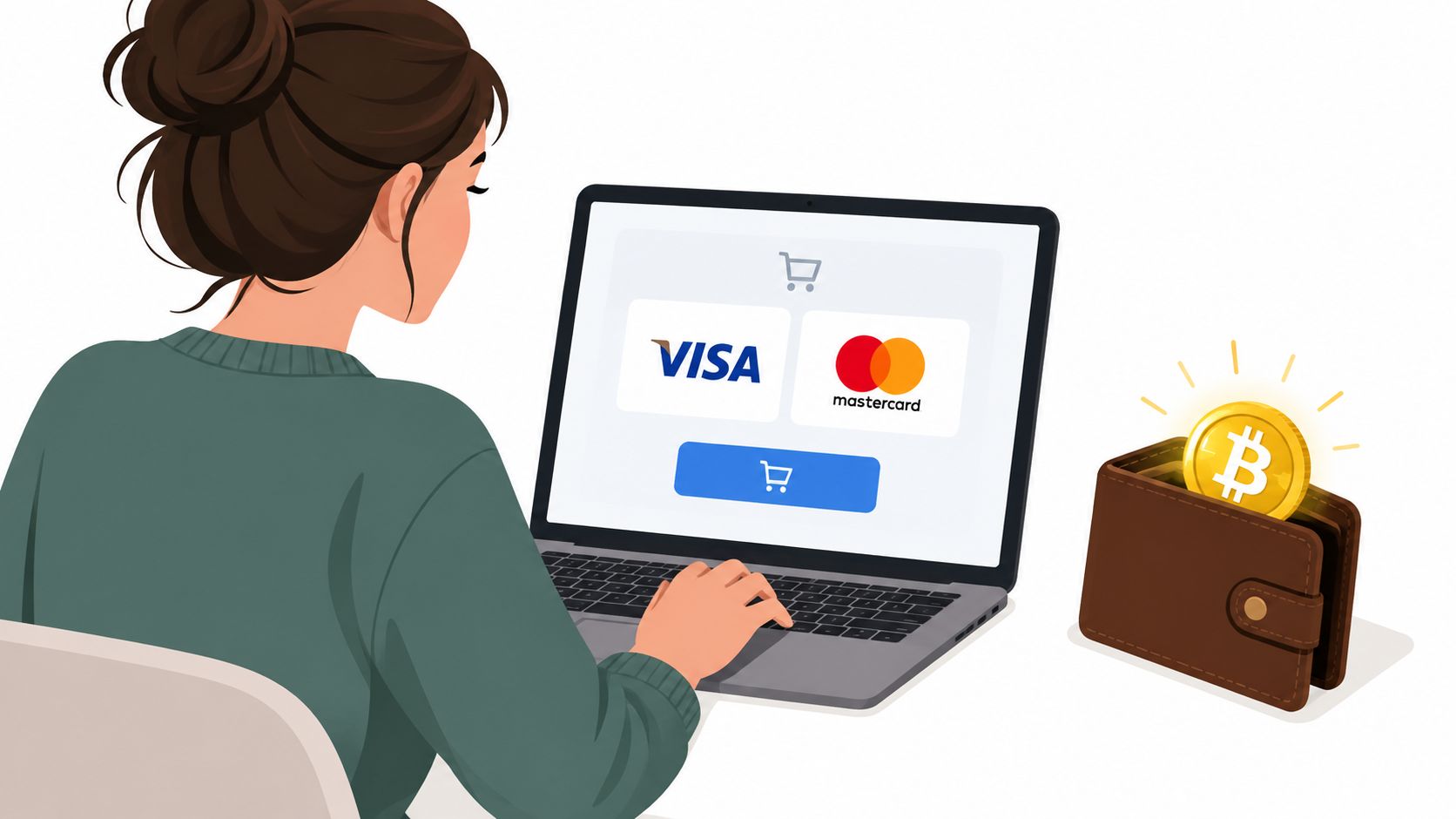
That leaves three obvious choices. You can sell crypto before every purchase, search for merchants that accept direct blockchain payments, or use a crypto-linked card that translates your balance into a card transaction. The first option is familiar but operationally tedious. The second protects more of the original payment model but works only where the merchant has built the necessary infrastructure.
The checkout problem is more than acceptance
Volatile assets create another mental barrier. If the price of Bitcoin moves sharply between the moment you approve a payment and the moment the merchant settles it, the buyer and seller face uncertainty. Stablecoins reduce that issue at the point of purchase because dollar-backed tokens are designed to track a fiat value more closely than assets such as Bitcoin or Ether.
The adoption data points toward this practical use. Dollar-backed stablecoins funded about 70% of more than 10 million crypto card transactions in July 2026, according to CoinDesk's report on stablecoins and crypto card spending. That doesn't mean every crypto user should sell volatile assets for stablecoins, but it does explain why stablecoins are increasingly used as the spending balance.
Practical rule: Treat your investment wallet and spending wallet as separate tools. The former manages long-term exposure. The latter should hold only what you're prepared to use.
The broader payment gap remains substantial. In the U.S., about 9% of adults used crypto for investment in 2025, compared with 2% for payments and 1% for transfers to family or friends, as reported in coverage of the Federal Reserve survey. Adoption alone doesn't create payment behavior. People need a method that fits the checkout they already use.
The Four Ways to Spend Crypto Online
There isn't one universally correct way to spend digital assets. The right method depends on whether you prioritize acceptance, privacy, custody, settlement speed, or control over the conversion.
| Method | Acceptance | Privacy level | Typical fees | Best for |
|---|---|---|---|---|
| Crypto-linked debit card | Broad wherever the network is accepted | Lower, because identity checks are common | Provider, conversion, and possible FX charges | Everyday online purchases and subscriptions |
| Direct crypto payment | Limited to participating merchants | Higher on the merchant side, but blockchain activity remains visible | Network and processor fees | Buyers who want direct settlement |
| Gift card marketplace | Retailer-specific | Varies by platform and account requirements | Exchange-rate spread and marketplace margin | Specific retailers and one-off purchases |
| Peer-to-peer payment | Depends on the counterparty | Can be higher, but depends on the platform and wallet path | Network, platform, or conversion fees | Personal transfers and flexible settlement |
Crypto-linked cards
Cards offer the broadest practical acceptance because the merchant sees a normal card transaction. The trade-off is that the issuer or program operator usually needs to identify you, apply spending controls, and manage the conversion from crypto to the merchant's settlement currency.
This route is convenient, but don't judge it by the headline annual fee alone. A card with no visible subscription charge can still be expensive if it uses a wide conversion spread, adds a foreign-exchange markup, or restricts the assets you can spend.
Direct payments
Direct Bitcoin, Ether, or stablecoin payments can preserve more control and avoid an intermediary card issuer. They also create a cleaner settlement path when the merchant supports the same asset and network. The limitation is simple: most online checkout flows still aren't designed for arbitrary wallet payments.
Refunds can also be less familiar. Blockchain transactions generally don't behave like card chargebacks, so you may need the merchant to initiate a separate return transfer. For a purchase where consumer protection matters, card rails may be worth the custody compromise.
Gift cards and peer-to-peer transfers
Gift card marketplaces can work when you shop with a specific retailer, but the effective exchange rate matters more than the advertised convenience. Check the final crypto amount, denomination restrictions, expiry rules, and refund policy before confirming.
Peer-to-peer transfers are useful for people or businesses that already accept your chosen asset. They aren't a universal online checkout solution, and they require careful wallet verification. Sending to the wrong address or incompatible network can be difficult or impossible to reverse.
Crypto Cards, the Mainstream Bridge
Crypto cards sit between self-custody and conventional payments. You maintain a crypto balance, the provider authorizes a transaction, and the card network presents the merchant with the payment method it already understands. Depending on the program, conversion can happen when you load the card, when you authorize a purchase, or through a linked custodial or self-custodial wallet.
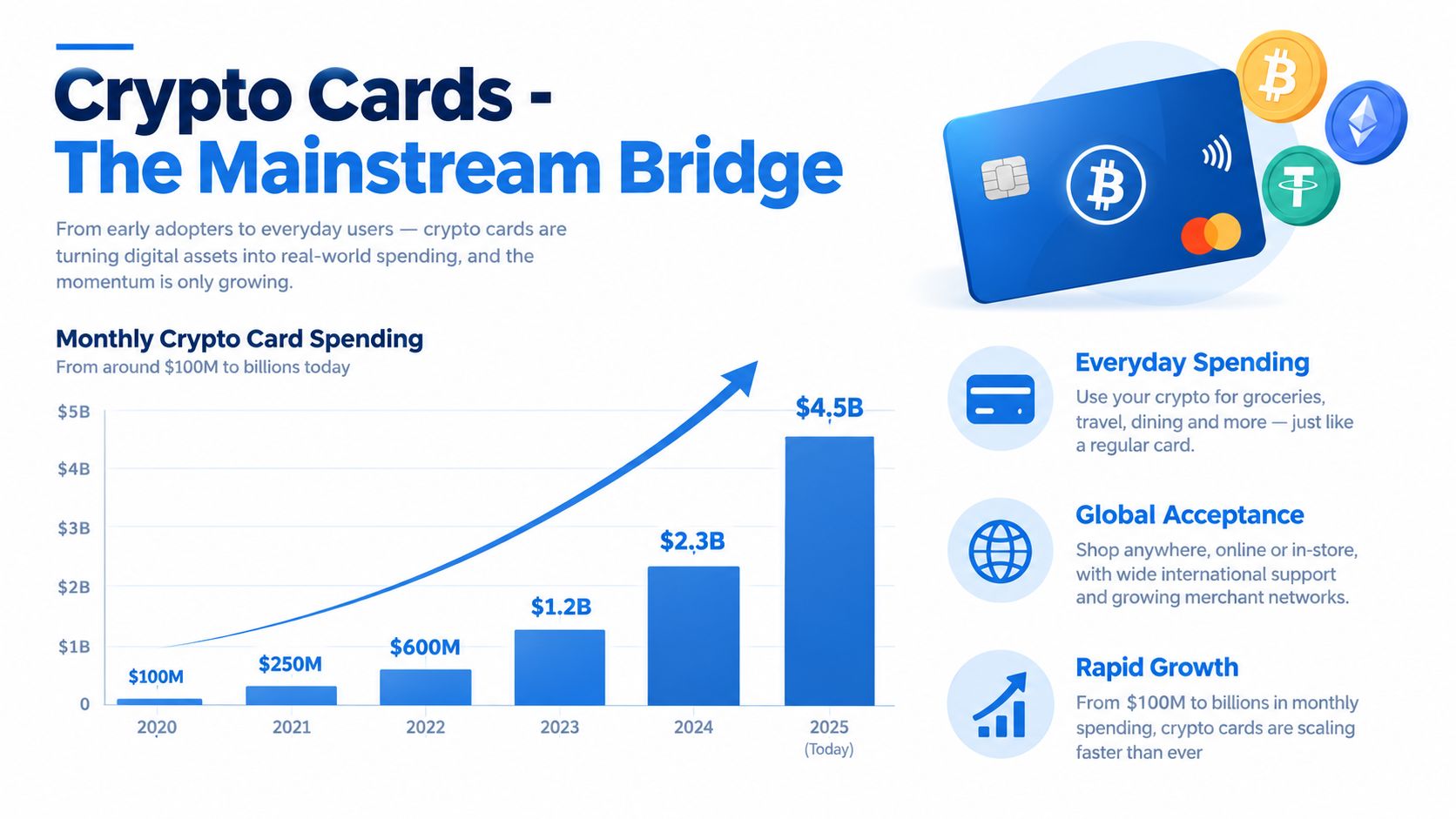
The scale has changed quickly. Tracked monthly crypto card volume rose from about $100 million in early 2023 to $759 million in July 2025, then to roughly $1.04 billion in July 2026, according to a16z crypto's payment card data. The same dataset recorded nearly 9 million purchases in July 2026, compared with about 5.2 million a year earlier. The increase therefore reflects broader transaction use as well as larger total volume.
Why stablecoins fit the card model
A card program must turn a digital asset into a predictable payment amount. Stablecoins are well suited to that job because they reduce the price movement between funding and purchase. This is particularly useful for subscriptions, software bills, household purchases, and other charges where you care about the fiat amount more than preserving exposure to a volatile token.
Online spending remains central, although it isn't the whole market. Crypto.com's 2025 consumer spending analysis found that online spending represented 51% of volume, while a separate summary of European cardholders reported that 65% of transactions were routine expenses such as groceries, subscriptions, transport, utilities, online shopping, and cafés, as detailed in Crypto.com's consumer spending analysis. That pattern favors cards that handle small, repeated purchases reliably rather than products designed only for occasional premium spending.
What the card doesn't solve
A card removes merchant acceptance friction, but it doesn't eliminate the underlying financial decisions. You still need to check the conversion rate, determine who controls the funds, understand how refunds work, and confirm that the program operates in your country.
The card also isn't automatically a privacy tool. The issuer may see your identity, transaction history, funding source, and spending pattern. A self-custodial design can reduce dependence on an exchange or card balance, but it still won't make a Visa or Mastercard transaction invisible to the network and issuer.
Choosing the Right Crypto Card for Your Needs
Start with the purchase pattern, not the rewards banner. A card for recurring online subscriptions has different requirements from a card for travel, cross-border shopping, or privacy-sensitive spending.
Step one, confirm regional availability
A card can look ideal until you discover that it doesn't issue in your country, supports only a virtual card in your region, or blocks transactions with merchants in certain jurisdictions. Check residence requirements, card delivery, supported currencies, and whether online payments are enabled before completing verification.
Regional availability also affects settlement. CoinGate reported that the U.S. represented 23.2% of global crypto-shopping orders in 2025, while its H1 2025 data showed 59.1% of merchants still settled to fiat and 41% chose crypto settlement, as described in its H1 2025 crypto payments report. A card may let you spend crypto while the merchant still receives fiat. Those are different parts of the transaction.
Step two, compare custody and verification
Ask where your funds sit before authorization. A custodial card may be easier to use, but it introduces dependence on the provider. A self-custodial or on-chain model may give you more control, although it can involve more complex wallet interactions and fewer supported assets.
Then check the identity tier. Read this guide to crypto card KYC levels before assuming that “no KYC” means no verification at all. Some programs request an email, impose lower limits, restrict regions, or introduce additional checks when activity changes.
Step three, calculate the complete cost
Compare the following as one spending cost rather than isolated line items:
- Conversion spread: The difference between the provider's rate and a transparent market rate.
- FX markup: The extra charge when the transaction currency differs from the card's settlement currency.
- Network or wallet cost: Charges for moving assets into the spending balance.
- Account fees: Annual, monthly, replacement, inactivity, or withdrawal charges.
- Reward conditions: Staking, token holding, tier requirements, or redemption restrictions.
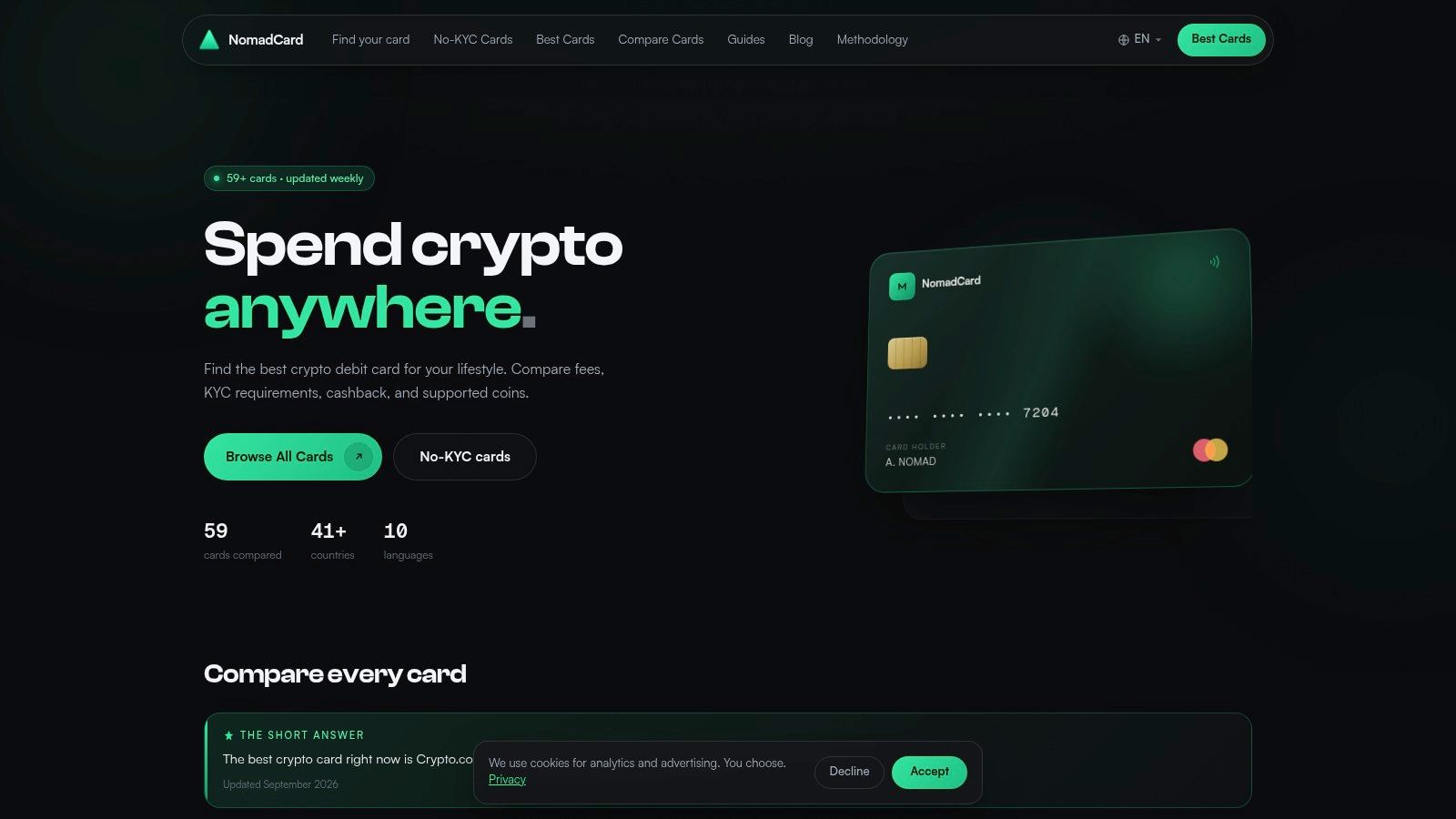
Use the comparison view to filter by network, supported assets, KYC level, card type, custody model, and country. NomadCards aggregates these fields across active programs, but you should still verify final terms with the issuer before funding the card.
Once you've shortlisted a program, complete verification, read its fee schedule, fund it with a small test balance, and make a low-value purchase. Don't move your entire spending reserve until the authorization, refund path, and conversion record all make sense.
Setting Up and Using Your Crypto Card
A successful first purchase depends less on the card image than on the funding and conversion configuration behind it. Treat setup as a controlled test rather than an invitation to transfer your entire portfolio.
Verify the account and connect the balance
Complete the required identity process using the official issuer application. Check the legal entity, supported residence, and card terms before uploading documents. If the product connects to an exchange, confirm whether the card draws from your exchange balance or requires a separate transfer.
For self-custodial products, inspect the wallet permissions carefully. Understand whether a smart contract, spending authorization, or automated conversion service can move funds. Convenience is useful, but permission scope matters.
Fund with the asset that matches the purchase
Stablecoins generally make more sense for predictable online expenses because they reduce the volatility problem at checkout. Volatile assets can still be supported, but the provider may sell them at authorization, and the value you expected may differ from the final settlement amount.
Load only a practical spending balance at first. Keep recurring bills separate from long-term holdings, and set transaction or daily limits if the provider offers them. A virtual card is often enough for online shopping, while a physical card adds value for in-person use but may introduce delivery or replacement considerations.
Test the full payment cycle
Make a small purchase from a merchant with a clear refund policy. Record the crypto balance before authorization, the quoted conversion, the final fiat amount, and any separate fee. Then check how the transaction appears in the card dashboard and wallet history.
If the first transaction fails, check the merchant category, available balance, online-payment setting, regional restrictions, and asset support before retrying repeatedly. Repeated declines can trigger security controls, and retrying without understanding the reason won't fix a provider-side restriction.
Avoiding Hidden Costs and Common Pitfalls
The largest cost isn't always the displayed card fee. A wide conversion spread can quietly reduce the value of every purchase, while a foreign-exchange markup can matter more than a small network charge when you shop across currencies. Compare the final amount debited from your crypto balance with an independent market reference at the same time.
Rewards deserve similar skepticism. Cashback may depend on staking, a particular token, selected merchant categories, minimum activity, or delayed redemption. A reward isn't valuable if the conditions force you to hold an asset or pay fees you wouldn't otherwise accept.
Custody is part of the price
A custodial card can be simple, but the provider controls the operational account. You may face withdrawal limits, account reviews, frozen balances, or changes to supported assets. Self-custodial designs can reduce counterparty exposure, yet they don't remove smart-contract risk, wallet-security responsibilities, or card-network surveillance.
Privacy-focused users should choose deliberately. Lower KYC can mean lower limits or narrower regional access. Full verification can open up broader functionality but creates a larger identity relationship with the issuer. Read the program's custody, dispute, closure, and withdrawal terms before funding it.
For a structured way to compare card charges with ordinary payment processing costs, the Creem payment fee calculator can help you model the arithmetic rather than relying on promotional language. You can also review normalized card charges in this crypto card fees comparison, then confirm current pricing directly with the provider.
Keep records of acquisition cost, disposal value, fees, and the purpose of each transaction. Spending crypto may count as disposing of a digital asset for tax purposes in your jurisdiction, even when the merchant experiences an ordinary card payment. A tax professional can explain the rules that apply to your residence and asset type.
When Crypto Cards Aren't the Answer
A card is a useful bridge, not a universal default. If a merchant accepts the exact stablecoin and network you already use, a direct transfer may give you more control and avoid card-program restrictions. Verify the address, network, amount, refund process, and merchant identity before sending.
Direct payment is also sensible for a cross-border transfer to a person or business that wants crypto rather than fiat. In that case, a card can add an unnecessary conversion layer. Stablecoin transfers may be more suitable than volatile assets when the recipient expects a stable amount, but network and service fees still need checking.
Gift cards can work for a specific retailer when the marketplace offers a clear final rate and reliable redemption. Peer-to-peer payments suit trusted counterparties, not unfamiliar sellers who ask you to waive protections.
Troubleshoot before switching methods
- Declined card: Confirm regional eligibility, merchant category restrictions, virtual-card support, balance, and online-payment activation.
- Unexpectedly expensive purchase: Compare the provider's conversion rate, FX markup, and any dynamic currency conversion chosen by the merchant.
- Refund missing: Ask whether the issuer returns the same asset or fiat equivalent, and keep the original transaction reference.
- Regional block: Check both your residence and the merchant's country. A globally branded network doesn't guarantee universal program availability.
For a direct-payment workflow and its trade-offs, see this guide on spending crypto without selling. The best method depends on the purchase, the counterparty, and how much custody and privacy you're willing to exchange for convenience.
NomadCards compares crypto-linked debit and credit cards across fees, supported assets, KYC requirements, custody models, networks, and regional availability. Use NomadCards to shortlist cards that fit your spending pattern, then verify the issuer's current terms before you fund one.