The worst advice about a stablecoin card is that it lets you “spend crypto anywhere.” That phrase sounds simple, but it hides the part that matters at checkout: the merchant almost never touches crypto at all.
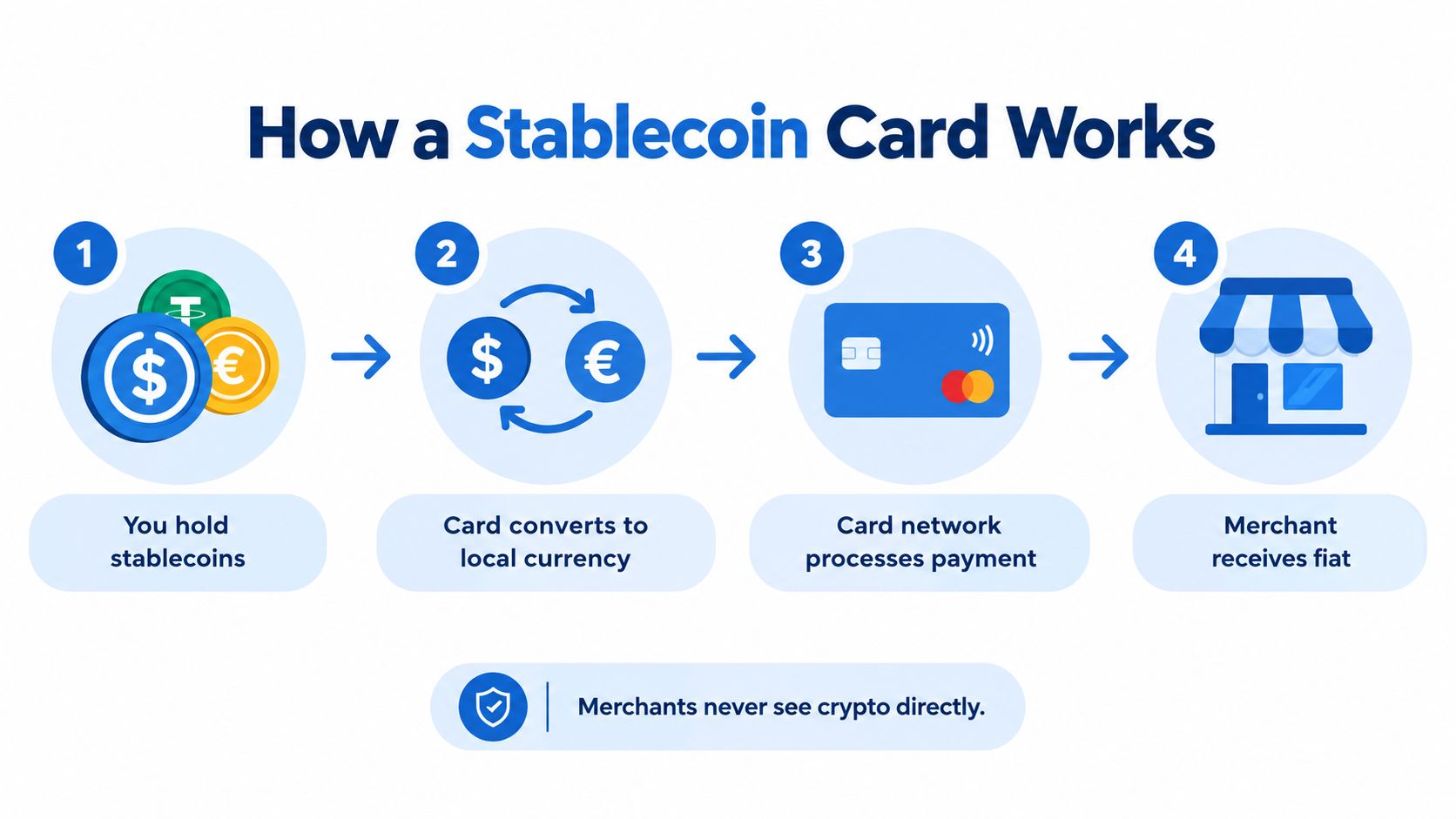
What happens instead is a bridge between two systems. The card network approves a purchase in fiat, then the issuer later funds its side using stablecoins behind the scenes, which keeps ordinary Visa or Mastercard acceptance intact while shifting treasury movement onto blockchain rails (Chaincatcher).
If you want the plain-English version of the mechanics before you compare products, this guide to spending crypto without selling matches the same operational reality.
Table of Contents
- What a Stablecoin Card Does
- How Stablecoin Cards Convert Purchases
- Custody Models and Control Tradeoffs
- Stablecoins, Networks, Fees, Limits, and KYC
- Dispute Protections and Real Risks
- Choosing the Right Stablecoin Card
What a Stablecoin Card Does
A stablecoin card looks like a crypto product in the wallet and a normal card at checkout. You tap or insert it, the terminal reads a fiat payment, and the merchant receives standard settlement through the card rails, not a token transfer from your wallet.
The checkout moment is ordinary, the back end is not
That split explains why these cards work in places that never accept crypto directly. The merchant does not need to price goods in USDT or USDC, and staff do not need special tooling. The issuer handles the stablecoin side separately, so the product behaves like a regular card on the surface while using blockchain liquidity behind the scenes.
Practical rule: if a card product cannot tell you where conversion happens, you do not yet know what you are paying.
That distinction keeps marketing honest. Many card pages imply direct crypto acceptance, but the mechanism is usually card-network authorization plus issuer-side stablecoin funding. The result preserves merchant compatibility, while the user's experience still depends on the issuer's custody model, conversion policy, and compliance stack.
Why the operational gap matters
The visible checkout price is only part of the story. The issuer may move stablecoins in the background, but that does not make merchant settlement instant in the consumer sense, and it does not remove ordinary card-program controls.
Merchants see fiat, not crypto. That is why the product can expand spending access without forcing merchants to change how they get paid.
For buyers, the question is not whether the card “uses crypto.” It is whether the card can convert cleanly, at a tolerable spread, in the country and network you need, with enough protection if something goes wrong. If you want a plain-English refresher on the mechanics, this guide to spending crypto without selling matches the same operational reality.
How Stablecoin Cards Convert Purchases
The mechanics are easier to understand if you separate the layers. You hold the stablecoin balance, the issuer or processor handles conversion, the card network authorizes the purchase, and the acquiring side runs the normal merchant payment flow. At the register, it looks like a regular tap or swipe, but several systems have already done their part.
Authorization comes first
At checkout, the network authorizes the transaction in fiat. That is the point where the merchant decides whether the payment is approved, declined, or flagged. The stablecoin side is funding that layer, not replacing it.
After authorization, the issuer settles its own obligation using stablecoins or fiat converted from stablecoins. The cardholder may experience that as fast, even though the back office still has to reconcile multiple steps. The World Trade Organization notes that stablecoin-card economics are driven less by blockchain transfer fees than by fiat entry and exit, FX, compliance, and liquidity costs (WTO PDF).
Why the cheap part is rarely the expensive part
Many users look for “low gas fee” cards and stop there. That misses the full cost stack. A program may debit USDC or USDT from a custodial balance, convert it into the transaction currency, and route the purchase through ordinary card acquiring, so the visible blockchain fee can be tiny while the true user cost is buried in spread, markup, or issuer charges.
A useful model is four layers:
- Authorization layer: the merchant's existing card flow continues normally.
- Conversion layer: stablecoins are sold, moved, or debited to fund the fiat obligation.
- Settlement layer: the issuer reconciles its position with banks, networks, and liquidity providers.
- Risk layer: compliance checks, FX handling, and reversal rules still sit outside the blockchain.
That separation explains why “near-real-time settlement” does not mean instant merchant finality. Chargebacks, local acquiring, and compliance screening still exist. Once you can name the layer where cost appears, you can compare cards on numbers instead of slogans.
Custody Models and Control Tradeoffs
The biggest divide in the market isn't between “crypto card” and “normal card.” It's between who controls the funds that back the card. Once you understand that, a lot of fine print stops being confusing and starts being predictable.

Custodial cards trade control for convenience
A custodial stablecoin card is usually the easiest to use. The issuer holds the balance, performs the conversion, and often gives you cleaner top-ups, smoother fiat conversion, and a more familiar support flow when something breaks. The tradeoff is obvious, the issuer can freeze, reject, or delay activity because it controls the account.
That control can be useful when disputes or recovery matter. It can also be uncomfortable if you're trying to minimize counterparty exposure. A custodial card is closer to a fintech account with crypto funding than to a wallet that spends directly from your own keys.
Self-custody changes the failure mode
A self-custodial or non-custodial card reduces the platform's control over your balance, which appeals to users who don't want a company holding the whole stack. It also changes the consequences of mistakes. Wrong-chain transfers, wrong-address funding, and wallet-level errors can become your problem much faster than they would in a bank-like product.
That's why the question isn't “Which model is better?” It's “Which risks are you trying to move?” For someone who values reversibility and support, custodial often wins. For someone who values direct control over assets, self-custody may be worth the extra operational burden.
Hybrid programs sit in the middle
Hybrid cards pull from a web3 wallet, an on-chain contract, or a linked balance while still relying on a centralized issuer to complete the card transaction. They can feel more flexible than fully custodial products and less fragile than pure wallet spending, but they still inherit card-network rules and issuer policy.
For comparison work, that means the custody label is only the starting point. You also need to know whether the issuer can suspend the account, whether the balance is segregated, and whether the spending flow still depends on a centralized conversion step. NomadCards is useful here because it normalizes custody language across different card programs instead of forcing you to decode each issuer's wording separately.
Stablecoins, Networks, Fees, Limits, and KYC
Once you move past the basic mechanics, comparison gets practical very quickly. Two cards can both support USDC, both sit on Mastercard, and still behave very differently at checkout because of fee structure, regional access, or verification requirements.
| Dimension | What to Check | Why It Matters |
|---|---|---|
| Supported stablecoins | USDC, USDT, or other supported assets | Determines whether your existing balance is usable without extra conversion |
| Card network | Visa or Mastercard acceptance | Affects merchant reach and where the card is likely to work smoothly |
| Fee stack | Spread, FX markup, card fees, withdrawal fees | The true cost of spending usually sits here, not in on-chain transfer cost |
| Limits | Per-transaction, daily, or monthly caps | Controls whether the card is usable for groceries or only small purchases |
| KYC level | No KYC, email-only, or full verification | Shapes privacy, onboarding friction, and regulatory availability |
| Geographic availability | Country and region coverage | A card that looks good on paper can still be unavailable where you live |
What the fee stack tells you
The fee stack separates what you spend at the point of sale from the cost of moving value into and out of the program. In practice, a stablecoin card can show a visible card fee and still hide a spread on conversion, FX markup, loading or withdrawal charges, or a separate fee for foreign-currency spending.
That is why headline cashback can mislead. A card that returns rewards but takes more on conversion and FX can leave you worse off than a plain card with cleaner pricing.
Why limits and KYC deserve equal attention
Limits tell you whether the card works as everyday payment rail or only as a narrow bridge for occasional use. KYC determines how quickly you can onboard, how much privacy the program preserves, and whether the card is available in your country at all.
A simple decision rule helps:
- If you travel often, prioritize network reach and FX transparency.
- If you spend small amounts regularly, look at limits and reload friction.
- If privacy matters, compare KYC tier, custody model, and account-freeze power.
- If you want rewards, check the effective cost after spreads and fees, not just cashback.
For a normalized view of these fields, NomadCards is a sensible comparison layer because it groups fees, supported assets, and access rules in one place instead of scattering them across issuer pages.
Dispute Protections and Real Risks
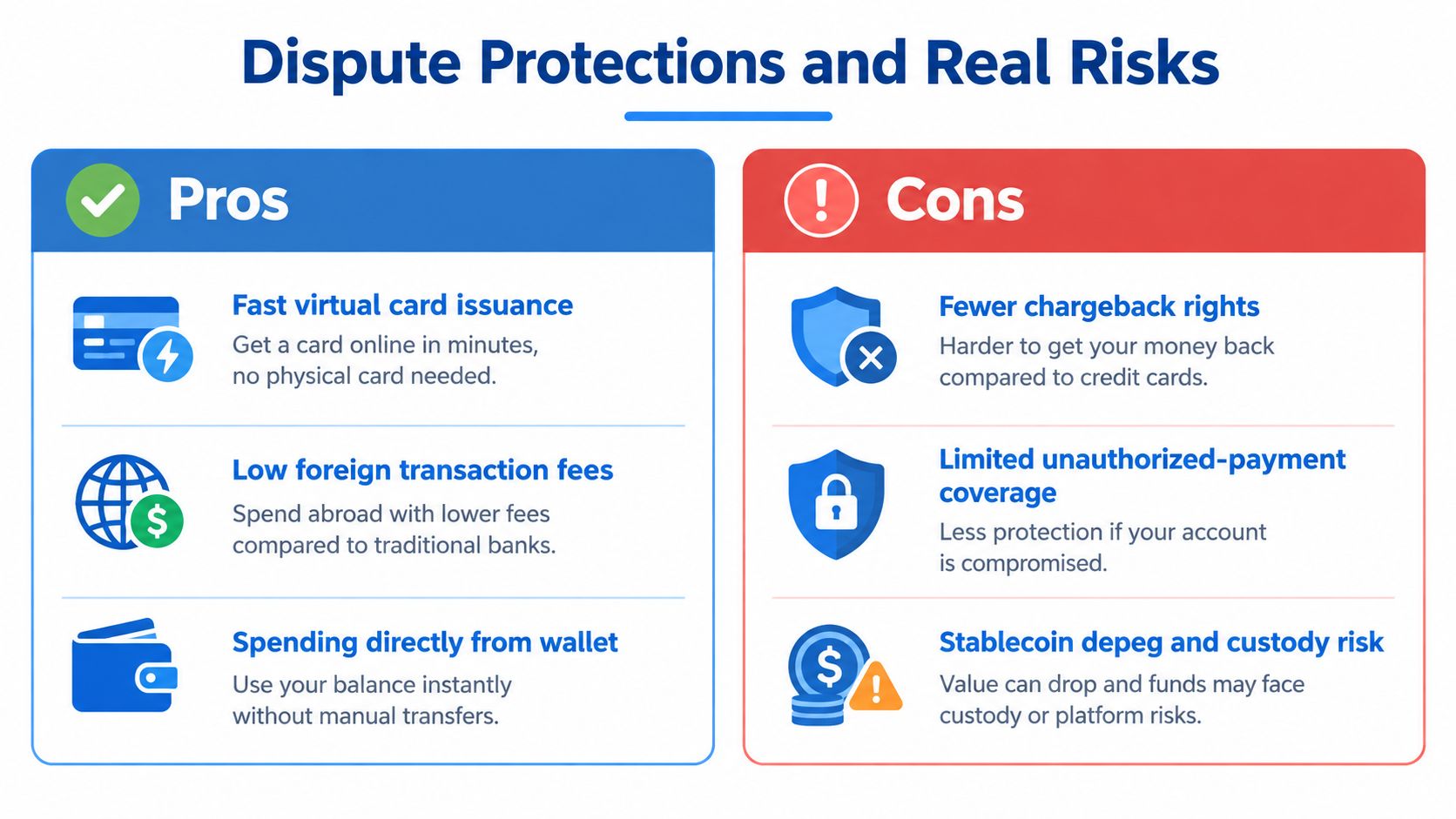
A lot of people assume that if a card can spend stablecoins, it must either inherit full card protections or lose them completely. Real products sit in between. The protection picture depends on the card network, the issuer policy, the custody model, and the law that applies in your country.
Fraud coverage is not automatic
A 2025 consumer-policy analysis argues that payment stablecoins don't automatically receive the core protections common in conventional card and electronic-payment law, including mandated investigation of errors and procedures for unauthorized transfers (Consumer Policy report). That matters because the user-facing question is simple, even if the legal answer isn't.
If a stablecoin card is hacked, used fraudulently, or charged for something that never arrives, who makes the user whole? The answer can vary by jurisdiction, custody structure, and whether the payment was processed as a card transaction or an on-chain transfer.
Practical rule: the more a product relies on self-custody, the more you need to read the recovery and freeze policy before loading funds.
Card purchase risk is different from wallet transfer risk
A card transaction may still have some network-level dispute process, but that doesn't mean every related loss is reversible. Wrong-address transfers, wrong-chain transfers, and direct wallet mistakes are a different category, and those outcomes can be much harder to unwind once they've left the card layer.
That's why it helps to separate these risks:
- Unauthorized card use: look at issuer response, card network rules, and account-freeze procedures.
- Undelivered purchase: check whether the issuer supports disputes or chargebacks.
- Mistaken on-chain transfer: assume recovery is limited unless the provider says otherwise.
- Account freeze: review what triggers it and how quickly balances can be accessed again.
The market's convenience pitch often skips this part. A stablecoin card can be easy to use and still offer weaker practical recourse than a bank-issued debit or credit card. That's not a reason to avoid the category, it's a reason to choose the custody model and issuer policy with eyes open.
Choosing the Right Stablecoin Card
The right card depends on which problem you're trying to solve. If you want routine spending, the priority is low friction. If you want travel flexibility, network reach and FX behavior matter more. If you care about control, custody and dispute policy move to the top of the list.
Match the card to the job
For everyday spending, choose the program that keeps conversion simple and the fee stack understandable. For travel, look closely at network acceptance, foreign-currency handling, and regional availability. For large purchases, the dispute process matters more than a flashy rewards rate.
For privacy-focused use, don't stop at marketing language. Check whether the card is custodial or self-custodial, what KYC it requires, and whether the issuer can freeze balances quickly. Those three items usually decide whether the card fits your actual tolerance for counterparty risk.
Use a short checklist before applying
- Supported asset: Does the card support the stablecoin you hold?
- Conversion point: Does it debit from a wallet, a custodial balance, or an on-chain contract?
- Effective cost: What are the spread, FX markup, and card fees combined?
- Protection level: Are disputes, freezes, and reversals clearly described?
- Availability: Is the card issued where you live, and does it work where you spend?
- Limits: Will the daily or per-transaction cap fit your real spending pattern?
That's the part most reviews miss. A stablecoin card isn't a single product category, it's a bundle of network access, custody policy, and conversion mechanics. Once you rank those pieces separately, the marketing noise gets much easier to ignore.
NomadCards collects those fields into one comparison view, so you can check supported coins, custody model, KYC tier, fees, and regional availability without reading every issuer page line by line. If you're comparing cards for daily use, travel, or privacy, start at NomadCards and work from the actual mechanics, not the slogan.