There isn't a single best prepaid credit card, and the answer changes fast once you include the actual cost structure. In 2023, government agencies used general-use prepaid cards across more than 1,300 reported programs and disbursed $188.4 billion to cardholders, which is a reminder that prepaid rails are big business, but popularity still doesn't make a card good for your situation.
| Card | Network | Cashback | Monthly fee | KYC tier | Funding | Score |
|---|---|---|---|---|---|---|
| Traditional prepaid card with clear fee schedule | Visa or Mastercard | Often modest or none | Varies by issuer | Usually full KYC | Bank transfer, payroll, or reload | 8.4 |
| Government-benefit prepaid card | Visa or Mastercard | None | Typically low or none | Identity verified through program | Public funds | 8.0 |
| Travel-focused prepaid card | Visa or Mastercard | Sometimes | Often low | Usually full KYC | Bank funding, card load | 7.8 |
| Crypto-funded prepaid card with custodial wallet | Visa or Mastercard | Variable | Variable | Email to full KYC | Stablecoins or other crypto | 7.2 |
| Crypto-funded prepaid card with self-custody link | Visa or Mastercard | Variable | Variable | Usually stronger verification | On-chain wallet balance | 7.0 |
| Privacy-oriented prepaid card | Visa or Mastercard | Usually none | Usually low | No KYC or light KYC | Cash-like load, bank transfer, or limited reload | 6.9 |
Table of Contents
- Why the Best Prepaid Credit Card Is Not the One With the Highest Cashback
- The Four Criteria That Matter When You Compare Prepaid Cards
- Ranked Comparison of the Best Prepaid and Crypto Prepaid Cards in 2026
- What a Prepaid Card Costs You in 2026
- KYC Tiers Explained From No Verification to Full Identity Checks
- Which Card Fits Which Situation
- The Protection Gap Most Prepaid Card Comparisons Ignore
Why the Best Prepaid Credit Card Is Not the One With the Highest Cashback
Headline cashback is the easiest number to sell, and it's the wrong number to trust first. A card can advertise a strong reward rate and still lose in practice once you add foreign-exchange markup, ATM charges, inactivity fees, reload friction, and the way the issuer gets paid on each purchase.
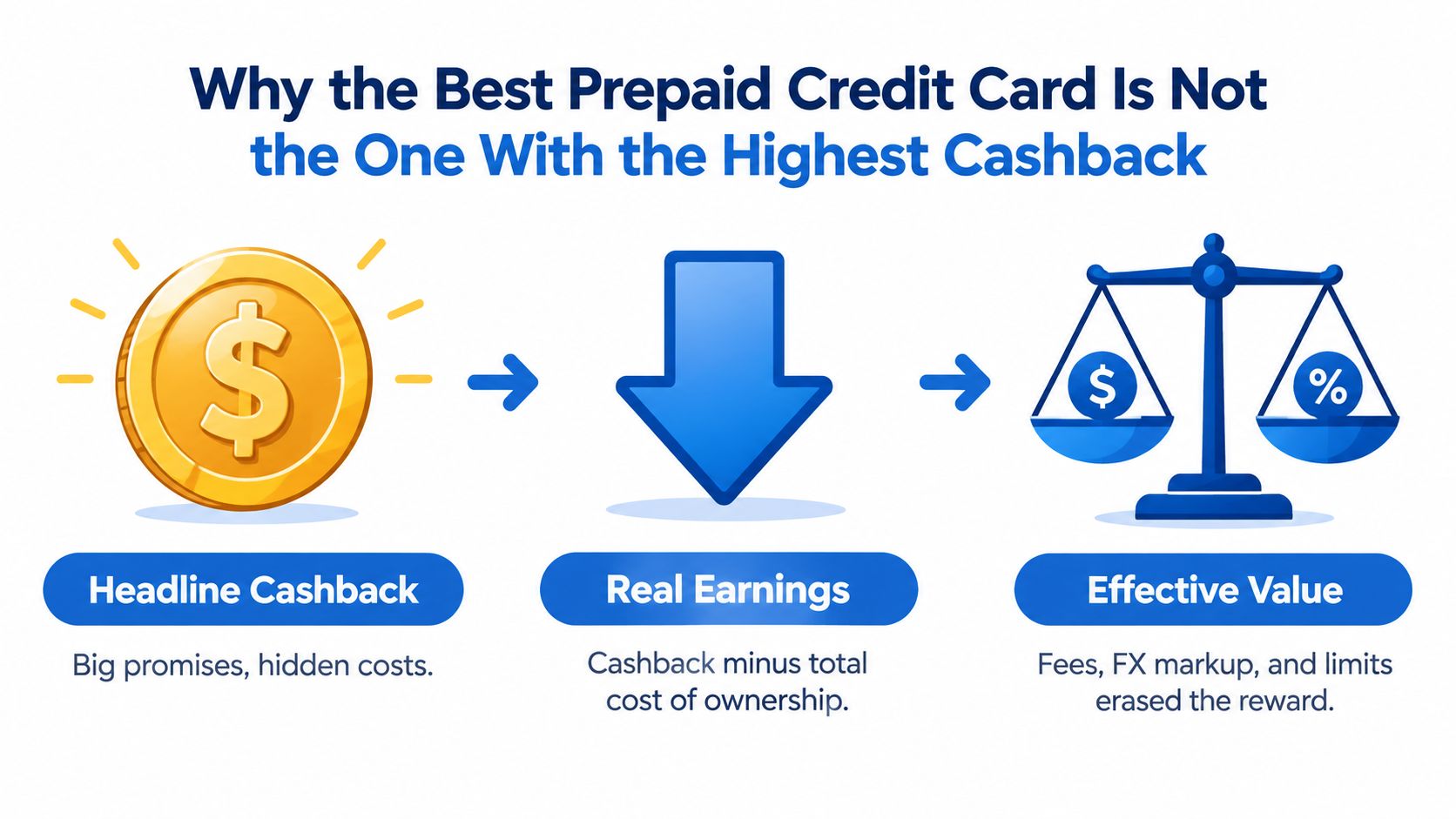
A useful comparison starts with effective value, not the marketing rate. The Federal Reserve's 2023 government-prepaid report shows why this matters, since cardholder fees alone totaled $129.6 million and interchange added another layer of cost recovery on top of the amount loaded and spent (Federal Reserve report).
Practical rule: if the card only looks good when you ignore fees, it isn't a good card.
Here's the blunt version. A card promising 5% cashback can still trail a 1% card if the first card charges enough in FX markup, ATM access, inactivity, or conversion spread to erase the extra reward. That is especially true for crypto-linked products, where the key question is how much value disappears between the asset balance and the final fiat purchase.
For readers comparing spend cards, the better benchmark is simple: calculate the net result after all visible and hidden costs, then add a separate score for dispute rights and protection. If you want a deeper breakdown of whether rewards survive actual usage, this guide on whether crypto card cashback is worth it is the right companion read.
The Four Criteria That Matter When You Compare Prepaid Cards
A serious comparison starts with four buckets, and none can be skipped: effective cost, consumer protection, KYC and privacy, and rewards. The CFPB prepaid-account framework is a solid baseline because it forces issuers to disclose the fees that change the outcome, including periodic fees, purchase fees, ATM withdrawal fees, balance-inquiry charges, cash-reload charges, customer-service charges, and inactivity fees (CFPB prepaid rule).
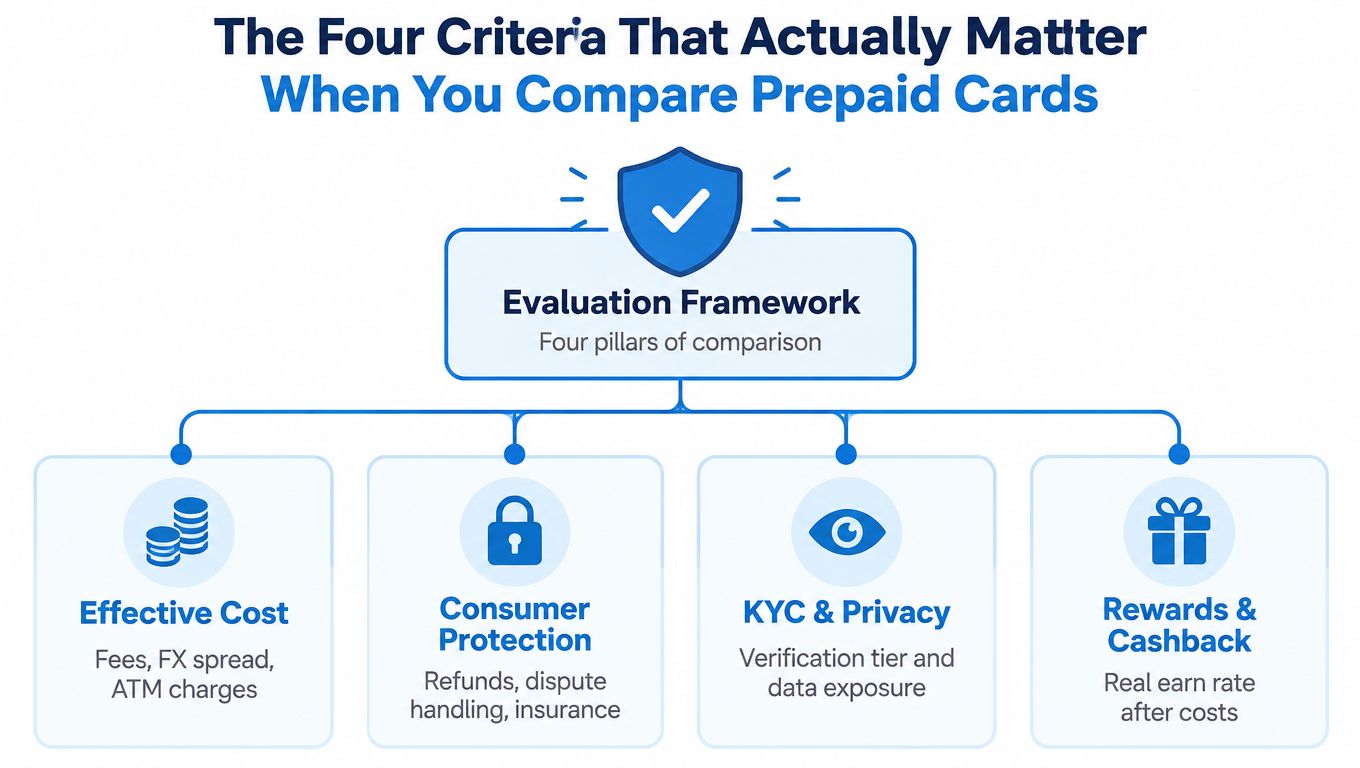
Effective cost comes first
This is the bucket people miss most often. Look at the full cost of using the card, not the branding on the landing page. A card with no monthly fee can still be expensive if the issuer makes money through FX markup, ATM operator surcharges, or cash-reload fees.
Protection is not optional
A prepaid card only works if the dispute process, unauthorized-transaction coverage, and account recovery rules are clear and usable. The CFPB's protections also matter because they give consumers access to balances and transaction history, and they limit unauthorized-transaction liability to $50 when loss or fraud is reported promptly (CFPB finalizes prepaid protections).
KYC and privacy should match your use case
Some users want the lightest possible verification. Others need higher limits, travel access, or simpler recovery if the card is compromised. KYC is not just a nuisance checkbox, because it also tells you what the issuer can freeze, what support can verify, and which jurisdictions the product can realistically serve.
Rewards matter, but only after cost
A reward only matters if you keep it after deductions. Crypto-linked cards make this even messier because the card can convert a token balance into fiat at the point of sale, so spread and settlement terms matter as much as the headline earn rate.
A quick two-minute check works well:
- Scan fees first. Look for monthly, ATM, FX, inactivity, and reload charges.
- Check recourse. Find the dispute process, liability cap, and account-freeze policy.
- Confirm verification. Decide whether no-KYC, light KYC, or full KYC fits your use case.
- Discount rewards. Count cashback only after conversion costs and practical restrictions.
The methodology page shows how each bucket is scored, so you can see whether a ranking puts cost and protection ahead of rewards.
Ranked Comparison of the Best Prepaid and Crypto Prepaid Cards in 2026
The cards below are ranked by what survives real usage, not by how aggressive the marketing page looks. I'm weighting effective cost and protection above reward hype, because rewards without recourse are just dressed-up risk.
For a normalized field-by-field view, the card fees master table is the kind of reference that stops people from comparing apples to lemons.
| Rank | Card | Network | Cashback | Monthly fee | KYC tier | Funding | Score |
|---|---|---|---|---|---|---|---|
| 1 | Traditional prepaid card with strong disclosures | Visa or Mastercard | Low to moderate | Varies | Full KYC | Bank funding or payroll | 9.1 |
| 2 | Government-benefit prepaid card | Visa or Mastercard | None | Low or none | Verified by program | Public funds | 8.8 |
| 3 | Travel-preferred prepaid card | Visa or Mastercard | Sometimes | Low | Full KYC | Bank load | 8.3 |
| 4 | Crypto-funded card with clear spread disclosure | Visa or Mastercard | Variable | Variable | Mixed | Stablecoins | 7.6 |
| 5 | Privacy-first prepaid card | Visa or Mastercard | None | Low | No KYC or light KYC | Limited reload | 7.1 |
| 6 | Crypto card tied to self-custody | Visa or Mastercard | Variable | Variable | Mixed | On-chain wallet | 7.0 |
The strongest traditional prepaid cards usually win because they're boring in the right way. They disclose fees clearly, handle disputes in a familiar framework, and don't force you to decode conversion logic every time you spend.
The best card is the one you can predict under stress, not the one with the prettiest reward banner.
Government-benefit cards deserve a high rank because the user problem is different. The key issue is reliable access to funds, not maximizing reward yield. They're not designed for shopping optimization, but they often beat flashier alternatives on clarity and practical usability.
Crypto-funded cards sit lower because too many of them bury the cost in spread, custody structure, or reward rules. A clean-looking cashback number can be misleading if the card converts a token balance at a weak rate or makes redemption conditions annoying. That said, a well-structured crypto card can still be the right answer for users who want to spend digital assets without a manual sell step.
I would be cautious with privacy-first cards if your priority is frequent travel or broad merchant acceptance. They can be useful for narrow budgeting or limited loads, but the trade-off is often tighter limits and weaker recovery if something goes wrong. If the product description sounds vague about limits, supported countries, or recourse, treat that as a red flag.
What a Prepaid Card Costs You in 2026
The cheap-looking card is often the expensive one once you use it normally. A low monthly fee does little if the card charges you every time you convert currency, withdraw cash, reload balance, or let the account sit idle.
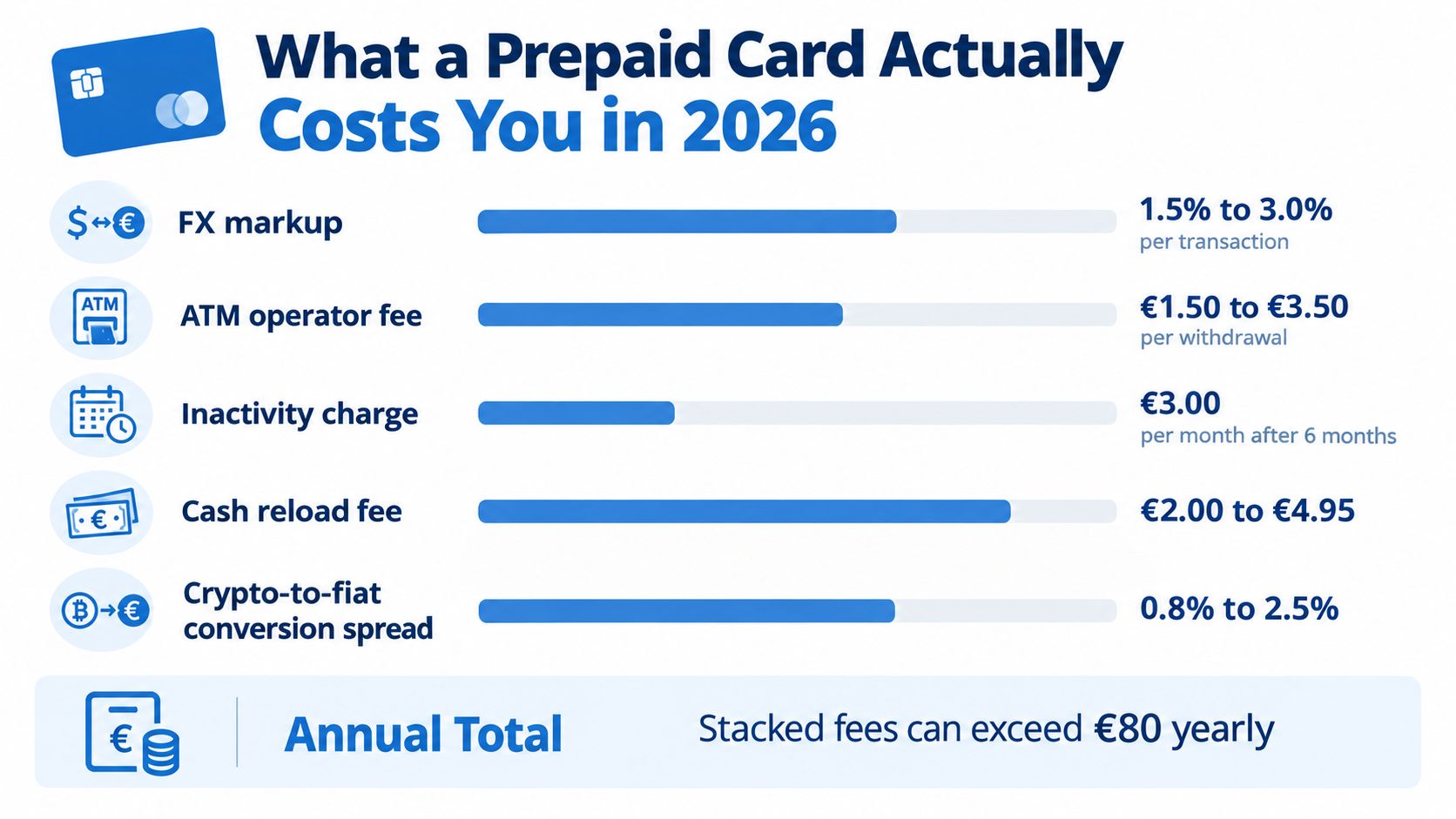
The main cost buckets are FX markup, ATM operator charges, inactivity fees, cash reload fees, and, for crypto-linked products, the asset-to-fiat conversion spread. A card with a tidy headline fee can still drain value fast if you travel, pull cash, or keep only a small balance for irregular spending.
The biggest hidden cost is usually conversion, because users notice it least and pay it most often.
Use this rough formula on any card:
annual effective cost = periodic fees + purchase friction + ATM costs + FX cost + reload cost + inactivity cost + conversion spread + unrecoverable-loss risk
That last term matters for crypto-funded cards because conversion and custody are not the same as ordinary card spending. The BIS analysis notes that stablecoin-funded arrangements convert a stablecoin balance into local fiat at point of sale through existing card rails, which brings legal, financial, operational, AML/CFT, and consumer-protection risks into the spend flow.
For a broader consumer-finance angle on hidden costs and product complexity, Singapore BNPL costs and risks is a useful parallel. Different product, same lesson: the advertised convenience often hides the actual bill.
If two cards look close on cashback, choose the one with lower all-in friction. That usually means better FX behavior, better ATM treatment, and fewer charges that only appear after you have already committed.
KYC Tiers Explained From No Verification to Full Identity Checks
KYC is not just a compliance hurdle. It's the thing that decides how much you can load, where you can use the card, and how much support can help when something breaks.
No KYC and light KYC
These products appeal to users who want minimal data exposure and faster issuance. They can be fine for low-stakes spending or limited testing, but you usually give up something in return, often higher limits, broader availability, or stronger recovery if the account gets flagged.
Full KYC
Full verification is the normal path for travelers, frequent spenders, and anyone who values account recovery over anonymity. It usually means the issuer can support more regions, more limits, and better complaint handling, though it also means more personal data collected and stored.
For crypto-funded cards, the verification question gets sharper because the funding source can be custodial or self-custodial. If the issuer only understands a wallet address badly, or only supports one custody model, the card may work perfectly in theory and fail at onboarding in practice.
Rule of thumb: if a card's KYC page is vague, the limits probably are too.
The right tier depends on the job. If you want a privacy-first spare card, light KYC may be enough. If you need stable travel usage, easy disputes, and fewer freezes, full KYC is usually the cleaner trade.
The best comparison mindset is to choose the minimum verification level that still supports your real spending pattern. Anything beyond that is usually extra friction without a matching benefit.
Which Card Fits Which Situation
For travel and FX-heavy spending, I'd pick the traditional prepaid card with the clearest disclosures, and I'd keep the crypto-funded option only as a runner-up if you already hold digital assets. The reason is simple, travel exposes weak FX terms fast. The card to avoid here is the privacy-first card, because restricted access and weaker support are a bad combo when you're away from home.
For privacy-first everyday use, the privacy-oriented prepaid card is the cleanest fit if your spending is small and your expectation of recourse is modest. The runner-up is the low-friction crypto card with strong wallet control, but only if you understand the custody model. Avoid the government-benefit card here, because it isn't built for privacy optimization.
For spending crypto without selling, the crypto-funded card with clear spread disclosure is the best practical choice, provided the redemption rules are plain. The runner-up is the self-custody-linked version if you're comfortable managing wallet risk yourself. Avoid any card that hides the conversion rate, because the advertised cashback can be cancelled by the spread before you notice.
For tight-budget everyday budgeting, the government-benefit or traditional prepaid card with stable disclosures is usually the safest recommendation. You want the lowest surprise factor, not the flashiest feature set. Avoid the crypto card category here unless you've already verified the conversion costs and support process.
NomadCards fits naturally into the research stage here because it consolidates card type, network, supported assets, KYC requirements, custody model, and regional availability in one place. It's useful when you want to narrow the field before you start comparing issuer fine print.
The Protection Gap Most Prepaid Card Comparisons Ignore
Most prepaid-card rankings overrate rewards and underrate what happens after something goes wrong. That is the true test, because the gap between a decent card and a poor one usually shows up after a stolen card, an unauthorized transfer, or a frozen account.
The Consumer Policy Center's stablecoin report warns that some proposed stablecoin frameworks may lack protections familiar from conventional payment systems, including unauthorized-transfer remedies, error resolution, periodic statements, and a private right of action (consumer-law analysis). A crypto-linked prepaid card can look like a normal spend product while carrying a much weaker recovery stack.
What Good Recourse Looks Like
A strong product has more than one safety layer. It includes card-network dispute rights, issuer liability rules, a clear wallet custody model, defined complaint jurisdiction, and a visible path for account review or reversal. If the issuer will not explain those pieces plainly, the product is weaker than it looks.
FCA consumer research cited in that same report found that 87% of crypto users who personally experienced scams or fraud lost money. Only 7% expected recourse from the bank, payment firm, or card provider they used to buy cryptoassets. That is why a lower-reward card with stronger consumer protection can be the better deal.
I would test any shortlisted card against six scenarios:
- Card stolen
- Wallet drained
- Merchant dispute
- Issuer failure
- Stablecoin depeg
- Frozen account
If the support article cannot answer those cases clearly, the card is not ready for serious use. For travelers, broader planning matters too, because payment problems and trip disruption often overlap with coverage gaps. A good companion resource on medical and evacuation coverage shows how much value clear recovery rights add when you are far from home.
The verdict is simple. Cashback is nice, but recourse is what keeps a card usable after stress hits. If two cards are close on cost, pick the one with the better dispute path, clearer liability rules, and the least ambiguous support model.
If you want a sharper shortlist instead of guesswork, start with NomadCards and filter by KYC level, network, funding source, and region, then compare the fee and custody details side by side on NomadCards. It is the fastest way to separate a genuinely useful prepaid card from one that only looks good in a banner ad.