A virtual card number is a masked, 16-digit payment credential tied to an underlying account that protects your real card details by never sharing them with merchants. It usually has its own expiration date and security code, so you can pay online or in an app without exposing your primary card number.
You're booking a room from a new travel site, paying for a VPN, or signing up for software while moving between countries. The checkout page asks for your card number, expiry date, and security code. The purchase may be legitimate, but handing over your main payment credential still feels like an unnecessary gamble.
A virtual card number gives you a separate credential for that transaction or merchant. The convenience is immediate, but the main benefit appears later, when you need to control, replace, or migrate the number across subscriptions, wallets, and apps.
Table of Contents
- The Problem with Sharing Your Real Card Number Online
- How Virtual Card Numbers Actually Work Under the Hood
- Security and Privacy Benefits of Using a Virtual Card
- Best Use Cases for Virtual Card Numbers
- Combining Virtual Cards with Crypto and Wallets
- How to Obtain and Manage Your Virtual Card
The Problem with Sharing Your Real Card Number Online
The familiar checkout routine creates a quiet dependency. You give a merchant your primary card details, then rely on that merchant, its payment processor, its stored-credential system, and every connected app to protect them indefinitely. You may never know where the details are stored or whether a later breach exposes them.
That risk is especially uncomfortable when the merchant is unfamiliar. A small booking platform, a newly launched app, or a service operating in another country may have perfectly good intentions, but you still have limited control over its security practices. If your real card number appears in its systems, a breach can expose a credential that remains useful beyond the original purchase.

The exposure continues after checkout
The problem isn't only the first payment. Merchants may retain card details for renewals, refunds, account recovery, or faster checkout. A subscription can keep charging the same credential long after you've stopped thinking about the original signup.
A virtual card number changes the exposure model. The merchant receives the virtual credential rather than your underlying card number, which means a stolen number is less useful when it is restricted to a merchant, transaction, amount, or validity window. Google's payment documentation explains how masking the underlying PAN helps protect against fraud.
Practical rule: Use your primary card where you have a strong reason to trust the merchant and need stable recurring billing. Use a controlled virtual credential when reducing exposure matters more than keeping the payment setup permanent.
For privacy-conscious travelers, a virtual card can sit between your account and an unfamiliar checkout page. That doesn't make the merchant trustworthy, and it doesn't eliminate disputes or account takeover risk, but it limits what the merchant can learn about your main payment relationship. If you're also evaluating identity requirements and issuer practices, this guide to safer no-KYC crypto cards provides useful context.
How Virtual Card Numbers Actually Work Under the Hood
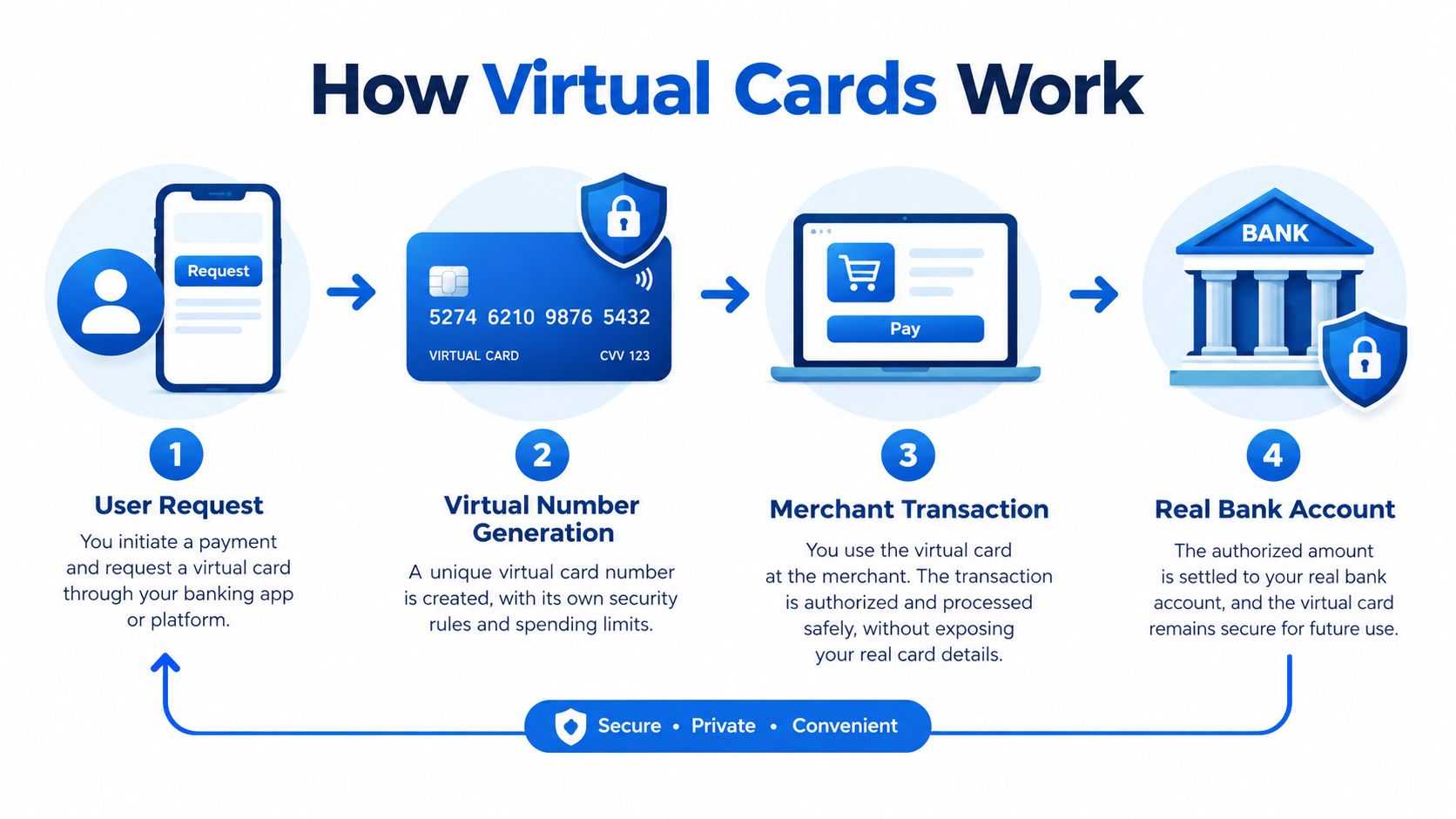
A virtual card number usually looks familiar at checkout. It's typically a separate 16-digit payment credential connected to an underlying account, with its own expiry date and security code. The distinction is that the number shown to the merchant acts as a controlled substitute, not as the account's permanent primary card number.
Think of the underlying card as a passport kept in a secure office. The virtual card is a limited-purpose credential issued for a particular journey. The merchant checks the credential and receives authorization, but it doesn't receive the passport's full details.
The token replaces the underlying PAN
Payment systems commonly refer to the card number as the PAN, or Primary Account Number. A virtual card or network token replaces that PAN with a surrogate value. The merchant uses the surrogate during authorization, while the issuer or network resolves it through protected systems.
EMVCo tokenization specifications describe tokens as values that can include domain controls and be tied to a particular payment environment. In practical terms, the token may be limited to a merchant, device, channel, amount, or time period. Those controls determine whether a transaction is accepted.
That distinction matters during a breach. If a merchant database leaks the virtual credential, the attacker may have a number that only works in a restricted context. A token bound to one merchant or already deactivated after use has far less value than a permanent card number accepted across many services.
Convenience still depends on the issuer
The payment can feel identical to an ordinary card transaction. You enter the virtual number, expiry date, and security code, and the merchant requests authorization. Behind the scenes, the issuer checks the token's rules and connects the approved payment to the underlying account.
The setup isn't magic, though. A virtual card can be declined because the merchant, wallet, region, amount, or recurring-payment pattern doesn't match the credential's rules. The more aggressively you restrict a number, the more carefully you need to choose where and how you'll use it.
Security and Privacy Benefits of Using a Virtual Card
The strongest benefit is reduced exposure, not invisibility. A merchant still knows that a card payment occurred, and the issuer still processes the transaction. What changes is the credential shared with the merchant.
If a website stores your virtual number and later suffers a breach, attackers don't automatically receive the underlying account number. Google describes virtual-card masking as a way to keep the underlying PAN hidden while helping protect against fraud. That separation gives you a narrower problem to solve if the merchant's systems are compromised.
Controls turn a card into a payment boundary
Many issuers let you configure a virtual card for a specific purpose. Depending on the product, the number may be restricted to:
- One transaction: The credential can be deactivated after the intended purchase.
- One merchant: The number can be tied to a named supplier or service.
- A preset amount: Authorization can be limited to the expected spend.
- A short validity window: The number can stop working after the relevant booking or payment period.
These controls aren't available in the same form on a conventional card number that you use repeatedly. Corpay describes virtual credentials that can be limited to a transaction, merchant, or amount, while also noting the wider fraud environment that makes restricted credentials useful for organizations.
A single-use number is excellent for a one-off purchase from an unfamiliar merchant. It is less suitable for a subscription that needs to renew automatically. A merchant-locked, reusable number may work better for a trusted service, but it gives you less separation between billing events.
A secure credential is only useful when its lifecycle matches the payment relationship.
Privacy has practical limits
A virtual card doesn't hide your identity from the issuer, remove merchant records, or guarantee approval in every country. It also doesn't protect you if someone gains access to the account that generates or controls the cards. Strong account security, transaction alerts, and a clear dispute process still matter.
The useful privacy improvement is narrower and more realistic. You can reduce the number of places that hold your primary card details, make compromised credentials less reusable, and separate different merchants or spending purposes. That combination improves control without pretending that online payments can be anonymous by default.
Best Use Cases for Virtual Card Numbers
A virtual card works best when the payment has a clear boundary. Ask what should happen if the merchant is breached, the service changes its price, or you stop using the account. The answer will tell you whether you need a disposable number, a merchant-specific number, or a stable credential that can survive renewals.
Travel and unfamiliar merchants
Travel creates a strong case for separation. You may pay a new accommodation provider, a local transport service, or an online booking platform while away from home. A virtual number can protect your primary card from being stored directly by each merchant.
For a hotel deposit or a one-time booking, a controlled number may be appropriate. Before using it, check whether the merchant will place a delayed hold, adjust the final amount, or require the same credential at check-in. Tight controls can cause trouble when the final charge differs from the authorization.
Subscriptions and recurring billing
Subscriptions require more caution than one-time purchases. A disposable number may stop working before renewal, and rotating a reusable number can break the merchant's stored credential. For software, mobile services, and recurring travel tools, use a virtual card designed for repeat billing and keep a private record of every merchant using it.
A spending limit can help control unexpected increases, but it won't replace account management. If a subscription changes its price or billing schedule, the transaction may be declined, leaving you to update the payment method manually. That friction is useful when you want to review charges, but inconvenient when uninterrupted access matters.
One-time purchases
A lesser-known online store is where a single-use virtual card offers the clearest trade-off. You get the convenience of card checkout without giving that store a permanent credential. The approach works best when you don't expect refunds, adjustments, or a second charge.
| Payment situation | Suitable virtual-card approach | Main trade-off |
|---|---|---|
| New travel merchant | Merchant-specific or limited-use number | Holds and final charges may need flexibility |
| Recurring software | Reusable number with monitoring | Rotation can break stored billing |
| One-off online purchase | Single-use number | Refunds or follow-up charges may fail |
The right choice isn't always the most restrictive one. Control must match the merchant's billing behavior, or security settings become an avoidable source of declined payments.
Combining Virtual Cards with Crypto and Wallets
Crypto-linked cards add another layer to the payment journey. A card provider may connect spending to a custodial balance, a supported wallet, or another digital-asset account, allowing the user to pay through ordinary card checkout rather than manually arranging every conversion. The practical experience can resemble any other virtual card, but the funding source and account controls differ.
For a nomad, the appeal is obvious. One virtual credential can reduce exposure at unfamiliar merchants, while the linked crypto account may provide a way to spend supported assets across card-accepting services. The important question isn't only whether the card works at checkout. You also need to understand custody, conversion rules, supported assets, regional availability, and what happens when the card is replaced.
Choose the funding and custody model first
Start by identifying where the funds sit and who can control them. A custodial card may be easier to manage through an app, while a self-custody arrangement can give you a different level of control and responsibility. This comparison of custodial and self-custody crypto cards can help clarify that decision before you focus on card design or rewards.
Then check the operational details:
- Confirm supported assets. Don't assume that a card funded by one token supports every asset in your wallet.
- Check regional access. Issuance, verification, wallet features, and merchant acceptance can vary by country.
- Understand conversion timing. Learn when the provider converts assets and what rate or fee applies.
- Test small payments first. Confirm that online checkout, wallet enrollment, and transaction notifications work before relying on the card while traveling.
Rotation creates a maintenance problem
The hardest issue is portability. A virtual card number may be stored by merchants, enrolled in autofill, added to a mobile wallet, or used for recurring billing. If you regenerate the number, those relationships don't necessarily migrate with it.
Google's virtual-card flow is tied to eligible U.S. cards and Chrome or Android checkout, with international availability limited, while issuer guidance shows that regenerating a virtual number can make the old number stop working immediately. Google's Android payment guidance covers this virtual-card availability and replacement context.
Before rotating a crypto-linked virtual card, export or write down the merchants that use it. Update subscriptions one by one, remove the old credential from wallets and autofill, and keep the old account accessible until you know which services have accepted the replacement. If the old number stops immediately, don't assume a failed subscription is a merchant error. The stored credential may be obsolete.
Use the video below as a visual introduction to the relationship between crypto funding and card payments.
A wallet change can create the same problem as a card rotation. The new wallet may display the card correctly, but merchants still hold their own token or stored payment reference. Wallet portability and merchant portability are separate tasks, so manage both during a migration.
How to Obtain and Manage Your Virtual Card
Start with the payment job, not the provider's marketing page. A traveler who needs occasional online purchases has different requirements from a business paying suppliers, a subscriber managing recurring software, or a crypto user spending from a wallet.
Select the right product structure
Compare providers across the controls that affect daily use:
- Funding source: Decide whether you need a bank account, credit line, prepaid balance, or crypto-linked account.
- Usage controls: Look for merchant restrictions, amount limits, freeze options, and the ability to generate a replacement.
- Recurring payments: Confirm whether the number is designed for subscriptions or only for one-time transactions.
- Wallet support: Check whether the card can be added to the wallet you use, in your region.
- Fees and exchange terms: Review annual charges, transaction costs, and foreign-exchange treatment before moving regular spending.
- Verification requirements: Match the provider's onboarding process to your identity and privacy needs. This explanation of crypto-card KYC levels can help you compare those trade-offs.
A business user may also want a separate prepaid control layer. For that use case, the Rally prepaid business card is a relevant resource to review alongside ordinary bank and fintech options. The right comparison depends on spending controls, acceptance, funding, reporting, and how easily you can replace a credential without interrupting operations.
Build a replacement routine
Once you receive a virtual card number, record where you use it. A simple private list can include the merchant, billing date, wallet enrollment, and whether the payment is one-time or recurring. Don't store the full card details in an insecure note. The purpose is to track relationships, not create another concentrated source of sensitive data.
Turn on transaction alerts and review failed payments quickly. If you suspect misuse, freeze or cancel the number, then check every merchant that may have stored it. When you replace the number, update critical subscriptions first, test the next billing event, and remove the old credential from saved checkout and wallet settings.
Migration rule: Never rotate a widely used virtual card immediately before travel, renewal dates, or a period when you can't respond to declined payments.
The most reliable setup separates payment purposes. Use one number for recurring essentials, another for travel bookings, and a disposable credential for one-off purchases when the issuer supports it. That arrangement takes more organization, but it prevents one replacement from disrupting every service in your financial routine.
NomadCards helps you compare crypto-linked card programs by factors such as fees, custody model, KYC requirements, supported assets, networks, and regional availability. Visit NomadCards to evaluate options before choosing a virtual card number for travel, subscriptions, or wallet-based spending.