The usual advice, choose virtual because it's safer, skips the part where you have to pay. A tightly controlled virtual number can protect an online purchase, yet leave you unable to complete a hotel deposit. A physical card can get you through that desk interaction without protecting the number you typed into an unfamiliar website.
For crypto spenders, virtual card vs physical card is a choice about payment environments, not just convenience or fraud. The strongest setup often combines replaceable online credentials with a physical fallback, provided the issuer's funding rules, controls, and regional eligibility work for you.
Table of Contents
- Why the Card Format Changes the Payment
- Virtual Card vs Physical Card at a Glance
- Which Format Actually Limits Fraud
- Acceptance Wallets ATMs and Dead Phones
- Fees Limits Regions and Issuance Time
- Spending Situations That Pick a Winner
- Pick Virtual Physical or Both
Why the Card Format Changes the Payment
Say you've funded a crypto-card account before a trip. You can use the virtual number to buy a train ticket online, but the rental-car agent at your destination wants to insert a card bearing your name. The account has money, the network is accepted, and the transaction still fails because you brought the wrong format.
Choose virtual-only for predominantly remote spending with credentials you can control. Choose physical when cash access or card-present verification matters. Choose both when your spending crosses those environments.
The distinction reflects how people pay. In 2025, more than 40% of U.S. consumers had used a virtual card within the previous six months, while physical cards were used for more than 70% of restaurant purchases and over 69% of in-store purchases, according to PYMNTS Intelligence findings reported by CardRates.
Start with the payment you can't afford to lose
Your essential payment should determine the format before rewards enter the comparison:
- Remote purchases: Prioritize access to the credential, online authentication, and controls that match the merchant.
- Travel and cash: Prioritize a usable physical card, a working PIN, and explicit support for your intended transactions.
- Mixed spending: Look for dual-format availability and understand whether the credentials operate independently.
A virtual crypto card isn't a different payment network. It's a digital credential attached to a card program, with whatever restrictions that program imposes. Physical plastic adds an interface that a phone can't reproduce at a chip reader.
Practical rule: Pick the format for your hardest essential payment, then optimize the rest.
That approach also prevents a misleading brand comparison. An issuer can offer an appealing virtual product while restricting physical delivery, cash access, or the account tier you need in your country.
Virtual Card vs Physical Card at a Glance
Virtual versus physical crypto cards by criterion
| Criterion | Virtual crypto card | Physical crypto card |
|---|---|---|
| Issuance time | Can become available digitally after approval | Requires production and delivery |
| Online and in-app spend | Usable once activated and credentials are accessible | Usable once the issuer releases active credentials |
| In-store chip and PIN | No chip insertion; supported wallet may enable contactless | Direct insertion or tap where supported |
| ATM cash | Don't assume access without explicit issuer support | Available where the issuer permits withdrawals |
| Apple Pay or Google Pay | Main in-person route when supported | Wallet enrollment may also be supported |
| Single-use or merchant lock | Available from issuers offering these controls | Printed credential is generally persistent |
| Hotel and car-rental holds | Confirm acceptance with the specific desk | Better suited to physical-card verification |
| Recurring subscriptions | Use a stable, reusable credential | Persistent credential suits recurring billing |
| Dead phone or offline terminal | Dead phone removes the normal wallet route; offline approval isn't guaranteed | Independent of phone power; offline approval still requires program support |
| Replacement after compromise | Digital replacement may avoid delivery | Replacement plastic requires delivery |
| Regional rollout | Check virtual enrollment eligibility | Check physical issuance and shipping eligibility separately |
| Format-specific cost | No plastic delivery required | Delivery or replacement charges may apply |
The visual comparison highlights the format differences, but the issuer's terms decide which features you receive.
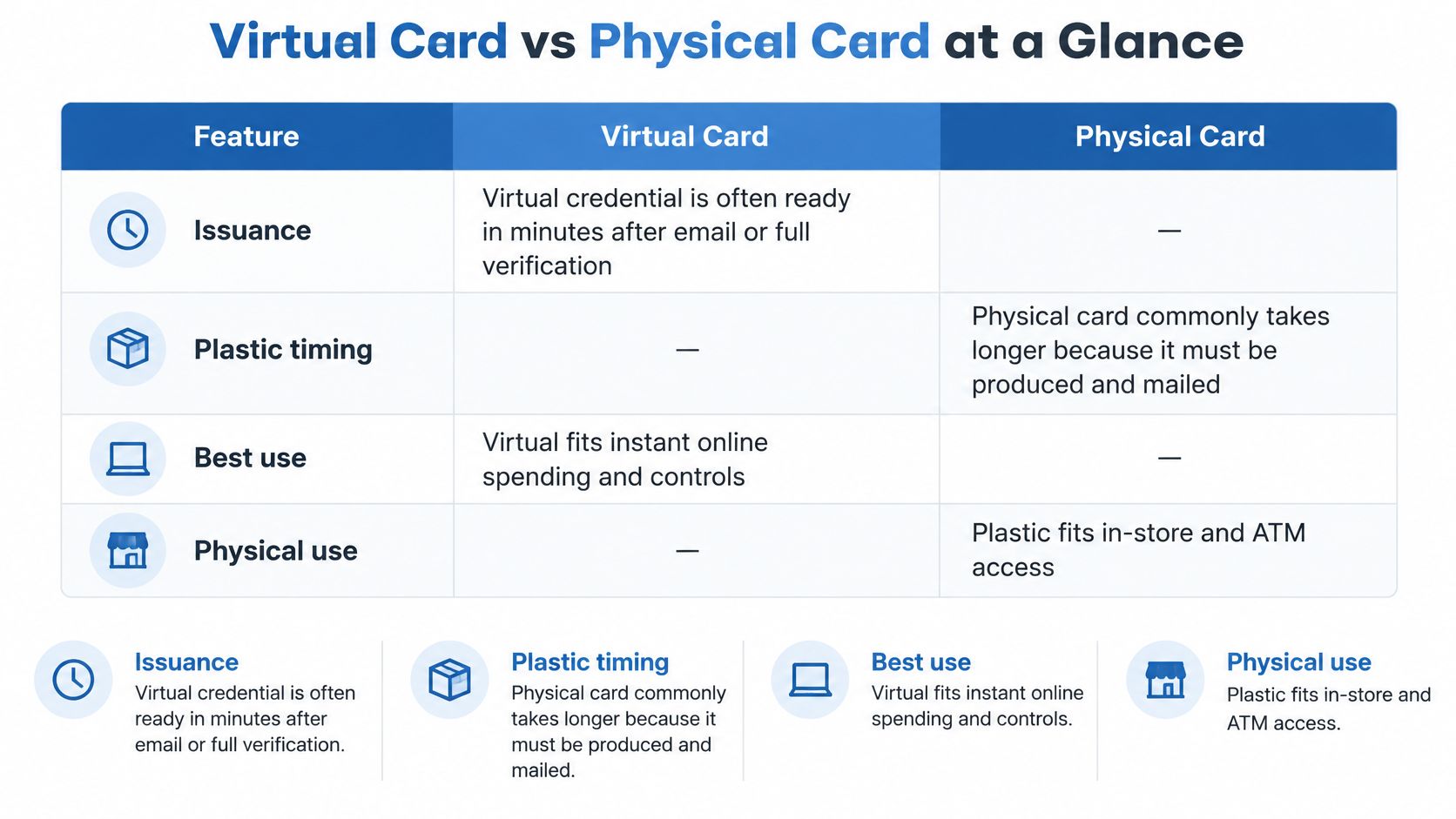
The rows people misread
Digital issuance isn't automatic approval. Identity review, account activation, and funding can still stand between registration and a usable credential. The useful milestone is an activated card you can successfully authorize, not an account-created email.
The case for digital access is substantial: remote purchases represented 22% of purchases in 2023, according to the Federal Reserve's 2023 Survey and Diary of Consumer Payment Choice. For a remote purchase, waiting for plastic adds little value if the issuer already provides usable credentials.
Wallet compatibility isn't chip-and-PIN capability. Adding a virtual card to Apple Pay or Google Pay gives you a contactless interface. It doesn't give you something to insert when a terminal or employee requires the physical card.
Similarly, physical doesn't mean unrestricted. A card with a PIN can still have cash withdrawals disabled. A desk can reject a prepaid or debit product even when you present plastic. Card format, card type, and merchant policy are separate checks.
Credentials need a lifecycle
A disposable number and a persistent virtual number serve different purposes. Don't choose a temporary credential just because the app makes it easy to generate one. Decide whether the merchant needs to charge again, adjust the amount, verify the purchase at pickup, or return money later.
The same scrutiny applies to replacement. A new number solves exposure only if you can identify the affected subscriptions and understand what happens to pending transactions. Before applying, treat any missing field as unconfirmed, rather than assuming it matches another card from the same network.
For an additional explanation of the formats, use the video alongside the issuer's written product terms.
Which Format Actually Limits Fraud
Virtual is not a security control by itself. A reusable virtual number with broad permissions remains valuable to a thief. Its advantage comes from restrictions the issuer lets you apply, not from the absence of plastic.
A stronger setup creates a credential for a particular vendor or purpose, then restricts its amount, expiry, merchant scope, or reuse. Mastercard's cross-regional SME research found that 45% of SMEs identified stronger fraud and security guarantees as the leading adoption enabler for virtual cards, according to Mastercard's analysis of virtual-card security. That finding concerns business adoption, not a guarantee of protection for an individual crypto-card account.
Match each control to the exposure it can reduce.
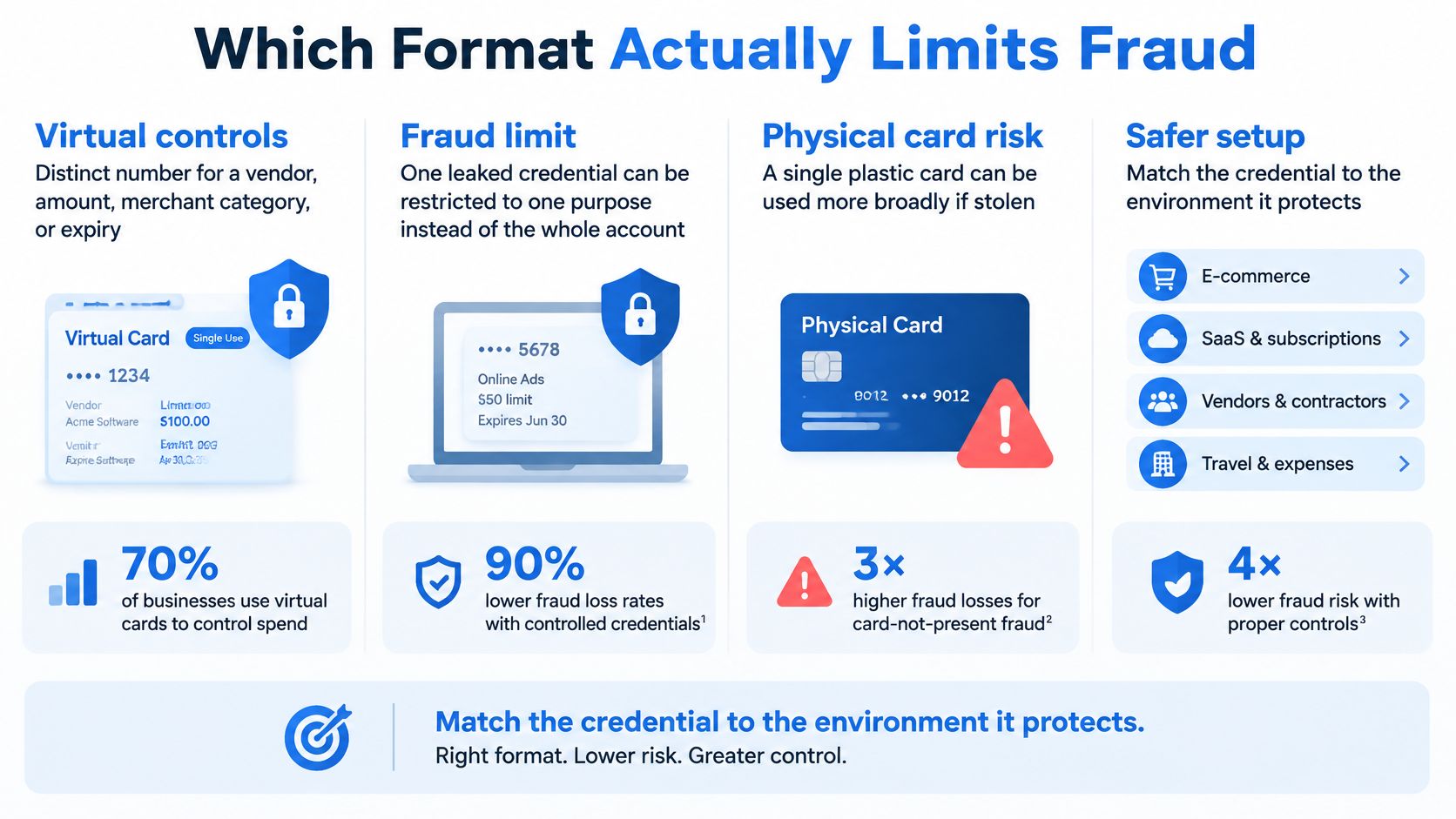
Score controls rather than labels
Use the issuer's app documentation to establish what you can restrict:
- Single-use credentials: Check when the credential closes and whether the purchase workflow requires further authorizations.
- Merchant locks: Establish whether the lock applies to a specific merchant or a broader category.
- Configurable limits: Look for controls you can lower yourself, rather than only a maximum advertised allowance.
- Immediate freeze: Confirm whether the action blocks the selected credential, the whole card account, or associated wallet tokens.
- Separate authorization: Determine whether compromised card access also creates access to the custody or funding account.
A merchant lock can contain a leaked credential, but it doesn't stop the permitted merchant from submitting an unwanted charge within the allowed rules. An amount cap can restrict spending, but an overly tight cap can also reject a legitimate adjustment.
Protecting the credential isn't protecting the account
Tokenization replaces a primary card number with a constrained alternative credential. That's different from displaying a virtual card number in an app. Don't assume that the words digital, virtual, and tokenized describe the same protection.
Physical cards also have security controls. At the terminal, an EMV chip creates transaction-specific data rather than relying solely on a reusable magnetic-stripe record. But a stolen physical card may still permit unauthorized contactless attempts before you freeze it.
A restricted card number reduces exposure at the payment layer. It doesn't secure your exchange login, recovery phrase, or wallet approvals.
For crypto spending, keep account security separate from card security. Strong authentication and careful funding permissions remain necessary even when you use disposable credentials. Dual-format availability can improve resilience, but only independent controls tell you whether freezing a compromised online number leaves your travel card usable.
Acceptance Wallets ATMs and Dead Phones
A network logo answers only part of the acceptance question. The merchant must also accept the card type, the transaction method, and the authorization the issuer provides.
At online checkout, either format can supply conventional card credentials. At a terminal, the interface matters: payments coverage from The Kansas City Star describes situations involving older terminals, hotels, rental agencies, and other merchants that may require insertion or swipe rather than a mobile wallet. You can't resolve that requirement by showing the employee a card number on your screen.
Test the wallet before departure
Provisioning means successfully adding the specific card to the wallet on your device. A payment-network logo or a general statement about mobile payments isn't enough.
Our guide to crypto cards with Apple Pay and Google Pay helps you evaluate that bridge between digital credentials and contactless checkout. Complete enrollment while you still have access to the issuer's authentication methods, then make an ordinary purchase before relying on it abroad.
Use this departure checklist:
- Provisioning: Confirm the card appears as ready to pay, not awaiting verification.
- Device access: Know how you'll recover issuer access if the phone is lost or replaced.
- Physical readiness: Activate the card, establish the PIN, and check whether cash withdrawals require a separate setting.
- Merchant requirements: Ask the hotel or rental location about card type, the named cardholder, and deposit requirements.
For device-side precautions, ThriveXDNA's guide to mobile payment safety for busy professionals is a useful companion to the payment-acceptance checks. A working wallet still needs protection against unauthorized device and account access.
A dead phone and an offline terminal are different problems
A physical card removes dependence on your phone's battery. It does not guarantee that a terminal can approve a payment without contacting the issuer.
Likewise, losing mobile data doesn't automatically mean an already provisioned wallet cannot make a contactless payment. Wallet behavior, device state, and terminal authorization requirements matter. Generating a new credential or completing an issuer challenge may still require connectivity.
ATMs need their own check. Some machines support contactless access, but that doesn't establish that your crypto-card program supports wallet-based withdrawals. If cash is essential, confirm the permitted withdrawal method before leaving.
Travel is where the physical fallback earns its place. Carry it separately from the phone where practical, and retain a payment alternative outside the same funding account. Different interfaces won't help if the issuer suspends the shared account.
Fees Limits Regions and Issuance Time
Compare account economics, format costs, and eligibility separately. A virtual card can avoid plastic delivery without avoiding the charges associated with converting and spending crypto.
What changes by format versus what stays on the account
| Item | Virtual | Physical | Where it is set |
|---|---|---|---|
| Time to first spend | After approval, activation, and funding | After activation and delivery unless credentials are released earlier | Issuer and shipping country |
| Delivery or replacement fee | No plastic delivery; check digital reissue charges | Delivery or replacement charge may apply | Card tier and fee schedule |
| FX and crypto conversion | Account's applicable rate | Account's applicable rate unless terms distinguish formats | Account |
| ATM access and ATM fee | Requires explicit withdrawal support | Requires enabled cash access; check withdrawal charges | Issuer and tier |
| Per-transaction ceiling | Account tier and verification rules | Account tier and verification rules | Issuer's authorization rules |
| Countries that can order it | Virtual enrollment eligibility list | Physical issuance and shipping eligibility list | Residency rules |
Compare the complete payment cost
Start with the transaction you'll make. For an overseas purchase funded from crypto, inspect the conversion method, any conversion spread or fee, and the foreign-exchange treatment. Don't subtract advertised cashback until you know which spending qualifies and what conditions apply.
Check account maintenance, top-up, inactivity, delivery, and replacement terms separately. For cash, establish whether the issuer's withdrawal charge is distinct from an ATM operator's surcharge.
Our crypto-card fees comparison supports this primary-source check. We publish our own fees report built from primary data across every card we track, and our editorial team verifies every published fee across 59 crypto cards against issuer documentation, showing the verification date on every figure.
If the underlying problem is a temporary cash shortfall, changing card formats won't supply funds. A separate product such as Gerald Technologies, Inc.’s instant cash advance belongs in a different comparison, with its own eligibility, access conditions, and repayment obligations. Don't treat cash-advance access as a feature of your crypto card.
Confirm residency and usable limits
Accepted abroad and available to residents are different claims. Check enrollment eligibility, delivery availability, and any restrictions that apply when you use the card outside its issuance region.
We let readers filter by per-transaction limit using $1K+, $5K+, $10K+, or $25K+. Those are comparison filters, not a promise that your application will receive that allowance. Your usable capacity also needs to accommodate pending holds, account limits, and the available funded balance.
A shipping estimate starts only when the issuer says it starts. Don't book essential spending around an assumed approval or delivery date.
Before funding: Confirm your country, account tier, required transaction size, and access method before moving assets into the program.
Finally, a permitted card transaction can still fail at the funding layer. Custodial restrictions, insufficient spendable value, or an incomplete self-custody authorization won't be fixed by switching from a virtual credential to plastic.
Spending Situations That Pick a Winner
The useful question is what happens after authorization, not merely whether checkout succeeds. Temporary credentials can complicate recurring payments and in-person pickup verification, as Checkbook's consumer guidance on virtual credit cards explains.
Which format fits the spend
| Situation | Better format | Why it wins |
|---|---|---|
| Subscriptions and SaaS | Stable virtual number | Recurring bills can fail if the number rotates |
| Untrusted one-off website | Single-use virtual | Reuse is blocked once the credential closes under its rules |
| Hotels and car rental | Physical, plus wallet | Better suited to desk verification and chip-based holds |
| ATM cash abroad | Physical | Supports the usual card-and-PIN withdrawal route when enabled |
| Need to pay today | Virtual | Avoids production and shipping once approved and activated |
| Online life plus travel | Dual format | Combines replaceable credentials with an in-person fallback |
These examples show where tighter controls help and where they can obstruct a legitimate payment.
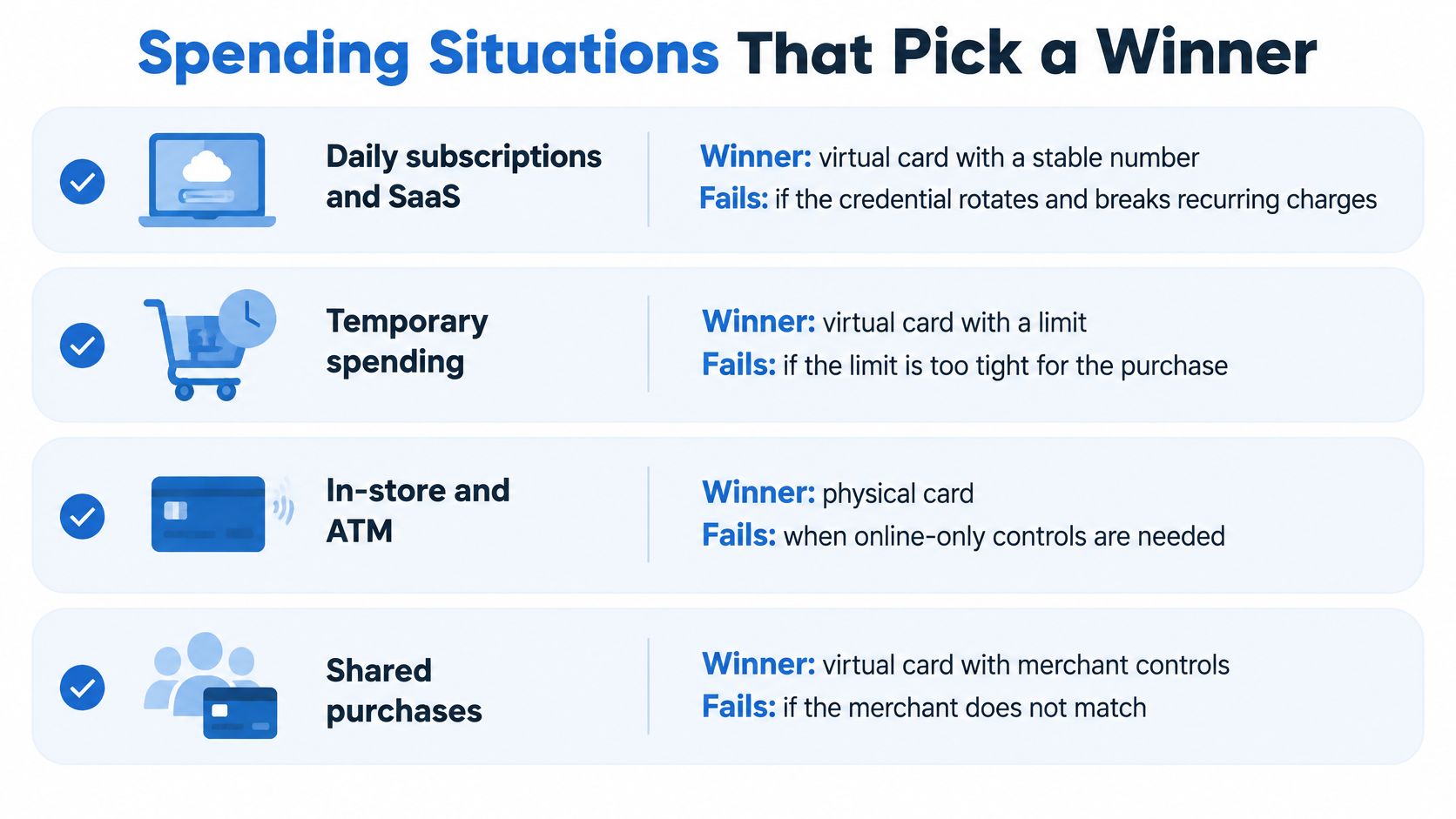
Repeat billing and purchases that change
Subscriptions need continuity. Use a stable merchant-specific credential where available, with enough allowance for legitimate billing changes. Replacing the number isn't a substitute for cancelling the subscription with the merchant.
For an unfamiliar seller, a restricted virtual credential can limit unauthorized reuse. But single-use doesn't mean the merchant becomes trustworthy: you still need to consider non-delivery, misrepresented goods, and the dispute process.
Refunds require particular care. Don't assume closing a number makes a refund impossible, or that every issuer automatically routes it correctly. Establish how the issuer handles credits to replaced credentials, retain the transaction record, and ask about partial refunds and dispute rights before a significant purchase.
Travel and urgent spending
At a hotel or rental desk, use a physical card that meets the location's rules and has room for the hold. Ask whether the final charge will replace or temporarily overlap the authorization. A successful online reservation doesn't prove that the same credential will satisfy check-in requirements.
For an urgent online purchase funded with USDT or USDC, a virtual card can remove the delivery wait. It can't remove verification, funding settlement, merchant authentication, or authorization requirements. Make sure the app shows spendable funds, not just a crypto balance.
For a trip combining reservations, cafés, and cash, dual format is the more resilient choice. Our guide to where you can use a crypto card helps separate merchant acceptance from program restrictions.
Don't let higher advertised cashback outweigh an essential failure point. If you need both controlled online credentials and card-present verification, choose a setup that provides both rather than improvising at the desk.
Pick Virtual Physical or Both
Choose virtual-only when remote spending dominates, digital access matters, and you can accept the product's restrictions on cash and card-present transactions. Choose physical when your essential purchases require a tangible card. Choose both when you need online controls without surrendering an in-person fallback.
Don't decide from the word virtual on a marketing page. Start with the features that make your actual payments possible, then compare custody, verification, and costs.
Build a shortlist you can test
At NomadCards, we compare more than 60 crypto cards side by side on fees, limits, KYC levels, and coin support. Our filters include Virtual, Physical, Apple Pay, Google Pay, Non-custodial, IBAN, and No annual fee, alongside network and other eligibility-related criteria.
Use a practical shortlist:
- A virtual-only candidate: Test whether its controls and remote-payment access justify giving up plastic.
- Dual-format alternatives: Compare the physical issuance requirements, wallet compatibility, and account economics.
- A rejection checklist: Remove anything that fails your residency, necessary transaction capacity, funding preference, or required payment interface.
Then open the shortlisted providers' own terms. Card conditions can differ by country and tier, so confirm current details before applying. Save the relevant fee schedule and eligibility information so you know which terms informed your decision.
We're an independent comparison site, not a bank, card issuer, or financial adviser. Crypto and the cards that spend it carry risks, including loss of funds; choosing a format doesn't remove those risks.
The right result isn't necessarily the most feature-rich card. It's the smallest, clearest setup that lets you complete essential payments while limiting unnecessary exposure.
Visit NomadCards to compare virtual and physical crypto cards alongside fees, limits, verification requirements, and supported assets. Filter for your required format and wallet features, build a shortlist, then confirm the country-specific terms on each provider's site before you apply.