You're ready to book a flight or renew a subscription, but your spending money sits in Bitcoin, Ethereum, or stablecoins. The checkout accepts Visa, not a wallet address. A virtual Visa card with crypto can bridge that gap, but the important question isn't what the card looks like in your app. It's what happens to your money between approval and the merchant getting paid.
Table of Contents
- What a Virtual Visa Crypto Card Actually Is
- Custodial vs Non-Custodial Crypto Cards Side by Side
- How a Purchase Moves From Crypto to Merchant
- Security Layers and Who Covers Losses
- Fees, Rewards and What a Purchase Really Costs
- KYC Levels and Where Virtual Crypto Cards Work
- Choose and Activate Your First Virtual Crypto Card
What a Virtual Visa Crypto Card Actually Is
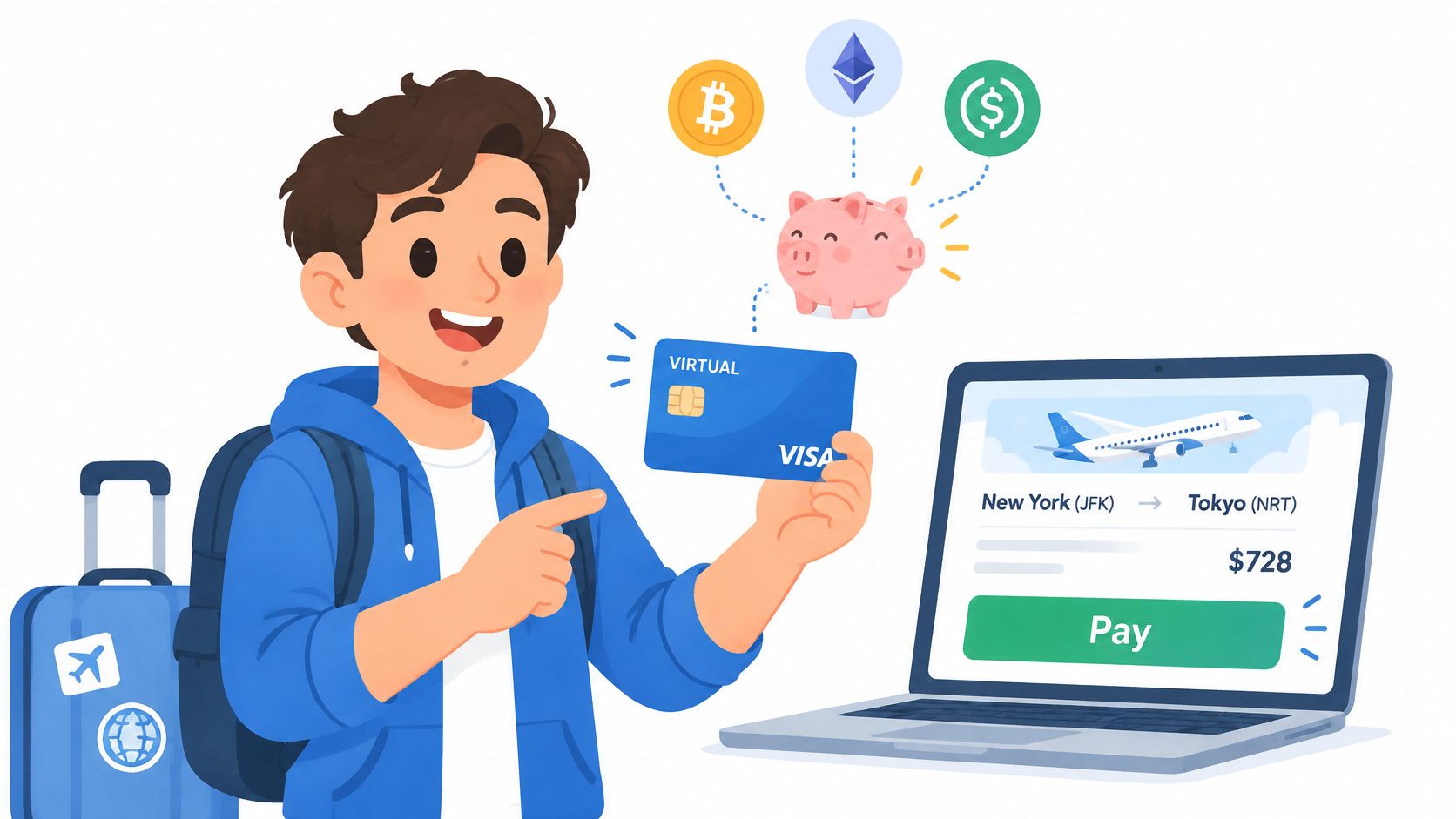
A virtual Visa crypto card is a digital card credential connected to a crypto-funded spending account or wallet. You enter its details at checkout like another payment card, while the program arranges conversion into the currency needed for payment.
Think of a prepaid gift card topped up from a crypto account. The card number is the checkout tool, not the asset itself. Unlike a simple gift card, though, the underlying balance might remain in crypto until the program needs to fund a purchase.
Keep the card, balance, and conversion separate
These parts do different jobs:
- Card credential: The card number, expiration date, and security code identify the payment account.
- Funding balance: Your value sits with an exchange, an issuer, or a wallet arrangement.
- Conversion step: The program turns that value into spendable payment currency, either before purchase or as part of processing it.
This separation explains why replacing a card number doesn't necessarily move your crypto, and why seeing a balance in an app doesn't prove you control its private keys.
Virtual cards suit online purchases. Supported programs can also provision them into Apple Pay or Google Pay for contactless payments, while some offer a physical companion card. Neither feature is automatic, so check the actual program rather than assuming every Visa-branded product supports it.
A growing category, not a replacement for banking
Visa reported approximately $5.2 billion in stablecoin-linked card payment volume in 2025, a 319% year-over-year increase. That demonstrates meaningful use, but it doesn't tell you whether a particular card is suitable for your location or spending habits.
The card itself isn't a bank account. Unless the agreement explicitly describes credit or borrowing, it isn't a loan either.
Before applying, answer three practical questions: Who holds the crypto? What happens during a purchase? What will using the card cost and require?
Custodial vs Non-Custodial Crypto Cards Side by Side
Custodial means a company controls the spending balance. Non-custodial means you retain control through your keys, although spending permissions and contracts can complicate that distinction.
The everyday analogy is leaving cash with a service provider versus carrying it yourself. Neither arrangement removes risk. They assign responsibility to different people.
Custody and settlement models for virtual crypto Visa cards
| Model | Who holds the crypto | How a purchase settles | Typical verification | Main risk to you |
|---|---|---|---|---|
| Custodial exchange-linked card | Exchange platform | Crypto is sold for payment or drawn from a pre-converted balance | Identity verification under the exchange and card program | Account restriction or platform freeze |
| Custodial issuer or program-manager card | Issuer, program manager, or custody partner | Program arranges conversion and funds card-network obligations | Issuer's identity and eligibility checks | Insolvency or program change |
| Non-custodial wallet-spend card | You, subject to wallet permissions | Wallet or contract supplies value supporting card authorization and settlement | Card-program checks still apply | Key loss or contract failure |
| Stablecoin-funded card | Provider holds your stablecoin spending balance | Stablecoin value funds payment without selling a volatile asset | Issuer's stated onboarding requirements | Depeg and redemption exposure |
| Stablecoin-funded card, non-custodial variant | You, through a self-custody wallet or contract | Contract moves or reserves stablecoins under the program's payment rules | Issuer's eligibility and identity requirements | Contract and depeg exposure |
Stablecoin funding isn't a separate custody model. It describes the asset being spent, which is why it appears in both custodial and self-custodial arrangements.
An exchange-linked card is convenient if you already keep spending funds on that exchange. The consequence is that restrictions on your exchange account can affect card access too.
With an issuer-run balance, examine who legally owes you the money and how customer assets are safeguarded. A familiar app interface doesn't establish ownership or insolvency protection.
What self-custody changes
A wallet-spend model reduces reliance on a provider holding your entire balance, but it introduces permission and contract questions. Check whether you authorize individual transfers, grant an ongoing spending allowance, or deposit funds into a contract with administrative controls.
Stablecoin cards behave more like digital-dollar spending tools than cards that sell Bitcoin at checkout. Visa's global economic analysis put retail-sized stablecoin transaction volume at approximately $69.8 billion in 2025, though that measure isn't card spending alone.
Custody test: Ask who can move the balance, who can stop you moving it, and whether either power changes after you fund the card.
How a Purchase Moves From Crypto to Merchant
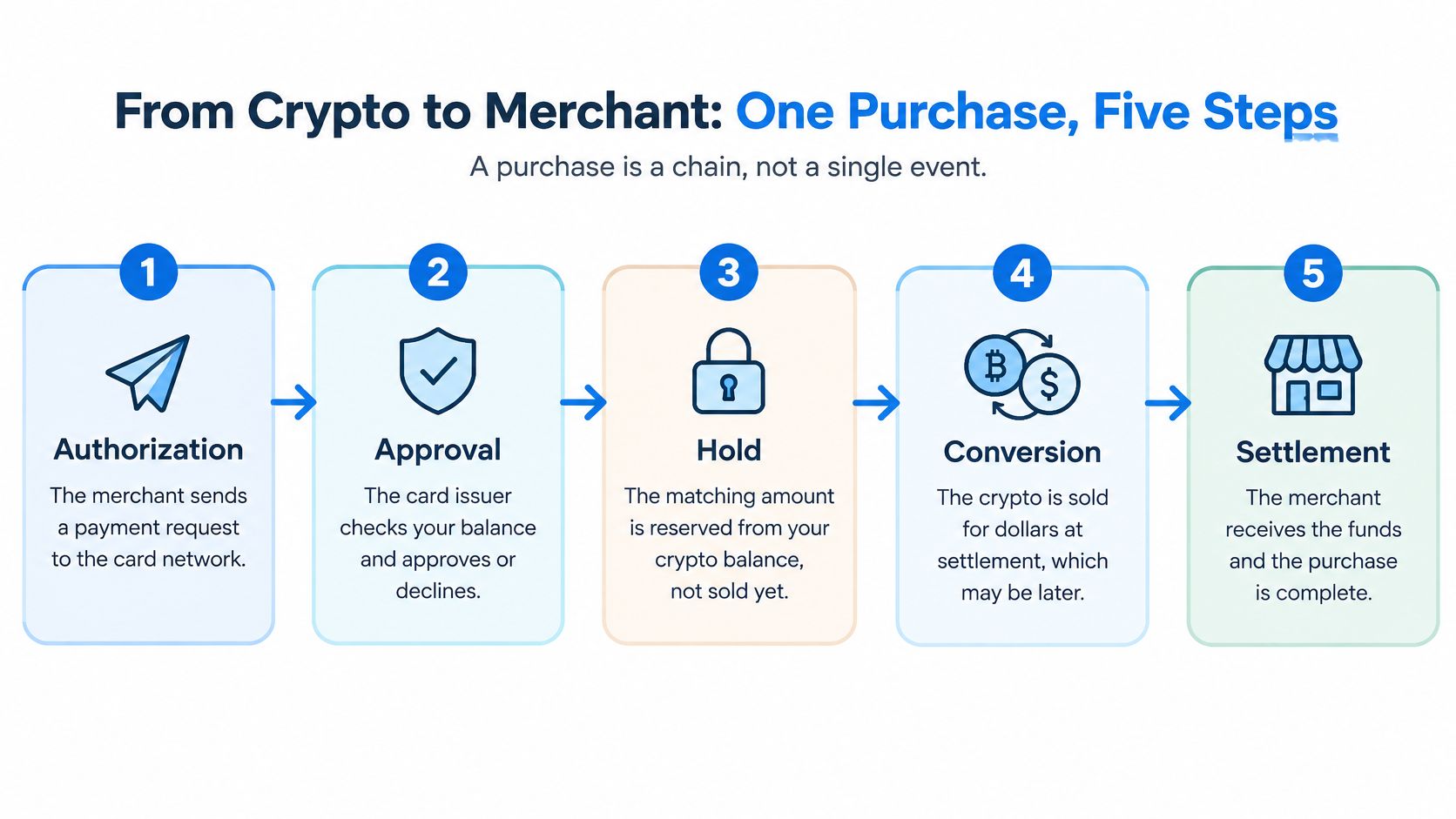
A purchase is a chain of instructions, not a single transfer. The checkout approval confirms that the issuer accepts the payment request. It doesn't necessarily mean your crypto has already been sold or the merchant has received final funds.
The diagram illustrates a deferred-conversion arrangement. Other programs convert earlier or require you to pre-fund a spending balance.
Follow the authorization and funding path
- The merchant requests authorization. Its payment provider routes the request through the card network to your issuer.
- The issuer checks the account. It evaluates available funds, spending limits, merchant restrictions, and fraud signals. It may reserve the corresponding value.
- The program arranges funding. It can sell crypto, reserve assets for later liquidation, or draw on a previously funded balance. This step's timing is program-specific.
- The merchant receives approval. The checkout can complete, although the amount may still be pending.
- The payment obligations settle. The issuer and acquiring side complete their financial obligations through the applicable settlement arrangement.
- A reversal or refund follows its own rules. A canceled hold, merchant refund, and repurchase of previously sold crypto aren't necessarily the same operation.
Visa's USDC settlement announcement describes eligible U.S. issuers and acquirers settling obligations in USDC, with seven-day fund availability. That's institutional settlement infrastructure, not proof that a purchase travels directly from your personal wallet to the merchant.
Find the price-setting moment
Suppose you buy something while Bitcoin's price is falling. If the program fixes your conversion quote at authorization, your asset debit may be determined then. If it fixes the price later, more Bitcoin may be required to fund the same fiat purchase unless the program absorbs that movement.
The decisive detail is the quote timestamp, not when you tapped. Ask how long the quote remains valid, what happens if settlement is delayed, and whether the provider guarantees the quoted asset amount.
For a closer look at arrangements that don't immediately liquidate holdings, use the guide to spending crypto without selling. Read borrowing terms carefully if the arrangement uses collateral instead of a sale.
This video provides an additional visual explanation of the payment process.
Look for clear funding labels: custodial conversion, wallet-based settlement, direct stablecoin spending, or pre-funded balance. Even direct stablecoin spending still needs a mechanism that funds the merchant's conventional card payment.
Security Layers and Who Covers Losses
A secure card credential and a protected funding balance are different things. You need both, but they fail in different ways and have different recovery routes.
Visa's payment-choice research found that 79% of respondents globally considered security extremely important. For crypto-funded cards, that concern should extend beyond fraudulent purchases to account recovery and access to the underlying assets.
Card protection isn't balance protection
Visa Token Service replaces the underlying card number with a token, supports restrictions such as device or merchant binding, and can use transaction-specific cryptograms alongside online authentication. Those controls can make stolen payment credentials less useful.
But a virtual card isn't automatically network-tokenized. Displaying card details in an app is different from provisioning a restricted payment token into a supported wallet.
Ask the provider whether it supports device binding, token deletion, online purchase authentication, and immediate freezing. At the account level, look for strong multifactor authentication, withdrawal allowlists, and a recovery process that doesn't let an attacker bypass those controls through customer support.
Incident types and recovery routes
| Incident | Card dispute route | Crypto recovery | First action |
|---|---|---|---|
| Unauthorized card transaction | A dispute or chargeback may apply under program and network rules | Usually not the initial route | Freeze the card and report the transaction |
| Card number exposed online | Replace the credential; dispute unauthorized charges | Exposure alone doesn't transfer the balance | Freeze and replace the affected card or token |
| Mistaken on-chain transfer | Not covered by a card dispute | Usually irreversible without recipient cooperation | Check transaction status and contact the recipient or receiving platform |
| Compromised exchange or issuer account | Provider's account-fraud process; card disputes address qualifying card charges | Recovery follows provider safeguards and reimbursement terms | Lock access, revoke sessions, and contact the provider |
| Compromised self-custody wallet | Not covered by card disputes | Usually irreversible after an unauthorized transfer | Secure remaining assets using a clean device and uncompromised wallet |
| Program shutdown or issuer failure | Card disputes don't generally recover an insolvent provider's balance | Withdrawal, redemption, or a creditor claim under applicable terms | Follow official withdrawal or redemption instructions promptly |
A card dispute can address a merchant transaction. It can't reverse a blockchain transfer just because the same app displayed both activities.
For wallet compromise, don't transfer assets to another address generated from the same exposed recovery phrase. Use an independently secured wallet, and seek specialist help if automated theft or malicious contract permissions make a normal transfer unsafe.
A provider's regulatory status isn't a promise that every balance is insured or every loss will be reimbursed.
Read the safeguarding and reimbursement terms separately. Identify the legal entity responsible, the reporting deadline, the evidence required, and whether stablecoin redemption remains available if card spending stops.
Fees, Rewards and What a Purchase Really Costs
A travel booking exposes costs that small domestic purchases can hide. Say you are comparing cards for a return business-class flight from Barcelona to Tokyo for two travelers. Price it with the actual fare shown at checkout, because advertised starting prices shift with route and travel date.
Fares, issuer fees and exchange spreads change by route, travel date and provider, so the most reliable comparison is a cost worksheet built from your own quotes. The steps below show you how to build one, layer by layer.
Identify every chargeable event
Work through each point where money can leave your pocket before you compare headline rates:
- Issuance: Check the virtual card's setup charge separately from physical-card delivery.
- Recurring fees: Include subscription charges and the conditions for fee waivers.
- Conversion spread: Compare the provider's executable crypto quote with a market reference taken at the same moment.
- Foreign exchange: Check the card's billing currency and any markup on a purchase in another currency.
- Funding costs: Include deposit, withdrawal, blockchain, and bridging charges needed to reach the supported balance.
- Rewards: Count only eligible cashback you can realistically receive and use.
Cost layers and their effect on your airfare
| Cost item | Pricing rule to obtain | Effect on the airfare | What to check |
|---|---|---|---|
| Virtual card issuance | Published setup charge | Add the fixed charge when evaluating initial use | Whether a physical upgrade costs extra |
| Monthly or annual fee | Subscription price and waiver conditions | Allocate the relevant period's fee across expected spending | Whether spending thresholds waive it |
| Crypto conversion spread | Difference between executable quote and reference price | Increases the crypto needed to fund the fare | Quote timestamp and guaranteed asset debit |
| Foreign exchange markup | Published foreign-currency pricing | Adds a currency-conversion cost when applicable | Network rate, issuer markup, and merchant conversion |
| Top-up or deposit fee | Funding-method charge plus network costs | Add the cost of placing enough funds on the card | Supported chain and minimum deposit |
| Cashback reward | Eligible rate, exclusions, cap, and reward asset | Subtract only the realizable reward | Staking, redemption restrictions, and airfare eligibility |
Use this formula:
Effective cost = fare + conversion costs + FX costs + funding charges + allocated account fees − usable cashback.
Timing matters here. The crypto amount is deducted when the provider's quote executes, while the merchant receives dollars at settlement later, so the spread you pay is locked in before the purchase even clears. A fare quoted in euros on a card billed in dollars can also pick up a second conversion at the network rate plus any issuer markup.
Watch for double counting too. If the quoted asset debit already includes the spread, don't add it again as a separate line. Compare the final amount of crypto deducted with the value of the purchase, then reconcile separately disclosed fees on top of that figure.
Treat rewards as conditional value
Cashback paid in a volatile token can lose value before redemption, and rewards requiring a token stake tie up capital you could otherwise spend. Neither is equivalent to unconditional cash returned on an ordinary purchase, so subtract only what you will actually receive and use.
The guide to crypto-card hidden fees provides a useful framework for checking statements against advertised pricing. Founders paying recurring overseas business expenses can also compare international banking for founders through Mazurly to assess whether a conventional business account better suits their payments.
Comparison rule: Choose using the total cost of your own spending pattern. A large cashback headline can hide the fees that outweigh it.
KYC Levels and Where Virtual Crypto Cards Work
Verification follows the issuer's obligations and program design, not the wallet's branding. A self-custody wallet can operate without collecting identity documents while its attached card requires identity verification. The wallet and the card are separate products with separate gatekeepers, even when they share an app.
KYC, or know your customer, describes the provider's customer-identification process. Marketing labels such as no KYC or email only don't establish legal anonymity, guaranteed access, or permanent exemption from later checks.
Verification tiers and what they usually enable
| KYC level | Typical documents | Typical spend limits | Best for |
|---|---|---|---|
| No KYC | No identity documents at initial onboarding; a wallet address may be required | Use the program's published prepaid and transaction caps | Small purchases where the program lawfully permits this tier |
| Email only | Email, sometimes a phone number | Published entry-tier limits; further checks may be triggered | Testing an eligible program with limited funds |
| Full KYC | Identity document, selfie, and sometimes address or source-of-funds evidence | Approved account limits under the issuer's rules | Regular spending and travel requiring broader functionality |
These are comparison categories, not guaranteed packages. Email verification doesn't prove identity, and full verification doesn't automatically grant credit or unlimited spending. Read the tier table the way you'd read a phone plan: the advertised level is the starting point, and the fine print defines what applies to your account.
Check what triggers enhanced verification before depositing. A program may request additional information after a funding event, an unusual transaction, or a change in account activity, potentially leaving funds inaccessible while the review continues.
Network reach isn't issuance eligibility
Visa's annual report describes stablecoin-linked card spending across more than 200 countries and territories. Spending across those markets doesn't mean residents of every market can apply, just as a card network's logo on a foreign ATM doesn't mean your bank issued the card you hold.
Eligibility, merchant acceptance, and mobile-wallet support are separate checks:
- Issuer identity: Find the legal issuer and the jurisdiction governing your agreement.
- Residency eligibility: Confirm your actual residence qualifies, not merely your citizenship.
- Local product availability: Check that virtual issuance is active where you live, rather than only announced.
- Wallet support: Confirm Apple Pay or Google Pay provisioning for the specific card and region.
- Regulatory standing: Check the relevant regulator's register for the services the provider offers.
For travel, verify restrictions on merchant categories and destination use before relying on the card. Carry another payment method for a lost phone, an unsupported terminal, or a merchant that requires a physical card.
Choose and Activate Your First Virtual Crypto Card
Start with the compromise you're willing to make. Privacy, rewards, low costs, and direct control of assets don't always point to the same product.
A card that fits occasional online purchases may be unsuitable for rent, travel deposits, or business expenses. Select for your actual payment needs before comparing optional features.
Move from comparison to a controlled test
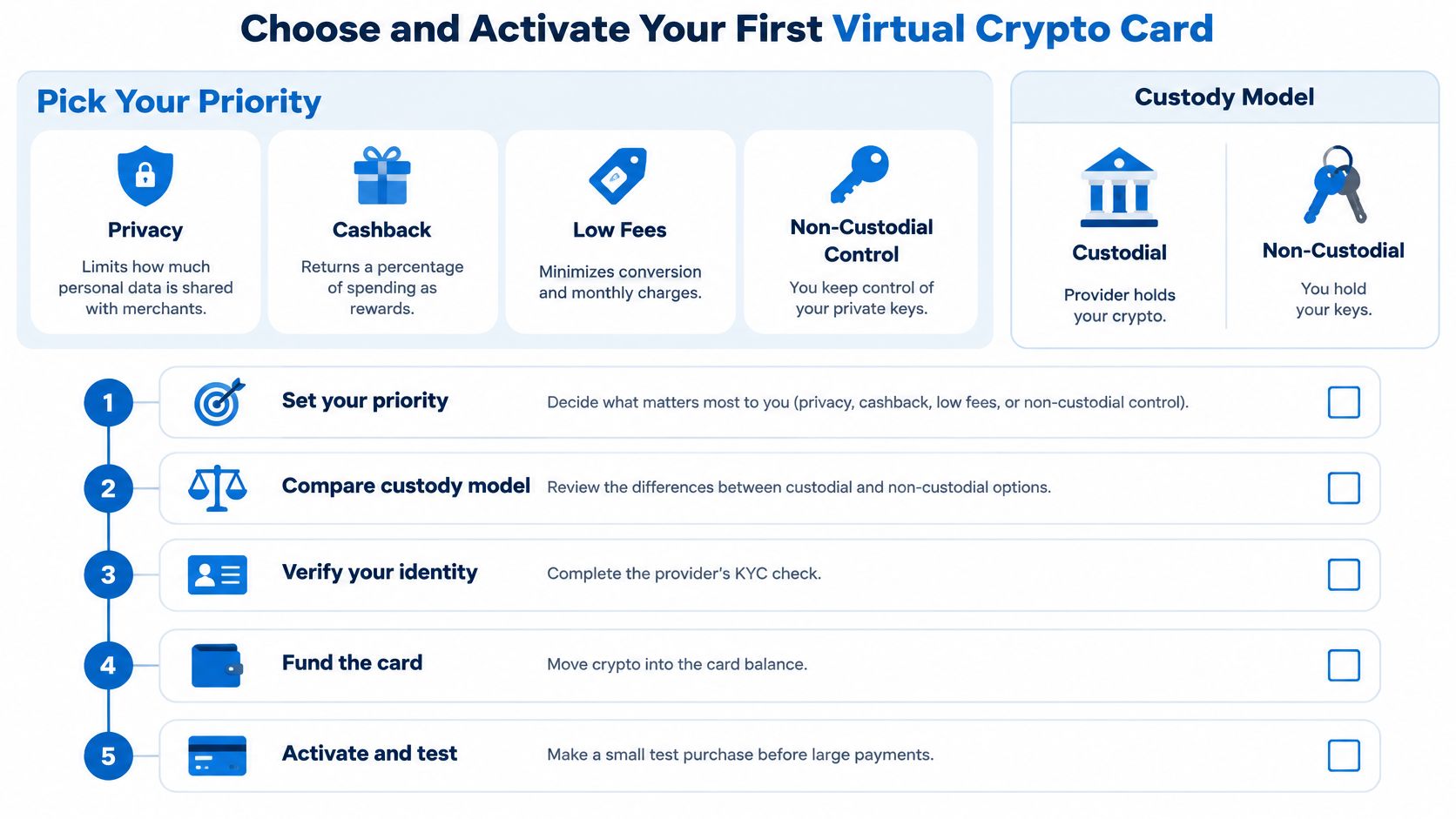
- Rank your priorities and choose a custody model. Decide which matters most: minimizing provider-held funds, reducing charges, earning usable rewards, or limiting identity disclosure where lawfully supported.
- Check verification before funding. Read the onboarding requirements and account limits. Don't deposit first and assume you can resolve an eligibility problem afterward.
- Confirm regional access. Verify residency eligibility, virtual issuance, supported merchant use, and mobile-wallet provisioning.
- Price your normal spending. Model your usual purchase currencies and funding method. Include the cost of moving assets from wherever you currently hold them.
- Read the failure terms. Find the freeze control, fraud-reporting route, safeguarding explanation, and balance-redemption procedure. Save the support details outside the app.
- Activate and secure the card. Complete required verification, enable strong authentication, and set available spending controls. Add it to Apple Pay or Google Pay only if supported.
- Fund a small amount and test. Confirm the asset and blockchain before transferring. Make a modest purchase, then inspect the authorization, final debit, and any separate charges.
- Reconcile the statement. Compare the executed conversion with the quote you accepted. Investigate unexplained differences before increasing the balance.
The visual checklist summarizes the setup sequence.
Compare candidates, then verify the agreement
Use a current crypto-card comparison to build a shortlist, alongside the issuer's fee schedule and cardholder agreement. A ranking helps organize options, but the agreement determines what happens to your money.
Check advertiser disclosures when a comparison site earns affiliate commissions. Then confirm material terms directly with the issuer before applying, especially custody, conversion timing, and withdrawal rights.
Pick the custody model first, the verification tier next, and the effective cost after that. Increase your spending balance only once the test payment behaves as expected.
NomadCards offers filters for card network, verification requirements, supported assets, custody features, and regional availability, alongside standardized fee and reward profiles. Use its finder to shortlist virtual Visa crypto cards that match your needs, then verify the issuer's terms and make a small test purchase before committing more funds.